The Impact of Enteral Feeding
Protocols on Enteral Nutrition
Delivery: Results of a multicenter
observational study
Rupinder Dhaliwal, RD
Daren K. Heyland, MD
Naomi E Cahill, RD
Xiaoqun Sun, MSc
Andrew G Day, MSc
Stephen A. McClave, MD
1
Background
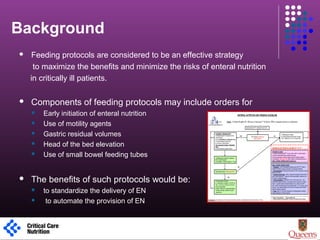
 Feeding protocols are considered to be an effective strategy
to maximize the benefits and minimize the risks of enteral nutrition
in critically ill patients.
 Components of feeding protocols may include orders for
 Early initiation of enteral nutrition
 Use of motility agents
 Gastric residual volumes
 Head of the bed elevation
 Use of small bowel feeding tubes
 The benefits of such protocols would be:
 to standardize the delivery of EN
 to automate the provision of EN
1
1
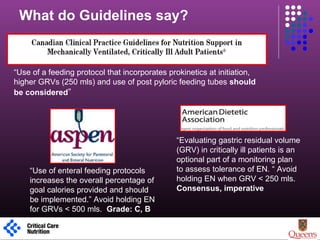
“Use of a feeding protocol that incorporates prokinetics at initiation,
higher GRVs (250 mls) and use of post pyloric feeding tubes should
be considered”
What do Guidelines say?
“Evaluating gastric residual volume
(GRV) in critically ill patients is an
optional part of a monitoring plan
to assess tolerance of EN. “ Avoid
holding EN when GRV < 250 mls.
Consensus, imperative
“Use of enteral feeding protocols
increases the overall percentage of
goal calories provided and should
be implemented.” Avoid holding EN
for GRVs < 500 mls. Grade: C, B
RCT Level of Evidence
 RCTs of aggressive feeding protocols
 Results in better protein-energy intake
 Associated with reduced complications and improved survival
Taylor et al Crit Care Med 1999; Martin CMAJ 2004; Doig GS JAMA 2008
However, the estimates of their effectiveness are limited due to:
 the nature of small single-center studies
 the bundling with many other interventions in cluster
randomized controlled trials.
1
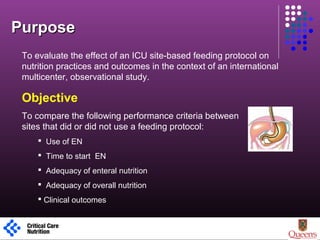
To evaluate the effect of an ICU site-based feeding protocol on
nutrition practices and outcomes in the context of an international
multicenter, observational study.
Objective
To compare the following performance criteria between
sites that did or did not use a feeding protocol:
 Use of EN
 Time to start EN
 Adequacy of enteral nutrition
 Adequacy of overall nutrition
 Clinical outcomes
PurposePurpose
1
Primary Outcomes
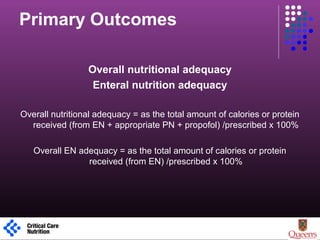
Overall nutritional adequacy
Enteral nutrition adequacy
Overall nutritional adequacy = as the total amount of calories or protein
received (from EN + appropriate PN + propofol) /prescribed x 100%
Overall EN adequacy = as the total amount of calories or protein
received (from EN) /prescribed x 100%
1
Methods
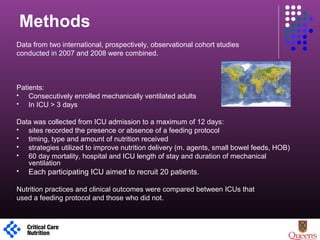
Data from two international, prospectively, observational cohort studies
conducted in 2007 and 2008 were combined.
Patients:
 Consecutively enrolled mechanically ventilated adults
 In ICU > 3 days
Data was collected from ICU admission to a maximum of 12 days:
 sites recorded the presence or absence of a feeding protocol
 timing, type and amount of nutrition received
 strategies utilized to improve nutrition delivery (m. agents, small bowel feeds, HOB)
 60 day mortality, hospital and ICU length of stay and duration of mechanical
ventilation
 Each participating ICU aimed to recruit 20 patients.
Nutrition practices and clinical outcomes were compared between ICUs that
used a feeding protocol and those who did not.
1
Data Management
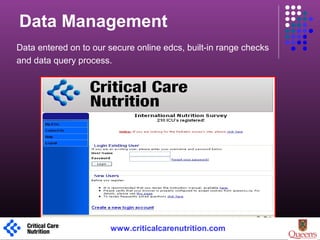
Data entered on to our secure online edcs, built-in range checks
and data query process.
1 www.criticalcarenutrition.com
Data Analysis
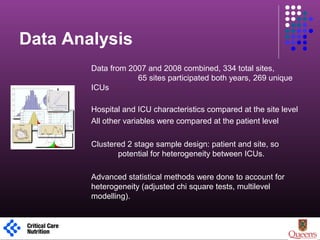
Data from 2007 and 2008 combined, 334 total sites,
65 sites participated both years, 269 unique
ICUs
Hospital and ICU characteristics compared at the site level
All other variables were compared at the patient level
Clustered 2 stage sample design: patient and site, so
potential for heterogeneity between ICUs.
Advanced statistical methods were done to account for
heterogeneity (adjusted chi square tests, multilevel
modelling).
1
Results
269 ICUs participated from 28 countries
2007: 128/167 (77%) used protocol
2008: 132/167 (79%) used protocol
Protocol No Protocol
208/269 (77%) 61/269 (23%)
Results
269 ICUs participated from 28 countries
Canada 46/57
(80.7%)
USA
48/77
(62.3%)
UK
19/19
(100%)
Australia
28/28
(100%)
New
Zealand
6/7
(85.7%)
India
5/9
(55.5%)
Brazil
2/4 (50%)
China
16/25
(64%)
Italy
7/7
(100%)
Ireland
7/7
(100%)
29/61 (48%) of the non-protocolized sites being from the United States.
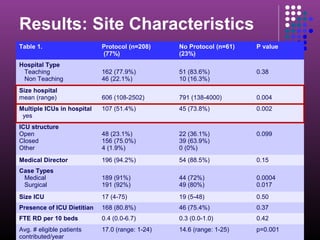
Results: Site Characteristics
Table 1. Protocol (n=208)
(77%)
No Protocol (n=61)
(23%)
P value
Hospital Type
Teaching
Non Teaching
162 (77.9%)
46 (22.1%)
51 (83.6%)
10 (16.3%)
0.38
Size hospital
mean (range) 606 (108-2502) 791 (138-4000) 0.004
Multiple ICUs in hospital
yes
107 (51.4%) 45 (73.8%) 0.002
ICU structure
Open
Closed
Other
48 (23.1%)
156 (75.0%)
4 (1.9%)
22 (36.1%)
39 (63.9%)
0 (0%)
0.099
Medical Director 196 (94.2%) 54 (88.5%) 0.15
Case Types
Medical
Surgical
189 (91%)
191 (92%)
44 (72%)
49 (80%)
0.0004
0.017
Size ICU 17 (4-75) 19 (5-48) 0.50
Presence of ICU Dietitian 168 (80.8%) 46 (75.4%) 0.37
FTE RD per 10 beds 0.4 (0.0-6.7) 0.3 (0.0-1.0) 0.42
Avg. # eligible patients
contributed/year
17.0 (range: 1-24) 14.6 (range: 1-25) p=0.001
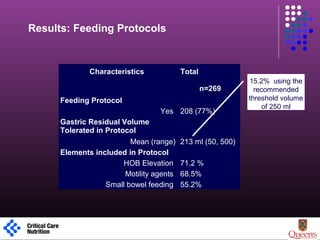
Characteristics Total
n=269
Feeding Protocol
Yes 208 (77%)
Gastric Residual Volume
Tolerated in Protocol
Mean (range) 213 ml (50, 500)
Elements included in Protocol
HOB Elevation 71.2 %
Motility agents 68.5%
Small bowel feeding 55.2%
Results: Feeding Protocols
15.2% using the
recommended
threshold volume
of 250 ml
1
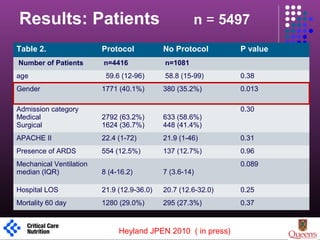
Results: Patients n = 5497
Table 2. Protocol No Protocol P value
Number of Patients n=4416 n=1081
age 59.6 (12-96) 58.8 (15-99) 0.38
Gender 1771 (40.1%) 380 (35.2%) 0.013
Admission category
Medical
Surgical
2792 (63.2%)
1624 (36.7%)
633 (58.6%)
448 (41.4%)
0.30
APACHE II 22.4 (1-72) 21.9 (1-46) 0.31
Presence of ARDS 554 (12.5%) 137 (12.7%) 0.96
Mechanical Ventilation
median (IQR) 8 (4-16.2) 7 (3.6-14)
0.089
Hospital LOS 21.9 (12.9-36.0) 20.7 (12.6-32.0) 0.25
Mortality 60 day 1280 (29.0%) 295 (27.3%) 0.37
1
Heyland JPEN 2010 ( in press)
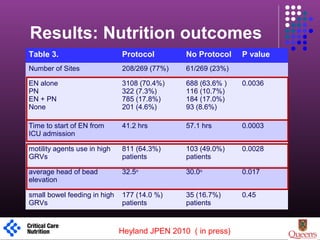
Results: Nutrition outcomes
Table 3. Protocol No Protocol P value
Number of Sites 208/269 (77%) 61/269 (23%)
EN alone
PN
EN + PN
None
3108 (70.4%)
322 (7.3%)
785 (17.8%)
201 (4.6%)
688 (63.6% )
116 (10.7%)
184 (17.0%)
93 (8.6%)
0.0036
Time to start of EN from
ICU admission
41.2 hrs 57.1 hrs 0.0003
motility agents use in high
GRVs
811 (64.3%)
patients
103 (49.0%)
patients
0.0028
average head of bead
elevation
32.5o
30.0o
0.017
small bowel feeding in high
GRVs
177 (14.0 %)
patients
35 (16.7%)
patients
0.45
1
Heyland JPEN 2010 ( in press)
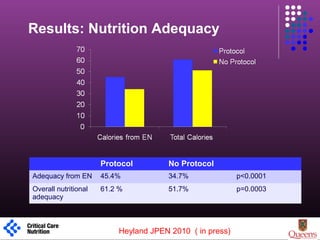
Results: Nutrition Adequacy
Protocol No Protocol
Adequacy from EN 45.4% 34.7% p<0.0001
Overall nutritional
adequacy
61.2 % 51.7% p=0.0003
1
Heyland JPEN 2010 ( in press)
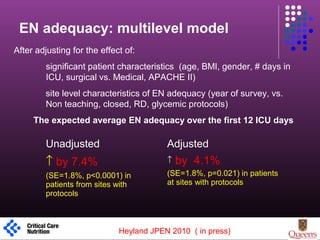
EN adequacy: multilevel model
After adjusting for the effect of:
significant patient characteristics (age, BMI, gender, # days in
ICU, surgical vs. Medical, APACHE II)
site level characteristics of EN adequacy (year of survey, vs.
Non teaching, closed, RD, glycemic protocols)
The expected average EN adequacy over the first 12 ICU days
Unadjusted Adjusted
↑ by 7.4%
(SE=1.8%, p<0.0001) in
patients from sites with
protocols
↑ by 4.1%
(SE=1.8%, p=0.021) in patients
at sites with protocols
1
Heyland JPEN 2010 ( in press)
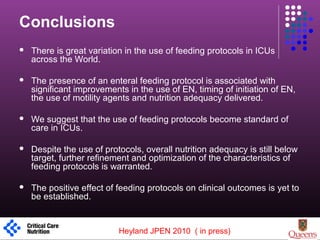
Conclusions
 There is great variation in the use of feeding protocols in ICUs
across the World.
 The presence of an enteral feeding protocol is associated with
significant improvements in the use of EN, timing of initiation of EN,
the use of motility agents and nutrition adequacy delivered.
 We suggest that the use of feeding protocols become standard of
care in ICUs.
 Despite the use of protocols, overall nutrition adequacy is still below
target, further refinement and optimization of the characteristics of
feeding protocols is warranted.
 The positive effect of feeding protocols on clinical outcomes is yet to
be established.
1
Heyland JPEN 2010 ( in press)
Strengths and Weaknesses
Weaknesses
 observational nature of the study design
 did not standardize the specific nutrition interventions included in
the feeding protocols
 did not optimize the utilization of protocols at each site. We are
unable to comment on the quality of these existing protocols or
the level of compliance at the bed-side.
Strengths
 large number of participating sites from around the world
 Use of a structured, validated data capture system, which
enhances the generalizability and validity of the observations.
1
Heyland JPEN 2010 ( in press)
Efficacy of Enhanced Protein-Energy
Provision via the Enteral Route
in Critically Ill Patients:
The PEP uP Protocol
A Single center feasibility trial
Acknowledgements
1
 The authors are grateful to the critical care practitioners
from all participating ICU sites for their dedication and
commitment to collecting data for this study.
 Colleagues at the Clinical Evaluation Research Unit
 Naomi Cahill currently holds a Canadian Institutes
for Health Research (CIHR) Fellowship in
Knowledge Translation.
 All authors declare no conflicts of interest relevant to the
subject of this manuscript.

Impactof en feeding protocols

  • 1.
    The Impact ofEnteral Feeding Protocols on Enteral Nutrition Delivery: Results of a multicenter observational study Rupinder Dhaliwal, RD Daren K. Heyland, MD Naomi E Cahill, RD Xiaoqun Sun, MSc Andrew G Day, MSc Stephen A. McClave, MD 1
  • 2.
    Background  Feeding protocolsare considered to be an effective strategy to maximize the benefits and minimize the risks of enteral nutrition in critically ill patients.  Components of feeding protocols may include orders for  Early initiation of enteral nutrition  Use of motility agents  Gastric residual volumes  Head of the bed elevation  Use of small bowel feeding tubes  The benefits of such protocols would be:  to standardize the delivery of EN  to automate the provision of EN 1
  • 3.
    1 “Use of afeeding protocol that incorporates prokinetics at initiation, higher GRVs (250 mls) and use of post pyloric feeding tubes should be considered” What do Guidelines say? “Evaluating gastric residual volume (GRV) in critically ill patients is an optional part of a monitoring plan to assess tolerance of EN. “ Avoid holding EN when GRV < 250 mls. Consensus, imperative “Use of enteral feeding protocols increases the overall percentage of goal calories provided and should be implemented.” Avoid holding EN for GRVs < 500 mls. Grade: C, B
  • 4.
    RCT Level ofEvidence  RCTs of aggressive feeding protocols  Results in better protein-energy intake  Associated with reduced complications and improved survival Taylor et al Crit Care Med 1999; Martin CMAJ 2004; Doig GS JAMA 2008 However, the estimates of their effectiveness are limited due to:  the nature of small single-center studies  the bundling with many other interventions in cluster randomized controlled trials. 1
  • 5.
    To evaluate theeffect of an ICU site-based feeding protocol on nutrition practices and outcomes in the context of an international multicenter, observational study. Objective To compare the following performance criteria between sites that did or did not use a feeding protocol:  Use of EN  Time to start EN  Adequacy of enteral nutrition  Adequacy of overall nutrition  Clinical outcomes PurposePurpose 1
  • 6.
    Primary Outcomes Overall nutritionaladequacy Enteral nutrition adequacy Overall nutritional adequacy = as the total amount of calories or protein received (from EN + appropriate PN + propofol) /prescribed x 100% Overall EN adequacy = as the total amount of calories or protein received (from EN) /prescribed x 100% 1
  • 7.
    Methods Data from twointernational, prospectively, observational cohort studies conducted in 2007 and 2008 were combined. Patients:  Consecutively enrolled mechanically ventilated adults  In ICU > 3 days Data was collected from ICU admission to a maximum of 12 days:  sites recorded the presence or absence of a feeding protocol  timing, type and amount of nutrition received  strategies utilized to improve nutrition delivery (m. agents, small bowel feeds, HOB)  60 day mortality, hospital and ICU length of stay and duration of mechanical ventilation  Each participating ICU aimed to recruit 20 patients. Nutrition practices and clinical outcomes were compared between ICUs that used a feeding protocol and those who did not. 1
  • 8.
    Data Management Data enteredon to our secure online edcs, built-in range checks and data query process. 1 www.criticalcarenutrition.com
  • 9.
    Data Analysis Data from2007 and 2008 combined, 334 total sites, 65 sites participated both years, 269 unique ICUs Hospital and ICU characteristics compared at the site level All other variables were compared at the patient level Clustered 2 stage sample design: patient and site, so potential for heterogeneity between ICUs. Advanced statistical methods were done to account for heterogeneity (adjusted chi square tests, multilevel modelling). 1
  • 10.
    Results 269 ICUs participatedfrom 28 countries 2007: 128/167 (77%) used protocol 2008: 132/167 (79%) used protocol Protocol No Protocol 208/269 (77%) 61/269 (23%)
  • 11.
    Results 269 ICUs participatedfrom 28 countries Canada 46/57 (80.7%) USA 48/77 (62.3%) UK 19/19 (100%) Australia 28/28 (100%) New Zealand 6/7 (85.7%) India 5/9 (55.5%) Brazil 2/4 (50%) China 16/25 (64%) Italy 7/7 (100%) Ireland 7/7 (100%) 29/61 (48%) of the non-protocolized sites being from the United States.
  • 12.
    Results: Site Characteristics Table1. Protocol (n=208) (77%) No Protocol (n=61) (23%) P value Hospital Type Teaching Non Teaching 162 (77.9%) 46 (22.1%) 51 (83.6%) 10 (16.3%) 0.38 Size hospital mean (range) 606 (108-2502) 791 (138-4000) 0.004 Multiple ICUs in hospital yes 107 (51.4%) 45 (73.8%) 0.002 ICU structure Open Closed Other 48 (23.1%) 156 (75.0%) 4 (1.9%) 22 (36.1%) 39 (63.9%) 0 (0%) 0.099 Medical Director 196 (94.2%) 54 (88.5%) 0.15 Case Types Medical Surgical 189 (91%) 191 (92%) 44 (72%) 49 (80%) 0.0004 0.017 Size ICU 17 (4-75) 19 (5-48) 0.50 Presence of ICU Dietitian 168 (80.8%) 46 (75.4%) 0.37 FTE RD per 10 beds 0.4 (0.0-6.7) 0.3 (0.0-1.0) 0.42 Avg. # eligible patients contributed/year 17.0 (range: 1-24) 14.6 (range: 1-25) p=0.001
  • 13.
    Characteristics Total n=269 Feeding Protocol Yes208 (77%) Gastric Residual Volume Tolerated in Protocol Mean (range) 213 ml (50, 500) Elements included in Protocol HOB Elevation 71.2 % Motility agents 68.5% Small bowel feeding 55.2% Results: Feeding Protocols 15.2% using the recommended threshold volume of 250 ml 1
  • 14.
    Results: Patients n= 5497 Table 2. Protocol No Protocol P value Number of Patients n=4416 n=1081 age 59.6 (12-96) 58.8 (15-99) 0.38 Gender 1771 (40.1%) 380 (35.2%) 0.013 Admission category Medical Surgical 2792 (63.2%) 1624 (36.7%) 633 (58.6%) 448 (41.4%) 0.30 APACHE II 22.4 (1-72) 21.9 (1-46) 0.31 Presence of ARDS 554 (12.5%) 137 (12.7%) 0.96 Mechanical Ventilation median (IQR) 8 (4-16.2) 7 (3.6-14) 0.089 Hospital LOS 21.9 (12.9-36.0) 20.7 (12.6-32.0) 0.25 Mortality 60 day 1280 (29.0%) 295 (27.3%) 0.37 1 Heyland JPEN 2010 ( in press)
  • 15.
    Results: Nutrition outcomes Table3. Protocol No Protocol P value Number of Sites 208/269 (77%) 61/269 (23%) EN alone PN EN + PN None 3108 (70.4%) 322 (7.3%) 785 (17.8%) 201 (4.6%) 688 (63.6% ) 116 (10.7%) 184 (17.0%) 93 (8.6%) 0.0036 Time to start of EN from ICU admission 41.2 hrs 57.1 hrs 0.0003 motility agents use in high GRVs 811 (64.3%) patients 103 (49.0%) patients 0.0028 average head of bead elevation 32.5o 30.0o 0.017 small bowel feeding in high GRVs 177 (14.0 %) patients 35 (16.7%) patients 0.45 1 Heyland JPEN 2010 ( in press)
  • 16.
    Results: Nutrition Adequacy ProtocolNo Protocol Adequacy from EN 45.4% 34.7% p<0.0001 Overall nutritional adequacy 61.2 % 51.7% p=0.0003 1 Heyland JPEN 2010 ( in press)
  • 17.
    EN adequacy: multilevelmodel After adjusting for the effect of: significant patient characteristics (age, BMI, gender, # days in ICU, surgical vs. Medical, APACHE II) site level characteristics of EN adequacy (year of survey, vs. Non teaching, closed, RD, glycemic protocols) The expected average EN adequacy over the first 12 ICU days Unadjusted Adjusted ↑ by 7.4% (SE=1.8%, p<0.0001) in patients from sites with protocols ↑ by 4.1% (SE=1.8%, p=0.021) in patients at sites with protocols 1 Heyland JPEN 2010 ( in press)
  • 18.
    Conclusions  There isgreat variation in the use of feeding protocols in ICUs across the World.  The presence of an enteral feeding protocol is associated with significant improvements in the use of EN, timing of initiation of EN, the use of motility agents and nutrition adequacy delivered.  We suggest that the use of feeding protocols become standard of care in ICUs.  Despite the use of protocols, overall nutrition adequacy is still below target, further refinement and optimization of the characteristics of feeding protocols is warranted.  The positive effect of feeding protocols on clinical outcomes is yet to be established. 1 Heyland JPEN 2010 ( in press)
  • 19.
    Strengths and Weaknesses Weaknesses observational nature of the study design  did not standardize the specific nutrition interventions included in the feeding protocols  did not optimize the utilization of protocols at each site. We are unable to comment on the quality of these existing protocols or the level of compliance at the bed-side. Strengths  large number of participating sites from around the world  Use of a structured, validated data capture system, which enhances the generalizability and validity of the observations. 1 Heyland JPEN 2010 ( in press)
  • 20.
    Efficacy of EnhancedProtein-Energy Provision via the Enteral Route in Critically Ill Patients: The PEP uP Protocol A Single center feasibility trial
  • 21.
    Acknowledgements 1  The authorsare grateful to the critical care practitioners from all participating ICU sites for their dedication and commitment to collecting data for this study.  Colleagues at the Clinical Evaluation Research Unit  Naomi Cahill currently holds a Canadian Institutes for Health Research (CIHR) Fellowship in Knowledge Translation.  All authors declare no conflicts of interest relevant to the subject of this manuscript.

Editor's Notes

  • #4 Rupinder to update
  • #7 Our primary objective was to compare nutrition practices between sites that protocol or not. Outcomes were: overall nutritional adequacy as the total amount of calories or protein received (from either EN or PN plus propofol) over the first 12 ICU days, divided by the amount prescribed and expressed as a percentage. Days without EN or PN were included and counted as 0% adequacy. Days following permanent progression to exclusive oral intake were excluded from the calculation of adequacy. EN adequacy was calculated similarly but included only the calories or protein received by the EN route.
  • #10 To reduce the potential heterogeneity between ICUs due to the clustered 2 stage sample design, variables such as medical/surgical, yes/no options (categorical) were compared between the groups cy Chi square test (Rao method) that adjusts for clustering. Categorical variables (Yes/no, medical/surgical, etc) were compared between the 2 groups using the adjusted Chi-Squared method Continuous variables (age, BMI, etc) were compared between the 2 groups using multilevel modelling that accounted for the heterogeneity between same ICU across years Three level multi-modelling, where patients are nested within an ICU by year, which are nested in ICUs
  • #12 feeding protocols varied significantly between countries
  • #13 Characteristics of the 269 unique ICUs are presented in table 1 where only the 2008 values are reported for sites participating in both years. Protocols were more often used in closed ICUs from smaller, single ICU hospitals.
  • #15 Protocolized ICUs had a higher proportion of female patients (40.1% versus 35.2% p=0.013), but otherwise patient characteristics and clinical outcomes were similar between sites with and without bedside feeding protocols (table 2).
  • #16 On average, EN was initiated earlier in sites with protocols compared to those without protocols (41.2. hours from admission to ICU vs. 57.1, p=0.0003). In patients with high gastric residual volumes, more patients in protocolized sites received motility agents (64.3% of patients vs. 49.0%, p=0.0028) compared to sites that did not use a feeding protocol. There was no difference in the use of small bowel feeding tubes in patients with high gastric residual volumes between sites (14.0 vs 16.7% of patients, p=0.45). The average head of bead elevation was slightly higher (32.5 versus 30.0 p=0.017) at sites that used feeding protocols (see Table 3).
  • #17 Overall nutritional adequacy (61.2 % of patient’s caloric requirements vs 51.7%) and adequacy from EN (45.4% of requirements vs 34.7%) was higher in protocolized sites compared to non-protocolized sites.
  • #18 Expected average EN adequacy over first 12 days greater for patients from sites with feeding protocols (53.2% SE=1.0% versus 45.8% SE=1.7%). by 7.4% (SE=1.8%, p&amp;lt;0.0001) BMI, days in hospital prior to admission and ICU days were modelled as categorical variables due to the statistically significant non-linearity of the relationship between these variables and EN adequacy (all p&amp;lt;0.01). No patient or ICU level variables (BMI, age, days iN ICU prior to admission, interacted significantly with feeding protocol use (all p&amp;gt;0.05).
  • #20 As such, our observed estimate reflects the ‘real world’ experience.