NON-CONFIDENTIAL AND NON-PROPRIETARY, ENTIRELY SHAREABLE
Purpose+, Amstel 95, Amsterdam, The Netherlands
Purpose in Organisations
Internal research project, Purpose+
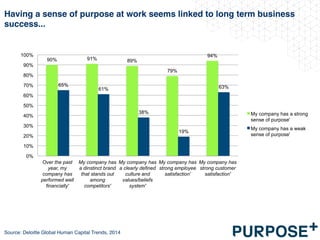
Having a sense of purpose at work seems linked to long term business
success...
90% 91% 89%
79%
94%
65%
61%
38%
19%
63%
0%
10%
20%
30%
40%
50%
60%
70%
80%
90%
100%
Over the past
year, my
company has
performed well
financially'
My company has
a dinstinct brand
that stands out
among
competitors'
My company has
a clearly defined
culture and
values/beliefs
system'
My company has
strong employee
satisfaction'
My company has
strong customer
satisfaction'
My company has a strong
sense of purpose'
My company has a weak
sense of purpose'
Source: Deloitte Global Human Capital Trends, 2014
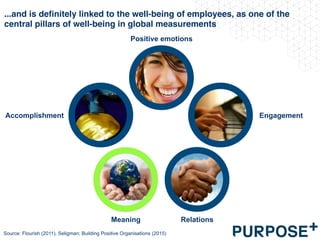
...and is definitely linked to the well-being of employees, as one of the
central pillars of well-being in global measurements
Positive emotions
Meaning Relations
EngagementAccomplishment
Source: Flourish (2011), Seligman; Building Positive Organisations (2015)
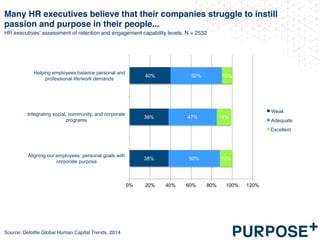
Many HR executives believe that their companies struggle to instill
passion and purpose in their people...
38%
38%
40%
50%
47%
50%
12%
14%
10%
0% 20% 40% 60% 80% 100% 120%
Aligning our employees; personal goals with
corporate purpose
Integrating social, community, and corporate
programs
Helping employees balance personal and
professional life/work demands
Weak
Adequate
Excellent
HR executives’ assessment of retention and engagement capability levels, N = 2532
Source: Deloitte Global Human Capital Trends, 2014
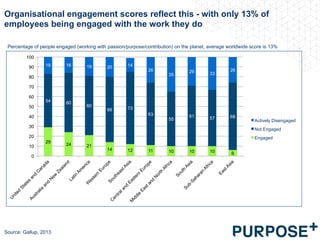
Organisational engagement scores reflect this - with only 13% of
employees being engaged with the work they do
Source: Gallup, 2013
29
24 21
14 12 11 10 10 10 6
54 60
60
66 73
63
55
61 57 68
18 16 19 20 14
26
35
29 33
26
0
10
20
30
40
50
60
70
80
90
100
Actively Disengaged
Not Engaged
Engaged
Percentage of people engaged (working with passion/purpose/contribution) on the planet, average worldwide score is 13%
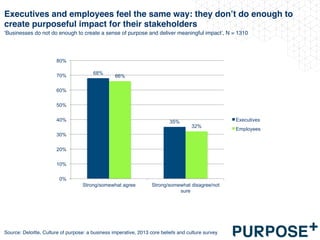
Executives and employees feel the same way: they don’t do enough to
create purposeful impact for their stakeholders
Source: Deloitte, Culture of purpose: a business imperative, 2013 core beliefs and culture survey
68%
35%
66%
32%
0%
10%
20%
30%
40%
50%
60%
70%
80%
Strong/somewhat agree Strong/somewhat disagree/not
sure
Executives
Employees
‘Businesses do not do enough to create a sense of purpose and deliver meaningful impact’, N = 1310
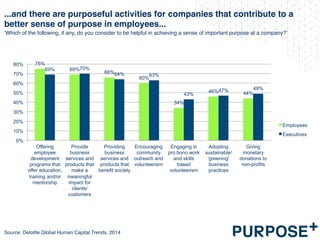
...and there are purposeful activities for companies that contribute to a
better sense of purpose in employees...
75%
69%
66%
60%
34%
46% 44%
69% 70%
64% 63%
43%
47% 49%
0%
10%
20%
30%
40%
50%
60%
70%
80%
Offering
employee
development
programs that
offer education,
training and/or
mentorship
Provide
business
services and
products that
make a
meaningful
impact for
clients/
customers
Providing
business
services and
products that
benefit society
Encouraging
community
outreach and
volunteerism
Engaging in
pro bono work
and skills
based
volunteerism
Adopting
sustainable/
'greening'
business
practices
Giving
monetary
donations to
non-profits
Employees
Executives
‘Which of the following, if any, do you consider to be helpful in achieving a sense of important purpose at a company?’
Source: Deloitte Global Human Capital Trends, 2014
...but most companies fail to integrate purpose into their core business;
although executives seem to believe differently
‘To what degree are each of the following integrated into your company’s business and brand strategy (completely/very)?’
48%
68%
59%
46%
42%
39%
26%
70%
78%
73%
57%
50%
52%
44%
0%
10%
20%
30%
40%
50%
60%
70%
80%
90%
Offering employee
development
programmes that offer
education, training,
and/or mentorship
Providing business
services and products
that make a
meaningful impact for
clients/customers
Providing business
services and products
that benefit society
Encouraging
community outreach
and volunteerism
Adopting
sustainable/'greening'
business practices
Giving monetary
donations to non-
profits
Engaging in pro bono
work and skills based
volunteerism
Employees
Executives
Source: Deloitte Global Human Capital Trends, 2014
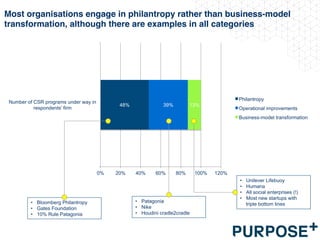
Most organisations engage in philantropy rather than business-model
transformation, although there are examples in all categories
48% 39% 13%
0% 20% 40% 60% 80% 100% 120%
Number of CSR programs under way in
respondents' firm
Philantropy
Operational improvements
Business-model transformation
•  Bloomberg Philantropy
•  Gates Foundation
•  10% Rule Patagonia
•  Patagonia
•  Nike
•  Houdini cradle2cradle
•  Unilever Lifebuoy
•  Humana
•  All social enterprises (!)
•  Most new startups with
triple bottom lines

Purpose-in-Organisations-P- (2)

  • 1.
    NON-CONFIDENTIAL AND NON-PROPRIETARY,ENTIRELY SHAREABLE Purpose+, Amstel 95, Amsterdam, The Netherlands Purpose in Organisations Internal research project, Purpose+
  • 2.
    Having a senseof purpose at work seems linked to long term business success... 90% 91% 89% 79% 94% 65% 61% 38% 19% 63% 0% 10% 20% 30% 40% 50% 60% 70% 80% 90% 100% Over the past year, my company has performed well financially' My company has a dinstinct brand that stands out among competitors' My company has a clearly defined culture and values/beliefs system' My company has strong employee satisfaction' My company has strong customer satisfaction' My company has a strong sense of purpose' My company has a weak sense of purpose' Source: Deloitte Global Human Capital Trends, 2014
  • 3.
    ...and is definitelylinked to the well-being of employees, as one of the central pillars of well-being in global measurements Positive emotions Meaning Relations EngagementAccomplishment Source: Flourish (2011), Seligman; Building Positive Organisations (2015)
  • 4.
    Many HR executivesbelieve that their companies struggle to instill passion and purpose in their people... 38% 38% 40% 50% 47% 50% 12% 14% 10% 0% 20% 40% 60% 80% 100% 120% Aligning our employees; personal goals with corporate purpose Integrating social, community, and corporate programs Helping employees balance personal and professional life/work demands Weak Adequate Excellent HR executives’ assessment of retention and engagement capability levels, N = 2532 Source: Deloitte Global Human Capital Trends, 2014
  • 5.
    Organisational engagement scoresreflect this - with only 13% of employees being engaged with the work they do Source: Gallup, 2013 29 24 21 14 12 11 10 10 10 6 54 60 60 66 73 63 55 61 57 68 18 16 19 20 14 26 35 29 33 26 0 10 20 30 40 50 60 70 80 90 100 Actively Disengaged Not Engaged Engaged Percentage of people engaged (working with passion/purpose/contribution) on the planet, average worldwide score is 13%
  • 6.
    Executives and employeesfeel the same way: they don’t do enough to create purposeful impact for their stakeholders Source: Deloitte, Culture of purpose: a business imperative, 2013 core beliefs and culture survey 68% 35% 66% 32% 0% 10% 20% 30% 40% 50% 60% 70% 80% Strong/somewhat agree Strong/somewhat disagree/not sure Executives Employees ‘Businesses do not do enough to create a sense of purpose and deliver meaningful impact’, N = 1310
  • 7.
    ...and there arepurposeful activities for companies that contribute to a better sense of purpose in employees... 75% 69% 66% 60% 34% 46% 44% 69% 70% 64% 63% 43% 47% 49% 0% 10% 20% 30% 40% 50% 60% 70% 80% Offering employee development programs that offer education, training and/or mentorship Provide business services and products that make a meaningful impact for clients/ customers Providing business services and products that benefit society Encouraging community outreach and volunteerism Engaging in pro bono work and skills based volunteerism Adopting sustainable/ 'greening' business practices Giving monetary donations to non-profits Employees Executives ‘Which of the following, if any, do you consider to be helpful in achieving a sense of important purpose at a company?’ Source: Deloitte Global Human Capital Trends, 2014
  • 8.
    ...but most companiesfail to integrate purpose into their core business; although executives seem to believe differently ‘To what degree are each of the following integrated into your company’s business and brand strategy (completely/very)?’ 48% 68% 59% 46% 42% 39% 26% 70% 78% 73% 57% 50% 52% 44% 0% 10% 20% 30% 40% 50% 60% 70% 80% 90% Offering employee development programmes that offer education, training, and/or mentorship Providing business services and products that make a meaningful impact for clients/customers Providing business services and products that benefit society Encouraging community outreach and volunteerism Adopting sustainable/'greening' business practices Giving monetary donations to non- profits Engaging in pro bono work and skills based volunteerism Employees Executives Source: Deloitte Global Human Capital Trends, 2014
  • 9.
    Most organisations engagein philantropy rather than business-model transformation, although there are examples in all categories 48% 39% 13% 0% 20% 40% 60% 80% 100% 120% Number of CSR programs under way in respondents' firm Philantropy Operational improvements Business-model transformation •  Bloomberg Philantropy •  Gates Foundation •  10% Rule Patagonia •  Patagonia •  Nike •  Houdini cradle2cradle •  Unilever Lifebuoy •  Humana •  All social enterprises (!) •  Most new startups with triple bottom lines