PURPOSE
IN PRACTICE
CLARITY, AUTHENTICITY
AND THE SPECTRE OF
PURPOSE WASH
5	FOREWORD
6	 WHAT IS PURPOSE?
8	 FROM CSR TO PURPOSE
10	 PURPOSE IS A MINDSET
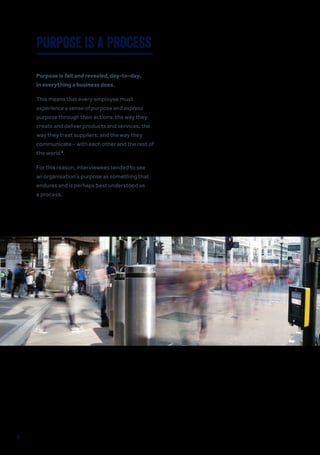
12	 PURPOSE IS A PROCESS
16	 WHY DO PURPOSE?
18	 DRIVE PROFIT
20	MANAGE RISK AND BUILD TRUST
22	 RECRUIT AND RETAIN TALENT
24	 IMPROVE WELLBEING
26	IMPROVE THE SUPPLY CHAIN
28	 BE SUSTAINABLE
30	 MAKE THE WORLD A BETTER PLACE
32	 DOING PURPOSE-DRIVEN BUSINESS
42	 THE SPECTRE OF PURPOSE WASH
44	WHAT NEXT?
46	FURTHER READING
47	CREDITS
It seems everybody’s talking about purpose-driven business,
and increasing numbers of CEOs around the world are committing
themselves to delivering positive social and environmental impact.
But what does this mean for you and your business in practice?
You’ve no doubt seen reports and articles saying companies that
commit to making the world a better place for everyone – not just
themselves – outperform those that don’t 1
. There seems to be no end
of research highlighting how purpose drives customer acquisition, brand
loyalty and market share. We’re told that purpose-driven organisations
have more innovative, productive and happy workforces 2
because they
can recruit and retain the best talent 3
. And purpose-driven businesses
are more sustainable because their positive social and environmental
impact strengthens the ecosystems on which they depend.
But all this can feel intangible – if not overwhelming – when set against
the day-to-day realities of running an effective organisation or
profitable business.
While many CSR programmes did – and do – deliver substantial benefit,
at its worst CSR and sustainability initiatives were used as an
instrument of reputation management, giving rise to greenwash as
detractors seized on the contradiction between marketing and reality
on the ground.
Are we doomed to an era of purpose wash, which would undermine
trust in – and the impact of – companies that are authentically
purpose-driven?
We asked senior decision makers and thinkers across multiple sectors
for their views on the role of purpose in business. In the course of 25
in-depth interviews this is what we learned.
Henry Playfoot
Strategy Director, Claremont Communications
1. A 2012 Deutsche Bank
review of 56 academic
research papers revealed
that 89% of the studies
showed companies with
strong ‘Environmental,
Social and Governance’
(ESG) factors outperformed
competitors on a market
basis, while 85% showed
these types of companies
exhibited accounting-based
outperformance. Mark Fulton
et al, Sustainable Investing:
Establishing Long-Term
Value and Performance, DB
Climate Change Advisors,
Deutsche Bank Group, 2012,
dbadvisors.com, p. 5.
2. The Business Case
for Purpose, Harvard
Business Review Analytics
Services, Harvard Business
Review, 2015, hbr.org/
resources/pdfs/comm/
ey/19392HBRReportEY.pdf
pp. 8-10.
3. According to a 2013 report
by Deloitte, executives are
more than 50% likely to be
attracted to and retained by
a company if they feel there
is a strong sense of purpose.
Culture of Purpose: A Business
Imperative, 2013 Core Beliefs
and Culture Survey, Deloitte
LLP, 2013, deloitte.com/us/
en/pages/about-deloitte/
articles/culture-of-purpose.
html pp. 6-8.
FOREWORD
3
In a landmark report published in the
Harvard Business Review in 2011, Michael
Porter and Mark Kramer argued that
capitalism was in crisis due to a narrow
approach to “value creation” and a short-
term focus on financial performance.
Their remedy was purpose, which demands
a fundamentally different approach:
“Companies could bring business and society
back together if they redefined their purpose as
creating ‘shared value’ - generating economic
value in a way that also produces value for
society by addressing its challenges.” 4
Our interviewees do not share a single
definition of purpose, but agree that it is about
looking beyond the need to generate profit to
positively impact individuals, society and the
environment.
Purpose-driven organisations, including
businesses, Government, social enterprises,
not-for-profits and charities, seem to be
characterised by long-termism, commitment
to craft – doing something really well – and
recognition of the connection between the
wellbeing of the company and the wellbeing
of its staff, partners, suppliers and the
wider world.
Although definitions may vary, our participants
were unanimous on one thing: purpose must
be authentic and lived, and when it is, it is
experienced and felt by everyone.
4
WHAT IS PURPOSE?
4. Michael E. Porter & Mark
Kramer, Creating Shared
Value: Redefining Capitalism
and the Role of the Corporation
in Society, Harvard Business
Review, 2011.
The belief that business should do less harm
initiated the emergence of Corporate Social
Responsibility and its growth over the past
60 years.
“The phrase Corporate Social Responsibility was
coined in 1953 with the publication of Bowen’s
Social Responsibility of Businessmen, which
posed the question: ‘Which responsibilities
to society can businesspeople be reasonably
expected to assume?’ In 1984, the celebrated
management consultant Peter Drucker wrote
about the imperative to turn social problems into
economic opportunities.” 5
But CSR has largely failed to live up to its
promise. Certainly, a thoughtful, structured
and properly resourced CSR programme can
generate substantial social and environmental
impact. But in practice – in most cases –
CSR’s impact is limited by its role as an add-on.
In the worst case scenario, claims of CSR are
used to create a false or misleading impression
of the company they are serving 6
.
Where CSR is usually treated as an
organisational function, social purpose is
the business’s raison d’etre 7
. If CSR is the
department used to offset the sometimes
brutal business of maximising profits, purpose
is fundamental to how the business thinks and
is at the heart of everything it does.
CSR does not create or necessarily reflect
a purpose-driven business (although it may be
part of how that business operates).
Authentic purpose-driven business requires
a worldview that goes above and beyond CSR;
rather than being a business unit, purpose
is best understood as both a mindset and a
process.
FROM CSR TO PURPOSE
5. What’s Wrong With Corporate Social Responsibility?
Corporate Watch.
6. For examples and case studies in the oil and gas industry, see
Jedrzej George Frynas, ‘The False Developmental Promise of
Corporate Social Responsibility: Evidence From Multinational
Oil Companies’, International Affairs, 81: 581-598, 2005.
7. Paul Polman, Business, Society, and the Future of Capitalism,
McKinsey Quarterly, May 2014, mckinsey.com/business-
functions/sustainability-and-resource-productivity/our-
insights/business-society-and-the-future-of-capitalism.
“WHILE BUSINESS HAS MADE A
COMMITMENT TO BECOMING MORE
SOCIALLY RESPONSIBLE, MOST
ORGANISATIONS VIEW THIS ROLE IN
HYGIENE TERMS. IT IS ABOUT MAKING
SURE THEY DON’T DO BAD STUFF
– OR DON’T GET CAUGHT DOING BAD
STUFF. BUT THE SMART COMPANIES
ARE WAKING UP TO THE FACT THAT THE
FUTURE OF BUSINESS IS NOT ABOUT
MINIMISING THE BAD THINGS IT DOES
(CORPORATE SOCIAL RESPONSIBILITY)
BUT MAXIMIZING THE GOOD IT DOES
(CORPORATE SOCIAL ENGAGEMENT).”
DAVID GERSHON
EMPOWERMENT INSTITUTE
5
“THERE’S A BIG DIFFERENCE
BETWEEN PURPOSE AND CSR.
WITH CSR, ‘DOING GOOD’ IS SILOED
IN A SEPARATE FUNCTION AND
CAN BE DROPPED WHEN TIMES
GET TOUGH; WITH PURPOSE,
DOING GOOD SHOULD BE BAKED
INTO EVERYTHING YOU DO.”
RAJEEB DEY
CEO, ENTERNSHIPS
FROM CSR TO PURPOSE
6
“IT’S ABOUT PEOPLE WHO KEEP
THEIR EYE ON THE LONG TERM,
PEOPLE WHO UNDERSTAND
VALUE, WHO UNDERSTAND WHAT
YOU INVEST IN; YOU INVEST IN
THE CULTURE OF YOUR BUSINESS,
AND YOU’RE NOT JUST INVESTING
FOR THIS YEAR’S PROFIT, YOU’RE
INVESTING RIGHT THE WAY DOWN
THE LINE.”
ANDREW HARDING
CHARTERED INSTITUTE OF MANAGEMENT ACCOUNTANTS
PURPOSE IS A MINDSET
7
Participants were clear that a business can
only be said to be purpose-driven insofar
as people throughout the business are
meaningfully engaged in the company’s
purpose.
Those interviewed explained that a CEO and
leadership team with a purposeful mindset is
necessary – but insufficient – for a company
to become authentically purpose-driven. And
while mission statements are helpful, words
alone are never enough.
“Purpose really comes down to mindset.
It means building a culture that taps into
your people’s sense of aspiration. It means
empowering everyone you work with - from your
clients or customers to your employees to your
communities - not just to do better, but to be
better. After all, purpose is truly about doing well
by doing good.” 8
Participants also stated that having a purpose
means thinking differently about value. It
involves thinking about the short term and
the long term – about economic and societal
wellbeing – about how business relates to
society and the world at large.
8
“IT’S IMPORTANT FOR THOSE OF US
IN BUSINESS TO SAY ‘WE’RE IN THE
BUSINESS OF MAKING MONEY.’ AND
THAT’S A GOOD THING, BUT THAT’S
ALMOST THE LAST PURPOSE THAT
ANYONE TALKS ABOUT BECAUSE
SOMEHOW IT SEEMS GRUBBY.”
David Baker
The School of Life
“I CAME TO A CROSSROADS WHERE I
HAD TO DECIDE – ‘DO I GO AND DO
GOOD IN THE WORLD, OR DO I GO AND
DO BUSINESS?’ SO WHEN I FOUND OUT
ABOUT ETSY IT FELT LIKE THIS SUDDEN
REVELATION, LIKE THERE WAS A WAY TO
BRING THESE TWO THINGS TOGETHER.”
Nicole Vanderbilt
Etsy
“ONLY ONE FIFTH OF OUR CEO’S KPIS IS
RELATED TO TURNOVER… OBVIOUSLY
WE NEED TO SELL, WE NEED TO BE
PROFITABLE – BECAUSE THAT’S LIKE OUR
OXYGEN – BUT THAT’S NOT OUR PURPOSE
AND IT CAN NEVER BE OUR PURPOSE.”
Lene Friis
LEGO
8. Mark Weinberger (Global
Chairman and CEO, EY),
The Power of Purpose,
betterworkingworld.ey.com/
purpose/power-purpose.
PURPOSE IS A MINDSET
Purpose is felt and revealed, day-to-day,
in everything a business does.
This means that every employee must
experience a sense of purpose and express
purpose through their actions: the way they
create and deliver products and services; the
way they treat suppliers; and the way they
communicate – with each other and the rest of
the world 9
.
For this reason, interviewees tended to see
an organisation’s purpose as something that
endures and is perhaps best understood as
a process.
PURPOSE IS A PROCESS
9
10
PURPOSE IS A PROCESS
“ORGANISATIONS TYPICALLY CONSTRUCT
PURPOSE THROUGH IDEAS AND WORDS,
DILUTING VISCERAL CONVICTIONS ABOUT
PURPOSE IN THE PROCESS AND WHEN
IT COMES TO DECIDING ON PURPOSE,
WHOLE ORGANISATIONS OFTEN END
UP WORKING FROM THE ‘STOMACH’
– THE FELT SENSE OF PURPOSE – OF
ONE OR TWO LEADERS, FEELINGS THAT
ULTIMATELY MAY NOT CARRY THROUGH
THE ORGANISATION, UNLESS THEY ARE
COMMUNICATED IN WAYS THAT HELP
GIVE RISE TO SHARED EXPERIENCE OF
THAT SENSE – NOT IDEA – OF PURPOSE.”
MATTHEW TAYLOR
SOCIETY FOR THE ENCOURAGEMENT OF ARTS,
MANUFACTURES AND COMMERCE (RSA)
Whilst purpose can galvanise collective
efforts, it must not be used to justify action
that is detrimental to a business’s interests
or as a get-out-of-jail free card to duck difficult
questions or decisions.
PURPOSE IS A PROCESS
“SCOUTING EXISTS TO ACTIVELY
SUPPORT AND ENGAGE YOUNG PEOPLE
IN THEIR PERSONAL DEVELOPMENT,
EMPOWERING THEM TO MAKE A POSITIVE
CONTRIBUTION TO SOCIETY. AND
ACTUALLY THAT IS JUST AS RELEVANT
TODAY AS IT WAS IN 1907 WHEN WE
WERE FOUNDED. OUR PURPOSE RUNS
THROUGH OUR DNA AND HAS CHANGED
VERY LITTLE SINCE THEN, DESPITE
CHANGES IN THE MECHANICS OF HOW WE
DO THINGS.”
David Hamilton
The Scout Association
“I’VE WORKED A LOT WITH BIG CULTURAL
INSTITUTIONS THAT HAVE BEEN FOUNDED
OFTEN ON A PURPOSE BUT HAVE BECOME
ABOUT CHANNELS - THEY’VE BECOME
ABOUT DISTRIBUTION AND PRODUCTION
AND BECOME MACHINES TO MAKE STUFF
AND DISTRIBUTE STUFF AND BECAUSE
THEY’VE BECOME SUCCESSFUL AT THAT,
THEY HAVE FORGOTTEN THEIR PURPOSE.”
Anthony Lilley OBE
9. In a 2016 survey of
7,700 Millennials, Deloitte
ascertained that 80% of the
Millennials who envisioned
a commitment of 5 years
or more to their employers
believed that they shared
values with the company.
Winning Over the Next
Generation of Leaders: The
Deloitte 2016 Millennial
Survey 2016, Deloitte LLP,
2016, deloitte.com/global/
en/pages/about-deloitte/
articles/millennialsurvey.
html pp. 10-13.
11
PURPOSE IS A PROCESS
“YOU CAN HAVE A SITUATION
WHERE THE SENSE OF
PURPOSE OVERWHELMS THE
ORGANISATION. IT CAN, ON
OCCASION, DIVERT PEOPLE FROM
BEHAVING STRATEGICALLY AND,
IF YOU’RE NOT CAREFUL, IT CAN
CREATE ANARCHY.”
HARRY RICH
12
13
WHY DO PURPOSE?
BECOMING – AND REMAINING
– A PURPOSE-DRIVEN
ORGANISATION IS CLEARLY
A SIGNIFICANT UNDERTAKING,
REQUIRING EFFORT AND
INVESTMENT. SO WHY IS PURPOSE
SO HIGH ON THE AGENDA? WHY
ARE SO MANY BUSINESSES TAKING
IT SERIOUSLY? IN ANSWERING
THIS, THERE ARE VARIOUS LENSES
THROUGH WHICH WE CAN LOOK.
14
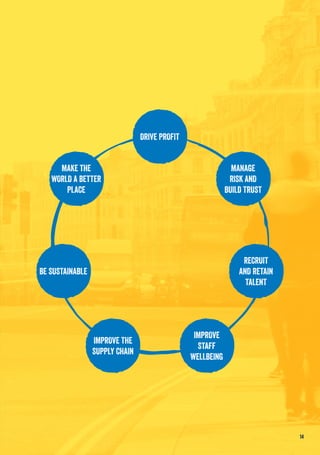
RECRUIT
AND RETAIN
TALENT
BE SUSTAINABLE
MAKE THE
WORLD A BETTER
PLACE
IMPROVE
STAFF
WELLBEING
MANAGE
RISK AND
BUILD TRUST
IMPROVE THE
SUPPLY CHAIN
DRIVE PROFIT
15
“I DO THINK THAT CRAFTSMANSHIP,
AT ITS HEART, IS ABOUT PURPOSE.
BUILDING FOR THE LONG TERM IS
SOMETHING THAT WE TRY AND
HOLD ON TO TIGHTLY.”
NICOLE VANDERBILT
ETSY
DRIVE PROFIT
16
Our research suggests that having an
authentic purpose can also result in gaining
market share and cementing loyalty – what
Ben & Jerry’s refers to as fans (as opposed to
customers).
“I think in the end this is all inevitable - all
business will have to become positive impact
business, because people will demand it and
customers will buy from companies that include
a corporate sense of empathy and focus on
how they grow their impact on their global
community.”
Jostein Solheim, CEO, Ben & Jerry’s
Consumers will often choose where to spend
their money based on their feelings about a
brand’s values 10
, and companies that connect
with – and have empathy with – consumers’
deeper needs and own sense of purpose will
therefore be at a competitive advantage.
“A sense of purpose has come to be seen, rightly,
as a value that not only has a place in business
but is essential to long-term success.”
Arianna Huffington
“There’s so much yet to be invented. Think about
an average day and consider everything that
makes you unhappy… Businesses are still aimed
at the bottom of Maslow’s pyramid, not the top.”
Alain de Botton
“Consumers want some help in answering the
question of what, in a profound sense, their
spending is for. When you have enough, what
need is being served by having more?”
Will Hutton
Interviewees recognised that employees who
feel a strong sense of purpose are more likely
to produce higher quality work, as working with
purpose will correlate with a commitment to
excellence and a sense of craft. A person who
believes there is purpose in what they are doing
typically feels more connected and committed
to their work, which often translates easily into
gains in customer satisfaction and loyalty.
And there is a growing body of work arguing
that purpose can also drive the distribution
of leadership, creativity and innovation across
organisations.
“Purpose and principles, clearly understood,
articulated and commonly shared, are the
genetic code of any healthy organization. To
the degree that you hold purpose and principles
in common among you, you can dispense with
command and control. People will know how to
behave in accordance with them, and they’ll do it
in thousands of unimaginable, creative ways.
The organization will become a vital, living set
of beliefs.” 11
10. In a study conducted
by Elite Daily, 75% of
Millennials said that it was
either “fairly important” or
“very important” that the
company from which they
purchased contributed to
society. Millennial Consumer
Trends 2015, Elite Daily, 2015,
elitedaily.com/millennial-
consumer-trends-2015.
11. Dee Hock, founder of
VISA, quoted by Adrian
Bridgwater in his article
Why Workplace Automation
Intelligence Can’t Replace Us
Humans, 2015.
DRIVE PROFIT
17
MANAGE RISK AND BUILD TRUST
At its most basic, participants remarked
that thinking about and expressing purpose
is about meeting the expectations of – and
building trust with – the markets that
business serves.
In the aftermath of the 2008 financial crisis,
many commentators including Which? and
the CBI noted the influence of a culture that
prioritised short-term personal gain above
all else:
“Too many bankers, especially at the most
senior levels, have operated in an environment
with insufficient personal responsibility…
Remuneration has incentivised misconduct and
excessive risk-taking, reinforcing a culture where
poor standards were often considered normal.” 12
It is easy to see how a business whose sole
purpose is ‘profit at any cost’ can lead to
behaviours at an individual, institutional and
even regulatory level that disconnect an entire
sector from its lifeblood: customers and
society.
Purpose is of particular concern to Millennials
(although not exclusively so), and many
companies recognise the imperative of
articulating and demonstrating a purpose in
order to manage reputational risk and build
positive relationships with the people they rely
on, are influenced by and influence.
This point is echoed by the following sources:
“Eight in ten respondents… say it’s the
responsibility of business to lead to solve societal
problems - that’s a six percent increase from
just a year ago. Business and its leaders should
be authentic and visible not only in talking about
its actions on societal challenges, but the values
that underpin those actions and its operational
performance.” 13
“According to our 2015 survey, which polled
more than 7,700 Millennials in 29 countries, the
majority believe that business needs to reset its
purpose... While they believe the pursuit of profit
is important to sustaining a business, Millennials
also say that pursuit must be accompanied by a
sense of purpose.” 14
12. Parliamentary
Commission on Banking
Standards 2013b, pp. 8-9.
13. Edelman Trust
Barometer, A New Business
as Usual, 2016.
14. Punit Renjen, CEO,
Deloitte Touche Tohmatsu
(Deloitte Global), Millennials
and Purpose: The Message is
Clear for Business Leaders.
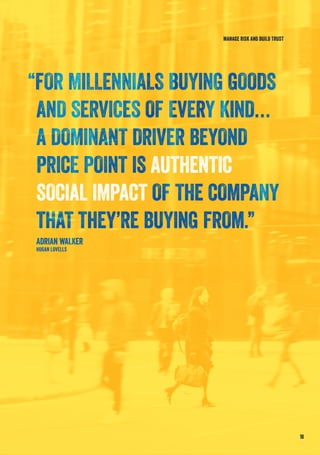
“FOR MILLENNIALS BUYING GOODS
AND SERVICES OF EVERY KIND…
A DOMINANT DRIVER BEYOND
PRICE POINT IS AUTHENTIC
SOCIAL IMPACT OF THE COMPANY
THAT THEY’RE BUYING FROM.”
ADRIAN WALKER
HOGAN LOVELLS
18
MANAGE RISK AND BUILD TRUST
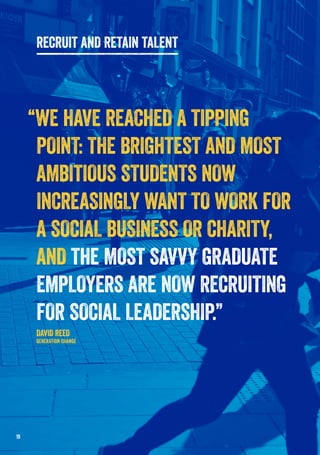
“WE HAVE REACHED A TIPPING
POINT: THE BRIGHTEST AND MOST
AMBITIOUS STUDENTS NOW
INCREASINGLY WANT TO WORK FOR
A SOCIAL BUSINESS OR CHARITY,
AND THE MOST SAVVY GRADUATE
EMPLOYERS ARE NOW RECRUITING
FOR SOCIAL LEADERSHIP.”
DAVID REED
GENERATION CHANGE
19
RECRUIT AND RETAIN TALENT
20
In the competition to recruit and retain
talent, participants attached value to paying
increasing attention to (current and potential)
employees’ demand for purpose. The talent
pool (at least in those markets where talent is
scarce) is a substantial force in encouraging
companies to take action on purpose.
“NOW CONVERSATIONS WITH
UNDERGRADUATES ARE ‘I WANT TO
WORK IN A REAL BUSINESS, I WANT
TO SEE THE VALUE OF THAT BUSINESS
AND I WANT TO BE ABLE TO FEEL I AM
PART OF DELIVERING THAT VALUE.’
THIS IS A VERY, VERY FUNDAMENTAL
MINDSET SHIFT THAT PLAYS RIGHT
ALONGSIDE YOUR ORGANISATIONAL
PURPOSE AND AGENDA.”
Andrew Harding
Chartered Institute of Management Accountants
“WE HAVE AWARDS FOR PEOPLE WHO WE
THINK HAVE MADE A BIG DIFFERENCE,
SOMEONE WHO WENT ABOVE AND BEYOND
THE SCOPE OF THEIR REMIT AND SAID
‘I’M GOING TO MAKE A DIFFERENCE
SOMEHOW,’ TO COLGATE... OR TO THE
EXTERNAL ENVIRONMENT.”
Ana Sanchez
Colgate
Again, this was reflected in our wider research:
“60% of the Millennials we surveyed say a ‘sense
of purpose’ is part of the reason they chose
to work for their current employer. And, in
businesses where Millennials say there is a strong
sense of purpose, there is significantly greater
financial and recruitment success and higher
employee satisfaction.” 15
“The future of work, and indeed the future
of the planet, is dependent on tomorrow’s
top talent. And that’s a good thing. The next
generation of industry leaders has its heart and
mind set on making the world a better place and
improving bottom lines for stakeholders, not just
shareholders.” 16
As a lever for talent retention, participants
identified purpose as playing a central role
in engaging staff in their work and acting as
a focal point for rewarding effort that has an
impact beyond numbers or productivity:
15. Ibid.
16. John Converse Townsend
and Kennerley Roper, The
New Age Of Purpose-Driven
Talent, Forbes online, 2015.
RECRUIT AND RETAIN TALENT
21
IMPROVE WELLBEING
To attract and retain talent, to increase
productivity and sometimes to uphold ethical
standards, interviewees said companies
should recognise the need to ensure the
wellbeing of their staff.
“According to reports that Gallup has been
generating since 2000, two thirds of employees
today feel disengaged and experience a lack of
meaning at work, costing the American economy
an estimated $450-$550 billion annually …
Globally, the percentage of disengagement
in the workplace is 87 percent across 142
countries.” 17
The ability to understand, articulate and
pursue our own purpose is widely regarded as
a fundamental determinant of our wellbeing,
and relates closely to other basic needs such
as our need for autonomy, integrity, belonging,
growth and self-actualisation, to name but
a few. This point is powerfully argued by
pioneering academic William Damon:
“Study after study has found a person’s sense of
life purpose to be closely connected to virtually
all dimensions of wellbeing… The implication
of these studies is that a disposition toward
purposeful activity has been bred into us and
plays a central role in energising and guiding
many of us through the most important choices
that we make in life.” 18
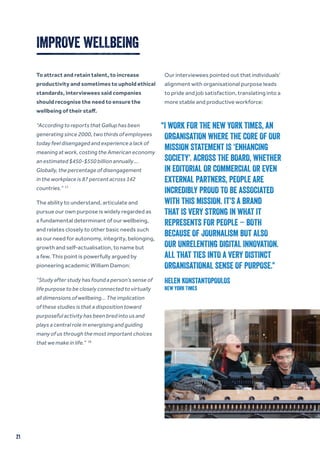
Our interviewees pointed out that individuals’
alignment with organisational purpose leads
to pride and job satisfaction, translating into a
more stable and productive workforce:
“I WORK FOR THE NEW YORK TIMES, AN
ORGANISATION WHERE THE CORE OF OUR
MISSION STATEMENT IS ‘ENHANCING
SOCIETY’. ACROSS THE BOARD, WHETHER
IN EDITORIAL OR COMMERCIAL OR EVEN
EXTERNAL PARTNERS, PEOPLE ARE
INCREDIBLY PROUD TO BE ASSOCIATED
WITH THIS MISSION. IT’S A BRAND
THAT IS VERY STRONG IN WHAT IT
REPRESENTS FOR PEOPLE – BOTH
BECAUSE OF JOURNALISM BUT ALSO
OUR UNRELENTING DIGITAL INNOVATION.
ALL THAT TIES INTO A VERY DISTINCT
ORGANISATIONAL SENSE OF PURPOSE.”
HELEN KONSTANTOPOULOS
New York Times
22
IMPROVE WELLBEING
Our research suggests that employees’ overall
wellbeing is improved if they understand and
identify with the organisation’s purpose. But it
is also important for an individual’s wellbeing
(and therefore the wellbeing of the business)
that they have the opportunity to express and
pursue their own sense of purpose through
their work.
Some interviewees point out that there is a risk
of organisations using their social purpose as
a mechanism to drive performance, exposing
claims of a commitment to staff wellbeing as
inauthentic and cynical:
17. Lori Hanau, The Paradigm
Shift to Shared Leadership,
Conscious Company
Magazine.
18. William Damon, The Path
to Purpose, New York: Free
Press, 2009.
“IN MY EXPERIENCE, SOME COMPANIES
ARE REALLY INTERESTED IN THE
WELLBEING OF THEIR EMPLOYEES –
AND THERE’S NO DOUBT THAT THIS IS
THEIR PRIMARY DRIVER AND MOTIVE.
BUT THERE ARE DEFINITELY OTHERS
WHO CLAIM AN INTEREST IN SOCIAL
PURPOSE AND WELLBEING BUT WHO ARE
ACTUALLY MUCH MORE INTERESTED IN
PRODUCTIVITY – GETTING THE MOST OUT
OF THEIR STAFF. THEY’RE MORE BRUTAL
IN THEIR MOTIVES.”
Paul Buck
EPIC Risk Management
23
IMPROVE THE SUPPLY CHAIN
Our research and interviews underline one
key finding in relation to supply chains:
purpose-driven companies think about the
wider ecosystem in which they exist, their
place in it, and their reliance and impact on it.
Purpose-driven companies are aware of – and
sensitive to – their staff and customers, and
their families and communities. They look
backwards to their supply chains, recognising
the value to be gained from working with
suppliers and partners in ways that are aligned
to a shared sense of value and purpose.
The outdoor brand The North Face believes
that its success is inextricably linked to the
responsible management of the natural world
– the outdoors so beloved by their customer
base. As part of its Mindful Processing and
Manufacturing programme, The North Face
developed a new approach to managing
the farming and production of down (a key
insulation element in its garments and
products) with the Textile Exchange. The
Responsible Down Standard (RDS) 19
promotes
positive animal welfare and traceability in the
supply chain, and has been rolled out to other
manufacturers in the sector, free of charge.
This open-source approach to supply chain
management exemplifies the shared value
approach of a genuinely purpose-driven
business.
“IN TODAY’S INTERCONNECTED WORLD,
THE ‘TENTACLES’ OF A BUSINESS
REACH OUT FAR AND WIDE THROUGH A
COMPLEX ECOSYSTEM OF CUSTOMERS,
CONSUMERS, SUPPLIERS, PARTNERS,
EMPLOYEES, COMMUNITIES AND NATURAL
RESOURCES. HAVING PURPOSE AT YOUR
HEART REQUIRES BEING TRUE TO YOUR
MISSION FOR EVERYONE, EVERYWHERE
THAT YOUR BUSINESS TOUCHES.”
Sarah Redshaw
WaterAid
19. The Responsible Down
Standard is an independent,
voluntary global standard
administered by the Textile
Exchange responsibledown.
org/about-us/.
24
IMPROVE THE SUPPLY CHAIN
“IF WE WANT OUR CUSTOMERS TO
‘NEVER STOP EXPLORING’ WE HAVE
TO BE CUSTODIANS OF THE NATURAL
WORLD… THAT IS ABSOLUTELY
ABOUT CHAMPIONING SUSTAINABILITY
THROUGHOUT OUR OWN SUPPLY CHAIN,
BUT BY GIVING THE RESPONSIBLE DOWN
STANDARD TO THE WIDER INDUSTRY WE
CAN MAKE A MUCH BIGGER IMPACT.”
Julian Lings
The North Face
25
BE SUSTAINABLE
Our wider research underlined that acting
with purpose also means working in
ways that improve (or at least minimise)
environmental impact – often with the belief
that doing so is good for the long-term
survival and health of the business. 20
Unilever is a well-known pioneer in this field,
but substantial investment has also been made
by businesses including McDonalds, Marks &
Spencer and PepsiCo, all of whom are working
with their supply chains to reduce waste and
pollution. 21
Sports brand Puma has a rigorous and
transparent sustainability programme that is
deeper and more comprehensive than most
manufacturers, covering economic, social and
environmental wellbeing under the banner of
Forever Faster. Puma introduced the world’s
first ever Environmental Profit and Loss
Account (E P&L), which measures the cost of
everything it produces in terms of impact on
the natural world. Significantly, Puma uses the
language of purpose – not just sustainability –
to frame its commitments:
‘Working towards a more just and sustainable
future, accelerating positive change in the
industry and the world’
Protecting the natural world must surely
be central to a company’s purpose – but
the idea of sustainability should go further.
Interviewees fed back that a business
genuinely living its social purpose is powerful
because employees, suppliers, customers and
other stakeholders all unite around – and act
in line with – shared goals that are explicitly
intended to strengthen and sustain all of the
communities, environments and ecosystems
within which the business exists.
A point also made by management
consultancy McKinsey in their analysis of
Wal-Mart’s ambitious sustainability policies:
“These [renewable energy and zero waste]
initiatives not only safeguard the environment
and the sustainability of Wal-Mart’s products,
but also reduce energy costs and help the
company build deeper relationships with local
communities.” 22
20. Sheila Bonini and
Steven Swartz, Profits with
purpose: How organizing for
sustainability can benefit the
bottom line, McKinsey on
Sustainability and Resource
Productivity, July 2014, p.10.
21. Paul Polman, Business,
society, and the future
of capitalism, McKinsey
Quarterly, May 2014
mckinsey.com/business-
functions/sustainability-
and-resource-productivity/
our-insights/business-
society-and-the-future-of-
capitalism.
22. McKinsey & Company,
Shaping the Future: Solving
Social Problems through
Business Strategy, 2010.
“IT IS INHERENT IN LEGO THAT WE WANT
TO TRY FOR THE BEST, WHETHER THAT’S
PRODUCT SAFETY, PRODUCT QUALITY [OR]
BEING GOOD AT THE THINGS WE DO AND
HOW WE WORK TOGETHER. IT’S ABOUT
BEING A GOOD PLACE TO WORK FOR
EMPLOYEES, BEING A GREAT PARTNER TO
OUR SUPPLIERS AND CUSTOMERS, LIVING
AND HAVING A POSITIVE IMPACT ON
THE PLANET. SO IT’S NOT JUST WITHIN
PRODUCTS BUT ALSO THE WAY WE
INTERACT WITH THE WORLD.”
Lene Friis
LEGO
26
BE SUSTAINABLE
27
MAKE THE WORLD A BETTER PLACE
Participants agreed that among people who
work with purpose-driven companies, it is
common to encounter the belief that acting
with purpose is simply the right thing to do.
These people often see their own wellbeing
as something more than a purely economic
construct. They understand that their own
wellbeing is tied to the wellbeing of the
business they work with and inextricably
entwined with the wellbeing of everyone and
everything else.
“FROM OUR PERSPECTIVE AS A UNIVERSITY
EDUCATING THE WORKFORCE OF THE
FUTURE, PURPOSE IS BECOMING
INCREASINGLY IMPORTANT. STUDENTS
OBVIOUSLY NEED TECHNICAL SKILLS
– THE ‘HOW’ – BUT MORE AND MORE
THEY’RE ASKING ABOUT THE ‘WHY’. WHY
SHOULD I WORK FOR A COMPANY THAT
DOESN’T DO SOMETHING ABOVE AND
BEYOND JUST PROVIDING A PAY CHEQUE?”
Nick Petford
Vice-Chancellor, University of Northampton
28
MAKE THE WORLD A BETTER PLACE
It is these people who believe that businesses
should make a positive impact on individuals,
communities and the world at large. They
believe in solving problems (not just avoiding
them) and in maximizing the good. It is these
people who not only commit their own
businesses to purpose but who also encourage
and lobby others to do so – often with
extraordinary ambition.
“A massive prize awaits business if it successfully
ushers in an era of shared prosperity and
increased sustainability.”
Mark Malloch-Brown, Co-Chair, Global Commission for
Business and Sustainable Development
“There is no business case for enduring poverty.
Business can unlock trillions of dollars through
new markets, investments and innovation
- but to do so we must challenge our current
practices and address poverty, inequality and
environmental challenges. Every business will
benefit from operating in a more equitable,
resilient world if we achieve the Sustainable
Development Goals.”
Paul Polman, CEO, Unilever
29
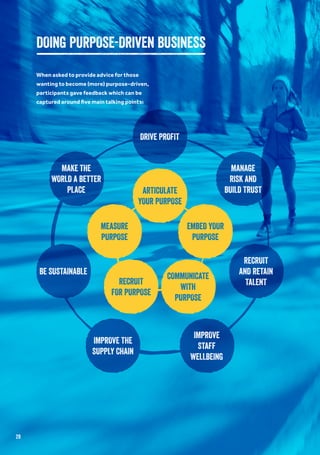
DOING PURPOSE-DRIVEN BUSINESS
When asked to provide advice for those
wanting to become (more) purpose-driven,
participants gave feedback which can be
captured around five main talking points:
EMBED YOUR
PURPOSE
RECRUIT
FOR PURPOSE
ARTICULATE
YOUR PURPOSE
MEASURE
PURPOSE
COMMUNICATE
WITH
PURPOSE
RECRUIT
AND RETAIN
TALENT
BE SUSTAINABLE
MAKE THE
WORLD A BETTER
PLACE
IMPROVE
STAFF
WELLBEING
MANAGE
RISK AND
BUILD TRUST
IMPROVE THE
SUPPLY CHAIN
DRIVE PROFIT
30
DOING PURPOSE-DRIVEN BUSINESS
1. ARTICULATE YOUR PURPOSE
Although a statement of a company’s values,
vision and mission is widely regarded as
insufficient – and can often belie a business’s
true purpose – a clear articulation, awareness
and understanding of the company’s values,
vision and mission (across the organisation)
is an essential component of a purpose-
driven business.
In particular, a deep, compelling purpose
will arise from leaders’ refusal to accept the
status quo. By rejecting business thinking
that only prioritises profit – and committing
to different, broader outcomes – purpose-
driven businesses are often inherently more
innovative and ambitious than their more
traditional counterparts.
“Entrepreneurs who are truly change makers
must be highly creative and able to look at a
problem or opportunity from a completely new
angle. This is summed up by something Robert
Kennedy, one of my political heroes, said: ‘Some
men see things as they are and ask “Why?” I see
the things that never were and ask “Why not?”’”
Paul Lindley, Ella’s Kitchen
While there is consensus that the purpose
agenda needs to be owned and driven from the
top, our wider research threw up the challenge
of achieving this against the day-to-day
backdrop of doing international business.
“How do you manage to convey a sense of
meaning when your workforce might be
scattered in four continents, when the project
that you’re working on might take five years to
complete, when you keep losing thread of what
it is you’re doing? We need to become better
storytellers.” 23
Alain de Botton
This can take substantial courage and effort
on the part of the company’s leadership – and
significant open-mindedness and investment
by the body of the organisation.
23. Taken from Alain De
Botton’s keynote speech
at 2015’s Business Wise
conference.
31
2. EMBED YOUR PURPOSE
Beyond articulating your purpose, it is
essential to embed your purpose in the
mindsets, actions and culture of your
organisation. Moving past rhetoric to make
your purpose lived is often one of the hardest
challenges to overcome.
To do so, it is important to give people time,
space and incentives to contribute to – and
act on – the company’s purpose as they deal
with the day-to-day realities of their job. With
this in mind, the thoughtful use of events and
other rituals can be helpful – interviewees
emphasised the importance of organisational
structure, personal objectives, KPIs, training
and appraisals, as well as staff recognition,
awards and rewards.
Legal policies and structures – such as the
emergence of B Corps (Benefit Corporations)
– are examples of the growing desire to
cement the commitment to purpose in law.
B Corp certification is granted by B Lab, a
not-for-profit body that evaluates a for-profit
business’s performance against rigorous
social and environmental criteria. B Corps are
growing in number internationally, with more
than 1600 businesses in 41 countries now
certified, and the movement is gaining traction
across every industry, from fast-moving
consumer goods (FMCG) through to financial
and professional services. 24
“THE DIFFICULT PIECE IS WIRING THE
ORGANISATION SO THAT CONTRIBUTING
TO THE PURPOSE IS FELT IN EVERY
ROLE. IT’S ABOUT DESIGNING THE
ORGANISATIONAL MECHANICS –
COMMUNICATIONS, JOB CONTENT,
RECOGNITION, TARGET SETTING,
DEVELOPMENT, RECRUITMENT,
LEADERSHIP AND WAYS OF WORKING…
IT’S ABOUT HOW ALL THE PIECES FIT
TOGETHER TO CONNECT EVERYDAY
WORK TO YOUR PURPOSE.”
Sarah Redshaw
WaterAid
24. Statistics taken from B
Lab’s website, March 2016,
bcorporation.net.
32
DOING PURPOSE-DRIVEN BUSINESS
“WE HAVE A COMPETENCY
FRAMEWORK THAT COVERS OUR
VOLUNTEERS, OUR STAFF AND
OUR SENIOR LEADERSHIP TEAM...
SO IT GOES RIGHT THROUGH
THE ORGANISATION AND IS ALL
BASED ON AND BUILT AROUND
OUR VALUES.”
STACEY ADAMS
RALEIGH INTERNATIONAL
3. COMMUNICATE WITH PURPOSE
Central to the ability to embed purpose
in a business will be the business’s ability
to communicate effectively with its staff,
suppliers, partners, shareholders and
customers.
Participants suggest that this is increasingly
important in today’s hyper-connected world,
in which people can celebrate or decimate a
brand at frightening speed and at a previously
unimaginable scale.
The VW emissions scandal was cited as
an example of serious misalignment with
core purpose that has had far-reaching
consequences for one of the most trusted
global brands. If a brand is a promise, VW
has broken that promise, and international
consultancy Brand Finance estimate that the
company has lost $10bn in brand value since
the scandal broke, suggesting that its fall from
grace could even threaten Germany’s position
as the world’s most trusted engineering and
manufacturing nation.
“HOW LONG WOULD IT HAVE TAKEN
TO DISCOVER THAT ALL YOUR DIESEL
ENGINES ARE LIES 20 YEARS AGO? HOW
LONG WOULD IT HAVE HELD OFF? HOW
LONG WOULD THAT STORY HAVE TAKEN
TO BREAK? HOW LONG BEFORE IT BECAME
AN ABSOLUTE CRISIS? WHAT’S THE DELTA
BETWEEN DISCOVERING AND LOSING THE
CHIEF EXECUTIVE 20 YEARS AGO?
I SUSPECT A LOT LONGER.”
Anthony Lilley OBE
33
In commercial terms, a disconnect between a
stated purpose and actual business behaviour
can be catastrophic, but we note this also
extends into the not-for-profit sector, where
actions that contradict stated charitable aims
can jar even more painfully.
This can be seen in Age UK and E.ON’s ill-fated
partnership – offering donors and beneficiaries
‘deals’ on their energy bills – which, although
hastily withdrawn, has resulted in serious
reputational damage.
At the other end of the spectrum, our research
revealed that articulating your purpose
authentically, clearly and in a compelling way
can be positively transformative.
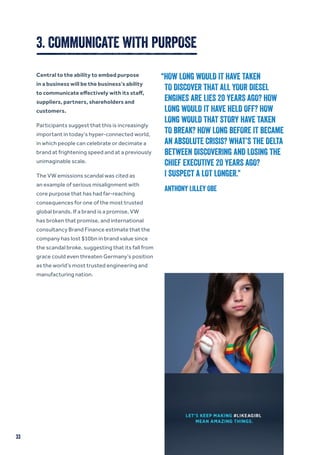
The ongoing and hugely successful Like a
Girl campaign run by Always tackles sexism
manifested in commonly-used language. By
reflecting the experiences of its customers
and taking a position on an issue that matters
to them, the brand has connected with
its heartland on a deep level and made a
significant contribution to fighting pervasive,
underlying sexist attitudes.
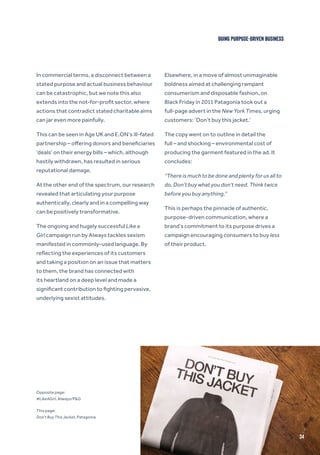
Elsewhere, in a move of almost unimaginable
boldness aimed at challenging rampant
consumerism and disposable fashion, on
Black Friday in 2011 Patagonia took out a
full-page advert in the New York Times, urging
customers: ‘Don’t buy this jacket.’
The copy went on to outline in detail the
full – and shocking – environmental cost of
producing the garment featured in the ad. It
concludes:
“There is much to be done and plenty for us all to
do. Don’t buy what you don’t need. Think twice
before you buy anything.”
This is perhaps the pinnacle of authentic,
purpose-driven communication, where a
brand’s commitment to its purpose drives a
campaign encouraging consumers to buy less
of their product.
DOING PURPOSE-DRIVEN BUSINESS
34
Opposite page:
#LikeAGirl, Always/P&G
This page:
Don’t Buy This Jacket, Patagonia
4. RECRUIT FOR PURPOSE
The increasing importance of purpose in
relation to the competition for talent was
touched on above. Of course, the process
of recruiting with – and for – purpose
is easier said than done, but there are
recommendations, for example:
Have a great purpose.
Be authentic.
“THE MOST TALENTED PEOPLE HAVE A
CHOICE. BEING IN AN ORGANISATION
THAT YOU’RE PROUD OF, BEING ABLE TO
COME BACK TO YOUR FAMILY AND SAY
‘YES, I’M HAPPY TO BE HERE BECAUSE
MY BUSINESS IS DOING THE RIGHT
THING,’ THAT’S WHAT MAKES TALENTED
PEOPLE STAY.”
Carl Fitzsimons
Thai Union
“IT’S REALLY IMPORTANT TO BE
AUTHENTIC WHEN YOU’RE TALKING TO
PEOPLE ABOUT WHAT IT IS YOU STAND
FOR, WHAT YOU’RE TRYING TO ACHIEVE
– YOU THEN GET THE RIGHT PEOPLE
INTO THE ORGANISATION.”
DAN JOY
Ikano Bank
35
“THEY ALL WANT TO EARN GOOD MONEY,
BUT THEY ARE INTERESTED IN THINGS
BEYOND THAT. THEY ARE INTERESTED
IN WHETHER THEY ARE DOING THINGS
WITH INTEGRITY, WHETHER THERE IS
OPPORTUNITY FOR CREATIVITY, WHETHER
THEY’RE ACTUALLY GOING TO CREATE
SOMETHING OF GENUINE SUSTAINED
VALUE AND WHETHER THE PEOPLE THEY
ARE WORKING WITH ARE DOING THAT
– AND DOING THAT WITH INTEGRITY.”
ADRIAN WALKER
Hogan Lovells
36
“I TRULY BELIEVE THAT WITHOUT A
‘WHY’ THAT CENTRES ON MEANINGFUL
PURPOSE, A COMPANY CANNOT GROW.
OFTEN WE LOOK FOR CORPORATE VALUES
THAT GENERALISE, BUT UNTIL THE
PURPOSE IS THE CENTRAL AUTHENTIC
NARRATIVE, THOSE VALUES ARE
MEANINGLESS.”
GURTEJ SANDHU
CEO, QS UNISOLUTION
Our wider research touched upon the
importance of screening candidates for
purpose, with research company Imperative
and New York University’s 2015 Workforce
Purpose Index arguing that:
“Purpose-Oriented Workers show up at work
in a big way. They thrive as employees and
human beings at significantly higher levels in
every measure… Purpose-Driven Workers are
the foundation for successful organizations, a
thriving economy, and healthy society overall.” 25
Participants also talked about clarity
around the ‘why’ as key to the success of
any endeavour, and communicating your
purpose internally can lead to powerful – even
transformational – change as it motivates
employees at a deep emotional level.
25. In partnership with New
York University, research
company Imperative
conducted an Organizational
Purpose Index for LinkedIn
and surveyed more than
2,000 employees across the
globe. Full report available at
issuu.com/imperative2015/
docs/index_updated10.
DOING PURPOSE-DRIVEN BUSINESS
37
26. In one study,
organisational culture
was credited with a 29%
variation in productivity
levels between companies.
Malcolm G Patterson
et al, Impact of People
Management Practices on
Business Performance,
Issues in People
Management, Institute of
Personal Development,
1998, p. 10.
5. MEASURE PURPOSE
Interviewees touched on purpose-driven
companies committing to objectives that
align with and reinforce their purpose. They
measure their performance against these
objectives and they report openly and
comprehensively on their performance.
In this context, performance also covers
culture, in other words what does it feel like
to work in this organisation? Attitudes and
behaviours, the way people treat each other, is
as important as sustainability or procurement
policies. Put simply, if your culture is
disconnected with your purpose, you cannot
hope to achieve your commercial or impact
objectives. 26
Our wider research led us to The Body Shop
as a pioneer in purpose-driven business. It
has long placed its commitment to making a
positive impact at the heart of its operations
and its proposition – a commitment amply
reflected in its reporting.
“Instead of being driven by comparisons with
our past performance, competitors or industry
standards, our Enrich Not Exploit Commitment
is inspired by the needs of our planet and its
people. This is not simply about doing less harm,
but rather about actively working toward a clear
destination: a future in which humanity and other
life can flourish on Earth forever.”
The Body Shop’s 2016 sustainability report
This is easier for businesses created with
purpose in mind. As participants remarked,
for those looking to reform or deepen their
purpose, honest and sometimes painful
reflection will be required to drive meaningful
change.
“THE OLD IDEA OF DRAWING A LINE
BETWEEN OUR WORK IDENTITY AND
PERSONAL IDENTITY IS FADING. AS PEW
REPORTED, MILLENNIALS ARE VERY
EXPRESSIVE AND OPEN TO CHANGE. THIS
CAN BE DISTURBING TO THE OLD GUARD
BUT IF YOU LOOK AT ANY MILLENNIAL-
RUN ORGANIZATION, THEY HAVE A
CULTURE WHERE YOU ARE NOT ONLY
ALLOWED TO BE HUMAN AT WORK BUT IT
IS EXPECTED OF YOU EVERY DAY.”
AARON HURST
Author and Entrepreneur
“CHANGE BEGINS WITH THE
COURAGE TO ACKNOWLEDGE
REALITY. OUR BRAND, OUR
EMPLOYEES, OUR CUSTOMERS –
WHAT ARE WE ACTUALLY SAYING
AND DOING? WHAT DOES OUR GUT
TELL US? WHAT DOES THE DATA
SHOW US? HONESTLY FACING OUR
STRENGTHS (AND OUR SHADOWS)
SEEMS ESSENTIAL IF WE’RE
TO CLOSE THE GAP BETWEEN
INTENTION AND ACTION.”
NATALIE HORNE
FOUNDER, PRIME DECISION
38
DOING PURPOSE-DRIVEN BUSINESS
39
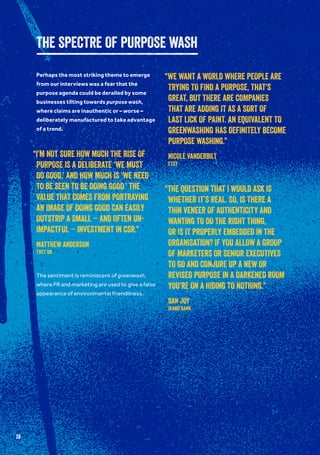
THE SPECTRE OF PURPOSE WASH
Perhaps the most striking theme to emerge
from our interviews was a fear that the
purpose agenda could be derailed by some
businesses tilting towards purpose wash,
where claims are inauthentic or – worse –
deliberately manufactured to take advantage
of a trend.
The sentiment is reminiscent of greenwash,
where PR and marketing are used to give a false
appearance of environmental friendliness.
“I’M NOT SURE HOW MUCH THE RISE OF
PURPOSE IS A DELIBERATE ‘WE MUST
DO GOOD,’ AND HOW MUCH IS ‘WE NEED
TO BE SEEN TO BE DOING GOOD.’ THE
VALUE THAT COMES FROM PORTRAYING
AN IMAGE OF DOING GOOD CAN EASILY
OUTSTRIP A SMALL – AND OFTEN UN-
IMPACTFUL – INVESTMENT IN CSR.”
MATTHEW ANDERSON
TVET UK
“WE WANT A WORLD WHERE PEOPLE ARE
TRYING TO FIND A PURPOSE, THAT’S
GREAT, BUT THERE ARE COMPANIES
THAT ARE ADDING IT AS A SORT OF
LAST LICK OF PAINT. AN EQUIVALENT TO
GREENWASHING HAS DEFINITELY BECOME
PURPOSE WASHING.”
NICOLE VANDERBILT
Etsy
“THE QUESTION THAT I WOULD ASK IS
WHETHER IT’S REAL. SO, IS THERE A
THIN VENEER OF AUTHENTICITY AND
WANTING TO DO THE RIGHT THING,
OR IS IT PROPERLY EMBEDDED IN THE
ORGANISATION? IF YOU ALLOW A GROUP
OF MARKETERS OR SENIOR EXECUTIVES
TO GO AND CONJURE UP A NEW OR
REVISED PURPOSE IN A DARKENED ROOM
YOU’RE ON A HIDING TO NOTHING.”
DAN JOY
Ikano Bank
40
Participants were clear that purpose must be
authentic. If it isn’t – and purpose becomes yet
another jaded, over-used piece of corporate
jargon – the movement’s potential for change
could be seriously undermined.
More and more businesses and organisations
from every conceivable sector are adopting
purpose as a frame for what they do, and
with its explicit emphasis on shared value,
purpose holds the promise of a more
equitable, sustainable and fulfilling model of
consumption, work and business for everyone.
But there are major risks associated with
mass adoption that arise from opportunistic
bandwagon-jumping and a misunderstanding –
wilful or otherwise – of the level of commitment
required to be truly purpose-driven:
“GIVE ME THE UNADULTERATED,
UNAPOLOGETIC, UNETHICAL CAPITALIST
ANY DAY, BECAUSE YOU KNOW THE
NATURE OF THE BEAST YOU’RE DEALING
WITH. WHEN GREED COVERS ITSELF IN
LAMB’S CLOTHING AND PRETENDS TO BE
SOMETHING ELSE – THAT’S DANGEROUS.”
CAL COURTNEY
London School of Business & Management
“THE DANGER IS ’PURPOSE’ BECOMES A
THROWAWAY LINE THAT IS PASSIVELY
MENTIONED IN THE SAME WAY THAT
CORPORATE VALUES OFTEN CAN BE...
PURPOSE NEEDS TO BE ACTIVELY LIVED.”
JULIAN LINGS
The North Face
“IF WE TRY TO GENERATE PURPOSE IN
ORGANISATIONS WITHOUT REFLECTING
ON THE DEPTH AND BREADTH OF
PURPOSIVE CAPACITY, WE WILL
AT BEST BE MYTHMAKING AND AT
WORST EMBEDDING ORGANISATIONAL
DISHONESTY.”
MATTHEW TAYLOR
RSA
THE SPECTRE OF PURPOSE WASH
PURPOSE IN PRACTICE IS NOT
INTENDED TO OFFER A DEFINITIVE
ANALYSIS OF THE COMPLEX
ISSUES COVERED. RATHER,
OUR AIM IS TO STIMULATE
CONVERSATION, CATALYSE
ENQUIRY AND, ULTIMATELY,
HELP MORE COMPANIES BECOME
AUTHENTICALLY PURPOSE-DRIVEN.
41
WHAT NEXT?
42
Our findings to date are clear on a number of points:
Minimising the risk of purpose wash should be an explicit aim of
businesses that care about the movement. And it’s for this reason
that Claremont is committed to building on this report, with a series
of publications, events and other activities that will give voice to
people who genuinely care about purpose-driven business.
We would like to thank all of those who have contributed so far and
hope you will join us.
• Purpose needs leadership – but it must be woven throughout a
business’s organisation, processes and culture
• Mission statements are helpful – but purpose goes much further
and is rooted in commitments to others, including individuals,
communities and the world at large
• Claims of being purpose-driven are important – but inauthentic
claims threaten the whole purpose movement.
WHAT NEXT?
43
FURTHER READING
QUICK READS
The Rediscovery and Valuing of People Power,
Robin Chase, CEO, Zipcar
The Paradigm Shift to Shared Leadership: From
Round Earth to Flat Hierarchies, Lori Hannau,
Global Round Table Leadership
Purpose-driven organisations far outperform
traditional for-profit businesses, Andrew
Hewitt, Founder, GameChangers500
Millenials Work for Purpose not Paycheck, Karl
Moore, Desautels Faculty McGill University
The Values Revolution: Embedding Empathy in
the New Economy, Ai-Jen Poo, Founder and
Director, National Domestic Workers Alliance
Universities are Failing to Prepare Students
for the Social Economy, David Reed, Director,
Generation Change
Millenials and Purpose: The Message is Clear
for Business Leaders, Punit Renjen, CEO,
Deloitte Global
What is the Purpose of Business, Isabella
Rimanoczy, Partner, Leadership in Motion
The Power of Purpose, Mark Weinberger,
Global Chairman, EY
Beyond Profit, Graham Brown-Martin, Founder,
Learning Without Frontiers
Do Purpose: Why Brands with a Purpose Do
Better and Matter More, David Hieatt
DEEP THINKING
Balancing Purpose and Profit: Legal mechanisms
to lock in social mission for “profit with purpose”
businesses across the G8, Thomson Reuters
Foundation, UnLtd and Orrick, 2014
Combining Profit and Purpose: A new dialogue
on the role of business in society, Coca Cola
Enterprises 2014
Culture of Purpose: Building Business
Confidence, Driving Growth, Deloitte, 2014
The Deloitte Millennial Survey 2016: Winning over
the next generation of leaders, Deloitte, 2016
Profits With Purpose: How organizing for
sustainability can benefit the bottom line,
McKinsey 2014
The Business Case for Purpose, Harvard
Business Review and EY, 2016
The Future of Capitalism, Paul Polman,
CEO, Unilever
The Performance Frontier: Innovating for a
sustainable business Strategy, Robert Eccles and
George Serrafeim, Harvard Business Review
44
CREDITS
DIGITAL RESOURCES
purposegeneration.com/millennials/
Global Commission on Business and
Sustainable Development
Video: Reinventing the Planet, Josie Maran,
Josie Maran Cosmetics
Video: Find your purpose and put it to work,
Harvard Business Review
Blog: Introducing What’s Working: Purpose
+ Profit, Arianna Huffington, Huffington Post
THANK YOU
Interviews and writing by Henry Playfoot
and Ross Hall
Design by Arch Creative
Photography by Tano Lam
We’d like to thank all of our interviewees for
their time, thoughts and generosity.
If you would like to get involved with Purpose
in Practice as it evolves please contact Henry
Playfoot at Claremont Communications
– we’d love to hear from you.
CLAREMONT
Claremont is an integrated communications
agency providing strategy and campaigns to
clients across the private, public and
not-for-profit sectors.
Claremont’s 20-strong multidisciplinary team
is based in Clerkenwell, London. Our network
spans the media, the arts, politics, brands,
business, technology and academia.
Youth employment. Ageing population. Open
data. Economic growth. Our award-winning
work takes us to the heart of society’s biggest
issues.
claremontcomms.com
WITH CONTRIBUTIONS FROM: STACEY ADAMS, RALEIGH
INTERNATIONAL, MATTHEW ANDERSON, TVET UK, DAVID BAKER,
THE SCHOOL OF LIFE, DAVID BONBRIGHT, KEYSTONE, ADELE
BLAKEBROUGH, SOCIAL BUSINESS TRUST, PAUL BUCK, EPIC RISK
MANAGEMENT, ANNIE CLEMENTS, AUTISM & ADHD, CAL COURTNEY,
LONDON SCHOOL OF BUSINESS AND MANAGEMENT, RAJEEB DEY,
ENTERNSHIPS, CARL FITZSIMONS, THAI UNION, LENE FRIIS, LEGO,
DAVID GERSHON, THE EMPOWERMENT INSTITUTE, DAVID HAMILTON,
THE SCOUT ASSOCIATION, ANDREW HARDING, CHARTERED INSTITUTE
OF MANAGEMENT ACCOUNTANTS, NATALIE HORNE, PRIME DECISION,
AARON HURST, IMPERATIVE, SASKIA JONES, OXFAM, DAN JOY, IKANO
BANK, HELEN KONSTANTOPOULOS, THE NEW YORK TIMES, ANTHONY
LILLEY OBE, MAGIC LANTERN, JULIAN LINGS, THE NORTH FACE,
NICK PETFORD, NORTHAMPTON UNIVERSITY, SARAH REDSHAW,
WATERAID, DAVID REED, GENERATION CHANGE, HARRY RICH, ANA
SANCHEZ, COLGATE, GURTEJ SANDHU, QS UNISOLUTION, MATTHEW
TAYLOR, THE ROYAL SOCIETY FOR THE ENCOURAGEMENT OF ARTS,
MANUFACTURES AND COMMERCE (RSA), NICOLE VANDERBILT, ETSY,
ADRIAN WALKER, HOGAN LOVELLS.

Purpose_in_Practice

  • 1.
  • 2.
    5 FOREWORD 6 WHAT ISPURPOSE? 8 FROM CSR TO PURPOSE 10 PURPOSE IS A MINDSET 12 PURPOSE IS A PROCESS 16 WHY DO PURPOSE? 18 DRIVE PROFIT 20 MANAGE RISK AND BUILD TRUST 22 RECRUIT AND RETAIN TALENT 24 IMPROVE WELLBEING 26 IMPROVE THE SUPPLY CHAIN 28 BE SUSTAINABLE 30 MAKE THE WORLD A BETTER PLACE 32 DOING PURPOSE-DRIVEN BUSINESS 42 THE SPECTRE OF PURPOSE WASH 44 WHAT NEXT? 46 FURTHER READING 47 CREDITS
  • 3.
    It seems everybody’stalking about purpose-driven business, and increasing numbers of CEOs around the world are committing themselves to delivering positive social and environmental impact. But what does this mean for you and your business in practice? You’ve no doubt seen reports and articles saying companies that commit to making the world a better place for everyone – not just themselves – outperform those that don’t 1 . There seems to be no end of research highlighting how purpose drives customer acquisition, brand loyalty and market share. We’re told that purpose-driven organisations have more innovative, productive and happy workforces 2 because they can recruit and retain the best talent 3 . And purpose-driven businesses are more sustainable because their positive social and environmental impact strengthens the ecosystems on which they depend. But all this can feel intangible – if not overwhelming – when set against the day-to-day realities of running an effective organisation or profitable business. While many CSR programmes did – and do – deliver substantial benefit, at its worst CSR and sustainability initiatives were used as an instrument of reputation management, giving rise to greenwash as detractors seized on the contradiction between marketing and reality on the ground. Are we doomed to an era of purpose wash, which would undermine trust in – and the impact of – companies that are authentically purpose-driven? We asked senior decision makers and thinkers across multiple sectors for their views on the role of purpose in business. In the course of 25 in-depth interviews this is what we learned. Henry Playfoot Strategy Director, Claremont Communications 1. A 2012 Deutsche Bank review of 56 academic research papers revealed that 89% of the studies showed companies with strong ‘Environmental, Social and Governance’ (ESG) factors outperformed competitors on a market basis, while 85% showed these types of companies exhibited accounting-based outperformance. Mark Fulton et al, Sustainable Investing: Establishing Long-Term Value and Performance, DB Climate Change Advisors, Deutsche Bank Group, 2012, dbadvisors.com, p. 5. 2. The Business Case for Purpose, Harvard Business Review Analytics Services, Harvard Business Review, 2015, hbr.org/ resources/pdfs/comm/ ey/19392HBRReportEY.pdf pp. 8-10. 3. According to a 2013 report by Deloitte, executives are more than 50% likely to be attracted to and retained by a company if they feel there is a strong sense of purpose. Culture of Purpose: A Business Imperative, 2013 Core Beliefs and Culture Survey, Deloitte LLP, 2013, deloitte.com/us/ en/pages/about-deloitte/ articles/culture-of-purpose. html pp. 6-8. FOREWORD 3
  • 4.
    In a landmarkreport published in the Harvard Business Review in 2011, Michael Porter and Mark Kramer argued that capitalism was in crisis due to a narrow approach to “value creation” and a short- term focus on financial performance. Their remedy was purpose, which demands a fundamentally different approach: “Companies could bring business and society back together if they redefined their purpose as creating ‘shared value’ - generating economic value in a way that also produces value for society by addressing its challenges.” 4 Our interviewees do not share a single definition of purpose, but agree that it is about looking beyond the need to generate profit to positively impact individuals, society and the environment. Purpose-driven organisations, including businesses, Government, social enterprises, not-for-profits and charities, seem to be characterised by long-termism, commitment to craft – doing something really well – and recognition of the connection between the wellbeing of the company and the wellbeing of its staff, partners, suppliers and the wider world. Although definitions may vary, our participants were unanimous on one thing: purpose must be authentic and lived, and when it is, it is experienced and felt by everyone. 4 WHAT IS PURPOSE? 4. Michael E. Porter & Mark Kramer, Creating Shared Value: Redefining Capitalism and the Role of the Corporation in Society, Harvard Business Review, 2011.
  • 5.
    The belief thatbusiness should do less harm initiated the emergence of Corporate Social Responsibility and its growth over the past 60 years. “The phrase Corporate Social Responsibility was coined in 1953 with the publication of Bowen’s Social Responsibility of Businessmen, which posed the question: ‘Which responsibilities to society can businesspeople be reasonably expected to assume?’ In 1984, the celebrated management consultant Peter Drucker wrote about the imperative to turn social problems into economic opportunities.” 5 But CSR has largely failed to live up to its promise. Certainly, a thoughtful, structured and properly resourced CSR programme can generate substantial social and environmental impact. But in practice – in most cases – CSR’s impact is limited by its role as an add-on. In the worst case scenario, claims of CSR are used to create a false or misleading impression of the company they are serving 6 . Where CSR is usually treated as an organisational function, social purpose is the business’s raison d’etre 7 . If CSR is the department used to offset the sometimes brutal business of maximising profits, purpose is fundamental to how the business thinks and is at the heart of everything it does. CSR does not create or necessarily reflect a purpose-driven business (although it may be part of how that business operates). Authentic purpose-driven business requires a worldview that goes above and beyond CSR; rather than being a business unit, purpose is best understood as both a mindset and a process. FROM CSR TO PURPOSE 5. What’s Wrong With Corporate Social Responsibility? Corporate Watch. 6. For examples and case studies in the oil and gas industry, see Jedrzej George Frynas, ‘The False Developmental Promise of Corporate Social Responsibility: Evidence From Multinational Oil Companies’, International Affairs, 81: 581-598, 2005. 7. Paul Polman, Business, Society, and the Future of Capitalism, McKinsey Quarterly, May 2014, mckinsey.com/business- functions/sustainability-and-resource-productivity/our- insights/business-society-and-the-future-of-capitalism. “WHILE BUSINESS HAS MADE A COMMITMENT TO BECOMING MORE SOCIALLY RESPONSIBLE, MOST ORGANISATIONS VIEW THIS ROLE IN HYGIENE TERMS. IT IS ABOUT MAKING SURE THEY DON’T DO BAD STUFF – OR DON’T GET CAUGHT DOING BAD STUFF. BUT THE SMART COMPANIES ARE WAKING UP TO THE FACT THAT THE FUTURE OF BUSINESS IS NOT ABOUT MINIMISING THE BAD THINGS IT DOES (CORPORATE SOCIAL RESPONSIBILITY) BUT MAXIMIZING THE GOOD IT DOES (CORPORATE SOCIAL ENGAGEMENT).” DAVID GERSHON EMPOWERMENT INSTITUTE 5
  • 6.
    “THERE’S A BIGDIFFERENCE BETWEEN PURPOSE AND CSR. WITH CSR, ‘DOING GOOD’ IS SILOED IN A SEPARATE FUNCTION AND CAN BE DROPPED WHEN TIMES GET TOUGH; WITH PURPOSE, DOING GOOD SHOULD BE BAKED INTO EVERYTHING YOU DO.” RAJEEB DEY CEO, ENTERNSHIPS FROM CSR TO PURPOSE 6
  • 7.
    “IT’S ABOUT PEOPLEWHO KEEP THEIR EYE ON THE LONG TERM, PEOPLE WHO UNDERSTAND VALUE, WHO UNDERSTAND WHAT YOU INVEST IN; YOU INVEST IN THE CULTURE OF YOUR BUSINESS, AND YOU’RE NOT JUST INVESTING FOR THIS YEAR’S PROFIT, YOU’RE INVESTING RIGHT THE WAY DOWN THE LINE.” ANDREW HARDING CHARTERED INSTITUTE OF MANAGEMENT ACCOUNTANTS PURPOSE IS A MINDSET 7
  • 8.
    Participants were clearthat a business can only be said to be purpose-driven insofar as people throughout the business are meaningfully engaged in the company’s purpose. Those interviewed explained that a CEO and leadership team with a purposeful mindset is necessary – but insufficient – for a company to become authentically purpose-driven. And while mission statements are helpful, words alone are never enough. “Purpose really comes down to mindset. It means building a culture that taps into your people’s sense of aspiration. It means empowering everyone you work with - from your clients or customers to your employees to your communities - not just to do better, but to be better. After all, purpose is truly about doing well by doing good.” 8 Participants also stated that having a purpose means thinking differently about value. It involves thinking about the short term and the long term – about economic and societal wellbeing – about how business relates to society and the world at large. 8 “IT’S IMPORTANT FOR THOSE OF US IN BUSINESS TO SAY ‘WE’RE IN THE BUSINESS OF MAKING MONEY.’ AND THAT’S A GOOD THING, BUT THAT’S ALMOST THE LAST PURPOSE THAT ANYONE TALKS ABOUT BECAUSE SOMEHOW IT SEEMS GRUBBY.” David Baker The School of Life “I CAME TO A CROSSROADS WHERE I HAD TO DECIDE – ‘DO I GO AND DO GOOD IN THE WORLD, OR DO I GO AND DO BUSINESS?’ SO WHEN I FOUND OUT ABOUT ETSY IT FELT LIKE THIS SUDDEN REVELATION, LIKE THERE WAS A WAY TO BRING THESE TWO THINGS TOGETHER.” Nicole Vanderbilt Etsy “ONLY ONE FIFTH OF OUR CEO’S KPIS IS RELATED TO TURNOVER… OBVIOUSLY WE NEED TO SELL, WE NEED TO BE PROFITABLE – BECAUSE THAT’S LIKE OUR OXYGEN – BUT THAT’S NOT OUR PURPOSE AND IT CAN NEVER BE OUR PURPOSE.” Lene Friis LEGO 8. Mark Weinberger (Global Chairman and CEO, EY), The Power of Purpose, betterworkingworld.ey.com/ purpose/power-purpose. PURPOSE IS A MINDSET
  • 9.
    Purpose is feltand revealed, day-to-day, in everything a business does. This means that every employee must experience a sense of purpose and express purpose through their actions: the way they create and deliver products and services; the way they treat suppliers; and the way they communicate – with each other and the rest of the world 9 . For this reason, interviewees tended to see an organisation’s purpose as something that endures and is perhaps best understood as a process. PURPOSE IS A PROCESS 9
  • 10.
    10 PURPOSE IS APROCESS “ORGANISATIONS TYPICALLY CONSTRUCT PURPOSE THROUGH IDEAS AND WORDS, DILUTING VISCERAL CONVICTIONS ABOUT PURPOSE IN THE PROCESS AND WHEN IT COMES TO DECIDING ON PURPOSE, WHOLE ORGANISATIONS OFTEN END UP WORKING FROM THE ‘STOMACH’ – THE FELT SENSE OF PURPOSE – OF ONE OR TWO LEADERS, FEELINGS THAT ULTIMATELY MAY NOT CARRY THROUGH THE ORGANISATION, UNLESS THEY ARE COMMUNICATED IN WAYS THAT HELP GIVE RISE TO SHARED EXPERIENCE OF THAT SENSE – NOT IDEA – OF PURPOSE.” MATTHEW TAYLOR SOCIETY FOR THE ENCOURAGEMENT OF ARTS, MANUFACTURES AND COMMERCE (RSA)
  • 11.
    Whilst purpose cangalvanise collective efforts, it must not be used to justify action that is detrimental to a business’s interests or as a get-out-of-jail free card to duck difficult questions or decisions. PURPOSE IS A PROCESS “SCOUTING EXISTS TO ACTIVELY SUPPORT AND ENGAGE YOUNG PEOPLE IN THEIR PERSONAL DEVELOPMENT, EMPOWERING THEM TO MAKE A POSITIVE CONTRIBUTION TO SOCIETY. AND ACTUALLY THAT IS JUST AS RELEVANT TODAY AS IT WAS IN 1907 WHEN WE WERE FOUNDED. OUR PURPOSE RUNS THROUGH OUR DNA AND HAS CHANGED VERY LITTLE SINCE THEN, DESPITE CHANGES IN THE MECHANICS OF HOW WE DO THINGS.” David Hamilton The Scout Association “I’VE WORKED A LOT WITH BIG CULTURAL INSTITUTIONS THAT HAVE BEEN FOUNDED OFTEN ON A PURPOSE BUT HAVE BECOME ABOUT CHANNELS - THEY’VE BECOME ABOUT DISTRIBUTION AND PRODUCTION AND BECOME MACHINES TO MAKE STUFF AND DISTRIBUTE STUFF AND BECAUSE THEY’VE BECOME SUCCESSFUL AT THAT, THEY HAVE FORGOTTEN THEIR PURPOSE.” Anthony Lilley OBE 9. In a 2016 survey of 7,700 Millennials, Deloitte ascertained that 80% of the Millennials who envisioned a commitment of 5 years or more to their employers believed that they shared values with the company. Winning Over the Next Generation of Leaders: The Deloitte 2016 Millennial Survey 2016, Deloitte LLP, 2016, deloitte.com/global/ en/pages/about-deloitte/ articles/millennialsurvey. html pp. 10-13. 11
  • 12.
    PURPOSE IS APROCESS “YOU CAN HAVE A SITUATION WHERE THE SENSE OF PURPOSE OVERWHELMS THE ORGANISATION. IT CAN, ON OCCASION, DIVERT PEOPLE FROM BEHAVING STRATEGICALLY AND, IF YOU’RE NOT CAREFUL, IT CAN CREATE ANARCHY.” HARRY RICH 12
  • 13.
    13 WHY DO PURPOSE? BECOMING– AND REMAINING – A PURPOSE-DRIVEN ORGANISATION IS CLEARLY A SIGNIFICANT UNDERTAKING, REQUIRING EFFORT AND INVESTMENT. SO WHY IS PURPOSE SO HIGH ON THE AGENDA? WHY ARE SO MANY BUSINESSES TAKING IT SERIOUSLY? IN ANSWERING THIS, THERE ARE VARIOUS LENSES THROUGH WHICH WE CAN LOOK.
  • 14.
    14 RECRUIT AND RETAIN TALENT BE SUSTAINABLE MAKETHE WORLD A BETTER PLACE IMPROVE STAFF WELLBEING MANAGE RISK AND BUILD TRUST IMPROVE THE SUPPLY CHAIN DRIVE PROFIT
  • 15.
    15 “I DO THINKTHAT CRAFTSMANSHIP, AT ITS HEART, IS ABOUT PURPOSE. BUILDING FOR THE LONG TERM IS SOMETHING THAT WE TRY AND HOLD ON TO TIGHTLY.” NICOLE VANDERBILT ETSY DRIVE PROFIT
  • 16.
    16 Our research suggeststhat having an authentic purpose can also result in gaining market share and cementing loyalty – what Ben & Jerry’s refers to as fans (as opposed to customers). “I think in the end this is all inevitable - all business will have to become positive impact business, because people will demand it and customers will buy from companies that include a corporate sense of empathy and focus on how they grow their impact on their global community.” Jostein Solheim, CEO, Ben & Jerry’s Consumers will often choose where to spend their money based on their feelings about a brand’s values 10 , and companies that connect with – and have empathy with – consumers’ deeper needs and own sense of purpose will therefore be at a competitive advantage. “A sense of purpose has come to be seen, rightly, as a value that not only has a place in business but is essential to long-term success.” Arianna Huffington “There’s so much yet to be invented. Think about an average day and consider everything that makes you unhappy… Businesses are still aimed at the bottom of Maslow’s pyramid, not the top.” Alain de Botton “Consumers want some help in answering the question of what, in a profound sense, their spending is for. When you have enough, what need is being served by having more?” Will Hutton Interviewees recognised that employees who feel a strong sense of purpose are more likely to produce higher quality work, as working with purpose will correlate with a commitment to excellence and a sense of craft. A person who believes there is purpose in what they are doing typically feels more connected and committed to their work, which often translates easily into gains in customer satisfaction and loyalty. And there is a growing body of work arguing that purpose can also drive the distribution of leadership, creativity and innovation across organisations. “Purpose and principles, clearly understood, articulated and commonly shared, are the genetic code of any healthy organization. To the degree that you hold purpose and principles in common among you, you can dispense with command and control. People will know how to behave in accordance with them, and they’ll do it in thousands of unimaginable, creative ways. The organization will become a vital, living set of beliefs.” 11 10. In a study conducted by Elite Daily, 75% of Millennials said that it was either “fairly important” or “very important” that the company from which they purchased contributed to society. Millennial Consumer Trends 2015, Elite Daily, 2015, elitedaily.com/millennial- consumer-trends-2015. 11. Dee Hock, founder of VISA, quoted by Adrian Bridgwater in his article Why Workplace Automation Intelligence Can’t Replace Us Humans, 2015. DRIVE PROFIT
  • 17.
    17 MANAGE RISK ANDBUILD TRUST At its most basic, participants remarked that thinking about and expressing purpose is about meeting the expectations of – and building trust with – the markets that business serves. In the aftermath of the 2008 financial crisis, many commentators including Which? and the CBI noted the influence of a culture that prioritised short-term personal gain above all else: “Too many bankers, especially at the most senior levels, have operated in an environment with insufficient personal responsibility… Remuneration has incentivised misconduct and excessive risk-taking, reinforcing a culture where poor standards were often considered normal.” 12 It is easy to see how a business whose sole purpose is ‘profit at any cost’ can lead to behaviours at an individual, institutional and even regulatory level that disconnect an entire sector from its lifeblood: customers and society. Purpose is of particular concern to Millennials (although not exclusively so), and many companies recognise the imperative of articulating and demonstrating a purpose in order to manage reputational risk and build positive relationships with the people they rely on, are influenced by and influence. This point is echoed by the following sources: “Eight in ten respondents… say it’s the responsibility of business to lead to solve societal problems - that’s a six percent increase from just a year ago. Business and its leaders should be authentic and visible not only in talking about its actions on societal challenges, but the values that underpin those actions and its operational performance.” 13 “According to our 2015 survey, which polled more than 7,700 Millennials in 29 countries, the majority believe that business needs to reset its purpose... While they believe the pursuit of profit is important to sustaining a business, Millennials also say that pursuit must be accompanied by a sense of purpose.” 14 12. Parliamentary Commission on Banking Standards 2013b, pp. 8-9. 13. Edelman Trust Barometer, A New Business as Usual, 2016. 14. Punit Renjen, CEO, Deloitte Touche Tohmatsu (Deloitte Global), Millennials and Purpose: The Message is Clear for Business Leaders.
  • 18.
    “FOR MILLENNIALS BUYINGGOODS AND SERVICES OF EVERY KIND… A DOMINANT DRIVER BEYOND PRICE POINT IS AUTHENTIC SOCIAL IMPACT OF THE COMPANY THAT THEY’RE BUYING FROM.” ADRIAN WALKER HOGAN LOVELLS 18 MANAGE RISK AND BUILD TRUST
  • 19.
    “WE HAVE REACHEDA TIPPING POINT: THE BRIGHTEST AND MOST AMBITIOUS STUDENTS NOW INCREASINGLY WANT TO WORK FOR A SOCIAL BUSINESS OR CHARITY, AND THE MOST SAVVY GRADUATE EMPLOYERS ARE NOW RECRUITING FOR SOCIAL LEADERSHIP.” DAVID REED GENERATION CHANGE 19 RECRUIT AND RETAIN TALENT
  • 20.
    20 In the competitionto recruit and retain talent, participants attached value to paying increasing attention to (current and potential) employees’ demand for purpose. The talent pool (at least in those markets where talent is scarce) is a substantial force in encouraging companies to take action on purpose. “NOW CONVERSATIONS WITH UNDERGRADUATES ARE ‘I WANT TO WORK IN A REAL BUSINESS, I WANT TO SEE THE VALUE OF THAT BUSINESS AND I WANT TO BE ABLE TO FEEL I AM PART OF DELIVERING THAT VALUE.’ THIS IS A VERY, VERY FUNDAMENTAL MINDSET SHIFT THAT PLAYS RIGHT ALONGSIDE YOUR ORGANISATIONAL PURPOSE AND AGENDA.” Andrew Harding Chartered Institute of Management Accountants “WE HAVE AWARDS FOR PEOPLE WHO WE THINK HAVE MADE A BIG DIFFERENCE, SOMEONE WHO WENT ABOVE AND BEYOND THE SCOPE OF THEIR REMIT AND SAID ‘I’M GOING TO MAKE A DIFFERENCE SOMEHOW,’ TO COLGATE... OR TO THE EXTERNAL ENVIRONMENT.” Ana Sanchez Colgate Again, this was reflected in our wider research: “60% of the Millennials we surveyed say a ‘sense of purpose’ is part of the reason they chose to work for their current employer. And, in businesses where Millennials say there is a strong sense of purpose, there is significantly greater financial and recruitment success and higher employee satisfaction.” 15 “The future of work, and indeed the future of the planet, is dependent on tomorrow’s top talent. And that’s a good thing. The next generation of industry leaders has its heart and mind set on making the world a better place and improving bottom lines for stakeholders, not just shareholders.” 16 As a lever for talent retention, participants identified purpose as playing a central role in engaging staff in their work and acting as a focal point for rewarding effort that has an impact beyond numbers or productivity: 15. Ibid. 16. John Converse Townsend and Kennerley Roper, The New Age Of Purpose-Driven Talent, Forbes online, 2015. RECRUIT AND RETAIN TALENT
  • 21.
    21 IMPROVE WELLBEING To attractand retain talent, to increase productivity and sometimes to uphold ethical standards, interviewees said companies should recognise the need to ensure the wellbeing of their staff. “According to reports that Gallup has been generating since 2000, two thirds of employees today feel disengaged and experience a lack of meaning at work, costing the American economy an estimated $450-$550 billion annually … Globally, the percentage of disengagement in the workplace is 87 percent across 142 countries.” 17 The ability to understand, articulate and pursue our own purpose is widely regarded as a fundamental determinant of our wellbeing, and relates closely to other basic needs such as our need for autonomy, integrity, belonging, growth and self-actualisation, to name but a few. This point is powerfully argued by pioneering academic William Damon: “Study after study has found a person’s sense of life purpose to be closely connected to virtually all dimensions of wellbeing… The implication of these studies is that a disposition toward purposeful activity has been bred into us and plays a central role in energising and guiding many of us through the most important choices that we make in life.” 18 Our interviewees pointed out that individuals’ alignment with organisational purpose leads to pride and job satisfaction, translating into a more stable and productive workforce: “I WORK FOR THE NEW YORK TIMES, AN ORGANISATION WHERE THE CORE OF OUR MISSION STATEMENT IS ‘ENHANCING SOCIETY’. ACROSS THE BOARD, WHETHER IN EDITORIAL OR COMMERCIAL OR EVEN EXTERNAL PARTNERS, PEOPLE ARE INCREDIBLY PROUD TO BE ASSOCIATED WITH THIS MISSION. IT’S A BRAND THAT IS VERY STRONG IN WHAT IT REPRESENTS FOR PEOPLE – BOTH BECAUSE OF JOURNALISM BUT ALSO OUR UNRELENTING DIGITAL INNOVATION. ALL THAT TIES INTO A VERY DISTINCT ORGANISATIONAL SENSE OF PURPOSE.” HELEN KONSTANTOPOULOS New York Times
  • 22.
    22 IMPROVE WELLBEING Our researchsuggests that employees’ overall wellbeing is improved if they understand and identify with the organisation’s purpose. But it is also important for an individual’s wellbeing (and therefore the wellbeing of the business) that they have the opportunity to express and pursue their own sense of purpose through their work. Some interviewees point out that there is a risk of organisations using their social purpose as a mechanism to drive performance, exposing claims of a commitment to staff wellbeing as inauthentic and cynical: 17. Lori Hanau, The Paradigm Shift to Shared Leadership, Conscious Company Magazine. 18. William Damon, The Path to Purpose, New York: Free Press, 2009. “IN MY EXPERIENCE, SOME COMPANIES ARE REALLY INTERESTED IN THE WELLBEING OF THEIR EMPLOYEES – AND THERE’S NO DOUBT THAT THIS IS THEIR PRIMARY DRIVER AND MOTIVE. BUT THERE ARE DEFINITELY OTHERS WHO CLAIM AN INTEREST IN SOCIAL PURPOSE AND WELLBEING BUT WHO ARE ACTUALLY MUCH MORE INTERESTED IN PRODUCTIVITY – GETTING THE MOST OUT OF THEIR STAFF. THEY’RE MORE BRUTAL IN THEIR MOTIVES.” Paul Buck EPIC Risk Management
  • 23.
    23 IMPROVE THE SUPPLYCHAIN Our research and interviews underline one key finding in relation to supply chains: purpose-driven companies think about the wider ecosystem in which they exist, their place in it, and their reliance and impact on it. Purpose-driven companies are aware of – and sensitive to – their staff and customers, and their families and communities. They look backwards to their supply chains, recognising the value to be gained from working with suppliers and partners in ways that are aligned to a shared sense of value and purpose. The outdoor brand The North Face believes that its success is inextricably linked to the responsible management of the natural world – the outdoors so beloved by their customer base. As part of its Mindful Processing and Manufacturing programme, The North Face developed a new approach to managing the farming and production of down (a key insulation element in its garments and products) with the Textile Exchange. The Responsible Down Standard (RDS) 19 promotes positive animal welfare and traceability in the supply chain, and has been rolled out to other manufacturers in the sector, free of charge. This open-source approach to supply chain management exemplifies the shared value approach of a genuinely purpose-driven business. “IN TODAY’S INTERCONNECTED WORLD, THE ‘TENTACLES’ OF A BUSINESS REACH OUT FAR AND WIDE THROUGH A COMPLEX ECOSYSTEM OF CUSTOMERS, CONSUMERS, SUPPLIERS, PARTNERS, EMPLOYEES, COMMUNITIES AND NATURAL RESOURCES. HAVING PURPOSE AT YOUR HEART REQUIRES BEING TRUE TO YOUR MISSION FOR EVERYONE, EVERYWHERE THAT YOUR BUSINESS TOUCHES.” Sarah Redshaw WaterAid 19. The Responsible Down Standard is an independent, voluntary global standard administered by the Textile Exchange responsibledown. org/about-us/.
  • 24.
    24 IMPROVE THE SUPPLYCHAIN “IF WE WANT OUR CUSTOMERS TO ‘NEVER STOP EXPLORING’ WE HAVE TO BE CUSTODIANS OF THE NATURAL WORLD… THAT IS ABSOLUTELY ABOUT CHAMPIONING SUSTAINABILITY THROUGHOUT OUR OWN SUPPLY CHAIN, BUT BY GIVING THE RESPONSIBLE DOWN STANDARD TO THE WIDER INDUSTRY WE CAN MAKE A MUCH BIGGER IMPACT.” Julian Lings The North Face
  • 25.
    25 BE SUSTAINABLE Our widerresearch underlined that acting with purpose also means working in ways that improve (or at least minimise) environmental impact – often with the belief that doing so is good for the long-term survival and health of the business. 20 Unilever is a well-known pioneer in this field, but substantial investment has also been made by businesses including McDonalds, Marks & Spencer and PepsiCo, all of whom are working with their supply chains to reduce waste and pollution. 21 Sports brand Puma has a rigorous and transparent sustainability programme that is deeper and more comprehensive than most manufacturers, covering economic, social and environmental wellbeing under the banner of Forever Faster. Puma introduced the world’s first ever Environmental Profit and Loss Account (E P&L), which measures the cost of everything it produces in terms of impact on the natural world. Significantly, Puma uses the language of purpose – not just sustainability – to frame its commitments: ‘Working towards a more just and sustainable future, accelerating positive change in the industry and the world’ Protecting the natural world must surely be central to a company’s purpose – but the idea of sustainability should go further. Interviewees fed back that a business genuinely living its social purpose is powerful because employees, suppliers, customers and other stakeholders all unite around – and act in line with – shared goals that are explicitly intended to strengthen and sustain all of the communities, environments and ecosystems within which the business exists. A point also made by management consultancy McKinsey in their analysis of Wal-Mart’s ambitious sustainability policies: “These [renewable energy and zero waste] initiatives not only safeguard the environment and the sustainability of Wal-Mart’s products, but also reduce energy costs and help the company build deeper relationships with local communities.” 22 20. Sheila Bonini and Steven Swartz, Profits with purpose: How organizing for sustainability can benefit the bottom line, McKinsey on Sustainability and Resource Productivity, July 2014, p.10. 21. Paul Polman, Business, society, and the future of capitalism, McKinsey Quarterly, May 2014 mckinsey.com/business- functions/sustainability- and-resource-productivity/ our-insights/business- society-and-the-future-of- capitalism. 22. McKinsey & Company, Shaping the Future: Solving Social Problems through Business Strategy, 2010.
  • 26.
    “IT IS INHERENTIN LEGO THAT WE WANT TO TRY FOR THE BEST, WHETHER THAT’S PRODUCT SAFETY, PRODUCT QUALITY [OR] BEING GOOD AT THE THINGS WE DO AND HOW WE WORK TOGETHER. IT’S ABOUT BEING A GOOD PLACE TO WORK FOR EMPLOYEES, BEING A GREAT PARTNER TO OUR SUPPLIERS AND CUSTOMERS, LIVING AND HAVING A POSITIVE IMPACT ON THE PLANET. SO IT’S NOT JUST WITHIN PRODUCTS BUT ALSO THE WAY WE INTERACT WITH THE WORLD.” Lene Friis LEGO 26 BE SUSTAINABLE
  • 27.
    27 MAKE THE WORLDA BETTER PLACE Participants agreed that among people who work with purpose-driven companies, it is common to encounter the belief that acting with purpose is simply the right thing to do. These people often see their own wellbeing as something more than a purely economic construct. They understand that their own wellbeing is tied to the wellbeing of the business they work with and inextricably entwined with the wellbeing of everyone and everything else. “FROM OUR PERSPECTIVE AS A UNIVERSITY EDUCATING THE WORKFORCE OF THE FUTURE, PURPOSE IS BECOMING INCREASINGLY IMPORTANT. STUDENTS OBVIOUSLY NEED TECHNICAL SKILLS – THE ‘HOW’ – BUT MORE AND MORE THEY’RE ASKING ABOUT THE ‘WHY’. WHY SHOULD I WORK FOR A COMPANY THAT DOESN’T DO SOMETHING ABOVE AND BEYOND JUST PROVIDING A PAY CHEQUE?” Nick Petford Vice-Chancellor, University of Northampton
  • 28.
    28 MAKE THE WORLDA BETTER PLACE It is these people who believe that businesses should make a positive impact on individuals, communities and the world at large. They believe in solving problems (not just avoiding them) and in maximizing the good. It is these people who not only commit their own businesses to purpose but who also encourage and lobby others to do so – often with extraordinary ambition. “A massive prize awaits business if it successfully ushers in an era of shared prosperity and increased sustainability.” Mark Malloch-Brown, Co-Chair, Global Commission for Business and Sustainable Development “There is no business case for enduring poverty. Business can unlock trillions of dollars through new markets, investments and innovation - but to do so we must challenge our current practices and address poverty, inequality and environmental challenges. Every business will benefit from operating in a more equitable, resilient world if we achieve the Sustainable Development Goals.” Paul Polman, CEO, Unilever
  • 29.
    29 DOING PURPOSE-DRIVEN BUSINESS Whenasked to provide advice for those wanting to become (more) purpose-driven, participants gave feedback which can be captured around five main talking points: EMBED YOUR PURPOSE RECRUIT FOR PURPOSE ARTICULATE YOUR PURPOSE MEASURE PURPOSE COMMUNICATE WITH PURPOSE RECRUIT AND RETAIN TALENT BE SUSTAINABLE MAKE THE WORLD A BETTER PLACE IMPROVE STAFF WELLBEING MANAGE RISK AND BUILD TRUST IMPROVE THE SUPPLY CHAIN DRIVE PROFIT
  • 30.
    30 DOING PURPOSE-DRIVEN BUSINESS 1.ARTICULATE YOUR PURPOSE Although a statement of a company’s values, vision and mission is widely regarded as insufficient – and can often belie a business’s true purpose – a clear articulation, awareness and understanding of the company’s values, vision and mission (across the organisation) is an essential component of a purpose- driven business. In particular, a deep, compelling purpose will arise from leaders’ refusal to accept the status quo. By rejecting business thinking that only prioritises profit – and committing to different, broader outcomes – purpose- driven businesses are often inherently more innovative and ambitious than their more traditional counterparts. “Entrepreneurs who are truly change makers must be highly creative and able to look at a problem or opportunity from a completely new angle. This is summed up by something Robert Kennedy, one of my political heroes, said: ‘Some men see things as they are and ask “Why?” I see the things that never were and ask “Why not?”’” Paul Lindley, Ella’s Kitchen While there is consensus that the purpose agenda needs to be owned and driven from the top, our wider research threw up the challenge of achieving this against the day-to-day backdrop of doing international business. “How do you manage to convey a sense of meaning when your workforce might be scattered in four continents, when the project that you’re working on might take five years to complete, when you keep losing thread of what it is you’re doing? We need to become better storytellers.” 23 Alain de Botton This can take substantial courage and effort on the part of the company’s leadership – and significant open-mindedness and investment by the body of the organisation. 23. Taken from Alain De Botton’s keynote speech at 2015’s Business Wise conference.
  • 31.
    31 2. EMBED YOURPURPOSE Beyond articulating your purpose, it is essential to embed your purpose in the mindsets, actions and culture of your organisation. Moving past rhetoric to make your purpose lived is often one of the hardest challenges to overcome. To do so, it is important to give people time, space and incentives to contribute to – and act on – the company’s purpose as they deal with the day-to-day realities of their job. With this in mind, the thoughtful use of events and other rituals can be helpful – interviewees emphasised the importance of organisational structure, personal objectives, KPIs, training and appraisals, as well as staff recognition, awards and rewards. Legal policies and structures – such as the emergence of B Corps (Benefit Corporations) – are examples of the growing desire to cement the commitment to purpose in law. B Corp certification is granted by B Lab, a not-for-profit body that evaluates a for-profit business’s performance against rigorous social and environmental criteria. B Corps are growing in number internationally, with more than 1600 businesses in 41 countries now certified, and the movement is gaining traction across every industry, from fast-moving consumer goods (FMCG) through to financial and professional services. 24 “THE DIFFICULT PIECE IS WIRING THE ORGANISATION SO THAT CONTRIBUTING TO THE PURPOSE IS FELT IN EVERY ROLE. IT’S ABOUT DESIGNING THE ORGANISATIONAL MECHANICS – COMMUNICATIONS, JOB CONTENT, RECOGNITION, TARGET SETTING, DEVELOPMENT, RECRUITMENT, LEADERSHIP AND WAYS OF WORKING… IT’S ABOUT HOW ALL THE PIECES FIT TOGETHER TO CONNECT EVERYDAY WORK TO YOUR PURPOSE.” Sarah Redshaw WaterAid 24. Statistics taken from B Lab’s website, March 2016, bcorporation.net.
  • 32.
    32 DOING PURPOSE-DRIVEN BUSINESS “WEHAVE A COMPETENCY FRAMEWORK THAT COVERS OUR VOLUNTEERS, OUR STAFF AND OUR SENIOR LEADERSHIP TEAM... SO IT GOES RIGHT THROUGH THE ORGANISATION AND IS ALL BASED ON AND BUILT AROUND OUR VALUES.” STACEY ADAMS RALEIGH INTERNATIONAL
  • 33.
    3. COMMUNICATE WITHPURPOSE Central to the ability to embed purpose in a business will be the business’s ability to communicate effectively with its staff, suppliers, partners, shareholders and customers. Participants suggest that this is increasingly important in today’s hyper-connected world, in which people can celebrate or decimate a brand at frightening speed and at a previously unimaginable scale. The VW emissions scandal was cited as an example of serious misalignment with core purpose that has had far-reaching consequences for one of the most trusted global brands. If a brand is a promise, VW has broken that promise, and international consultancy Brand Finance estimate that the company has lost $10bn in brand value since the scandal broke, suggesting that its fall from grace could even threaten Germany’s position as the world’s most trusted engineering and manufacturing nation. “HOW LONG WOULD IT HAVE TAKEN TO DISCOVER THAT ALL YOUR DIESEL ENGINES ARE LIES 20 YEARS AGO? HOW LONG WOULD IT HAVE HELD OFF? HOW LONG WOULD THAT STORY HAVE TAKEN TO BREAK? HOW LONG BEFORE IT BECAME AN ABSOLUTE CRISIS? WHAT’S THE DELTA BETWEEN DISCOVERING AND LOSING THE CHIEF EXECUTIVE 20 YEARS AGO? I SUSPECT A LOT LONGER.” Anthony Lilley OBE 33
  • 34.
    In commercial terms,a disconnect between a stated purpose and actual business behaviour can be catastrophic, but we note this also extends into the not-for-profit sector, where actions that contradict stated charitable aims can jar even more painfully. This can be seen in Age UK and E.ON’s ill-fated partnership – offering donors and beneficiaries ‘deals’ on their energy bills – which, although hastily withdrawn, has resulted in serious reputational damage. At the other end of the spectrum, our research revealed that articulating your purpose authentically, clearly and in a compelling way can be positively transformative. The ongoing and hugely successful Like a Girl campaign run by Always tackles sexism manifested in commonly-used language. By reflecting the experiences of its customers and taking a position on an issue that matters to them, the brand has connected with its heartland on a deep level and made a significant contribution to fighting pervasive, underlying sexist attitudes. Elsewhere, in a move of almost unimaginable boldness aimed at challenging rampant consumerism and disposable fashion, on Black Friday in 2011 Patagonia took out a full-page advert in the New York Times, urging customers: ‘Don’t buy this jacket.’ The copy went on to outline in detail the full – and shocking – environmental cost of producing the garment featured in the ad. It concludes: “There is much to be done and plenty for us all to do. Don’t buy what you don’t need. Think twice before you buy anything.” This is perhaps the pinnacle of authentic, purpose-driven communication, where a brand’s commitment to its purpose drives a campaign encouraging consumers to buy less of their product. DOING PURPOSE-DRIVEN BUSINESS 34 Opposite page: #LikeAGirl, Always/P&G This page: Don’t Buy This Jacket, Patagonia
  • 35.
    4. RECRUIT FORPURPOSE The increasing importance of purpose in relation to the competition for talent was touched on above. Of course, the process of recruiting with – and for – purpose is easier said than done, but there are recommendations, for example: Have a great purpose. Be authentic. “THE MOST TALENTED PEOPLE HAVE A CHOICE. BEING IN AN ORGANISATION THAT YOU’RE PROUD OF, BEING ABLE TO COME BACK TO YOUR FAMILY AND SAY ‘YES, I’M HAPPY TO BE HERE BECAUSE MY BUSINESS IS DOING THE RIGHT THING,’ THAT’S WHAT MAKES TALENTED PEOPLE STAY.” Carl Fitzsimons Thai Union “IT’S REALLY IMPORTANT TO BE AUTHENTIC WHEN YOU’RE TALKING TO PEOPLE ABOUT WHAT IT IS YOU STAND FOR, WHAT YOU’RE TRYING TO ACHIEVE – YOU THEN GET THE RIGHT PEOPLE INTO THE ORGANISATION.” DAN JOY Ikano Bank 35
  • 36.
    “THEY ALL WANTTO EARN GOOD MONEY, BUT THEY ARE INTERESTED IN THINGS BEYOND THAT. THEY ARE INTERESTED IN WHETHER THEY ARE DOING THINGS WITH INTEGRITY, WHETHER THERE IS OPPORTUNITY FOR CREATIVITY, WHETHER THEY’RE ACTUALLY GOING TO CREATE SOMETHING OF GENUINE SUSTAINED VALUE AND WHETHER THE PEOPLE THEY ARE WORKING WITH ARE DOING THAT – AND DOING THAT WITH INTEGRITY.” ADRIAN WALKER Hogan Lovells 36 “I TRULY BELIEVE THAT WITHOUT A ‘WHY’ THAT CENTRES ON MEANINGFUL PURPOSE, A COMPANY CANNOT GROW. OFTEN WE LOOK FOR CORPORATE VALUES THAT GENERALISE, BUT UNTIL THE PURPOSE IS THE CENTRAL AUTHENTIC NARRATIVE, THOSE VALUES ARE MEANINGLESS.” GURTEJ SANDHU CEO, QS UNISOLUTION Our wider research touched upon the importance of screening candidates for purpose, with research company Imperative and New York University’s 2015 Workforce Purpose Index arguing that: “Purpose-Oriented Workers show up at work in a big way. They thrive as employees and human beings at significantly higher levels in every measure… Purpose-Driven Workers are the foundation for successful organizations, a thriving economy, and healthy society overall.” 25 Participants also talked about clarity around the ‘why’ as key to the success of any endeavour, and communicating your purpose internally can lead to powerful – even transformational – change as it motivates employees at a deep emotional level. 25. In partnership with New York University, research company Imperative conducted an Organizational Purpose Index for LinkedIn and surveyed more than 2,000 employees across the globe. Full report available at issuu.com/imperative2015/ docs/index_updated10. DOING PURPOSE-DRIVEN BUSINESS
  • 37.
    37 26. In onestudy, organisational culture was credited with a 29% variation in productivity levels between companies. Malcolm G Patterson et al, Impact of People Management Practices on Business Performance, Issues in People Management, Institute of Personal Development, 1998, p. 10. 5. MEASURE PURPOSE Interviewees touched on purpose-driven companies committing to objectives that align with and reinforce their purpose. They measure their performance against these objectives and they report openly and comprehensively on their performance. In this context, performance also covers culture, in other words what does it feel like to work in this organisation? Attitudes and behaviours, the way people treat each other, is as important as sustainability or procurement policies. Put simply, if your culture is disconnected with your purpose, you cannot hope to achieve your commercial or impact objectives. 26 Our wider research led us to The Body Shop as a pioneer in purpose-driven business. It has long placed its commitment to making a positive impact at the heart of its operations and its proposition – a commitment amply reflected in its reporting. “Instead of being driven by comparisons with our past performance, competitors or industry standards, our Enrich Not Exploit Commitment is inspired by the needs of our planet and its people. This is not simply about doing less harm, but rather about actively working toward a clear destination: a future in which humanity and other life can flourish on Earth forever.” The Body Shop’s 2016 sustainability report This is easier for businesses created with purpose in mind. As participants remarked, for those looking to reform or deepen their purpose, honest and sometimes painful reflection will be required to drive meaningful change. “THE OLD IDEA OF DRAWING A LINE BETWEEN OUR WORK IDENTITY AND PERSONAL IDENTITY IS FADING. AS PEW REPORTED, MILLENNIALS ARE VERY EXPRESSIVE AND OPEN TO CHANGE. THIS CAN BE DISTURBING TO THE OLD GUARD BUT IF YOU LOOK AT ANY MILLENNIAL- RUN ORGANIZATION, THEY HAVE A CULTURE WHERE YOU ARE NOT ONLY ALLOWED TO BE HUMAN AT WORK BUT IT IS EXPECTED OF YOU EVERY DAY.” AARON HURST Author and Entrepreneur
  • 38.
    “CHANGE BEGINS WITHTHE COURAGE TO ACKNOWLEDGE REALITY. OUR BRAND, OUR EMPLOYEES, OUR CUSTOMERS – WHAT ARE WE ACTUALLY SAYING AND DOING? WHAT DOES OUR GUT TELL US? WHAT DOES THE DATA SHOW US? HONESTLY FACING OUR STRENGTHS (AND OUR SHADOWS) SEEMS ESSENTIAL IF WE’RE TO CLOSE THE GAP BETWEEN INTENTION AND ACTION.” NATALIE HORNE FOUNDER, PRIME DECISION 38 DOING PURPOSE-DRIVEN BUSINESS
  • 39.
    39 THE SPECTRE OFPURPOSE WASH Perhaps the most striking theme to emerge from our interviews was a fear that the purpose agenda could be derailed by some businesses tilting towards purpose wash, where claims are inauthentic or – worse – deliberately manufactured to take advantage of a trend. The sentiment is reminiscent of greenwash, where PR and marketing are used to give a false appearance of environmental friendliness. “I’M NOT SURE HOW MUCH THE RISE OF PURPOSE IS A DELIBERATE ‘WE MUST DO GOOD,’ AND HOW MUCH IS ‘WE NEED TO BE SEEN TO BE DOING GOOD.’ THE VALUE THAT COMES FROM PORTRAYING AN IMAGE OF DOING GOOD CAN EASILY OUTSTRIP A SMALL – AND OFTEN UN- IMPACTFUL – INVESTMENT IN CSR.” MATTHEW ANDERSON TVET UK “WE WANT A WORLD WHERE PEOPLE ARE TRYING TO FIND A PURPOSE, THAT’S GREAT, BUT THERE ARE COMPANIES THAT ARE ADDING IT AS A SORT OF LAST LICK OF PAINT. AN EQUIVALENT TO GREENWASHING HAS DEFINITELY BECOME PURPOSE WASHING.” NICOLE VANDERBILT Etsy “THE QUESTION THAT I WOULD ASK IS WHETHER IT’S REAL. SO, IS THERE A THIN VENEER OF AUTHENTICITY AND WANTING TO DO THE RIGHT THING, OR IS IT PROPERLY EMBEDDED IN THE ORGANISATION? IF YOU ALLOW A GROUP OF MARKETERS OR SENIOR EXECUTIVES TO GO AND CONJURE UP A NEW OR REVISED PURPOSE IN A DARKENED ROOM YOU’RE ON A HIDING TO NOTHING.” DAN JOY Ikano Bank
  • 40.
    40 Participants were clearthat purpose must be authentic. If it isn’t – and purpose becomes yet another jaded, over-used piece of corporate jargon – the movement’s potential for change could be seriously undermined. More and more businesses and organisations from every conceivable sector are adopting purpose as a frame for what they do, and with its explicit emphasis on shared value, purpose holds the promise of a more equitable, sustainable and fulfilling model of consumption, work and business for everyone. But there are major risks associated with mass adoption that arise from opportunistic bandwagon-jumping and a misunderstanding – wilful or otherwise – of the level of commitment required to be truly purpose-driven: “GIVE ME THE UNADULTERATED, UNAPOLOGETIC, UNETHICAL CAPITALIST ANY DAY, BECAUSE YOU KNOW THE NATURE OF THE BEAST YOU’RE DEALING WITH. WHEN GREED COVERS ITSELF IN LAMB’S CLOTHING AND PRETENDS TO BE SOMETHING ELSE – THAT’S DANGEROUS.” CAL COURTNEY London School of Business & Management “THE DANGER IS ’PURPOSE’ BECOMES A THROWAWAY LINE THAT IS PASSIVELY MENTIONED IN THE SAME WAY THAT CORPORATE VALUES OFTEN CAN BE... PURPOSE NEEDS TO BE ACTIVELY LIVED.” JULIAN LINGS The North Face “IF WE TRY TO GENERATE PURPOSE IN ORGANISATIONS WITHOUT REFLECTING ON THE DEPTH AND BREADTH OF PURPOSIVE CAPACITY, WE WILL AT BEST BE MYTHMAKING AND AT WORST EMBEDDING ORGANISATIONAL DISHONESTY.” MATTHEW TAYLOR RSA THE SPECTRE OF PURPOSE WASH
  • 41.
    PURPOSE IN PRACTICEIS NOT INTENDED TO OFFER A DEFINITIVE ANALYSIS OF THE COMPLEX ISSUES COVERED. RATHER, OUR AIM IS TO STIMULATE CONVERSATION, CATALYSE ENQUIRY AND, ULTIMATELY, HELP MORE COMPANIES BECOME AUTHENTICALLY PURPOSE-DRIVEN. 41 WHAT NEXT?
  • 42.
    42 Our findings todate are clear on a number of points: Minimising the risk of purpose wash should be an explicit aim of businesses that care about the movement. And it’s for this reason that Claremont is committed to building on this report, with a series of publications, events and other activities that will give voice to people who genuinely care about purpose-driven business. We would like to thank all of those who have contributed so far and hope you will join us. • Purpose needs leadership – but it must be woven throughout a business’s organisation, processes and culture • Mission statements are helpful – but purpose goes much further and is rooted in commitments to others, including individuals, communities and the world at large • Claims of being purpose-driven are important – but inauthentic claims threaten the whole purpose movement. WHAT NEXT?
  • 43.
    43 FURTHER READING QUICK READS TheRediscovery and Valuing of People Power, Robin Chase, CEO, Zipcar The Paradigm Shift to Shared Leadership: From Round Earth to Flat Hierarchies, Lori Hannau, Global Round Table Leadership Purpose-driven organisations far outperform traditional for-profit businesses, Andrew Hewitt, Founder, GameChangers500 Millenials Work for Purpose not Paycheck, Karl Moore, Desautels Faculty McGill University The Values Revolution: Embedding Empathy in the New Economy, Ai-Jen Poo, Founder and Director, National Domestic Workers Alliance Universities are Failing to Prepare Students for the Social Economy, David Reed, Director, Generation Change Millenials and Purpose: The Message is Clear for Business Leaders, Punit Renjen, CEO, Deloitte Global What is the Purpose of Business, Isabella Rimanoczy, Partner, Leadership in Motion The Power of Purpose, Mark Weinberger, Global Chairman, EY Beyond Profit, Graham Brown-Martin, Founder, Learning Without Frontiers Do Purpose: Why Brands with a Purpose Do Better and Matter More, David Hieatt DEEP THINKING Balancing Purpose and Profit: Legal mechanisms to lock in social mission for “profit with purpose” businesses across the G8, Thomson Reuters Foundation, UnLtd and Orrick, 2014 Combining Profit and Purpose: A new dialogue on the role of business in society, Coca Cola Enterprises 2014 Culture of Purpose: Building Business Confidence, Driving Growth, Deloitte, 2014 The Deloitte Millennial Survey 2016: Winning over the next generation of leaders, Deloitte, 2016 Profits With Purpose: How organizing for sustainability can benefit the bottom line, McKinsey 2014 The Business Case for Purpose, Harvard Business Review and EY, 2016 The Future of Capitalism, Paul Polman, CEO, Unilever The Performance Frontier: Innovating for a sustainable business Strategy, Robert Eccles and George Serrafeim, Harvard Business Review
  • 44.
    44 CREDITS DIGITAL RESOURCES purposegeneration.com/millennials/ Global Commissionon Business and Sustainable Development Video: Reinventing the Planet, Josie Maran, Josie Maran Cosmetics Video: Find your purpose and put it to work, Harvard Business Review Blog: Introducing What’s Working: Purpose + Profit, Arianna Huffington, Huffington Post THANK YOU Interviews and writing by Henry Playfoot and Ross Hall Design by Arch Creative Photography by Tano Lam We’d like to thank all of our interviewees for their time, thoughts and generosity. If you would like to get involved with Purpose in Practice as it evolves please contact Henry Playfoot at Claremont Communications – we’d love to hear from you. CLAREMONT Claremont is an integrated communications agency providing strategy and campaigns to clients across the private, public and not-for-profit sectors. Claremont’s 20-strong multidisciplinary team is based in Clerkenwell, London. Our network spans the media, the arts, politics, brands, business, technology and academia. Youth employment. Ageing population. Open data. Economic growth. Our award-winning work takes us to the heart of society’s biggest issues. claremontcomms.com
  • 45.
    WITH CONTRIBUTIONS FROM:STACEY ADAMS, RALEIGH INTERNATIONAL, MATTHEW ANDERSON, TVET UK, DAVID BAKER, THE SCHOOL OF LIFE, DAVID BONBRIGHT, KEYSTONE, ADELE BLAKEBROUGH, SOCIAL BUSINESS TRUST, PAUL BUCK, EPIC RISK MANAGEMENT, ANNIE CLEMENTS, AUTISM & ADHD, CAL COURTNEY, LONDON SCHOOL OF BUSINESS AND MANAGEMENT, RAJEEB DEY, ENTERNSHIPS, CARL FITZSIMONS, THAI UNION, LENE FRIIS, LEGO, DAVID GERSHON, THE EMPOWERMENT INSTITUTE, DAVID HAMILTON, THE SCOUT ASSOCIATION, ANDREW HARDING, CHARTERED INSTITUTE OF MANAGEMENT ACCOUNTANTS, NATALIE HORNE, PRIME DECISION, AARON HURST, IMPERATIVE, SASKIA JONES, OXFAM, DAN JOY, IKANO BANK, HELEN KONSTANTOPOULOS, THE NEW YORK TIMES, ANTHONY LILLEY OBE, MAGIC LANTERN, JULIAN LINGS, THE NORTH FACE, NICK PETFORD, NORTHAMPTON UNIVERSITY, SARAH REDSHAW, WATERAID, DAVID REED, GENERATION CHANGE, HARRY RICH, ANA SANCHEZ, COLGATE, GURTEJ SANDHU, QS UNISOLUTION, MATTHEW TAYLOR, THE ROYAL SOCIETY FOR THE ENCOURAGEMENT OF ARTS, MANUFACTURES AND COMMERCE (RSA), NICOLE VANDERBILT, ETSY, ADRIAN WALKER, HOGAN LOVELLS.