Punctuation Formulas
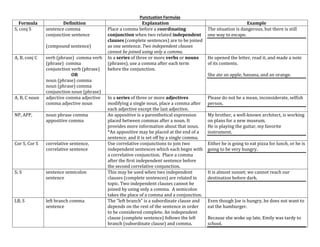
Formula Definition Explanation Example
S, conj S sentence comma
conjunction sentence
(compound sentence)
Place a comma before a coordinating
conjunction when two related independent
clauses (complete sentences) are to be joined
as one sentence. Two independent clauses
cannot be joined using only a comma.
The situation is dangerous, but there is still
one way to escape.
A, B, conj C verb (phrase) comma verb
(phrase) comma
conjunction verb (phrase)
OR
noun (phrase) comma
noun (phrase) comma
conjunction noun (phrase)
In a series of three or more verbs or nouns
(phrases), use a comma after each term
before the conjunction.
He opened the letter, read it, and made a note
of its contents.
She ate an apple, banana, and an orange.
A, B, C noun adjective comma adjective
comma adjective noun
In a series of three or more adjectives
modifying a single noun, place a comma after
each adjective except the last adjective.
Please do not be a mean, inconsiderate, selfish
person.
NP, APP, noun phrase comma
appositive comma
An appositive is a parenthetical expression
placed between commas after a noun. It
provides more information about that noun.
*An appositive may be placed at the end of a
sentence, and it is set off by a single comma.
My brother, a well-known architect, is working
on plans for a new museum.
He is playing the guitar, my favorite
instrument.
Cor S, Cor S correlative sentence,
correlative sentence
Use correlative conjunctions to join two
independent sentences which each begin with
a correlative conjunction. Place a comma
after the first independent sentence before
the second correlative conjunction.
Either he is going to eat pizza for lunch, or he is
going to be very hungry.
S; S sentence semicolon
sentence
This may be used when two independent
clauses (complete sentences) are related in
topic. Two independent clauses cannot be
joined by using only a comma. A semicolon
takes the place of a comma and a conjunction.
It is almost sunset; we cannot reach our
destination before dark.
LB, S left branch comma
sentence
The “left branch” is a subordinate clause and
depends on the rest of the sentence in order
to be considered complete. An independent
clause (complete sentence) follows the left
branch (subordinate clause) and comma.
Even though Joe is hungry, he does not want to
eat the hamburger.
Because she woke up late, Emily was tardy to
school.
Punctuation Formulas
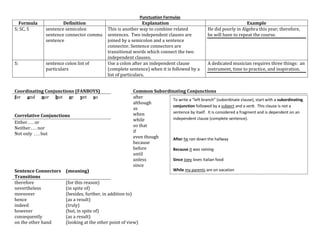
Formula Definition Explanation Example
S; SC, S sentence semicolon
sentence connector comma
sentence
This is another way to combine related
sentences. Two independent clauses are
joined by a semicolon and a sentence
connector. Sentence connectors are
transitional words which connect the two
independent clauses.
He did poorly in Algebra this year; therefore,
he will have to repeat the course.
S: sentence colon list of
particulars
Use a colon after an independent clause
(complete sentence) when it is followed by a
list of particulars.
A dedicated musician requires three things: an
instrument, time to practice, and inspiration.
Coordinating Conjunctions (FANBOYS) Common Subordinating Conjunctions
for and nor but or yet so after
although
as
when
while
so that
if
even though
because
before
until
unless
since
Correlative Conjunctions
Either . . . or
Neither . . . nor
Not only . . . but
Sentence Connectors
Transitions
(meaning)
therefore
nevertheless
moreover
hence
indeed
however
consequently
on the other hand
(for this reason)
(in spite of)
(besides, further, in addition to)
(as a result)
(truly)
(but, in spite of)
(as a result)
(looking at the other point of view)
To write a “left branch” (subordinate clause), start with a subordinating
conjunction followed by a subject and a verb. This clause is not a
sentence by itself. It is considered a fragment and is dependent on an
independent clause (complete sentence).
After he ran down the hallway
Because it was raining
Since Joey loves Italian food
While my parents are on vacation

Punctuation Formulas Grammar for High School

  • 1.
    Punctuation Formulas Formula DefinitionExplanation Example S, conj S sentence comma conjunction sentence (compound sentence) Place a comma before a coordinating conjunction when two related independent clauses (complete sentences) are to be joined as one sentence. Two independent clauses cannot be joined using only a comma. The situation is dangerous, but there is still one way to escape. A, B, conj C verb (phrase) comma verb (phrase) comma conjunction verb (phrase) OR noun (phrase) comma noun (phrase) comma conjunction noun (phrase) In a series of three or more verbs or nouns (phrases), use a comma after each term before the conjunction. He opened the letter, read it, and made a note of its contents. She ate an apple, banana, and an orange. A, B, C noun adjective comma adjective comma adjective noun In a series of three or more adjectives modifying a single noun, place a comma after each adjective except the last adjective. Please do not be a mean, inconsiderate, selfish person. NP, APP, noun phrase comma appositive comma An appositive is a parenthetical expression placed between commas after a noun. It provides more information about that noun. *An appositive may be placed at the end of a sentence, and it is set off by a single comma. My brother, a well-known architect, is working on plans for a new museum. He is playing the guitar, my favorite instrument. Cor S, Cor S correlative sentence, correlative sentence Use correlative conjunctions to join two independent sentences which each begin with a correlative conjunction. Place a comma after the first independent sentence before the second correlative conjunction. Either he is going to eat pizza for lunch, or he is going to be very hungry. S; S sentence semicolon sentence This may be used when two independent clauses (complete sentences) are related in topic. Two independent clauses cannot be joined by using only a comma. A semicolon takes the place of a comma and a conjunction. It is almost sunset; we cannot reach our destination before dark. LB, S left branch comma sentence The “left branch” is a subordinate clause and depends on the rest of the sentence in order to be considered complete. An independent clause (complete sentence) follows the left branch (subordinate clause) and comma. Even though Joe is hungry, he does not want to eat the hamburger. Because she woke up late, Emily was tardy to school.
  • 2.
    Punctuation Formulas Formula DefinitionExplanation Example S; SC, S sentence semicolon sentence connector comma sentence This is another way to combine related sentences. Two independent clauses are joined by a semicolon and a sentence connector. Sentence connectors are transitional words which connect the two independent clauses. He did poorly in Algebra this year; therefore, he will have to repeat the course. S: sentence colon list of particulars Use a colon after an independent clause (complete sentence) when it is followed by a list of particulars. A dedicated musician requires three things: an instrument, time to practice, and inspiration. Coordinating Conjunctions (FANBOYS) Common Subordinating Conjunctions for and nor but or yet so after although as when while so that if even though because before until unless since Correlative Conjunctions Either . . . or Neither . . . nor Not only . . . but Sentence Connectors Transitions (meaning) therefore nevertheless moreover hence indeed however consequently on the other hand (for this reason) (in spite of) (besides, further, in addition to) (as a result) (truly) (but, in spite of) (as a result) (looking at the other point of view) To write a “left branch” (subordinate clause), start with a subordinating conjunction followed by a subject and a verb. This clause is not a sentence by itself. It is considered a fragment and is dependent on an independent clause (complete sentence). After he ran down the hallway Because it was raining Since Joey loves Italian food While my parents are on vacation