WMP-125-1  Level sensing in harsh environments with guided-wave radar ABB Automation & Power World: April 18-21, 2011 © ABB Inc. May 31, 2011  | Slide
WMP-125-1   Level sensing in harsh environments with guided-wave radar Speaker name: Charles Richard Speaker title: Product Manager – Radar Products Company name: K-TEK, A Member of the ABB Group Location: Prairieville, LA  © ABB Inc.  May 31, 2011  | Slide
Level sensing in harsh environments with GWR Agenda Today’s common level measurement technologies Troublesome installation and applications  How guided-wave radar solves level problems Why GWR has better reliability Applications to avoid with GWR Conclusions © ABB Inc.  May 31, 2011  | Slide
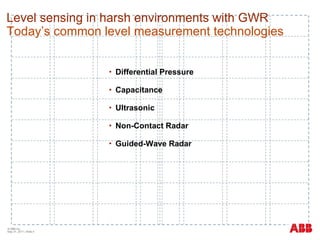
Differential Pressure Capacitance Ultrasonic Non-Contact Radar Guided-Wave Radar © ABB Inc.  May 31, 2011  | Slide  Level sensing in harsh environments with GWR Today’s common level measurement technologies
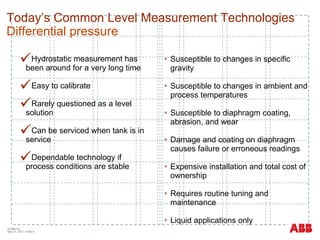
Hydrostatic measurement has been around for a very long time Easy to calibrate Rarely questioned as a level solution Can be serviced when tank is in service Dependable technology if process conditions are stable © ABB Inc.  May 31, 2011  | Slide  Today’s Common Level Measurement Technologies Differential pressure Susceptible to changes in specific gravity Susceptible to changes in ambient and process temperatures Susceptible to diaphragm coating, abrasion, and wear Damage and coating on diaphragm causes failure or erroneous readings Expensive installation and total cost of ownership Requires routine tuning and maintenance  Liquid applications only
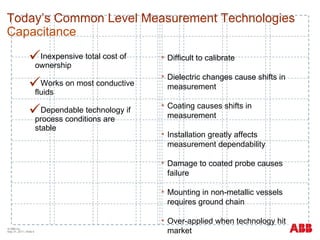
Inexpensive total cost of ownership Works on most conductive fluids Dependable technology if process conditions are stable © ABB Inc.  May 31, 2011  | Slide  Difficult to calibrate Dielectric changes cause shifts in measurement Coating causes shifts in measurement Installation greatly affects measurement dependability Damage to coated probe causes failure Mounting in non-metallic vessels requires ground chain Over-applied when technology hit market Today’s Common Level Measurement Technologies Capacitance
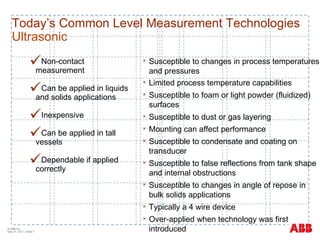
Non-contact measurement Can be applied in liquids and solids applications Inexpensive Can be applied in tall vessels Dependable if applied correctly © ABB Inc.  May 31, 2011  | Slide  Susceptible to changes in process temperatures and pressures Limited process temperature capabilities Susceptible to foam or light powder (fluidized) surfaces Susceptible to dust or gas layering Mounting can affect performance Susceptible to condensate and coating on transducer Susceptible to false reflections from tank shape and internal obstructions Susceptible to changes in angle of repose in bulk solids applications Typically a 4 wire device Over-applied when technology was first introduced Today’s Common Level Measurement Technologies Ultrasonic
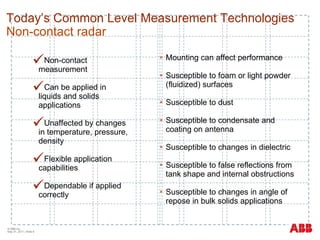
Non-contact measurement Can be applied in liquids and solids applications Unaffected by changes in temperature, pressure, density Flexible application capabilities Dependable if applied correctly © ABB Inc.  May 31, 2011  | Slide  Mounting can affect performance Susceptible to foam or light powder (fluidized) surfaces Susceptible to dust Susceptible to condensate and coating on antenna Susceptible to changes in dielectric Susceptible to false reflections from tank shape and internal obstructions Susceptible to changes in angle of repose in bulk solids applications Today’s Common Level Measurement Technologies Non-contact radar
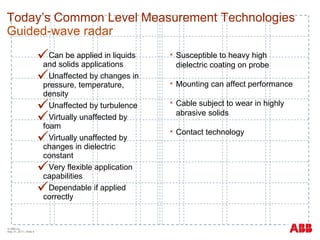
Can be applied in liquids and solids applications Unaffected by changes in pressure, temperature, density Unaffected by turbulence Virtually unaffected by foam Virtually unaffected by changes in dielectric constant Very flexible application capabilities Dependable if applied correctly © ABB Inc.  May 31, 2011  | Slide  Susceptible to heavy high dielectric coating on probe Mounting can affect performance Cable subject to wear in highly abrasive solids Contact technology Today’s Common Level Measurement Technologies Guided-wave radar
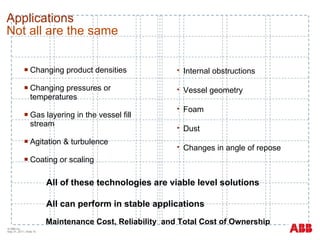
Applications Not all are the same Changing product densities Changing pressures or temperatures Gas layering in the vessel fill stream Agitation & turbulence Coating or scaling © ABB Inc.  May 31, 2011  | Slide  All of these technologies are viable level solutions All can perform in stable applications Internal obstructions Vessel geometry Foam Dust Changes in angle of repose Maintenance Cost, Reliability  and Total Cost of Ownership
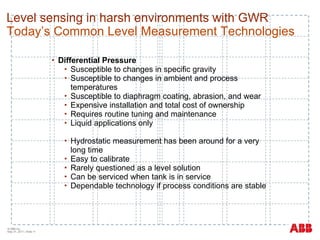
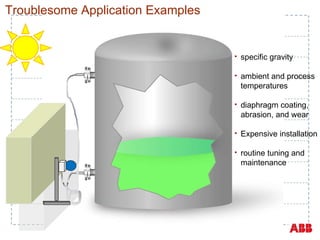
Differential Pressure Susceptible to changes in specific gravity Susceptible to changes in ambient and process temperatures Susceptible to diaphragm coating, abrasion, and wear Expensive installation and total cost of ownership Requires routine tuning and maintenance  Liquid applications only Hydrostatic measurement has been around for a very long time Easy to calibrate Rarely questioned as a level solution Can be serviced when tank is in service Dependable technology if process conditions are stable © ABB Inc.  May 31, 2011  | Slide  Level sensing in harsh environments with GWR Today’s Common Level Measurement Technologies
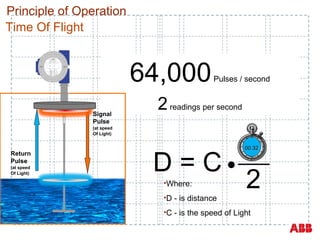
Principle of Operation Distance is determined by measuring the time it takes for a signal pulse to be emitted and received by the transmitter. 64,000  Pulses / second 2  readings per second Return Pulse (at speed Of Light) Signal Pulse (at speed Of Light) Time Of Flight  Where:  D - is distance  C - is the speed of Light 00.32 2 D = C
specific gravity ambient and process temperatures diaphragm coating, abrasion, and wear Expensive installation routine tuning and maintenance  Troublesome Application Examples
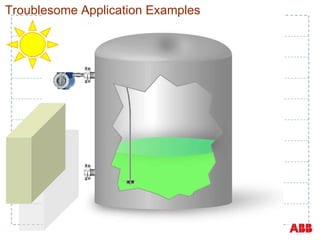
Troublesome Application Examples
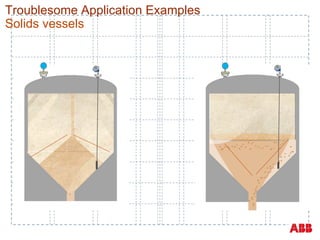
Troublesome Application Examples Solids vessels
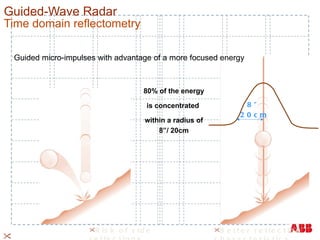
Guided-Wave Radar  Time domain reflectometry Slide  Guided micro-impulses with advantage of a more focused energy Better reflection characteristics Risk of side reflections 80% of the energy is concentrated  within a radius of 8”/ 20cm 8” 20cm
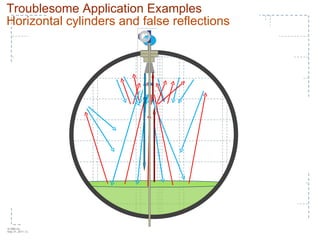
Troublesome Application Examples Horizontal cylinders and false reflections © ABB Inc.  May 31, 2011  | Slide
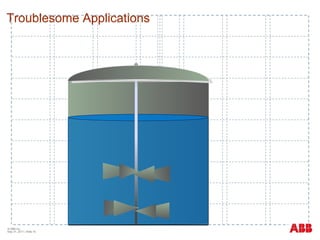
Troublesome Applications © ABB Inc.  May 31, 2011  | Slide
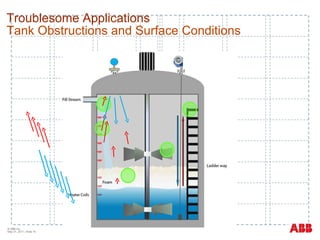
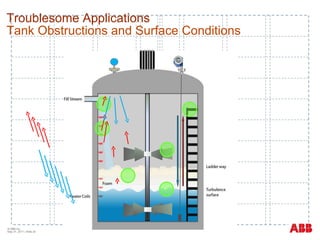
Troublesome Applications Tank Obstructions and Surface Conditions © ABB Inc.  May 31, 2011  | Slide
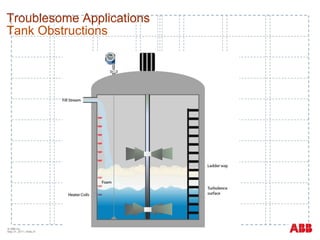
Troublesome Applications Tank Obstructions  © ABB Inc.  May 31, 2011  | Slide
© ABB Group  May 31, 2011  | Slide

Level sensing in harsh environments with GWR

  • 1.
    WMP-125-1 Levelsensing in harsh environments with guided-wave radar ABB Automation & Power World: April 18-21, 2011 © ABB Inc. May 31, 2011 | Slide
  • 2.
    WMP-125-1 Level sensing in harsh environments with guided-wave radar Speaker name: Charles Richard Speaker title: Product Manager – Radar Products Company name: K-TEK, A Member of the ABB Group Location: Prairieville, LA © ABB Inc. May 31, 2011 | Slide
  • 3.
    Level sensing inharsh environments with GWR Agenda Today’s common level measurement technologies Troublesome installation and applications How guided-wave radar solves level problems Why GWR has better reliability Applications to avoid with GWR Conclusions © ABB Inc. May 31, 2011 | Slide
  • 4.
    Differential Pressure CapacitanceUltrasonic Non-Contact Radar Guided-Wave Radar © ABB Inc. May 31, 2011 | Slide Level sensing in harsh environments with GWR Today’s common level measurement technologies
  • 5.
    Hydrostatic measurement hasbeen around for a very long time Easy to calibrate Rarely questioned as a level solution Can be serviced when tank is in service Dependable technology if process conditions are stable © ABB Inc. May 31, 2011 | Slide Today’s Common Level Measurement Technologies Differential pressure Susceptible to changes in specific gravity Susceptible to changes in ambient and process temperatures Susceptible to diaphragm coating, abrasion, and wear Damage and coating on diaphragm causes failure or erroneous readings Expensive installation and total cost of ownership Requires routine tuning and maintenance Liquid applications only
  • 6.
    Inexpensive total costof ownership Works on most conductive fluids Dependable technology if process conditions are stable © ABB Inc. May 31, 2011 | Slide Difficult to calibrate Dielectric changes cause shifts in measurement Coating causes shifts in measurement Installation greatly affects measurement dependability Damage to coated probe causes failure Mounting in non-metallic vessels requires ground chain Over-applied when technology hit market Today’s Common Level Measurement Technologies Capacitance
  • 7.
    Non-contact measurement Canbe applied in liquids and solids applications Inexpensive Can be applied in tall vessels Dependable if applied correctly © ABB Inc. May 31, 2011 | Slide Susceptible to changes in process temperatures and pressures Limited process temperature capabilities Susceptible to foam or light powder (fluidized) surfaces Susceptible to dust or gas layering Mounting can affect performance Susceptible to condensate and coating on transducer Susceptible to false reflections from tank shape and internal obstructions Susceptible to changes in angle of repose in bulk solids applications Typically a 4 wire device Over-applied when technology was first introduced Today’s Common Level Measurement Technologies Ultrasonic
  • 8.
    Non-contact measurement Canbe applied in liquids and solids applications Unaffected by changes in temperature, pressure, density Flexible application capabilities Dependable if applied correctly © ABB Inc. May 31, 2011 | Slide Mounting can affect performance Susceptible to foam or light powder (fluidized) surfaces Susceptible to dust Susceptible to condensate and coating on antenna Susceptible to changes in dielectric Susceptible to false reflections from tank shape and internal obstructions Susceptible to changes in angle of repose in bulk solids applications Today’s Common Level Measurement Technologies Non-contact radar
  • 9.
    Can be appliedin liquids and solids applications Unaffected by changes in pressure, temperature, density Unaffected by turbulence Virtually unaffected by foam Virtually unaffected by changes in dielectric constant Very flexible application capabilities Dependable if applied correctly © ABB Inc. May 31, 2011 | Slide Susceptible to heavy high dielectric coating on probe Mounting can affect performance Cable subject to wear in highly abrasive solids Contact technology Today’s Common Level Measurement Technologies Guided-wave radar
  • 10.
    Applications Not allare the same Changing product densities Changing pressures or temperatures Gas layering in the vessel fill stream Agitation & turbulence Coating or scaling © ABB Inc. May 31, 2011 | Slide All of these technologies are viable level solutions All can perform in stable applications Internal obstructions Vessel geometry Foam Dust Changes in angle of repose Maintenance Cost, Reliability and Total Cost of Ownership
  • 11.
    Differential Pressure Susceptibleto changes in specific gravity Susceptible to changes in ambient and process temperatures Susceptible to diaphragm coating, abrasion, and wear Expensive installation and total cost of ownership Requires routine tuning and maintenance Liquid applications only Hydrostatic measurement has been around for a very long time Easy to calibrate Rarely questioned as a level solution Can be serviced when tank is in service Dependable technology if process conditions are stable © ABB Inc. May 31, 2011 | Slide Level sensing in harsh environments with GWR Today’s Common Level Measurement Technologies
  • 12.
    Principle of OperationDistance is determined by measuring the time it takes for a signal pulse to be emitted and received by the transmitter. 64,000 Pulses / second 2 readings per second Return Pulse (at speed Of Light) Signal Pulse (at speed Of Light) Time Of Flight Where: D - is distance C - is the speed of Light 00.32 2 D = C
  • 13.
    specific gravity ambientand process temperatures diaphragm coating, abrasion, and wear Expensive installation routine tuning and maintenance Troublesome Application Examples
  • 14.
  • 15.
  • 16.
    Guided-Wave Radar Time domain reflectometry Slide Guided micro-impulses with advantage of a more focused energy Better reflection characteristics Risk of side reflections 80% of the energy is concentrated within a radius of 8”/ 20cm 8” 20cm
  • 17.
    Troublesome Application ExamplesHorizontal cylinders and false reflections © ABB Inc. May 31, 2011 | Slide
  • 18.
    Troublesome Applications ©ABB Inc. May 31, 2011 | Slide
  • 19.
    Troublesome Applications TankObstructions and Surface Conditions © ABB Inc. May 31, 2011 | Slide
  • 20.
    Troublesome Applications TankObstructions and Surface Conditions © ABB Inc. May 31, 2011 | Slide
  • 21.
    Troublesome Applications TankObstructions © ABB Inc. May 31, 2011 | Slide
  • 22.
    © ABB Group May 31, 2011 | Slide