MAKE IN INDIA : OPPORTUNITIES AND CHALLENGE IN
PUBLIC SECTOR AND PRIVATE SECTOR
Marutha muthukumar. M
Introduction
A type of Swadeshi movement covering 25 sectors of economy was
launched by the Government of India. As per the current policy, 100% FDI is permitted in
all the 25 sectors, Make-in-India Special Finance Facility" fund.
In other important Government of India schemes, such as Bharat
mala, Sager mala, Dedicated Freight Corridors, Industrial corridors, UDAN-RCS, Bharat
Net and Digital India.
Public Sector
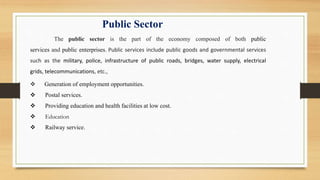
The public sector is the part of the economy composed of both public
services and public enterprises. Public services include public goods and governmental services
such as the military, police, infrastructure of public roads, bridges, water supply, electrical
grids, telecommunications, etc.,
 Generation of employment opportunities.
 Postal services.
 Providing education and health facilities at low cost.
 Education
 Railway service.
Public sector
Statutory corporation
Government
Companies
Departmental
undertakings
Private Sector
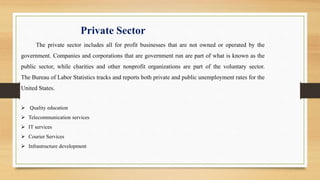
The private sector includes all for profit businesses that are not owned or operated by the
government. Companies and corporations that are government run are part of what is known as the
public sector, while charities and other nonprofit organizations are part of the voluntary sector.
The Bureau of Labor Statistics tracks and reports both private and public unemployment rates for the
United States.
 Quality education
 Telecommunication services
 IT services
 Courier Services
 Infrastructure development
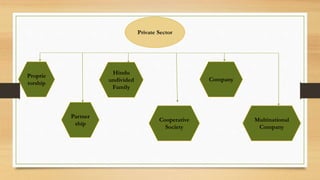
Private Sector
Proprie
torship
Partner
ship
Hindu
undivided
Family
Cooperative
Society
Company
Multinational
Company
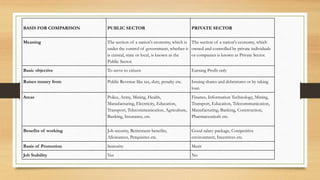
BASIS FOR COMPARISON PUBLIC SECTOR PRIVATE SECTOR
Meaning The section of a nation's economy, which is
under the control of government, whether it
is central, state or local, is known as the
Public Sector.
The section of a nation's economy, which
owned and controlled by private individuals
or companies is known as Private Sector.
Basic objective To serve to citizen Earning Profit only
Raises money from Public Revenue like tax, duty, penalty etc. Issuing shares and debentures or by taking
loan
Areas Police, Army, Mining, Health,
Manufacturing, Electricity, Education,
Transport, Telecommunication, Agriculture,
Banking, Insurance, etc.
Finance, Information Technology, Mining,
Transport, Education, Telecommunication,
Manufacturing, Banking, Construction,
Pharmaceuticals etc.
Benefits of working Job security, Retirement benefits,
Allowances, Perquisites etc.
Good salary package, Competitive
environment, Incentives etc.
Basis of Promotion Seniority Merit
Job Stability Yes No
Differences Between Public Sector and Private Sector
 Public Sector is a part of the country’s economy where the control and maintenance are in the hands
of Government.
 The aim of the public sector is to serve people, but private sector enterprises are established with the
profit motive.
 In the public sector, the government has full control over the organizations. Conversely, Private Sector
companies enjoy less government interference.
 The employees of the public sector have the security of the job along with that they are given the
benefits of allowances, perquisites, and retirement like gratuity, pension, superannuation fund, etc.
which are absent in the case of the private sector.
Public and Private Sector Challenges
 Improve governance.
 Raise educational achievement.
 Increase quality and quantity of universities.
 Introduce a credible fiscal policy.
 Liberalize financial markets.
 Increase trade with neighbors.
 Increase agricultural productivity.
 Improve infrastructure.
 Improve environmental quality.
 Control inflation.
Conclusion
Nowadays, Private Sector is progressing faster because promotes quality, not
quantity; it encourages talent.
Public Sector is full of reservations like reservations for minority section,
females, a person with a disability and much more, here nobody sees talent, it is
completely ignored and because of this, competent youths remain unemployed.
Conclusion
THANK YOU

Mmk

  • 1.
    MAKE IN INDIA: OPPORTUNITIES AND CHALLENGE IN PUBLIC SECTOR AND PRIVATE SECTOR Marutha muthukumar. M
  • 2.
    Introduction A type ofSwadeshi movement covering 25 sectors of economy was launched by the Government of India. As per the current policy, 100% FDI is permitted in all the 25 sectors, Make-in-India Special Finance Facility" fund. In other important Government of India schemes, such as Bharat mala, Sager mala, Dedicated Freight Corridors, Industrial corridors, UDAN-RCS, Bharat Net and Digital India.
  • 3.
    Public Sector The publicsector is the part of the economy composed of both public services and public enterprises. Public services include public goods and governmental services such as the military, police, infrastructure of public roads, bridges, water supply, electrical grids, telecommunications, etc.,  Generation of employment opportunities.  Postal services.  Providing education and health facilities at low cost.  Education  Railway service.
  • 4.
  • 5.
    Private Sector The privatesector includes all for profit businesses that are not owned or operated by the government. Companies and corporations that are government run are part of what is known as the public sector, while charities and other nonprofit organizations are part of the voluntary sector. The Bureau of Labor Statistics tracks and reports both private and public unemployment rates for the United States.  Quality education  Telecommunication services  IT services  Courier Services  Infrastructure development
  • 6.
  • 7.
    BASIS FOR COMPARISONPUBLIC SECTOR PRIVATE SECTOR Meaning The section of a nation's economy, which is under the control of government, whether it is central, state or local, is known as the Public Sector. The section of a nation's economy, which owned and controlled by private individuals or companies is known as Private Sector. Basic objective To serve to citizen Earning Profit only Raises money from Public Revenue like tax, duty, penalty etc. Issuing shares and debentures or by taking loan Areas Police, Army, Mining, Health, Manufacturing, Electricity, Education, Transport, Telecommunication, Agriculture, Banking, Insurance, etc. Finance, Information Technology, Mining, Transport, Education, Telecommunication, Manufacturing, Banking, Construction, Pharmaceuticals etc. Benefits of working Job security, Retirement benefits, Allowances, Perquisites etc. Good salary package, Competitive environment, Incentives etc. Basis of Promotion Seniority Merit Job Stability Yes No
  • 8.
    Differences Between PublicSector and Private Sector  Public Sector is a part of the country’s economy where the control and maintenance are in the hands of Government.  The aim of the public sector is to serve people, but private sector enterprises are established with the profit motive.  In the public sector, the government has full control over the organizations. Conversely, Private Sector companies enjoy less government interference.  The employees of the public sector have the security of the job along with that they are given the benefits of allowances, perquisites, and retirement like gratuity, pension, superannuation fund, etc. which are absent in the case of the private sector.
  • 9.
    Public and PrivateSector Challenges  Improve governance.  Raise educational achievement.  Increase quality and quantity of universities.  Introduce a credible fiscal policy.  Liberalize financial markets.  Increase trade with neighbors.  Increase agricultural productivity.  Improve infrastructure.  Improve environmental quality.  Control inflation.
  • 10.
    Conclusion Nowadays, Private Sectoris progressing faster because promotes quality, not quantity; it encourages talent. Public Sector is full of reservations like reservations for minority section, females, a person with a disability and much more, here nobody sees talent, it is completely ignored and because of this, competent youths remain unemployed. Conclusion
  • 11.