Alan Gershenfeld President, E-Line Media Chairman, Games For Change Former SVP, Activision Studios Public-Interest Computer and Video Games March, 2010
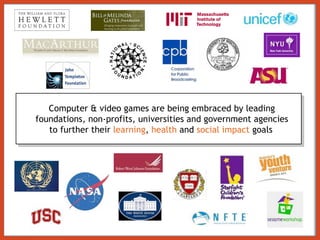
Computer & video games are being embraced by leading foundations, non-profits, universities and government agencies to further their  learning ,  health  and  social impact  goals
Top  10  reasons why  games  are a powerful platform for  highly engaged  learning ,  health  and  social  impact.
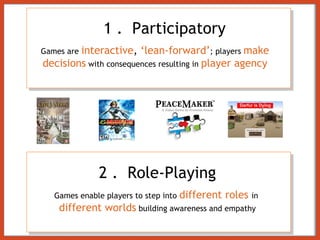
1 .   Participatory Games are  interactive ,  ‘lean-forward’ ; players  make decisions   with consequences resulting in  player agency 2 .   Role-Playing Games enable players to step into  different roles  in  different worlds   building awareness and empathy
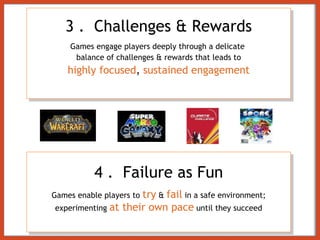
3 .   Challenges & Rewards Games engage players deeply through a delicate  balance of challenges & rewards that leads to highly focused ,  sustained engagement 4 .   Failure as Fun Games enable players to   try   &  fail  in a safe environment; experimenting  at their own pace  until they succeed
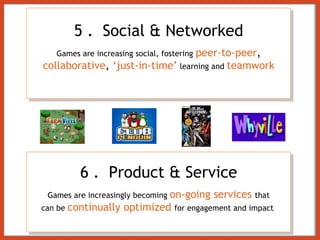
5 .   Social & Networked Games are increasing social, fostering   peer-to-peer ,  collaborative ,  ‘just-in-time’   learning and  teamwork 6 .   Product & Service Games are increasingly becoming  on-going services  that can be  continually optimized  for engagement and impact
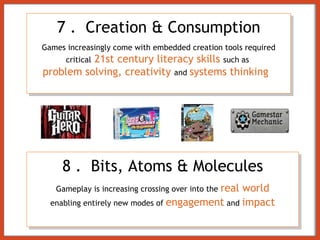
8 .   Bits, Atoms & Molecules Gameplay is increasing crossing over into the  real world enabling entirely new modes of  engagement  and  impact 7 .   Creation & Consumption Games increasingly come with embedded creation tools required critical   21st century literacy skills  such as  problem solving, creativity  and  systems thinking
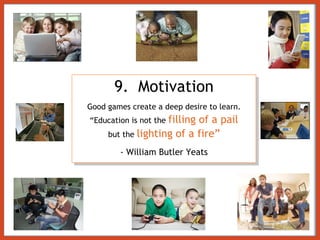
9.   Motivation Good games create a deep desire to learn. “ Education is not the  filling of a pail but the  lighting of a fire” - William Butler Yeats
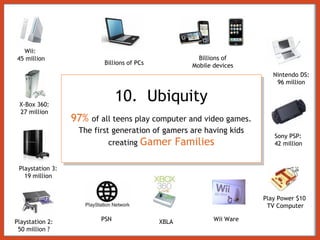
10.   Ubiquity 97%  of all teens play computer and video games. The first generation of  gamers  are having kids creating  Gamer Families Wii:  45 million  X-Box 360: 27 million Playstation 3: 19 million Wii Ware XBLA  PSN Nintendo DS: 96 million Sony PSP: 42 million Playstation 2: 50 million ? Play Power $10  TV Computer Billions of Mobile devices Billions of PCs Talkers and Doers
8  steps to understanding how to make  games  that have meaningful  learning, heath  and  social  impact
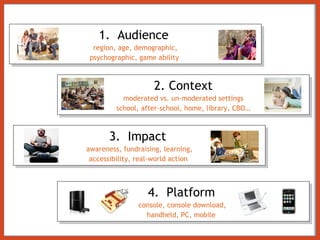
1.  Audience   region, age, demographic, psychographic, game ability  3.  Impact   awareness, fundraising, learning, accessibility, real-world action  4.  Platform  console, console download,  handheld, PC, mobile  2. Context moderated vs. un-moderated settings school, after-school, home, library, CBO…
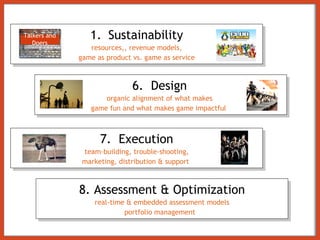
7.  Execution team-building, trouble-shooting, marketing, distribution & support  6.  Design   organic alignment of what makes  game fun and what makes game impactful  Sustainability resources,, revenue models, game as product vs. game as service 8. Assessment & Optimization real-time & embedded assessment models portfolio management  Talkers and Doers
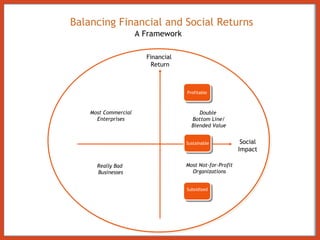
Balancing Financial and Social Returns A Framework Most Not-for-Profit Organizations Most Commercial Enterprises Really Bad  Businesses Profitable Social Impact Impact  First Fund Subsidized Sustainable Double  Bottom Line/ Blended Value Financial  Return
contact Alan Gershenfeld E-Line Ventures 363 Seventh Avenue, 20th Floor New York, NY 10001 [email_address]

Public Interest Gaming by Alan Gershenfeld

  • 1.
    Alan Gershenfeld President,E-Line Media Chairman, Games For Change Former SVP, Activision Studios Public-Interest Computer and Video Games March, 2010
  • 2.
    Computer & videogames are being embraced by leading foundations, non-profits, universities and government agencies to further their learning , health and social impact goals
  • 3.
    Top 10 reasons why games are a powerful platform for highly engaged learning , health and social impact.
  • 4.
    1 . Participatory Games are interactive , ‘lean-forward’ ; players make decisions with consequences resulting in player agency 2 . Role-Playing Games enable players to step into different roles in different worlds building awareness and empathy
  • 5.
    3 . Challenges & Rewards Games engage players deeply through a delicate balance of challenges & rewards that leads to highly focused , sustained engagement 4 . Failure as Fun Games enable players to try & fail in a safe environment; experimenting at their own pace until they succeed
  • 6.
    5 . Social & Networked Games are increasing social, fostering peer-to-peer , collaborative , ‘just-in-time’ learning and teamwork 6 . Product & Service Games are increasingly becoming on-going services that can be continually optimized for engagement and impact
  • 7.
    8 . Bits, Atoms & Molecules Gameplay is increasing crossing over into the real world enabling entirely new modes of engagement and impact 7 . Creation & Consumption Games increasingly come with embedded creation tools required critical 21st century literacy skills such as problem solving, creativity and systems thinking
  • 8.
    9. Motivation Good games create a deep desire to learn. “ Education is not the filling of a pail but the lighting of a fire” - William Butler Yeats
  • 9.
    10. Ubiquity 97% of all teens play computer and video games. The first generation of gamers are having kids creating Gamer Families Wii: 45 million X-Box 360: 27 million Playstation 3: 19 million Wii Ware XBLA PSN Nintendo DS: 96 million Sony PSP: 42 million Playstation 2: 50 million ? Play Power $10 TV Computer Billions of Mobile devices Billions of PCs Talkers and Doers
  • 10.
    8 stepsto understanding how to make games that have meaningful learning, heath and social impact
  • 11.
    1. Audience region, age, demographic, psychographic, game ability 3. Impact awareness, fundraising, learning, accessibility, real-world action 4. Platform console, console download, handheld, PC, mobile 2. Context moderated vs. un-moderated settings school, after-school, home, library, CBO…
  • 12.
    7. Executionteam-building, trouble-shooting, marketing, distribution & support 6. Design organic alignment of what makes game fun and what makes game impactful Sustainability resources,, revenue models, game as product vs. game as service 8. Assessment & Optimization real-time & embedded assessment models portfolio management Talkers and Doers
  • 13.
    Balancing Financial andSocial Returns A Framework Most Not-for-Profit Organizations Most Commercial Enterprises Really Bad Businesses Profitable Social Impact Impact First Fund Subsidized Sustainable Double Bottom Line/ Blended Value Financial Return
  • 14.
    contact Alan GershenfeldE-Line Ventures 363 Seventh Avenue, 20th Floor New York, NY 10001 [email_address]