Biological Terrorism
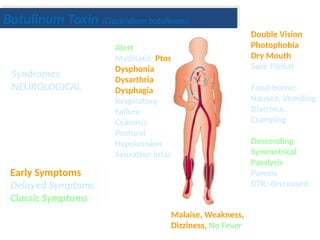
Syndromes
NEUROLOGICAL
Alert
Mydriasis, Ptosis
Dysphonia
Dysarthria
Dysphagia
Respiratory
Failure
Cyanosis
Postural
Hypotension
Sensation Intact
Double Vision
Photophobia
Dry Mouth
Sore Throat
Food-borne:
Nausea, Vomiting
Diarrhea,
Cramping
Descending
Symmetrical
Paralysis
Paresis
DTR: decreased
Malaise, Weakness,
Dizziness, No Fever
Early Symptoms
Delayed Symptoms
Classic Symptoms
Botulinum Toxin (Clostridium botulinum)
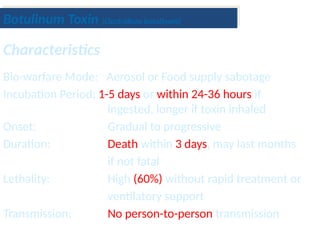
Characteristics
Bio-warfare Mode: Aerosol or Food supply sabotage
Incubation Period: 1-5 days or within 24-36 hours if
ingested, longer if toxin inhaled
Onset: Gradual to progressive
Duration: Death within 3 days, may last months
if not fatal
Lethality: High (60%) without rapid treatment or
ventilatory support
Transmission: No person-to-person transmission
TIMELINE
1820-Justinus Kerner, a small-town German medical officer and
romantic poet, gave the first complete description of clinical botulism
based on extensive clinical observations of so-called “sausage
poisoning
1875- Émile van Ermengem, professor of bacteriology and a student of
Robert Koch, correctly described Clostridium botulinum as the bacterial
source of the toxin.
World War II-weaponization of botulinum toxin was investigated at Fort
Detrick in Maryland. Carl Lamanna and James Duff[40]
developed the
concentration and crystallization techniques that Edward J. Schantz
used to create the first clinical product.
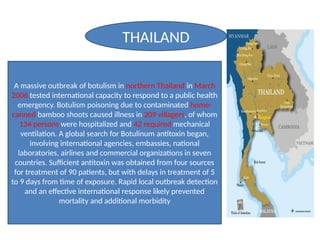
A massive outbreak of botulism in northern Thailand in March
2006 tested international capacity to respond to a public health
emergency. Botulism poisoning due to contaminated home-
canned bamboo shoots caused illness in 209 villagers, of whom
134 persons were hospitalized and 42 required mechanical
ventilation. A global search for Botulinum antitoxin began,
involving international agencies, embassies, national
laboratories, airlines and commercial organizations in seven
countries. Sufficient antitoxin was obtained from four sources
for treatment of 90 patients, but with delays in treatment of 5
to 9 days from time of exposure. Rapid local outbreak detection
and an effective international response likely prevented
mortality and additional morbidity
THAILAND
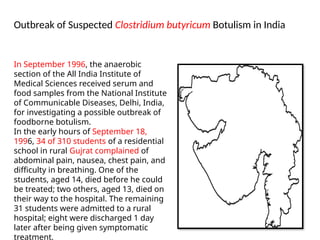
Outbreak of Suspected Clostridium butyricum Botulism in India
In September 1996, the anaerobic
section of the All India Institute of
Medical Sciences received serum and
food samples from the National Institute
of Communicable Diseases, Delhi, India,
for investigating a possible outbreak of
foodborne botulism.
In the early hours of September 18,
1996, 34 of 310 students of a residential
school in rural Gujrat complained of
abdominal pain, nausea, chest pain, and
difficulty in breathing. One of the
students, aged 14, died before he could
be treated; two others, aged 13, died on
their way to the hospital. The remaining
31 students were admitted to a rural
hospital; eight were discharged 1 day
later after being given symptomatic
treatment,
Samples: (G.I.) Toxin in serum, stool,
gastric aspirate or incriminated
food
(Wound) Toxin in serum or
culture
Differential: Myasthenia Gravis, Guillain-Barre,
Eaton-Lambert, Tick Paralysis, Stroke,
Organophosphate Poisoning,
Atropine Poisoning, Polio,
Mushroom Poisoning
Diagnosis
Botulinum Toxin (Clostridium botulinum)
Therapy
1. Trivalent (A, B, E) Antitoxin* (Equine: Skin Test)
*ONLY available from CDC through New Jersey
Department of Health and Senior Services
Isolation/Decon Precautions
1. Victim: Undress, soap/shower
2. Responder: no decon necessary
3. Environment: Normal housekeeping. Use EPA
registered low-intermediate
disinfectants. Gross contamination
bleach solution as specific for anthrax
Botulinum Toxin (Clostridium botulinum)
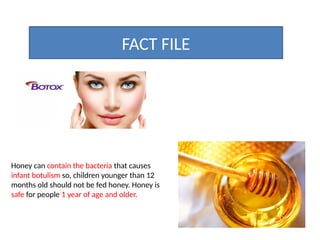
FACT FILE
Honey can contain the bacteria that causes
infant botulism so, children younger than 12
months old should not be fed honey. Honey is
safe for people 1 year of age and older.
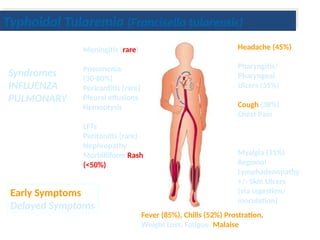
Typhoidal Tularemia (Francisella tularensis)
Syndromes
INFLUENZA
PULMONARY
Meningitis (rare)
Pneumonia
(30-80%)
Pericarditis (rare)
Pleural effusions
Hemoptysis
LFTs
Peritonitis (rare)
Nephropathy
Morbilliform Rash
(<50%)
Headache (45%)
Pharyngitis/
Pharyngeal
Ulcers (35%)
Cough (38%)
Chest Pain
Myalgia (31%)
Regional
Lymphadenopathy
+/- Skin Ulcers
(via ingestion/
inoculation)
Fever (85%), Chills (52%) Prostration,
Weight Loss, Fatigue, Malaise
Early Symptoms
Delayed Symptoms
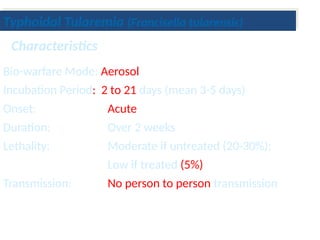
Bio-warfare Mode: Aerosol
Incubation Period: 2 to 21 days (mean 3-5 days)
Onset: Acute
Duration: Over 2 weeks
Lethality: Moderate if untreated (20-30%);
Low if treated (5%)
Transmission: No person to person transmission
Characteristics
Typhoidal Tularemia (Francisella tularensis)
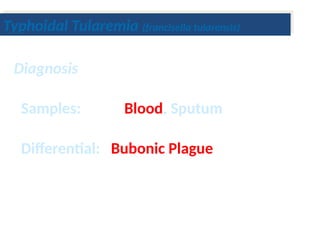
Diagnosis
Samples: Blood, Sputum
Differential: Bubonic Plague
Typhoidal Tularemia (francisella tularensis)
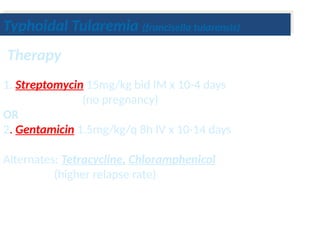
1. Streptomycin 15mg/kg bid IM x 10-4 days
(no pregnancy)
OR
2. Gentamicin 1.5mg/kg/q 8h IV x 10-14 days
Alternates: Tetracycline, Chloramphenicol
(higher relapse rate)
Therapy
Typhoidal Tularemia (francisella tularensis)
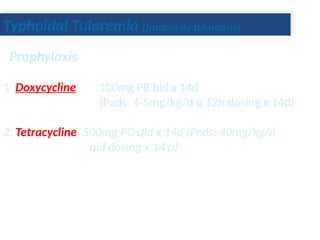
1. Doxycycline 100mg PB bid x 14d
(Peds: 4-5mg/kg/d q 12h dosing x 14d)
2. Tetracycline 500mg PO qid x 14d (Peds: 40mg/kg/d
qid dosing x 14 d)
Prophylaxis
Typhoidal Tularemia (francisella tularensis)
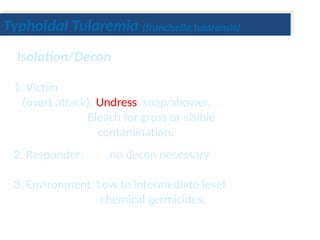
1. Victim
(overt attack): Undress, soap/shower.
Bleach for gross or visible
contamination.
2. Responder: no decon necessary
3. Environment: Low to intermediate level
chemical germicides.
Isolation/Decon
Typhoidal Tularemia (francisella tularensis)
Reminders
• Be alert and informed
• Practice Hand washing
• Administer Flu Vaccine
Do Not
•Act on rumor
•Give antibiotics on demand -
without medical indication
•Order nasal cultures -
without medical indication

barath.pptx zoonotic pathogens and control

  • 1.
  • 2.
    Syndromes NEUROLOGICAL Alert Mydriasis, Ptosis Dysphonia Dysarthria Dysphagia Respiratory Failure Cyanosis Postural Hypotension Sensation Intact DoubleVision Photophobia Dry Mouth Sore Throat Food-borne: Nausea, Vomiting Diarrhea, Cramping Descending Symmetrical Paralysis Paresis DTR: decreased Malaise, Weakness, Dizziness, No Fever Early Symptoms Delayed Symptoms Classic Symptoms Botulinum Toxin (Clostridium botulinum)
  • 3.
    Botulinum Toxin (Clostridiumbotulinum) Characteristics Bio-warfare Mode: Aerosol or Food supply sabotage Incubation Period: 1-5 days or within 24-36 hours if ingested, longer if toxin inhaled Onset: Gradual to progressive Duration: Death within 3 days, may last months if not fatal Lethality: High (60%) without rapid treatment or ventilatory support Transmission: No person-to-person transmission
  • 4.
    TIMELINE 1820-Justinus Kerner, asmall-town German medical officer and romantic poet, gave the first complete description of clinical botulism based on extensive clinical observations of so-called “sausage poisoning 1875- Émile van Ermengem, professor of bacteriology and a student of Robert Koch, correctly described Clostridium botulinum as the bacterial source of the toxin. World War II-weaponization of botulinum toxin was investigated at Fort Detrick in Maryland. Carl Lamanna and James Duff[40] developed the concentration and crystallization techniques that Edward J. Schantz used to create the first clinical product.
  • 5.
    A massive outbreakof botulism in northern Thailand in March 2006 tested international capacity to respond to a public health emergency. Botulism poisoning due to contaminated home- canned bamboo shoots caused illness in 209 villagers, of whom 134 persons were hospitalized and 42 required mechanical ventilation. A global search for Botulinum antitoxin began, involving international agencies, embassies, national laboratories, airlines and commercial organizations in seven countries. Sufficient antitoxin was obtained from four sources for treatment of 90 patients, but with delays in treatment of 5 to 9 days from time of exposure. Rapid local outbreak detection and an effective international response likely prevented mortality and additional morbidity THAILAND
  • 6.
    Outbreak of SuspectedClostridium butyricum Botulism in India In September 1996, the anaerobic section of the All India Institute of Medical Sciences received serum and food samples from the National Institute of Communicable Diseases, Delhi, India, for investigating a possible outbreak of foodborne botulism. In the early hours of September 18, 1996, 34 of 310 students of a residential school in rural Gujrat complained of abdominal pain, nausea, chest pain, and difficulty in breathing. One of the students, aged 14, died before he could be treated; two others, aged 13, died on their way to the hospital. The remaining 31 students were admitted to a rural hospital; eight were discharged 1 day later after being given symptomatic treatment,
  • 7.
    Samples: (G.I.) Toxinin serum, stool, gastric aspirate or incriminated food (Wound) Toxin in serum or culture Differential: Myasthenia Gravis, Guillain-Barre, Eaton-Lambert, Tick Paralysis, Stroke, Organophosphate Poisoning, Atropine Poisoning, Polio, Mushroom Poisoning Diagnosis Botulinum Toxin (Clostridium botulinum)
  • 8.
    Botulinum Toxin (Clostridiumbotulinum) Therapy 1. Trivalent (A, B, E) Antitoxin* (Equine: Skin Test) *ONLY available from CDC through New Jersey Department of Health and Senior Services
  • 9.
    Isolation/Decon Precautions 1. Victim:Undress, soap/shower 2. Responder: no decon necessary 3. Environment: Normal housekeeping. Use EPA registered low-intermediate disinfectants. Gross contamination bleach solution as specific for anthrax Botulinum Toxin (Clostridium botulinum)
  • 10.
    FACT FILE Honey cancontain the bacteria that causes infant botulism so, children younger than 12 months old should not be fed honey. Honey is safe for people 1 year of age and older.
  • 11.
    Typhoidal Tularemia (Francisellatularensis) Syndromes INFLUENZA PULMONARY Meningitis (rare) Pneumonia (30-80%) Pericarditis (rare) Pleural effusions Hemoptysis LFTs Peritonitis (rare) Nephropathy Morbilliform Rash (<50%) Headache (45%) Pharyngitis/ Pharyngeal Ulcers (35%) Cough (38%) Chest Pain Myalgia (31%) Regional Lymphadenopathy +/- Skin Ulcers (via ingestion/ inoculation) Fever (85%), Chills (52%) Prostration, Weight Loss, Fatigue, Malaise Early Symptoms Delayed Symptoms
  • 12.
    Bio-warfare Mode: Aerosol IncubationPeriod: 2 to 21 days (mean 3-5 days) Onset: Acute Duration: Over 2 weeks Lethality: Moderate if untreated (20-30%); Low if treated (5%) Transmission: No person to person transmission Characteristics Typhoidal Tularemia (Francisella tularensis)
  • 13.
    Diagnosis Samples: Blood, Sputum Differential:Bubonic Plague Typhoidal Tularemia (francisella tularensis)
  • 14.
    1. Streptomycin 15mg/kgbid IM x 10-4 days (no pregnancy) OR 2. Gentamicin 1.5mg/kg/q 8h IV x 10-14 days Alternates: Tetracycline, Chloramphenicol (higher relapse rate) Therapy Typhoidal Tularemia (francisella tularensis)
  • 15.
    1. Doxycycline 100mgPB bid x 14d (Peds: 4-5mg/kg/d q 12h dosing x 14d) 2. Tetracycline 500mg PO qid x 14d (Peds: 40mg/kg/d qid dosing x 14 d) Prophylaxis Typhoidal Tularemia (francisella tularensis)
  • 16.
    1. Victim (overt attack):Undress, soap/shower. Bleach for gross or visible contamination. 2. Responder: no decon necessary 3. Environment: Low to intermediate level chemical germicides. Isolation/Decon Typhoidal Tularemia (francisella tularensis)
  • 17.
    Reminders • Be alertand informed • Practice Hand washing • Administer Flu Vaccine
  • 18.
    Do Not •Act onrumor •Give antibiotics on demand - without medical indication •Order nasal cultures - without medical indication

Editor's Notes

  • #10 Spread of toxin effects. The effect of botulinum toxin may affect areas away from the injection site and cause serious symptoms including: loss of strength and all-over muscle weakness, double vision, blurred vision and drooping eyelids, hoarseness or change or loss of voice, trouble saying words clearly, loss of bladder control, trouble breathing, trouble swallowing
  • #16 Check notes