Submitted by:
B.Nandini
WV/2021-25
1.)Airborne diseases– classification,
health hazard, prevention and control.
2.)Water- Sources,Contamination and
their prevention
Submitted to :
Dr.Beesam Srinu sir.
Dept.of Veterinary public
health and epidemiology
2.
Air borne diseases
Air borne diseases in humans and animals
occur mainly due to presence of
1. Particulate matter
2. Toxic chemicals
3. Infectious pathogens in Air
3.
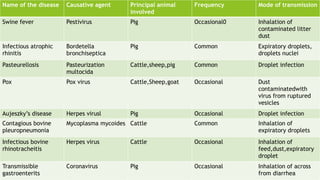
Name of thedisease Causative agent Principal animal
involved
Frequency Mode of transmission
Swine fever Pestivirus Pig Occasional0 Inhalation of
contaminated litter
dust
Infectious atrophic
rhinitis
Bordetella
bronchiseptica
Pig Common Expiratory droplets,
droplets nuclei
Pasteurellosis Pasteurization
multocida
Cattle,sheep,pig Common Droplet infection
Pox Pox virus Cattle,Sheep,goat Occasional Dust
contaminatedwith
virus from ruptured
vesicles
Aujeszky’s disease Herpes virusl Pig Occasional Droplet infection
Contagious bovine
pleuropneumonia
Mycoplasma mycoides Cattle Common Inhalation of
expiratory droplets
Infectious bovine
rhinotracheitis
Herpes virus Cattle Occasional Inhalation of
feed,dust,expiratory
droplet
Transmissible
gastroenterits
Coronavirus Pig Occasional Inhalation of across
from diarrhea
4.
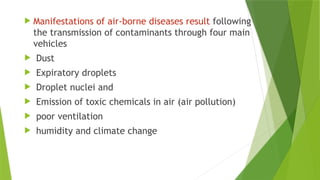
Manifestations ofair-borne diseases result following
the transmission of contaminants through four main
vehicles
Dust
Expiratory droplets
Droplet nuclei and
Emission of toxic chemicals in air (air pollution)
poor ventilation
humidity and climate change
5.
Dust
Dust refersto finely powdered solid particles formed during the
physical processes like grinding or crushing,abrading.
Dust particles larger than 10 u settle down rapidly while smaller
particles remain suspended in the air and are directly inhaled into
the lungs. This fraction of dust is called respirable dust.
This dust on account of its own physical and chemical attributes is
capable of causing a disease condition commonly known as
pneumoconiosis.
Depending upon the nature of the particles involved, the condition
resulting from the inhalation of dust may be classified as byssinosis,
anthracosis, silicosis or asbestosis.
6.
Drying up offluids such as discharge, urine and sputum also
results in the formation of dust.
Most dust-borne infectious agents result in local endemic
infections of the upper respiratory tract.
However the finer dust particles may enter deeper tissues of
the respiratory tractend may lead to generalised/systemic
disease.
Some of the diseases being transmitted through contaminated
dust are coccidiodomycosis, strepto- and staphylococcal
infections, pneumonia, tuberculosis, Q fever and psittacosis.
7.
Expiratory droplets
Expiratorydroplets are formed by the atomization of
fluids in the respiratory tract which are ejected
violently from the nostrils and mouth when the animal
or man coughs or sneezes.
The average size of the expiratory droplets is about 10
µ and they settle down very fast on the ground.
Diseases like influenza, atrophic rhinitis and
tuberculosis can be transmitted through expiratory
droplets.
8.
Droplet nuclei
Droplet nuclei are basically derived from the expiratory
droplets. The expiratory droplet contains water along with a
certain amount of solid particles, which could be some
proteinaceous matter harbouring an infectious agent.
When water in the expiratory droplets evaporates before
settling on the ground, the remaining portion remains
suspended in the air as droplet nuclei.
The size of the droplet nuclei ranges between 1 µ to 10 µ.
Some of the diseases spread by droplet nuclei include
tuberculosis, influenza, measles, Q fever, psittacosis and
brucellosis.
9.
Chemical pollutants inair
Contamination of air by various toxic chemicals being spewed
in the atmosphere has been a cause of serious disease
problems.
Studies have shown that a direct (positive) correlation exists
between an increased air pollution and enhanced human and
animal morbidity and mortality.
Diseases like chronic bronchitis (asthma) and primary lung
cancer have been attributed to an increasing incidence of air
pollution.
Lead (toxicity) is the most common air-borne chemical
hazard.
The greatest lead polluter in the air is petroleum.
10.
Health hazard ofair-borne diseases
The hazardous effects of dust depend on a
number of factors:
1. Size of the dust particles: Large sized dust particles are
trapped in the upper respiratory tract but smaller particles
escape these entrapments to reach lung alveoli or bronchioles.
2. Chemical composition: The dust formed of toxic chemicals is
more hazardous than the inert ones.
3. Concentration: The concentration of dust is positively
correlated to its deleterious effects on health.
11.
4. “Period ofexposure: The longer the period of
exposure to dust the greater is its detrimental
effect.
5.Health status: Healthy individuals are more
resistant to the ill effects of dust than the
individuals with poor health status.
12.
Occupation diseases causedby dust particles
1. Silicosis: It is caused by dust containing free silica or silicon-dioxide.
It is seen commonly in the workers employed in various mines, viz. Coal, mica,
gold, silver, zinc and manganese mines and in industries like pottery and
ceramics, construction work, sand blasting, metal grinding, rock mining, etc.
Particles between 0.5 to 3.0 µ are the most dangerous as they reach the
interior of the lung. The initial symptoms are, irritating cough, dyspnoea and
pain in the chest. Chronic exposure results in impairment of the total lung
capacity due to fibrosis.
2. Asbestosis:
Asbestosis a silicate, is highly resistant to heat and moisture making it a deadly
hazard.
The dust deposited in the lungs causes pulmonary fibrosis leading to respiratory
insufficiency and death. In most severe cases it causes cancer of bronchi and
gastrointestinal tract.
13.
3. Byssinosis:Byssinosis is caused by the inhalation of cotton dust for
a long duration..
The workers start wheezing and coughing soon after they start work.
These symptoms wear off gradually as the day goes on due to
acclimatisation. The disease is progressive in nature and in due course of
time it causes permanent breathlessnes.
4. Anthracosis:
Anthracosis is caused by the constant inhalation of coal dust which results
in its accumulation in the lungs giving the disease the name, black lungs.
In addition to respiratory problems, anthracosis predisposes a person to an
array of infectious diseases like tuberculosis. Further exposure to coal dust
may result in massive fibrosis of the lungs resulting in severe respiratory
disability and premature death.
5. Bagassosis:
Bagassosis is the name given to the occupational disease of the lung caused
by inhalation of bagasse or sugar cane dust. It is caused due to fungus
Actinomycete and the symptoms consist of breathlessness, cough,
haemoptysis and slight fever.
14.
Prevention and control
##Biosecurity Measures
1. Quarantine and isolation:
Separate infected animals to prevent disease spread.
2. Vaccination: Vaccinate animals against airborne
diseases, such as canine distemper or feline
calicivirus.
3 . Sanitation and hygiene:
Regularly clean and disinfect animal enclosures and
equipment.
15.
# Environmental Controls
1.Ventilation: Provide adequate ventilation to reduce
airborne pathogen concentrations.
2. Air filtration: Use air filtration
systems to remove airborne pathogens.
3. Temperature and humidity
Maintain optimal temperature and humidity levels to
reduce pathogen survival.
16.
# Animal Management
1.Reduce animal density: Avoid overcrowding to reduce
disease transmission.
2. Monitor animal health: Regularly monitor animals for signs
of illness.
3. Provide stress-free environment:
Minimize stress, which can increase susceptibility to disease.
#Testing and Diagnosis
1. Regular testing: Regularly test animals for airborne
diseases.
2. Accurate diagnosis: Accurately diagnose airborne diseases
to inform treatment and control measures.
17.
Importance
1. Animal health:Preventing and controlling
airborne diseases is crucial for animal health and
welfare.
2. Public health: Some airborne diseases can be
transmitted to humans, making prevention and
control important for public health.
3. Economic benefits: Preventing and
controlling airborne diseases can reduce
economic losses in animal agriculture and
related industries.
18.
Water
Water is indispensableto support life & to help in
productive processes of animals
Water is needed for various operations & to maintain
cleanliness of animals and their habitations
Also used for cleaning various utensils
Lack of knowledge on the quality of water & it’s sources
will bring down the efficiency of farm management
leading to general breakdown in health and production of
animals
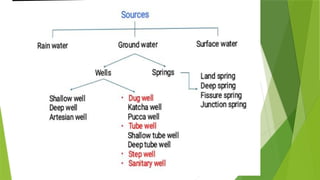
Sources of water💦
NaturalSources
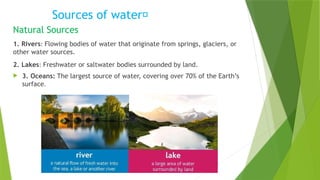
1. Rivers: Flowing bodies of water that originate from springs, glaciers, or
other water sources.
2. Lakes: Freshwater or saltwater bodies surrounded by land.
3. Oceans: The largest source of water, covering over 70% of the Earth’s
surface.
21.
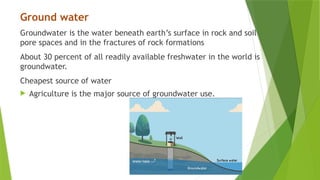
Ground water
Groundwater isthe water beneath earth’s surface in rock and soil
pore spaces and in the fractures of rock formations
About 30 percent of all readily available freshwater in the world is
groundwater.
Cheapest source of water
Agriculture is the major source of groundwater use.
22.
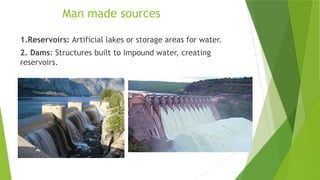
Man made sources
1.Reservoirs:Artificial lakes or storage areas for water.
2. Dams: Structures built to impound water, creating
reservoirs.
23.
Other sources
Rain water
Rainis water droplets that have condensed from atmospheric water vapour
and then fall under gravity
Rain is a major component of the water cycle and is responsible for
depositing most of the fresh water on the Earth.
It provides water for hydroelectric power plants, crop irrigation, and
suitable conditions for many types of ecosystems
The amount of rain water depends upon the rainfall and distribution of
rain over a period in particular region
24.
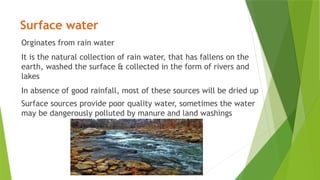
Surface water
Orginates fromrain water
It is the natural collection of rain water, that has fallens on the
earth, washed the surface & collected in the form of rivers and
lakes
In absence of good rainfall, most of these sources will be dried up
Surface sources provide poor quality water, sometimes the water
may be dangerously polluted by manure and land washings
25.
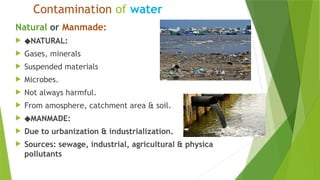
Contamination of water
Naturalor Manmade:
◆NATURAL:
Gases, minerals
Suspended materials
Microbes.
Not always harmful.
From amosphere, catchment area & soil.
◆MANMADE:
Due to urbanization & industrialization.
Sources: sewage, industrial, agricultural & physica
pollutants
26.
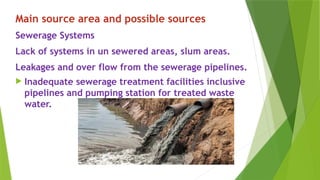
Main source areaand possible sources
Sewerage Systems
Lack of systems in un sewered areas, slum areas.
Leakages and over flow from the sewerage pipelines.
Inadequate sewerage treatment facilities inclusive
pipelines and pumping station for treated waste
water.
27.
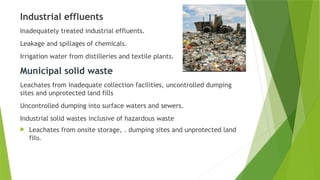
Industrial effluents
Inadequately treatedindustrial effluents.
Leakage and spillages of chemicals.
Irrigation water from distilleries and textile plants.
Municipal solid waste
Leachates from inadequate collection facilities, uncontrolled dumping
sites and unprotected land fills
Uncontrolled dumping into surface waters and sewers.
Industrial solid wastes inclusive of hazardous waste
Leachates from onsite storage, . dumping sites and unprotected land
fills.
28.
Prevention of waterpollution
Ganga action plan-1986
River water monitoring
Restoration of polluted water bodies
Treatment of water
29.
Phase1 Phase2
Launched in1986 and closed in
March 2000
Strated in 19930-1996
Implemented in April 2001
Included 3 states Included 7 states
Up Westbengal,Bihar Up,Westbengal,Bihar,Uttarakhand,
Jharkhand, Haryana, Delhi
Two phases
30.
Objectives
Improving the waterquality of river ganga
Interception and diversion of industrial and
domestic sewage to sewage treatment plants(STPs)
Installation of STPs to treat sewage
Afforestation
Public participation in cleaning the river
Providing sanitation facilities to people residing
near ganga
31.
Water pollution law
1974-theWater (prevention & control of pollution)
Act.
It is the legal control of water pollution in India.
For maintaining or restoring of wholesomeness of
water in the country
Central & state water board.
Joint water board.