

















Service Delivery System
Elective 5
Introduction to Service Delivery Systems
Introduction
Key Concepts in Service Delivery
Key Concepts in Service
Delivery
Key Concepts in Service Delivery
Challenges in
Service Delivery
Resource Constraints: One of the primary challenges in
service delivery is the limitation of resources, including
financial, human, and technological resources.
Resource constraints often lead to underfunded and
understaffed services, which can negatively impact
their quality and reach.
Governance and Institutional Capacity: Weak
governance structures and limited institutional
capacity are significant obstacles to effective service
delivery. Issues such as corruption, lack of
accountability, and inadequate policy frameworks can
hinder the delivery of essential services.
Inequality and Access Barriers: Inequalities based on
income, gender, ethnicity, and geography can create
significant barriers to accessing services. These
inequalities often result in marginalized communities
receiving poorer quality services or no services at all.
Challenges in Service Delivery
Resource Policy Implementation Gaps:
There is often a gap between policy
design and implementation. Well-
intended policies may fail to achieve
their objectives due to poor planning,
lack of coordination, and insufficient
monitoring and evaluation
mechanisms.
Technological Challenges: The
integration of technology into service
delivery can enhance efficiency and
accessibility. However, in many
developing countries, technological
challenges such as limited internet
penetration, lack of digital literacy, and
inadequate infrastructure remain
significant barriers.
Related Sustainable Development Goals (SDGs)
Other Relevant SDGs:
The Role of Strong
Institutions in Service
Delivery
The Role of Strong Institutions
in Service Delivery
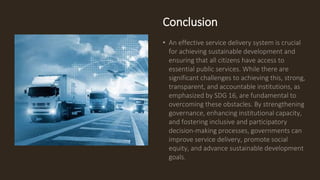
Conclusion
To God be the Glory!
Service Delivery System
Elective 5
Professor: Rommel R. Regala, Ph.D.
Models and Approaches to Public Service Delivery
Introduction
• Public service delivery is central to
governance and the achievement of
sustainable development.
Governments and public
administrators adopt various models
and approaches to deliver services
to their citizens efficiently and
equitably. This discussion explores
key models and approaches to
public service delivery, drawing from
the works of Denhardt et al.
(Chapter 3) and Pollitt & Bouckaert
(Chapter 2). It also highlights the
alignment of these approaches with
Sustainable Development Goal
(SDG) 8, which focuses on Decent
Work and Economic Growth, and
SDG 9, which emphasizes Industry,
Innovation, and Infrastructure.
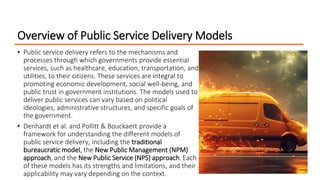
Overview of Public Service Delivery Models
• Public service delivery refers to the mechanisms and
processes through which governments provide essential
services, such as healthcare, education, transportation, and
utilities, to their citizens. These services are integral to
promoting economic development, social well-being, and
public trust in government institutions. The models used to
deliver public services can vary based on political
ideologies, administrative structures, and specific goals of
the government.
• Denhardt et al. and Pollitt & Bouckaert provide a
framework for understanding the different models of
public service delivery, including the traditional
bureaucratic model, the New Public Management (NPM)
approach, and the New Public Service (NPS) approach. Each
of these models has its strengths and limitations, and their
applicability may vary depending on the context.
Traditional Bureaucratic
Model
• The traditional bureaucratic model is one of
the oldest approaches to public service
delivery and is rooted in the ideas of
Weberian bureaucracy. It is characterized
by hierarchical organizational structures,
clear rules and procedures, and a focus on
stability and control.
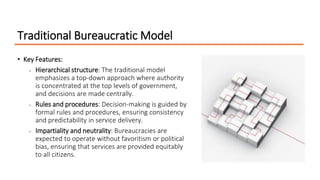
Traditional Bureaucratic Model
• Key Features:
• Hierarchical structure: The traditional model
emphasizes a top-down approach where authority
is concentrated at the top levels of government,
and decisions are made centrally.
• Rules and procedures: Decision-making is guided by
formal rules and procedures, ensuring consistency
and predictability in service delivery.
• Impartiality and neutrality: Bureaucracies are
expected to operate without favoritism or political
bias, ensuring that services are provided equitably
to all citizens.
Traditional Bureaucratic Model
• Relevance to SDGs:
• SDG 8: Decent Work and Economic
Growth: Bureaucracies are responsible
for enforcing labor regulations,
ensuring fair wages, and protecting
workers' rights, all of which contribute
to the goal of promoting decent work.
• SDG 9: Industry, Innovation, and
Infrastructure: Traditional bureaucratic
structures are often involved in the
planning and regulation of
infrastructure projects, ensuring that
they meet public standards and
contribute to economic growth.
Traditional
Bureaucratic Model
• Limitations:
• The traditional bureaucratic
model has been criticized for
being too rigid, slow to adapt,
and resistant to change. It can
also become overly focused on
process rather than outcomes,
which may hinder innovation
and responsiveness to citizens'
needs.
New Public
Management (NPM)
• The New Public Management (NPM)
approach emerged in the 1980s as a
response to the perceived
inefficiencies of the traditional
bureaucratic model. Influenced by
neoliberal economic thinking, NPM
sought to make public service delivery
more market-oriented by borrowing
techniques and practices from the
private sector.
New Public Management (NPM)
• Key Features:
• Decentralization: NPM promotes decentralizing
decision-making to lower levels of government
and agencies, allowing for greater flexibility and
responsiveness.
• Performance-based management: Emphasis is
placed on setting performance targets and
measuring outcomes to ensure that services are
delivered efficiently.
• Competition and contracting out: NPM encourages
competition among service providers, often
leading to the outsourcing of services to private or
non-profit organizations through contracts.
• Customer focus: Citizens are viewed as customers,
and services are designed to meet their needs and
preferences, with a focus on satisfaction and
service quality.
New Public Management
(NPM)
• Relevance to SDGs:
• SDG 8: Decent Work and Economic Growth:
NPM models encourage economic growth by
fostering competition, innovation, and
efficiency in service delivery. By improving the
efficiency of government services, NPM can
also create an environment conducive to
private sector investment and job creation.
• SDG 9: Industry, Innovation, and Infrastructure:
The NPM approach supports infrastructure
development through public-private
partnerships (PPPs) and competitive
contracting, promoting innovation in public
service delivery and ensuring that
infrastructure projects contribute to economic
growth.
New Public Management
(NPM)
• Limitations:
• Critics argue that NPM's focus on
efficiency and competition can
sometimes undermine equity and social
justice. By treating citizens as
customers, NPM may prioritize
profitability over universal access to
services, potentially leading to
disparities in service delivery.
New Public Service (NPS)
• The New Public Service (NPS) approach
represents a shift from the market-driven
orientation of NPM toward a more citizen-
centered model of public service delivery.
Denhardt et al. emphasize that NPS focuses
on the role of public servants as facilitators
of democratic governance, with an
emphasis on collaboration, civic
engagement, and service to the public
good.
New Public Service (NPS)
• Key Features:
• Citizen engagement: NPS promotes
active involvement of citizens in
decision-making processes, ensuring that
services reflect the needs and priorities
of the community.
• Collaboration and partnership: NPS
encourages partnerships between
government, private sector, civil society,
and citizens to deliver public services in a
collaborative and inclusive manner.
• Public interest focus: Unlike NPM, which
focuses on market-based solutions, NPS
is concerned with advancing the public
interest and ensuring that services are
equitable and accessible to all.
New Public Service
(NPS)
• Relevance to SDGs:
• SDG 8: Decent Work and Economic
Growth: NPS promotes inclusive
economic growth by prioritizing social
equity and ensuring that public
services are accessible to marginalized
populations. It also fosters civic
engagement in the creation of policies
that promote decent work and
economic opportunities.
• SDG 9: Industry, Innovation, and
Infrastructure: By encouraging
collaboration and civic participation,
NPS supports innovative approaches
to infrastructure development,
ensuring that projects are community-
driven and sustainable.
New Public Service
(NPS)
• Limitations:
• While NPS emphasizes inclusivity
and participation, it can be
resource-intensive and time-
consuming. In some cases,
involving citizens in decision-
making may slow down the
implementation of services and
policies, particularly in urgent
situations.
Approaches to Public Service Delivery
• In addition to the models mentioned above,
Denhardt et al. and Pollitt & Bouckaert highlight
several approaches to public service delivery that
align with the objectives of SDG 8 and SDG 9.
These approaches focus on ensuring that services
are provided in a way that fosters economic
growth, innovation, and the development of
sustainable infrastructure.
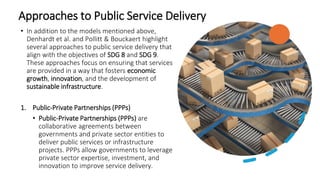
1. Public-Private Partnerships (PPPs)
• Public-Private Partnerships (PPPs) are
collaborative agreements between
governments and private sector entities to
deliver public services or infrastructure
projects. PPPs allow governments to leverage
private sector expertise, investment, and
innovation to improve service delivery.
Approaches to Public
Service Delivery
• Key Features:
• Shared risk and reward: In PPPs, both
the government and the private sector
share the risks and rewards of service
delivery or infrastructure development.
• Long-term contracts: PPPs typically
involve long-term contracts that outline
the roles and responsibilities of each
partner, as well as performance
expectations and financial
arrangements.
Approaches to Public
Service Delivery
• Relevance to SDGs:
• SDG 8: Decent Work and Economic Growth:
PPPs promote economic growth by
attracting private sector investment in
public services and infrastructure, creating
jobs, and stimulating local economies.
• SDG 9: Industry, Innovation, and
Infrastructure: PPPs facilitate the
development of critical infrastructure, such
as roads, energy, and telecommunications,
which are essential for economic
development and industrialization. They
also encourage the use of innovative
technologies and practices in service
delivery.
Approaches to Public
Service Delivery
2.E-Governance and Digital Service
Delivery
• E-governance refers to the use
of digital technologies to
improve government services
and operations. It involves the
digitalization of public service
delivery, enabling citizens to
access services online,
streamline processes, and
enhance transparency and
accountability.
Approaches to Public Service Delivery
• Key Features:
• Online services: Governments
offer a range of services online,
such as tax filing, license
applications, and healthcare
appointments, making it easier for
citizens to access services.
• Data-driven decision-making: E-
governance allows governments
to collect and analyze data on
service delivery, enabling
evidence-based policy decisions.
Approaches to Public
Service Delivery
• Relevance to SDGs:
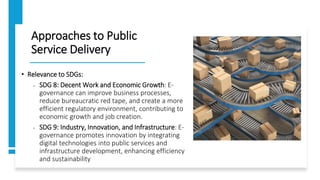
• SDG 8: Decent Work and Economic Growth: E-
governance can improve business processes,
reduce bureaucratic red tape, and create a more
efficient regulatory environment, contributing to
economic growth and job creation.
• SDG 9: Industry, Innovation, and Infrastructure: E-
governance promotes innovation by integrating
digital technologies into public services and
infrastructure development, enhancing efficiency
and sustainability
Conclusion
• The models and approaches to public service
delivery—ranging from the traditional bureaucratic
model to New Public Management and New Public
Service—offer different strategies for achieving
efficient, equitable, and sustainable service delivery.
Each model has strengths and limitations, and the
choice of model should be informed by the specific
context and objectives of the government. Aligning
these models with SDGs, particularly SDG 8: Decent
Work and Economic Growth and SDG 9: Industry,
Innovation, and Infrastructure, is essential for
fostering inclusive economic development,
promoting innovation, and ensuring that public
services contribute to broader development goals.
By understanding and applying these models and
approaches, governments can enhance their
capacity to deliver high-quality services that meet
the needs of their citizens.
To God be the Glory!
Prepared by :
Rommel R. Regala, Ph.D.
Service Delivery System
Elective 5
Professor: Rommel R. Regala, Ph.D.
Governance,
Accountability, and
Public Participation
Introduction
• Governance, accountability, and
public participation are essential
components of modern public
administration. These elements
define how governments operate
in a democratic context, enabling
the efficient delivery of services
while fostering public trust and
legitimacy. The roles they play are
also highlighted within global
frameworks like the Sustainable
Development Goals (SDGs),
specifically SDG 16 (Peace,
Justice, and Strong Institutions)
and SDG 17 (Partnerships for the
Goals).
Governance
• Governance involves the processes and structures through which political, economic, and
administrative authority is exercised. In public administration, it refers to how power is shared
among institutions and stakeholders, ensuring that the government remains effective,
transparent, and accountable. Governance is no longer seen merely as the domain of state actors;
it involves collaboration with non-state actors like civil society and private sector partners,
contributing to the broader concept of good governance.
• Denhardt et al. argue that governance is about managing complex relationships between multiple
sectors—public, private, and non-governmental. They emphasize the importance of governance
frameworks that ensure coordination across these sectors for better public service delivery.
• Peters focuses on the institutional aspect of governance, stressing that sound governance
requires well-designed institutions that enable responsiveness and accountability. He highlights
the importance of the rule of law, transparency, and citizen engagement to prevent corruption
and ensure effective public administration.
• Link to SDG 16:
• SDG 16 advocates for "peaceful and inclusive societies for sustainable development" through
strong governance mechanisms. It calls for the establishment of effective, accountable, and
transparent institutions. The goal recognizes that corruption, weak governance, and a lack of
accountability undermine social stability, public trust, and development.
Accountability
• Accountability in governance refers to the obligation of public officials to report on their
activities, accept responsibility, and disclose outcomes in a transparent manner. Without
accountability, government actions can become arbitrary and self-serving, leading to
inefficiency and corruption.
• Denhardt et al. describe accountability as a multifaceted concept that encompasses
several dimensions—political, legal, and managerial. They assert that public
administrators must be accountable not only to elected officials but also to the public
they serve, with mechanisms in place to monitor performance and ensure compliance
with established standards.
• Peters, in his discussion, highlights how accountability links to bureaucratic performance.
He suggests that institutional checks and balances, such as legislative oversight and public
audits, are critical to ensuring that public servants act in the public's best interest. Peters
further argues that accountability systems should also be outward-facing, allowing
citizens to voice concerns and hold their leaders accountable through public participation.
• Link to SDG 16:
• Accountability is one of the core themes of SDG 16, which stresses the need for
institutions that are accountable, just, and inclusive. Governments are expected to
provide citizens with the means to hold officials accountable, creating trust and fostering
a culture of integrity and rule of law.
• Public participation ensures that citizens are actively involved in decision-making processes that
affect their lives. It is a cornerstone of democratic governance and is essential for making public
policies more responsive to the needs and preferences of society.
• Denhardt et al. stress that public participation is more than just a symbolic gesture. It has to be
substantive and meaningful, allowing citizens to influence decisions. They suggest that public
administrators should encourage participation through various mechanisms such as public
hearings, consultations, and direct engagement through digital platforms.
• Peters focuses on the structural challenges that sometimes hinder meaningful public
participation. He notes that for participation to be effective, there must be a deliberate effort to
reach marginalized groups, create channels for feedback, and institutionalize citizen
engagement in governance processes.
• Link to SDG 16:
• SDG 16 calls for inclusive societies where decision-making processes are participatory and
responsive at all levels. It emphasizes the need for governments to provide access to
information and to engage with citizens in transparent and inclusive processes that contribute
to justice and peace.
• Link to SDG 17:
• SDG 17 emphasizes the importance of partnerships in achieving sustainable development goals.
It highlights the role of governments in building alliances with the private sector, civil society,
and international bodies. Public participation in governance can strengthen these partnerships
by fostering dialogue and cooperation among stakeholders to achieve shared objectives.
Public Participation
Intersection of
Governance,
Accountability,
and Public
Participation
with SDGs
Governance, accountability, and public participation are deeply
interconnected with SDG 16 and SDG 17. SDG 16 underscores the
importance of effective governance and accountability in ensuring peace,
justice, and inclusive institutions, while SDG 17 highlights the need for
partnerships and collaborative efforts to drive sustainable development.
• Strengthening Institutions: Both goals push for reforms in governance to
ensure that institutions are effective, transparent, and inclusive. SDG 16
directly addresses the need for good governance as a prerequisite for
sustainable development, while SDG 17 underscores the role of
partnerships, which are grounded in trust, transparency, and
accountability.
• Citizen Engagement: Public participation is not just a matter of good
governance but also a means to improve accountability and create more
responsive institutions. As Peters notes, ensuring that citizens, especially
those from marginalized groups, have a voice in public affairs can reduce
social inequalities and prevent conflict.
• Building Trust through Accountability: Trust between governments and
citizens is built on the foundation of accountability. When citizens
perceive their governments as accountable, they are more likely to
engage in participatory governance. This directly contributes to the
achievement of both SDG 16 and SDG 17 by fostering partnerships and
collective action.
Summary:
To God be the Glory!
Prepared by :
Rommel R. Regala, Ph.D.
Service Delivery
System
Elective 5
Professor: Rommel R. Regala, Ph.D.
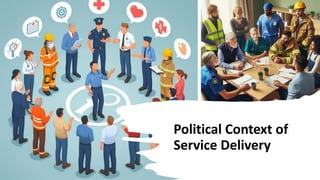
Political Context of
Service Delivery
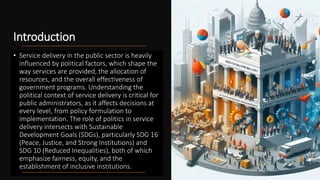
Introduction
• Service delivery in the public sector is heavily
influenced by political factors, which shape the
way services are provided, the allocation of
resources, and the overall effectiveness of
government programs. Understanding the
political context of service delivery is critical for
public administrators, as it affects decisions at
every level, from policy formulation to
implementation. The role of politics in service
delivery intersects with Sustainable
Development Goals (SDGs), particularly SDG 16
(Peace, Justice, and Strong Institutions) and
SDG 10 (Reduced Inequalities), both of which
emphasize fairness, equity, and the
establishment of inclusive institutions.
Political Influence on Service Delivery
• In public administration, political leadership plays a
central role in shaping the delivery of public
services. As highlighted in Kettl’s Chapters 2 and 3,
the political environment can determine which
services are prioritized, who receives them, and how
resources are distributed. Political agendas often
guide policy decisions, with elected officials shaping
service delivery based on electoral promises,
constituency demands, and political ideologies.
• This dynamic can lead to unequal access to services,
as political leaders may focus on certain populations
or regions over others, depending on their political
priorities. Such disparities are often rooted in
broader societal inequalities, which may further
marginalize vulnerable groups.
• The UNDP Report (Ch. 2) underscores that political
considerations can lead to inefficiencies in service
delivery when decisions are made based on political
gains rather than objective needs. This can lead to a
lack of transparency, corruption, or patronage
systems, where access to public services is granted
in exchange for political loyalty.
• One of the key trends in modern governance is the decentralization of
service delivery, which transfers responsibilities from national
governments to local governments. Kettl argues that while
decentralization can enhance responsiveness and make service
delivery more efficient, it can also magnify local political dynamics.
Local elites or political parties may dominate the decision-making
process, influencing which services are provided and to whom.
• The UNDP Report points out that decentralization, while promoting
local autonomy, can sometimes worsen regional disparities, as
wealthier areas may have more resources to provide better services
compared to poorer regions. This disparity highlights the challenges of
ensuring equitable service delivery across diverse political and
economic contexts.
• Link to SDG 10:
• SDG 10 aims to reduce inequalities, including those created or
exacerbated by political decisions regarding service delivery. Ensuring
that services are distributed equitably, regardless of political influence,
is essential for reducing social and economic disparities. Political actors
must be aware of the need to minimize regional and group-based
inequalities in access to services, particularly in decentralized systems.
Decentralization
and Local
Politics
Governance, Accountability, and Political Context
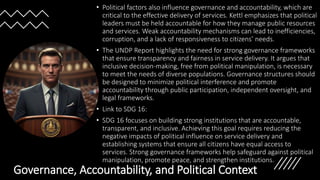
• Political factors also influence governance and accountability, which are
critical to the effective delivery of services. Kettl emphasizes that political
leaders must be held accountable for how they manage public resources
and services. Weak accountability mechanisms can lead to inefficiencies,
corruption, and a lack of responsiveness to citizens’ needs.
• The UNDP Report highlights the need for strong governance frameworks
that ensure transparency and fairness in service delivery. It argues that
inclusive decision-making, free from political manipulation, is necessary
to meet the needs of diverse populations. Governance structures should
be designed to minimize political interference and promote
accountability through public participation, independent oversight, and
legal frameworks.
• Link to SDG 16:
• SDG 16 focuses on building strong institutions that are accountable,
transparent, and inclusive. Achieving this goal requires reducing the
negative impacts of political influence on service delivery and
establishing systems that ensure all citizens have equal access to
services. Strong governance frameworks help safeguard against political
manipulation, promote peace, and strengthen institutions.
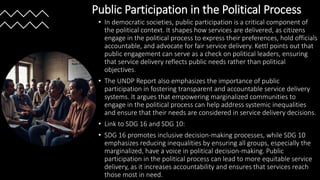
Public Participation in the Political Process
• In democratic societies, public participation is a critical component of
the political context. It shapes how services are delivered, as citizens
engage in the political process to express their preferences, hold officials
accountable, and advocate for fair service delivery. Kettl points out that
public engagement can serve as a check on political leaders, ensuring
that service delivery reflects public needs rather than political
objectives.
• The UNDP Report also emphasizes the importance of public
participation in fostering transparent and accountable service delivery
systems. It argues that empowering marginalized communities to
engage in the political process can help address systemic inequalities
and ensure that their needs are considered in service delivery decisions.
• Link to SDG 16 and SDG 10:
• SDG 16 promotes inclusive decision-making processes, while SDG 10
emphasizes reducing inequalities by ensuring all groups, especially the
marginalized, have a voice in political decision-making. Public
participation in the political process can lead to more equitable service
delivery, as it increases accountability and ensures that services reach
those most in need.
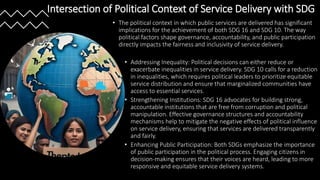
Intersection of Political Context of Service Delivery with SDG
• The political context in which public services are delivered has significant
implications for the achievement of both SDG 16 and SDG 10. The way
political factors shape governance, accountability, and public participation
directly impacts the fairness and inclusivity of service delivery.
• Addressing Inequality: Political decisions can either reduce or
exacerbate inequalities in service delivery. SDG 10 calls for a reduction
in inequalities, which requires political leaders to prioritize equitable
service distribution and ensure that marginalized communities have
access to essential services.
• Strengthening Institutions: SDG 16 advocates for building strong,
accountable institutions that are free from corruption and political
manipulation. Effective governance structures and accountability
mechanisms help to mitigate the negative effects of political influence
on service delivery, ensuring that services are delivered transparently
and fairly.
• Enhancing Public Participation: Both SDGs emphasize the importance
of public participation in the political process. Engaging citizens in
decision-making ensures that their voices are heard, leading to more
responsive and equitable service delivery systems.
Conclusion
• In conclusion, the political context
of service delivery plays a pivotal
role in shaping the quality,
accessibility, and equity of public
services. By addressing the political
factors that influence service
delivery and aligning efforts with
SDG 16 and SDG 10, public
administrators can work toward
creating more just, accountable,
and inclusive systems.
To God be the Glory!
Prepared by :
Rommel R. Regala, Ph.D.
Service Delivery
System
Elective 5
Professor: Rommel R. Regala, Ph.D.
Challenges in
Service
Delivery:
Efficiency and
Equity
Introduction
• Service delivery in public administration faces
significant challenges in balancing efficiency
and equity, both of which are critical to
ensuring that public services are accessible,
timely, and beneficial to all citizens,
particularly the most vulnerable populations.
These challenges are also reflected in global
development goals such as SDG 1 (No Poverty)
and SDG 3 (Good Health and Well-being),
which emphasize the need for equitable
access to essential services to reduce poverty
and promote health and well-being.
Efficiency in Service
Delivery
• Efficiency in public service delivery refers to the optimal use of
resources to achieve the best possible outcomes with minimal
waste, delays, or excessive costs. Public administrators are
under pressure to maximize the effectiveness of services,
especially in contexts where resources are limited and demand
is high.
• Denhardt et al. (Ch. 5) highlight that achieving efficiency
involves improving organizational processes, adopting new
technologies, and creating systems that streamline service
delivery. However, efficiency should not come at the expense
of service quality or access for vulnerable populations. The
drive for efficiency often focuses on cost-cutting measures,
which may result in reduced access to essential services for
marginalized groups.
• The World Bank Report (Ch. 3) reinforces the need for
efficiency, particularly in sectors like healthcare and education,
where resource constraints are most apparent. The report
suggests that improving efficiency requires governments to
reduce bureaucratic hurdles, eliminate corruption, and invest
in innovative technologies that enhance service delivery.
Efficiency in Service
Delivery
Equity in Service Delivery
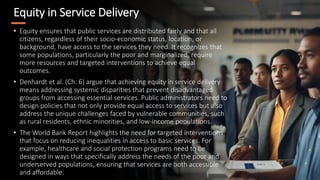
• Equity ensures that public services are distributed fairly and that all
citizens, regardless of their socio-economic status, location, or
background, have access to the services they need. It recognizes that
some populations, particularly the poor and marginalized, require
more resources and targeted interventions to achieve equal
outcomes.
• Denhardt et al. (Ch. 6) argue that achieving equity in service delivery
means addressing systemic disparities that prevent disadvantaged
groups from accessing essential services. Public administrators need to
design policies that not only provide equal access to services but also
address the unique challenges faced by vulnerable communities, such
as rural residents, ethnic minorities, and low-income populations.
• The World Bank Report highlights the need for targeted interventions
that focus on reducing inequalities in access to basic services. For
example, healthcare and social protection programs need to be
designed in ways that specifically address the needs of the poor and
underserved populations, ensuring that services are both accessible
and affordable.
Equity in Service
Delivery
• Link to SDG 1:
• Equitable service delivery is central
to SDG 1 (No Poverty), as access to
essential services like healthcare,
education, and social protection can
help lift individuals and communities
out of poverty. Addressing inequities
in service provision is crucial to
reducing poverty and promoting
inclusive development.
Balancing Efficiency and Equity
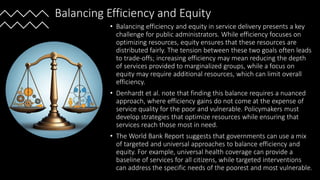
• Balancing efficiency and equity in service delivery presents a key
challenge for public administrators. While efficiency focuses on
optimizing resources, equity ensures that these resources are
distributed fairly. The tension between these two goals often leads
to trade-offs; increasing efficiency may mean reducing the depth
of services provided to marginalized groups, while a focus on
equity may require additional resources, which can limit overall
efficiency.
• Denhardt et al. note that finding this balance requires a nuanced
approach, where efficiency gains do not come at the expense of
service quality for the poor and vulnerable. Policymakers must
develop strategies that optimize resources while ensuring that
services reach those most in need.
• The World Bank Report suggests that governments can use a mix
of targeted and universal approaches to balance efficiency and
equity. For example, universal health coverage can provide a
baseline of services for all citizens, while targeted interventions
can address the specific needs of the poorest and most vulnerable.
Balancing
Efficiency and
Equity
• Several challenges complicate the pursuit of both efficiency and equity in
service delivery:
• Resource Constraints: Public services often operate under tight budget
constraints, making it difficult to meet the needs of all citizens while
maintaining high standards of efficiency and equity. This is particularly
true in low-income countries where public funding is limited.
• Geographic Disparities: Rural and remote areas often face significant
challenges in accessing services, as governments may prioritize urban
centers where services can be delivered more efficiently. This
geographic imbalance creates inequities in service access.
• Corruption and Bureaucracy: Inefficient bureaucratic processes and
corruption undermine both efficiency and equity by diverting resources
away from those who need them most and delaying service delivery.
• Technological Gaps: While technology can improve efficiency, not all
communities have equal access to technological advancements,
creating further disparities in service delivery.
• Denhardt et al. emphasize that overcoming these challenges requires
governments to adopt a proactive approach, investing in capacity-building,
anti-corruption measures, and infrastructure that supports equitable and
efficient service delivery.
Challenges
in Achieving
Efficiency
and Equity
Challenges in Achieving
Efficiency and Equity
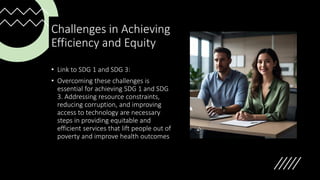
• Link to SDG 1 and SDG 3:
• Overcoming these challenges is
essential for achieving SDG 1 and SDG
3. Addressing resource constraints,
reducing corruption, and improving
access to technology are necessary
steps in providing equitable and
efficient services that lift people out of
poverty and improve health outcomes
Intersection of Efficiency and Equity with SDGs
• Both efficiency and equity are crucial to achieving the goals of
SDG 1 (No Poverty) and SDG 3 (Good Health and Well-being). An
efficient service delivery system ensures that resources are used
optimally, allowing services like healthcare and social protection
to reach more people. Meanwhile, a focus on equity ensures that
the most vulnerable populations—those most affected by poverty
and poor health—receive the attention and resources they need.
• Reducing Poverty: Efficient and equitable service delivery
systems are key to reducing poverty. When public services are
accessible, affordable, and responsive to the needs of the
poor, they help alleviate the conditions that perpetuate
poverty.
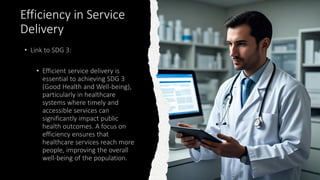
• Promoting Health and Well-being: Access to quality
healthcare is essential for improving public health outcomes,
and efficient service delivery ensures that more people can
benefit from these services. Equity in healthcare delivery
ensures that vulnerable populations, such as low-income
families and rural communities, receive the care they need to
live healthier lives.
Conclusion
To God be the Glory!
Prepared by :
Rommel R. Regala, Ph.D.
Service Delivery
System
Elective 5
Professor: Rommel R. Regala, Ph.D.
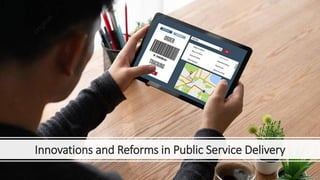
Innovations and Reforms in Public Service Delivery
Introduction
• Public service delivery is constantly evolving to
meet the changing needs of citizens and to adapt
to global challenges. In recent decades,
innovations and reforms in public service delivery
have aimed to improve the efficiency,
effectiveness, and inclusiveness of public services.
These innovations are driven by technological
advancements, governance reforms, and a focus
on sustainability. The importance of innovation in
public service is underscored by global
development frameworks such as SDG 9 (Industry,
Innovation, and Infrastructure) and SDG 11
(Sustainable Cities and Communities), both of
which emphasize the role of innovation in creating
resilient and inclusive communities.
Public Service
Innovations
Technological Innovations
in Public Service Delivery
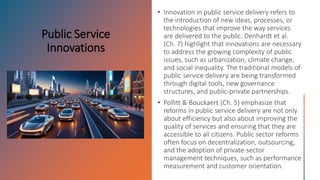
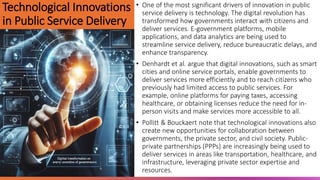
• One of the most significant drivers of innovation in public
service delivery is technology. The digital revolution has
transformed how governments interact with citizens and
deliver services. E-government platforms, mobile
applications, and data analytics are being used to
streamline service delivery, reduce bureaucratic delays, and
enhance transparency.
• Denhardt et al. argue that digital innovations, such as smart
cities and online service portals, enable governments to
deliver services more efficiently and to reach citizens who
previously had limited access to public services. For
example, online platforms for paying taxes, accessing
healthcare, or obtaining licenses reduce the need for in-
person visits and make services more accessible to all.
• Pollitt & Bouckaert note that technological innovations also
create new opportunities for collaboration between
governments, the private sector, and civil society. Public-
private partnerships (PPPs) are increasingly being used to
deliver services in areas like transportation, healthcare, and
infrastructure, leveraging private sector expertise and
resources.
Technological
Innovations in
Public Service
Delivery
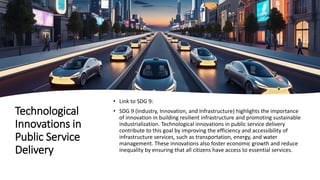
• Link to SDG 9:
• SDG 9 (Industry, Innovation, and Infrastructure) highlights the importance
of innovation in building resilient infrastructure and promoting sustainable
industrialization. Technological innovations in public service delivery
contribute to this goal by improving the efficiency and accessibility of
infrastructure services, such as transportation, energy, and water
management. These innovations also foster economic growth and reduce
inequality by ensuring that all citizens have access to essential services.
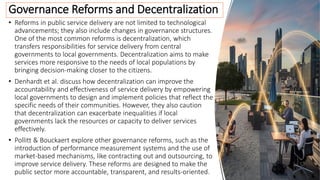
• Reforms in public service delivery are not limited to technological
advancements; they also include changes in governance structures.
One of the most common reforms is decentralization, which
transfers responsibilities for service delivery from central
governments to local governments. Decentralization aims to make
services more responsive to the needs of local populations by
bringing decision-making closer to the citizens.
• Denhardt et al. discuss how decentralization can improve the
accountability and effectiveness of service delivery by empowering
local governments to design and implement policies that reflect the
specific needs of their communities. However, they also caution
that decentralization can exacerbate inequalities if local
governments lack the resources or capacity to deliver services
effectively.
• Pollitt & Bouckaert explore other governance reforms, such as the
introduction of performance measurement systems and the use of
market-based mechanisms, like contracting out and outsourcing, to
improve service delivery. These reforms are designed to make the
public sector more accountable, transparent, and results-oriented.
Governance Reforms and Decentralization
Governance
Reforms and
Decentralization
• Link to SDG 11:
• SDG 11 (Sustainable Cities and Communities) calls for inclusive, safe, and
sustainable urban development. Governance reforms, such as
decentralization, contribute to this goal by enabling local governments
to address urban challenges, such as housing, transportation, and waste
management, more effectively. Decentralized governance also allows for
more citizen participation in decision-making, ensuring that urban
development is inclusive and responsive to the needs of all residents.
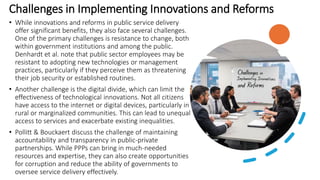
Challenges in Implementing Innovations and Reforms
• While innovations and reforms in public service delivery
offer significant benefits, they also face several challenges.
One of the primary challenges is resistance to change, both
within government institutions and among the public.
Denhardt et al. note that public sector employees may be
resistant to adopting new technologies or management
practices, particularly if they perceive them as threatening
their job security or established routines.
• Another challenge is the digital divide, which can limit the
effectiveness of technological innovations. Not all citizens
have access to the internet or digital devices, particularly in
rural or marginalized communities. This can lead to unequal
access to services and exacerbate existing inequalities.
• Pollitt & Bouckaert discuss the challenge of maintaining
accountability and transparency in public-private
partnerships. While PPPs can bring in much-needed
resources and expertise, they can also create opportunities
for corruption and reduce the ability of governments to
oversee service delivery effectively.
Challenges in
Implementing Innovations
and Reforms
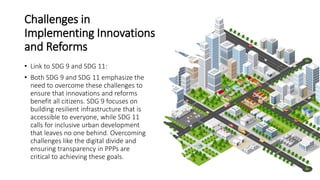
• Link to SDG 9 and SDG 11:
• Both SDG 9 and SDG 11 emphasize the
need to overcome these challenges to
ensure that innovations and reforms
benefit all citizens. SDG 9 focuses on
building resilient infrastructure that is
accessible to everyone, while SDG 11
calls for inclusive urban development
that leaves no one behind. Overcoming
challenges like the digital divide and
ensuring transparency in PPPs are
critical to achieving these goals.
• An important aspect of innovations and reforms in public
service delivery is the increasing emphasis on public
participation and citizen-centered approaches. Denhardt et al.
argue that involving citizens in the design and implementation
of public services leads to better outcomes, as services are
more likely to meet the needs of the population.
• Citizen-centered reforms include participatory budgeting, where
citizens are directly involved in deciding how public funds are
allocated, and co-production, where citizens work alongside
government agencies to deliver services. These approaches not
only improve service delivery but also strengthen the
relationship between citizens and their governments.
• Pollitt & Bouckaert highlight that citizen-centered reforms
require governments to adopt a customer-oriented mindset,
where citizens are viewed as clients whose satisfaction is a key
measure of success. This shift in perspective is part of a broader
trend toward new public management (NPM), which
emphasizes efficiency, customer service, and performance
measurement in the public sector.
Public Participation and Citizen-Centered Reforms
Public Participation
and Citizen-
Centered Reforms
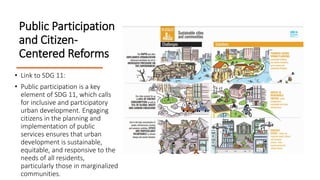
• Link to SDG 11:
• Public participation is a key
element of SDG 11, which calls
for inclusive and participatory
urban development. Engaging
citizens in the planning and
implementation of public
services ensures that urban
development is sustainable,
equitable, and responsive to the
needs of all residents,
particularly those in marginalized
communities.
Intersection of
Innovations and
Reforms with SDGs
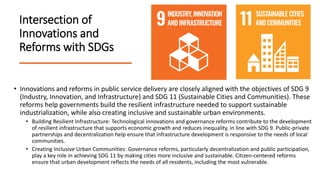
• Innovations and reforms in public service delivery are closely aligned with the objectives of SDG 9
(Industry, Innovation, and Infrastructure) and SDG 11 (Sustainable Cities and Communities). These
reforms help governments build the resilient infrastructure needed to support sustainable
industrialization, while also creating inclusive and sustainable urban environments.
• Building Resilient Infrastructure: Technological innovations and governance reforms contribute to the development
of resilient infrastructure that supports economic growth and reduces inequality, in line with SDG 9. Public-private
partnerships and decentralization help ensure that infrastructure development is responsive to the needs of local
communities.
• Creating Inclusive Urban Communities: Governance reforms, particularly decentralization and public participation,
play a key role in achieving SDG 11 by making cities more inclusive and sustainable. Citizen-centered reforms
ensure that urban development reflects the needs of all residents, including the most vulnerable.
Conclusion
• In conclusion, innovations and reforms in public service delivery
are essential for creating efficient, effective, and inclusive public
services. By leveraging technology, decentralization, and public
participation, governments can improve service delivery in ways
that align with the goals of SDG 9 and SDG 11, building resilient,
sustainable, and inclusive communities.
To God be the Glory!
Prepared by :
Rommel R. Regala, Ph.D.
Service Delivery System
Elective 5
Professor: Rommel R. Regala, Ph.D.
Service Delivery and Sustainable Development Goals
Introduction
• Effective service delivery is integral to achieving the Sustainable Development
Goals (SDGs) and ensuring that public services contribute to sustainable
development. The UNDP Report (Ch. 4) and various scholarly articles
emphasize the crucial role that service delivery plays in addressing global
challenges and advancing key SDGs, particularly SDG 1 (No Poverty), SDG 4
(Quality Education), and SDG 6 (Clean Water and Sanitation). This discussion
explores how service delivery impacts these goals and highlights strategies for
improving service outcomes to support sustainable development.
Introduction to
Service Delivery
and SDGs
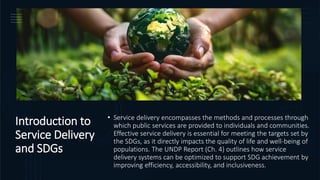
• Service delivery encompasses the methods and processes through
which public services are provided to individuals and communities.
Effective service delivery is essential for meeting the targets set by
the SDGs, as it directly impacts the quality of life and well-being of
populations. The UNDP Report (Ch. 4) outlines how service
delivery systems can be optimized to support SDG achievement by
improving efficiency, accessibility, and inclusiveness.
Service Delivery and SDG 1: No Poverty
• SDG 1 (No Poverty) aims to eradicate extreme poverty and reduce the
number of people living in poverty by 2030. Service delivery systems play a
pivotal role in achieving this goal by providing essential services such as
healthcare, education, and social protection to disadvantaged populations.
• Healthcare Services: Access to quality healthcare services is
fundamental for preventing and treating illnesses that
disproportionately affect poor populations. Effective service delivery in
healthcare ensures that vulnerable groups receive the necessary
medical care and support to improve their health outcomes and
reduce poverty-related health disparities.
• Social Protection: Social protection programs, including cash transfers,
food assistance, and unemployment benefits, are critical for helping
individuals and families manage economic shocks and build resilience.
Well-designed service delivery systems can enhance the efficiency and
reach of these programs, reducing poverty and supporting economic
stability.
• The UNDP Report emphasizes that targeting and delivering social
protection services effectively can mitigate the effects of poverty and
provide a safety net for the most vulnerable, thus contributing to SDG 1.
Service Delivery
and SDG 4:
Quality
Education
• SDG 4 (Quality Education) seeks to ensure inclusive and equitable quality education and promote
lifelong learning opportunities for all. Service delivery in education is crucial for achieving this goal by
improving access to and the quality of educational services.
• Access to Education: Ensuring that all children, especially those from marginalized communities,
have access to quality education is a key component of SDG 4. This involves addressing barriers
such as school fees, inadequate infrastructure, and long distances to schools.
• Quality of Education: Beyond access, improving the quality of education is essential for meeting
SDG 4. This includes training teachers, developing relevant curricula, and providing adequate
learning materials and facilities. Effective service delivery systems in education ensure that
resources are allocated efficiently and that schools are equipped to deliver high-quality education.
• Selected articles highlight that integrating technology and innovative practices in education can
enhance service delivery, making education more accessible and effective. For example, e-learning
platforms and digital resources can bridge gaps in access and improve educational outcomes.
Service Delivery and SDG 6: Clean Water and Sanitation
• Service Delivery and SDG 6: Clean Water and Sanitation
• SDG 6 (Clean Water and Sanitation) aims to ensure availability and
sustainable management of water and sanitation for all. Service
delivery systems are central to achieving this goal by providing safe
and reliable water supply and sanitation services.
• Water Supply: Effective service delivery in water supply involves
ensuring that clean and safe drinking water is available to all
communities. This requires investment in water infrastructure,
maintenance of water systems, and monitoring of water quality.
• Sanitation Services: Adequate sanitation facilities and services are
crucial for preventing waterborne diseases and promoting public
health. Service delivery systems must ensure that sanitation
services are accessible and hygienic, particularly in underserved
and rural areas.
• The UNDP Report highlights that improving water and sanitation
infrastructure and services is essential for achieving SDG 6 and for
enhancing overall public health and well-being.
Intersection of Service Delivery with SDGs
• The intersection of service delivery with SDGs underscores
the importance of effective and equitable public services in
achieving sustainable development. Efficient service
delivery systems contribute to poverty reduction (SDG 1),
enhance educational opportunities (SDG 4), and ensure
access to clean water and sanitation (SDG 6).
• Integration and Coordination: Coordinating service
delivery across different sectors—such as health,
education, and water management—can lead to more
comprehensive and integrated approaches to
addressing development challenges. This integration
helps ensure that services are delivered in a holistic
manner that supports multiple SDGs simultaneously.
• Monitoring and Evaluation: Regular monitoring and
evaluation of service delivery systems are essential for
assessing their impact on SDG achievement and for
identifying areas for improvement. Data-driven
decision-making can enhance the effectiveness of
service delivery and ensure that resources are
allocated where they are most needed.
Challenges and Strategies for Improvement
• While effective service delivery is crucial for achieving SDGs, several
challenges can hinder progress:
• Resource Constraints: Limited financial and human resources can
impact the quality and reach of services. Governments and
organizations need to prioritize and allocate resources effectively
to address these constraints.
• Infrastructure Gaps: Inadequate infrastructure can impede service
delivery, particularly in remote and underserved areas.
Investments in infrastructure development are necessary to
ensure that services are accessible to all.
• Equity and Inclusion: Ensuring that services reach all segments of
the population, including marginalized and vulnerable groups, is a
key challenge. Strategies to address this include targeting
interventions, improving outreach, and promoting inclusivity in
service design and delivery.
• The UNDP Report suggests that innovative approaches, such as
leveraging technology and fostering partnerships, can help overcome
these challenges and enhance service delivery outcomes.
Conclusion
• Service delivery is integral to achieving
the Sustainable Development Goals,
particularly SDG 1 (No Poverty), SDG 4
(Quality Education), and SDG 6 (Clean
Water and Sanitation). Effective service
delivery systems contribute to poverty
reduction, educational advancement,
and improved access to essential water
and sanitation services. By addressing
challenges and implementing strategies
for improvement, governments and
organizations can enhance service
delivery and support sustainable
development, ultimately advancing the
global agenda for a more equitable and
prosperous world.
To God be the Glory!
Prepared by :
Rommel R. Regala, Ph.D.

Public Administration: Service Delivery System

  • 1.
  • 2.
    Introduction to ServiceDelivery Systems
  • 3.
  • 4.
    Key Concepts inService Delivery
  • 5.
    Key Concepts inService Delivery
  • 6.
    Key Concepts inService Delivery
  • 7.
    Challenges in Service Delivery ResourceConstraints: One of the primary challenges in service delivery is the limitation of resources, including financial, human, and technological resources. Resource constraints often lead to underfunded and understaffed services, which can negatively impact their quality and reach. Governance and Institutional Capacity: Weak governance structures and limited institutional capacity are significant obstacles to effective service delivery. Issues such as corruption, lack of accountability, and inadequate policy frameworks can hinder the delivery of essential services. Inequality and Access Barriers: Inequalities based on income, gender, ethnicity, and geography can create significant barriers to accessing services. These inequalities often result in marginalized communities receiving poorer quality services or no services at all.
  • 8.
    Challenges in ServiceDelivery Resource Policy Implementation Gaps: There is often a gap between policy design and implementation. Well- intended policies may fail to achieve their objectives due to poor planning, lack of coordination, and insufficient monitoring and evaluation mechanisms. Technological Challenges: The integration of technology into service delivery can enhance efficiency and accessibility. However, in many developing countries, technological challenges such as limited internet penetration, lack of digital literacy, and inadequate infrastructure remain significant barriers.
  • 9.
  • 10.
  • 11.
    The Role ofStrong Institutions in Service Delivery
  • 12.
    The Role ofStrong Institutions in Service Delivery
  • 13.
  • 14.
    To God bethe Glory!
  • 15.
    Service Delivery System Elective5 Professor: Rommel R. Regala, Ph.D.
  • 16.
    Models and Approachesto Public Service Delivery
  • 17.
    Introduction • Public servicedelivery is central to governance and the achievement of sustainable development. Governments and public administrators adopt various models and approaches to deliver services to their citizens efficiently and equitably. This discussion explores key models and approaches to public service delivery, drawing from the works of Denhardt et al. (Chapter 3) and Pollitt & Bouckaert (Chapter 2). It also highlights the alignment of these approaches with Sustainable Development Goal (SDG) 8, which focuses on Decent Work and Economic Growth, and SDG 9, which emphasizes Industry, Innovation, and Infrastructure.
  • 18.
    Overview of PublicService Delivery Models • Public service delivery refers to the mechanisms and processes through which governments provide essential services, such as healthcare, education, transportation, and utilities, to their citizens. These services are integral to promoting economic development, social well-being, and public trust in government institutions. The models used to deliver public services can vary based on political ideologies, administrative structures, and specific goals of the government. • Denhardt et al. and Pollitt & Bouckaert provide a framework for understanding the different models of public service delivery, including the traditional bureaucratic model, the New Public Management (NPM) approach, and the New Public Service (NPS) approach. Each of these models has its strengths and limitations, and their applicability may vary depending on the context.
  • 19.
    Traditional Bureaucratic Model • Thetraditional bureaucratic model is one of the oldest approaches to public service delivery and is rooted in the ideas of Weberian bureaucracy. It is characterized by hierarchical organizational structures, clear rules and procedures, and a focus on stability and control.
  • 20.
    Traditional Bureaucratic Model •Key Features: • Hierarchical structure: The traditional model emphasizes a top-down approach where authority is concentrated at the top levels of government, and decisions are made centrally. • Rules and procedures: Decision-making is guided by formal rules and procedures, ensuring consistency and predictability in service delivery. • Impartiality and neutrality: Bureaucracies are expected to operate without favoritism or political bias, ensuring that services are provided equitably to all citizens.
  • 21.
    Traditional Bureaucratic Model •Relevance to SDGs: • SDG 8: Decent Work and Economic Growth: Bureaucracies are responsible for enforcing labor regulations, ensuring fair wages, and protecting workers' rights, all of which contribute to the goal of promoting decent work. • SDG 9: Industry, Innovation, and Infrastructure: Traditional bureaucratic structures are often involved in the planning and regulation of infrastructure projects, ensuring that they meet public standards and contribute to economic growth.
  • 22.
    Traditional Bureaucratic Model • Limitations: •The traditional bureaucratic model has been criticized for being too rigid, slow to adapt, and resistant to change. It can also become overly focused on process rather than outcomes, which may hinder innovation and responsiveness to citizens' needs.
  • 23.
    New Public Management (NPM) •The New Public Management (NPM) approach emerged in the 1980s as a response to the perceived inefficiencies of the traditional bureaucratic model. Influenced by neoliberal economic thinking, NPM sought to make public service delivery more market-oriented by borrowing techniques and practices from the private sector.
  • 24.
    New Public Management(NPM) • Key Features: • Decentralization: NPM promotes decentralizing decision-making to lower levels of government and agencies, allowing for greater flexibility and responsiveness. • Performance-based management: Emphasis is placed on setting performance targets and measuring outcomes to ensure that services are delivered efficiently. • Competition and contracting out: NPM encourages competition among service providers, often leading to the outsourcing of services to private or non-profit organizations through contracts. • Customer focus: Citizens are viewed as customers, and services are designed to meet their needs and preferences, with a focus on satisfaction and service quality.
  • 25.
    New Public Management (NPM) •Relevance to SDGs: • SDG 8: Decent Work and Economic Growth: NPM models encourage economic growth by fostering competition, innovation, and efficiency in service delivery. By improving the efficiency of government services, NPM can also create an environment conducive to private sector investment and job creation. • SDG 9: Industry, Innovation, and Infrastructure: The NPM approach supports infrastructure development through public-private partnerships (PPPs) and competitive contracting, promoting innovation in public service delivery and ensuring that infrastructure projects contribute to economic growth.
  • 26.
    New Public Management (NPM) •Limitations: • Critics argue that NPM's focus on efficiency and competition can sometimes undermine equity and social justice. By treating citizens as customers, NPM may prioritize profitability over universal access to services, potentially leading to disparities in service delivery.
  • 27.
    New Public Service(NPS) • The New Public Service (NPS) approach represents a shift from the market-driven orientation of NPM toward a more citizen- centered model of public service delivery. Denhardt et al. emphasize that NPS focuses on the role of public servants as facilitators of democratic governance, with an emphasis on collaboration, civic engagement, and service to the public good.
  • 28.
    New Public Service(NPS) • Key Features: • Citizen engagement: NPS promotes active involvement of citizens in decision-making processes, ensuring that services reflect the needs and priorities of the community. • Collaboration and partnership: NPS encourages partnerships between government, private sector, civil society, and citizens to deliver public services in a collaborative and inclusive manner. • Public interest focus: Unlike NPM, which focuses on market-based solutions, NPS is concerned with advancing the public interest and ensuring that services are equitable and accessible to all.
  • 29.
    New Public Service (NPS) •Relevance to SDGs: • SDG 8: Decent Work and Economic Growth: NPS promotes inclusive economic growth by prioritizing social equity and ensuring that public services are accessible to marginalized populations. It also fosters civic engagement in the creation of policies that promote decent work and economic opportunities. • SDG 9: Industry, Innovation, and Infrastructure: By encouraging collaboration and civic participation, NPS supports innovative approaches to infrastructure development, ensuring that projects are community- driven and sustainable.
  • 30.
    New Public Service (NPS) •Limitations: • While NPS emphasizes inclusivity and participation, it can be resource-intensive and time- consuming. In some cases, involving citizens in decision- making may slow down the implementation of services and policies, particularly in urgent situations.
  • 31.
    Approaches to PublicService Delivery • In addition to the models mentioned above, Denhardt et al. and Pollitt & Bouckaert highlight several approaches to public service delivery that align with the objectives of SDG 8 and SDG 9. These approaches focus on ensuring that services are provided in a way that fosters economic growth, innovation, and the development of sustainable infrastructure. 1. Public-Private Partnerships (PPPs) • Public-Private Partnerships (PPPs) are collaborative agreements between governments and private sector entities to deliver public services or infrastructure projects. PPPs allow governments to leverage private sector expertise, investment, and innovation to improve service delivery.
  • 32.
    Approaches to Public ServiceDelivery • Key Features: • Shared risk and reward: In PPPs, both the government and the private sector share the risks and rewards of service delivery or infrastructure development. • Long-term contracts: PPPs typically involve long-term contracts that outline the roles and responsibilities of each partner, as well as performance expectations and financial arrangements.
  • 33.
    Approaches to Public ServiceDelivery • Relevance to SDGs: • SDG 8: Decent Work and Economic Growth: PPPs promote economic growth by attracting private sector investment in public services and infrastructure, creating jobs, and stimulating local economies. • SDG 9: Industry, Innovation, and Infrastructure: PPPs facilitate the development of critical infrastructure, such as roads, energy, and telecommunications, which are essential for economic development and industrialization. They also encourage the use of innovative technologies and practices in service delivery.
  • 34.
    Approaches to Public ServiceDelivery 2.E-Governance and Digital Service Delivery • E-governance refers to the use of digital technologies to improve government services and operations. It involves the digitalization of public service delivery, enabling citizens to access services online, streamline processes, and enhance transparency and accountability.
  • 35.
    Approaches to PublicService Delivery • Key Features: • Online services: Governments offer a range of services online, such as tax filing, license applications, and healthcare appointments, making it easier for citizens to access services. • Data-driven decision-making: E- governance allows governments to collect and analyze data on service delivery, enabling evidence-based policy decisions.
  • 36.
    Approaches to Public ServiceDelivery • Relevance to SDGs: • SDG 8: Decent Work and Economic Growth: E- governance can improve business processes, reduce bureaucratic red tape, and create a more efficient regulatory environment, contributing to economic growth and job creation. • SDG 9: Industry, Innovation, and Infrastructure: E- governance promotes innovation by integrating digital technologies into public services and infrastructure development, enhancing efficiency and sustainability
  • 37.
    Conclusion • The modelsand approaches to public service delivery—ranging from the traditional bureaucratic model to New Public Management and New Public Service—offer different strategies for achieving efficient, equitable, and sustainable service delivery. Each model has strengths and limitations, and the choice of model should be informed by the specific context and objectives of the government. Aligning these models with SDGs, particularly SDG 8: Decent Work and Economic Growth and SDG 9: Industry, Innovation, and Infrastructure, is essential for fostering inclusive economic development, promoting innovation, and ensuring that public services contribute to broader development goals. By understanding and applying these models and approaches, governments can enhance their capacity to deliver high-quality services that meet the needs of their citizens.
  • 38.
    To God bethe Glory! Prepared by : Rommel R. Regala, Ph.D.
  • 39.
    Service Delivery System Elective5 Professor: Rommel R. Regala, Ph.D.
  • 40.
  • 41.
    Introduction • Governance, accountability,and public participation are essential components of modern public administration. These elements define how governments operate in a democratic context, enabling the efficient delivery of services while fostering public trust and legitimacy. The roles they play are also highlighted within global frameworks like the Sustainable Development Goals (SDGs), specifically SDG 16 (Peace, Justice, and Strong Institutions) and SDG 17 (Partnerships for the Goals).
  • 42.
    Governance • Governance involvesthe processes and structures through which political, economic, and administrative authority is exercised. In public administration, it refers to how power is shared among institutions and stakeholders, ensuring that the government remains effective, transparent, and accountable. Governance is no longer seen merely as the domain of state actors; it involves collaboration with non-state actors like civil society and private sector partners, contributing to the broader concept of good governance. • Denhardt et al. argue that governance is about managing complex relationships between multiple sectors—public, private, and non-governmental. They emphasize the importance of governance frameworks that ensure coordination across these sectors for better public service delivery. • Peters focuses on the institutional aspect of governance, stressing that sound governance requires well-designed institutions that enable responsiveness and accountability. He highlights the importance of the rule of law, transparency, and citizen engagement to prevent corruption and ensure effective public administration. • Link to SDG 16: • SDG 16 advocates for "peaceful and inclusive societies for sustainable development" through strong governance mechanisms. It calls for the establishment of effective, accountable, and transparent institutions. The goal recognizes that corruption, weak governance, and a lack of accountability undermine social stability, public trust, and development.
  • 43.
    Accountability • Accountability ingovernance refers to the obligation of public officials to report on their activities, accept responsibility, and disclose outcomes in a transparent manner. Without accountability, government actions can become arbitrary and self-serving, leading to inefficiency and corruption. • Denhardt et al. describe accountability as a multifaceted concept that encompasses several dimensions—political, legal, and managerial. They assert that public administrators must be accountable not only to elected officials but also to the public they serve, with mechanisms in place to monitor performance and ensure compliance with established standards. • Peters, in his discussion, highlights how accountability links to bureaucratic performance. He suggests that institutional checks and balances, such as legislative oversight and public audits, are critical to ensuring that public servants act in the public's best interest. Peters further argues that accountability systems should also be outward-facing, allowing citizens to voice concerns and hold their leaders accountable through public participation. • Link to SDG 16: • Accountability is one of the core themes of SDG 16, which stresses the need for institutions that are accountable, just, and inclusive. Governments are expected to provide citizens with the means to hold officials accountable, creating trust and fostering a culture of integrity and rule of law.
  • 44.
    • Public participationensures that citizens are actively involved in decision-making processes that affect their lives. It is a cornerstone of democratic governance and is essential for making public policies more responsive to the needs and preferences of society. • Denhardt et al. stress that public participation is more than just a symbolic gesture. It has to be substantive and meaningful, allowing citizens to influence decisions. They suggest that public administrators should encourage participation through various mechanisms such as public hearings, consultations, and direct engagement through digital platforms. • Peters focuses on the structural challenges that sometimes hinder meaningful public participation. He notes that for participation to be effective, there must be a deliberate effort to reach marginalized groups, create channels for feedback, and institutionalize citizen engagement in governance processes. • Link to SDG 16: • SDG 16 calls for inclusive societies where decision-making processes are participatory and responsive at all levels. It emphasizes the need for governments to provide access to information and to engage with citizens in transparent and inclusive processes that contribute to justice and peace. • Link to SDG 17: • SDG 17 emphasizes the importance of partnerships in achieving sustainable development goals. It highlights the role of governments in building alliances with the private sector, civil society, and international bodies. Public participation in governance can strengthen these partnerships by fostering dialogue and cooperation among stakeholders to achieve shared objectives. Public Participation
  • 45.
    Intersection of Governance, Accountability, and Public Participation withSDGs Governance, accountability, and public participation are deeply interconnected with SDG 16 and SDG 17. SDG 16 underscores the importance of effective governance and accountability in ensuring peace, justice, and inclusive institutions, while SDG 17 highlights the need for partnerships and collaborative efforts to drive sustainable development. • Strengthening Institutions: Both goals push for reforms in governance to ensure that institutions are effective, transparent, and inclusive. SDG 16 directly addresses the need for good governance as a prerequisite for sustainable development, while SDG 17 underscores the role of partnerships, which are grounded in trust, transparency, and accountability. • Citizen Engagement: Public participation is not just a matter of good governance but also a means to improve accountability and create more responsive institutions. As Peters notes, ensuring that citizens, especially those from marginalized groups, have a voice in public affairs can reduce social inequalities and prevent conflict. • Building Trust through Accountability: Trust between governments and citizens is built on the foundation of accountability. When citizens perceive their governments as accountable, they are more likely to engage in participatory governance. This directly contributes to the achievement of both SDG 16 and SDG 17 by fostering partnerships and collective action.
  • 46.
  • 47.
    To God bethe Glory! Prepared by : Rommel R. Regala, Ph.D.
  • 48.
  • 49.
  • 50.
    Introduction • Service deliveryin the public sector is heavily influenced by political factors, which shape the way services are provided, the allocation of resources, and the overall effectiveness of government programs. Understanding the political context of service delivery is critical for public administrators, as it affects decisions at every level, from policy formulation to implementation. The role of politics in service delivery intersects with Sustainable Development Goals (SDGs), particularly SDG 16 (Peace, Justice, and Strong Institutions) and SDG 10 (Reduced Inequalities), both of which emphasize fairness, equity, and the establishment of inclusive institutions.
  • 51.
    Political Influence onService Delivery • In public administration, political leadership plays a central role in shaping the delivery of public services. As highlighted in Kettl’s Chapters 2 and 3, the political environment can determine which services are prioritized, who receives them, and how resources are distributed. Political agendas often guide policy decisions, with elected officials shaping service delivery based on electoral promises, constituency demands, and political ideologies. • This dynamic can lead to unequal access to services, as political leaders may focus on certain populations or regions over others, depending on their political priorities. Such disparities are often rooted in broader societal inequalities, which may further marginalize vulnerable groups. • The UNDP Report (Ch. 2) underscores that political considerations can lead to inefficiencies in service delivery when decisions are made based on political gains rather than objective needs. This can lead to a lack of transparency, corruption, or patronage systems, where access to public services is granted in exchange for political loyalty.
  • 52.
    • One ofthe key trends in modern governance is the decentralization of service delivery, which transfers responsibilities from national governments to local governments. Kettl argues that while decentralization can enhance responsiveness and make service delivery more efficient, it can also magnify local political dynamics. Local elites or political parties may dominate the decision-making process, influencing which services are provided and to whom. • The UNDP Report points out that decentralization, while promoting local autonomy, can sometimes worsen regional disparities, as wealthier areas may have more resources to provide better services compared to poorer regions. This disparity highlights the challenges of ensuring equitable service delivery across diverse political and economic contexts. • Link to SDG 10: • SDG 10 aims to reduce inequalities, including those created or exacerbated by political decisions regarding service delivery. Ensuring that services are distributed equitably, regardless of political influence, is essential for reducing social and economic disparities. Political actors must be aware of the need to minimize regional and group-based inequalities in access to services, particularly in decentralized systems. Decentralization and Local Politics
  • 53.
    Governance, Accountability, andPolitical Context • Political factors also influence governance and accountability, which are critical to the effective delivery of services. Kettl emphasizes that political leaders must be held accountable for how they manage public resources and services. Weak accountability mechanisms can lead to inefficiencies, corruption, and a lack of responsiveness to citizens’ needs. • The UNDP Report highlights the need for strong governance frameworks that ensure transparency and fairness in service delivery. It argues that inclusive decision-making, free from political manipulation, is necessary to meet the needs of diverse populations. Governance structures should be designed to minimize political interference and promote accountability through public participation, independent oversight, and legal frameworks. • Link to SDG 16: • SDG 16 focuses on building strong institutions that are accountable, transparent, and inclusive. Achieving this goal requires reducing the negative impacts of political influence on service delivery and establishing systems that ensure all citizens have equal access to services. Strong governance frameworks help safeguard against political manipulation, promote peace, and strengthen institutions.
  • 54.
    Public Participation inthe Political Process • In democratic societies, public participation is a critical component of the political context. It shapes how services are delivered, as citizens engage in the political process to express their preferences, hold officials accountable, and advocate for fair service delivery. Kettl points out that public engagement can serve as a check on political leaders, ensuring that service delivery reflects public needs rather than political objectives. • The UNDP Report also emphasizes the importance of public participation in fostering transparent and accountable service delivery systems. It argues that empowering marginalized communities to engage in the political process can help address systemic inequalities and ensure that their needs are considered in service delivery decisions. • Link to SDG 16 and SDG 10: • SDG 16 promotes inclusive decision-making processes, while SDG 10 emphasizes reducing inequalities by ensuring all groups, especially the marginalized, have a voice in political decision-making. Public participation in the political process can lead to more equitable service delivery, as it increases accountability and ensures that services reach those most in need.
  • 55.
    Intersection of PoliticalContext of Service Delivery with SDG • The political context in which public services are delivered has significant implications for the achievement of both SDG 16 and SDG 10. The way political factors shape governance, accountability, and public participation directly impacts the fairness and inclusivity of service delivery. • Addressing Inequality: Political decisions can either reduce or exacerbate inequalities in service delivery. SDG 10 calls for a reduction in inequalities, which requires political leaders to prioritize equitable service distribution and ensure that marginalized communities have access to essential services. • Strengthening Institutions: SDG 16 advocates for building strong, accountable institutions that are free from corruption and political manipulation. Effective governance structures and accountability mechanisms help to mitigate the negative effects of political influence on service delivery, ensuring that services are delivered transparently and fairly. • Enhancing Public Participation: Both SDGs emphasize the importance of public participation in the political process. Engaging citizens in decision-making ensures that their voices are heard, leading to more responsive and equitable service delivery systems.
  • 56.
    Conclusion • In conclusion,the political context of service delivery plays a pivotal role in shaping the quality, accessibility, and equity of public services. By addressing the political factors that influence service delivery and aligning efforts with SDG 16 and SDG 10, public administrators can work toward creating more just, accountable, and inclusive systems.
  • 57.
    To God bethe Glory! Prepared by : Rommel R. Regala, Ph.D.
  • 58.
  • 59.
  • 60.
    Introduction • Service deliveryin public administration faces significant challenges in balancing efficiency and equity, both of which are critical to ensuring that public services are accessible, timely, and beneficial to all citizens, particularly the most vulnerable populations. These challenges are also reflected in global development goals such as SDG 1 (No Poverty) and SDG 3 (Good Health and Well-being), which emphasize the need for equitable access to essential services to reduce poverty and promote health and well-being.
  • 61.
    Efficiency in Service Delivery •Efficiency in public service delivery refers to the optimal use of resources to achieve the best possible outcomes with minimal waste, delays, or excessive costs. Public administrators are under pressure to maximize the effectiveness of services, especially in contexts where resources are limited and demand is high. • Denhardt et al. (Ch. 5) highlight that achieving efficiency involves improving organizational processes, adopting new technologies, and creating systems that streamline service delivery. However, efficiency should not come at the expense of service quality or access for vulnerable populations. The drive for efficiency often focuses on cost-cutting measures, which may result in reduced access to essential services for marginalized groups. • The World Bank Report (Ch. 3) reinforces the need for efficiency, particularly in sectors like healthcare and education, where resource constraints are most apparent. The report suggests that improving efficiency requires governments to reduce bureaucratic hurdles, eliminate corruption, and invest in innovative technologies that enhance service delivery.
  • 62.
  • 63.
    Equity in ServiceDelivery • Equity ensures that public services are distributed fairly and that all citizens, regardless of their socio-economic status, location, or background, have access to the services they need. It recognizes that some populations, particularly the poor and marginalized, require more resources and targeted interventions to achieve equal outcomes. • Denhardt et al. (Ch. 6) argue that achieving equity in service delivery means addressing systemic disparities that prevent disadvantaged groups from accessing essential services. Public administrators need to design policies that not only provide equal access to services but also address the unique challenges faced by vulnerable communities, such as rural residents, ethnic minorities, and low-income populations. • The World Bank Report highlights the need for targeted interventions that focus on reducing inequalities in access to basic services. For example, healthcare and social protection programs need to be designed in ways that specifically address the needs of the poor and underserved populations, ensuring that services are both accessible and affordable.
  • 64.
    Equity in Service Delivery •Link to SDG 1: • Equitable service delivery is central to SDG 1 (No Poverty), as access to essential services like healthcare, education, and social protection can help lift individuals and communities out of poverty. Addressing inequities in service provision is crucial to reducing poverty and promoting inclusive development.
  • 65.
    Balancing Efficiency andEquity • Balancing efficiency and equity in service delivery presents a key challenge for public administrators. While efficiency focuses on optimizing resources, equity ensures that these resources are distributed fairly. The tension between these two goals often leads to trade-offs; increasing efficiency may mean reducing the depth of services provided to marginalized groups, while a focus on equity may require additional resources, which can limit overall efficiency. • Denhardt et al. note that finding this balance requires a nuanced approach, where efficiency gains do not come at the expense of service quality for the poor and vulnerable. Policymakers must develop strategies that optimize resources while ensuring that services reach those most in need. • The World Bank Report suggests that governments can use a mix of targeted and universal approaches to balance efficiency and equity. For example, universal health coverage can provide a baseline of services for all citizens, while targeted interventions can address the specific needs of the poorest and most vulnerable.
  • 66.
  • 67.
    • Several challengescomplicate the pursuit of both efficiency and equity in service delivery: • Resource Constraints: Public services often operate under tight budget constraints, making it difficult to meet the needs of all citizens while maintaining high standards of efficiency and equity. This is particularly true in low-income countries where public funding is limited. • Geographic Disparities: Rural and remote areas often face significant challenges in accessing services, as governments may prioritize urban centers where services can be delivered more efficiently. This geographic imbalance creates inequities in service access. • Corruption and Bureaucracy: Inefficient bureaucratic processes and corruption undermine both efficiency and equity by diverting resources away from those who need them most and delaying service delivery. • Technological Gaps: While technology can improve efficiency, not all communities have equal access to technological advancements, creating further disparities in service delivery. • Denhardt et al. emphasize that overcoming these challenges requires governments to adopt a proactive approach, investing in capacity-building, anti-corruption measures, and infrastructure that supports equitable and efficient service delivery. Challenges in Achieving Efficiency and Equity
  • 68.
    Challenges in Achieving Efficiencyand Equity • Link to SDG 1 and SDG 3: • Overcoming these challenges is essential for achieving SDG 1 and SDG 3. Addressing resource constraints, reducing corruption, and improving access to technology are necessary steps in providing equitable and efficient services that lift people out of poverty and improve health outcomes
  • 69.
    Intersection of Efficiencyand Equity with SDGs • Both efficiency and equity are crucial to achieving the goals of SDG 1 (No Poverty) and SDG 3 (Good Health and Well-being). An efficient service delivery system ensures that resources are used optimally, allowing services like healthcare and social protection to reach more people. Meanwhile, a focus on equity ensures that the most vulnerable populations—those most affected by poverty and poor health—receive the attention and resources they need. • Reducing Poverty: Efficient and equitable service delivery systems are key to reducing poverty. When public services are accessible, affordable, and responsive to the needs of the poor, they help alleviate the conditions that perpetuate poverty. • Promoting Health and Well-being: Access to quality healthcare is essential for improving public health outcomes, and efficient service delivery ensures that more people can benefit from these services. Equity in healthcare delivery ensures that vulnerable populations, such as low-income families and rural communities, receive the care they need to live healthier lives.
  • 70.
  • 71.
    To God bethe Glory! Prepared by : Rommel R. Regala, Ph.D.
  • 72.
  • 73.
    Innovations and Reformsin Public Service Delivery
  • 74.
    Introduction • Public servicedelivery is constantly evolving to meet the changing needs of citizens and to adapt to global challenges. In recent decades, innovations and reforms in public service delivery have aimed to improve the efficiency, effectiveness, and inclusiveness of public services. These innovations are driven by technological advancements, governance reforms, and a focus on sustainability. The importance of innovation in public service is underscored by global development frameworks such as SDG 9 (Industry, Innovation, and Infrastructure) and SDG 11 (Sustainable Cities and Communities), both of which emphasize the role of innovation in creating resilient and inclusive communities.
  • 75.
  • 76.
    Technological Innovations in PublicService Delivery • One of the most significant drivers of innovation in public service delivery is technology. The digital revolution has transformed how governments interact with citizens and deliver services. E-government platforms, mobile applications, and data analytics are being used to streamline service delivery, reduce bureaucratic delays, and enhance transparency. • Denhardt et al. argue that digital innovations, such as smart cities and online service portals, enable governments to deliver services more efficiently and to reach citizens who previously had limited access to public services. For example, online platforms for paying taxes, accessing healthcare, or obtaining licenses reduce the need for in- person visits and make services more accessible to all. • Pollitt & Bouckaert note that technological innovations also create new opportunities for collaboration between governments, the private sector, and civil society. Public- private partnerships (PPPs) are increasingly being used to deliver services in areas like transportation, healthcare, and infrastructure, leveraging private sector expertise and resources.
  • 77.
    Technological Innovations in Public Service Delivery •Link to SDG 9: • SDG 9 (Industry, Innovation, and Infrastructure) highlights the importance of innovation in building resilient infrastructure and promoting sustainable industrialization. Technological innovations in public service delivery contribute to this goal by improving the efficiency and accessibility of infrastructure services, such as transportation, energy, and water management. These innovations also foster economic growth and reduce inequality by ensuring that all citizens have access to essential services.
  • 78.
    • Reforms inpublic service delivery are not limited to technological advancements; they also include changes in governance structures. One of the most common reforms is decentralization, which transfers responsibilities for service delivery from central governments to local governments. Decentralization aims to make services more responsive to the needs of local populations by bringing decision-making closer to the citizens. • Denhardt et al. discuss how decentralization can improve the accountability and effectiveness of service delivery by empowering local governments to design and implement policies that reflect the specific needs of their communities. However, they also caution that decentralization can exacerbate inequalities if local governments lack the resources or capacity to deliver services effectively. • Pollitt & Bouckaert explore other governance reforms, such as the introduction of performance measurement systems and the use of market-based mechanisms, like contracting out and outsourcing, to improve service delivery. These reforms are designed to make the public sector more accountable, transparent, and results-oriented. Governance Reforms and Decentralization
  • 79.
    Governance Reforms and Decentralization • Linkto SDG 11: • SDG 11 (Sustainable Cities and Communities) calls for inclusive, safe, and sustainable urban development. Governance reforms, such as decentralization, contribute to this goal by enabling local governments to address urban challenges, such as housing, transportation, and waste management, more effectively. Decentralized governance also allows for more citizen participation in decision-making, ensuring that urban development is inclusive and responsive to the needs of all residents.
  • 80.
    Challenges in ImplementingInnovations and Reforms • While innovations and reforms in public service delivery offer significant benefits, they also face several challenges. One of the primary challenges is resistance to change, both within government institutions and among the public. Denhardt et al. note that public sector employees may be resistant to adopting new technologies or management practices, particularly if they perceive them as threatening their job security or established routines. • Another challenge is the digital divide, which can limit the effectiveness of technological innovations. Not all citizens have access to the internet or digital devices, particularly in rural or marginalized communities. This can lead to unequal access to services and exacerbate existing inequalities. • Pollitt & Bouckaert discuss the challenge of maintaining accountability and transparency in public-private partnerships. While PPPs can bring in much-needed resources and expertise, they can also create opportunities for corruption and reduce the ability of governments to oversee service delivery effectively.
  • 81.
    Challenges in Implementing Innovations andReforms • Link to SDG 9 and SDG 11: • Both SDG 9 and SDG 11 emphasize the need to overcome these challenges to ensure that innovations and reforms benefit all citizens. SDG 9 focuses on building resilient infrastructure that is accessible to everyone, while SDG 11 calls for inclusive urban development that leaves no one behind. Overcoming challenges like the digital divide and ensuring transparency in PPPs are critical to achieving these goals.
  • 82.
    • An importantaspect of innovations and reforms in public service delivery is the increasing emphasis on public participation and citizen-centered approaches. Denhardt et al. argue that involving citizens in the design and implementation of public services leads to better outcomes, as services are more likely to meet the needs of the population. • Citizen-centered reforms include participatory budgeting, where citizens are directly involved in deciding how public funds are allocated, and co-production, where citizens work alongside government agencies to deliver services. These approaches not only improve service delivery but also strengthen the relationship between citizens and their governments. • Pollitt & Bouckaert highlight that citizen-centered reforms require governments to adopt a customer-oriented mindset, where citizens are viewed as clients whose satisfaction is a key measure of success. This shift in perspective is part of a broader trend toward new public management (NPM), which emphasizes efficiency, customer service, and performance measurement in the public sector. Public Participation and Citizen-Centered Reforms
  • 83.
    Public Participation and Citizen- CenteredReforms • Link to SDG 11: • Public participation is a key element of SDG 11, which calls for inclusive and participatory urban development. Engaging citizens in the planning and implementation of public services ensures that urban development is sustainable, equitable, and responsive to the needs of all residents, particularly those in marginalized communities.
  • 84.
    Intersection of Innovations and Reformswith SDGs • Innovations and reforms in public service delivery are closely aligned with the objectives of SDG 9 (Industry, Innovation, and Infrastructure) and SDG 11 (Sustainable Cities and Communities). These reforms help governments build the resilient infrastructure needed to support sustainable industrialization, while also creating inclusive and sustainable urban environments. • Building Resilient Infrastructure: Technological innovations and governance reforms contribute to the development of resilient infrastructure that supports economic growth and reduces inequality, in line with SDG 9. Public-private partnerships and decentralization help ensure that infrastructure development is responsive to the needs of local communities. • Creating Inclusive Urban Communities: Governance reforms, particularly decentralization and public participation, play a key role in achieving SDG 11 by making cities more inclusive and sustainable. Citizen-centered reforms ensure that urban development reflects the needs of all residents, including the most vulnerable.
  • 85.
    Conclusion • In conclusion,innovations and reforms in public service delivery are essential for creating efficient, effective, and inclusive public services. By leveraging technology, decentralization, and public participation, governments can improve service delivery in ways that align with the goals of SDG 9 and SDG 11, building resilient, sustainable, and inclusive communities.
  • 86.
    To God bethe Glory! Prepared by : Rommel R. Regala, Ph.D.
  • 87.
    Service Delivery System Elective5 Professor: Rommel R. Regala, Ph.D.
  • 88.
    Service Delivery andSustainable Development Goals
  • 89.
    Introduction • Effective servicedelivery is integral to achieving the Sustainable Development Goals (SDGs) and ensuring that public services contribute to sustainable development. The UNDP Report (Ch. 4) and various scholarly articles emphasize the crucial role that service delivery plays in addressing global challenges and advancing key SDGs, particularly SDG 1 (No Poverty), SDG 4 (Quality Education), and SDG 6 (Clean Water and Sanitation). This discussion explores how service delivery impacts these goals and highlights strategies for improving service outcomes to support sustainable development.
  • 90.
    Introduction to Service Delivery andSDGs • Service delivery encompasses the methods and processes through which public services are provided to individuals and communities. Effective service delivery is essential for meeting the targets set by the SDGs, as it directly impacts the quality of life and well-being of populations. The UNDP Report (Ch. 4) outlines how service delivery systems can be optimized to support SDG achievement by improving efficiency, accessibility, and inclusiveness.
  • 91.
    Service Delivery andSDG 1: No Poverty • SDG 1 (No Poverty) aims to eradicate extreme poverty and reduce the number of people living in poverty by 2030. Service delivery systems play a pivotal role in achieving this goal by providing essential services such as healthcare, education, and social protection to disadvantaged populations. • Healthcare Services: Access to quality healthcare services is fundamental for preventing and treating illnesses that disproportionately affect poor populations. Effective service delivery in healthcare ensures that vulnerable groups receive the necessary medical care and support to improve their health outcomes and reduce poverty-related health disparities. • Social Protection: Social protection programs, including cash transfers, food assistance, and unemployment benefits, are critical for helping individuals and families manage economic shocks and build resilience. Well-designed service delivery systems can enhance the efficiency and reach of these programs, reducing poverty and supporting economic stability. • The UNDP Report emphasizes that targeting and delivering social protection services effectively can mitigate the effects of poverty and provide a safety net for the most vulnerable, thus contributing to SDG 1.
  • 92.
    Service Delivery and SDG4: Quality Education • SDG 4 (Quality Education) seeks to ensure inclusive and equitable quality education and promote lifelong learning opportunities for all. Service delivery in education is crucial for achieving this goal by improving access to and the quality of educational services. • Access to Education: Ensuring that all children, especially those from marginalized communities, have access to quality education is a key component of SDG 4. This involves addressing barriers such as school fees, inadequate infrastructure, and long distances to schools. • Quality of Education: Beyond access, improving the quality of education is essential for meeting SDG 4. This includes training teachers, developing relevant curricula, and providing adequate learning materials and facilities. Effective service delivery systems in education ensure that resources are allocated efficiently and that schools are equipped to deliver high-quality education. • Selected articles highlight that integrating technology and innovative practices in education can enhance service delivery, making education more accessible and effective. For example, e-learning platforms and digital resources can bridge gaps in access and improve educational outcomes.
  • 93.
    Service Delivery andSDG 6: Clean Water and Sanitation • Service Delivery and SDG 6: Clean Water and Sanitation • SDG 6 (Clean Water and Sanitation) aims to ensure availability and sustainable management of water and sanitation for all. Service delivery systems are central to achieving this goal by providing safe and reliable water supply and sanitation services. • Water Supply: Effective service delivery in water supply involves ensuring that clean and safe drinking water is available to all communities. This requires investment in water infrastructure, maintenance of water systems, and monitoring of water quality. • Sanitation Services: Adequate sanitation facilities and services are crucial for preventing waterborne diseases and promoting public health. Service delivery systems must ensure that sanitation services are accessible and hygienic, particularly in underserved and rural areas. • The UNDP Report highlights that improving water and sanitation infrastructure and services is essential for achieving SDG 6 and for enhancing overall public health and well-being.
  • 94.
    Intersection of ServiceDelivery with SDGs • The intersection of service delivery with SDGs underscores the importance of effective and equitable public services in achieving sustainable development. Efficient service delivery systems contribute to poverty reduction (SDG 1), enhance educational opportunities (SDG 4), and ensure access to clean water and sanitation (SDG 6). • Integration and Coordination: Coordinating service delivery across different sectors—such as health, education, and water management—can lead to more comprehensive and integrated approaches to addressing development challenges. This integration helps ensure that services are delivered in a holistic manner that supports multiple SDGs simultaneously. • Monitoring and Evaluation: Regular monitoring and evaluation of service delivery systems are essential for assessing their impact on SDG achievement and for identifying areas for improvement. Data-driven decision-making can enhance the effectiveness of service delivery and ensure that resources are allocated where they are most needed.
  • 95.
    Challenges and Strategiesfor Improvement • While effective service delivery is crucial for achieving SDGs, several challenges can hinder progress: • Resource Constraints: Limited financial and human resources can impact the quality and reach of services. Governments and organizations need to prioritize and allocate resources effectively to address these constraints. • Infrastructure Gaps: Inadequate infrastructure can impede service delivery, particularly in remote and underserved areas. Investments in infrastructure development are necessary to ensure that services are accessible to all. • Equity and Inclusion: Ensuring that services reach all segments of the population, including marginalized and vulnerable groups, is a key challenge. Strategies to address this include targeting interventions, improving outreach, and promoting inclusivity in service design and delivery. • The UNDP Report suggests that innovative approaches, such as leveraging technology and fostering partnerships, can help overcome these challenges and enhance service delivery outcomes.
  • 96.
    Conclusion • Service deliveryis integral to achieving the Sustainable Development Goals, particularly SDG 1 (No Poverty), SDG 4 (Quality Education), and SDG 6 (Clean Water and Sanitation). Effective service delivery systems contribute to poverty reduction, educational advancement, and improved access to essential water and sanitation services. By addressing challenges and implementing strategies for improvement, governments and organizations can enhance service delivery and support sustainable development, ultimately advancing the global agenda for a more equitable and prosperous world.
  • 97.
    To God bethe Glory! Prepared by : Rommel R. Regala, Ph.D.