Strategic Management
CBME 2
Professor: Rommel R. Regala, Ph.D.
Sorsogon State University
Basic Concepts of Strategic Management
Definition and
Importance of
Strategic Management
Definition of Strategic
Management
• Strategic management is the process of formulating,
implementing, and evaluating strategies that enable
an organization to achieve its objectives and maintain
a competitive advantage. According to Wheelen,
Hunger, Hoffman, and Bamford (2018), strategic
management is:
• "A set of managerial decisions and actions that
determines the long-run performance of an
organization by integrating environmental analysis,
strategy formulation, implementation, and
evaluation."
• This definition highlights the dynamic and continuous
nature of strategic management, emphasizing its role
in sustaining long-term organizational success.
Importance of Strategic
Management
• Strategic management is essential for
organizations to remain competitive, optimize
performance, and adapt to market changes. The
following are key reasons why it is important:
• 1. Provides Clear Vision and Direction
• Establishes a long-term roadmap for the
organization.
• Helps leaders align decisions with the
company's mission and vision.
• Ensures consistency in strategic decision-
making.
Importance of Strategic
Management
• 2. Enhances Competitive Advantage
• Enables firms to differentiate
themselves in the market.
• Supports the development of core
competencies and sustainable
market positioning.
• Helps businesses anticipate and
respond to industry trends.
Importance of Strategic
Management
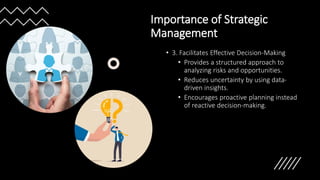
• 3. Facilitates Effective Decision-Making
• Provides a structured approach to
analyzing risks and opportunities.
• Reduces uncertainty by using data-
driven insights.
• Encourages proactive planning instead
of reactive decision-making.
Importance of Strategic
Management
• 4. Promotes Innovation and
Adaptability
• Encourages businesses to
embrace digital transformation
and technological advancements.
• Supports business model
evolution and new market
expansion.
• Helps firms navigate industry
disruptions and economic
fluctuations.
Importance of
Strategic Management
Importance of Strategic
Management
Importance of
Strategic Management
• 7. Aligns Business with Ethical and
Social Responsibility
• Encourages ethical business
practices and corporate
governance.
• Enhances brand reputation and
stakeholder trust.
• Promotes transparency and
accountability in decision-
making.
Real-World Applications
of Strategic Management
• 1. Apple Inc. – Innovation-Driven
Strategy
• Apple applies strategic management
principles to remain a leader in
technology and innovation.
• Uses a differentiation strategy by
focusing on premium design and
user experience.
• Adapts to global market trends by
investing in research and
development (R&D).
Real-World Applications
of Strategic
Management
Real-World Applications of
Strategic Management
• 3. Unilever – Sustainable Business Strategy
• Unilever integrates strategic management
by:
• Implementing sustainable sourcing
and ethical labor policies.
• Reducing plastic waste and carbon
footprint in its supply chain.
• These examples demonstrate how
strategic management enables companies
to innovate, expand, and maintain a
competitive edge in their respective
industries.
Conclusion
Evolution of
Strategic
Management
Evolution of Strategic Management
• Strategic management has evolved significantly over the years,
influenced by economic, technological, and organizational
developments. This evolution can be categorized into distinct
phases that reflect changes in management thinking and business
challenges.
• 1. Early Foundations (Pre-1950s)
• Before strategic management became a formal discipline, business
leaders relied on financial planning and operational efficiency to
drive success. Key characteristics of this period include:
• Emphasis on budgeting and cost control.
• Focus on short-term planning rather than long-term strategy.
• Businesses operated in relatively stable environments with
minimal competition.
Evolution of Strategic
Management
• 2. Long-Range Planning (1950s-1960s)
• As markets became more complex,
businesses began forecasting future
trends and planning for long-term growth.
This era saw the emergence of:
• Long-range planning models to
anticipate future industry conditions.
• The application of quantitative
techniques for decision-making.
• Growth strategies focusing on
diversification and expansion.
Evolution of Strategic
Management
• 3. Strategic Planning (1970s-1980s)
• With increased globalization and
competition, businesses shifted toward a
proactive strategic approach. This period
introduced:
• The formalization of strategic
planning frameworks.
• The rise of SWOT Analysis (Strengths,
Weaknesses, Opportunities, Threats).
• Michael Porter’s Competitive
Strategy Model, including Five Forces
Analysis and Generic Strategies.
Evolution of Strategic
Management
• 4. Strategic Management (1990s-Present)
• The modern era of strategic management
emphasizes adaptability, innovation, and
sustainability. Key developments include:
• Resource-Based View (RBV): Organizations
focus on developing unique capabilities and
competitive advantages.
• Digital Transformation: Technology and data
analytics play a crucial role in decision-
making.
• Agile and Adaptive Strategies: Companies
must respond quickly to changing market
conditions.
• Corporate Social Responsibility (CSR): Ethical
considerations and sustainability are integral
to long-term strategy.
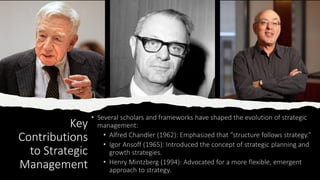
Key
Contributions
to Strategic
Management
Conclusion
• Strategic management has evolved from basic
financial planning to a sophisticated discipline
integrating competitive analysis, resource-
based strategy, and innovation. Today,
organizations must:
• Adapt to dynamic market conditions.
• Leverage technology for strategic decision-
making.
• Incorporate sustainability and ethical
considerations.
• Understanding the evolution of strategic
management provides businesses with
valuable insights into best practices for
achieving long-term success in an increasingly
competitive and complex global economy.
Strategic
Management
Process
Strategic Management
Process
• Strategic management consists of four
interrelated stages:
• 1. Environmental Scanning
• The process of assessing external
and internal factors that impact
the organization.
• Tools used include SWOT Analysis
(Strengths, Weaknesses,
Opportunities, Threats), PESTEL
Analysis, and Porter’s Five Forces.
Strategic
Management Process
• 2. Strategy Formulation
• Developing strategies based
on environmental analysis.
• Involves setting corporate,
business, and functional-level
strategies such as cost
leadership, differentiation,
and focus strategies.
Strategic
Management
Process
• 3. Strategy Implementation
• Converting strategies
into actions through
resource allocation and
organizational
restructuring.
• Requires strong
leadership, cultural
alignment, and
motivation to ensure
success.
Strategic Management
Process
• 4. Strategy Evaluation and Control
• Monitoring progress and adjusting
strategies as needed.
• Uses performance measurement
tools like the Balanced Scorecard
and Key Performance Indicators
(KPIs).
Importance of the Strategic
Management Process
• The strategic management process is
crucial for several reasons:
• Adaptation to Changing Market
Conditions: Through
environmental scanning and
ongoing evaluation, organizations
can remain agile and responsive
to market shifts.
Importance of the
Strategic Management
Process
Importance of the Strategic
Management Process
• Sustaining Competitive
Advantage: Proactive
strategy development
helps businesses maintain
a competitive edge by
capitalizing on emerging
opportunities and
addressing potential
threats before they
materialize.
Importance of the Strategic
Management Process
• Alignment with Long-Term
Goals: The process
ensures that day-to-day
operations and decisions
are aligned with broader
strategic objectives,
driving long-term success.
CONCLUSION
• By following a structured approach to strategic management, organizations can not only
navigate challenges and seize new opportunities but also ensure they are prepared for
future growth and sustainability in an increasingly complex and competitive global
landscape.
Reference
• Wheelen, T. L., Hunger, J. D., Hoffman,
A. N., & Bamford, C. E. (2018).
Strategic Management and Business
Policy: Globalization, Innovation, and
Sustainability (15th ed.). Pearson
Education.
To God be the Glory!
Prepared by :
Rommel R. Regala, Ph.D.

Chapter 1. Basic Concepts of Strategic Management.pdf

  • 1.
    Strategic Management CBME 2 Professor:Rommel R. Regala, Ph.D. Sorsogon State University
  • 2.
    Basic Concepts ofStrategic Management
  • 3.
  • 4.
    Definition of Strategic Management •Strategic management is the process of formulating, implementing, and evaluating strategies that enable an organization to achieve its objectives and maintain a competitive advantage. According to Wheelen, Hunger, Hoffman, and Bamford (2018), strategic management is: • "A set of managerial decisions and actions that determines the long-run performance of an organization by integrating environmental analysis, strategy formulation, implementation, and evaluation." • This definition highlights the dynamic and continuous nature of strategic management, emphasizing its role in sustaining long-term organizational success.
  • 5.
    Importance of Strategic Management •Strategic management is essential for organizations to remain competitive, optimize performance, and adapt to market changes. The following are key reasons why it is important: • 1. Provides Clear Vision and Direction • Establishes a long-term roadmap for the organization. • Helps leaders align decisions with the company's mission and vision. • Ensures consistency in strategic decision- making.
  • 6.
    Importance of Strategic Management •2. Enhances Competitive Advantage • Enables firms to differentiate themselves in the market. • Supports the development of core competencies and sustainable market positioning. • Helps businesses anticipate and respond to industry trends.
  • 7.
    Importance of Strategic Management •3. Facilitates Effective Decision-Making • Provides a structured approach to analyzing risks and opportunities. • Reduces uncertainty by using data- driven insights. • Encourages proactive planning instead of reactive decision-making.
  • 8.
    Importance of Strategic Management •4. Promotes Innovation and Adaptability • Encourages businesses to embrace digital transformation and technological advancements. • Supports business model evolution and new market expansion. • Helps firms navigate industry disruptions and economic fluctuations.
  • 9.
  • 10.
  • 11.
    Importance of Strategic Management •7. Aligns Business with Ethical and Social Responsibility • Encourages ethical business practices and corporate governance. • Enhances brand reputation and stakeholder trust. • Promotes transparency and accountability in decision- making.
  • 12.
    Real-World Applications of StrategicManagement • 1. Apple Inc. – Innovation-Driven Strategy • Apple applies strategic management principles to remain a leader in technology and innovation. • Uses a differentiation strategy by focusing on premium design and user experience. • Adapts to global market trends by investing in research and development (R&D).
  • 13.
  • 14.
    Real-World Applications of StrategicManagement • 3. Unilever – Sustainable Business Strategy • Unilever integrates strategic management by: • Implementing sustainable sourcing and ethical labor policies. • Reducing plastic waste and carbon footprint in its supply chain. • These examples demonstrate how strategic management enables companies to innovate, expand, and maintain a competitive edge in their respective industries.
  • 15.
  • 16.
  • 17.
    Evolution of StrategicManagement • Strategic management has evolved significantly over the years, influenced by economic, technological, and organizational developments. This evolution can be categorized into distinct phases that reflect changes in management thinking and business challenges. • 1. Early Foundations (Pre-1950s) • Before strategic management became a formal discipline, business leaders relied on financial planning and operational efficiency to drive success. Key characteristics of this period include: • Emphasis on budgeting and cost control. • Focus on short-term planning rather than long-term strategy. • Businesses operated in relatively stable environments with minimal competition.
  • 18.
    Evolution of Strategic Management •2. Long-Range Planning (1950s-1960s) • As markets became more complex, businesses began forecasting future trends and planning for long-term growth. This era saw the emergence of: • Long-range planning models to anticipate future industry conditions. • The application of quantitative techniques for decision-making. • Growth strategies focusing on diversification and expansion.
  • 19.
    Evolution of Strategic Management •3. Strategic Planning (1970s-1980s) • With increased globalization and competition, businesses shifted toward a proactive strategic approach. This period introduced: • The formalization of strategic planning frameworks. • The rise of SWOT Analysis (Strengths, Weaknesses, Opportunities, Threats). • Michael Porter’s Competitive Strategy Model, including Five Forces Analysis and Generic Strategies.
  • 20.
    Evolution of Strategic Management •4. Strategic Management (1990s-Present) • The modern era of strategic management emphasizes adaptability, innovation, and sustainability. Key developments include: • Resource-Based View (RBV): Organizations focus on developing unique capabilities and competitive advantages. • Digital Transformation: Technology and data analytics play a crucial role in decision- making. • Agile and Adaptive Strategies: Companies must respond quickly to changing market conditions. • Corporate Social Responsibility (CSR): Ethical considerations and sustainability are integral to long-term strategy.
  • 21.
  • 22.
    Conclusion • Strategic managementhas evolved from basic financial planning to a sophisticated discipline integrating competitive analysis, resource- based strategy, and innovation. Today, organizations must: • Adapt to dynamic market conditions. • Leverage technology for strategic decision- making. • Incorporate sustainability and ethical considerations. • Understanding the evolution of strategic management provides businesses with valuable insights into best practices for achieving long-term success in an increasingly competitive and complex global economy.
  • 23.
  • 24.
    Strategic Management Process • Strategicmanagement consists of four interrelated stages: • 1. Environmental Scanning • The process of assessing external and internal factors that impact the organization. • Tools used include SWOT Analysis (Strengths, Weaknesses, Opportunities, Threats), PESTEL Analysis, and Porter’s Five Forces.
  • 25.
    Strategic Management Process • 2.Strategy Formulation • Developing strategies based on environmental analysis. • Involves setting corporate, business, and functional-level strategies such as cost leadership, differentiation, and focus strategies.
  • 26.
    Strategic Management Process • 3. StrategyImplementation • Converting strategies into actions through resource allocation and organizational restructuring. • Requires strong leadership, cultural alignment, and motivation to ensure success.
  • 27.
    Strategic Management Process • 4.Strategy Evaluation and Control • Monitoring progress and adjusting strategies as needed. • Uses performance measurement tools like the Balanced Scorecard and Key Performance Indicators (KPIs).
  • 28.
    Importance of theStrategic Management Process • The strategic management process is crucial for several reasons: • Adaptation to Changing Market Conditions: Through environmental scanning and ongoing evaluation, organizations can remain agile and responsive to market shifts.
  • 29.
    Importance of the StrategicManagement Process
  • 30.
    Importance of theStrategic Management Process • Sustaining Competitive Advantage: Proactive strategy development helps businesses maintain a competitive edge by capitalizing on emerging opportunities and addressing potential threats before they materialize.
  • 31.
    Importance of theStrategic Management Process • Alignment with Long-Term Goals: The process ensures that day-to-day operations and decisions are aligned with broader strategic objectives, driving long-term success.
  • 32.
    CONCLUSION • By followinga structured approach to strategic management, organizations can not only navigate challenges and seize new opportunities but also ensure they are prepared for future growth and sustainability in an increasingly complex and competitive global landscape.
  • 33.
    Reference • Wheelen, T.L., Hunger, J. D., Hoffman, A. N., & Bamford, C. E. (2018). Strategic Management and Business Policy: Globalization, Innovation, and Sustainability (15th ed.). Pearson Education.
  • 34.
    To God bethe Glory! Prepared by : Rommel R. Regala, Ph.D.