TROMBOCITOPENIA  asociado  al  EMBARAZO Pedro García Lázaro Hematólogo clínico HNAAA Chiclayo,10 de julio del 2007
TROMBOCITOPENIA Y EMBARAZO:EPIDEMIOLOGIA Estudios prospectivos (nivell evidencia III): plaquetas 120,000-150,000/ul no son incomunes III-trimestre Afecta al 7% de todos los embarazos 1357 embarazadas-parto a término: Promedio: 225,000/ul Intervalo confianza 95%:109,000-341,000 Disminución fisiológica
DIAGNOSTICO DIFERENCIAL Isolated thrombocytopenia        Gestational :74%     Immune (ITP) :4%     Drug-induced      Type IIb von Willebrand disease      Congenital  Thrombocytopenia associated with systemic disorders   Pregnancy-specific : 21%   Preeclampsia       HELLP (hemolysis, elevated liver function tests, low platelets syndrome)          Acute fatty liver     
DIAGNOSTICO DIFERENCIAL Not pregnancy specific : Thrombotic microangiopathies: Thrombotic  thrombocytopenic  purpura (PTT) Hemolytic uremic syndrome (SUH) Systemic lupus erythematosus (LES) Antiphospholipid antibodies (SAF) Disseminated intravascular coagulation (CID) Viral infection (human immunodeficiency virus [HIV],Epstein-Barr virus [EBV], cytomegalovirus [CMV])  Bone marrow dysfunction  Nutritional deficiency Hypersplenism
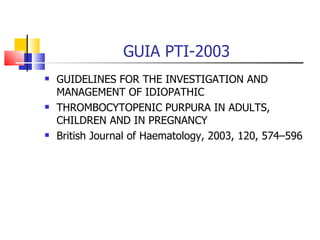
GUIA PTI-2003 GUIDELINES FOR THE INVESTIGATION AND MANAGEMENT OF IDIOPATHIC THROMBOCYTOPENIC PURPURA IN ADULTS, CHILDREN AND IN PREGNANCY British Journal of Haematology, 2003, 120, 574–596
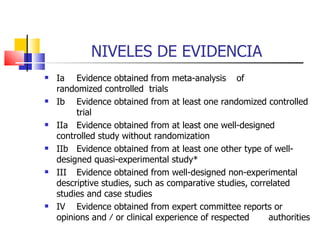
NIVELES DE EVIDENCIA Ia  Evidence obtained from meta-analysis  of  randomized  controlled  trials Ib  Evidence obtained from at least one randomized  controlled  trial IIa  Evidence obtained from at least one well-designed  controlled study without randomization IIb  Evidence obtained from at least one other type of  well- designed quasi-experimental study* III  Evidence obtained from well-designed non-experimental  descriptive studies, such as comparative studies, correlated  studies and case studies IV  Evidence obtained from expert committee reports or  opinions and ⁄ or clinical experience of respected  authorities
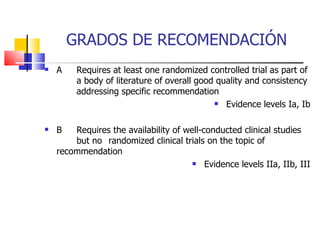
GRADOS DE RECOMENDACIÓN A  Requires at least one r andomized controlled trial  as part of  a body of literature of overall good quality and  consistency  addressing specific recommendation Evidence levels Ia, Ib B  Requires the availability of  well-conducted clinical studies  but no  randomized  clinical trials on the topic  of  recommendation Evidence levels IIa, IIb, III
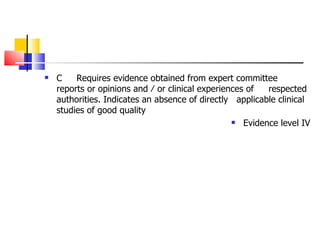
C Requires evidence obtained from expert committee  reports  or opinions and ⁄ or clinical  experiences of  respected  authorities. Indicates an absence of directly  applicable  clinical studies of good quality Evidence level IV
LABORATORIO:PLAQUETAS<100,000(recomendación GRADO C) Blood film (to exclude spurious thrombocytopenia, red cell  fragments, other haematological disorders) Coagulation screen (PT, APTT, fibrinogen, D-dimer) Liver function tests Anticardiolipin antibodies ⁄ lupus anticoagulant SLE serology No se recomienda anticuerpos antiplaquetarios!!! No necesario aspirado médula ósea
Trombocitopenia Gestacional >75% todos los casos trombocitopenia –embarazo Patogenesis:Efectos de hemodilución o depuración acelerada de plaquetas x mecanismos inmunes o no inmunes.  CARACTERISTICAS: trombocitopenia leve (raro < 80,000/ul) Gestantes saludables con resto cuentas sanguíneas normales Ocurre comúnmente en III trimestre Plaquetas normales antes y después del embarazo No se asocia con hemorragia materna
No se asocia con hemorragia fetal o neonatal Trombocitopenia Gestacional es díficil distinguir de PTI:  cuando trombocitopenia es identificada por primera vez durante embarazo cuentas previas de plaquetas:no están documentadas, no historia previa de PTI MANEJO Cuidado obstétrico estandar Parto con analgesia epidural si lo requiere
Púrpura trombocitopénica inmune Causa mas común de trombocitopenia significativa en I trimestre 1 caso x 1000 embarazos 5% de casos de trombocitopenia-embarazo PATOGENESIS: Anticuerpos contra glicoproteínas plaquetarias GPIIb/IIIa y GP Ib/IX Depuración de estas plaquetas cubiertas por Ig-G x RES
PTI: DIAGNÓSTICO Diagnóstico por exclusión Historia previa de trombocitopenia Trombocitopenia moderada a severa:<50,000 En ausencia de cuentas plaquetarias pre-gestacionales, instalación de trombocitopenia tempranamente en el embarazo, con declinación mayor según progresa el embarazo. No necesario AMO No anticuerpos antiplaquetarios
TRATAMIENTO
Recommendation: (All Grade C) Asymptomatic women with platelet counts > 20 x 109  ⁄ l do not need treatment until delivery is imminent Platelet counts >50 x 109  ⁄ l are safe for normal  vaginal delivery in patients with otherwise normal  coagulation Platelet counts > 80 x 109 ⁄ l  are safe for caesarean  section, spinal or epidural anaesthesia in patients with  otherwise normal coagulation
Recommendation: (All Grade C) In women who need treatment , both oral corticosteroids and IVIg appear to have a similar response rate to the use of these agents in the non-pregnant patient Although many clinicians now favour the use of IVIg in pregnancy there are no good comparative studies and the decision must take into account maternal clinical factors and preference in addition to the expense, availability and (remote) risks of microbial  transmission by IVIg.
Recommendation: (All Grade C) There are no convincing data on the effect (beneficial or otherwise) of corticosteroids or IVIg on the  fetal ⁄ neonatal platelet count. Severe refractory ITP may respond to high dose IV methyl prednisolone ± IVIg or azathioprine. If essential, splenectomy may be performed (ideally in the second trimester) and the laparoscopic route may have clinical advantages similar to those seen in non pregnant patients
The mode of delivery  in women with ITP should be decided by primarily obstetric indications. There is no evidence to support the routine use of caesarean  section (Grade B) Women undergoing operative delivery should be considered for thromboprophylaxis according to their individual clinical risk factors. Standard prophylactic doses of UFH or LMW heparin should be used if the  maternal platelet count is > 100 x 109 ⁄ l (Grade C)
Non-steroidal anti-inflammatory drugs should be avoided  for post-partum or post-operative analgesia in women with platelet counts < 100 x109 ⁄ l (Grade C) The risk of clinically dangerous thrombocytopenia in the neonate is very low but cannot be predicted by clinical or laboratory parameters in the mother. Attempts to measure the fetal platelet count by cordocentesis or fetal scalp blood sampling are not recommended as they carry more risks than potential  clinical benefits (Grade B)
Because of the risk of haemorrhagic complications in the neonate the application of scalp electrodes for monitoring in labour and fetal blood sampling should be avoided. The use of vacuum extraction (ventouse) is contraindicated and complicated instrumental delivery (e.g. rotational forceps) should be avoided if possible  (Grade C) •  Cord platelet counts should be measured in all neonates of mothers with ITP and those with subnormal levels monitored clinically and with daily counts until after the nadir which usually occurs on d 2–5  after delivery (Grade C)
Treatment of the thrombocytopenic neonate should be reserved for those with clinical evidence of haemorrhage  or a platelet count < 20 x109 ⁄ l when there is  usually a prompt response to IVIg (1 g ⁄ kg).  Lifethreatening haemorrhage should be treated with immediate platelet transfusion and IVIg (Grade C).
CONCLUSIONES PTI debe ser diferenciado de la trombocitopenia gestacional. A pesar de que las plaquetas disminuyen en gestantes con PTI, una severa morbilidad y mortalidad es característicamente incomún para las madres Frecuencia global de trombocitopenia en el infante es muy baja  6-10% infantes <50,000 5% infantes <20,000 plaquetas  <1% -complicaciones de sangrado severos
GRACIAS

PTI

  • 1.
    TROMBOCITOPENIA asociado al EMBARAZO Pedro García Lázaro Hematólogo clínico HNAAA Chiclayo,10 de julio del 2007
  • 2.
    TROMBOCITOPENIA Y EMBARAZO:EPIDEMIOLOGIAEstudios prospectivos (nivell evidencia III): plaquetas 120,000-150,000/ul no son incomunes III-trimestre Afecta al 7% de todos los embarazos 1357 embarazadas-parto a término: Promedio: 225,000/ul Intervalo confianza 95%:109,000-341,000 Disminución fisiológica
  • 3.
    DIAGNOSTICO DIFERENCIAL Isolatedthrombocytopenia       Gestational :74%     Immune (ITP) :4%     Drug-induced      Type IIb von Willebrand disease      Congenital Thrombocytopenia associated with systemic disorders Pregnancy-specific : 21%   Preeclampsia       HELLP (hemolysis, elevated liver function tests, low platelets syndrome)          Acute fatty liver     
  • 4.
    DIAGNOSTICO DIFERENCIAL Notpregnancy specific : Thrombotic microangiopathies: Thrombotic thrombocytopenic purpura (PTT) Hemolytic uremic syndrome (SUH) Systemic lupus erythematosus (LES) Antiphospholipid antibodies (SAF) Disseminated intravascular coagulation (CID) Viral infection (human immunodeficiency virus [HIV],Epstein-Barr virus [EBV], cytomegalovirus [CMV]) Bone marrow dysfunction Nutritional deficiency Hypersplenism
  • 5.
    GUIA PTI-2003 GUIDELINESFOR THE INVESTIGATION AND MANAGEMENT OF IDIOPATHIC THROMBOCYTOPENIC PURPURA IN ADULTS, CHILDREN AND IN PREGNANCY British Journal of Haematology, 2003, 120, 574–596
  • 6.
    NIVELES DE EVIDENCIAIa Evidence obtained from meta-analysis of randomized controlled trials Ib Evidence obtained from at least one randomized controlled trial IIa Evidence obtained from at least one well-designed controlled study without randomization IIb Evidence obtained from at least one other type of well- designed quasi-experimental study* III Evidence obtained from well-designed non-experimental descriptive studies, such as comparative studies, correlated studies and case studies IV Evidence obtained from expert committee reports or opinions and ⁄ or clinical experience of respected authorities
  • 7.
    GRADOS DE RECOMENDACIÓNA Requires at least one r andomized controlled trial as part of a body of literature of overall good quality and consistency addressing specific recommendation Evidence levels Ia, Ib B Requires the availability of well-conducted clinical studies but no randomized clinical trials on the topic of recommendation Evidence levels IIa, IIb, III
  • 8.
    C Requires evidenceobtained from expert committee reports or opinions and ⁄ or clinical experiences of respected authorities. Indicates an absence of directly applicable clinical studies of good quality Evidence level IV
  • 9.
    LABORATORIO:PLAQUETAS<100,000(recomendación GRADO C)Blood film (to exclude spurious thrombocytopenia, red cell fragments, other haematological disorders) Coagulation screen (PT, APTT, fibrinogen, D-dimer) Liver function tests Anticardiolipin antibodies ⁄ lupus anticoagulant SLE serology No se recomienda anticuerpos antiplaquetarios!!! No necesario aspirado médula ósea
  • 10.
    Trombocitopenia Gestacional >75%todos los casos trombocitopenia –embarazo Patogenesis:Efectos de hemodilución o depuración acelerada de plaquetas x mecanismos inmunes o no inmunes. CARACTERISTICAS: trombocitopenia leve (raro < 80,000/ul) Gestantes saludables con resto cuentas sanguíneas normales Ocurre comúnmente en III trimestre Plaquetas normales antes y después del embarazo No se asocia con hemorragia materna
  • 11.
    No se asociacon hemorragia fetal o neonatal Trombocitopenia Gestacional es díficil distinguir de PTI: cuando trombocitopenia es identificada por primera vez durante embarazo cuentas previas de plaquetas:no están documentadas, no historia previa de PTI MANEJO Cuidado obstétrico estandar Parto con analgesia epidural si lo requiere
  • 12.
    Púrpura trombocitopénica inmuneCausa mas común de trombocitopenia significativa en I trimestre 1 caso x 1000 embarazos 5% de casos de trombocitopenia-embarazo PATOGENESIS: Anticuerpos contra glicoproteínas plaquetarias GPIIb/IIIa y GP Ib/IX Depuración de estas plaquetas cubiertas por Ig-G x RES
  • 13.
    PTI: DIAGNÓSTICO Diagnósticopor exclusión Historia previa de trombocitopenia Trombocitopenia moderada a severa:<50,000 En ausencia de cuentas plaquetarias pre-gestacionales, instalación de trombocitopenia tempranamente en el embarazo, con declinación mayor según progresa el embarazo. No necesario AMO No anticuerpos antiplaquetarios
  • 14.
  • 15.
    Recommendation: (All GradeC) Asymptomatic women with platelet counts > 20 x 109 ⁄ l do not need treatment until delivery is imminent Platelet counts >50 x 109 ⁄ l are safe for normal vaginal delivery in patients with otherwise normal coagulation Platelet counts > 80 x 109 ⁄ l are safe for caesarean section, spinal or epidural anaesthesia in patients with otherwise normal coagulation
  • 16.
    Recommendation: (All GradeC) In women who need treatment , both oral corticosteroids and IVIg appear to have a similar response rate to the use of these agents in the non-pregnant patient Although many clinicians now favour the use of IVIg in pregnancy there are no good comparative studies and the decision must take into account maternal clinical factors and preference in addition to the expense, availability and (remote) risks of microbial transmission by IVIg.
  • 17.
    Recommendation: (All GradeC) There are no convincing data on the effect (beneficial or otherwise) of corticosteroids or IVIg on the fetal ⁄ neonatal platelet count. Severe refractory ITP may respond to high dose IV methyl prednisolone ± IVIg or azathioprine. If essential, splenectomy may be performed (ideally in the second trimester) and the laparoscopic route may have clinical advantages similar to those seen in non pregnant patients
  • 18.
    The mode ofdelivery in women with ITP should be decided by primarily obstetric indications. There is no evidence to support the routine use of caesarean section (Grade B) Women undergoing operative delivery should be considered for thromboprophylaxis according to their individual clinical risk factors. Standard prophylactic doses of UFH or LMW heparin should be used if the maternal platelet count is > 100 x 109 ⁄ l (Grade C)
  • 19.
    Non-steroidal anti-inflammatory drugsshould be avoided for post-partum or post-operative analgesia in women with platelet counts < 100 x109 ⁄ l (Grade C) The risk of clinically dangerous thrombocytopenia in the neonate is very low but cannot be predicted by clinical or laboratory parameters in the mother. Attempts to measure the fetal platelet count by cordocentesis or fetal scalp blood sampling are not recommended as they carry more risks than potential clinical benefits (Grade B)
  • 20.
    Because of therisk of haemorrhagic complications in the neonate the application of scalp electrodes for monitoring in labour and fetal blood sampling should be avoided. The use of vacuum extraction (ventouse) is contraindicated and complicated instrumental delivery (e.g. rotational forceps) should be avoided if possible (Grade C) • Cord platelet counts should be measured in all neonates of mothers with ITP and those with subnormal levels monitored clinically and with daily counts until after the nadir which usually occurs on d 2–5 after delivery (Grade C)
  • 21.
    Treatment of thethrombocytopenic neonate should be reserved for those with clinical evidence of haemorrhage or a platelet count < 20 x109 ⁄ l when there is usually a prompt response to IVIg (1 g ⁄ kg). Lifethreatening haemorrhage should be treated with immediate platelet transfusion and IVIg (Grade C).
  • 22.
    CONCLUSIONES PTI debeser diferenciado de la trombocitopenia gestacional. A pesar de que las plaquetas disminuyen en gestantes con PTI, una severa morbilidad y mortalidad es característicamente incomún para las madres Frecuencia global de trombocitopenia en el infante es muy baja 6-10% infantes <50,000 5% infantes <20,000 plaquetas <1% -complicaciones de sangrado severos
  • 23.