PTA Data Presentation
By: Dustin James and Michelle Carter
Introduction
• Our mission is to provide the highest degree of
instructional excellence while recognizing the
unique needs and developing the abilities of
every student. Through the cooperative efforts
of family, school, and community, students will
prepare to be responsible, productive citizens
and lifelong learners.
(River Ridge Middle School, 2013)
Data Analysis
65
57
47
71
59 61
0
10
20
30
40
50
60
70
80
6th Grade 7th Grade 8th Grade
PercentScoringLevel3andabove
2011 FCAT Reading
Smith Middle
District
Data Analysis
61 59 60 58
65
42
56
61 61
57
32
37
42
55
47
0
10
20
30
40
50
60
70
2007 2008 2009 2010 2011
PercentScoringLevel3orabove
FCAT READING
6th Grade
7th Grade
8th Grade
Improvement Plan
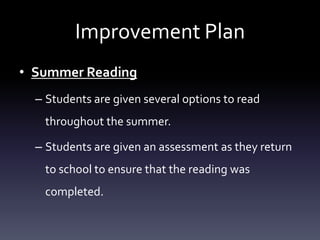
• Summer Reading
– Students are given several options to read
throughout the summer.
– Students are given an assessment as they return
to school to ensure that the reading was
completed.
Improvement Plan
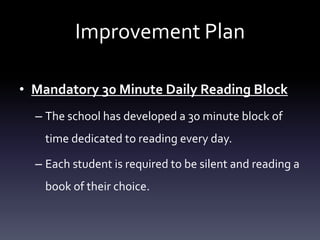
• Mandatory 30 Minute Daily Reading Block
– The school has developed a 30 minute block of
time dedicated to reading every day.
– Each student is required to be silent and reading a
book of their choice.
Partners in Education
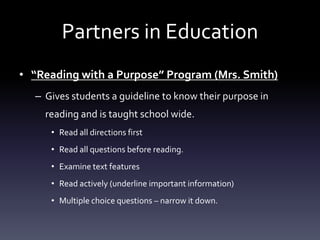
• “Reading with a Purpose” Program (Mrs. Smith)
– Gives students a guideline to know their purpose in
reading and is taught school wide.
• Read all directions first
• Read all questions before reading.
• Examine text features
• Read actively (underline important information)
• Multiple choice questions – narrow it down.
Reference
River Ridge Middle School. (2013). Open house powerpoint.
Retrieved from http://rrms.pasco.k12.fl.us/?page_id=1525
The Reading Genie. (2013). Developing Reading Fluency. Retrieved
from http://www.auburn.edu/~murraba/fluency.html
How to be a Successful Student. (1991). The Purpose of Reading.
Retrieved from
http://www.iwu.edu/advising/students/reading_comprehension.pdf

Pta data presentation 2

  • 1.
    PTA Data Presentation By:Dustin James and Michelle Carter
  • 2.
    Introduction • Our missionis to provide the highest degree of instructional excellence while recognizing the unique needs and developing the abilities of every student. Through the cooperative efforts of family, school, and community, students will prepare to be responsible, productive citizens and lifelong learners. (River Ridge Middle School, 2013)
  • 3.
    Data Analysis 65 57 47 71 59 61 0 10 20 30 40 50 60 70 80 6thGrade 7th Grade 8th Grade PercentScoringLevel3andabove 2011 FCAT Reading Smith Middle District
  • 4.
    Data Analysis 61 5960 58 65 42 56 61 61 57 32 37 42 55 47 0 10 20 30 40 50 60 70 2007 2008 2009 2010 2011 PercentScoringLevel3orabove FCAT READING 6th Grade 7th Grade 8th Grade
  • 5.
    Improvement Plan • SummerReading – Students are given several options to read throughout the summer. – Students are given an assessment as they return to school to ensure that the reading was completed.
  • 6.
    Improvement Plan • Mandatory30 Minute Daily Reading Block – The school has developed a 30 minute block of time dedicated to reading every day. – Each student is required to be silent and reading a book of their choice.
  • 7.
    Partners in Education •“Reading with a Purpose” Program (Mrs. Smith) – Gives students a guideline to know their purpose in reading and is taught school wide. • Read all directions first • Read all questions before reading. • Examine text features • Read actively (underline important information) • Multiple choice questions – narrow it down.
  • 8.
    Reference River Ridge MiddleSchool. (2013). Open house powerpoint. Retrieved from http://rrms.pasco.k12.fl.us/?page_id=1525 The Reading Genie. (2013). Developing Reading Fluency. Retrieved from http://www.auburn.edu/~murraba/fluency.html How to be a Successful Student. (1991). The Purpose of Reading. Retrieved from http://www.iwu.edu/advising/students/reading_comprehension.pdf

Editor's Notes

  • #3 Welcome! Tonight we are meeting to discuss and review 2011 FCAT data. As you are aware, our goal at Smith Middle School is to provide the highest degree of instructional excellence while recognizing the unique needs and developing the abilities of every student. It is through the cooperative efforts of family, school, and community, that students will prepare to be responsible, productive citizens and life longer learners. I know that together as a unit we are partners in education. In order to foster that partnership, I want to share with you some valuable data from our students most recent FCAT assessment, discuss how our data compares to the district’s data, and share our instructional improvement plan.
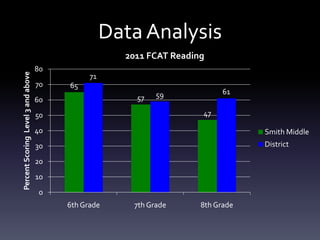
  • #4 Last year, our students took the FCAT Reading, Writing, Math, and Science. Tonight, we are going to focus on how our students scored in the FCAT reading section. Let’s first look at how our students scored compared to the students in the district. This chart shows the percent of students in each grade that scored a level 3, 4, or 5 on the Reading section of the FCAT. Level 3 is considered proficient, so this is our goal for all students at Smith Middle. As you can see, Smith Middle students, shown in green, scored below the district average, shown in blue, in every grade. The most obvious disparity is in the 8th grade. Only 47% of students at Smith Middle scored a level 3 or above compared to 61% across the district.
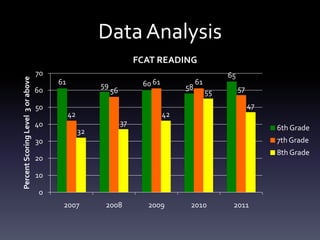
  • #5 Looking further at the data, we can see that not only is the 8th grade body below district percent, but they have been consistently below, often times far below, the 6th and 7th grade students. While we have seen much improvement from 2007 when only 32% of our students were scoring proficient, we still have a ways to go in order to get our 8th graders meeting proficiency in reading. We, as a staff, have worked feverishly to develop a plan that will bring our 8th grade students up to where they need to be.
  • #6 We attempt to get the students involved with reading before they enter the Language Arts classroom. A reading list is sent to all students at the beginning of the summer with several options for them to read. Upon returning to school in the fall the students are expected to have read one of the offered books and be prepared to be assessed on the book. This continued practice of reading will help the students obtain fluency in reading (Reading Genie, p. 5).It is vitally important for us, as the school, to work with you parents at home to ensure the best outcomes for your students. We appreciate all of the support that you are showing your child by coming tonight and we further appreciate your help when it comes to encouraging reading at home.We have had great input from students as to what type of books that they would enjoy to read throughout the summer. For example, last year we had a committee of Randall Johnson, Emily Jones, Annie Williams, Ben Griffith, Holly Compton, and Trent Beasley that were vital in helping the Language Arts department choose the books to read in the summer.
  • #7 Another improvement plan that we have implemented is a 30 minute daily reading block. As administrators, we have been hearing from our teachers that we could help the students in reading by actually giving them a chance to read during the school day (Reading Genie, p. 5) Being dedicated to our students’ improvement we have made this possible. We have set aside 30 minutes every day for the classroom to be totally quiet while students have a chance to read for pleasure. Teachers are provided a class library of 40 books for the students to pick from if they do not have a book to read.
  • #8 Finally, we have embraced a program called “Reading with a Purpose” (Martin, 1991, p.1). The program helps students to focus on answering the question of “why” they are reading. This program has been amazingly implemented, school wide, with Mrs. Smith heading up the efforts. Mrs. Smith is the department head of our Language Arts department. This program is introduced by in the students’ Language Arts classes at the beginning of the school year so that it can be used in each of their academic classes. The program focuses on 5 bullet points that normally hinder performance in the reading comprehension of the students. The focus of this program is below:Read all directions first.Read all questions before reading.Examine text features.Read actively (underline important information)Narrow down multiple choice questions. Eliminate “dumb” answersLook for answers with vocabulary from the textIdentify possible distractorsNever guess! Pick the most logical answer.
  • #9 Take this slide out of the final powerpoint, but I needed a place to put my reference 