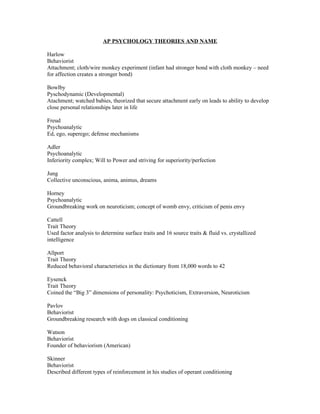

AP PSYCHOLOGY THEORIES AND NAME

Harlow
Behaviorist
Attachment; cloth/wire monkey experiment (infant had stronger bond with cloth monkey – need
for affection creates a stronger bond)

Bowlby
Pyschodynamic (Developmental)
Atachment; watched babies, theorized that secure attachment early on leads to ability to develop
close personal relationships later in life

Freud
Psychoanalytic
Ed, ego, superego; defense mechanisms

Adler
Psychoanalytic
Inferiority complex; Will to Power and striving for superiority/perfection

Jung
Collective unconscious, anima, animus, dreams

Horney
Psychoanalytic
Groundbreaking work on neuroticism; concept of womb envy, criticism of penis envy

Cattell
Trait Theory
Used factor analysis to determine surface traits and 16 source traits & fluid vs. crystallized
intelligence

Allport
Trait Theory
Reduced behavioral characteristics in the dictionary from 18,000 words to 42

Eysenck
Trait Theory
Coined the “Big 3” dimensions of personality: Psychoticism, Extraversion, Neuroticism

Pavlov
Behaviorist
Groundbreaking research with dogs on classical conditioning

Watson
Behaviorist
Founder of behaviorism (American)

Skinner
Behaviorist
Described different types of reinforcement in his studies of operant conditioning
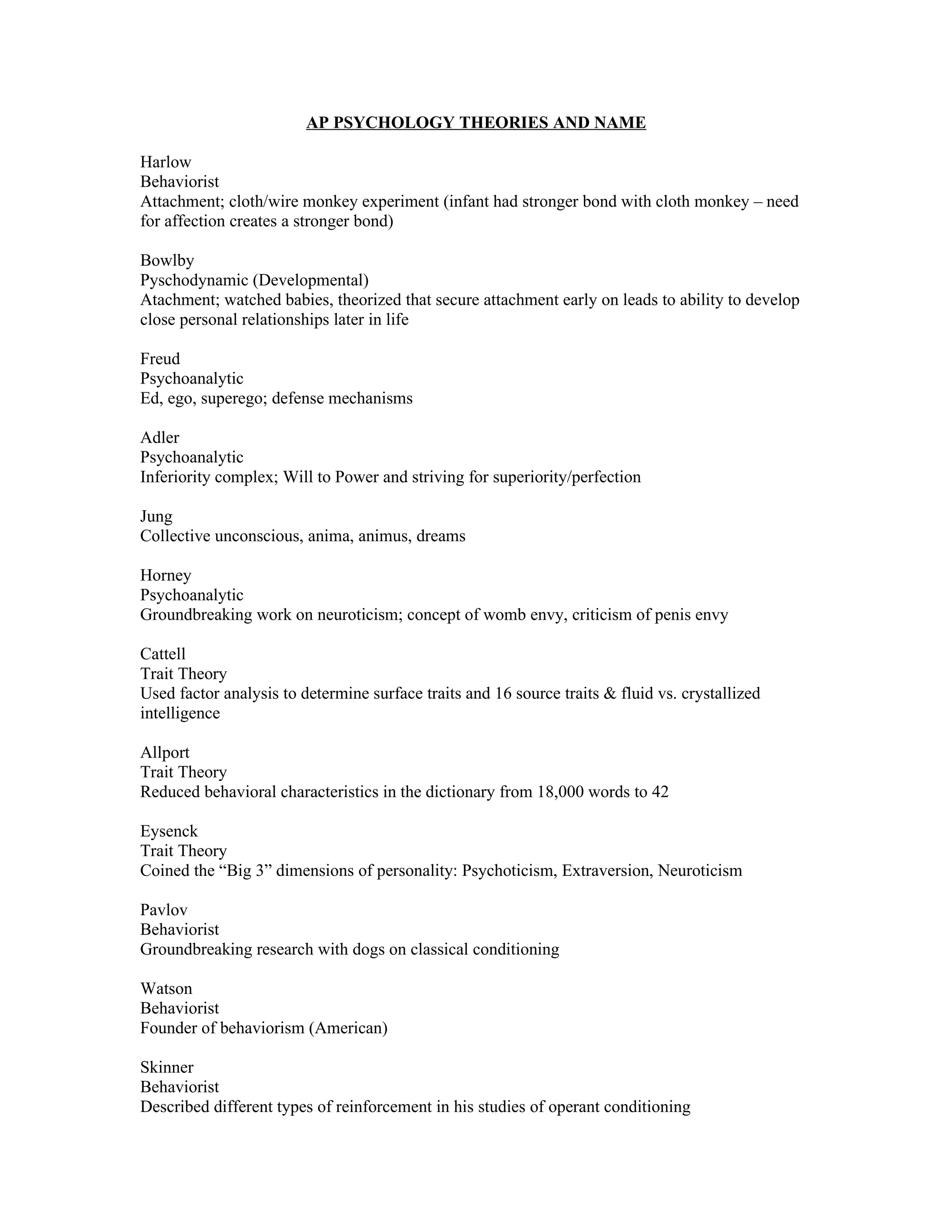
Bandura
Behaviorist/Cognitive
Studied observational learning (aka vicarious learning) in his Bobo Doll study; also created the
theory of reciprocal determinism, a social-cognitive theory of personality (external and internal
determinants of behavior interact reciprocally)

Kohlberg
Cognitive
Came up with stages of moral reasoning (preconventional, conventional, and postconventional) in
development of moral judgement

Erikson
Psychoanalytic
He said the world gets bigger, failure is cumulative, and described stages of development that
include an adolescent identity crisis

Rotter
Behaviorist (Cognitive)
Personality theory; looked at expectancy and reinforcement value in determining behavior
potential

Maslow
Humanist
Pyramid of needs; peak experiences

May
Existentialist
This existentialist psychologist believed that the individual must bravely face life as it is. He also
talked about 4 stages of development: innocence, rebellion, ordinary, and creative

Rogers
Humanist
The founder of the humanistic approach, he described an “actualizing tendency” – towards
fulfilling your potential.

Piaget
Cognitive
He described 4 stages of cognitive development (sensori-motor, pre-operational, concrete
operational, formal operational); also assimilation and accomodation

Asch
Behaviorist/Social
Studied compliance – by putting subjects in groups, asking simple questions where some
assistants had been told to give wrong answers

Milgram
Behaviorist/Social
Studied obedience to authority by putting subjects in a situation where they believed they were
shocking somenone, potentially fatally
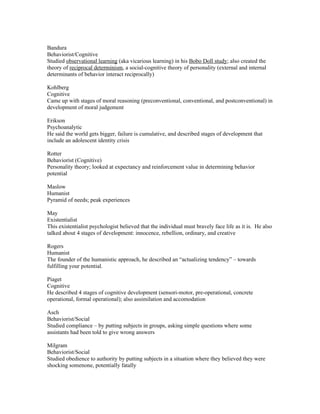
Zimbardo
Behaviorist/Social
Studied instiutional norms; Stanford prison experiment

Bern
Psychoanalytic/social
“Exotic becomes erotic” theory of development of sexual orientation

Kathleen McCoy
Studied teenage suicide; refuted Lee’s idea of the importance of Sturm und Drang

Bowlby
Behaviorist/Object Relations
Studied attachment (secure attachment in early years = ability to form close personal rel’s later
on)

Ainsworth
Behaviorist/Object Relations
Categories babies as securely attached, insecure-avoidant, or insecure-ambivalent (insecurely
attached don’t deal with new experiences as well, may have problems with relationships later in
life)

Chomsky
Cognitive (linguistic)
Deep structure of language and the idea of a built-in language acquisition device

Darwin
Evolutionary
Form follows function; motivation is explained by biological necessity

Aristotle
Greek
Studied the soul; identified reason and physical faculties as separate elements

Plato
Greek
Described levels of consciousness in his “Cave”

Ekman
Found that facial expressions of emotions are constant across cultures (but that display rules
differ)

Festinger
Cognitive
Cognitive dissonance

Heider
Cognitive
Pioneer of attribution theory

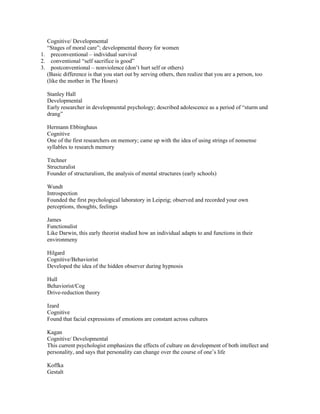
Carol Gilligan & Kolberg
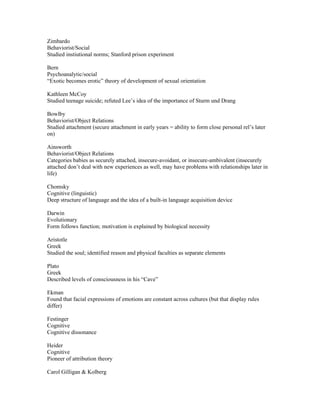
Cognitive/ Developmental
  “Stages of moral care”; developmental theory for women
1. preconventional – individual survival
2. conventional “self sacrifice is good”
3. postconventional – nonviolence (don’t hurt self or others)
  (Basic difference is that you start out by serving others, then realize that you are a person, too
  (like the mother in The Hours)

  Stanley Hall
  Developmental
  Early researcher in developmental psychology; described adolescence as a period of “sturm und
  drang”

  Hermann Ebbinghaus
  Cognitive
  One of the first researchers on memory; came up with the idea of using strings of nonsense
  syllables to research memory

  Titchner
  Structuralist
  Founder of structuralism, the analysis of mental structures (early schools)

  Wundt
  Introspection
  Founded the first psychological laboratory in Leipzig; observed and recorded your own
  perceptions, thoughts, feelings

  James
  Functionalist
  Like Darwin, this early theorist studied how an individual adapts to and functions in their
  environmeny

  Hilgard
  Cognitive/Behaviorist
  Developed the idea of the hidden observer during hypnosis

  Hull
  Behaviorist/Cog
  Drive-reduction theory

  Izard
  Cognitive
  Found that facial expressions of emotions are constant across cultures

  Kagan
  Cognitive/ Developmental
  This current psychologist emphasizes the effects of culture on development of both intellect and
  personality, and says that personality can change over the course of one’s life

  Koffka
  Gestalt
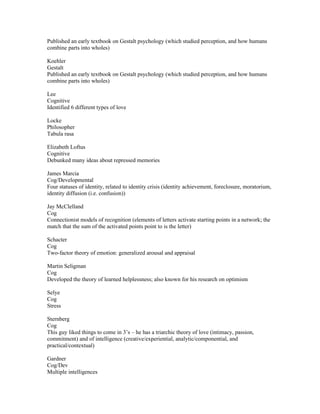
Published an early textbook on Gestalt psychology (which studied perception, and how humans
combine parts into wholes)

Koehler
Gestalt
Published an early textbook on Gestalt psychology (which studied perception, and how humans
combine parts into wholes)

Lee
Cognitive
Identified 6 different types of love

Locke
Philosopher
Tabula rasa

Elizabeth Loftus
Cognitive
Debunked many ideas about repressed memories

James Marcia
Cog/Developmental
Four statuses of identity, related to identity crisis (identity achievement, foreclosure, moratorium,
identity diffusion (i.e. confusion))

Jay McClelland
Cog
Connectionist models of recognition (elements of letters activate starting points in a network; the
match that the sum of the activated points point to is the letter)

Schacter
Cog
Two-factor theory of emotion: generalized arousal and appraisal

Martin Seligman
Cog
Developed the theory of learned helplessness; also known for his research on optimism

Selye
Cog
Stress

Sternberg
Cog
This guy liked things to come in 3’s – he has a triarchic theory of love (intimacy, passion,
commitment) and of intelligence (creative/experiential, analytic/componential, and
practical/contextual)

Gardner
Cog/Dev
Multiple intelligences
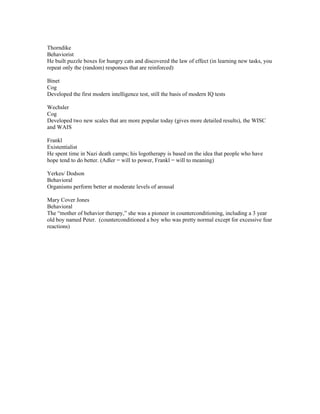
Thorndike
Behaviorist
He built puzzle boxes for hungry cats and discovered the law of effect (in learning new tasks, you
repeat only the (random) responses that are reinforced)

Binet
Cog
Developed the first modern intelligence test, still the basis of modern IQ tests

Wechsler
Cog
Developed two new scales that are more popular today (gives more detailed results), the WISC
and WAIS

Frankl
Existentialist
He spent time in Nazi death camps; his logotherapy is based on the idea that people who have
hope tend to do better. (Adler = will to power, Frankl = will to meaning)

Yerkes/ Dodson
Behavioral
Organisms perform better at moderate levels of arousal

Mary Cover Jones
Behavioral
The “mother of behavior therapy,” she was a pioneer in counterconditioning, including a 3 year
old boy named Peter. (counterconditioned a boy who was pretty normal except for excessive fear
reactions)
Psych theories and names

Psych theories and names

  • 1.
    AP PSYCHOLOGY THEORIESAND NAME Harlow Behaviorist Attachment; cloth/wire monkey experiment (infant had stronger bond with cloth monkey – need for affection creates a stronger bond) Bowlby Pyschodynamic (Developmental) Atachment; watched babies, theorized that secure attachment early on leads to ability to develop close personal relationships later in life Freud Psychoanalytic Ed, ego, superego; defense mechanisms Adler Psychoanalytic Inferiority complex; Will to Power and striving for superiority/perfection Jung Collective unconscious, anima, animus, dreams Horney Psychoanalytic Groundbreaking work on neuroticism; concept of womb envy, criticism of penis envy Cattell Trait Theory Used factor analysis to determine surface traits and 16 source traits & fluid vs. crystallized intelligence Allport Trait Theory Reduced behavioral characteristics in the dictionary from 18,000 words to 42 Eysenck Trait Theory Coined the “Big 3” dimensions of personality: Psychoticism, Extraversion, Neuroticism Pavlov Behaviorist Groundbreaking research with dogs on classical conditioning Watson Behaviorist Founder of behaviorism (American) Skinner Behaviorist Described different types of reinforcement in his studies of operant conditioning
  • 2.
    Bandura Behaviorist/Cognitive Studied observational learning(aka vicarious learning) in his Bobo Doll study; also created the theory of reciprocal determinism, a social-cognitive theory of personality (external and internal determinants of behavior interact reciprocally) Kohlberg Cognitive Came up with stages of moral reasoning (preconventional, conventional, and postconventional) in development of moral judgement Erikson Psychoanalytic He said the world gets bigger, failure is cumulative, and described stages of development that include an adolescent identity crisis Rotter Behaviorist (Cognitive) Personality theory; looked at expectancy and reinforcement value in determining behavior potential Maslow Humanist Pyramid of needs; peak experiences May Existentialist This existentialist psychologist believed that the individual must bravely face life as it is. He also talked about 4 stages of development: innocence, rebellion, ordinary, and creative Rogers Humanist The founder of the humanistic approach, he described an “actualizing tendency” – towards fulfilling your potential. Piaget Cognitive He described 4 stages of cognitive development (sensori-motor, pre-operational, concrete operational, formal operational); also assimilation and accomodation Asch Behaviorist/Social Studied compliance – by putting subjects in groups, asking simple questions where some assistants had been told to give wrong answers Milgram Behaviorist/Social Studied obedience to authority by putting subjects in a situation where they believed they were shocking somenone, potentially fatally
  • 3.
    Zimbardo Behaviorist/Social Studied instiutional norms;Stanford prison experiment Bern Psychoanalytic/social “Exotic becomes erotic” theory of development of sexual orientation Kathleen McCoy Studied teenage suicide; refuted Lee’s idea of the importance of Sturm und Drang Bowlby Behaviorist/Object Relations Studied attachment (secure attachment in early years = ability to form close personal rel’s later on) Ainsworth Behaviorist/Object Relations Categories babies as securely attached, insecure-avoidant, or insecure-ambivalent (insecurely attached don’t deal with new experiences as well, may have problems with relationships later in life) Chomsky Cognitive (linguistic) Deep structure of language and the idea of a built-in language acquisition device Darwin Evolutionary Form follows function; motivation is explained by biological necessity Aristotle Greek Studied the soul; identified reason and physical faculties as separate elements Plato Greek Described levels of consciousness in his “Cave” Ekman Found that facial expressions of emotions are constant across cultures (but that display rules differ) Festinger Cognitive Cognitive dissonance Heider Cognitive Pioneer of attribution theory Carol Gilligan & Kolberg
  • 4.
    Cognitive/ Developmental “Stages of moral care”; developmental theory for women 1. preconventional – individual survival 2. conventional “self sacrifice is good” 3. postconventional – nonviolence (don’t hurt self or others) (Basic difference is that you start out by serving others, then realize that you are a person, too (like the mother in The Hours) Stanley Hall Developmental Early researcher in developmental psychology; described adolescence as a period of “sturm und drang” Hermann Ebbinghaus Cognitive One of the first researchers on memory; came up with the idea of using strings of nonsense syllables to research memory Titchner Structuralist Founder of structuralism, the analysis of mental structures (early schools) Wundt Introspection Founded the first psychological laboratory in Leipzig; observed and recorded your own perceptions, thoughts, feelings James Functionalist Like Darwin, this early theorist studied how an individual adapts to and functions in their environmeny Hilgard Cognitive/Behaviorist Developed the idea of the hidden observer during hypnosis Hull Behaviorist/Cog Drive-reduction theory Izard Cognitive Found that facial expressions of emotions are constant across cultures Kagan Cognitive/ Developmental This current psychologist emphasizes the effects of culture on development of both intellect and personality, and says that personality can change over the course of one’s life Koffka Gestalt
  • 5.
    Published an earlytextbook on Gestalt psychology (which studied perception, and how humans combine parts into wholes) Koehler Gestalt Published an early textbook on Gestalt psychology (which studied perception, and how humans combine parts into wholes) Lee Cognitive Identified 6 different types of love Locke Philosopher Tabula rasa Elizabeth Loftus Cognitive Debunked many ideas about repressed memories James Marcia Cog/Developmental Four statuses of identity, related to identity crisis (identity achievement, foreclosure, moratorium, identity diffusion (i.e. confusion)) Jay McClelland Cog Connectionist models of recognition (elements of letters activate starting points in a network; the match that the sum of the activated points point to is the letter) Schacter Cog Two-factor theory of emotion: generalized arousal and appraisal Martin Seligman Cog Developed the theory of learned helplessness; also known for his research on optimism Selye Cog Stress Sternberg Cog This guy liked things to come in 3’s – he has a triarchic theory of love (intimacy, passion, commitment) and of intelligence (creative/experiential, analytic/componential, and practical/contextual) Gardner Cog/Dev Multiple intelligences
  • 6.
    Thorndike Behaviorist He built puzzleboxes for hungry cats and discovered the law of effect (in learning new tasks, you repeat only the (random) responses that are reinforced) Binet Cog Developed the first modern intelligence test, still the basis of modern IQ tests Wechsler Cog Developed two new scales that are more popular today (gives more detailed results), the WISC and WAIS Frankl Existentialist He spent time in Nazi death camps; his logotherapy is based on the idea that people who have hope tend to do better. (Adler = will to power, Frankl = will to meaning) Yerkes/ Dodson Behavioral Organisms perform better at moderate levels of arousal Mary Cover Jones Behavioral The “mother of behavior therapy,” she was a pioneer in counterconditioning, including a 3 year old boy named Peter. (counterconditioned a boy who was pretty normal except for excessive fear reactions)