Creative Writing Ms. Harrigan and Ms. Sarno September 17, 2008
Chat Agenda Mood and Tone Characterization Show, don’t Tell! Web Resources Q & A
Mood and Tone Mood:  the feeling that the writer creates for the reader. A writer uses details in his or her writing to create this feeling. The setting can affect the mood dramatically. If you describe a dark, dingy alleyway, the reader will get a feeling of danger and uneasiness. If you describe a lush, sunny countryside, he will sense an atmosphere of calming beauty.
Mood and Tone Tone: describes a writer's  attitude  toward his or her subject. A writer might use a serious tone to write about a subject, or a humorous tone, depending on the subject matter.  **Mood and Tone differ in that mood is determined by the response of the  reader  to a piece of writing. Tone is the  writer's  attitude about a subject as that attitude comes through in the writing.**
Mood and Tone Let’s look at the passages from the “Descriptive Examples Opinion Forum” assignment, and analyze them for the authors’ use of mood and tone…
Mood and Tone Example #1 -  Lord of the Flies  by William Golding The boy with fair hair lowered himself down the last few feet of rock and began to pick his way toward the lagoon. Though he had taken off his school sweater and trailed it now from one hand, his gray shirt stuck to him and his hair was plastered to his forehead. All round him the long scar smashed into the jungle was a bath of heat. He was clambering heavily among the creepers and broken trunks when a bird, a vision of red and yellow, flashed upwards with a witch-like cry; and this cry was echoed by another. "Hi!" it said. "Wait a minute!" The undergrowth at the side of the scar was shaken and a multitude of raindrops fell  What is the mood, or atmosphere of this piece?  What is the tone, or attitude of the author/narrator?
Mood and Tone Example #2 -  Alice's Adventures in Wonderland  by Lewis Carroll Suddenly she came upon a little three-legged table, all made of solid glass: there was nothing on it but a tiny golden key, and Alice's first idea was that this might belong to one of the doors of the hall; but, alas! either the locks were too large, or the key was too small, but at any rate it would not open any of them. However, on the second time round, she came upon a low curtain she had not noticed before, and behind it was a little door about fifteen inches high: she tried the little golden key in the lock, and to her great delight it fitted!  Alice opened the door and found that it led into a small passage, not much larger than a rat-hole: she knelt down and looked along the passage into the loveliest garden you ever saw. How she longed to get out of that dark hall, and wander about among those beds of bright flowers and those cool fountains, but she could not even get her head through the doorway...  What is the mood, or atmosphere of this piece?  What is the tone, or attitude of the author/narrator?
Mood and Tone Example #3 -  Anne of Green Gables  by Lucy Maud Montgomery   She had been watching him ever since he had passed her and she had her eyes on him now. Matthew was not looking at her and would not have seen what she was really like if he had been, but an ordinary observer would have seen this: A child of about eleven, garbed in a very short, very tight, very ugly dress of yellowish-gray wincey. She wore a faded brown sailor hat and beneath the hat, extending down her back, were two braids of very thick, decidedly red hair. Her face was small, white and thin, also much freckled; her mouth was large and so were her eyes, which looked green in some lights and moods and gray in others.  So far, the ordinary observer; an extraordinary observer might have seen that the chin was very pointed and pronounced; that the big eyes were full of spirit and vivacity; that the mouth was sweet-lipped and expressive; that the forehead was broad and full; in short, our discerning extraordinary observer might have concluded that no commonplace soul inhabited the body of this stray woman- child of whom shy Matthew Cuthbert was so ludicrously afraid.  What is the mood, or atmosphere of this piece?  What is the tone, or attitude of the author/narrator?
Mood and Tone Example #4 -  The Tell-Tale Heart  by Edgar Allen Poe   But even yet I refrained and kept still. I scarcely breathed. I held the lantern motionless. I tried how steadily I could maintain the ray upon the eye. Meantime the hellish tattoo of the heart increased. It grew quicker and quicker, and louder and louder, every instant. The old man's terror must have been extreme! It grew louder, I say, louder every moment! -- do you mark me well? I have told you that I am nervous: so I am. And now at the dead hour of the night, amid the dreadful silence of that old house, so strange a noise as this excited me to uncontrollable terror. Yet, for some minutes longer I refrained and stood still. But the beating grew louder, louder! I thought the heart must burst. And now a new anxiety seized me -- the sound would be heard by a neighbour! The old man's hour had come! With a loud yell, I threw open the lantern and leaped into the room. He shrieked once -- once only. In an instant I dragged him to the floor, and pulled the heavy bed over him. I then smiled gaily, to find the deed so far done. But for many minutes the heart beat on with a muffled sound. This, however, did not vex me; it would not be heard through the wall. At length it ceased. The old man was dead. I removed the bed and examined the corpse. Yes, he was stone, stone dead. I placed my hand upon the heart and held it there many minutes. There was no pulsation. He was stone dead. His eye would trouble me no more.  What is the mood, or atmosphere of this piece?  What is the tone, or attitude of the author/narrator?
Mood and Tone Remember, to help you figure out the mood and tone of a piece, think about: Images you create in your mind Metaphors and other literary techniques the author uses Characterization Organization of the passage When writing, remember that the mood is about what feeling you create, and the tone is the attitude of the writer or the narrator.
Characterization Characterization  is the process of revealing traits, motives, and information about characters in a piece of literature. The amount of characterization, or development, that goes into a character will affect how  dimensional  the character will be.
Characterization For the “Revealing Character Traits” assignment, you created a list of adjectives to describe two characters from a piece of literature, then explained why or why not these characters were multi-dimensional. Here is what some of you said…
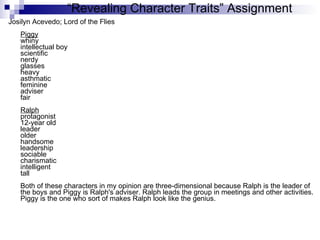
“ Revealing Character Traits” Assignment Josilyn Acevedo; Lord of the Flies Piggy whiny  intellectual boy  scientific nerdy glasses heavy asthmatic feminine adviser fair Ralph protagonist 12-year old leader older handsome leadership sociable charismatic intelligent tall Both of these characters in my opinion are three-dimensional because Ralph is the leader of the boys and Piggy is Ralph's adviser. Ralph leads the group in meetings and other activities. Piggy is the one who sort of makes Ralph look like the genius.
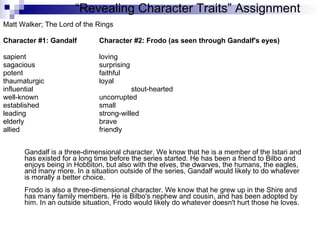
Matt Walker; The Lord of the Rings Character #1: Gandalf Character #2: Frodo (as seen through Gandalf's eyes) sapient  loving  sagacious  surprising  potent  faithful  thaumaturgic  loyal  influential  stout-hearted well-known  uncorrupted  established  small  leading  strong-willed elderly  brave  allied  friendly  Gandalf is a three-dimensional character. We know that he is a member of the Istari and has existed for a long time before the series started. He has been a friend to Bilbo and enjoys being in Hobbiton, but also with the elves, the dwarves, the humans, the eagles, and many more. In a situation outside of the series, Gandalf would likely to do whatever is morally a better choice. Frodo is also a three-dimensional character. We know that he grew up in the Shire and has many family members. He is Bilbo's nephew and cousin, and has been adopted by him. In an outside situation, Frodo would likely do whatever doesn't hurt those he loves.  “ Revealing Character Traits” Assignment
“ Creating a Three-Dimensional Character” Assignment For Part 1 of this assignment, you must complete the Character Profile Worksheet.  The purpose of this is for you to know everything you can about your character.  For Part 2, you need to write a short scene that reveals some of the background information you outlined.  REMEMBER: you do not need to include everything from your character profile! We simply need to get a glimpse of your character through description, dialogue, action, or some of each.
Remember… You want to SHOW your reader, not TELL the reader!  What do we mean by this? “ Telling  communicates facts;  showing  invites understanding.” Let’s look at some examples! The following excerpts are from Professor Dennis Jerz’s weblog:  http://jerz.setonhill.edu/writing/creative/showing.htm
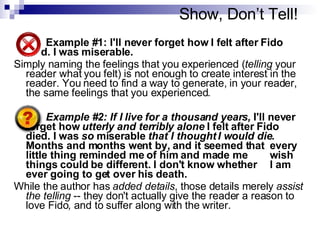
Show, Don’t Tell! Example #1: I'll never forget how I felt after Fido  died. I was miserable. Simply naming the feelings that you experienced ( telling  your reader what you felt) is not enough to create interest in the reader. You need to find a way to generate, in your reader, the same feelings that you experienced.  Example #2: If I live for a thousand years,  I'll never  forget how  utterly and terribly alone  I felt after Fido  died. I was  so  miserable  that I thought I would die .  Months and months went by, and it seemed that  every little thing reminded me of him and made me  wish things could be different. I don't know whether  I am ever going to get over his death. While the author has  added details , those details merely  assist the telling  -- they don't actually give the reader a reason to love Fido ,  and to suffer along with the writer.
Show, Don’t Tell! Example #3: Whenever puppies in the pet store  window distracted me from the  serious business of  taking him for his walk, Fido snarled fiercely and  pulled mightily at his leash yet he always forgave  me instantly. Over the past few years he lost his  hearing and his sight, but when he felt the leash click  on his collar and smelled fresh air, he still tried to  caper. He's been dead for three months now. This  morning I filled his water bowl all the way to the top -- just the way he likes it -- before I remembered.  The author does not need to  tell  the reader "I loved Fido and I still haven't come to terms with his death," because the paragraph contains specific details that  show  the depths of the relationship. For more information on this topic, visit: http://jerz.setonhill.edu/writing/creative/showing.htm
Remember… Some of these concepts are difficult to grasp, and even more difficult to correctly implement in your writing! Right now we are reviewing these concepts and assessing where your writing skills are at.  We will review all of these techniques and elements as we progress through the course.  The main purpose of these assignments is to provide an opportunity for you to receive feedback as you develop these writing skills.

Cw Chat 9

  • 1.
    Creative Writing Ms.Harrigan and Ms. Sarno September 17, 2008
  • 2.
    Chat Agenda Moodand Tone Characterization Show, don’t Tell! Web Resources Q & A
  • 3.
    Mood and ToneMood: the feeling that the writer creates for the reader. A writer uses details in his or her writing to create this feeling. The setting can affect the mood dramatically. If you describe a dark, dingy alleyway, the reader will get a feeling of danger and uneasiness. If you describe a lush, sunny countryside, he will sense an atmosphere of calming beauty.
  • 4.
    Mood and ToneTone: describes a writer's attitude toward his or her subject. A writer might use a serious tone to write about a subject, or a humorous tone, depending on the subject matter. **Mood and Tone differ in that mood is determined by the response of the reader to a piece of writing. Tone is the writer's attitude about a subject as that attitude comes through in the writing.**
  • 5.
    Mood and ToneLet’s look at the passages from the “Descriptive Examples Opinion Forum” assignment, and analyze them for the authors’ use of mood and tone…
  • 6.
    Mood and ToneExample #1 - Lord of the Flies by William Golding The boy with fair hair lowered himself down the last few feet of rock and began to pick his way toward the lagoon. Though he had taken off his school sweater and trailed it now from one hand, his gray shirt stuck to him and his hair was plastered to his forehead. All round him the long scar smashed into the jungle was a bath of heat. He was clambering heavily among the creepers and broken trunks when a bird, a vision of red and yellow, flashed upwards with a witch-like cry; and this cry was echoed by another. "Hi!" it said. "Wait a minute!" The undergrowth at the side of the scar was shaken and a multitude of raindrops fell What is the mood, or atmosphere of this piece? What is the tone, or attitude of the author/narrator?
  • 7.
    Mood and ToneExample #2 - Alice's Adventures in Wonderland by Lewis Carroll Suddenly she came upon a little three-legged table, all made of solid glass: there was nothing on it but a tiny golden key, and Alice's first idea was that this might belong to one of the doors of the hall; but, alas! either the locks were too large, or the key was too small, but at any rate it would not open any of them. However, on the second time round, she came upon a low curtain she had not noticed before, and behind it was a little door about fifteen inches high: she tried the little golden key in the lock, and to her great delight it fitted! Alice opened the door and found that it led into a small passage, not much larger than a rat-hole: she knelt down and looked along the passage into the loveliest garden you ever saw. How she longed to get out of that dark hall, and wander about among those beds of bright flowers and those cool fountains, but she could not even get her head through the doorway... What is the mood, or atmosphere of this piece? What is the tone, or attitude of the author/narrator?
  • 8.
    Mood and ToneExample #3 - Anne of Green Gables by Lucy Maud Montgomery She had been watching him ever since he had passed her and she had her eyes on him now. Matthew was not looking at her and would not have seen what she was really like if he had been, but an ordinary observer would have seen this: A child of about eleven, garbed in a very short, very tight, very ugly dress of yellowish-gray wincey. She wore a faded brown sailor hat and beneath the hat, extending down her back, were two braids of very thick, decidedly red hair. Her face was small, white and thin, also much freckled; her mouth was large and so were her eyes, which looked green in some lights and moods and gray in others. So far, the ordinary observer; an extraordinary observer might have seen that the chin was very pointed and pronounced; that the big eyes were full of spirit and vivacity; that the mouth was sweet-lipped and expressive; that the forehead was broad and full; in short, our discerning extraordinary observer might have concluded that no commonplace soul inhabited the body of this stray woman- child of whom shy Matthew Cuthbert was so ludicrously afraid. What is the mood, or atmosphere of this piece? What is the tone, or attitude of the author/narrator?
  • 9.
    Mood and ToneExample #4 - The Tell-Tale Heart by Edgar Allen Poe But even yet I refrained and kept still. I scarcely breathed. I held the lantern motionless. I tried how steadily I could maintain the ray upon the eye. Meantime the hellish tattoo of the heart increased. It grew quicker and quicker, and louder and louder, every instant. The old man's terror must have been extreme! It grew louder, I say, louder every moment! -- do you mark me well? I have told you that I am nervous: so I am. And now at the dead hour of the night, amid the dreadful silence of that old house, so strange a noise as this excited me to uncontrollable terror. Yet, for some minutes longer I refrained and stood still. But the beating grew louder, louder! I thought the heart must burst. And now a new anxiety seized me -- the sound would be heard by a neighbour! The old man's hour had come! With a loud yell, I threw open the lantern and leaped into the room. He shrieked once -- once only. In an instant I dragged him to the floor, and pulled the heavy bed over him. I then smiled gaily, to find the deed so far done. But for many minutes the heart beat on with a muffled sound. This, however, did not vex me; it would not be heard through the wall. At length it ceased. The old man was dead. I removed the bed and examined the corpse. Yes, he was stone, stone dead. I placed my hand upon the heart and held it there many minutes. There was no pulsation. He was stone dead. His eye would trouble me no more. What is the mood, or atmosphere of this piece? What is the tone, or attitude of the author/narrator?
  • 10.
    Mood and ToneRemember, to help you figure out the mood and tone of a piece, think about: Images you create in your mind Metaphors and other literary techniques the author uses Characterization Organization of the passage When writing, remember that the mood is about what feeling you create, and the tone is the attitude of the writer or the narrator.
  • 11.
    Characterization Characterization is the process of revealing traits, motives, and information about characters in a piece of literature. The amount of characterization, or development, that goes into a character will affect how dimensional the character will be.
  • 12.
    Characterization For the“Revealing Character Traits” assignment, you created a list of adjectives to describe two characters from a piece of literature, then explained why or why not these characters were multi-dimensional. Here is what some of you said…
  • 13.
    “ Revealing CharacterTraits” Assignment Josilyn Acevedo; Lord of the Flies Piggy whiny intellectual boy scientific nerdy glasses heavy asthmatic feminine adviser fair Ralph protagonist 12-year old leader older handsome leadership sociable charismatic intelligent tall Both of these characters in my opinion are three-dimensional because Ralph is the leader of the boys and Piggy is Ralph's adviser. Ralph leads the group in meetings and other activities. Piggy is the one who sort of makes Ralph look like the genius.
  • 14.
    Matt Walker; TheLord of the Rings Character #1: Gandalf Character #2: Frodo (as seen through Gandalf's eyes) sapient loving sagacious surprising potent faithful thaumaturgic loyal influential stout-hearted well-known uncorrupted established small leading strong-willed elderly brave allied friendly Gandalf is a three-dimensional character. We know that he is a member of the Istari and has existed for a long time before the series started. He has been a friend to Bilbo and enjoys being in Hobbiton, but also with the elves, the dwarves, the humans, the eagles, and many more. In a situation outside of the series, Gandalf would likely to do whatever is morally a better choice. Frodo is also a three-dimensional character. We know that he grew up in the Shire and has many family members. He is Bilbo's nephew and cousin, and has been adopted by him. In an outside situation, Frodo would likely do whatever doesn't hurt those he loves. “ Revealing Character Traits” Assignment
  • 15.
    “ Creating aThree-Dimensional Character” Assignment For Part 1 of this assignment, you must complete the Character Profile Worksheet. The purpose of this is for you to know everything you can about your character. For Part 2, you need to write a short scene that reveals some of the background information you outlined. REMEMBER: you do not need to include everything from your character profile! We simply need to get a glimpse of your character through description, dialogue, action, or some of each.
  • 16.
    Remember… You wantto SHOW your reader, not TELL the reader! What do we mean by this? “ Telling communicates facts; showing invites understanding.” Let’s look at some examples! The following excerpts are from Professor Dennis Jerz’s weblog: http://jerz.setonhill.edu/writing/creative/showing.htm
  • 17.
    Show, Don’t Tell!Example #1: I'll never forget how I felt after Fido died. I was miserable. Simply naming the feelings that you experienced ( telling your reader what you felt) is not enough to create interest in the reader. You need to find a way to generate, in your reader, the same feelings that you experienced. Example #2: If I live for a thousand years, I'll never forget how utterly and terribly alone I felt after Fido died. I was so miserable that I thought I would die . Months and months went by, and it seemed that every little thing reminded me of him and made me wish things could be different. I don't know whether I am ever going to get over his death. While the author has added details , those details merely assist the telling -- they don't actually give the reader a reason to love Fido , and to suffer along with the writer.
  • 18.
    Show, Don’t Tell!Example #3: Whenever puppies in the pet store window distracted me from the serious business of taking him for his walk, Fido snarled fiercely and pulled mightily at his leash yet he always forgave me instantly. Over the past few years he lost his hearing and his sight, but when he felt the leash click on his collar and smelled fresh air, he still tried to caper. He's been dead for three months now. This morning I filled his water bowl all the way to the top -- just the way he likes it -- before I remembered. The author does not need to tell the reader "I loved Fido and I still haven't come to terms with his death," because the paragraph contains specific details that show the depths of the relationship. For more information on this topic, visit: http://jerz.setonhill.edu/writing/creative/showing.htm
  • 19.
    Remember… Some ofthese concepts are difficult to grasp, and even more difficult to correctly implement in your writing! Right now we are reviewing these concepts and assessing where your writing skills are at. We will review all of these techniques and elements as we progress through the course. The main purpose of these assignments is to provide an opportunity for you to receive feedback as you develop these writing skills.