Introduction
• When India gained independence in 1947, the economic condition of the country
was very poor.
• There were hardly any public sector enterprises other than the Railways and the
Postal Services.
• It was determined that going forward public sector would play a big hand in our
economic development.
• The 1948 Resolution envisaged development of core sectors through the public
enterprises
• And then again in the 1990’s the trend changed again. So let us take a more detailed
look at the changing role of public sector.
• The first few Five Year Plans were all designed to promote and safeguard the public
sector.
• But then came the era of privatization and globalization in 1991.
• The role of public sector companies was reevaluated. Now the public sector was to
actively participate in a competitive market with the private enterprises
• In India, a government-owned corporation is termed as a public sector undertaking
(PSU).
• This term is used to refer to the companies in which the government (either the
federal, Union Government or the many state or territorial governments, or both)
own a majority (51 percent or more) of the company equity.
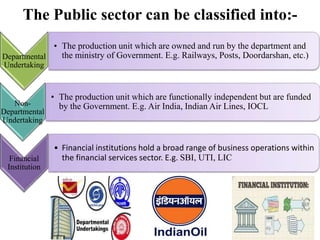
The Public sector can be classified into:-
Departmental
Undertaking
• The production unit which are owned and run by the department and
the ministry of Government. E.g. Railways, Posts, Doordarshan, etc.)
Non-
Departmental
Undertaking
• The production unit which are functionally independent but are funded
by the Government. E.g. Air India, Indian Air Lines, IOCL
Financial
Institution
• Financial institutions hold a broad range of business operations within
the financial services sector. E.g. SBI, UTI, LIC
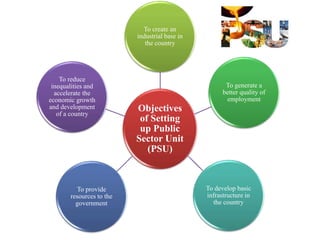
Objectives
of Setting
up Public
Sector Unit
(PSU)
To create an
industrial base in
the country
To generate a
better quality of
employment
To develop basic
infrastructure in
the country
To provide
resources to the
government
To reduce
inequalities and
accelerate the
economic growth
and development
of a country
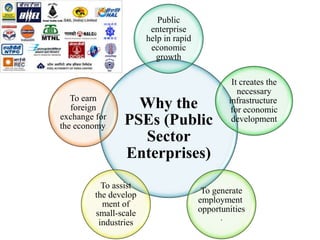
Why the
PSEs (Public
Sector
Enterprises)
Public
enterprise
help in rapid
economic
growth
It creates the
necessary
infrastructure
for economic
development
To generate
employment
opportunities
.
To assist
the develop
ment of
small-scale
industries
To earn
foreign
exchange for
the economy.
Importance of the Public Sector
Developing Infrastructure:
In a newly independent
country, with a nascent
economy, it is not suitable for
private enterprises to invest
huge capitals into
infrastructure projects. So
this responsibility falls to the
public sector. And the
development of infrastructure
is absolutely essential for the
development o an economy.
For example, all the rail, road,
and air transport projects were
carried out by public sector
undertakings in the post-
independence era.
Regional Balance:
Private sector companies tend
to focus on industrial areas.
This results in the backward
areas and the smaller towns
and villages to be excluded
from economic growth. But
the government can ensure
that growth happens
throughout the country in a
balanced manner. Public
sectors set up units and
factories in backward areas
bring employment
opportunities and economic
development to such areas
Check on the Concentration
of Economic Power:
When the private sector
sometimes the wealth gets
concentrated in the hands of a
few. This may lead to
monopolistic tendencies and
concentration of economic
power. The public sector
helps keep this in check. The
income generated by a public
enterprise is shared by a large
number of employees and
also the public at large. this
helps restore some
economic equality.
Need for Public Sector Reforms
• Lack of competition: In Public Sector Enterprises, the level of profit is low as
compared to the private sector, this was due to lack of competition and over
protection to PSEs.
• Long gestation period: For the completion of any project, the Public Sector
Enterprises normally takes much more time than expected.
• Over capitalization: In many cases, the actual cost of the planned project
exceeds the original cost due to mismanagement and Bureaucratic hurdles.
• Inefficient management: Lack of management and planning in Public Sector
Enterprises has created many issues and challenges for Public Sector
Enterprises.
• Lack of efficient and trained staff: Lack of skilled manpower in the Public
Sector Enterprises is also one the important issue due the which the production
and efficiency have decreased
• Employment Opportunities: Too provide the employments to the people

Public Sector Reforms.pptx

  • 1.
    Introduction • When Indiagained independence in 1947, the economic condition of the country was very poor. • There were hardly any public sector enterprises other than the Railways and the Postal Services. • It was determined that going forward public sector would play a big hand in our economic development. • The 1948 Resolution envisaged development of core sectors through the public enterprises • And then again in the 1990’s the trend changed again. So let us take a more detailed look at the changing role of public sector. • The first few Five Year Plans were all designed to promote and safeguard the public sector. • But then came the era of privatization and globalization in 1991. • The role of public sector companies was reevaluated. Now the public sector was to actively participate in a competitive market with the private enterprises • In India, a government-owned corporation is termed as a public sector undertaking (PSU). • This term is used to refer to the companies in which the government (either the federal, Union Government or the many state or territorial governments, or both) own a majority (51 percent or more) of the company equity.
  • 2.
    The Public sectorcan be classified into:- Departmental Undertaking • The production unit which are owned and run by the department and the ministry of Government. E.g. Railways, Posts, Doordarshan, etc.) Non- Departmental Undertaking • The production unit which are functionally independent but are funded by the Government. E.g. Air India, Indian Air Lines, IOCL Financial Institution • Financial institutions hold a broad range of business operations within the financial services sector. E.g. SBI, UTI, LIC
  • 3.
    Objectives of Setting up Public SectorUnit (PSU) To create an industrial base in the country To generate a better quality of employment To develop basic infrastructure in the country To provide resources to the government To reduce inequalities and accelerate the economic growth and development of a country
  • 4.
    Why the PSEs (Public Sector Enterprises) Public enterprise helpin rapid economic growth It creates the necessary infrastructure for economic development To generate employment opportunities . To assist the develop ment of small-scale industries To earn foreign exchange for the economy.
  • 5.
    Importance of thePublic Sector Developing Infrastructure: In a newly independent country, with a nascent economy, it is not suitable for private enterprises to invest huge capitals into infrastructure projects. So this responsibility falls to the public sector. And the development of infrastructure is absolutely essential for the development o an economy. For example, all the rail, road, and air transport projects were carried out by public sector undertakings in the post- independence era. Regional Balance: Private sector companies tend to focus on industrial areas. This results in the backward areas and the smaller towns and villages to be excluded from economic growth. But the government can ensure that growth happens throughout the country in a balanced manner. Public sectors set up units and factories in backward areas bring employment opportunities and economic development to such areas Check on the Concentration of Economic Power: When the private sector sometimes the wealth gets concentrated in the hands of a few. This may lead to monopolistic tendencies and concentration of economic power. The public sector helps keep this in check. The income generated by a public enterprise is shared by a large number of employees and also the public at large. this helps restore some economic equality.
  • 6.
    Need for PublicSector Reforms • Lack of competition: In Public Sector Enterprises, the level of profit is low as compared to the private sector, this was due to lack of competition and over protection to PSEs. • Long gestation period: For the completion of any project, the Public Sector Enterprises normally takes much more time than expected. • Over capitalization: In many cases, the actual cost of the planned project exceeds the original cost due to mismanagement and Bureaucratic hurdles. • Inefficient management: Lack of management and planning in Public Sector Enterprises has created many issues and challenges for Public Sector Enterprises. • Lack of efficient and trained staff: Lack of skilled manpower in the Public Sector Enterprises is also one the important issue due the which the production and efficiency have decreased • Employment Opportunities: Too provide the employments to the people