PSU’s and DisinvestmentPresented By,Shahane SirDivyaChabra	-	07HardikGor		-	17	Pratiktiberwal	-	53
Definition of PSUIn India, public sector undertaking (PSU) is a term used for a government-owned corporation (company in the public sector). The term is used to refer to companies in which the government (either the Union Government or state or territorial governments, or both) owned a majority (51 percent or more) of the company equity.
A Public Sector Undertaking is a corporation in the public sector in India, where management control of the company rests with the Government, it can be Central Government or the State GovernmentsGenesisThe main objectives of setting up the Public Sector enterprises as stated in Industrial policyResolution of 1956 were:To promote rapid economic development through creation and expansion of infrastructure
To generate financial resources for development
To promote redistribution of income and wealthCont…	To create employment opportunities
To promote balanced regional growth
To encourage the development of small-scale and ancillary industries, and
To promote exports on the one side and import substitution, on the other.Social ObjectivesEquitable distribution of wealthProvision of essential goods andTakeover of sick unitsPolitical objectivesPublic interest
National defence
Socialism  PSU companies are divided into three categories:MaharatnaNavratnaMiniratna
MaharatnaGovt. Conferred MAHARATNA Status  on 16th Nov 2010 to 4 PSU’sAllows the PSU’s to raise its Investment Ceiling from `1000 to `5000 cr.Gives the PSU Autonomy to decide on investments up to 15% of their net worth in a projectExamples:Indian Oil CorporationNTPC Ltd.Oil & Natural Gas CorporationSteel Authority of India Ltd.
Criteria for Maharatna StatusAccording to the criteria laid down by the Cabinet, the Maharatna status is granted to listed Navaratna central public sector companies with an average annual turnover of more than Rs 25,000 crore, net profit after tax of Rs 5,000 crore and net worth of Rs 15,000 crore during the past three year
Navratna statusNavratna status gives a company enhanced financial and operational autonomy and empowers it to invest up to `1000 cr. or 15% of their net worth on a single project without seeking government approvalIn a year, these companies can spend up to 30% of their net worth not exceeding ` 1000 cr. They will also have the freedom to enter joint ventures, form alliances and float subsidiaries abroad.
Criteria for Navratna StatusNav	ratna status is conferred by Department of Public Enterprises. Net profit to net worthTotal manpower cost to total cost of production or cost of servicesPBDIT to capital employedPBDIT to turnoverEPS  Inter-sectoral performance.Additionally, a company must first be a Miniratna and have four independent directors on its board before it can be made a Navratna.
Major Example of NavratnaBharat Electronics LimitedBharat Heavy Electricals LimitedBharat Petroleum Corporation LimitedCoal India LimitedGAIL (India) LimitedHindustan Aeronautics LimitedHindustan Petroleum Corporation LimitedMahanagar Telephone Nigam LimitedNational Aluminium Company LimitedNMDC LimitedOil India LimitedPower Finance Corporation LimitedPower Grid Corporation of India LimitedRural Electrification Corporation LimitedShipping Corporation of India Limited
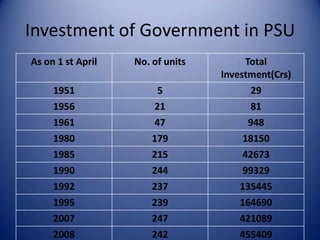
Investment of Government in PSU
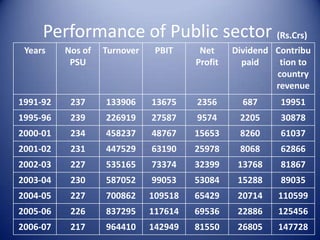
Performance of Public sector(Rs.Crs)
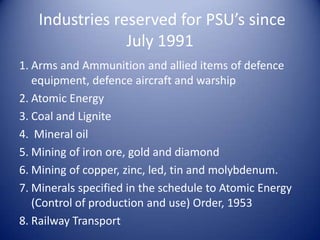
 Industries reserved for PSU’s since July 1991Arms and Ammunition and allied items of defence equipment, defence aircraft and warshipAtomic EnergyCoal and Lignite Mineral oilMining of iron ore, gold and diamondMining of copper, zinc, led, tin and molybdenum.Minerals specified in the schedule to Atomic Energy (Control of production and use) Order, 1953Railway Transport
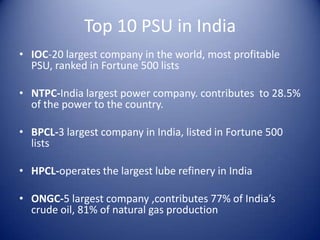
Top 10 PSU in IndiaIOC-20 largest company in the world, most profitable PSU, ranked in Fortune 500 listsNTPC-India largest power company. contributes  to 28.5% of the power to the country.BPCL-3 largest company in India, listed in Fortune 500 listsHPCL-operates the largest lube refinery in IndiaONGC-5 largest company ,contributes 77% of India’s crude oil, 81% of natural gas production
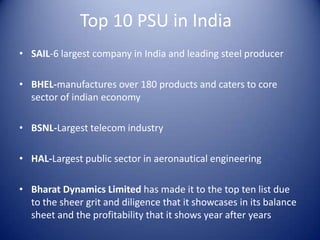
Top 10 PSU in India	SAIL-6 largest company in India and leading steel producerBHEL-manufactures over 180 products and caters to core sector of indian economyBSNL-Largest telecom industryHAL-Largest public sector in aeronautical engineeringBharat Dynamics Limited has made it to the top ten list due to the sheer grit and diligence that it showcases in its balance sheet and the profitability that it shows year after years
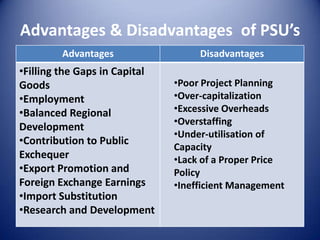
Advantages & Disadvantages  of PSU’sPoor Project Planning
Over-capitalization
Excessive Overheads
Overstaffing
Under-utilisation of Capacity
Lack of a Proper Price Policy
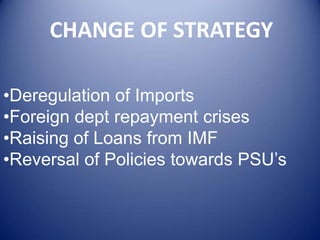
Inefficient Management CHANGE OF STRATEGYDeregulation of Imports
Foreign dept repayment crises
Raising of Loans from IMF
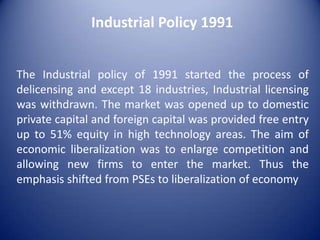
Reversal of Policies towards PSU’sIndustrial Policy 1991The Industrial policy of 1991 started the process of delicensing and except 18 industries, Industrial licensing was withdrawn. The market was opened up to domestic private capital and foreign capital was provided free entry up to 51% equity in high technology areas. The aim of economic liberalization was to enlarge competition and allowing new firms to enter the market. Thus the emphasis shifted from PSEs to liberalization of economy
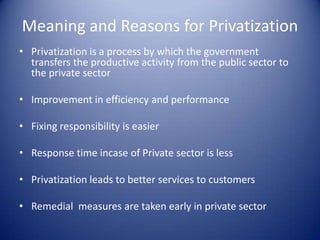
Meaning and Reasons for PrivatizationPrivatization is a process by which the government transfers the productive activity from the public sector to the private sectorImprovement in efficiency and performanceFixing responsibility is easierResponse time incase of Private sector is lessPrivatization leads to better services to customersRemedial  measures are taken early in private sector
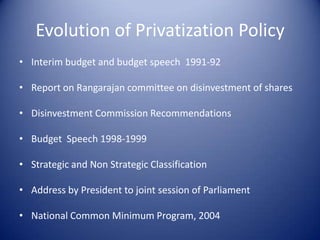
Evolution of Privatization PolicyInterim budget and budget speech  1991-92Report on Rangarajan committee on disinvestment of sharesDisinvestment Commission RecommendationsBudget  Speech 1998-1999Strategic and Non Strategic ClassificationAddress by President to joint session of ParliamentNational Common Minimum Program, 2004
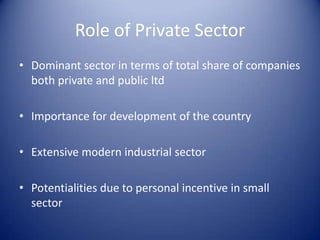
Role of Private SectorDominant sector in terms of total share of companies both private and public ltdImportance for development of the countryExtensive modern industrial sectorPotentialities due to personal incentive in small sector

Psu dec

  • 1.
    PSU’s and DisinvestmentPresentedBy,Shahane SirDivyaChabra - 07HardikGor - 17 Pratiktiberwal - 53
  • 2.
    Definition of PSUIn India, publicsector undertaking (PSU) is a term used for a government-owned corporation (company in the public sector). The term is used to refer to companies in which the government (either the Union Government or state or territorial governments, or both) owned a majority (51 percent or more) of the company equity.
  • 3.
    A Public SectorUndertaking is a corporation in the public sector in India, where management control of the company rests with the Government, it can be Central Government or the State GovernmentsGenesisThe main objectives of setting up the Public Sector enterprises as stated in Industrial policyResolution of 1956 were:To promote rapid economic development through creation and expansion of infrastructure
  • 4.
    To generate financialresources for development
  • 5.
    To promote redistributionof income and wealthCont… To create employment opportunities
  • 6.
    To promote balancedregional growth
  • 7.
    To encourage thedevelopment of small-scale and ancillary industries, and
  • 8.
    To promote exportson the one side and import substitution, on the other.Social ObjectivesEquitable distribution of wealthProvision of essential goods andTakeover of sick unitsPolitical objectivesPublic interest
  • 9.
  • 10.
    Socialism  PSU companiesare divided into three categories:MaharatnaNavratnaMiniratna
  • 11.
    MaharatnaGovt. Conferred MAHARATNAStatus on 16th Nov 2010 to 4 PSU’sAllows the PSU’s to raise its Investment Ceiling from `1000 to `5000 cr.Gives the PSU Autonomy to decide on investments up to 15% of their net worth in a projectExamples:Indian Oil CorporationNTPC Ltd.Oil & Natural Gas CorporationSteel Authority of India Ltd.
  • 12.
    Criteria for MaharatnaStatusAccording to the criteria laid down by the Cabinet, the Maharatna status is granted to listed Navaratna central public sector companies with an average annual turnover of more than Rs 25,000 crore, net profit after tax of Rs 5,000 crore and net worth of Rs 15,000 crore during the past three year
  • 13.
    Navratna statusNavratna statusgives a company enhanced financial and operational autonomy and empowers it to invest up to `1000 cr. or 15% of their net worth on a single project without seeking government approvalIn a year, these companies can spend up to 30% of their net worth not exceeding ` 1000 cr. They will also have the freedom to enter joint ventures, form alliances and float subsidiaries abroad.
  • 14.
    Criteria for NavratnaStatusNav ratna status is conferred by Department of Public Enterprises. Net profit to net worthTotal manpower cost to total cost of production or cost of servicesPBDIT to capital employedPBDIT to turnoverEPS Inter-sectoral performance.Additionally, a company must first be a Miniratna and have four independent directors on its board before it can be made a Navratna.
  • 15.
    Major Example ofNavratnaBharat Electronics LimitedBharat Heavy Electricals LimitedBharat Petroleum Corporation LimitedCoal India LimitedGAIL (India) LimitedHindustan Aeronautics LimitedHindustan Petroleum Corporation LimitedMahanagar Telephone Nigam LimitedNational Aluminium Company LimitedNMDC LimitedOil India LimitedPower Finance Corporation LimitedPower Grid Corporation of India LimitedRural Electrification Corporation LimitedShipping Corporation of India Limited
  • 16.
  • 17.
    Performance of Publicsector(Rs.Crs)
  • 18.
    Industries reservedfor PSU’s since July 1991Arms and Ammunition and allied items of defence equipment, defence aircraft and warshipAtomic EnergyCoal and Lignite Mineral oilMining of iron ore, gold and diamondMining of copper, zinc, led, tin and molybdenum.Minerals specified in the schedule to Atomic Energy (Control of production and use) Order, 1953Railway Transport
  • 19.
    Top 10 PSUin IndiaIOC-20 largest company in the world, most profitable PSU, ranked in Fortune 500 listsNTPC-India largest power company. contributes to 28.5% of the power to the country.BPCL-3 largest company in India, listed in Fortune 500 listsHPCL-operates the largest lube refinery in IndiaONGC-5 largest company ,contributes 77% of India’s crude oil, 81% of natural gas production
  • 20.
    Top 10 PSUin India SAIL-6 largest company in India and leading steel producerBHEL-manufactures over 180 products and caters to core sector of indian economyBSNL-Largest telecom industryHAL-Largest public sector in aeronautical engineeringBharat Dynamics Limited has made it to the top ten list due to the sheer grit and diligence that it showcases in its balance sheet and the profitability that it shows year after years
  • 21.
    Advantages & Disadvantages of PSU’sPoor Project Planning
  • 22.
  • 23.
  • 24.
  • 25.
  • 26.
    Lack of aProper Price Policy
  • 27.
    Inefficient Management CHANGEOF STRATEGYDeregulation of Imports
  • 28.
  • 29.
  • 30.
    Reversal of Policiestowards PSU’sIndustrial Policy 1991The Industrial policy of 1991 started the process of delicensing and except 18 industries, Industrial licensing was withdrawn. The market was opened up to domestic private capital and foreign capital was provided free entry up to 51% equity in high technology areas. The aim of economic liberalization was to enlarge competition and allowing new firms to enter the market. Thus the emphasis shifted from PSEs to liberalization of economy
  • 31.
    Meaning and Reasonsfor PrivatizationPrivatization is a process by which the government transfers the productive activity from the public sector to the private sectorImprovement in efficiency and performanceFixing responsibility is easierResponse time incase of Private sector is lessPrivatization leads to better services to customersRemedial measures are taken early in private sector
  • 32.
    Evolution of PrivatizationPolicyInterim budget and budget speech 1991-92Report on Rangarajan committee on disinvestment of sharesDisinvestment Commission RecommendationsBudget Speech 1998-1999Strategic and Non Strategic ClassificationAddress by President to joint session of ParliamentNational Common Minimum Program, 2004
  • 33.
    Role of PrivateSectorDominant sector in terms of total share of companies both private and public ltdImportance for development of the countryExtensive modern industrial sectorPotentialities due to personal incentive in small sector