Low Carbon Futures in Canada
Ralph Torrie, TEFP Managing Director
Sept. 17, 2012  University of Oxford,UK
rtorrie@trottierenergyfutures.ca
A partnership between the Canadian Academy of
Engineering and the David Suzuki Foundation:
1. To identify energy strategies for Canada to be implemented
between now and 2050 that would
• Reduce Canada's emissions of greenhouse gases from all aspects of the
energy sector with the target of 80% below 1990 levels by 2050
• Make Canada a global role model in the sustainable generation, distribution
and use of energy
• Ensure that all Canadians have access to the energy they need to enjoy a
high quality of life
2. To recommend the optimal strategy, from amongst those identified,
for implementation
3. To persuade the Canadian public, industry and governments that
implementing the optimal energy strategy is in the best interest of
Canada
4. To ensure that implementation of the optimal strategy has begun
within the terms of this project.
Conceptual Framework for Reducing
Energy-Related GHGs
Three broad levers available to lower
emissions:
* Carbon management (CCS) considered final lever due to cost/tonne
Consumption Per Unit
of Activity
Decarbonization/
Fuel Switching Activity Level
• The efficiency with
which fuel, electricity
are used to deliver
energy services
• No- and low-carbon
fuels
• Carbon capture
• The level and pattern
of activity in the
economy that
generates demand for
energy services
AUSI 2002
(Australia)
EREC 2010
(Canada)
RMI 2011
(USA)
PMO 2009
(Finland)
MIES 2004
(France)
BMU 2008
(Germany)
IVL 2010
(Sweden)
EKERC
2009
(UK)
Per capita end use of energy, GJ
In 2009 140 216 181 180 96 103 137 84
In 2050 129 96 111 115 91 78 125 58
% Reduction 8% 56% 39% 36% 5% 24% 9% 31%
End use energy per GDP, GJ
in 2009 5.8 8.6 4.9 6.8 4.2 4.2 4.4 3.1
In 2050 3.9 0.7 1.8 1.2 0.5 0.3 1.1 1.6
Energy
Productivity
Improvement
33% 92% 63% 82% 88% 93% 75% 48%
Carbon intensity of end use of energy, kg CO2e/GJ
In 2009 127.7 71.5 93.1 57.1 57.0 88.9 32.8 89.7
In 2050 30 7 16 11 6 4 9 27
Reduction in
Carbon
Intensity of
Energy
77% 90% 83% 81% 89% 96% 73% 70%
Emissions intensity of GDP, kg CO2e per thousand USD
In 2009 738 615 457 390 241 375 146 278
In 2050 77 17 26 24 11 7 17 32
Reduction
Emissions
Intensity of
GDP
90% 97% 94% 94% 95% 98% 88% 88%
Per capita greenhouse gas emissions, tonnes CO2e
In 2009 17.9 15.4 16.9 10.3 5.5 9.2 4.5 7.5
In 2050 3.9 0.7 1.8 1.2 0.5 0.3 1.1 1.6
Reduction
per capita
GHG
emissions
78% 95% 89% 88% 91% 97% 76% 79%
Selected Indicators from Illustrative Low Carbon Scenarios
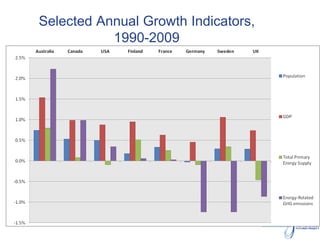
Selected Annual Growth Indicators,
1990-2009
Selected Country Indicators (Annual
Growth Rates 1990-2009)
In 2009 Australia Canada USA Finland France Germany Sweden UK
Percent of end use energy provided by electricity
In 2009 24% 21% 21% 27% 23% 19% 33% 21%
In 2050 25% 45% 24% 43% 51% 27% 38% 41%
Percent of all energy end use provided by renewable
In 2009 2% 13% 2% 8% 3% 3% 19% 1%
In 2050 48% 76% >80% 67% 49% 52% 93% 31%
Percent of electricity system powered by fossil fuels
In 2009 93% 23% 70% 37% 11% 61% 4% 74%
In 2050 26% 5% 10% 0% 23% 18% 0% 26%
Decarbonization of Fuel and Electricity in Low Carbon
Futures
2050 Electricity Supply in Low Carbon
Scenarios (PJ)
Petajoules
AUSI 2002
(Australia)
EREC
2010
(Canada)
RMI
2011
(USA)
FPMO
2009
(Finland)
MIES 2004
(France)
BMU 2008
(Germany)
IVL 2010
(Sweden)
UKERC
2009
(UK)
Hydro electricity 0 1,572 995 55 89 245 31
Wind electricity 500 396 5,897 67 672 188
Solar photovoltaics 100 43 5,163 0 100 0
Concentrated solar
power
0 0 920 0 327 0
Electricity from Biomass 157 7 192 14 194 59 38
Geothermal 91 0 228 0 128 387
Wave or tidal energy 0 50 0 0 64
Unspecified caarbon-
free electricity
0 0 0 0 924 190 263 0
Nuclear
0 0 0 150 1710 0
Included
above
769
Total carbon-free
electricity
847 2,041 13,395 286 2,634 1,699 566 1,477
Carbon-free as percent
of electricity supply
74% 95% 90% 100% 77% 82% 100% 74%
0
10
20
30
40
50
60
70
2008
2009
2010
2011
2012
2013
2014
2015
2016
2017
2018
2019
2020
2021
2022
2023
2024
2025
2026
2027
2028
2029
2030
2031
2032
2033
2034
2035
2036
2037
2038
2039
2040
2041
2042
2043
2044
2045
2046
2047
2048
2049
2050
Million
Tonnes
Primary Biomass Feedstock in an Illustrative
Low Carbon Future for Canada:
Non
Energy
Coal
Gas
Oil
ENERGY
Fossil fuel production and
consumption account for 82% of
Canada’s greenhouse gas emissions:
0
2,000
4,000
6,000
8,000
10,000
12,000
14,000
1926 1931 1936 1941 1946 1951 1956 1961 1966 1971 1976 1981 1986 1991 1996 2001 2006
PETAJOULES
Coal Petroleum
Natural Gas and NGLs Hydro
Wood Nuclear
Canadian Domestic Demand for
Primary Energy, 1926-2006
-
2
4
6
8
10
12
14
16
18
20
1926 1931 1936 1941 1946 1951 1956 1961 1966 1971 1976 1981 1986 1991 1996 2001 2006
1926-1.0
GDP CO2 Emissions Domestic Energy Demand Population
Relative growth of population, energy,
CO2 emissions and GDP – the long
view…
CO2 Intensity of Canadian Economy,
1926-2003
0.00
0.50
1.00
1.50
2.00
2.50
1926 1931 1936 1941 1946 1951 1956 1961 1966 1971 1976 1981 1986 1991 1996 2001
TONNESOFCO2PERMILLION1997$OFGDP Energy productivity improvement and progressive shifts to less carbon
intensive energy have resulted in a long term and persistent decline in
the CO2 intensity of the Canadian economy:
1.00
1.50
2.00
2.50
3.00
1971 1976 1981 1986 1991 1996 2001 2006
1971=1.0
Energy GDP
GDP and energy commodity consumption
“decoupled” in the early 1970’s, and energy
productivity growth has outstripped growth in
new supply since then:
0
5,000
10,000
15,000
20,000
25,000
Coal Oil Gas Hydro Wood Nuclear Energy Productivity
Petajoules
Two eras of post-War energy: from 1946 to early 1970’s, fuel
and electricity grew with economic output, starting in the 1970’s
energy productivity improvements have outstripped fuel and
electricity growth.
Energy productivity, measured as the ratio of GDP to energy
consumption, has improved throughout the OECD, including with
countries that already had much lower energy/GDP ratios than
Canada at the outset:
Primary energy demand vs. energy
productivity in the OECD
0
1,000
2,000
3,000
4,000
5,000
6,000
7,000
8,000
9,000
Coal Oil Gas Hydro Wood Nuclear Energy
Productivity
Petajoules
New supply from 1971-2006 compared
to energy productivity growth over the
same period:
Reference Case Emissions by Sector
0
100
200
300
400
500
600
700
800
1978
1980
1982
1984
1986
1988
1990
1992
1994
1996
1998
2000
2002
2004
2006
2008
2010
2012
2014
2016
2018
2020
2022
2024
2026
2028
2030
2032
2034
2036
2038
2040
2042
2044
2046
2048
2050
Mt
Oil and Gas
elec gen
industrial
freight transport
passenger transport
commercial
residential
Long term and deep
emission reduction
nature of this
scenario takes us
outside the climate
change policy box,
supports a “fresh
look” at strategies
and options
0
200
400
600
800
1926 1950 1974 1998 2022 2046
?
When GHG emissions are allocated according to where they take place,
the picture looks like this; just over half (55%) of Canada’s energy-
related greenhouse gas emissions are emitted from tailpipes, chimneys
and smokestacks where fossil fuels are burned – the other 45% are
emitted by the energy commodity industry itself (power plants and fossil
fuel industry):
Residential
7%
Commerical
6%
Personal
Transport
14%
Freight
Transport
17%
Industry
11%
Electricity
Generation
20%
Oil and Gas
(incl. fugitives,
pipelines,
refining)
25%
When the emissions of power plants and the oil and gas industry
are pro-rated to the end use sectors, the emission source takes on
a different look:
Residential
14%
Commercial
13%
Personal Transport
21%
Freight Transport
13%
Industry (excl
fossil fuel and
power plants)
23%
Production
Emissions for Oil
and Gas Exports
16%
Connecting greenhouse gas emissions to the energy service
demands that drive them provides yet another perspective…
Low Temp Heat
(<100C)
20%
Med Temp Heat
(100-260C)
7%
High Temp Heat
(>260C)
8%
Personal Mobility
21%
Goods Movement
13%
Industrial Motive
Power
5%
Electricity
Specific
13%
Production
Emissions for Oil
and Gas Exports
16%
Trottier Energy Futures Project – Research
and Strategy Development Framework
Synthesis
Energy
Intensive
Industries
Integrative
Industrial
Design
Access/
Mobility/
Personal
Transport
Supply
Chains and
Goods
Movement
Buildings:
Toward
Net Zero
Energy
Electricity
and the
Future
Grid
Fossil Fuel
Production
Bioenergy
Education/
Training
Investment/
Finance
Industrial
Strategy

Low Carbon Futures in Canada (2012)

  • 1.
    Low Carbon Futuresin Canada Ralph Torrie, TEFP Managing Director Sept. 17, 2012  University of Oxford,UK rtorrie@trottierenergyfutures.ca
  • 2.
    A partnership betweenthe Canadian Academy of Engineering and the David Suzuki Foundation: 1. To identify energy strategies for Canada to be implemented between now and 2050 that would • Reduce Canada's emissions of greenhouse gases from all aspects of the energy sector with the target of 80% below 1990 levels by 2050 • Make Canada a global role model in the sustainable generation, distribution and use of energy • Ensure that all Canadians have access to the energy they need to enjoy a high quality of life 2. To recommend the optimal strategy, from amongst those identified, for implementation 3. To persuade the Canadian public, industry and governments that implementing the optimal energy strategy is in the best interest of Canada 4. To ensure that implementation of the optimal strategy has begun within the terms of this project.
  • 3.
    Conceptual Framework forReducing Energy-Related GHGs Three broad levers available to lower emissions: * Carbon management (CCS) considered final lever due to cost/tonne Consumption Per Unit of Activity Decarbonization/ Fuel Switching Activity Level • The efficiency with which fuel, electricity are used to deliver energy services • No- and low-carbon fuels • Carbon capture • The level and pattern of activity in the economy that generates demand for energy services
  • 4.
    AUSI 2002 (Australia) EREC 2010 (Canada) RMI2011 (USA) PMO 2009 (Finland) MIES 2004 (France) BMU 2008 (Germany) IVL 2010 (Sweden) EKERC 2009 (UK) Per capita end use of energy, GJ In 2009 140 216 181 180 96 103 137 84 In 2050 129 96 111 115 91 78 125 58 % Reduction 8% 56% 39% 36% 5% 24% 9% 31% End use energy per GDP, GJ in 2009 5.8 8.6 4.9 6.8 4.2 4.2 4.4 3.1 In 2050 3.9 0.7 1.8 1.2 0.5 0.3 1.1 1.6 Energy Productivity Improvement 33% 92% 63% 82% 88% 93% 75% 48% Carbon intensity of end use of energy, kg CO2e/GJ In 2009 127.7 71.5 93.1 57.1 57.0 88.9 32.8 89.7 In 2050 30 7 16 11 6 4 9 27 Reduction in Carbon Intensity of Energy 77% 90% 83% 81% 89% 96% 73% 70% Emissions intensity of GDP, kg CO2e per thousand USD In 2009 738 615 457 390 241 375 146 278 In 2050 77 17 26 24 11 7 17 32 Reduction Emissions Intensity of GDP 90% 97% 94% 94% 95% 98% 88% 88% Per capita greenhouse gas emissions, tonnes CO2e In 2009 17.9 15.4 16.9 10.3 5.5 9.2 4.5 7.5 In 2050 3.9 0.7 1.8 1.2 0.5 0.3 1.1 1.6 Reduction per capita GHG emissions 78% 95% 89% 88% 91% 97% 76% 79% Selected Indicators from Illustrative Low Carbon Scenarios
  • 5.
    Selected Annual GrowthIndicators, 1990-2009
  • 6.
    Selected Country Indicators(Annual Growth Rates 1990-2009)
  • 7.
    In 2009 AustraliaCanada USA Finland France Germany Sweden UK Percent of end use energy provided by electricity In 2009 24% 21% 21% 27% 23% 19% 33% 21% In 2050 25% 45% 24% 43% 51% 27% 38% 41% Percent of all energy end use provided by renewable In 2009 2% 13% 2% 8% 3% 3% 19% 1% In 2050 48% 76% >80% 67% 49% 52% 93% 31% Percent of electricity system powered by fossil fuels In 2009 93% 23% 70% 37% 11% 61% 4% 74% In 2050 26% 5% 10% 0% 23% 18% 0% 26% Decarbonization of Fuel and Electricity in Low Carbon Futures
  • 8.
    2050 Electricity Supplyin Low Carbon Scenarios (PJ) Petajoules AUSI 2002 (Australia) EREC 2010 (Canada) RMI 2011 (USA) FPMO 2009 (Finland) MIES 2004 (France) BMU 2008 (Germany) IVL 2010 (Sweden) UKERC 2009 (UK) Hydro electricity 0 1,572 995 55 89 245 31 Wind electricity 500 396 5,897 67 672 188 Solar photovoltaics 100 43 5,163 0 100 0 Concentrated solar power 0 0 920 0 327 0 Electricity from Biomass 157 7 192 14 194 59 38 Geothermal 91 0 228 0 128 387 Wave or tidal energy 0 50 0 0 64 Unspecified caarbon- free electricity 0 0 0 0 924 190 263 0 Nuclear 0 0 0 150 1710 0 Included above 769 Total carbon-free electricity 847 2,041 13,395 286 2,634 1,699 566 1,477 Carbon-free as percent of electricity supply 74% 95% 90% 100% 77% 82% 100% 74%
  • 9.
  • 10.
    Non Energy Coal Gas Oil ENERGY Fossil fuel productionand consumption account for 82% of Canada’s greenhouse gas emissions:
  • 11.
    0 2,000 4,000 6,000 8,000 10,000 12,000 14,000 1926 1931 19361941 1946 1951 1956 1961 1966 1971 1976 1981 1986 1991 1996 2001 2006 PETAJOULES Coal Petroleum Natural Gas and NGLs Hydro Wood Nuclear Canadian Domestic Demand for Primary Energy, 1926-2006
  • 12.
    - 2 4 6 8 10 12 14 16 18 20 1926 1931 19361941 1946 1951 1956 1961 1966 1971 1976 1981 1986 1991 1996 2001 2006 1926-1.0 GDP CO2 Emissions Domestic Energy Demand Population Relative growth of population, energy, CO2 emissions and GDP – the long view…
  • 13.
    CO2 Intensity ofCanadian Economy, 1926-2003 0.00 0.50 1.00 1.50 2.00 2.50 1926 1931 1936 1941 1946 1951 1956 1961 1966 1971 1976 1981 1986 1991 1996 2001 TONNESOFCO2PERMILLION1997$OFGDP Energy productivity improvement and progressive shifts to less carbon intensive energy have resulted in a long term and persistent decline in the CO2 intensity of the Canadian economy:
  • 14.
    1.00 1.50 2.00 2.50 3.00 1971 1976 19811986 1991 1996 2001 2006 1971=1.0 Energy GDP GDP and energy commodity consumption “decoupled” in the early 1970’s, and energy productivity growth has outstripped growth in new supply since then:
  • 15.
    0 5,000 10,000 15,000 20,000 25,000 Coal Oil GasHydro Wood Nuclear Energy Productivity Petajoules Two eras of post-War energy: from 1946 to early 1970’s, fuel and electricity grew with economic output, starting in the 1970’s energy productivity improvements have outstripped fuel and electricity growth.
  • 16.
    Energy productivity, measuredas the ratio of GDP to energy consumption, has improved throughout the OECD, including with countries that already had much lower energy/GDP ratios than Canada at the outset: Primary energy demand vs. energy productivity in the OECD
  • 17.
    0 1,000 2,000 3,000 4,000 5,000 6,000 7,000 8,000 9,000 Coal Oil GasHydro Wood Nuclear Energy Productivity Petajoules New supply from 1971-2006 compared to energy productivity growth over the same period:
  • 18.
    Reference Case Emissionsby Sector 0 100 200 300 400 500 600 700 800 1978 1980 1982 1984 1986 1988 1990 1992 1994 1996 1998 2000 2002 2004 2006 2008 2010 2012 2014 2016 2018 2020 2022 2024 2026 2028 2030 2032 2034 2036 2038 2040 2042 2044 2046 2048 2050 Mt Oil and Gas elec gen industrial freight transport passenger transport commercial residential
  • 19.
    Long term anddeep emission reduction nature of this scenario takes us outside the climate change policy box, supports a “fresh look” at strategies and options 0 200 400 600 800 1926 1950 1974 1998 2022 2046 ?
  • 20.
    When GHG emissionsare allocated according to where they take place, the picture looks like this; just over half (55%) of Canada’s energy- related greenhouse gas emissions are emitted from tailpipes, chimneys and smokestacks where fossil fuels are burned – the other 45% are emitted by the energy commodity industry itself (power plants and fossil fuel industry): Residential 7% Commerical 6% Personal Transport 14% Freight Transport 17% Industry 11% Electricity Generation 20% Oil and Gas (incl. fugitives, pipelines, refining) 25%
  • 21.
    When the emissionsof power plants and the oil and gas industry are pro-rated to the end use sectors, the emission source takes on a different look: Residential 14% Commercial 13% Personal Transport 21% Freight Transport 13% Industry (excl fossil fuel and power plants) 23% Production Emissions for Oil and Gas Exports 16%
  • 22.
    Connecting greenhouse gasemissions to the energy service demands that drive them provides yet another perspective… Low Temp Heat (<100C) 20% Med Temp Heat (100-260C) 7% High Temp Heat (>260C) 8% Personal Mobility 21% Goods Movement 13% Industrial Motive Power 5% Electricity Specific 13% Production Emissions for Oil and Gas Exports 16%
  • 23.
    Trottier Energy FuturesProject – Research and Strategy Development Framework Synthesis Energy Intensive Industries Integrative Industrial Design Access/ Mobility/ Personal Transport Supply Chains and Goods Movement Buildings: Toward Net Zero Energy Electricity and the Future Grid Fossil Fuel Production Bioenergy Education/ Training Investment/ Finance Industrial Strategy