The role of bioenergy in Britain
UK Energy System in Transition: Technology, Infrastructure and Investment, Edinburgh, 1st April 2014
*pete.smith@abdn.ac.uk
Pete Smith1*, Andrew Lovett2, Jon Finch3, Dominic
Moran4, Gail Taylor5, Eric Casella6, Simon Taylor7,
Steven Firth7, Shifeng Wang1, Peter Alexander4, Chao
Wang7, Astley Hastings1, Mat Tallis5, Gilla Sunnenberg2,
Jon Hillier1, David Allinson7, Mohammed Quddus7,
James Morison6 & Iwona Cisowska3
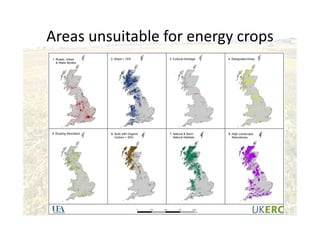
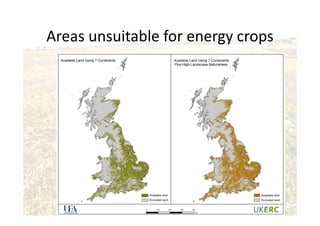
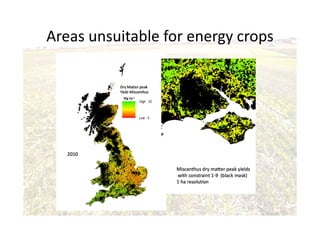
Areas unsuitable for energy crops
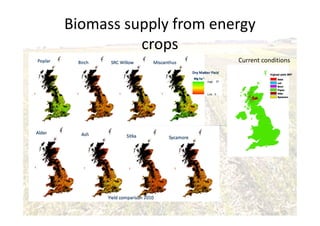
Biomass supply from energy
crops
Current conditions
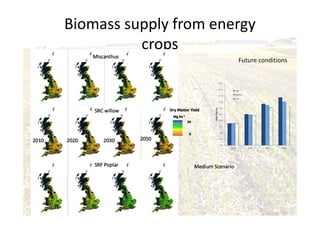
Biomass supply from energy
crops
Future conditions
8.0
8.5
9.0
9.5
10.0
10.5
11.0
11.5
12.0
12.5
13.0
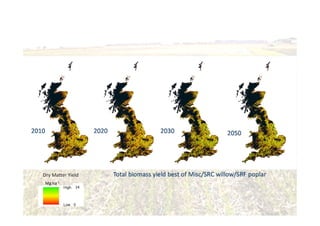
2010 2020 2030 2050
MxgMg/ha
High
Medium
Low
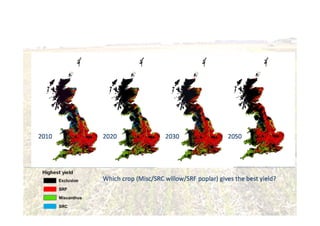
Biomass supply from energy
crops
Highest yield
Exclusion
SRF
Miscanthus
SRC
Biomass supply from energy
crops
Dry Matter Yield
Mg ha-1
24
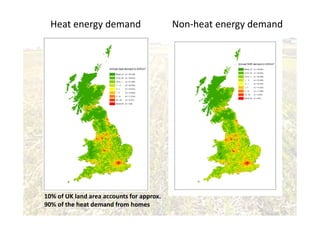
10% of UK land area accounts for approx.
90% of the heat demand from homes
Non-heat energy demandHeat energy demand
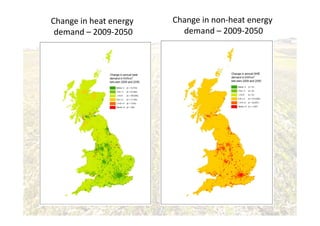
Change in non-heat energy
demand – 2009-2050
Change in heat energy
demand – 2009-2050
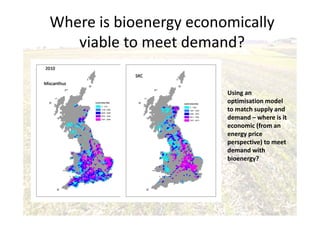
Where is bioenergy economically
viable to meet demand?
Using an
optimisation model
to match supply and
demand – where is it
economic (from an
energy price
perspective) to meet
demand with
bioenergy?
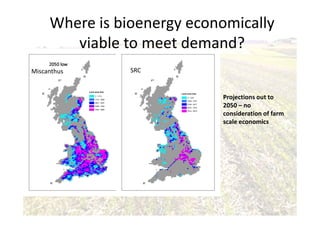
Where is bioenergy economically
viable to meet demand?
Projections out to
2050 – no
consideration of farm
scale economics
Miscanthus SRC
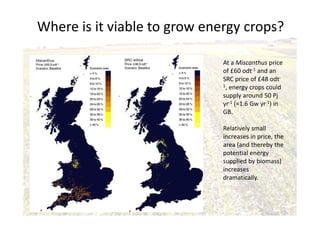
Where is it viable to grow energy crops?
At a Miscanthus price
of £60 odt-1 and an
SRC price of £48 odt-
1, energy crops could
supply around 50 Pj
yr-1 (=1.6 Gw yr-1) in
GB.
Relatively small
increases in price, the
area (and thereby the
potential energy
supplied by biomass)
increases
dramatically.
0.0
5.0
10.0
15.0
20.0
25.0
30.0
35.0
40.0
45.0
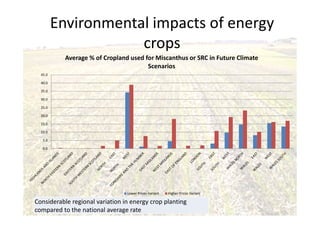
Average % of Cropland used for Miscanthus or SRC in Future Climate
Scenarios
Lower Prices Variant Higher Prices Variant
Environmental impacts of energy
crops
Considerable regional variation in energy crop planting
compared to the national average rate
0
100,000
200,000
300,000
400,000
500,000
600,000
700,000
800,000
900,000
SRC
Miscanthus
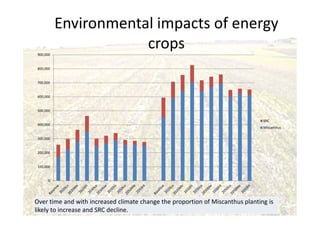
Environmental impacts of energy
crops
Over time and with increased climate change the proportion of Miscanthus planting is
likely to increase and SRC decline.
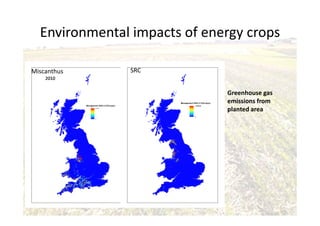
Environmental impacts of energy
crops
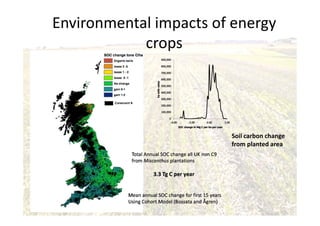
Soil carbon change
from planted area
Greenhouse gas
emissions from
planted area
Miscanthus SRC
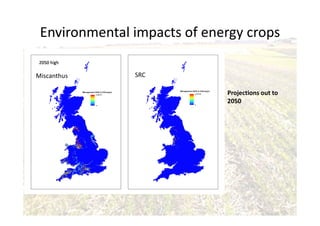
Environmental impacts of energy crops
Projections out to
2050
Miscanthus SRC
Miscanthus SRC
Conclusions
• Energy crops can help to meet energy demands, but
feasibility depends of price paid for feedstock
• The location of the nearest power plant is critical - more
distributed power generation infrastructure is needed
• Distribution will vary between regions and through time
• Environmental impacts vary – soil carbon may increase
or decrease, and GHG emissions from crop management
varies among crops.
• Special issue of Global Change Biology Bioenergy
published in February 2014.

The role of bioenergy in Britain, Pete Smith, University of Aberdeen

  • 1.
    The role ofbioenergy in Britain UK Energy System in Transition: Technology, Infrastructure and Investment, Edinburgh, 1st April 2014 *pete.smith@abdn.ac.uk Pete Smith1*, Andrew Lovett2, Jon Finch3, Dominic Moran4, Gail Taylor5, Eric Casella6, Simon Taylor7, Steven Firth7, Shifeng Wang1, Peter Alexander4, Chao Wang7, Astley Hastings1, Mat Tallis5, Gilla Sunnenberg2, Jon Hillier1, David Allinson7, Mohammed Quddus7, James Morison6 & Iwona Cisowska3
  • 2.
  • 3.
  • 4.
  • 5.
    Biomass supply fromenergy crops Current conditions
  • 6.
    Biomass supply fromenergy crops Future conditions 8.0 8.5 9.0 9.5 10.0 10.5 11.0 11.5 12.0 12.5 13.0 2010 2020 2030 2050 MxgMg/ha High Medium Low
  • 7.
    Biomass supply fromenergy crops Highest yield Exclusion SRF Miscanthus SRC
  • 8.
    Biomass supply fromenergy crops Dry Matter Yield Mg ha-1 24
  • 9.
    10% of UKland area accounts for approx. 90% of the heat demand from homes Non-heat energy demandHeat energy demand
  • 10.
    Change in non-heatenergy demand – 2009-2050 Change in heat energy demand – 2009-2050
  • 11.
    Where is bioenergyeconomically viable to meet demand? Using an optimisation model to match supply and demand – where is it economic (from an energy price perspective) to meet demand with bioenergy?
  • 12.
    Where is bioenergyeconomically viable to meet demand? Projections out to 2050 – no consideration of farm scale economics Miscanthus SRC
  • 13.
    Where is itviable to grow energy crops? At a Miscanthus price of £60 odt-1 and an SRC price of £48 odt- 1, energy crops could supply around 50 Pj yr-1 (=1.6 Gw yr-1) in GB. Relatively small increases in price, the area (and thereby the potential energy supplied by biomass) increases dramatically.
  • 14.
    0.0 5.0 10.0 15.0 20.0 25.0 30.0 35.0 40.0 45.0 Average % ofCropland used for Miscanthus or SRC in Future Climate Scenarios Lower Prices Variant Higher Prices Variant Environmental impacts of energy crops Considerable regional variation in energy crop planting compared to the national average rate
  • 15.
    0 100,000 200,000 300,000 400,000 500,000 600,000 700,000 800,000 900,000 SRC Miscanthus Environmental impacts ofenergy crops Over time and with increased climate change the proportion of Miscanthus planting is likely to increase and SRC decline.
  • 16.
    Environmental impacts ofenergy crops Soil carbon change from planted area
  • 17.
    Greenhouse gas emissions from plantedarea Miscanthus SRC Environmental impacts of energy crops
  • 18.
    Environmental impacts ofenergy crops Projections out to 2050 Miscanthus SRC Miscanthus SRC
  • 19.
    Conclusions • Energy cropscan help to meet energy demands, but feasibility depends of price paid for feedstock • The location of the nearest power plant is critical - more distributed power generation infrastructure is needed • Distribution will vary between regions and through time • Environmental impacts vary – soil carbon may increase or decrease, and GHG emissions from crop management varies among crops. • Special issue of Global Change Biology Bioenergy published in February 2014.