Department of Chemical Pathology,
Federal Teaching Hospital Abakaliki
Clinical Presentation on:
Proteinuria
By: Dr Onu Emmanuel Mbah
Date: 11 Feb. 2016
Supervising Consultant: Dr Okeke NJ
Outline
• Introduction
• Classification of proteinuria
• Testing for proteinuria
• Limitation of screening tests
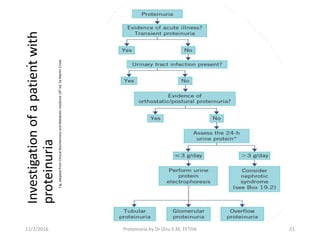
• Investigating a patient with proteinuria
• Appreciation
11/2/2016 2Proteinuria by Dr Onu E.M, FETHA
Introduction
• Proteinuria is defined as the presence of
excessive proteins in the urine.
• Normal urinary protein excretion is < 150 mg/24
hour, mostly alb. and then Tamm-Horsfall protein
• Daily albumin excretion in a normal person is < 30
mg.
11/2/2016 3Proteinuria by Dr Onu E.M, FETHA
.
• UAER averages 2.6-12.6 µg/min in males and 1.1-
21.9 µg/min in females.
• Microalbuminuria is referred to as the excretion of
30-300 mg of albumin daily or 20-200 µg of
albumin per minute.
11/2/2016 4Proteinuria by Dr Onu E.M, FETHA
.
• The glomerular basement membrane (GBM) acts
as an ultrafilter for plasma proteins
• The ability of individual proteins to pass through
the membrane is a function of:
• (1) molecular size
• (2) net ionic charge
• (3) plasma concentration of the proteins.
• Transport of protein molecules through the
glomerular membrane is inversely related to size
and net negative charge.
11/2/2016 5Proteinuria by Dr Onu E.M, FETHA
.
• Significant amount of Albumin (64 kDa) is passed
into the filtrate as a result of its high plasma
concentration and relatively low molecular mass.
• Proteins with molecular masses of 15 to 40
kDa filter more readily but in lesser quantities
because of their low plasma concentrations.
11/2/2016 6Proteinuria by Dr Onu E.M, FETHA
Classification of Proteinuria
11/2/2016 7Proteinuria by Dr Onu E.M, FETHA
Tubular Proteinuria
• Tubular proteinuria occurs most commonly in
tubulo-interstitial diseases of the kidney
• It comprises low molecular proteins such as beta-2
microglobulin, which in normal conditions are
completely reabsorbed by proximal tubules.
• The amount of proteinuria is < 2 g and dipstick may
be negative.
11/2/2016 8Proteinuria by Dr Onu E.M, FETHA
.
• Agarose electrophoresis of urine gives a
characteristic pattern-prominent a- and P-bands,
a relatively faint albumin band, and sometimes
a post-yband.
• Sodium dodecyl sulfate polyacrylamide gel
electrophoresis (SDS-PAGE) is more useful in
detecting tubular proteinuria in the presence of
glomerular proteinuria as it separates proteins by
molecular size.
11/2/2016 9Proteinuria by Dr Onu E.M, FETHA
.
• Acute tubular proteinuria complely reversible
• May occur in:
• (1) burns,
• (2) acute pancreatitis,
• (3) heavy metal poisoning,
• (4) administration of renotoxic drugs
11/2/2016 10Proteinuria by Dr Onu E.M, FETHA
.
• Chronic tubular proteinuria is usually irreversible, may
be severe
• Causes:
• Hereditary, as in Fanconi syndrome
• Acquired:- localized dz e.g chronic pyelonephritis -
systemic disease, e.gs cirrhosis, sarcoidosis.
• drugs, e.g phenacetin
• toxins e.g cadmium
• Diminished or diminishing tubular reabsorption is
suggested by increasing concentrations of low
molecular mass proteins in urine.
11/2/2016 11Proteinuria by Dr Onu E.M, FETHA
Glomerular Proteinuria
• This is the most common and serious type of
proteinuria.
• Patients are routinely screened for this disorder
by a simple diptick test for albumin.
• If the dipstick test result is negative, clinically
significant glomerular proteinuria is precluded.
• Because most of the excreted protein is albumin,
glomerular proteinuria is often termed albuminuria
11/2/2016 12Proteinuria by Dr Onu E.M, FETHA
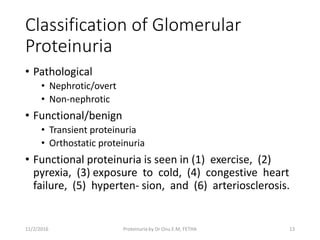
Classification of Glomerular
Proteinuria
• Pathological
• Nephrotic/overt
• Non-nephrotic
• Functional/benign
• Transient proteinuria
• Orthostatic proteinuria
• Functional proteinuria is seen in (1) exercise, (2)
pyrexia, (3) exposure to cold, (4) congestive heart
failure, (5) hyperten- sion, and (6) arteriosclerosis.
11/2/2016 13Proteinuria by Dr Onu E.M, FETHA
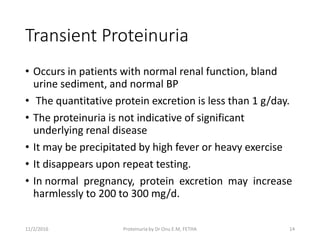
Transient Proteinuria
• Occurs in patients with normal renal function, bland
urine sediment, and normal BP
• The quantitative protein excretion is less than 1 g/day.
• The proteinuria is not indicative of significant
underlying renal disease
• It may be precipitated by high fever or heavy exercise
• It disappears upon repeat testing.
• In normal pregnancy, protein excretion may increase
harmlessly to 200 to 300 mg/d.
11/2/2016 14Proteinuria by Dr Onu E.M, FETHA
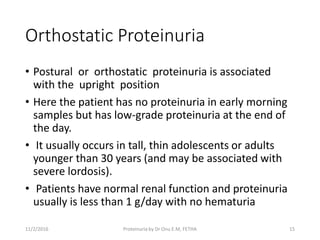
Orthostatic Proteinuria
• Postural or orthostatic proteinuria is associated
with the upright position
• Here the patient has no proteinuria in early morning
samples but has low-grade proteinuria at the end of
the day.
• It usually occurs in tall, thin adolescents or adults
younger than 30 years (and may be associated with
severe lordosis).
• Patients have normal renal function and proteinuria
usually is less than 1 g/day with no hematuria
11/2/2016 15Proteinuria by Dr Onu E.M, FETHA
.
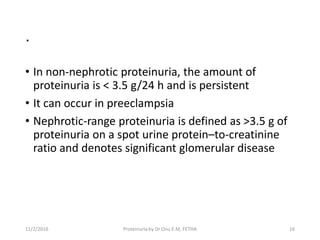
• In non-nephrotic proteinuria, the amount of
proteinuria is < 3.5 g/24 h and is persistent
• It can occur in preeclampsia
• Nephrotic-range proteinuria is defined as >3.5 g of
proteinuria on a spot urine protein–to-creatinine
ratio and denotes significant glomerular disease
11/2/2016 16Proteinuria by Dr Onu E.M, FETHA
Overflow Proteinuria
• Occurs when proteins are produced in amounts
greater than the reabsorptive capacity of the
proximal tubule.
• It includes (1) hemoglobinuria, (2)myoglobinuria,
and (3) Bence Jones proteinuria
• These low molecular proteins can be toxic to the
tubules and can cause acute kidney injury.
11/2/2016 17Proteinuria by Dr Onu E.M, FETHA
Testing for Urinary Protein
• Fresh sample should be used
• Screening test involves dipstick test e.g with
albustix (with tetrabromophenol blue)
• Albustix is buffered to PH 3; normally yellow
• It turns green or bluish-green if protein is
present.
• The colour is then matched on a chat to indicate
the protein conc.
11/2/2016 18Proteinuria by Dr Onu E.M, FETHA
Limitations of Screening Tests
• The tests were mainly developed to detect albumin
and may be negative in the presence of other
proteins, such as BJP.
• Because the tests depend on protein
concentrations, very dilute urine may give negative
results despite significant proteinuria.
• False-negative results occur if acid has been
added to the urine as a preservative
11/2/2016 19Proteinuria by Dr Onu E.M, FETHA
.
• False-positive results occur:
• if the specimen is contaminated with vaginal or
urethral secretions, including haematuria, semen or
menstrual fluid,
• in strongly alkaline (infected or stale) urine, when
buffering capacity is exceeded; a green colour in this
case is a reflection of the alkaline pH,
• if the urine container is contaminated with
disinfectants such as chlorhexidine.
• Spot urine ACR or P:C ratio (in pregnancy) is more
convenient. (P:C in mg/mmol; ACR in g/d)
11/2/2016 20Proteinuria by Dr Onu E.M, FETHA
.
Investigationofapatientwith
proteinuria
Fig.adaptedfromClinicalBiochemistryandMetabolicmedicine18thed.byMartinCrook
11/2/2016 Proteinuria by Dr Onu E.M, FETHA 21
Treatment
• Nonspecific treatment - Treatment that is
applicable irrespective of the underlying cause.
• Specific treatment - Treatment that depends on the
underlying renal or nonrenal cause
• The patient is referred to a nephrologiste esp. if
bad prognostic indecis are observed eg albuminuria
> 1g/d, or worsening renal funxn
11/2/2016 Proteinuria by Dr Onu E.M, FETHA 22
• Use of ACEIs or ARBs
• Target blood pressure is less than 125/75 mm Hg.
• The dose of ACE inhibitor should be increased as
tolerated until this blood pressure is achieved.
• Normotensive patients with proteinuria also should
be given ACEIs.
11/2/2016 Proteinuria by Dr Onu E.M, FETHA 23
• Diuretics
• Patients with moderate to severe proteinuria are
usually fluid overloaded and require diuretic
therapy along with dietary salt restriction.
11/2/2016 Proteinuria by Dr Onu E.M, FETHA 24
Appreciation
Thanks for Listening
11/2/2016 25Proteinuria by Dr Onu E.M, FETHA

Proteinuria dr onu em

  • 1.
    Department of ChemicalPathology, Federal Teaching Hospital Abakaliki Clinical Presentation on: Proteinuria By: Dr Onu Emmanuel Mbah Date: 11 Feb. 2016 Supervising Consultant: Dr Okeke NJ
  • 2.
    Outline • Introduction • Classificationof proteinuria • Testing for proteinuria • Limitation of screening tests • Investigating a patient with proteinuria • Appreciation 11/2/2016 2Proteinuria by Dr Onu E.M, FETHA
  • 3.
    Introduction • Proteinuria isdefined as the presence of excessive proteins in the urine. • Normal urinary protein excretion is < 150 mg/24 hour, mostly alb. and then Tamm-Horsfall protein • Daily albumin excretion in a normal person is < 30 mg. 11/2/2016 3Proteinuria by Dr Onu E.M, FETHA
  • 4.
    . • UAER averages2.6-12.6 µg/min in males and 1.1- 21.9 µg/min in females. • Microalbuminuria is referred to as the excretion of 30-300 mg of albumin daily or 20-200 µg of albumin per minute. 11/2/2016 4Proteinuria by Dr Onu E.M, FETHA
  • 5.
    . • The glomerularbasement membrane (GBM) acts as an ultrafilter for plasma proteins • The ability of individual proteins to pass through the membrane is a function of: • (1) molecular size • (2) net ionic charge • (3) plasma concentration of the proteins. • Transport of protein molecules through the glomerular membrane is inversely related to size and net negative charge. 11/2/2016 5Proteinuria by Dr Onu E.M, FETHA
  • 6.
    . • Significant amountof Albumin (64 kDa) is passed into the filtrate as a result of its high plasma concentration and relatively low molecular mass. • Proteins with molecular masses of 15 to 40 kDa filter more readily but in lesser quantities because of their low plasma concentrations. 11/2/2016 6Proteinuria by Dr Onu E.M, FETHA
  • 7.
    Classification of Proteinuria 11/2/20167Proteinuria by Dr Onu E.M, FETHA
  • 8.
    Tubular Proteinuria • Tubularproteinuria occurs most commonly in tubulo-interstitial diseases of the kidney • It comprises low molecular proteins such as beta-2 microglobulin, which in normal conditions are completely reabsorbed by proximal tubules. • The amount of proteinuria is < 2 g and dipstick may be negative. 11/2/2016 8Proteinuria by Dr Onu E.M, FETHA
  • 9.
    . • Agarose electrophoresisof urine gives a characteristic pattern-prominent a- and P-bands, a relatively faint albumin band, and sometimes a post-yband. • Sodium dodecyl sulfate polyacrylamide gel electrophoresis (SDS-PAGE) is more useful in detecting tubular proteinuria in the presence of glomerular proteinuria as it separates proteins by molecular size. 11/2/2016 9Proteinuria by Dr Onu E.M, FETHA
  • 10.
    . • Acute tubularproteinuria complely reversible • May occur in: • (1) burns, • (2) acute pancreatitis, • (3) heavy metal poisoning, • (4) administration of renotoxic drugs 11/2/2016 10Proteinuria by Dr Onu E.M, FETHA
  • 11.
    . • Chronic tubularproteinuria is usually irreversible, may be severe • Causes: • Hereditary, as in Fanconi syndrome • Acquired:- localized dz e.g chronic pyelonephritis - systemic disease, e.gs cirrhosis, sarcoidosis. • drugs, e.g phenacetin • toxins e.g cadmium • Diminished or diminishing tubular reabsorption is suggested by increasing concentrations of low molecular mass proteins in urine. 11/2/2016 11Proteinuria by Dr Onu E.M, FETHA
  • 12.
    Glomerular Proteinuria • Thisis the most common and serious type of proteinuria. • Patients are routinely screened for this disorder by a simple diptick test for albumin. • If the dipstick test result is negative, clinically significant glomerular proteinuria is precluded. • Because most of the excreted protein is albumin, glomerular proteinuria is often termed albuminuria 11/2/2016 12Proteinuria by Dr Onu E.M, FETHA
  • 13.
    Classification of Glomerular Proteinuria •Pathological • Nephrotic/overt • Non-nephrotic • Functional/benign • Transient proteinuria • Orthostatic proteinuria • Functional proteinuria is seen in (1) exercise, (2) pyrexia, (3) exposure to cold, (4) congestive heart failure, (5) hyperten- sion, and (6) arteriosclerosis. 11/2/2016 13Proteinuria by Dr Onu E.M, FETHA
  • 14.
    Transient Proteinuria • Occursin patients with normal renal function, bland urine sediment, and normal BP • The quantitative protein excretion is less than 1 g/day. • The proteinuria is not indicative of significant underlying renal disease • It may be precipitated by high fever or heavy exercise • It disappears upon repeat testing. • In normal pregnancy, protein excretion may increase harmlessly to 200 to 300 mg/d. 11/2/2016 14Proteinuria by Dr Onu E.M, FETHA
  • 15.
    Orthostatic Proteinuria • Posturalor orthostatic proteinuria is associated with the upright position • Here the patient has no proteinuria in early morning samples but has low-grade proteinuria at the end of the day. • It usually occurs in tall, thin adolescents or adults younger than 30 years (and may be associated with severe lordosis). • Patients have normal renal function and proteinuria usually is less than 1 g/day with no hematuria 11/2/2016 15Proteinuria by Dr Onu E.M, FETHA
  • 16.
    . • In non-nephroticproteinuria, the amount of proteinuria is < 3.5 g/24 h and is persistent • It can occur in preeclampsia • Nephrotic-range proteinuria is defined as >3.5 g of proteinuria on a spot urine protein–to-creatinine ratio and denotes significant glomerular disease 11/2/2016 16Proteinuria by Dr Onu E.M, FETHA
  • 17.
    Overflow Proteinuria • Occurswhen proteins are produced in amounts greater than the reabsorptive capacity of the proximal tubule. • It includes (1) hemoglobinuria, (2)myoglobinuria, and (3) Bence Jones proteinuria • These low molecular proteins can be toxic to the tubules and can cause acute kidney injury. 11/2/2016 17Proteinuria by Dr Onu E.M, FETHA
  • 18.
    Testing for UrinaryProtein • Fresh sample should be used • Screening test involves dipstick test e.g with albustix (with tetrabromophenol blue) • Albustix is buffered to PH 3; normally yellow • It turns green or bluish-green if protein is present. • The colour is then matched on a chat to indicate the protein conc. 11/2/2016 18Proteinuria by Dr Onu E.M, FETHA
  • 19.
    Limitations of ScreeningTests • The tests were mainly developed to detect albumin and may be negative in the presence of other proteins, such as BJP. • Because the tests depend on protein concentrations, very dilute urine may give negative results despite significant proteinuria. • False-negative results occur if acid has been added to the urine as a preservative 11/2/2016 19Proteinuria by Dr Onu E.M, FETHA
  • 20.
    . • False-positive resultsoccur: • if the specimen is contaminated with vaginal or urethral secretions, including haematuria, semen or menstrual fluid, • in strongly alkaline (infected or stale) urine, when buffering capacity is exceeded; a green colour in this case is a reflection of the alkaline pH, • if the urine container is contaminated with disinfectants such as chlorhexidine. • Spot urine ACR or P:C ratio (in pregnancy) is more convenient. (P:C in mg/mmol; ACR in g/d) 11/2/2016 20Proteinuria by Dr Onu E.M, FETHA
  • 21.
  • 22.
    Treatment • Nonspecific treatment- Treatment that is applicable irrespective of the underlying cause. • Specific treatment - Treatment that depends on the underlying renal or nonrenal cause • The patient is referred to a nephrologiste esp. if bad prognostic indecis are observed eg albuminuria > 1g/d, or worsening renal funxn 11/2/2016 Proteinuria by Dr Onu E.M, FETHA 22
  • 23.
    • Use ofACEIs or ARBs • Target blood pressure is less than 125/75 mm Hg. • The dose of ACE inhibitor should be increased as tolerated until this blood pressure is achieved. • Normotensive patients with proteinuria also should be given ACEIs. 11/2/2016 Proteinuria by Dr Onu E.M, FETHA 23
  • 24.
    • Diuretics • Patientswith moderate to severe proteinuria are usually fluid overloaded and require diuretic therapy along with dietary salt restriction. 11/2/2016 Proteinuria by Dr Onu E.M, FETHA 24
  • 25.
    Appreciation Thanks for Listening 11/2/201625Proteinuria by Dr Onu E.M, FETHA