Protein Synthesis
Part 1:
Introduction
Central Dogma of Biology
What do we need to make protein?
» Blueprint (DNA)
» Instructions (mRNA)
» Ingredients (Amino Acids)
» Place to make it (Ribosome)
Where do the instructions
come from?
» Instructions for a protein
originally come from DNA
What are the ingredients?
» Amino Acids!
» There are 20 amino acids that make up
all proteins
» That means that the amino acids are:
⋄ used in many combinations
⋄ more than one time
Where in the cell are proteins
assembled?
» THE RIBOSOME!
How does shape affect function?
» The shape of a protein is determined by its amino
acid sequence
» The amino acid sequence also determines how the
protein is folded
» A protein will only work if it it maintains its shape!
❖ DENATURATION: When a protein changes shape
and can NO LONGER WORK!
➢Caused by pH and temperature changes
Denaturation
Types of RNA
Type of RNA Functions
Messenger
RNA (mRNA)
Carries information specifying amino acid
sequences of proteins from DNA to ribosomes
in a series of three-base code words
(CODONS)
Transfer RNA
(tRNA)
Contains a complementary three-base
sequence (ANTICODON) which matches the
mRNA codon and places its corresponding
amino acid on the growing peptide chain.
Ribosomal
RNA (rRNA)
Associates with other proteins to form
ribosomes.
Difference between DNA & RNA
DNA RNA
Deoxyribonucleic Acid Ribonucleic Acid
Replicates and store genetic
information. Blueprint for an
organism.
Converts the genetic information in
DNA to format used to build proteins.
DNA is double stranded. RNA is single stranded.
DNA has a deoxyribose sugar. RNA has a ribose sugar.
DNA has Adenine (A), Thymine (T),
Guanine (G), and Cytosine (C ) as bases.
RNA has Adenine (A), Guanine (G), and
Cytosine (C ), but has Uracil (U) instead
of Thymine.
DNA is only found in the nucleus. RNA is able to leave the nucleus.
Part 2:
The Nitty Gritty
How do we get the instructions to
make a protein?
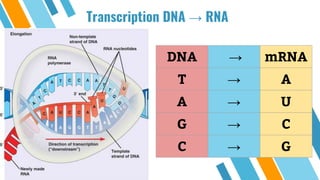
TRANSCRIPTION (occurs in the
nucleus)
1. DNA unzips at gene (recipe)
2. mRNA formed on DNA
3. mRNA goes to the ribosome
4. DNA zips up again
Transcription DNA → RNA
DNA → mRNA
T → A
A → U
G → C
C → G
Remember how DNA matches up?
» A → T
» T → A
» C → G
» G → C
How is this different from DNA to mRNA?
(Hint: It’s the previous slide guys…)
What form are the instructions in?
» The instructions are in the
form of mRNA or
messenger RNA
What’s up with the 3 - letter
sequence?
» The three letter sequence of mRNA makes up a
codon.
» A codon tells tRNA what amino acid needs to be
added to the polypeptide chain (aka growing
protein).
» The codon on mRNA matches with an anticodon on
tRNA that is attached to an amino acid.
Where do the instructions go?
» The mRNA goes
from the nucleus
to the ribosome
How are the instructions read?
» The ribosome reads the mRNA in
groups of three bases
» These three base groups are called
CODONS
» Codons are translated to tell the tRNA
(transfer RNA) what amino acid to add
to the growing polypeptide (protein) -
compliments tRNA’s anticodon
What happens if there is a mistake in the
instructions?
» MUTATIONS WILL OCCUR!!!
» This means that the protein
will not be made properly
and may not do the right job
» GASP!!!
Effects at the Amino Acid Level
1. Silent → no change to the amino acid sequence
so no change to the protein
2. Missense → changes the amino acid sequence
so changes the shape and function of the
protein (may not work!)
3. Nonsense → mutation causes the “STOP”
codon before a protein is completed (so it won’t
work obviously!)
Point Mutations - Changes to one
base in DNA code
» Substitution → one amino acid is put in place of the correct
amino acid (missense mutation)
» Insertion → a DNA base is added to the original sequence which
causes a frameshift to occur (every amino acid after insertion is
changed)
» Deletion → a DNA base is removed from the original sequence
causing a frameshift to occur (every amino acid after insertion is
changed)
» Duplication → a piece of DNA is abnormally copied one or more
times which can result in a frameshift mutation
» Inversion - the DNA sequence is flipped backwards
Amino Acid Practice:
A → U T → A
G → C G → C
DNA TAC GCA TGG AAT
mRNA
Amino
Acid
protein_synthesis

protein_synthesis

  • 1.
  • 2.
  • 3.
  • 4.
    What do weneed to make protein? » Blueprint (DNA) » Instructions (mRNA) » Ingredients (Amino Acids) » Place to make it (Ribosome)
  • 5.
    Where do theinstructions come from? » Instructions for a protein originally come from DNA
  • 6.
    What are theingredients? » Amino Acids! » There are 20 amino acids that make up all proteins » That means that the amino acids are: ⋄ used in many combinations ⋄ more than one time
  • 7.
    Where in thecell are proteins assembled? » THE RIBOSOME!
  • 8.
    How does shapeaffect function? » The shape of a protein is determined by its amino acid sequence » The amino acid sequence also determines how the protein is folded » A protein will only work if it it maintains its shape! ❖ DENATURATION: When a protein changes shape and can NO LONGER WORK! ➢Caused by pH and temperature changes
  • 9.
  • 10.
    Types of RNA Typeof RNA Functions Messenger RNA (mRNA) Carries information specifying amino acid sequences of proteins from DNA to ribosomes in a series of three-base code words (CODONS) Transfer RNA (tRNA) Contains a complementary three-base sequence (ANTICODON) which matches the mRNA codon and places its corresponding amino acid on the growing peptide chain. Ribosomal RNA (rRNA) Associates with other proteins to form ribosomes.
  • 11.
    Difference between DNA& RNA DNA RNA Deoxyribonucleic Acid Ribonucleic Acid Replicates and store genetic information. Blueprint for an organism. Converts the genetic information in DNA to format used to build proteins. DNA is double stranded. RNA is single stranded. DNA has a deoxyribose sugar. RNA has a ribose sugar. DNA has Adenine (A), Thymine (T), Guanine (G), and Cytosine (C ) as bases. RNA has Adenine (A), Guanine (G), and Cytosine (C ), but has Uracil (U) instead of Thymine. DNA is only found in the nucleus. RNA is able to leave the nucleus.
  • 12.
  • 13.
    How do weget the instructions to make a protein? TRANSCRIPTION (occurs in the nucleus) 1. DNA unzips at gene (recipe) 2. mRNA formed on DNA 3. mRNA goes to the ribosome 4. DNA zips up again
  • 14.
    Transcription DNA →RNA DNA → mRNA T → A A → U G → C C → G
  • 15.
    Remember how DNAmatches up? » A → T » T → A » C → G » G → C How is this different from DNA to mRNA? (Hint: It’s the previous slide guys…)
  • 16.
    What form arethe instructions in? » The instructions are in the form of mRNA or messenger RNA
  • 17.
    What’s up withthe 3 - letter sequence? » The three letter sequence of mRNA makes up a codon. » A codon tells tRNA what amino acid needs to be added to the polypeptide chain (aka growing protein). » The codon on mRNA matches with an anticodon on tRNA that is attached to an amino acid.
  • 18.
    Where do theinstructions go? » The mRNA goes from the nucleus to the ribosome
  • 19.
    How are theinstructions read? » The ribosome reads the mRNA in groups of three bases » These three base groups are called CODONS » Codons are translated to tell the tRNA (transfer RNA) what amino acid to add to the growing polypeptide (protein) - compliments tRNA’s anticodon
  • 20.
    What happens ifthere is a mistake in the instructions? » MUTATIONS WILL OCCUR!!! » This means that the protein will not be made properly and may not do the right job » GASP!!!
  • 21.
    Effects at theAmino Acid Level 1. Silent → no change to the amino acid sequence so no change to the protein 2. Missense → changes the amino acid sequence so changes the shape and function of the protein (may not work!) 3. Nonsense → mutation causes the “STOP” codon before a protein is completed (so it won’t work obviously!)
  • 23.
    Point Mutations -Changes to one base in DNA code » Substitution → one amino acid is put in place of the correct amino acid (missense mutation) » Insertion → a DNA base is added to the original sequence which causes a frameshift to occur (every amino acid after insertion is changed) » Deletion → a DNA base is removed from the original sequence causing a frameshift to occur (every amino acid after insertion is changed) » Duplication → a piece of DNA is abnormally copied one or more times which can result in a frameshift mutation » Inversion - the DNA sequence is flipped backwards
  • 25.
    Amino Acid Practice: A→ U T → A G → C G → C DNA TAC GCA TGG AAT mRNA Amino Acid