Understanding biology through structures Course work 2006
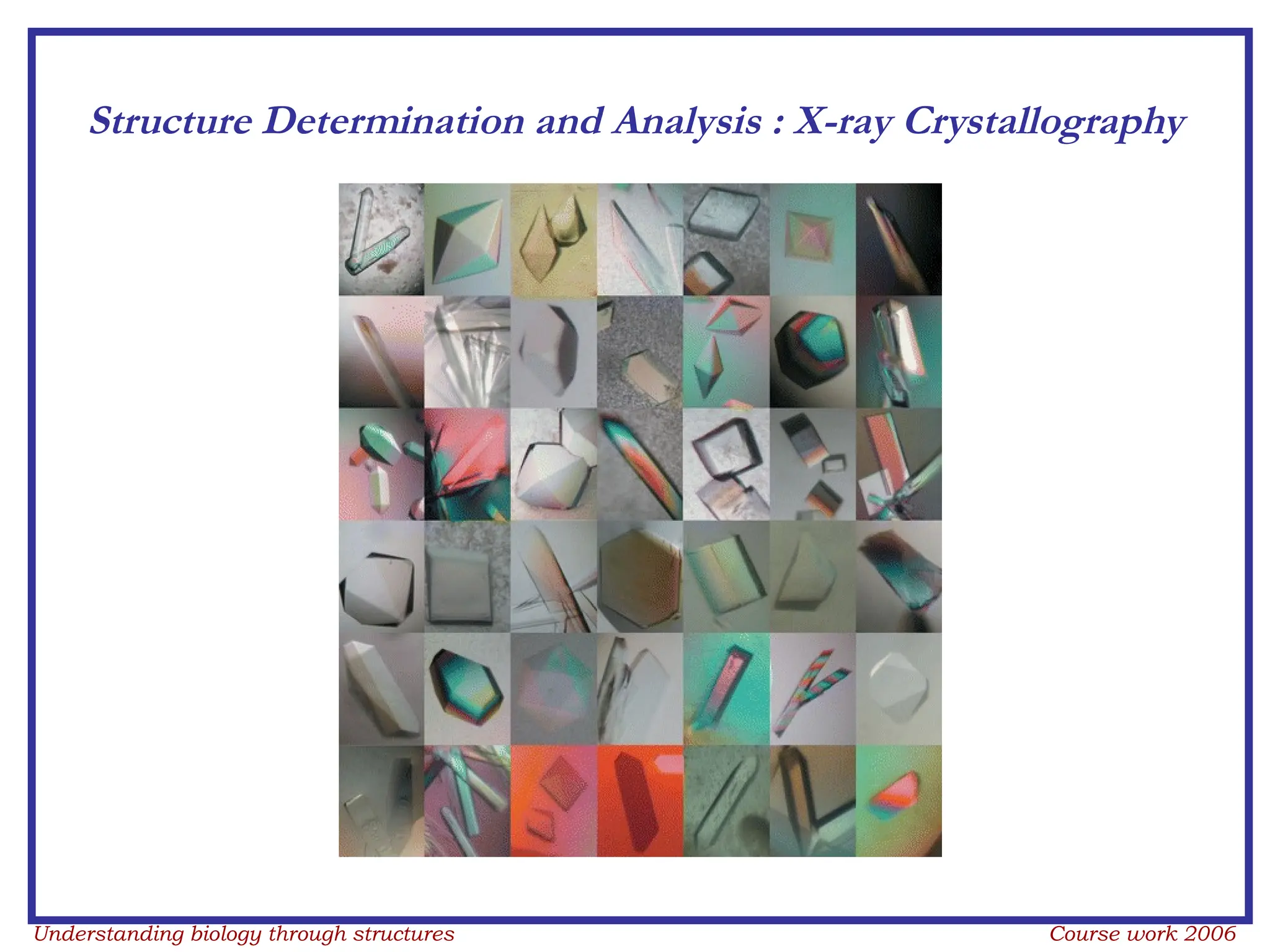
Structure Determination and Analysis : X-ray Crystallography
Understanding biology through structures Course work 2006
Energy = hc
λ
Understanding biology through structures Course work 2006
X-rays
•It is possible to translate information in the diffraction pattern
into atomic structure using Bragg’s law, which predicts the angle
of reflection of any diffracted beam from specific atomic planes
• Unlike using a light microscope,
there is no way of re-focusing
diffracted x-rays.
• Instead we must collect a
diffraction pattern (spots).
Understanding biology through structures Course work 2006
A typical crystallography experiment
Pure protein
Grow crystal
Characterize crystals
Collect diffraction data
Solve phase problem
Calculate electron density map
Build/rebuild model
Refine model
Analyze structure
Understanding biology through structures Course work 2006
Principles of X-ray diffraction
What is a crystal?
•The unit cell is the basic building block of the crystal
•The unit cell can contain multiple copies of the same molecule
whose positions are governed by symmetry rules
Understanding biology through structures Course work 2006
Proteins and crystallisation
•Proteins must be homogenous & monodispersed.
•Need large amount (mg quantities)
•Is it stable ( salt, pH, temp)
•Will modifications have to be made?
•What type of protein is it? Has
anything similar been crystallized
before?
•Proteins must be pure (> 99%) & fully
folded Check the activity of your protein
if you have an assay Check folding by
other spectroscopic methods
Understanding biology through structures Course work 2006
•Crystallisation of proteins ‘controlled’ precipitation of the
protein.
•Protein aggregates associate & form intermolecular contacts
that resemble those found in the final crystal. Aggregates reach
the critical nuclear size, growth proceeds by addition of
molecules to the crystalline lattice.
•The processes of nucleation and crystal growth both occur in
supersaturated solutions.
Precipitant
Cover-slip
sealed with
vacuum grease
Protein in
“Hanging drop”
Process controlled by:
•Temp
•pH
•Salt conc
•Precipitants (PEG, ethanol)
Understanding biology through structures Course work 2006
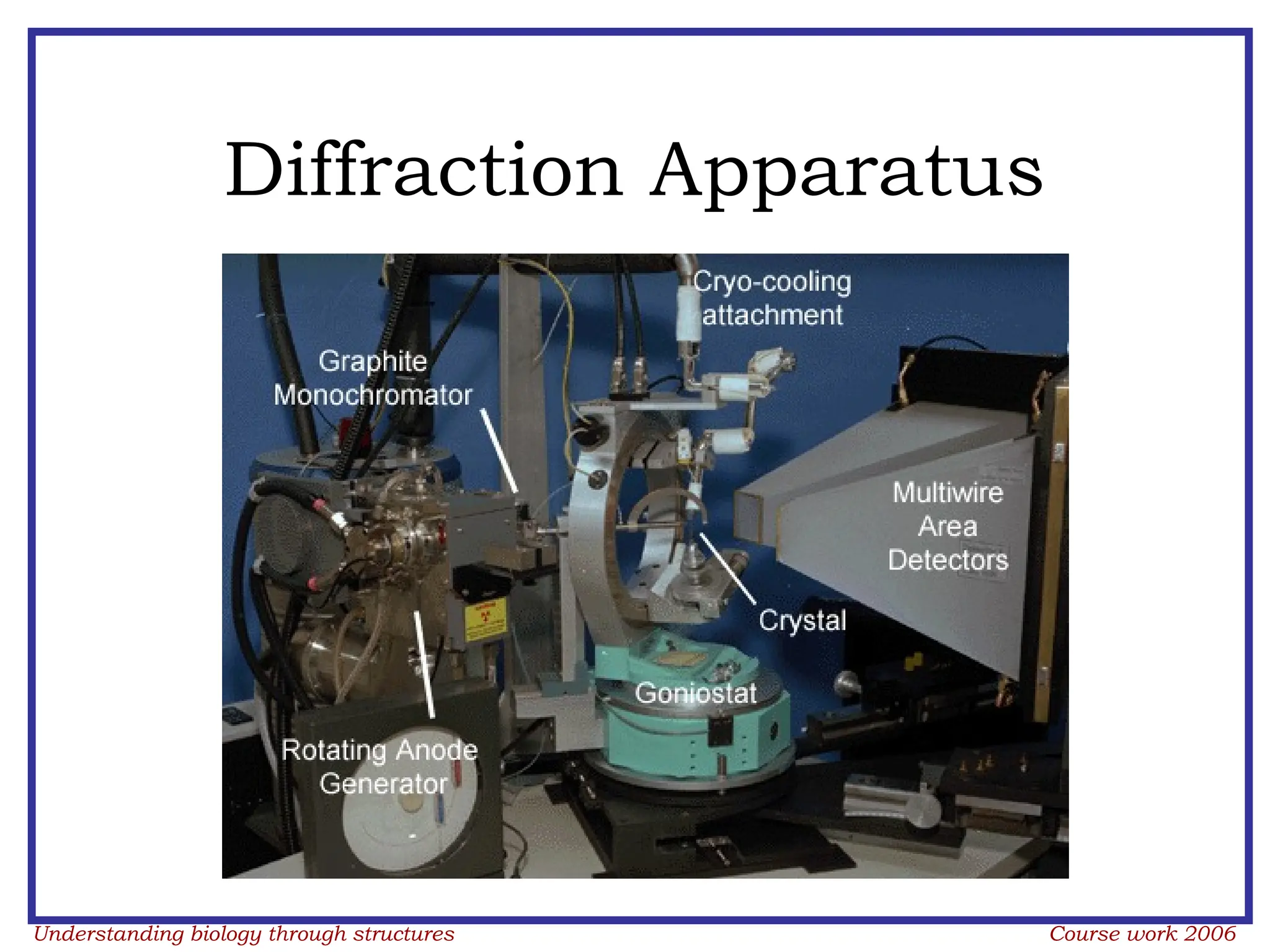
Diffraction Apparatus
Understanding biology through structures Course work 2006
Diffraction
•Each image represents the
rotation of the crystal 1
degree in the X-ray beam.
•Each images gives us the
position of each spot relative
to all the others & there
intensity.
•Intensity = square of
amplitude.
Understanding biology through structures Course work 2006
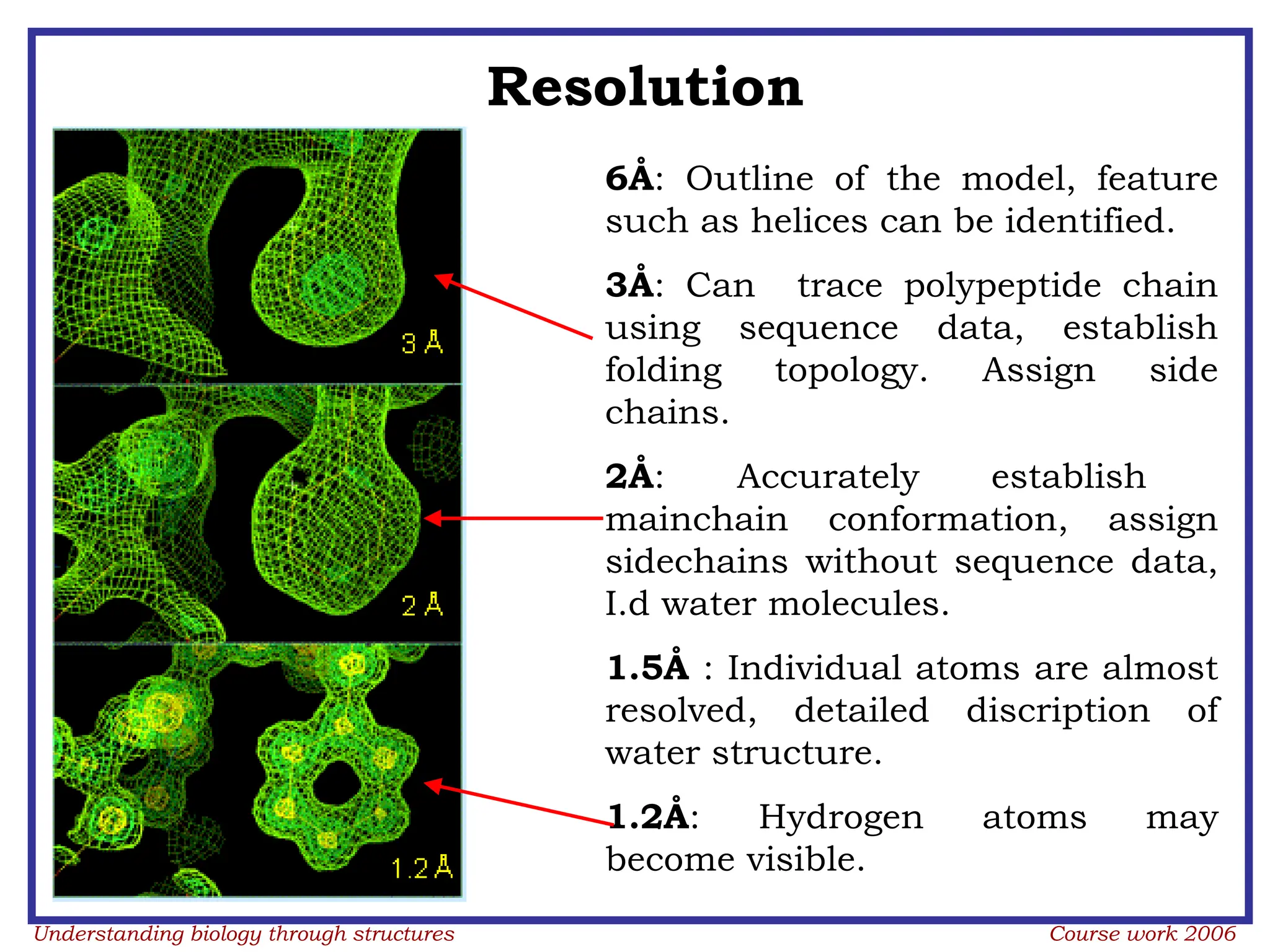
Resolution
6Å: Outline of the model, feature
such as helices can be identified.
3Å: Can trace polypeptide chain
using sequence data, establish
folding topology. Assign side
chains.
2Å: Accurately establish
mainchain conformation, assign
sidechains without sequence data,
I.d water molecules.
1.5Å : Individual atoms are almost
resolved, detailed discription of
water structure.
1.2Å: Hydrogen atoms may
become visible.
Understanding biology through structures Course work 2006
Final Structure
But the work is not over yet!
Understanding biology through structures Course work 2006
Refinement
• The process of building and rebuilding a model can cause
many errors in the structure.
1. Bond length,
2. Bond angle
3. Atomic clashes etc
• It is necessary to subject the structure to refinement in order
to remove these errors and produce a better structure.
• Minimization
• Thermal parameters
• In order to further improve the model, it is refined using a
simulated annealing protocol
• Refinement progress is monitored by following the agreement
between the the observed data ( data collected) and the
calculated data (data calculated from current model) = R
factor
Understanding biology through structures Course work 2006
• R-factor The agreement between the the observed data (data
collected) and the calculated data (data calculated from
current model) the lower the number the better; typically
around 20%
• Resolution The higher the resolution the more detail that can
be seen 3.0Å is fairly low whilst 1.1Å is approaching atomic
resolution
• B-factor Measure of thermal motion. i.e. how much energy
each atom contains. Gives us information on mobility &
stability
• Rms deviation Deviation of bond lengths & angles from ideal
Quality of the structure?
Understanding biology through structures Course work 2006
Where can Circular Dichroism be used?

Protein protein interaction important doc

  • 1.
    Understanding biology throughstructures Course work 2006 Structure Determination and Analysis : X-ray Crystallography
  • 2.
    Understanding biology throughstructures Course work 2006 Energy = hc λ
  • 3.
    Understanding biology throughstructures Course work 2006 X-rays •It is possible to translate information in the diffraction pattern into atomic structure using Bragg’s law, which predicts the angle of reflection of any diffracted beam from specific atomic planes • Unlike using a light microscope, there is no way of re-focusing diffracted x-rays. • Instead we must collect a diffraction pattern (spots).
  • 4.
    Understanding biology throughstructures Course work 2006 A typical crystallography experiment Pure protein Grow crystal Characterize crystals Collect diffraction data Solve phase problem Calculate electron density map Build/rebuild model Refine model Analyze structure
  • 5.
    Understanding biology throughstructures Course work 2006 Principles of X-ray diffraction What is a crystal? •The unit cell is the basic building block of the crystal •The unit cell can contain multiple copies of the same molecule whose positions are governed by symmetry rules
  • 6.
    Understanding biology throughstructures Course work 2006 Proteins and crystallisation •Proteins must be homogenous & monodispersed. •Need large amount (mg quantities) •Is it stable ( salt, pH, temp) •Will modifications have to be made? •What type of protein is it? Has anything similar been crystallized before? •Proteins must be pure (> 99%) & fully folded Check the activity of your protein if you have an assay Check folding by other spectroscopic methods
  • 7.
    Understanding biology throughstructures Course work 2006 •Crystallisation of proteins ‘controlled’ precipitation of the protein. •Protein aggregates associate & form intermolecular contacts that resemble those found in the final crystal. Aggregates reach the critical nuclear size, growth proceeds by addition of molecules to the crystalline lattice. •The processes of nucleation and crystal growth both occur in supersaturated solutions. Precipitant Cover-slip sealed with vacuum grease Protein in “Hanging drop” Process controlled by: •Temp •pH •Salt conc •Precipitants (PEG, ethanol)
  • 8.
    Understanding biology throughstructures Course work 2006 Diffraction Apparatus
  • 9.
    Understanding biology throughstructures Course work 2006 Diffraction •Each image represents the rotation of the crystal 1 degree in the X-ray beam. •Each images gives us the position of each spot relative to all the others & there intensity. •Intensity = square of amplitude.
  • 10.
    Understanding biology throughstructures Course work 2006 Resolution 6Å: Outline of the model, feature such as helices can be identified. 3Å: Can trace polypeptide chain using sequence data, establish folding topology. Assign side chains. 2Å: Accurately establish mainchain conformation, assign sidechains without sequence data, I.d water molecules. 1.5Å : Individual atoms are almost resolved, detailed discription of water structure. 1.2Å: Hydrogen atoms may become visible.
  • 11.
    Understanding biology throughstructures Course work 2006 Final Structure But the work is not over yet!
  • 12.
    Understanding biology throughstructures Course work 2006 Refinement • The process of building and rebuilding a model can cause many errors in the structure. 1. Bond length, 2. Bond angle 3. Atomic clashes etc • It is necessary to subject the structure to refinement in order to remove these errors and produce a better structure. • Minimization • Thermal parameters • In order to further improve the model, it is refined using a simulated annealing protocol • Refinement progress is monitored by following the agreement between the the observed data ( data collected) and the calculated data (data calculated from current model) = R factor
  • 13.
    Understanding biology throughstructures Course work 2006 • R-factor The agreement between the the observed data (data collected) and the calculated data (data calculated from current model) the lower the number the better; typically around 20% • Resolution The higher the resolution the more detail that can be seen 3.0Å is fairly low whilst 1.1Å is approaching atomic resolution • B-factor Measure of thermal motion. i.e. how much energy each atom contains. Gives us information on mobility & stability • Rms deviation Deviation of bond lengths & angles from ideal Quality of the structure?
  • 14.
    Understanding biology throughstructures Course work 2006
  • 15.
    Understanding biology throughstructures Course work 2006 Where can Circular Dichroism be used?