Protecting Location Privacy in
Sensor Networks against a Global
Eavesdropper

                  PRESENTED BY
                   JP INFOTECH
TO GET THIS PROJECT
CONTACT:
ABSTRACT
              We       propose     two
               techniques that prevent
               the leakage of location
               information:     periodic
               collection and source
               simulation.
              Periodic       collection
               provides a high level of
               location privacy, while
               source        simulation
               provides       trade-offs
               between          privacy,
               communication       cost,
               and latency.
ARCHITECTURE
EXISTING SYSTEM

              Existing    solutions
               can only be used to
               deal             with
               adversaries      who
               have only a local
               view of network
               traffic.
DISADVANTAGES OF
EXISTING SYSTEM

               Existing techniques
                defend the leakage
                of           location
                information from a
                limited    adversary
                who      can     only
                observe      network
                traffic in a small
                region.
PROPOSED SYSTEM
             We       show        the
              performance of the
              proposed       privacy-
              preserving techniques
              in terms of energy
              consumption         and
              latency and compare
              our methods with the
              phantom single-path
              method, a method
              that is effective only
              against            local
              eavesdroppers.
ADVANTAGES OF PROPOSED
SYSTEM
               The proposed system
                provides     trade-offs
                between        privacy,
                communication cost,
                and latency.
            

               The          proposed
                techniques         are
                efficient and effective
                for source and sink-
                location privacy in
                sensor networks.
MODULES

             1. Attackers
              Modules.
             2. Privacy-
              Preserving Routing
              Techniques.
             3. Adversary Model.
             4. Privacy
              Evaluation Model.
             5. Security Analysis.
1. Attackers Modules:

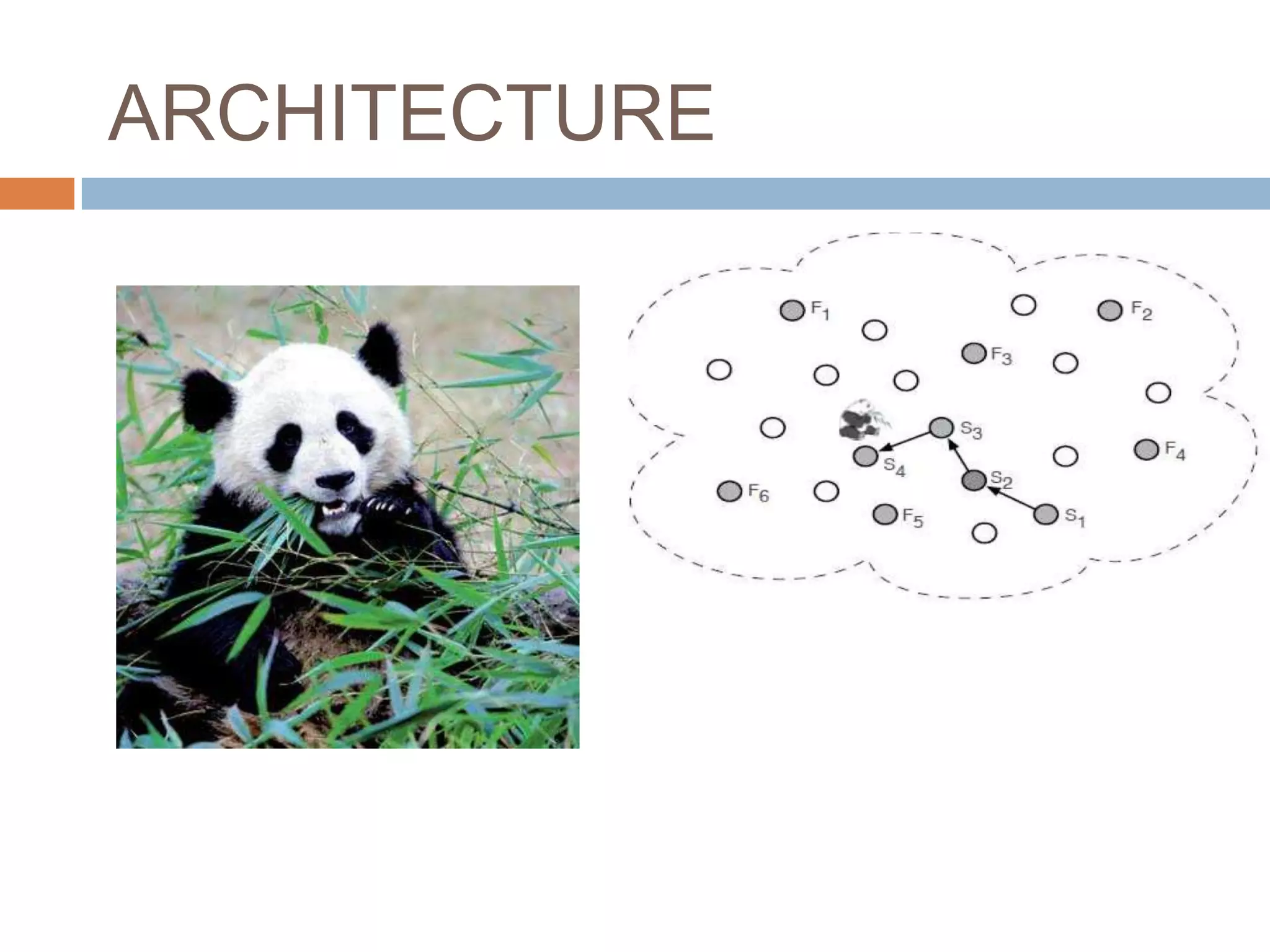
                 In this module we
                  form      the      WSN
                  network area and the
                  appearance of an
                  endangered       animal
                  (Attackers)     in    a
                  monitored area that is
                  survived by wireless
                  sensor, at the each
                  time the inside and
                  outside sensors are
                  sensing to find out the
                  attackers location and
                  the timing.
2. Privacy-Preserving Routing
Techniques:

                  In    this   module
                   presents         two
                   techniques        for
                   privacy preserving
                   routing in sensor
                   networks, a periodic
                   collection   method
                   and      a   source
                   simulation method.
3. Adversary Model:

                 For the kinds of
                  wireless       sensor
                  networks that we
                  envision, we expect
                  highly-motivated and
                  well-funded
                  attackers      whose
                  objective is to learn
                  sensitive    location-
                  based information.
4. Privacy Evaluation Model:

                 In this module, we
                  formalize the location
                  privacy issues under
                  the               global
                  eavesdropper model.
                  In this model, the
                  adversary deploys an
                  attacking network to
                  monitor the sensor
                  activities in the target
                  network.
5. Security Analysis:

                  The          generation
                   number of a packet
                   can be hidden in the
                   secure            routing
                   scheme          through
                   link-to-link
                   encryption. In this
                   way,           attackers
                   cannot       find     the
                   generation number
                   of a packet for their
                   further analysis.
ALGORITHM USED:

              Backbone
               Construction
               Algorithm
HARDWARE
REQUIREMENTS
             System           :
              Pentium IV 2.4 GHz.
             Hard Disk       :   40
              GB.
             Floppy Drive    : 1.44
              Mb.
             Monitor         :   15
              VGA Colour.
             Mouse           :
              Logitech.
             Ram
                  : 512 Mb.
SOFTWARE
REQUIREMENTS
             Operating system
                 : - Windows XP.
             Coding Language
                 : C#.Net.
             Data Base
                 : SQL Server
              2005
REFERENCE

               Kiran         Mehta,
                Donggang         Liu,
                Member, IEEE, and
                Matthew       Wright,
                Member,        IEEE,
                “Protecting Location
                Privacy in Sensor
                Networks against a
                Global
                Eavesdropper”, IEEE
                TRANSACTIONS ON
                MOBILE
                COMPUTING, VOL.
                11,       NO.      2,
                FEBRUARY 2012.
TO GET THIS PROJECT
CONTACT:

Protecting location privacy in sensor networks against a global eavesdropper

  • 1.
    Protecting Location Privacyin Sensor Networks against a Global Eavesdropper PRESENTED BY JP INFOTECH
  • 2.
    TO GET THISPROJECT CONTACT:
  • 3.
    ABSTRACT  We propose two techniques that prevent the leakage of location information: periodic collection and source simulation.  Periodic collection provides a high level of location privacy, while source simulation provides trade-offs between privacy, communication cost, and latency.
  • 4.
  • 5.
    EXISTING SYSTEM  Existing solutions can only be used to deal with adversaries who have only a local view of network traffic.
  • 6.
    DISADVANTAGES OF EXISTING SYSTEM  Existing techniques defend the leakage of location information from a limited adversary who can only observe network traffic in a small region.
  • 7.
    PROPOSED SYSTEM  We show the performance of the proposed privacy- preserving techniques in terms of energy consumption and latency and compare our methods with the phantom single-path method, a method that is effective only against local eavesdroppers.
  • 8.
    ADVANTAGES OF PROPOSED SYSTEM  The proposed system provides trade-offs between privacy, communication cost, and latency.   The proposed techniques are efficient and effective for source and sink- location privacy in sensor networks.
  • 9.
    MODULES  1. Attackers Modules.  2. Privacy- Preserving Routing Techniques.  3. Adversary Model.  4. Privacy Evaluation Model.  5. Security Analysis.
  • 10.
    1. Attackers Modules:  In this module we form the WSN network area and the appearance of an endangered animal (Attackers) in a monitored area that is survived by wireless sensor, at the each time the inside and outside sensors are sensing to find out the attackers location and the timing.
  • 11.
    2. Privacy-Preserving Routing Techniques:  In this module presents two techniques for privacy preserving routing in sensor networks, a periodic collection method and a source simulation method.
  • 12.
    3. Adversary Model:  For the kinds of wireless sensor networks that we envision, we expect highly-motivated and well-funded attackers whose objective is to learn sensitive location- based information.
  • 13.
    4. Privacy EvaluationModel:  In this module, we formalize the location privacy issues under the global eavesdropper model. In this model, the adversary deploys an attacking network to monitor the sensor activities in the target network.
  • 14.
    5. Security Analysis:  The generation number of a packet can be hidden in the secure routing scheme through link-to-link encryption. In this way, attackers cannot find the generation number of a packet for their further analysis.
  • 15.
    ALGORITHM USED:  Backbone Construction Algorithm
  • 16.
    HARDWARE REQUIREMENTS  System : Pentium IV 2.4 GHz.  Hard Disk : 40 GB.  Floppy Drive : 1.44 Mb.  Monitor : 15 VGA Colour.  Mouse : Logitech.  Ram : 512 Mb.
  • 17.
    SOFTWARE REQUIREMENTS  Operating system : - Windows XP.  Coding Language : C#.Net.  Data Base : SQL Server 2005
  • 18.
    REFERENCE  Kiran Mehta, Donggang Liu, Member, IEEE, and Matthew Wright, Member, IEEE, “Protecting Location Privacy in Sensor Networks against a Global Eavesdropper”, IEEE TRANSACTIONS ON MOBILE COMPUTING, VOL. 11, NO. 2, FEBRUARY 2012.
  • 19.
    TO GET THISPROJECT CONTACT: