Asset Protection Presented By: Richard J. Shapiro, J.D. and  Mindy Menke, J.D. Blustein, Shapiro, Rich & Barone, LLP 90 Crystal Run Road, Suite 409 Middletown, NY 10941 www.mid-hudsonlaw.com
Introduction What Asset Protection Is and Isn’t Basic Asset Protection Techniques What Won’t Work What Might Work What Should Work
What Asset Protection Is Asset protection is a structure which makes assets difficult or impossible to reach Asset Protection is putting a portion of your net worth behind some obstacles.  The more obstacles, the greater the protection. Asset Protection is planning for future liabilities
What Asset Protection Isn’t Asset Protection is not fraud Asset Protection is not tax avoidance Asset Protection is not transferring all assets out of your control Asset Protection does not rely on stealth alone
Easy Asset Protection Strategies Divide and Conquer Maintain Adequate Insurance Look Before You Leap Avoid General Partnerships
What Won’t Work Revocable Living Trusts Nevada Corporations Leaving No Equity Anywhere “ Giving It Away” (But Not Really) Lying Business Trusts, Pure Trusts, Constitutional Trusts, whatever
What Might Work Family Limited Partnerships (FLPs) Family Limited Liability Companies (FLLCs) Life Insurance Domestic Asset Protection Trusts Offshore Irrevocable Trusts
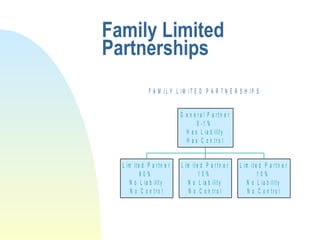
Family Limited Partnerships
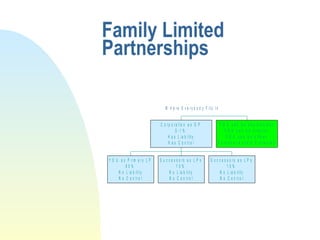
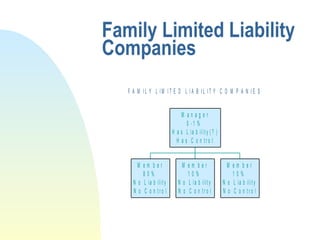
Family Limited Liability Companies
How It Can Work Limited Partners Have No Liability for Entity Debts General Partner Has Liability, But only Subject to Corporate Assets Creditors of Limited Partner Can Get “Charging Order” Charging Order Not Attractive to Creditors
Other Advantages Can Begin to Transfer Ownership Without Control  Can Transfer Assets Likely to Appreciate and Minimize Estate Tax Can Get Discounts to Minimize Gift Tax
Disadvantages Abuse Has Invited Scrutiny (from courts and IRS), including foreclosure of LP interests in lieu of Charging Order Cost (Atty’s. Fees, Appraisals, Upkeep) Complexity Ownership Transfer is Irrevocable
Life Insurance New York Insurance Law  § 3212 Beneficiary’s interest in policy protected against policy owner’s creditors If owner of policy insures life of another, owner is protected from creditors of insured If owner of policy insures life of spouse for owner’s own benefit, owner is protected from  own  creditors
Life Insurance (cont.) Policy owner’s interest in cash surrender value is protected from claims of owner’s own creditors
Life Insurance Trusts Greatest protection afforded by owning life insurance in Irrevocable Life Insurance Trust (ILIT) ILIT protects value from creditors of insured and trust beneficiaries ILIT also excludes death proceeds from taxation in insured’s estate
Access to ILIT Cash Value ILIT may be drafted to provide that discretionary distributions of trust assets to spouse and/or descendants Allows ready access to cash surrender value If no spouse, trust may be established in jurisdiction (i.e., Alaska) which allows discretionary distributions to trustmaker
Domestic Asset Protection Trusts Alaska Legislature passed landmark statute in 1997 For the first time, the law of an individual state enabled creation of an irrevocable trust providing discretionary benefits to the trustmaker without the transferred assets being included in the trustmaker’s estate at death. Delaware, Rhode Island, South Dakota and Nevada subsequently adopted similar legislation
Key Features Repeals rule against perpetuities – allows for “dynasty” planning Allows for discretionary distributions to trustmaker without assets being included in taxable estate Alaska law provides clear roadmap for creditor protection features
Will Alaska Law Apply? In general, law of jurisdiction where administration takes place controls Trust should include specific intent that trust be subject to Alaska law Some assets must be deposited in Alaska (often $10,000 is used) At least one trustee must be based in Alaska
Requirements for Creditor Protection Transfer into trust cannot be a fraudulent conveyance Transfer cannot render trustmaker insolvent Transfer cannot be intended to remove assets from the reach of a specifically known, or anticipated, creditor Alaska Statute of Limitations to commence suit claiming fraudulent conveyance is four years
Requirements for Creditor Protection Trustmaker cannot retain power to revoke the trust Trustmaker cannot retain entitlement to income or principal from the trust; rather, trustmaker may be eligible for discretionary distributions in the discretion of a trustee other than the trustmaker
Potential Limitations Full faith and credit attacks May be shielded by limiting trustees only to persons or entities residing in state where trust created  and  who do not have “minimum contacts” in trustmaker’s state of domicile Supremacy clause arguments May apply in bankruptcy context; however, bankruptcy laws use state laws to determine interests of trustmakers and beneficiaries
Potential Limitations Conflicts of Laws Claim that laws of trustmaker’s state of domicile govern the rights of trustmaker’s creditors However, trust may (and should) specify which state’s law governs instrument Restatement of Trusts sanctions choice of law clause in trust No existing case law
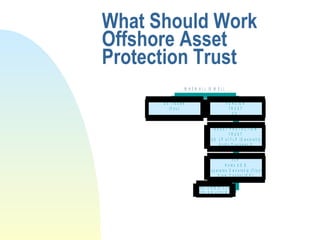
What Should Work Offshore Asset Protection Trust
Important Concepts Trust Protector Don’t Transfer To Foreign Trustee Without Protection
When Creditor Attack Likely Flight (Remove U.S. Assets) Fight (Resign as U.S. Trustee) Get Serious (Need Experienced Foreign Trustee, Protector, Counsel)
HOW DOES IT WORK? International Case Study: The Bahamas
1. Considered an “arm’s length”  transaction Usually Irrevocable Trustees with total discretion Guided by “Letter of Wishes” Supervised by Trust Protector Can only recover by proving a “fraudulent conveyance”
2.  Action limited to  actual  creditors  with claims existing  at the time  of transfer  who are  known  to the  Trustmaker. 3. Creditor has burden of proof.
4. Action barred 2 years after transfer.  5. Foreign law and judgments not  recognized by Bahamian courts, so  legal proceedings must be re- initiated in the Bahamas.
6. Hard to establish jurisdiction  because Trustmaker is not  physically within jurisdiction,  nor are his assets (except  those owned inside the  trust).
7. Creditor suing in Bahamas is  considered foreign plaintiff.  As such, must make  substantial cash deposit with  court to cover costs which  might be awarded to the  successful defendant.
8. No registration, filing, or  disclosure for trusts.  Stringent confidentiality  laws with civil and criminal  penalties.  Makes gaining  enough information to  formulate a claim difficult.
9. Usually leads to reasonable  out of court settlement,  such as for the amount of  insurance coverage.
10. If emotional creditor with  deep pockets overcomes all  of the barriers, will still be  barred by the 2 year rule.  Or  trustees may be fired and  replaced, assets migrated,  or trust itself migrated to  new jurisdiction.
11. If after overcoming all  hurdles a creditor is  successful in setting  aside the transfer, can only  satisfy his own claim,  leaving the balance of  assets intact within trust.
Disadvantages Complexity Cost (Atty’s. Fees, Appraisals, Upkeep) IRS Reporting Obligations (Increase without any U.S. Trustee) Ownership Transfer is Irrevocable, Control as/over Trustee need not be
Points To Remember Asset Protection is only one part of the Estate Planning puzzle Some simple asset planning techniques can protect a high percentage of your assets
Next Steps  Assess Your Assets and Vulnerability Get Competent Advice
Questions? Please complete workshop evaluation form

Asset Protection Strategies

  • 1.
    Asset Protection PresentedBy: Richard J. Shapiro, J.D. and Mindy Menke, J.D. Blustein, Shapiro, Rich & Barone, LLP 90 Crystal Run Road, Suite 409 Middletown, NY 10941 www.mid-hudsonlaw.com
  • 2.
    Introduction What AssetProtection Is and Isn’t Basic Asset Protection Techniques What Won’t Work What Might Work What Should Work
  • 3.
    What Asset ProtectionIs Asset protection is a structure which makes assets difficult or impossible to reach Asset Protection is putting a portion of your net worth behind some obstacles. The more obstacles, the greater the protection. Asset Protection is planning for future liabilities
  • 4.
    What Asset ProtectionIsn’t Asset Protection is not fraud Asset Protection is not tax avoidance Asset Protection is not transferring all assets out of your control Asset Protection does not rely on stealth alone
  • 5.
    Easy Asset ProtectionStrategies Divide and Conquer Maintain Adequate Insurance Look Before You Leap Avoid General Partnerships
  • 6.
    What Won’t WorkRevocable Living Trusts Nevada Corporations Leaving No Equity Anywhere “ Giving It Away” (But Not Really) Lying Business Trusts, Pure Trusts, Constitutional Trusts, whatever
  • 7.
    What Might WorkFamily Limited Partnerships (FLPs) Family Limited Liability Companies (FLLCs) Life Insurance Domestic Asset Protection Trusts Offshore Irrevocable Trusts
  • 8.
  • 9.
  • 10.
  • 11.
    How It CanWork Limited Partners Have No Liability for Entity Debts General Partner Has Liability, But only Subject to Corporate Assets Creditors of Limited Partner Can Get “Charging Order” Charging Order Not Attractive to Creditors
  • 12.
    Other Advantages CanBegin to Transfer Ownership Without Control Can Transfer Assets Likely to Appreciate and Minimize Estate Tax Can Get Discounts to Minimize Gift Tax
  • 13.
    Disadvantages Abuse HasInvited Scrutiny (from courts and IRS), including foreclosure of LP interests in lieu of Charging Order Cost (Atty’s. Fees, Appraisals, Upkeep) Complexity Ownership Transfer is Irrevocable
  • 14.
    Life Insurance NewYork Insurance Law § 3212 Beneficiary’s interest in policy protected against policy owner’s creditors If owner of policy insures life of another, owner is protected from creditors of insured If owner of policy insures life of spouse for owner’s own benefit, owner is protected from own creditors
  • 15.
    Life Insurance (cont.)Policy owner’s interest in cash surrender value is protected from claims of owner’s own creditors
  • 16.
    Life Insurance TrustsGreatest protection afforded by owning life insurance in Irrevocable Life Insurance Trust (ILIT) ILIT protects value from creditors of insured and trust beneficiaries ILIT also excludes death proceeds from taxation in insured’s estate
  • 17.
    Access to ILITCash Value ILIT may be drafted to provide that discretionary distributions of trust assets to spouse and/or descendants Allows ready access to cash surrender value If no spouse, trust may be established in jurisdiction (i.e., Alaska) which allows discretionary distributions to trustmaker
  • 18.
    Domestic Asset ProtectionTrusts Alaska Legislature passed landmark statute in 1997 For the first time, the law of an individual state enabled creation of an irrevocable trust providing discretionary benefits to the trustmaker without the transferred assets being included in the trustmaker’s estate at death. Delaware, Rhode Island, South Dakota and Nevada subsequently adopted similar legislation
  • 19.
    Key Features Repealsrule against perpetuities – allows for “dynasty” planning Allows for discretionary distributions to trustmaker without assets being included in taxable estate Alaska law provides clear roadmap for creditor protection features
  • 20.
    Will Alaska LawApply? In general, law of jurisdiction where administration takes place controls Trust should include specific intent that trust be subject to Alaska law Some assets must be deposited in Alaska (often $10,000 is used) At least one trustee must be based in Alaska
  • 21.
    Requirements for CreditorProtection Transfer into trust cannot be a fraudulent conveyance Transfer cannot render trustmaker insolvent Transfer cannot be intended to remove assets from the reach of a specifically known, or anticipated, creditor Alaska Statute of Limitations to commence suit claiming fraudulent conveyance is four years
  • 22.
    Requirements for CreditorProtection Trustmaker cannot retain power to revoke the trust Trustmaker cannot retain entitlement to income or principal from the trust; rather, trustmaker may be eligible for discretionary distributions in the discretion of a trustee other than the trustmaker
  • 23.
    Potential Limitations Fullfaith and credit attacks May be shielded by limiting trustees only to persons or entities residing in state where trust created and who do not have “minimum contacts” in trustmaker’s state of domicile Supremacy clause arguments May apply in bankruptcy context; however, bankruptcy laws use state laws to determine interests of trustmakers and beneficiaries
  • 24.
    Potential Limitations Conflictsof Laws Claim that laws of trustmaker’s state of domicile govern the rights of trustmaker’s creditors However, trust may (and should) specify which state’s law governs instrument Restatement of Trusts sanctions choice of law clause in trust No existing case law
  • 25.
    What Should WorkOffshore Asset Protection Trust
  • 26.
    Important Concepts TrustProtector Don’t Transfer To Foreign Trustee Without Protection
  • 27.
    When Creditor AttackLikely Flight (Remove U.S. Assets) Fight (Resign as U.S. Trustee) Get Serious (Need Experienced Foreign Trustee, Protector, Counsel)
  • 28.
    HOW DOES ITWORK? International Case Study: The Bahamas
  • 29.
    1. Considered an“arm’s length” transaction Usually Irrevocable Trustees with total discretion Guided by “Letter of Wishes” Supervised by Trust Protector Can only recover by proving a “fraudulent conveyance”
  • 30.
    2. Actionlimited to actual creditors with claims existing at the time of transfer who are known to the Trustmaker. 3. Creditor has burden of proof.
  • 31.
    4. Action barred2 years after transfer. 5. Foreign law and judgments not recognized by Bahamian courts, so legal proceedings must be re- initiated in the Bahamas.
  • 32.
    6. Hard toestablish jurisdiction because Trustmaker is not physically within jurisdiction, nor are his assets (except those owned inside the trust).
  • 33.
    7. Creditor suingin Bahamas is considered foreign plaintiff. As such, must make substantial cash deposit with court to cover costs which might be awarded to the successful defendant.
  • 34.
    8. No registration,filing, or disclosure for trusts. Stringent confidentiality laws with civil and criminal penalties. Makes gaining enough information to formulate a claim difficult.
  • 35.
    9. Usually leadsto reasonable out of court settlement, such as for the amount of insurance coverage.
  • 36.
    10. If emotionalcreditor with deep pockets overcomes all of the barriers, will still be barred by the 2 year rule. Or trustees may be fired and replaced, assets migrated, or trust itself migrated to new jurisdiction.
  • 37.
    11. If afterovercoming all hurdles a creditor is successful in setting aside the transfer, can only satisfy his own claim, leaving the balance of assets intact within trust.
  • 38.
    Disadvantages Complexity Cost(Atty’s. Fees, Appraisals, Upkeep) IRS Reporting Obligations (Increase without any U.S. Trustee) Ownership Transfer is Irrevocable, Control as/over Trustee need not be
  • 39.
    Points To RememberAsset Protection is only one part of the Estate Planning puzzle Some simple asset planning techniques can protect a high percentage of your assets
  • 40.
    Next Steps Assess Your Assets and Vulnerability Get Competent Advice
  • 41.
    Questions? Please completeworkshop evaluation form

Editor's Notes

  • #2 Copyright 2006 Richard J. Shapiro