Neil Readshaw, CISSP
Worldwide Chief Architect – Cloud Security
IBM Global Technology Services
   @readshaw


Protecting Data in the Cloud


                                             © 2012 IBM Corporation
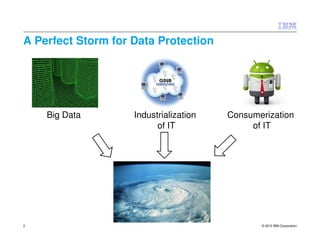
A Perfect Storm for Data Protection


    Big Data        Industrialization   Consumerization
                          of IT              of IT


2                                              © 2012 IBM Corporation
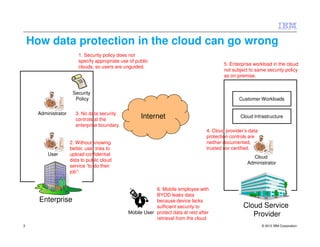
How data protection in the cloud can go wrong
                          1. Security policy does not
                          specify appropriate use of public
                                                                                             5. Enterprise workload in the cloud
                          clouds, so users are unguided.
                                                                                             not subject to same security policy
                                                                                             as on-premise.


                       Security
                        Policy                                                                      Customer Workloads

      Administrator     3. No data security
                        controls at the                Internet                                     Cloud Infrastructure
                        enterprise boundary.
                                                                                     4. Cloud provider’s data
                                                                                     protection controls are
                      2. Without knowing                                             neither documented,
                      better, user tries to                                          trusted nor certified.
          User        upload confidential
                                                                                                          Cloud
                      data to public cloud
                                                                                                        Administrator
                      service “to do their
                      job”:


                                                             6. Mobile employee with
                                                             BYOD leaks data
      Enterprise                                             because device lacks
                                                             sufficient security to                   Cloud Service
                                                 Mobile User protect data at rest after                  Provider
                                                             retrieval from the cloud
3                                                                                                               © 2012 IBM Corporation
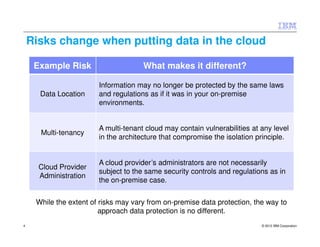
Risks change when putting data in the cloud

     Example Risk                     What makes it different?

                        Information may no longer be protected by the same laws
      Data Location     and regulations as if it was in your on-premise
                        environments.


                        A multi-tenant cloud may contain vulnerabilities at any level
      Multi-tenancy
                        in the architecture that compromise the isolation principle.


                        A cloud provider’s administrators are not necessarily
      Cloud Provider
                        subject to the same security controls and regulations as in
      Administration
                        the on-premise case.


     While the extent of risks may vary from on-premise data protection, the way to
                         approach data protection is no different.
4                                                                           © 2012 IBM Corporation
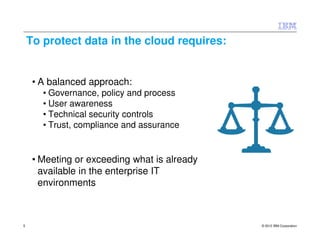
To protect data in the cloud requires:


     • A balanced approach:
       • Governance, policy and process
       • User awareness
       • Technical security controls
       • Trust, compliance and assurance


     • Meeting or exceeding what is already
       available in the enterprise IT
       environments


5                                             © 2012 IBM Corporation
Governance, policy and process

     • How effective is current your enterprise data protection
       policy?
       • And how accurate is the perception of its effectiveness?

     • Make your CIO Office/Cybersecurity policies and
       procedures cloud aware
       • System inventory
       • Endpoint security and compliance management
       • Incident response
       • Automation is a must

     • Taking a risk based approach allows for a balanced
       consideration of business opportunities
       • Cloud is not one-size-fits-all, nor should the evaluation of
         workloads and their suitability

6                                                                       © 2012 IBM Corporation
User awareness

    • The division of security and privacy responsibilities
      between the cloud service provider and cloud
      consumer should be clearly and consistently
      understood by all parties
      • Include end users, not just owners/admins

    • Demarcation of responsibilities will vary according to
      the cloud service and its delivery model


    • A program of ongoing education and awareness to
      users provides an opportunity to update users as
      the cybersecurity and compliance landscape
      changes

7                                                              © 2012 IBM Corporation
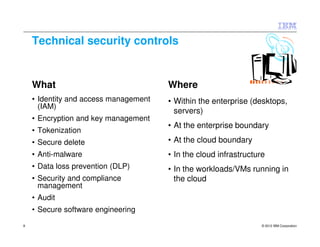
Technical security controls


    What                               Where
    • Identity and access management   • Within the enterprise (desktops,
      (IAM)
                                         servers)
    • Encryption and key management
                                       • At the enterprise boundary
    • Tokenization
    • Secure delete                    • At the cloud boundary
    • Anti-malware                     • In the cloud infrastructure
    • Data loss prevention (DLP)       • In the workloads/VMs running in
    • Security and compliance            the cloud
      management
    • Audit
    • Secure software engineering
8                                                                  © 2012 IBM Corporation
Trust, compliance and assurance

     • How is trust built between a cloud service
       provider and cloud service consumer?
       • Infrastructure certifications, e.g. ISO 27001,
         SSAE 16
       • Industry regulations, e.g. PCI-DSS
       • History and experience of a vendor to provide
         cloud/IT services


     • Providing visibility into the operation of the
       cloud is important for assurance
       • Directly with the cloud service provider or
         through a trusted third party


9                                                         © 2012 IBM Corporation
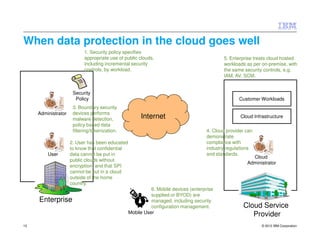
When data protection in the cloud goes well
                            1. Security policy specifies
                            appropriate use of public clouds,                              5. Enterprise treats cloud hosted
                            including incremental security                                 workloads as per on-premise, with
                            controls, by workload.                                         the same security controls, e.g.
                                                                                           IAM, AV, SCM.


                      Security
                       Policy                                                                     Customer Workloads
                      3. Boundary security
     Administrator    devices performs
                      malware detection,              Internet                                     Cloud Infrastructure
                      policy based data
                      filtering/tokenization.                                       4. Cloud provider can
                                                                                    demonstrate
                     2. User has been educated                                      compliance with
                     to know that confidential                                      industry regulations
         User        data cannot be put in                                          and standards.
                                                                                                        Cloud
                     public clouds without
                                                                                                      Administrator
                     encryption, and that SPI
                     cannot be put in a cloud
                     outside of the home
                     country.
                                                           6. Mobile devices (enterprise
                                                           supplied or BYOD) are
     Enterprise                                            managed, including security
                                                           configuration management.                Cloud Service
                                                 Mobile User                                           Provider
10                                                                                                           © 2012 IBM Corporation
Conclusion

     • Data protection in the cloud starts with data protection in
       the enterprise


     • A balanced approach is needed
       • Governance, policy and process
       • User awareness
       • Technical security controls
       • Trust, compliance and assurance


11                                                           © 2012 IBM Corporation
Thank you!


12                © 2012 IBM Corporation

Protecting Data in the Cloud

  • 1.
    Neil Readshaw, CISSP WorldwideChief Architect – Cloud Security IBM Global Technology Services @readshaw Protecting Data in the Cloud © 2012 IBM Corporation
  • 2.
    A Perfect Stormfor Data Protection Big Data Industrialization Consumerization of IT of IT 2 © 2012 IBM Corporation
  • 3.
    How data protectionin the cloud can go wrong 1. Security policy does not specify appropriate use of public 5. Enterprise workload in the cloud clouds, so users are unguided. not subject to same security policy as on-premise. Security Policy Customer Workloads Administrator 3. No data security controls at the Internet Cloud Infrastructure enterprise boundary. 4. Cloud provider’s data protection controls are 2. Without knowing neither documented, better, user tries to trusted nor certified. User upload confidential Cloud data to public cloud Administrator service “to do their job”: 6. Mobile employee with BYOD leaks data Enterprise because device lacks sufficient security to Cloud Service Mobile User protect data at rest after Provider retrieval from the cloud 3 © 2012 IBM Corporation
  • 4.
    Risks change whenputting data in the cloud Example Risk What makes it different? Information may no longer be protected by the same laws Data Location and regulations as if it was in your on-premise environments. A multi-tenant cloud may contain vulnerabilities at any level Multi-tenancy in the architecture that compromise the isolation principle. A cloud provider’s administrators are not necessarily Cloud Provider subject to the same security controls and regulations as in Administration the on-premise case. While the extent of risks may vary from on-premise data protection, the way to approach data protection is no different. 4 © 2012 IBM Corporation
  • 5.
    To protect datain the cloud requires: • A balanced approach: • Governance, policy and process • User awareness • Technical security controls • Trust, compliance and assurance • Meeting or exceeding what is already available in the enterprise IT environments 5 © 2012 IBM Corporation
  • 6.
    Governance, policy andprocess • How effective is current your enterprise data protection policy? • And how accurate is the perception of its effectiveness? • Make your CIO Office/Cybersecurity policies and procedures cloud aware • System inventory • Endpoint security and compliance management • Incident response • Automation is a must • Taking a risk based approach allows for a balanced consideration of business opportunities • Cloud is not one-size-fits-all, nor should the evaluation of workloads and their suitability 6 © 2012 IBM Corporation
  • 7.
    User awareness • The division of security and privacy responsibilities between the cloud service provider and cloud consumer should be clearly and consistently understood by all parties • Include end users, not just owners/admins • Demarcation of responsibilities will vary according to the cloud service and its delivery model • A program of ongoing education and awareness to users provides an opportunity to update users as the cybersecurity and compliance landscape changes 7 © 2012 IBM Corporation
  • 8.
    Technical security controls What Where • Identity and access management • Within the enterprise (desktops, (IAM) servers) • Encryption and key management • At the enterprise boundary • Tokenization • Secure delete • At the cloud boundary • Anti-malware • In the cloud infrastructure • Data loss prevention (DLP) • In the workloads/VMs running in • Security and compliance the cloud management • Audit • Secure software engineering 8 © 2012 IBM Corporation
  • 9.
    Trust, compliance andassurance • How is trust built between a cloud service provider and cloud service consumer? • Infrastructure certifications, e.g. ISO 27001, SSAE 16 • Industry regulations, e.g. PCI-DSS • History and experience of a vendor to provide cloud/IT services • Providing visibility into the operation of the cloud is important for assurance • Directly with the cloud service provider or through a trusted third party 9 © 2012 IBM Corporation
  • 10.
    When data protectionin the cloud goes well 1. Security policy specifies appropriate use of public clouds, 5. Enterprise treats cloud hosted including incremental security workloads as per on-premise, with controls, by workload. the same security controls, e.g. IAM, AV, SCM. Security Policy Customer Workloads 3. Boundary security Administrator devices performs malware detection, Internet Cloud Infrastructure policy based data filtering/tokenization. 4. Cloud provider can demonstrate 2. User has been educated compliance with to know that confidential industry regulations User data cannot be put in and standards. Cloud public clouds without Administrator encryption, and that SPI cannot be put in a cloud outside of the home country. 6. Mobile devices (enterprise supplied or BYOD) are Enterprise managed, including security configuration management. Cloud Service Mobile User Provider 10 © 2012 IBM Corporation
  • 11.
    Conclusion • Data protection in the cloud starts with data protection in the enterprise • A balanced approach is needed • Governance, policy and process • User awareness • Technical security controls • Trust, compliance and assurance 11 © 2012 IBM Corporation
  • 12.
    Thank you! 12 © 2012 IBM Corporation