PROTECTED
FOREST RESERVES
POINTS COVERED
 INTRODUCTION
 DIFFERENCE BETWEEN RESERVED AND
PROTECTED FOREST
 REASONS TO PROTECT FOREST
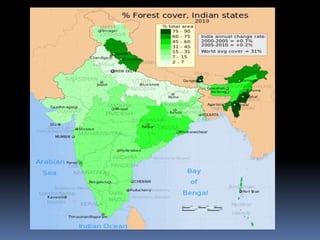
 FOREST COVER AREA IN DIFFERENT STATES
IN INDIA
 LIST OF PROTECTED AREAS IN INDIA
 INDIAN FOREST ACT 1927
 CONCLUSION
INTRODUCTION
 A protected forest is a forest with some amount of legal
or constitutional protection or where the habitat and
resident species are legally accorded protection from
further depletion.
 Protected forests of India were introduced in the Indian
Forest Act ,1927 in British India and were retained after
independence.
 A reserved forest is a specific term for designating
forests and other natural areas which enjoy judicial and
constitutional protection under the legal systems of
many countries.
DIFFERENCE BETWEEN RESERVED FOREST AND
PROTECTED FOREST
 Land rights to forests declared as reserved forest or
protected forest are typically acquired and owned by the
Government of India , both are declared by the
government .
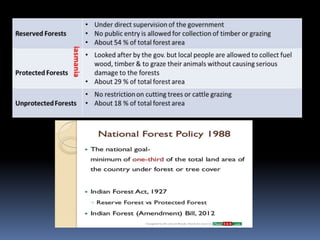
 The main difference between them is rights to all
activities like hunting, grazing ,etc in reserved forest is
banned unless specific orders are issued and in protected
forest rights to activities like hunting and grazing are
sometimes given to communities living on the fringes of
the forest who sustain their livelihood partially or wholly
from forest resources and products .
 Thus reserved forests enjoy a higher degree of protection
with respect to protected forests.
WHY ARE FORESTS PROTECTED?
Forest protection is the preservation or
improvement of a forest threatened or affected
by abuse or out of balance nature.
The reasons to protect forest is to prevent it
from
• Aggressive or unsustainable farming and
logging.
• Expanding city development caused by
population explosion and the resulting urban
sprawl.
LIST OF PROTECTED AREAS OF INDIA
NATIONAL
PARKS—
SANCTUARIES—
National parks in India are IUCN category
II protected areas . India’s first national
park was established in 1936 as Hailey
National Park now known as Jim Corbett
National Park. As ofApril 2012 there are
112 national parks.
There are over 440 wildlife sanctuaries as per
IUCN category IV protected forests in India.Some
sanctuaries are specifically bird sanctuaries like
Keoladeo National Park before attaining national
parks status.
TIGER
RESERVES—
BIOSPHERE
RESERVES—
There are 48 tiger reserves in India
which are governed by ProjectTiger
which is administered by the National
Tiger Conservation Authority.India is
home to 70% of tigers in the world.In
2006 there were 1411 tigers which
increased to 1706 in 2011 and 2226 in
2014.
The Indian Government has
established 18 Biosphere Reserves of
India, corresponding to IUCN Category
V Protected areas which protect larger
areas of natural habitat and often
include one or more national parks or
preserves along buffer zones that are
open to some economic uses.
ZOOS—
Protection is granted not only to the
flora and fauna of the protected region
but also to the human communities
who inhabit these regions and their
ways of life.
India has over 35 zoos governed by the
Central ZooAuthority of India which is
an associate member of the World
Association of Zoos and Aquariums .
Coral Reefs and Mangrove areas are
also considered protected areas .
JIM CORBETT NATIONAL PARK
ZOOSANCTUARIES
INDIAN FOREST ACT ,1927
It is an Act to consolidate the law relating to forests,the
transit of forest-produce and the duty leviable on timber
and other forest-produce. Its territorial is whole of India
except the state of Jammu and Kashmir and it is enacted
by Central Legislative Assembly .The Act was largely
based on previous Indian Forest Acts implemented under
the British .The most famous one was the Indian Forest
Act of 1878 .It defines the procedure to be followed for
declaring an area to be a Reserved Forest ,a Protected
Forest or aVillage Forest . It defines what is a forest
offence , what are the acts prohibited inside a Reserved
Forest ,and penalties leviable on violation of the
provisions of the Act .
CONCLUSION
So to conclude its not just government’s duty
to look after natural resources like forests but
even we as responsible citizens should do
something .The need to protect forests arise
because of over population and their growing
demands so we are responsible for such
exploitation .We need to preserve these
natural resources as they are our valuables.
PRESENTATION BY-
 MAMTA JAIN
 SHARVARI KELKAR
 SHREYA PEDNEKAR
 PRACHI VORA

Protected forest reserves

  • 1.
  • 2.
    POINTS COVERED  INTRODUCTION DIFFERENCE BETWEEN RESERVED AND PROTECTED FOREST  REASONS TO PROTECT FOREST  FOREST COVER AREA IN DIFFERENT STATES IN INDIA  LIST OF PROTECTED AREAS IN INDIA  INDIAN FOREST ACT 1927  CONCLUSION
  • 3.
    INTRODUCTION  A protectedforest is a forest with some amount of legal or constitutional protection or where the habitat and resident species are legally accorded protection from further depletion.  Protected forests of India were introduced in the Indian Forest Act ,1927 in British India and were retained after independence.  A reserved forest is a specific term for designating forests and other natural areas which enjoy judicial and constitutional protection under the legal systems of many countries.
  • 4.
    DIFFERENCE BETWEEN RESERVEDFOREST AND PROTECTED FOREST  Land rights to forests declared as reserved forest or protected forest are typically acquired and owned by the Government of India , both are declared by the government .  The main difference between them is rights to all activities like hunting, grazing ,etc in reserved forest is banned unless specific orders are issued and in protected forest rights to activities like hunting and grazing are sometimes given to communities living on the fringes of the forest who sustain their livelihood partially or wholly from forest resources and products .  Thus reserved forests enjoy a higher degree of protection with respect to protected forests.
  • 6.
    WHY ARE FORESTSPROTECTED? Forest protection is the preservation or improvement of a forest threatened or affected by abuse or out of balance nature. The reasons to protect forest is to prevent it from • Aggressive or unsustainable farming and logging. • Expanding city development caused by population explosion and the resulting urban sprawl.
  • 8.
    LIST OF PROTECTEDAREAS OF INDIA NATIONAL PARKS— SANCTUARIES— National parks in India are IUCN category II protected areas . India’s first national park was established in 1936 as Hailey National Park now known as Jim Corbett National Park. As ofApril 2012 there are 112 national parks. There are over 440 wildlife sanctuaries as per IUCN category IV protected forests in India.Some sanctuaries are specifically bird sanctuaries like Keoladeo National Park before attaining national parks status.
  • 9.
    TIGER RESERVES— BIOSPHERE RESERVES— There are 48tiger reserves in India which are governed by ProjectTiger which is administered by the National Tiger Conservation Authority.India is home to 70% of tigers in the world.In 2006 there were 1411 tigers which increased to 1706 in 2011 and 2226 in 2014. The Indian Government has established 18 Biosphere Reserves of India, corresponding to IUCN Category V Protected areas which protect larger areas of natural habitat and often include one or more national parks or preserves along buffer zones that are open to some economic uses.
  • 10.
    ZOOS— Protection is grantednot only to the flora and fauna of the protected region but also to the human communities who inhabit these regions and their ways of life. India has over 35 zoos governed by the Central ZooAuthority of India which is an associate member of the World Association of Zoos and Aquariums . Coral Reefs and Mangrove areas are also considered protected areas .
  • 11.
    JIM CORBETT NATIONALPARK ZOOSANCTUARIES
  • 12.
    INDIAN FOREST ACT,1927 It is an Act to consolidate the law relating to forests,the transit of forest-produce and the duty leviable on timber and other forest-produce. Its territorial is whole of India except the state of Jammu and Kashmir and it is enacted by Central Legislative Assembly .The Act was largely based on previous Indian Forest Acts implemented under the British .The most famous one was the Indian Forest Act of 1878 .It defines the procedure to be followed for declaring an area to be a Reserved Forest ,a Protected Forest or aVillage Forest . It defines what is a forest offence , what are the acts prohibited inside a Reserved Forest ,and penalties leviable on violation of the provisions of the Act .
  • 13.
    CONCLUSION So to concludeits not just government’s duty to look after natural resources like forests but even we as responsible citizens should do something .The need to protect forests arise because of over population and their growing demands so we are responsible for such exploitation .We need to preserve these natural resources as they are our valuables.
  • 14.
    PRESENTATION BY-  MAMTAJAIN  SHARVARI KELKAR  SHREYA PEDNEKAR  PRACHI VORA