@CrossrefOrg
Proposed schema changes -
have your say
Open schema development means
- opportunity for feedback
- no surprises (we hope)
- community investment
limited by:
- resources
- changing landscape
- conflicting needs of members
Priorities for upcoming update
● Expand identifier support
● Identifying and crediting contributors
● Improve data citation support
● Provenance
Don’t panic!
Backwards compatibility - do we really want to mess with that?
● it’s the best way to support changes
● it’s not a big change
● supporting the old and new ways will be messy and confusing and not
enforceable through the schema
BUT we try to stay backwards compatible for a reason, if we can’t support
current schema and new, we won’t do it (for now…)
Expanding identifier support
Why: identifiers are useful
the plan:
● start with identifiers for people and organizations
● accept all identifiers registered with identifiers.org
● continue to develop services for open community led
identifiers like ROR and ORCID
Contributors
We need to:
– extend identifier support for authors and institutions
– support CRediT
– make names less Western-centric
– refine affiliation support (ROR 🦁)
– expand support for organizational authors
<contributors>
<person_name sequence="first"
contributor_role="chair">
<given_name>Minerva</given_name>
<surname>Housecat</surname>
<affiliation>Crossref University</affiliation>
<ORCID authenticated="true">
https://orcid.org/0000-0002-4011-3590</ORCID>
</person_name>
<organization sequence=”first”
contributor_role=”author”>Crossref</organization>
</contributors>
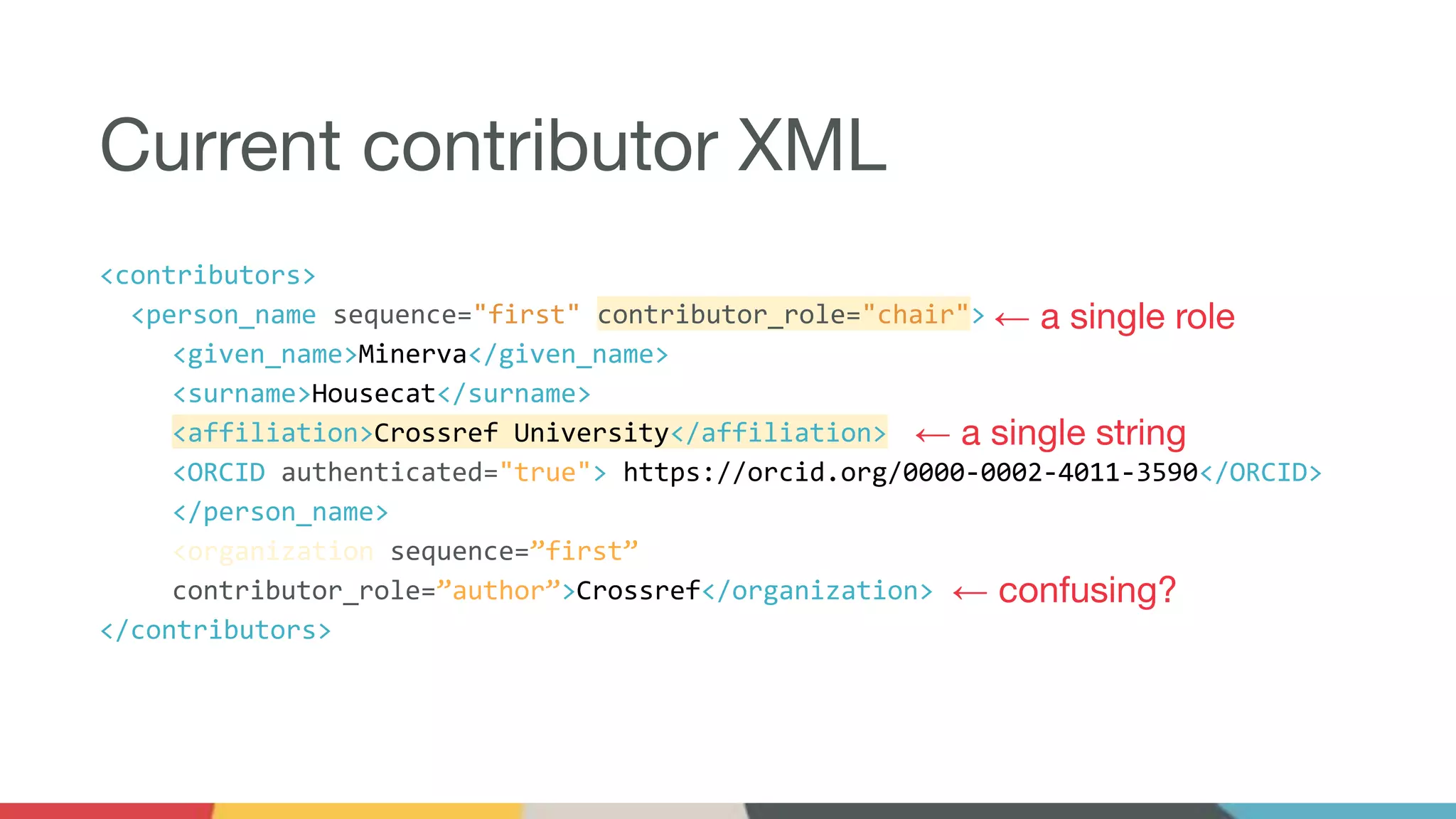
Current contributor XML
person
@role (single)
@sequence (first or additional)
> given name and surname
> affiliation
> ORCID iD
---
organization
@sequence
@role
<contributors>
<person_name sequence="first" contributor_role="chair">
<given_name>Minerva</given_name>
<surname>Housecat</surname>
<affiliation>Crossref University</affiliation>
<ORCID authenticated="true"> https://orcid.org/0000-0002-4011-3590</ORCID>
</person_name>
<organization sequence=”first”
contributor_role=”author”>Crossref</organization>
</contributors>
← a single role
← a single string
Current contributor XML
← confusing?
Person names
● given_name - no change
● surname - change to family_name
● ORCID - unchanged for now as a few services use this, may fold into identifier tags in the
future
● name-style - replace with alternate_name
● add alternate_name and include name-style and xml:lang attribute
● require given_name or surname instead of just surname as not all names have surnames
● add identifier support
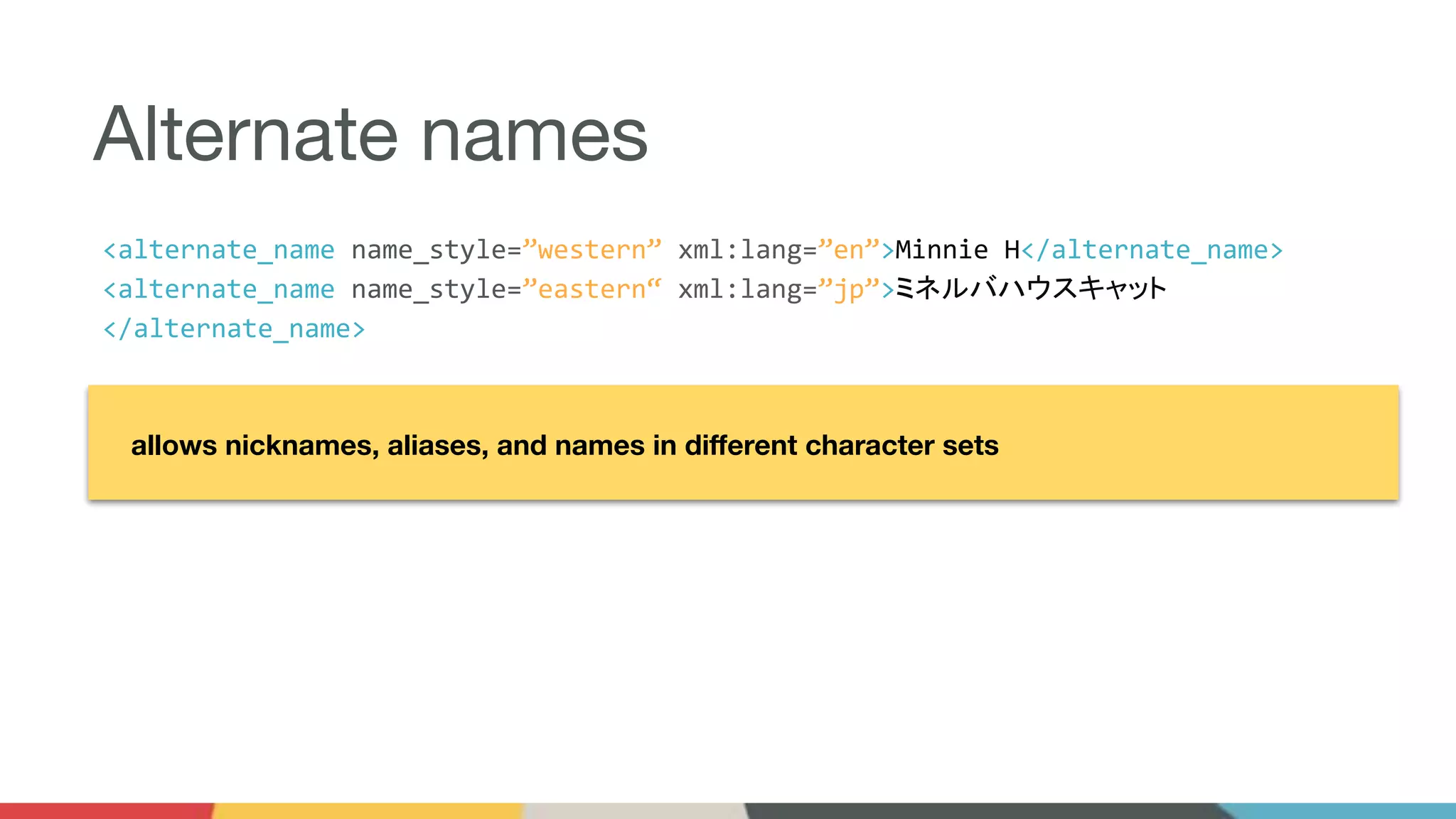
Alternate names
<alternate_name name_style=”western” xml:lang=”en”>Minnie H</alternate_name>
<alternate_name name_style=”eastern“ xml:lang=”jp”>ミネルバハウスキャット
</alternate_name>
allows nicknames, aliases, and names in different character sets
Identifiers for names
<contrib_id contrib_id_type=”isni”>0000000121032683</contrib_id>
<contrib_id contrib_id_type=”orcid”
authenticated=”true”>https://orcid.org/0000-0002-4011-3590</contrib_id>
allows multiple name identifiers and identifier type
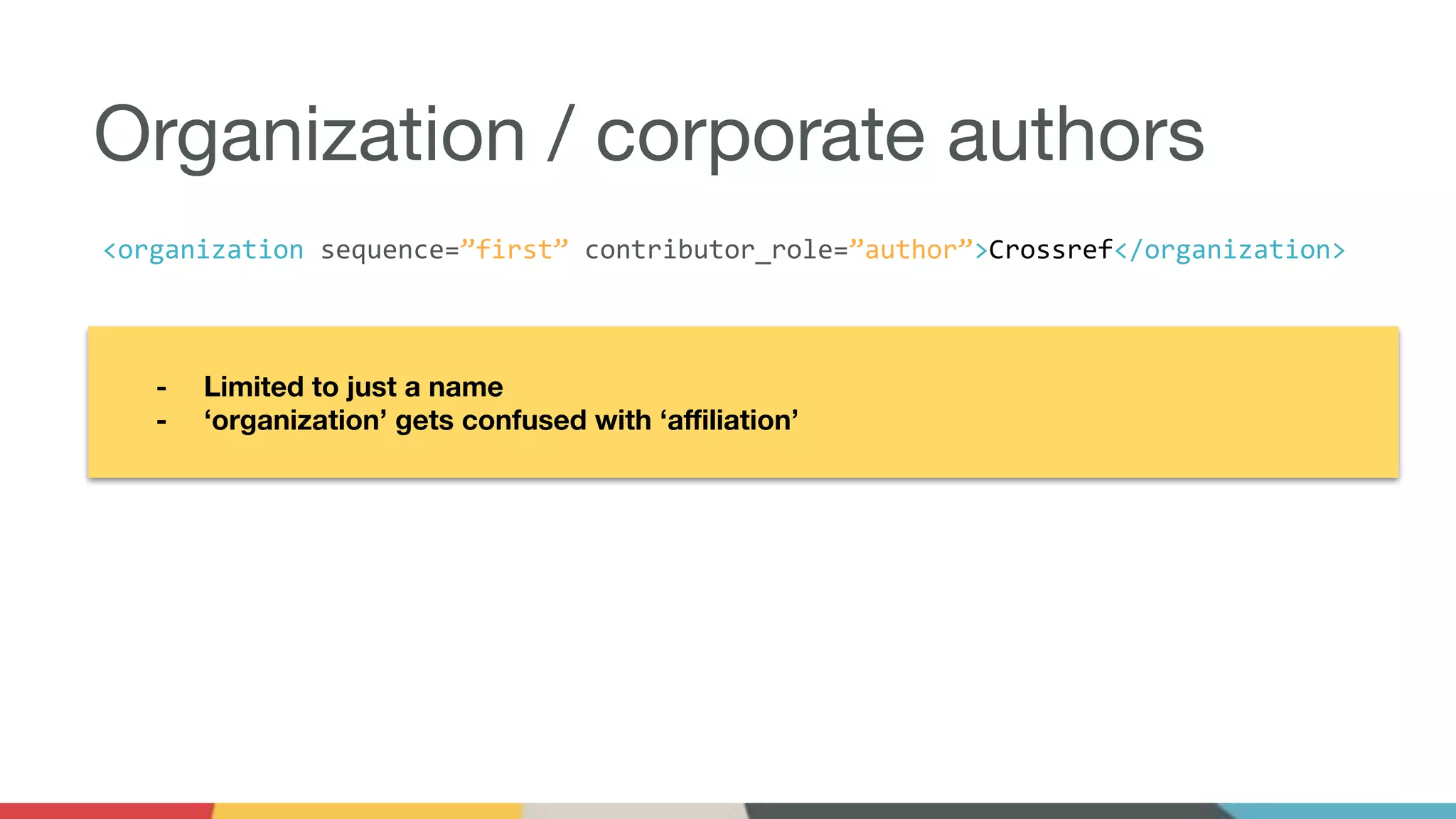
Organization / corporate authors
<organization sequence=”first” contributor_role=”author”>Crossref</organization>
- Limited to just a name
- ‘organization’ gets confused with ‘affiliation’
What will it look like?
<collab sequence=”additional”>
<collab_name>Crossref</collab_name>
<role role-type=”data_curation”/>
<contrib_id contrib_id_type="ror">https://ror.org/02twcfp32</contrib_id>
<contrib_id contrib_id_type="isni">0000000405062673</contrib_id>
<contrib_id contrib_id_type="wikidata”>Q5188229</contrib_id>
</collab>
</contributors>
- Change ‘organization’ to ‘collab’ (per JATS)*
- add role support
- add contributor ID support (institutional identifiers)
CRediT
What is it?
CRediT - Contributor Roles taxonomy; used to represent the roles typically played by
contributors to scientific scholarly output.
Why is Crossref adopting it?
Current contributor types are very limited and CRediT is becoming widely used; many members
are asking for it
Current roles:
● author
● editor
● chair
● translator
Roles for peer review:
● reviewer
● review-assistant
● stats-reviewer
● reviewer-external
● reader
CRediT roles
● Conceptualization
● Data curation
● Formal analysis
● Funding acquisition
● Investigation
● Methodology
● Project Administration
● Resources
● Software
● Supervision
● Validation
● Visualization
● Writing - original draft
● Writing - reviewing & editing
Changes:
● retire @contributor_role and replace with new repeatable <role> element -
this allows multiple roles to be included
● add @role-type to capture role type.
● add @vocab to capture vocabulary
CRediT breaks backwards compatibility - we need to support multiple roles
to accurately reflect contributions of authors
What will it look like?
<role role-type=”conceptualization” vocab=”credit”/>
<role role-type=”author” vocab=”crossref”/>
or
<role role-type=”data_curation” vocab=”credit”/>Data Curation</role>
<role role-type=”author” vocab=”credit”/>Author</role>
<role role-type=”other” vocab=”credit”/>Sentence Diagrammer</role>
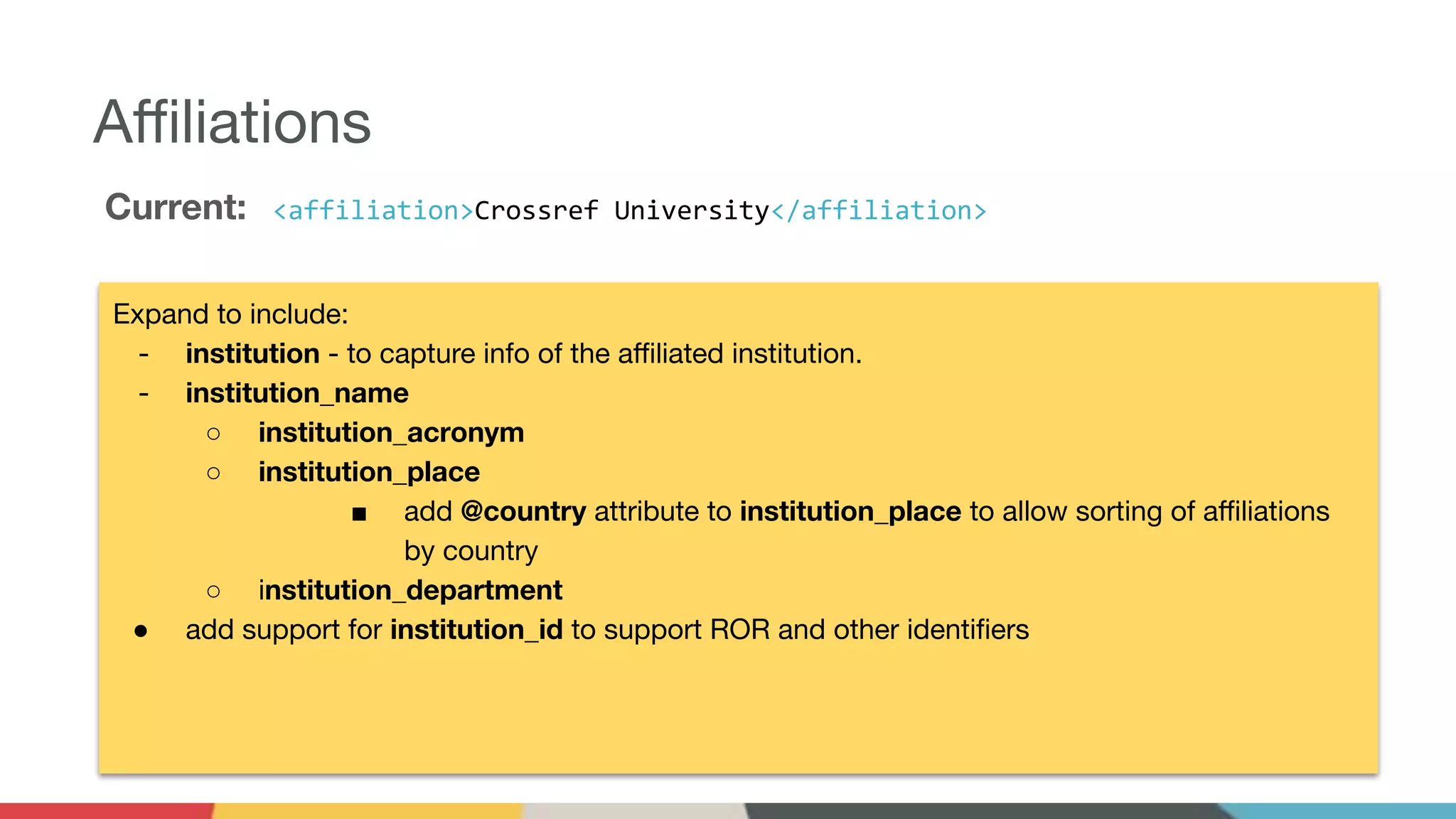
Affiliations
Expand to include:
- institution - to capture info of the affiliated institution.
- institution_name
○ institution_acronym
○ institution_place
■ add @country attribute to institution_place to allow sorting of affiliations
by country
○ institution_department
● add support for institution_id to support ROR and other identifiers
Current: <affiliation>Crossref University</affiliation>
<affiliations>
<institution>
<institution_name>Crossref</institution_name>
<institution_acronym>CR</institution_acronym>
<institution_place country=”us”>Lynnfield, MA</institution_place>
<institution_department>Feline Outreach</institution_department>
<institution_id institution_id_type="ror">https://ror.org/02twcfp32</institution_id>
<institution_id institution_id_type="isni">0000000405062673</institution_id>
<institution_id institution_id_type=”wikidata”>Q5188229</institution_id>
</institution>
<institution>
<institution_name>Institute of Sparse Metadata</institution_name>
</affiliations>
What will it look like?
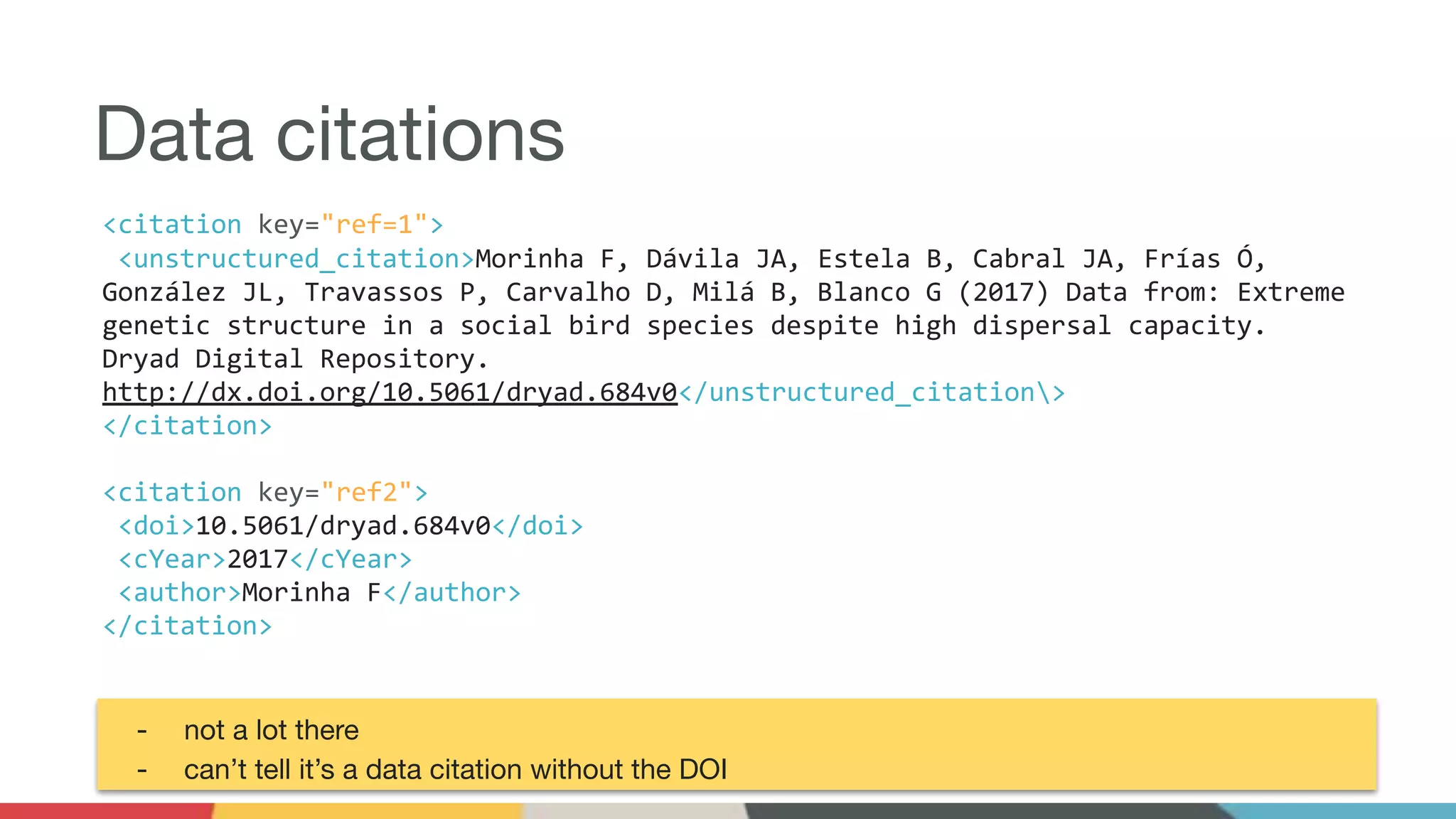
Data citations
<citation key="ref=1">
<unstructured_citation>Morinha F, Dávila JA, Estela B, Cabral JA, Frías Ó,
González JL, Travassos P, Carvalho D, Milá B, Blanco G (2017) Data from: Extreme
genetic structure in a social bird species despite high dispersal capacity.
Dryad Digital Repository.
http://dx.doi.org/10.5061/dryad.684v0</unstructured_citation>
</citation>
<citation key="ref2">
<doi>10.5061/dryad.684v0</doi>
<cYear>2017</cYear>
<author>Morinha F</author>
</citation>
- not a lot there
- can’t tell it’s a data citation without the DOI
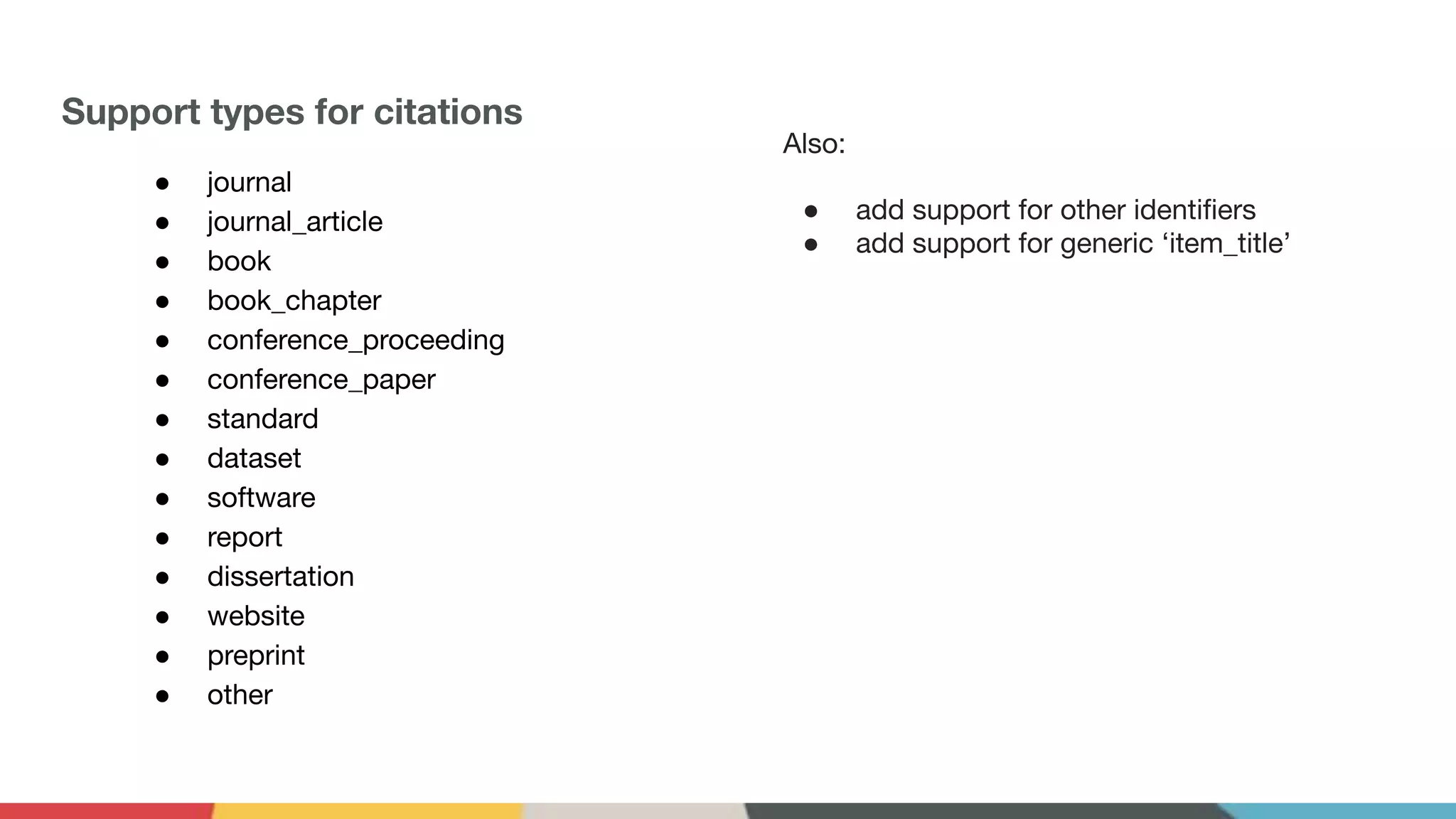
Support types for citations
● journal
● journal_article
● book
● book_chapter
● conference_proceeding
● conference_paper
● standard
● dataset
● software
● report
● dissertation
● website
● preprint
● other
Also:
● add support for other identifiers
● add support for generic ‘item_title’
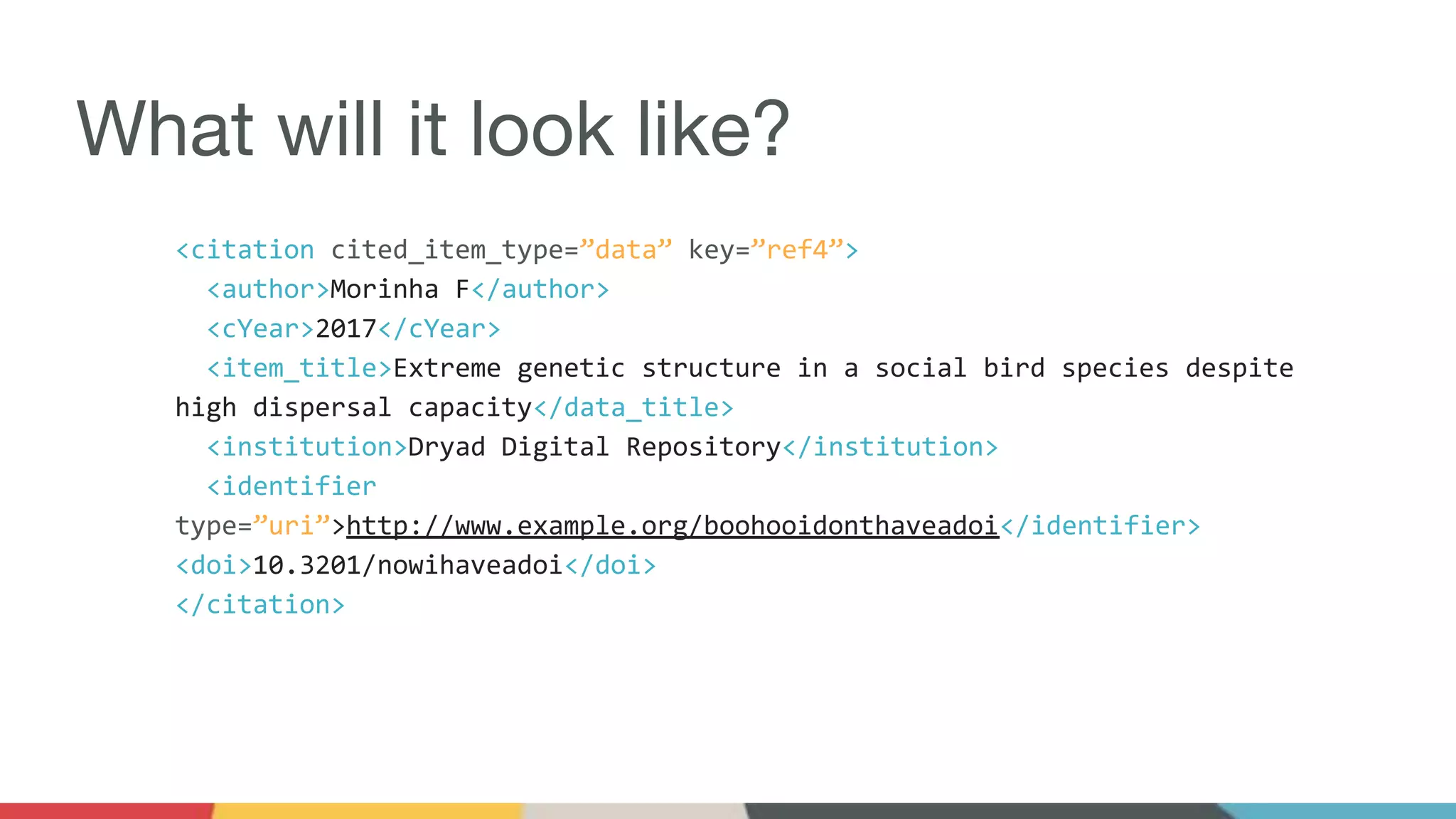
<citation cited_item_type=”data” key=”ref4”>
<author>Morinha F</author>
<cYear>2017</cYear>
<item_title>Extreme genetic structure in a social bird species despite
high dispersal capacity</data_title>
<institution>Dryad Digital Repository</institution>
<identifier
type=”uri”>http://www.example.org/boohooidonthaveadoi</identifier>
<doi>10.3201/nowihaveadoi</doi>
</citation>
What will it look like?
<citation cited_item_type=”data” key=”ref4”>
<unstructured_citation>Morinha F, Dávila JA, Estela B, Cabral JA, Frías
Ó, González JL, Travassos P, Carvalho D, Milá B, Blanco G (2017) Data from:
Extreme genetic structure in a social bird species despite high dispersal
capacity. Dryad Digital Repository.</unstructured_citation>
</citation>
What will it look like?
Provenance
Current: nothing for journal articles
For books, reports, standards, conference proceedings:
<publisher>
<publisher_name>Pumpkin Spice League of Hatred</publisher_name>
<publisher_place>Burlington, VT</publisher_place>
</publisher>
<publisher>
<publisher_name xml:lang=”en”>Pumpkin Spice League of Hatred</publisher_name>
<publisher_name xml:lang=”jp”>パンプキンスパイスリーグオブ憎しみ </publisher_name>
<publisher_place country=”us”>Burlington, VT</publisher_place>
</publisher>
What will it look like?
Expand support for dates
● citation date: to capture member’s preferred citation date (this can vary
greatly between print and online across publishers)
● submitted date: per member and internal requests
● copyright date: to capture the specific copyright date as it may differ
from a publication date
Other updates
● add e-location_id as an element
● add citations to peer reviews
● suggestions?
The future
new content types
open access indicators
versions
new relations
article type taxonomy identifiers for ?
more funding
metadata?
Conference IDs
Next steps
● Feedback
● Open development
– summarize feedback
– share a schema and examples
– share output plans (JSON, filters and facets for REST API)
– share timelines for implementation
– test
– implement
Have feedback on this proposal?
Leave comments in the proposal
Send me an email (pfeeney@crossref.org)
Create a GitLab issue
★★ I’ll be collecting feedback through January 15 ★★
Have your say!
Metadata Practitioners Interest Group
- will have monthly calls in 2020
- focus on sending Crossref metadata (for now)
- will be forming working groups for specific interests
- JATS, preprints, new content types
Thank you!
Patricia Feeney
pfeeney@crossref.org
@schemaschemer

Proposed schema changes - have your say

  • 1.
  • 2.
    Open schema developmentmeans - opportunity for feedback - no surprises (we hope) - community investment limited by: - resources - changing landscape - conflicting needs of members
  • 3.
    Priorities for upcomingupdate ● Expand identifier support ● Identifying and crediting contributors ● Improve data citation support ● Provenance
  • 4.
    Don’t panic! Backwards compatibility- do we really want to mess with that? ● it’s the best way to support changes ● it’s not a big change ● supporting the old and new ways will be messy and confusing and not enforceable through the schema BUT we try to stay backwards compatible for a reason, if we can’t support current schema and new, we won’t do it (for now…)
  • 5.
    Expanding identifier support Why:identifiers are useful the plan: ● start with identifiers for people and organizations ● accept all identifiers registered with identifiers.org ● continue to develop services for open community led identifiers like ROR and ORCID
  • 6.
    Contributors We need to: –extend identifier support for authors and institutions – support CRediT – make names less Western-centric – refine affiliation support (ROR 🦁) – expand support for organizational authors
  • 7.
    <contributors> <person_name sequence="first" contributor_role="chair"> <given_name>Minerva</given_name> <surname>Housecat</surname> <affiliation>Crossref University</affiliation> <ORCIDauthenticated="true"> https://orcid.org/0000-0002-4011-3590</ORCID> </person_name> <organization sequence=”first” contributor_role=”author”>Crossref</organization> </contributors> Current contributor XML person @role (single) @sequence (first or additional) > given name and surname > affiliation > ORCID iD --- organization @sequence @role
  • 8.
    <contributors> <person_name sequence="first" contributor_role="chair"> <given_name>Minerva</given_name> <surname>Housecat</surname> <affiliation>CrossrefUniversity</affiliation> <ORCID authenticated="true"> https://orcid.org/0000-0002-4011-3590</ORCID> </person_name> <organization sequence=”first” contributor_role=”author”>Crossref</organization> </contributors> ← a single role ← a single string Current contributor XML ← confusing?
  • 9.
    Person names ● given_name- no change ● surname - change to family_name ● ORCID - unchanged for now as a few services use this, may fold into identifier tags in the future ● name-style - replace with alternate_name ● add alternate_name and include name-style and xml:lang attribute ● require given_name or surname instead of just surname as not all names have surnames ● add identifier support
  • 10.
    Alternate names <alternate_name name_style=”western”xml:lang=”en”>Minnie H</alternate_name> <alternate_name name_style=”eastern“ xml:lang=”jp”>ミネルバハウスキャット </alternate_name> allows nicknames, aliases, and names in different character sets
  • 11.
    Identifiers for names <contrib_idcontrib_id_type=”isni”>0000000121032683</contrib_id> <contrib_id contrib_id_type=”orcid” authenticated=”true”>https://orcid.org/0000-0002-4011-3590</contrib_id> allows multiple name identifiers and identifier type
  • 12.
    Organization / corporateauthors <organization sequence=”first” contributor_role=”author”>Crossref</organization> - Limited to just a name - ‘organization’ gets confused with ‘affiliation’
  • 13.
    What will itlook like? <collab sequence=”additional”> <collab_name>Crossref</collab_name> <role role-type=”data_curation”/> <contrib_id contrib_id_type="ror">https://ror.org/02twcfp32</contrib_id> <contrib_id contrib_id_type="isni">0000000405062673</contrib_id> <contrib_id contrib_id_type="wikidata”>Q5188229</contrib_id> </collab> </contributors> - Change ‘organization’ to ‘collab’ (per JATS)* - add role support - add contributor ID support (institutional identifiers)
  • 14.
    CRediT What is it? CRediT- Contributor Roles taxonomy; used to represent the roles typically played by contributors to scientific scholarly output. Why is Crossref adopting it? Current contributor types are very limited and CRediT is becoming widely used; many members are asking for it
  • 15.
    Current roles: ● author ●editor ● chair ● translator Roles for peer review: ● reviewer ● review-assistant ● stats-reviewer ● reviewer-external ● reader CRediT roles ● Conceptualization ● Data curation ● Formal analysis ● Funding acquisition ● Investigation ● Methodology ● Project Administration ● Resources ● Software ● Supervision ● Validation ● Visualization ● Writing - original draft ● Writing - reviewing & editing
  • 16.
    Changes: ● retire @contributor_roleand replace with new repeatable <role> element - this allows multiple roles to be included ● add @role-type to capture role type. ● add @vocab to capture vocabulary CRediT breaks backwards compatibility - we need to support multiple roles to accurately reflect contributions of authors
  • 17.
    What will itlook like? <role role-type=”conceptualization” vocab=”credit”/> <role role-type=”author” vocab=”crossref”/> or <role role-type=”data_curation” vocab=”credit”/>Data Curation</role> <role role-type=”author” vocab=”credit”/>Author</role> <role role-type=”other” vocab=”credit”/>Sentence Diagrammer</role>
  • 18.
    Affiliations Expand to include: -institution - to capture info of the affiliated institution. - institution_name ○ institution_acronym ○ institution_place ■ add @country attribute to institution_place to allow sorting of affiliations by country ○ institution_department ● add support for institution_id to support ROR and other identifiers Current: <affiliation>Crossref University</affiliation>
  • 19.
    <affiliations> <institution> <institution_name>Crossref</institution_name> <institution_acronym>CR</institution_acronym> <institution_place country=”us”>Lynnfield, MA</institution_place> <institution_department>FelineOutreach</institution_department> <institution_id institution_id_type="ror">https://ror.org/02twcfp32</institution_id> <institution_id institution_id_type="isni">0000000405062673</institution_id> <institution_id institution_id_type=”wikidata”>Q5188229</institution_id> </institution> <institution> <institution_name>Institute of Sparse Metadata</institution_name> </affiliations> What will it look like?
  • 20.
    Data citations <citation key="ref=1"> <unstructured_citation>MorinhaF, Dávila JA, Estela B, Cabral JA, Frías Ó, González JL, Travassos P, Carvalho D, Milá B, Blanco G (2017) Data from: Extreme genetic structure in a social bird species despite high dispersal capacity. Dryad Digital Repository. http://dx.doi.org/10.5061/dryad.684v0</unstructured_citation> </citation> <citation key="ref2"> <doi>10.5061/dryad.684v0</doi> <cYear>2017</cYear> <author>Morinha F</author> </citation> - not a lot there - can’t tell it’s a data citation without the DOI
  • 21.
    Support types forcitations ● journal ● journal_article ● book ● book_chapter ● conference_proceeding ● conference_paper ● standard ● dataset ● software ● report ● dissertation ● website ● preprint ● other Also: ● add support for other identifiers ● add support for generic ‘item_title’
  • 22.
    <citation cited_item_type=”data” key=”ref4”> <author>MorinhaF</author> <cYear>2017</cYear> <item_title>Extreme genetic structure in a social bird species despite high dispersal capacity</data_title> <institution>Dryad Digital Repository</institution> <identifier type=”uri”>http://www.example.org/boohooidonthaveadoi</identifier> <doi>10.3201/nowihaveadoi</doi> </citation> What will it look like?
  • 23.
    <citation cited_item_type=”data” key=”ref4”> <unstructured_citation>MorinhaF, Dávila JA, Estela B, Cabral JA, Frías Ó, González JL, Travassos P, Carvalho D, Milá B, Blanco G (2017) Data from: Extreme genetic structure in a social bird species despite high dispersal capacity. Dryad Digital Repository.</unstructured_citation> </citation> What will it look like?
  • 24.
    Provenance Current: nothing forjournal articles For books, reports, standards, conference proceedings: <publisher> <publisher_name>Pumpkin Spice League of Hatred</publisher_name> <publisher_place>Burlington, VT</publisher_place> </publisher>
  • 25.
    <publisher> <publisher_name xml:lang=”en”>Pumpkin SpiceLeague of Hatred</publisher_name> <publisher_name xml:lang=”jp”>パンプキンスパイスリーグオブ憎しみ </publisher_name> <publisher_place country=”us”>Burlington, VT</publisher_place> </publisher> What will it look like?
  • 26.
    Expand support fordates ● citation date: to capture member’s preferred citation date (this can vary greatly between print and online across publishers) ● submitted date: per member and internal requests ● copyright date: to capture the specific copyright date as it may differ from a publication date
  • 27.
    Other updates ● adde-location_id as an element ● add citations to peer reviews ● suggestions?
  • 28.
    The future new contenttypes open access indicators versions new relations article type taxonomy identifiers for ? more funding metadata? Conference IDs
  • 29.
    Next steps ● Feedback ●Open development – summarize feedback – share a schema and examples – share output plans (JSON, filters and facets for REST API) – share timelines for implementation – test – implement
  • 30.
    Have feedback onthis proposal? Leave comments in the proposal Send me an email (pfeeney@crossref.org) Create a GitLab issue ★★ I’ll be collecting feedback through January 15 ★★
  • 31.
    Have your say! MetadataPractitioners Interest Group - will have monthly calls in 2020 - focus on sending Crossref metadata (for now) - will be forming working groups for specific interests - JATS, preprints, new content types
  • 32.