PROPOSAL WRITING FOR INDIVIDUALS
AND NGOS
BY
SUSAN PONI WAYA
Introduction to Proposal Writing.
A proposal is a formal document that outlines a plan or request for a project, idea,
or funding. It’s used to convince a recipient (such as a donor, organization, or
individual) to approve or fund the initiative.
Purpose of a proposal
• Securing funding or resources.
• Gaining approval for a project.
• Establishing partnerships or collaborations.
Understanding the Audience is crucial before writing
Know Your Audience:
• Understanding the priorities and goals of donors, investors, and government
agencies is crucial when writing for them.
• For NGOs: Donors typically look for proposals that align with their mission or
focus areas (e.g., education, healthcare, poverty alleviation).
• For Individuals: Investors are focused on return on investment (ROI) and the
proposal’s feasibility.
Tailoring the Proposal:
• Customize each proposal to match the recipient’s priorities.
• Speak to their specific needs and how your project will address them.
• Research past projects they’ve funded or supported to align your request
effectively
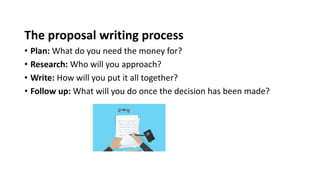
The proposal writing process
• Plan: What do you need the money for?
• Research: Who will you approach?
• Write: How will you put it all together?
• Follow up: What will you do once the decision has been made?
Components of a project proposal
• Cover letter
• Executive summary
• Problem statement
• Goals and objectives
• Project activities and methodologies
• Expected outcomes
• Monitoring and evaluation
• Budget
• Sustainability
Components of a proposal explained.
1. Cover Letter:
• A brief, formal letter introducing the proposal.
• Summarize the purpose of the proposal
• It shows the Project title, organization name, address, and contact information.
2. Executive Summary:
The executive summary is one of the most important parts of the proposal. The
reviewer will often read it first to determine if they want to continue reading the
rest of the proposal. It should include;
• Statement of need, the proposed solution, and the expected outcomes.
• Goals and objectives
• Background on your organization
• Typically written after the rest of the proposal is completed.
3. Problem Statement:
Clearly define the problem or need your project intends to address.
Use evidence, such as data or research, to support why this issue is critical.
Highlight why the problem is urgent and why your solution is needed now.
If possible use touching stories
Limit the explanation of the problem to your geographic focus area
Explain why it matters, who it affects, and the consequences of not addressing it.
4. Goals and objectives
Goals are broad, long-term achievements (e.g., "Reduce child
malnutrition in rural communities").
Objectives are specific, measurable actions to help achieve the goal
(e.g., "Provide nutritional supplements to 500 children within 6
months").
• Or- Improve economic opportunities for 50 women in rural areas through
vocational training and entrepreneurship support within 6 months.
Consider these when writing the objectives
• Key areas the project needs to change (what)
• Target group to be involved in the change (who)
• The direction of change
• Degree or amount of change required (by how much)
• The deadline to reach the degree of change (when)
• Be directly related to the project goal
• Begin with the word “to” followed by an action verb (Decrease,
Increase, Strengthen, Improve, enhance)
• Specify only one major result per objective
• Be SMART (Specific, Measurable, Achievable, Relevant and Time bounded)
5. Project activities and methodologies
✓ Describe the strategies, activities, and steps you will take to achieve the
project’s objectives.
✓ Include details on key activities, target populations, and specific actions.
• It describes who, what, when, and how
• List all of the tasks/activities
• Who is responsible
• Add the timeline
• How will you know this is accomplished?
Activities can include:
Training, workshops, street shows, rallies, conferences, meetings, articles,
publications, shelter home establishment, counseling, and legal support are also
needed. Forming cooperatives
6. Expected outcomes
Show the quantifiable results and impact of the project.
7. Monitoring and Evaluation Plan:
• Explain how you will measure the success of the project.
• Provide indicators and metrics that will be used to track progress and assess
whether objectives are being met
• Who should monitor and evaluate
• What to monitor and evaluate
• When to monitor and evaluate
• How to monitor and evaluate
• Resource requirement
.
What funders look for in an evaluation plan
• The evaluation plan flows logically from the objectives
specified in the work plan.
• Your evaluation plan promises to provide solid evidence of your
project’s effectiveness.
• The evaluation plan is detailed and specific
• The evaluation plan is realistic and feasible
8. Budget
• Present a detailed budget outlining the costs involved in executing the project
• Include direct costs (e.g., salaries, materials) and indirect costs (e.g., overhead).
• Ensure that the budget aligns with the project's activities and objectives.
What Funders Look for in the Budget
• A clear match between proposed activities and proposed expenditures
• Reasonable and realistic estimates of expected costs
• Adequate justification for all expenditures
• Appropriate staffing of project
• Accuracy
9. Sustainability
• Show how the project will continue or have a lasting impact after the
funding ends.
• Explain if other funding sources or income-generating activities will
sustain the project long-term.
• Include local institutions and communities to take over the project
• Shows long-term vision and funding plan for the project
Key Elements or tips for NGOs
Alignment with Donor Priorities:
▪ NGOs should ensure that their proposals align with the focus areas and mission of the donor.
▪ Review donor guidelines and past funded projects for better alignment.
Community Engagement:
• Show how the community is involved in the planning, execution, and sustainability of the
project.
• Donors value projects that are community-led and foster local ownership.
Monitoring and Reporting:
• Have a clear plan for monitoring the project’s progress and reporting to donors.
• Specify how and when progress reports will be submitted.
Writing Techniques
Clarity and Precision:
o Write clearly and avoid using technical jargon or overly complex language.
o Use simple, direct language to make your proposal understandable to all readers.
Persuasiveness:
o Use strong, evidence-backed arguments to make your case.
o Incorporate success stories, data, and testimonials to make the proposal more
compelling.
o Show urgency and explain why the project needs to happen now.
Conciseness:
o Be concise and to the point. Avoid unnecessary details that do not directly contribute
to the case.
o Respect the reader’s time by ensuring all sections are succinct but informative.
Common Mistakes to Avoid
• Vagueness: Not clearly defining the problem, objectives, or methodology.
• Lack of Research: Proposals without solid research, data, or evidence to back up
claims are often rejected.
• Unrealistic Budgets: Overestimating or underestimating costs or timelines can
undermine the proposal’s credibility.
• Ignoring Donor Guidelines: Not following specific donor requirements can lead
to automatic rejection.
• Lack of a plan
• Target group/population not clearly defined,
• Funders fund solutions to problems, not activities,
Barriers Encountered in Proposal Writing
• Lack of Research Resources: Difficulty in gathering relevant data or research to
back the problem statement.
• Time Constraints: Short deadlines often lead to rushed, underdeveloped
proposals.
• Unclear Donor Requirements: Misunderstanding or failing to meet donor
expectations and guidelines.
• Funding Competition: High competition for limited funding can lead to rejection,
even for well-written proposals.
What do funders really want to know?
What specific need are you addressing?
• What specific need are you addressing?
• What audience and community are you serving?
• What evidence do you have to support your need?
What are you trying to achieve?
• What are your goals and objectives? (think S.M.A.R.T.)
What is your strategy for making this happen
• What is your specific plan of action?
How will you know if you are successful?
• Specify program objectives in measurable terms
• Identify key indicators of success
• Outline data collection and analysis activities
• Develop a timeline to monitor the success of the program on an ongoing basis
Why are you the best organization to do this work?
• Mission and History
• Programs
• Leadership
• Accomplishments
How will this project sustain itself in the long run?
• How will your project move toward self-sufficiency in the future?
• How will this project sustain itself without foundation support?
Supporting materials
• Follow the funder’s guidelines
• Include everything they ask for (and very little of anything else)
• For online applications, it’s ok to add links where possible
Key takeaways
• Start with an outline
• Keep the language clear and concise
• Focus on the funders’ interests
• Follow the funders’ guidelines
• Revise and edit before submitting
Conclusion:
The final appeal for your project. Make it compelling. Tailor it to speak to
THIS particular funder’s guidelines and interests.
When writing imagine yourself as the donor.
Questions?

Proposal Writing for individuals and NGO Presentation

  • 1.
    PROPOSAL WRITING FORINDIVIDUALS AND NGOS BY SUSAN PONI WAYA
  • 2.
    Introduction to ProposalWriting. A proposal is a formal document that outlines a plan or request for a project, idea, or funding. It’s used to convince a recipient (such as a donor, organization, or individual) to approve or fund the initiative. Purpose of a proposal • Securing funding or resources. • Gaining approval for a project. • Establishing partnerships or collaborations.
  • 3.
    Understanding the Audienceis crucial before writing Know Your Audience: • Understanding the priorities and goals of donors, investors, and government agencies is crucial when writing for them. • For NGOs: Donors typically look for proposals that align with their mission or focus areas (e.g., education, healthcare, poverty alleviation). • For Individuals: Investors are focused on return on investment (ROI) and the proposal’s feasibility. Tailoring the Proposal: • Customize each proposal to match the recipient’s priorities. • Speak to their specific needs and how your project will address them. • Research past projects they’ve funded or supported to align your request effectively
  • 4.
    The proposal writingprocess • Plan: What do you need the money for? • Research: Who will you approach? • Write: How will you put it all together? • Follow up: What will you do once the decision has been made?
  • 5.
    Components of aproject proposal • Cover letter • Executive summary • Problem statement • Goals and objectives • Project activities and methodologies • Expected outcomes • Monitoring and evaluation • Budget • Sustainability
  • 6.
    Components of aproposal explained. 1. Cover Letter: • A brief, formal letter introducing the proposal. • Summarize the purpose of the proposal • It shows the Project title, organization name, address, and contact information. 2. Executive Summary: The executive summary is one of the most important parts of the proposal. The reviewer will often read it first to determine if they want to continue reading the rest of the proposal. It should include; • Statement of need, the proposed solution, and the expected outcomes. • Goals and objectives • Background on your organization • Typically written after the rest of the proposal is completed.
  • 7.
    3. Problem Statement: Clearlydefine the problem or need your project intends to address. Use evidence, such as data or research, to support why this issue is critical. Highlight why the problem is urgent and why your solution is needed now. If possible use touching stories Limit the explanation of the problem to your geographic focus area Explain why it matters, who it affects, and the consequences of not addressing it.
  • 8.
    4. Goals andobjectives Goals are broad, long-term achievements (e.g., "Reduce child malnutrition in rural communities"). Objectives are specific, measurable actions to help achieve the goal (e.g., "Provide nutritional supplements to 500 children within 6 months"). • Or- Improve economic opportunities for 50 women in rural areas through vocational training and entrepreneurship support within 6 months.
  • 9.
    Consider these whenwriting the objectives • Key areas the project needs to change (what) • Target group to be involved in the change (who) • The direction of change • Degree or amount of change required (by how much) • The deadline to reach the degree of change (when) • Be directly related to the project goal • Begin with the word “to” followed by an action verb (Decrease, Increase, Strengthen, Improve, enhance) • Specify only one major result per objective • Be SMART (Specific, Measurable, Achievable, Relevant and Time bounded)
  • 10.
    5. Project activitiesand methodologies ✓ Describe the strategies, activities, and steps you will take to achieve the project’s objectives. ✓ Include details on key activities, target populations, and specific actions. • It describes who, what, when, and how • List all of the tasks/activities • Who is responsible • Add the timeline • How will you know this is accomplished?
  • 11.
    Activities can include: Training,workshops, street shows, rallies, conferences, meetings, articles, publications, shelter home establishment, counseling, and legal support are also needed. Forming cooperatives 6. Expected outcomes Show the quantifiable results and impact of the project.
  • 12.
    7. Monitoring andEvaluation Plan: • Explain how you will measure the success of the project. • Provide indicators and metrics that will be used to track progress and assess whether objectives are being met • Who should monitor and evaluate • What to monitor and evaluate • When to monitor and evaluate • How to monitor and evaluate • Resource requirement .
  • 13.
    What funders lookfor in an evaluation plan • The evaluation plan flows logically from the objectives specified in the work plan. • Your evaluation plan promises to provide solid evidence of your project’s effectiveness. • The evaluation plan is detailed and specific • The evaluation plan is realistic and feasible
  • 14.
    8. Budget • Presenta detailed budget outlining the costs involved in executing the project • Include direct costs (e.g., salaries, materials) and indirect costs (e.g., overhead). • Ensure that the budget aligns with the project's activities and objectives. What Funders Look for in the Budget • A clear match between proposed activities and proposed expenditures • Reasonable and realistic estimates of expected costs • Adequate justification for all expenditures • Appropriate staffing of project • Accuracy
  • 15.
    9. Sustainability • Showhow the project will continue or have a lasting impact after the funding ends. • Explain if other funding sources or income-generating activities will sustain the project long-term. • Include local institutions and communities to take over the project • Shows long-term vision and funding plan for the project
  • 16.
    Key Elements ortips for NGOs Alignment with Donor Priorities: ▪ NGOs should ensure that their proposals align with the focus areas and mission of the donor. ▪ Review donor guidelines and past funded projects for better alignment. Community Engagement: • Show how the community is involved in the planning, execution, and sustainability of the project. • Donors value projects that are community-led and foster local ownership. Monitoring and Reporting: • Have a clear plan for monitoring the project’s progress and reporting to donors. • Specify how and when progress reports will be submitted.
  • 17.
    Writing Techniques Clarity andPrecision: o Write clearly and avoid using technical jargon or overly complex language. o Use simple, direct language to make your proposal understandable to all readers. Persuasiveness: o Use strong, evidence-backed arguments to make your case. o Incorporate success stories, data, and testimonials to make the proposal more compelling. o Show urgency and explain why the project needs to happen now. Conciseness: o Be concise and to the point. Avoid unnecessary details that do not directly contribute to the case. o Respect the reader’s time by ensuring all sections are succinct but informative.
  • 18.
    Common Mistakes toAvoid • Vagueness: Not clearly defining the problem, objectives, or methodology. • Lack of Research: Proposals without solid research, data, or evidence to back up claims are often rejected. • Unrealistic Budgets: Overestimating or underestimating costs or timelines can undermine the proposal’s credibility. • Ignoring Donor Guidelines: Not following specific donor requirements can lead to automatic rejection. • Lack of a plan • Target group/population not clearly defined, • Funders fund solutions to problems, not activities,
  • 19.
    Barriers Encountered inProposal Writing • Lack of Research Resources: Difficulty in gathering relevant data or research to back the problem statement. • Time Constraints: Short deadlines often lead to rushed, underdeveloped proposals. • Unclear Donor Requirements: Misunderstanding or failing to meet donor expectations and guidelines. • Funding Competition: High competition for limited funding can lead to rejection, even for well-written proposals.
  • 20.
    What do fundersreally want to know? What specific need are you addressing? • What specific need are you addressing? • What audience and community are you serving? • What evidence do you have to support your need? What are you trying to achieve? • What are your goals and objectives? (think S.M.A.R.T.) What is your strategy for making this happen • What is your specific plan of action?
  • 21.
    How will youknow if you are successful? • Specify program objectives in measurable terms • Identify key indicators of success • Outline data collection and analysis activities • Develop a timeline to monitor the success of the program on an ongoing basis Why are you the best organization to do this work? • Mission and History • Programs • Leadership • Accomplishments
  • 22.
    How will thisproject sustain itself in the long run? • How will your project move toward self-sufficiency in the future? • How will this project sustain itself without foundation support? Supporting materials • Follow the funder’s guidelines • Include everything they ask for (and very little of anything else) • For online applications, it’s ok to add links where possible
  • 23.
    Key takeaways • Startwith an outline • Keep the language clear and concise • Focus on the funders’ interests • Follow the funders’ guidelines • Revise and edit before submitting Conclusion: The final appeal for your project. Make it compelling. Tailor it to speak to THIS particular funder’s guidelines and interests. When writing imagine yourself as the donor.
  • 24.