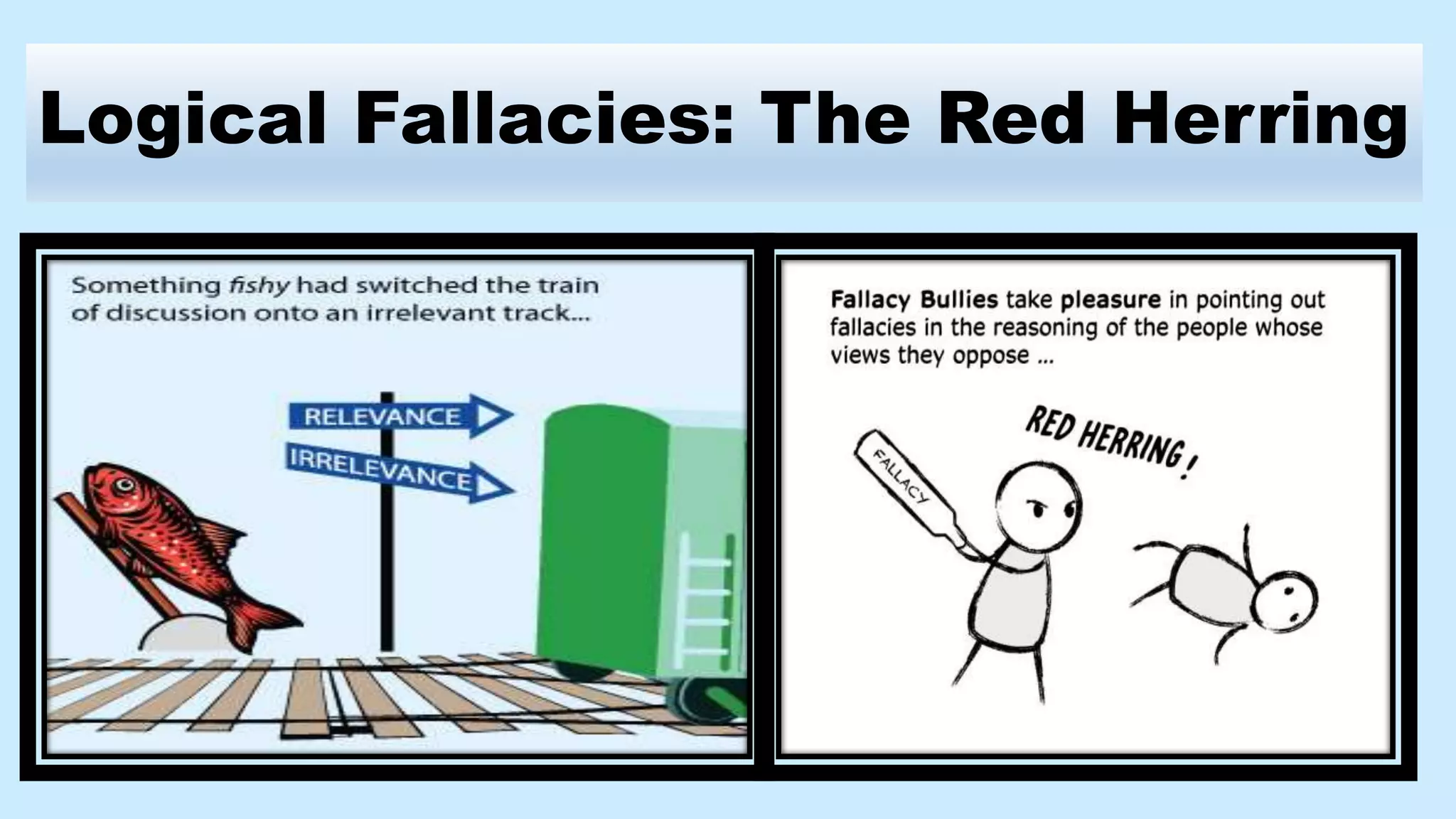
Logical Fallacies: The Red Herring
The Red Herring Fallacy
A Common Core Lesson
By
Dean Berry, Ed. D.
Gregg Berry, B. A.
Common Core Curriculum Solutions
www.commoncorecurriculum.info
Common Core Reading Standards
Delineate and evaluate the argument and
specific claims in a text, assessing whether
the reasoning is sound and the evidence is
relevant and sufficient; recognize when
irrelevant evidence is introduced.
Common Core Speaking
and Listening Standards
Engage effectively in a range of
collaborative discussions (one-on-
one, in groups, and teacher-led) with
diverse partners on topics, texts,
and issues, building on others’ ideas
and expressing their own clearly.
Common Core Speaking
and Listening Standards
Delineate a speaker’s argument
and specific claims, evaluating
the soundness of the reasoning
and relevance and sufficiency of
the evidence and identifying when
irrelevant evidence is introduced.
Reading with Your Eyes and Your Brain
Skillful readers learn how to read persuasive or
opinionated text with a very critical eye. They
realize that the author’s purpose is to convince the
reader to believe what the author is saying and to
consider the arguments given as valid even if they
violate logical reasoning and lack supporting
evidence. The author’s motive may be to get the
reader to buy something, vote a certain way,
change an attitude, or behave differently.
• In order to avoid manipulation by the author,
good readers learn how to detect poor
reasoning and faulty arguments. They are
able to identify the various logical fallacies
such as begging the question, strawman,
overgeneralization, slippery slope, and
others. During this lesson, we will study
logical fallacies.
Is this a good argument?
Why? Why Not?
Solving problems with logical thinking is
essential if we are interested in seeking
truth.
Let’s examine a technique that is often
used to mislead audiences.
The Red Herring Fallacy
• Definition: Partway through an argument, the arguer goes off on a
tangent, raising a side issue that distracts the audience from what’s
really at stake. Often, the arguer never returns to the original issue.
• Example: “Grading this exam on a curve would be the most fair thing
to do. After all, classes go more smoothly when the students and the
professor are getting along well.” Let’s see what’s wrong with this
argument:
• Premise: Classes go more smoothly when the students and the
professor are getting along well.
• Conclusion: Grading this exam on a curve would be the most fair thing
to do.
• When we lay it out this way, it’s pretty obvious that the
arguer went off on a tangent—the fact that something
helps people get along doesn’t necessarily make it more
fair; fairness and justice sometimes require us to do
things that cause conflict. But the audience may feel like
the issue of teachers and students agreeing is important
and be distracted from the fact that the arguer has not
given any evidence as to why a curve would be fair.
Arguing Off the Topic to
Distract Your Opponent
When the author lacks evidence to support his/her claim,
the red herring strategy is useful if the author wants to use
logical fallacies to persuade an unsuspecting reader.
Red Herring fallacies are used to
change the focus of the argument to
something unrelated to the claim.
Is this a red herring fallacy?
Why or Why Not?
Trans fats should be made illegal since many
research studies have shown that they can
increase dangerous plaque in the arteries
and lead to fatal heart attacks.
Go to Next Frame
Pair Share
Turn to your neighbor and discuss
your answer to this question.
Is this an example of the red herring fallacy?
Trans fats should be made illegal since many
research studies have shown that they can
increase dangerous plaque in the arteries and
lead to fatal heart attacks.
Is this a red herring logical fallacy?
A teacher catches a student cheating
during a test. The student in response says,
“I know I’ve made a mistake. But think of
my parents. They’re going to kill me”.
Go to Next Frame
Pair Share
Turn to your neighbor and discuss
your answer to this question.
Is this an example of the red herring fallacy?
A teacher catches a student cheating during a
test. The student in response says, “I know I’ve
made a mistake. But think of my parents. They’re
going to kill me”.
Is this a red herring logical fallacy?
The problem of undocumented
aliens in the country is complicated
and needs to be solved. In
particular, the Dream Act should be
continued because it keeps families
together.
Go to Next Frame
Pair Share
Turn to your neighbor and discuss
your answer to this question.
Is this an example of the red herring fallacy?
The problem of undocumented aliens in the
country is complicated and needs to be solved.
In particular, the Dream Act should be continued
because it keeps families together.
Is this an example of
the red herring fallacy?
• In business, arguing against giving raises -
“Sure, we haven’t given raises in over five
years to our employees. You know, we work
really hard to make a good product. We try
to ensure the best customer service, too.”
Go to Next Frame
Pair Share
Turn to your neighbor and discuss
your answer to this question.
Is this an example of the red herring fallacy?
In business, arguing against giving raises - “Sure,
we haven’t given raises in over five years to our
employees. You know, we work really hard to
make a good product. We try to ensure the best
customer service, too.”
Is this an example of the red herring fallacy?
Why? Why Not?
•“I am pretty sure that
evolution is not a very good
explanation for human life.
Anyway, I am pretty offended
that anyone would suggest
that I came from a monkey.”
Is this an example of a red herring fallacy?
Why? Why Not?
Arguing for raising taxes - “We
need more revenue to support
the programs that we have.
Children are our future. Don’t
turn your back on our children.
Quick Write
Think about one of the issues listed below and write an argument that
uses the red herring fallacy to confuse the reader by focusing on
an idea that is not related to your original proposal. You need to change
the focus of the argument rather than provide support or evidence.
• Increasing the state speed limit from 70 to 80mph
• Allowing gay couples to adopt children
• Allowing college students to carry guns on campus
• Making public school attendance voluntary
Additional Common Core
Standards Covered
Reading Standards
Cite the textual evidence that
most strongly supports an
analysis of what the text says
explicitly as well as inferences
drawn from the text.
Writing Standards
Use words, phrases, and
clauses to create cohesion and
clarify the relationships among
claim(s), counterclaims,
reasons, and evidence.
29
Copyright Protected © 2015 Dean R. Berry
All Rights Reserved
No part of this document may be reproduced without written
permission from the author

Propaganda techniques: Red herring lesson by Dean Berry

  • 1.
  • 2.
    The Red HerringFallacy A Common Core Lesson By Dean Berry, Ed. D. Gregg Berry, B. A. Common Core Curriculum Solutions www.commoncorecurriculum.info
  • 3.
    Common Core ReadingStandards Delineate and evaluate the argument and specific claims in a text, assessing whether the reasoning is sound and the evidence is relevant and sufficient; recognize when irrelevant evidence is introduced.
  • 4.
    Common Core Speaking andListening Standards Engage effectively in a range of collaborative discussions (one-on- one, in groups, and teacher-led) with diverse partners on topics, texts, and issues, building on others’ ideas and expressing their own clearly.
  • 5.
    Common Core Speaking andListening Standards Delineate a speaker’s argument and specific claims, evaluating the soundness of the reasoning and relevance and sufficiency of the evidence and identifying when irrelevant evidence is introduced.
  • 6.
    Reading with YourEyes and Your Brain Skillful readers learn how to read persuasive or opinionated text with a very critical eye. They realize that the author’s purpose is to convince the reader to believe what the author is saying and to consider the arguments given as valid even if they violate logical reasoning and lack supporting evidence. The author’s motive may be to get the reader to buy something, vote a certain way, change an attitude, or behave differently.
  • 7.
    • In orderto avoid manipulation by the author, good readers learn how to detect poor reasoning and faulty arguments. They are able to identify the various logical fallacies such as begging the question, strawman, overgeneralization, slippery slope, and others. During this lesson, we will study logical fallacies.
  • 8.
    Is this agood argument? Why? Why Not?
  • 9.
    Solving problems withlogical thinking is essential if we are interested in seeking truth. Let’s examine a technique that is often used to mislead audiences.
  • 10.
    The Red HerringFallacy • Definition: Partway through an argument, the arguer goes off on a tangent, raising a side issue that distracts the audience from what’s really at stake. Often, the arguer never returns to the original issue. • Example: “Grading this exam on a curve would be the most fair thing to do. After all, classes go more smoothly when the students and the professor are getting along well.” Let’s see what’s wrong with this argument: • Premise: Classes go more smoothly when the students and the professor are getting along well. • Conclusion: Grading this exam on a curve would be the most fair thing to do.
  • 11.
    • When welay it out this way, it’s pretty obvious that the arguer went off on a tangent—the fact that something helps people get along doesn’t necessarily make it more fair; fairness and justice sometimes require us to do things that cause conflict. But the audience may feel like the issue of teachers and students agreeing is important and be distracted from the fact that the arguer has not given any evidence as to why a curve would be fair.
  • 12.
    Arguing Off theTopic to Distract Your Opponent
  • 13.
    When the authorlacks evidence to support his/her claim, the red herring strategy is useful if the author wants to use logical fallacies to persuade an unsuspecting reader.
  • 14.
    Red Herring fallaciesare used to change the focus of the argument to something unrelated to the claim.
  • 15.
    Is this ared herring fallacy? Why or Why Not? Trans fats should be made illegal since many research studies have shown that they can increase dangerous plaque in the arteries and lead to fatal heart attacks. Go to Next Frame
  • 16.
    Pair Share Turn toyour neighbor and discuss your answer to this question. Is this an example of the red herring fallacy? Trans fats should be made illegal since many research studies have shown that they can increase dangerous plaque in the arteries and lead to fatal heart attacks.
  • 17.
    Is this ared herring logical fallacy? A teacher catches a student cheating during a test. The student in response says, “I know I’ve made a mistake. But think of my parents. They’re going to kill me”. Go to Next Frame
  • 18.
    Pair Share Turn toyour neighbor and discuss your answer to this question. Is this an example of the red herring fallacy? A teacher catches a student cheating during a test. The student in response says, “I know I’ve made a mistake. But think of my parents. They’re going to kill me”.
  • 19.
    Is this ared herring logical fallacy? The problem of undocumented aliens in the country is complicated and needs to be solved. In particular, the Dream Act should be continued because it keeps families together. Go to Next Frame
  • 20.
    Pair Share Turn toyour neighbor and discuss your answer to this question. Is this an example of the red herring fallacy? The problem of undocumented aliens in the country is complicated and needs to be solved. In particular, the Dream Act should be continued because it keeps families together.
  • 21.
    Is this anexample of the red herring fallacy? • In business, arguing against giving raises - “Sure, we haven’t given raises in over five years to our employees. You know, we work really hard to make a good product. We try to ensure the best customer service, too.” Go to Next Frame
  • 22.
    Pair Share Turn toyour neighbor and discuss your answer to this question. Is this an example of the red herring fallacy? In business, arguing against giving raises - “Sure, we haven’t given raises in over five years to our employees. You know, we work really hard to make a good product. We try to ensure the best customer service, too.”
  • 23.
    Is this anexample of the red herring fallacy? Why? Why Not? •“I am pretty sure that evolution is not a very good explanation for human life. Anyway, I am pretty offended that anyone would suggest that I came from a monkey.”
  • 24.
    Is this anexample of a red herring fallacy? Why? Why Not? Arguing for raising taxes - “We need more revenue to support the programs that we have. Children are our future. Don’t turn your back on our children.
  • 25.
    Quick Write Think aboutone of the issues listed below and write an argument that uses the red herring fallacy to confuse the reader by focusing on an idea that is not related to your original proposal. You need to change the focus of the argument rather than provide support or evidence. • Increasing the state speed limit from 70 to 80mph • Allowing gay couples to adopt children • Allowing college students to carry guns on campus • Making public school attendance voluntary
  • 26.
  • 27.
    Reading Standards Cite thetextual evidence that most strongly supports an analysis of what the text says explicitly as well as inferences drawn from the text.
  • 28.
    Writing Standards Use words,phrases, and clauses to create cohesion and clarify the relationships among claim(s), counterclaims, reasons, and evidence.
  • 29.
    29 Copyright Protected ©2015 Dean R. Berry All Rights Reserved No part of this document may be reproduced without written permission from the author