“ The great masses of the people will more easily fall victims to a big lie than to a small one.” – Adolf Hitler
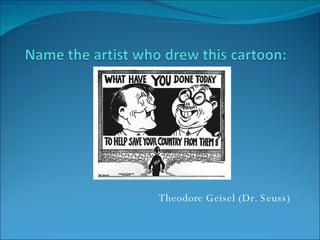
Theodore Geisel (Dr. Seuss)
Definition of propaganda:  ‘ the organized spreading of doctrine, true or false information, opinions etc., especially to bring about change or reform.’
Propaganda during World War I Used most effectively by the British against German atrocities Examples: http://www.firstworldwar.com/posters/uk.htm
Propaganda during World War I Copied by other Allies: Britain USA
Propaganda during World War I American Propaganda http://library.georgetown.edu/dept/speccoll/amposter.htm
Question  Why did millions of Germans vote from the Nazi Party in free elections and how did the party eventually acquire an extensive European empire?  Relentless propaganda campaigns issued by the Nazis changed the democratic state into a totalitarian regime.
Nazi Use of Propaganda Nazis used fear to create a Jewish scapegoat, as the cause for Germany’s troubles.  Examples:  bad economy loss of jobs stereotypes of Jews
Nazi Use of Propaganda “ By the skillful and sustained use of propaganda, one can make a people see even heaven as hell or an extremely wretched life as paradise.” – Adolf Hitler
Nazi Use of Propaganda Josef Goebbels – failed playwright –becomes German Minister for Propaganda under Nazi Rule
Nazi Use of Propaganda Hitler and Goebbels believed that propaganda could be used to not only pacify the masses, but make them into active supporters.  Germans were to not only accept Nazi policies, but also truly believe them and act on the ideology and beliefs.
Nazi Use of Propaganda Nazi used propaganda for two main purposes.  Use for the task of restructuring German values.  Nazis wanted to make Germans believe in the ‘solidarity of the national community’ and the need for racial purity.  In the years immediately before the war propaganda was used to build a new “Nazified society.”  This included both psychological preparation and mobilization for war.
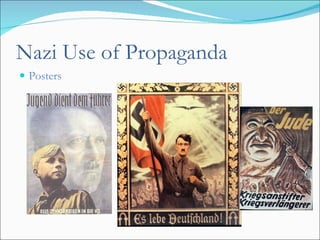
Nazi Use of Propaganda Posters
Nazi Use of Propaganda Films
Leni Riefenstahl Born 1902 Actress during 1920’s Begins to direct films in 1930’s Personally chosen by Hitler to Direct film about 1934 Nazi Party Rally at Nuremburg Later directs film (non-propaganda) about 1936 Berlin Olympics,  OLYMPIA Survives World War II, but is shunned after the war Dies at age 101 in 2003
Triumph Of The Will Made to show a microcosm of 1934 Germany Does not document so much of what Germany was, but “of the Germany Hitler willed it to become.”  . Film was a means of introducing Hitler and the Third Reich to Germans.  The film played to sold out movie theaters across Germany. Also served as a warning to foreign (especially European) countries that “Germany had awakened and they could not be pushed around any more.” covers aspects of Germany’s social rebirth under the Nazi party includes riveting speeches by Adolf Hitler and his party associates as to where the German nation is headed.  Without a commentator, the speeches and crowd reaction are the only vocal element of the film.  To aid continuity and to embellish the visual rhythm a heavy musical score was added and underscore by interaction from the crowd.
Propaganda by other powers “ Prelude to War” – 1943 – Prepared for new US soldiers, it describes the reasons for entering World War II, from a US perspective

Propaganda

  • 1.
    “ The greatmasses of the people will more easily fall victims to a big lie than to a small one.” – Adolf Hitler
  • 2.
  • 3.
    Definition of propaganda: ‘ the organized spreading of doctrine, true or false information, opinions etc., especially to bring about change or reform.’
  • 4.
    Propaganda during WorldWar I Used most effectively by the British against German atrocities Examples: http://www.firstworldwar.com/posters/uk.htm
  • 5.
    Propaganda during WorldWar I Copied by other Allies: Britain USA
  • 6.
    Propaganda during WorldWar I American Propaganda http://library.georgetown.edu/dept/speccoll/amposter.htm
  • 7.
    Question Whydid millions of Germans vote from the Nazi Party in free elections and how did the party eventually acquire an extensive European empire? Relentless propaganda campaigns issued by the Nazis changed the democratic state into a totalitarian regime.
  • 8.
    Nazi Use ofPropaganda Nazis used fear to create a Jewish scapegoat, as the cause for Germany’s troubles. Examples: bad economy loss of jobs stereotypes of Jews
  • 9.
    Nazi Use ofPropaganda “ By the skillful and sustained use of propaganda, one can make a people see even heaven as hell or an extremely wretched life as paradise.” – Adolf Hitler
  • 10.
    Nazi Use ofPropaganda Josef Goebbels – failed playwright –becomes German Minister for Propaganda under Nazi Rule
  • 11.
    Nazi Use ofPropaganda Hitler and Goebbels believed that propaganda could be used to not only pacify the masses, but make them into active supporters. Germans were to not only accept Nazi policies, but also truly believe them and act on the ideology and beliefs.
  • 12.
    Nazi Use ofPropaganda Nazi used propaganda for two main purposes. Use for the task of restructuring German values. Nazis wanted to make Germans believe in the ‘solidarity of the national community’ and the need for racial purity. In the years immediately before the war propaganda was used to build a new “Nazified society.” This included both psychological preparation and mobilization for war.
  • 13.
    Nazi Use ofPropaganda Posters
  • 14.
    Nazi Use ofPropaganda Films
  • 15.
    Leni Riefenstahl Born1902 Actress during 1920’s Begins to direct films in 1930’s Personally chosen by Hitler to Direct film about 1934 Nazi Party Rally at Nuremburg Later directs film (non-propaganda) about 1936 Berlin Olympics, OLYMPIA Survives World War II, but is shunned after the war Dies at age 101 in 2003
  • 16.
    Triumph Of TheWill Made to show a microcosm of 1934 Germany Does not document so much of what Germany was, but “of the Germany Hitler willed it to become.” . Film was a means of introducing Hitler and the Third Reich to Germans. The film played to sold out movie theaters across Germany. Also served as a warning to foreign (especially European) countries that “Germany had awakened and they could not be pushed around any more.” covers aspects of Germany’s social rebirth under the Nazi party includes riveting speeches by Adolf Hitler and his party associates as to where the German nation is headed. Without a commentator, the speeches and crowd reaction are the only vocal element of the film. To aid continuity and to embellish the visual rhythm a heavy musical score was added and underscore by interaction from the crowd.
  • 17.
    Propaganda by otherpowers “ Prelude to War” – 1943 – Prepared for new US soldiers, it describes the reasons for entering World War II, from a US perspective