K.L.E.SOCIETY’S, COLLEGE OF EDUCATION
VIDYANAGAR, HUBBALLI-31
POSS MATHEMATICS
TOPIC: PROOF-MEANING,NATURE,TYPES
submitted to submitted by
Shri.VEERESH.A.KALAKERI Mr.R.PRAKASH BABU
LECTURER B.Ed., 1st Semester
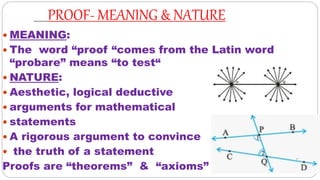
PROOF- MEANING & NATURE
 MEANING:
 The word “proof “comes from the Latin word
“probare” means “to test“
 NATURE:
 Aesthetic, logical deductive
 arguments for mathematical
 statements
 A rigorous argument to convince
 the truth of a statement
Proofs are “theorems” & “axioms”
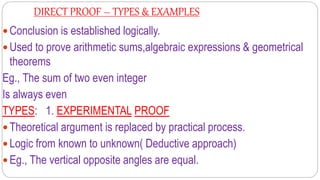
DIRECT PROOF – TYPES & EXAMPLES
 Conclusion is established logically.
 Used to prove arithmetic sums,algebraic expressions & geometrical
theorems
Eg., The sum of two even integer
Is always even
TYPES: 1. EXPERIMENTAL PROOF
 Theoretical argument is replaced by practical process.
 Logic from known to unknown( Deductive approach)
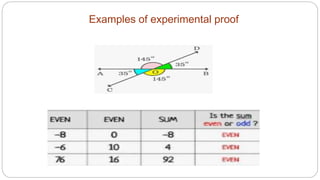
 Eg., The vertical opposite angles are equal.
Examples of experimental proof
2.LOGICAL PROOF
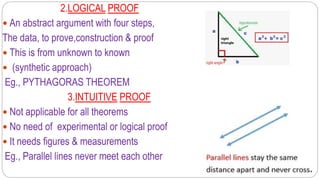
 An abstract argument with four steps,
The data, to prove,construction & proof
 This is from unknown to known
 (synthetic approach)
Eg., PYTHAGORAS THEOREM
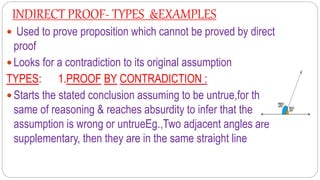
3.INTUITIVE PROOF
 Not applicable for all theorems
 No need of experimental or logical proof
 It needs figures & measurements
Eg., Parallel lines never meet each other
INDIRECT PROOF- TYPES &EXAMPLES
 Used to prove proposition which cannot be proved by direct
proof
 Looks for a contradiction to its original assumption
TYPES: 1.PROOF BY CONTRADICTION :
 Starts the stated conclusion assuming to be untrue,for the
same of reasoning & reaches absurdity to infer that the
assumption is wrong or untrueEg.,Two adjacent angles are
supplementary, then they are in the same straight line
2. PROOF BY EXHAUSTION
 Conclusion is established by dividing into many number of cases proving each
separately
 Possibility of exhaustion shown by contrary
 One possible left is accepted.
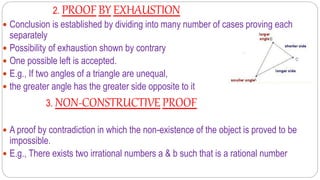
 E.g., If two angles of a triangle are unequal,
 the greater angle has the greater side opposite to it
3. NON-CONSTRUCTIVEPROOF
 A proof by contradiction in which the non-existence of the object is proved to be
impossible.
 E.g., There exists two irrational numbers a & b such that is a rational number
Proof meaning nature & its types

Proof meaning nature & its types

  • 1.
    K.L.E.SOCIETY’S, COLLEGE OFEDUCATION VIDYANAGAR, HUBBALLI-31 POSS MATHEMATICS TOPIC: PROOF-MEANING,NATURE,TYPES submitted to submitted by Shri.VEERESH.A.KALAKERI Mr.R.PRAKASH BABU LECTURER B.Ed., 1st Semester
  • 2.
    PROOF- MEANING &NATURE  MEANING:  The word “proof “comes from the Latin word “probare” means “to test“  NATURE:  Aesthetic, logical deductive  arguments for mathematical  statements  A rigorous argument to convince  the truth of a statement Proofs are “theorems” & “axioms”
  • 3.
    DIRECT PROOF –TYPES & EXAMPLES  Conclusion is established logically.  Used to prove arithmetic sums,algebraic expressions & geometrical theorems Eg., The sum of two even integer Is always even TYPES: 1. EXPERIMENTAL PROOF  Theoretical argument is replaced by practical process.  Logic from known to unknown( Deductive approach)  Eg., The vertical opposite angles are equal.
  • 4.
  • 5.
    2.LOGICAL PROOF  Anabstract argument with four steps, The data, to prove,construction & proof  This is from unknown to known  (synthetic approach) Eg., PYTHAGORAS THEOREM 3.INTUITIVE PROOF  Not applicable for all theorems  No need of experimental or logical proof  It needs figures & measurements Eg., Parallel lines never meet each other
  • 6.
    INDIRECT PROOF- TYPES&EXAMPLES  Used to prove proposition which cannot be proved by direct proof  Looks for a contradiction to its original assumption TYPES: 1.PROOF BY CONTRADICTION :  Starts the stated conclusion assuming to be untrue,for the same of reasoning & reaches absurdity to infer that the assumption is wrong or untrueEg.,Two adjacent angles are supplementary, then they are in the same straight line
  • 7.
    2. PROOF BYEXHAUSTION  Conclusion is established by dividing into many number of cases proving each separately  Possibility of exhaustion shown by contrary  One possible left is accepted.  E.g., If two angles of a triangle are unequal,  the greater angle has the greater side opposite to it 3. NON-CONSTRUCTIVEPROOF  A proof by contradiction in which the non-existence of the object is proved to be impossible.  E.g., There exists two irrational numbers a & b such that is a rational number