SPECIAL CARE CENTER

A SERVICE OF
AtlantiCare: Special Care Center
•   Faced with escalating care costs, especially for
    employees with chronic conditions, AtlantiCare
    and the Welfare Fund adopted the AIC-U model
    (Special Care Center) and opened the center July
    2007 (based on the original white paper)

•   Although the Special Care Center originally served
    only participants of the Local 54 Fund and
    AtlantiCare employees, it has subsequently been
    opened up to other patient populations
Time to Innovate
•   Care was fragmented
•   Chronic conditions were not managed
•   Payers needed to be partners
•   Healthcare needed to be done differently
Source: Sg2
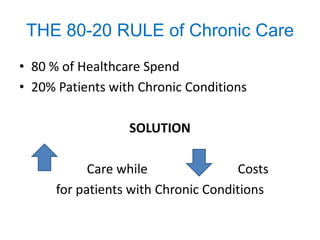
THE 80-20 RULE of Chronic Care
• 80 % of Healthcare Spend
• 20% Patients with Chronic Conditions

                  SOLUTION

            Care while               Costs
      for patients with Chronic Conditions
Innovative Healthcare for Chronic Conditions


• Partnered on solutions
• National innovations/best practices
• Piloted the “SCC” - a patient-centered medical
  home for individuals with chronic conditions
• Invitation Only Enrollment (screening form)
• Opened the doors in the summer of 2007
• Enrolled 2,600 patients to date
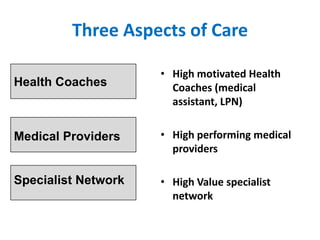
Three Aspects of Care

                     • High motivated Health
Health Coaches         Coaches (medical
                       assistant, LPN)


Medical Providers    • High performing medical
                       providers

Specialist Network   • High Value specialist
                       network
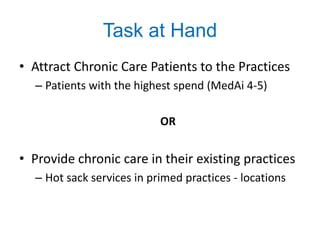
Task at Hand
• Attract Chronic Care Patients to the Practices
  – Patients with the highest spend (MedAi 4-5)

                           OR


• Provide chronic care in their existing practices
  – Hot sack services in primed practices - locations
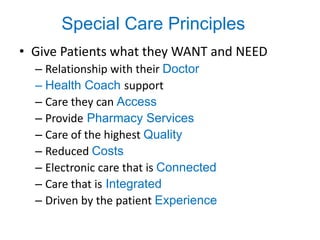
Special Care Principles
• Give Patients what they WANT and NEED
  – Relationship with their Doctor
  – Health Coach support
  – Care they can Access
  – Provide Pharmacy Services
  – Care of the highest Quality
  – Reduced Costs
  – Electronic care that is Connected
  – Care that is Integrated
  – Driven by the patient Experience
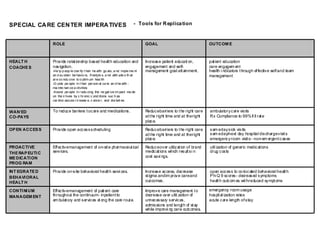
SPECIAL CA RE CEN TER IMPERA TIVES                                            - Tools for R eplica tion


                 ROLE                                                               GOAL                                  OUTCOM E


HEALT H          Provide relat ionship based healt h education and                  Increase patient educati on,          pat ient education
COACHE S         navigation.                                                        engagement and self-                  care engagem ent
                 -He lp p eop le clar ify t heir he alth go als, a nd imple me nt   management goal att ainment .         health i ndicators t hrough ef fective self and team
                 an d su stain be havio rs, li estyle s, a nd attit ude s th at
                                                f                                                                         management
                 ar e co ndu cive to o ptim um hea lth
                 -G uide pe ople in t heir per son al ca re an d he alth -
                 ma inte nan ce a ctivities
                 -Assist pe ople in r edu cing the ne gat ive im pact ma de
                 on the ir lives by c hr onic c ond itions suc h as
                 car diov ascula r d iseas e, c ance r, and dia bet es.


WAIV ED          To reduce barriers t o care and medications.                       Reduce barriers to t he right care    ambulatory care visits
CO-PAYS                                                                             at t he right time and at the right   Rx Compliance to 99% fi ll rat e
                                                                                    place.

OP EN ACCES S    Provide open access scheduling                                     Reduce barriers to t he right care    sam e day sick visits
                                                                                    at t he right time and at the right   sam e day/next day hospital discharge visit s
                                                                                    place.                                emergency room visit s - non-em ergent cases
PROACTI VE       Eff ective management of on-sit e pharmaceut ical                  Reduce over utilizat ion of brand     util ization of generic medicat ions
THE RAP EUTI C   services.                                                          medicat ions which result s i n       drug costs
ME DICATI ON                                                                        cost savi ngs.
PROG RAM

INT EGRATE D     Provide on-site behavioral healt h servi ces.                      Increase access, decrease             open access to co-located behavioral healt h
BEHAVI ORAL                                                                         st igma and im prove care and         P h-Q 9 scores - decreased symptoms
HEALT H                                                                             out comes.                            healt h outcom es wit h reduced sympt oms

CONTI NI UM      Eff ective management of pati ent care                             Improve care management t o           emergency room usage
MANAGEM ENT      throughout the continuum- inpatient to                             decrease over utili zation of         hospit al ization rates
                 am bulat ory and services al ong the care rout e.                  unnecessary services,                 acute care length of stay
                                                                                    admissions and lengt h of st ay
                                                                                    while improvi ng care outcomes.
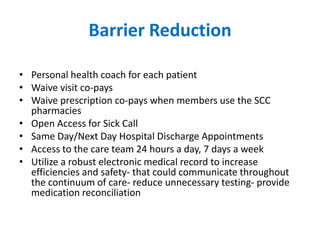
Barrier Reduction

• Personal health coach for each patient
• Waive visit co-pays
• Waive prescription co-pays when members use the SCC
  pharmacies
• Open Access for Sick Call
• Same Day/Next Day Hospital Discharge Appointments
• Access to the care team 24 hours a day, 7 days a week
• Utilize a robust electronic medical record to increase
  efficiencies and safety- that could communicate throughout
  the continuum of care- reduce unnecessary testing- provide
  medication reconciliation
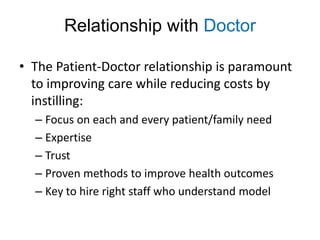
Relationship with Doctor

• The Patient-Doctor relationship is paramount
  to improving care while reducing costs by
  instilling:
  – Focus on each and every patient/family need
  – Expertise
  – Trust
  – Proven methods to improve health outcomes
  – Key to hire right staff who understand model
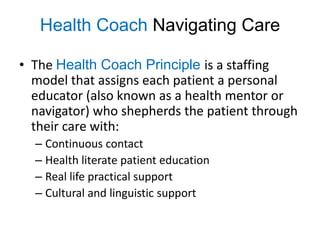
Health Coach Navigating Care

• The Health Coach Principle is a staffing
  model that assigns each patient a personal
  educator (also known as a health mentor or
  navigator) who shepherds the patient through
  their care with:
  – Continuous contact
  – Health literate patient education
  – Real life practical support
  – Cultural and linguistic support
Access to Care

• Easy to access
  – Same day sick visits
  – Same day/next day hospital discharge visits
  – 24/7 access to a doctor
• Affordable to access
  – No or reduced copay to visits if able in plan design
  – No or reduced copay for medications
• One-stop access
  – Onsite pharmacy services
  – Mail order pharmacy
Highest Quality Care

• Care models
• Procedures
• Hospital stays
Pharmacy Services
•   Built a Pharmacy on-site
•   Hospital based institutional pharmacy
•   Daily communication with team
•   Mechanisms to ensure patient pick up
•   Monitor compliance
Reduced Costs Care
• Focus on supporting patient health which
  results in maintaining community living
  without ED and hospital stays
• Effective care of chronic conditions CAN be
  done in an ambulatory setting if vision is to
  support each patient to manage their health
Reduced Costs Care

• Know the cost of everything-learn unknown
  costs
• Network of care that is cost responsible
• Reduce out of pocket cost for the patients
• Reduce cost to the partner
• Reduce overall PMPM- PMPY
Electronic Connected Care

• Electronic medical record
  – EMR follows patient through the continuum
• Patient registry
  – Optimizes patient and population management
• Accurate patient profile at each contact/portal
• Reduces duplication of testing/procedures
Integrated Care

• Team Approach
  – Use of “morning huddle” to review care plans
  – Each member ‘s input is integral to care
  – Each member is invested in the vision of care
• Behavioral Health Services
  – Mental health and substance abuse services
  – Social services to access community resources
  – Focus on reducing depression, anxiety and stress
Patient Experience Care

•   Desire to feel better
•   Want to feel special
•   Need to learn about their conditions
•   Support to effectively manage life circumstances
•   Adopted CG-CAHPS surveying
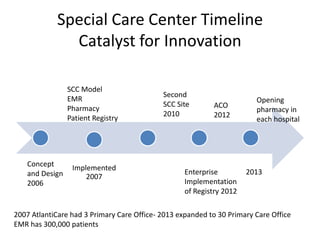
Special Care Center Timeline
              Catalyst for Innovation

                SCC Model
                                            Second
                EMR                                                     Opening
                                            SCC Site       ACO
                Pharmacy                                                pharmacy in
                                            2010           2012
                Patient Registry                                        each hospital


   Concept       Implemented
   and Design                                      Enterprise         2013
                     2007
   2006                                            Implementation
                                                   of Registry 2012

2007 AtlantiCare had 3 Primary Care Office- 2013 expanded to 30 Primary Care Office
EMR has 300,000 patients
DATA COLLECTION
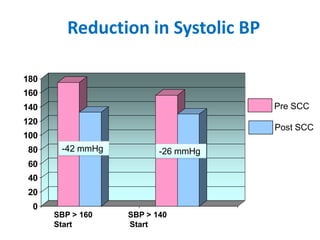
Reduction in Systolic BP

180
160
140                                 Pre SCC
120
                                    Post SCC
100
80     -42 mmHg          -26 mmHg
60
40
20
 0
      SBP > 160   SBP > 140
      Start       Start
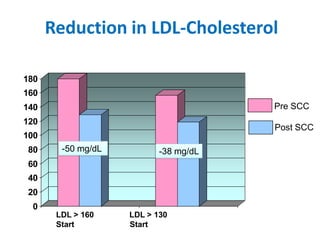
Reduction in LDL-Cholesterol

180
160
140                                    Pre SCC
120
                                       Post SCC
100
80      -50 mg/dL          -38 mg/dL
60
40
20
 0
       LDL > 160    LDL > 130
       Start        Start
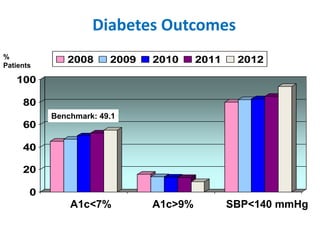
Diabetes Outcomes
%
Patients
              2008      2009   2010     2011    2012

   100

     80
           Benchmark: 49.1
     60

     40

     20

       0
               A1c<7%          A1c>9%          SBP<140 mmHg
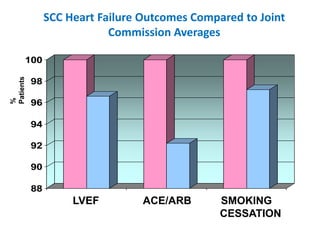
SCC Heart Failure Outcomes Compared to Joint
                            Commission Averages

       100
Patients


           98
%


           96

           94

           92

           90

           88
                     LVEF         ACE/ARB       SMOKING
                                                CESSATION
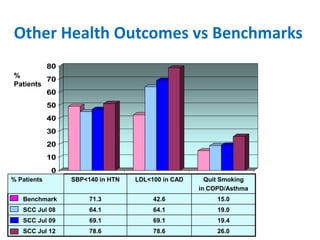
Other Health Outcomes vs Benchmarks
             80
%
         70
Patients
         60
             50
             40
             30
             20
             10
             0
% Patients        SBP<140 in HTN   LDL<100 in CAD     Quit Smoking
                                                    in COPD/Asthma
   Benchmark           71.3             42.6             15.0
   SCC Jul 08          64.1             64.1             19.0
   SCC Jul 09          69.1             69.1             19.4
   SCC Jul 12          78.6             78.6             26.0
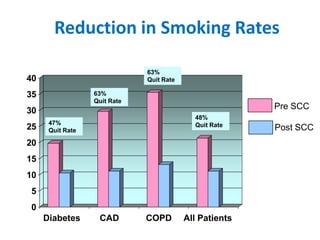
Reduction in Smoking Rates

                              63%
40                            Quit Rate

35                63%
                  Quit Rate
30                                                       Pre SCC
                                            48%
      47%                                   Quit Rate
25    Quit Rate                                          Post SCC
20
15
10
5
0
     Diabetes      CAD        COPD        All Patients
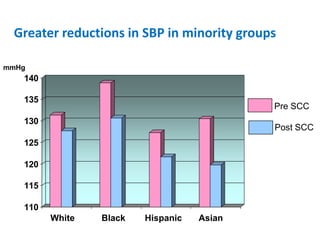
Greater reductions in SBP in minority groups

mmHg
   140

   135
                                            Pre SCC
   130
                                            Post SCC
   125

   120

   115

   110
         White   Black   Hispanic   Asian
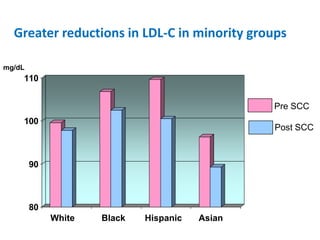
Greater reductions in LDL-C in minority groups

mg/dL
    110


                                                Pre SCC
    100
                                                Post SCC


        90


        80
             White   Black   Hispanic   Asian
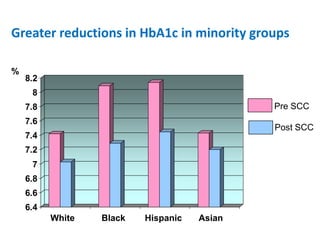
Greater reductions in HbA1c in minority groups

%
    8.2
     8
    7.8                                      Pre SCC
    7.6
                                             Post SCC
    7.4
    7.2
     7
    6.8
    6.6
    6.4
          White   Black   Hispanic   Asian
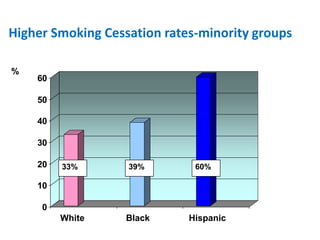
Higher Smoking Cessation rates-minority groups

%
    60

    50

    40

    30

    20   33%       39%        60%

    10

     0
         White     Black     Hispanic
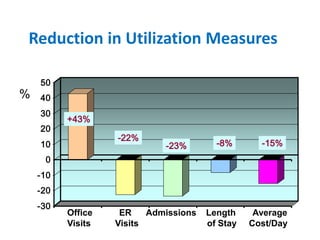
Reduction in Utilization Measures

    50
%   40
    30
          +43%
    20
                   -22%
    10                       -23%        -8%       -15%
     0
    -10
    -20
    -30
          Office    ER    Admissions   Length     Average
          Visits   Visits              of Stay   Cost/Day
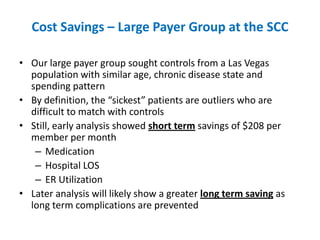
Cost Savings – Large Payer Group at the SCC

• Our large payer group sought controls from a Las Vegas
  population with similar age, chronic disease state and
  spending pattern
• By definition, the “sickest” patients are outliers who are
  difficult to match with controls
• Still, early analysis showed short term savings of $208 per
  member per month
   – Medication
   – Hospital LOS
   – ER Utilization
• Later analysis will likely show a greater long term saving as
  long term complications are prevented

AtlantiCare - Special Care Center

  • 1.
  • 2.
    AtlantiCare: Special CareCenter • Faced with escalating care costs, especially for employees with chronic conditions, AtlantiCare and the Welfare Fund adopted the AIC-U model (Special Care Center) and opened the center July 2007 (based on the original white paper) • Although the Special Care Center originally served only participants of the Local 54 Fund and AtlantiCare employees, it has subsequently been opened up to other patient populations
  • 3.
    Time to Innovate • Care was fragmented • Chronic conditions were not managed • Payers needed to be partners • Healthcare needed to be done differently
  • 4.
  • 5.
    THE 80-20 RULEof Chronic Care • 80 % of Healthcare Spend • 20% Patients with Chronic Conditions SOLUTION Care while Costs for patients with Chronic Conditions
  • 6.
    Innovative Healthcare forChronic Conditions • Partnered on solutions • National innovations/best practices • Piloted the “SCC” - a patient-centered medical home for individuals with chronic conditions • Invitation Only Enrollment (screening form) • Opened the doors in the summer of 2007 • Enrolled 2,600 patients to date
  • 7.
    Three Aspects ofCare • High motivated Health Health Coaches Coaches (medical assistant, LPN) Medical Providers • High performing medical providers Specialist Network • High Value specialist network
  • 8.
    Task at Hand •Attract Chronic Care Patients to the Practices – Patients with the highest spend (MedAi 4-5) OR • Provide chronic care in their existing practices – Hot sack services in primed practices - locations
  • 9.
    Special Care Principles •Give Patients what they WANT and NEED – Relationship with their Doctor – Health Coach support – Care they can Access – Provide Pharmacy Services – Care of the highest Quality – Reduced Costs – Electronic care that is Connected – Care that is Integrated – Driven by the patient Experience
  • 10.
    SPECIAL CA RECEN TER IMPERA TIVES - Tools for R eplica tion ROLE GOAL OUTCOM E HEALT H Provide relat ionship based healt h education and Increase patient educati on, pat ient education COACHE S navigation. engagement and self- care engagem ent -He lp p eop le clar ify t heir he alth go als, a nd imple me nt management goal att ainment . health i ndicators t hrough ef fective self and team an d su stain be havio rs, li estyle s, a nd attit ude s th at f management ar e co ndu cive to o ptim um hea lth -G uide pe ople in t heir per son al ca re an d he alth - ma inte nan ce a ctivities -Assist pe ople in r edu cing the ne gat ive im pact ma de on the ir lives by c hr onic c ond itions suc h as car diov ascula r d iseas e, c ance r, and dia bet es. WAIV ED To reduce barriers t o care and medications. Reduce barriers to t he right care ambulatory care visits CO-PAYS at t he right time and at the right Rx Compliance to 99% fi ll rat e place. OP EN ACCES S Provide open access scheduling Reduce barriers to t he right care sam e day sick visits at t he right time and at the right sam e day/next day hospital discharge visit s place. emergency room visit s - non-em ergent cases PROACTI VE Eff ective management of on-sit e pharmaceut ical Reduce over utilizat ion of brand util ization of generic medicat ions THE RAP EUTI C services. medicat ions which result s i n drug costs ME DICATI ON cost savi ngs. PROG RAM INT EGRATE D Provide on-site behavioral healt h servi ces. Increase access, decrease open access to co-located behavioral healt h BEHAVI ORAL st igma and im prove care and P h-Q 9 scores - decreased symptoms HEALT H out comes. healt h outcom es wit h reduced sympt oms CONTI NI UM Eff ective management of pati ent care Improve care management t o emergency room usage MANAGEM ENT throughout the continuum- inpatient to decrease over utili zation of hospit al ization rates am bulat ory and services al ong the care rout e. unnecessary services, acute care length of stay admissions and lengt h of st ay while improvi ng care outcomes.
  • 11.
    Barrier Reduction • Personalhealth coach for each patient • Waive visit co-pays • Waive prescription co-pays when members use the SCC pharmacies • Open Access for Sick Call • Same Day/Next Day Hospital Discharge Appointments • Access to the care team 24 hours a day, 7 days a week • Utilize a robust electronic medical record to increase efficiencies and safety- that could communicate throughout the continuum of care- reduce unnecessary testing- provide medication reconciliation
  • 12.
    Relationship with Doctor •The Patient-Doctor relationship is paramount to improving care while reducing costs by instilling: – Focus on each and every patient/family need – Expertise – Trust – Proven methods to improve health outcomes – Key to hire right staff who understand model
  • 13.
    Health Coach NavigatingCare • The Health Coach Principle is a staffing model that assigns each patient a personal educator (also known as a health mentor or navigator) who shepherds the patient through their care with: – Continuous contact – Health literate patient education – Real life practical support – Cultural and linguistic support
  • 14.
    Access to Care •Easy to access – Same day sick visits – Same day/next day hospital discharge visits – 24/7 access to a doctor • Affordable to access – No or reduced copay to visits if able in plan design – No or reduced copay for medications • One-stop access – Onsite pharmacy services – Mail order pharmacy
  • 15.
    Highest Quality Care •Care models • Procedures • Hospital stays
  • 16.
    Pharmacy Services • Built a Pharmacy on-site • Hospital based institutional pharmacy • Daily communication with team • Mechanisms to ensure patient pick up • Monitor compliance
  • 17.
    Reduced Costs Care •Focus on supporting patient health which results in maintaining community living without ED and hospital stays • Effective care of chronic conditions CAN be done in an ambulatory setting if vision is to support each patient to manage their health
  • 18.
    Reduced Costs Care •Know the cost of everything-learn unknown costs • Network of care that is cost responsible • Reduce out of pocket cost for the patients • Reduce cost to the partner • Reduce overall PMPM- PMPY
  • 19.
    Electronic Connected Care •Electronic medical record – EMR follows patient through the continuum • Patient registry – Optimizes patient and population management • Accurate patient profile at each contact/portal • Reduces duplication of testing/procedures
  • 20.
    Integrated Care • TeamApproach – Use of “morning huddle” to review care plans – Each member ‘s input is integral to care – Each member is invested in the vision of care • Behavioral Health Services – Mental health and substance abuse services – Social services to access community resources – Focus on reducing depression, anxiety and stress
  • 21.
    Patient Experience Care • Desire to feel better • Want to feel special • Need to learn about their conditions • Support to effectively manage life circumstances • Adopted CG-CAHPS surveying
  • 22.
    Special Care CenterTimeline Catalyst for Innovation SCC Model Second EMR Opening SCC Site ACO Pharmacy pharmacy in 2010 2012 Patient Registry each hospital Concept Implemented and Design Enterprise 2013 2007 2006 Implementation of Registry 2012 2007 AtlantiCare had 3 Primary Care Office- 2013 expanded to 30 Primary Care Office EMR has 300,000 patients
  • 23.
  • 24.
    Reduction in SystolicBP 180 160 140 Pre SCC 120 Post SCC 100 80 -42 mmHg -26 mmHg 60 40 20 0 SBP > 160 SBP > 140 Start Start
  • 25.
    Reduction in LDL-Cholesterol 180 160 140 Pre SCC 120 Post SCC 100 80 -50 mg/dL -38 mg/dL 60 40 20 0 LDL > 160 LDL > 130 Start Start
  • 26.
    Diabetes Outcomes % Patients 2008 2009 2010 2011 2012 100 80 Benchmark: 49.1 60 40 20 0 A1c<7% A1c>9% SBP<140 mmHg
  • 27.
    SCC Heart FailureOutcomes Compared to Joint Commission Averages 100 Patients 98 % 96 94 92 90 88 LVEF ACE/ARB SMOKING CESSATION
  • 28.
    Other Health Outcomesvs Benchmarks 80 % 70 Patients 60 50 40 30 20 10 0 % Patients SBP<140 in HTN LDL<100 in CAD Quit Smoking in COPD/Asthma Benchmark 71.3 42.6 15.0 SCC Jul 08 64.1 64.1 19.0 SCC Jul 09 69.1 69.1 19.4 SCC Jul 12 78.6 78.6 26.0
  • 29.
    Reduction in SmokingRates 63% 40 Quit Rate 35 63% Quit Rate 30 Pre SCC 48% 47% Quit Rate 25 Quit Rate Post SCC 20 15 10 5 0 Diabetes CAD COPD All Patients
  • 30.
    Greater reductions inSBP in minority groups mmHg 140 135 Pre SCC 130 Post SCC 125 120 115 110 White Black Hispanic Asian
  • 31.
    Greater reductions inLDL-C in minority groups mg/dL 110 Pre SCC 100 Post SCC 90 80 White Black Hispanic Asian
  • 32.
    Greater reductions inHbA1c in minority groups % 8.2 8 7.8 Pre SCC 7.6 Post SCC 7.4 7.2 7 6.8 6.6 6.4 White Black Hispanic Asian
  • 33.
    Higher Smoking Cessationrates-minority groups % 60 50 40 30 20 33% 39% 60% 10 0 White Black Hispanic
  • 34.
    Reduction in UtilizationMeasures 50 % 40 30 +43% 20 -22% 10 -23% -8% -15% 0 -10 -20 -30 Office ER Admissions Length Average Visits Visits of Stay Cost/Day
  • 35.
    Cost Savings –Large Payer Group at the SCC • Our large payer group sought controls from a Las Vegas population with similar age, chronic disease state and spending pattern • By definition, the “sickest” patients are outliers who are difficult to match with controls • Still, early analysis showed short term savings of $208 per member per month – Medication – Hospital LOS – ER Utilization • Later analysis will likely show a greater long term saving as long term complications are prevented