













Advertising
Public Relations
Sales Promotion
Personal Selling
Social Media and Promotion
Case Study
AGENDA
Nguyen Thanh Hieu
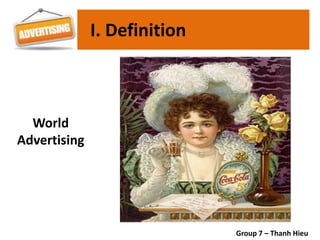
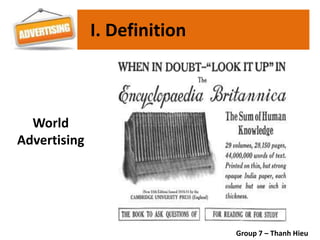
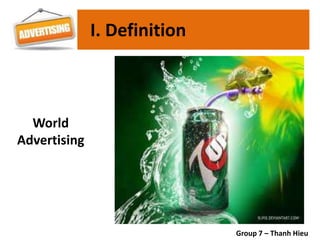
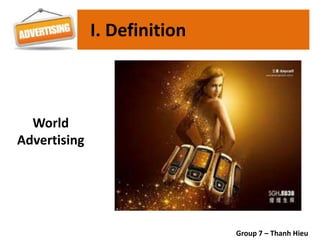
Any paid form of non-personal presentation and
promotion of ideas, goods or services through
mass media such as newspapers, magazines,
television or radio hy an identified sponsor.
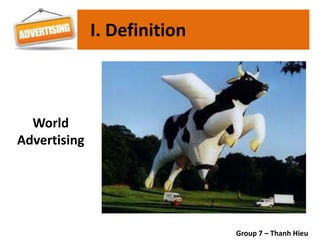
I. Definition
Group 7 – Thanh Hieu
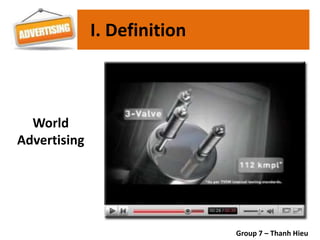
World
Advertising
I. Definition
Group 7 – Thanh Hieu
I. Definition
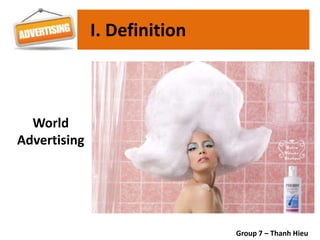
World
Advertising
Group 7 – Thanh Hieu
I. Definition
World
Advertising
Group 7 – Thanh Hieu
I. Definition
World
Advertising
Group 7 – Thanh Hieu
I. Definition
World
Advertising
Group 7 – Thanh Hieu
I. Definition
World
Advertising
Group 7 – Thanh Hieu
I. Definition
World
Advertising
Group 7 – Thanh Hieu
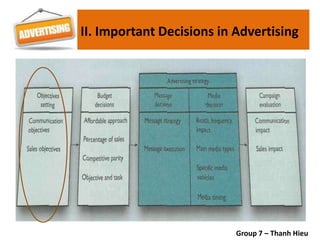
II. Important Decisions in Advertising
Group 7 – Thanh Hieu
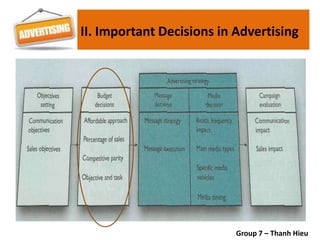
1. Setting Objectives
An advertising objective is a specific communication task to be
accomplished with a specific target audience during a specific
time
Objectives are classified by primary purpose
• Inform
• Persuade
• Remind
II. Important Decisions in Advertising
Group 7 – Thanh Hieu
II. Important Decisions in Advertising
Lexus is250c
Group 7 – Thanh Hieu
II. Important Decisions in Advertising
Mercedes Benz
Group 7 – Thanh Hieu
II. Important Decisions in Advertising
Group 7 – Thanh Hieu
II. Important Decisions in Advertising
Group 7 – Thanh Hieu
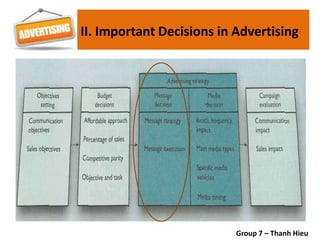
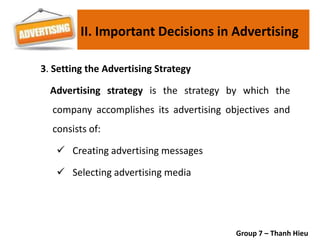
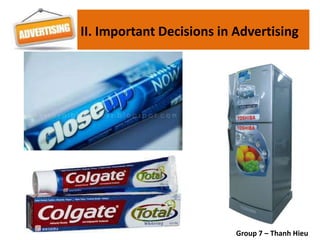
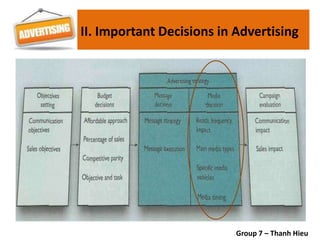
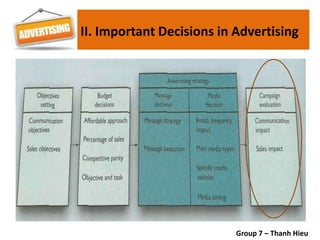
3. Setting the Advertising Strategy
Advertising strategy is the strategy by which the
company accomplishes its advertising objectives and
consists of:
 Creating advertising messages
 Selecting advertising media
Group 7 – Thanh Hieu
II. Important Decisions in Advertising
Group 7 – Thanh Hieu
II. Important Decisions in Advertising
Group 7 – Thanh Hieu
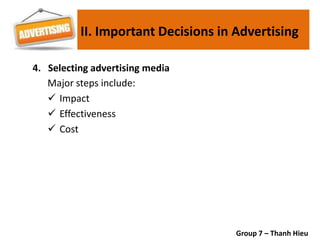
4. Selecting advertising media
Major steps include:
 Impact
 Effectiveness
 Cost
Group 7 – Thanh Hieu
II. Important Decisions in Advertising
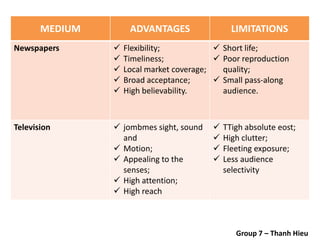
MEDIUM ADVANTAGES LIMITATIONS
Newspapers  Flexibility;
 Timeliness;
 Local market coverage;
 Broad acceptance;
 High believability.
 Short life;
 Poor reproduction
quality;
 Small pass-along
audience.
Television  jombmes sight, sound
and
 Motion;
 Appealing to the
senses;
 High attention;
 High reach
 TTigh absolute eost;
 High clutter;
 Fleeting exposure;
 Less audience
selectivity
Group 7 – Thanh Hieu
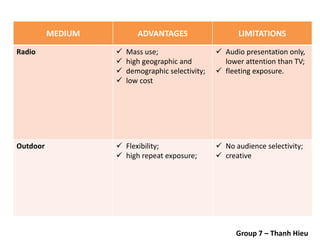
MEDIUM ADVANTAGES LIMITATIONS
Radio  Mass use;
 high geographic and
 demographic selectivity;
 low cost
 Audio presentation only,
lower attention than TV;
 fleeting exposure.
Outdoor  Flexibility;
 high repeat exposure;
 No audience selectivity;
 creative
Group 7 – Thanh Hieu
II. Important Decisions in Advertising
Group 7 – Thanh Hieu
27
 Advertising may change a consumer’s
negative attitude toward a product, or
reinforce a positive attitude.
 Advertising can affect consumer ranking of
a brand’s attributes.
Group 7 – Thanh Hieu
III. The Effects of Advertising on Consumers
28
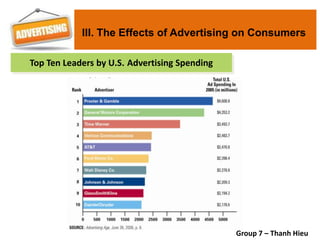
Top Ten Leaders by U.S. Advertising Spending
Group 7 – Thanh Hieu
III. The Effects of Advertising on Consumers
I. Definition
Group 7 - Phuong Loan
I. Definition
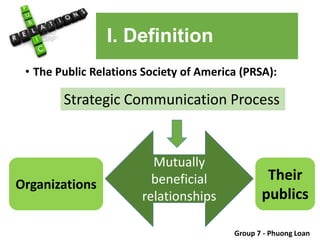
• The Public Relations Society of America (PRSA):
Group 7 - Phuong Loan
Strategic Communication Process
Organizations
Mutually
beneficial
relationships
Their
publics
I. Definition
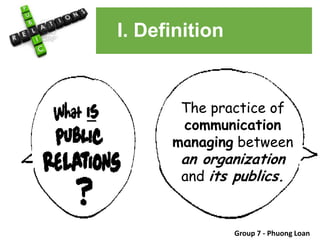
The practice of
communication
managing between
an organization
and its publics.
Group 7 - Phuong Loan
II. Functions
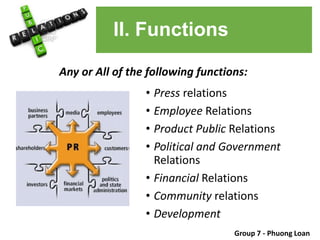
Any or All of the following functions:
• Press relations
• Employee Relations
• Product Public Relations
• Political and Government
Relations
• Financial Relations
• Community relations
• Development
Group 7 - Phuong Loan
III. Tools
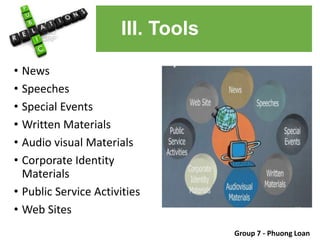
• News
• Speeches
• Special Events
• Written Materials
• Audio visual Materials
• Corporate Identity
Materials
• Public Service Activities
• Web Sites
Group 7 - Phuong Loan
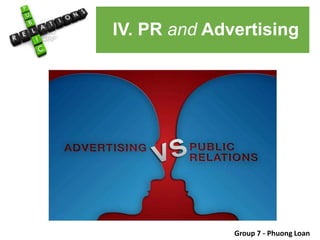
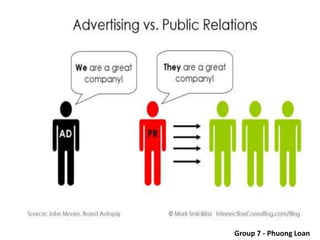
IV. PR and Advertising
Group 7 - Phuong Loan
1. Similarities
• Designed to raise
awareness of a
company or product in
a positive manner.
• The company target its
messages toward a
particular audience.
Group 7 - Phuong Loan
IV. PR and Advertising
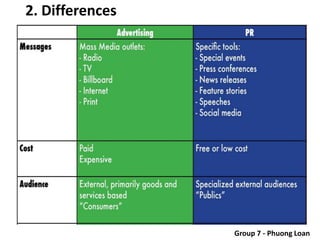
2. Differences
Group 7 - Phuong Loan
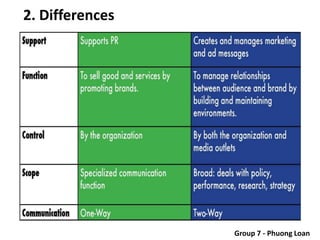
2. Differences
Group 7 - Phuong Loan
Le Minh Khoa
I. Definition
An activity to boost the sales of product
 Persuading a potential
customer
 Sort-term tactic
 Not use to build
long-term loyalty
Group 7 – Minh Khoa
Attract new customer
Encourage use product and make them brand loyal
Counter a competitor’s promotion activities
Introduce new product- penertrate the market
II. Purpose
Group 7 – Minh Khoa
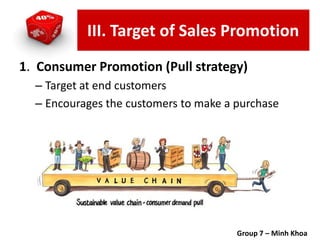
1. Consumer Promotion (Pull strategy)
– Target at end customers
– Encourages the customers to make a purchase
III. Target of Sales Promotion
Group 7 – Minh Khoa
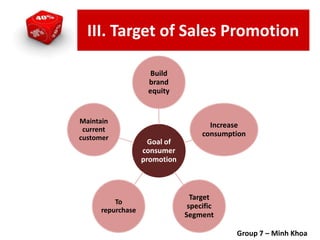
Goal of
consumer
promotion
Build
brand
equity
Increase
consumption
Target
specific
Segment
To
repurchase
Maintain
current
customer
Group 7 – Minh Khoa
III. Target of Sales Promotion
Type of Consumer Promotion
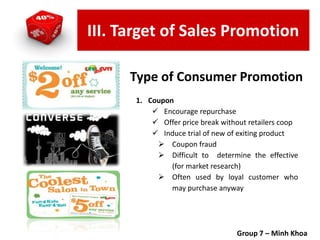
1. Coupon
 Encourage repurchase
 Offer price break without retailers coop
 Induce trial of new of exiting product
 Coupon fraud
 Difficult to determine the effective
(for market research)
 Often used by loyal customer who
may purchase anyway
Group 7 – Minh Khoa
III. Target of Sales Promotion
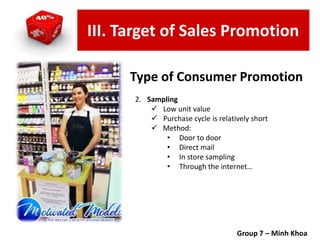
2. Sampling
 Low unit value
 Purchase cycle is relatively short
 Method:
• Door to door
• Direct mail
• In store sampling
• Through the internet…
Group 7 – Minh Khoa
Type of Consumer Promotion
III. Target of Sales Promotion
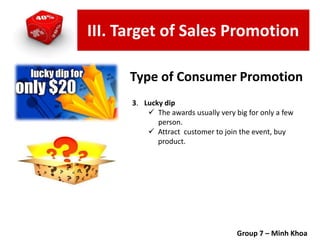
3. Lucky dip
 The awards usually very big for only a few
person.
 Attract customer to join the event, buy
product.
Group 7 – Minh Khoa
Type of Consumer Promotion
III. Target of Sales Promotion
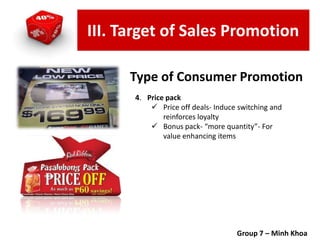
4. Price pack
 Price off deals- Induce switching and
reinforces loyalty
 Bonus pack- “more quantity”- For
value enhancing items
Group 7 – Minh Khoa
Type of Consumer Promotion
III. Target of Sales Promotion
2. Trade sales promotion (Push strategy)
– Target at distribution channel
– Encourages the channel members to stock the
product
Group 7 – Minh Khoa
III. Target of Sales Promotion
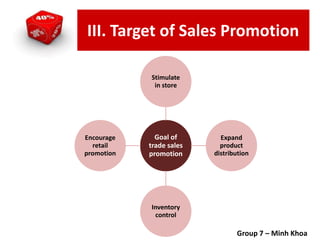
Goal of
trade sales
promotion
Stimulate
in store
Expand
product
distribution
Inventory
control
Encourage
retail
promotion
Group 7 – Minh Khoa
III. Target of Sales Promotion
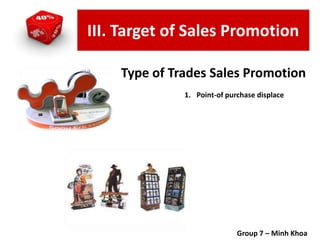
Type of Trades Sales Promotion
1. Point-of purchase displace
Group 7 – Minh Khoa
III. Target of Sales Promotion
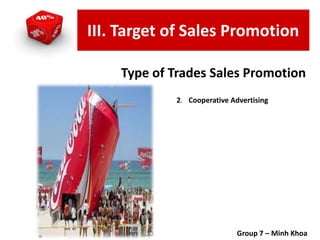
2. Cooperative Advertising
Group 7 – Minh Khoa
Type of Trades Sales Promotion
III. Target of Sales Promotion
3. Sale training program
Group 7 – Minh Khoa
Type of Trades Sales Promotion
III. Target of Sales Promotion
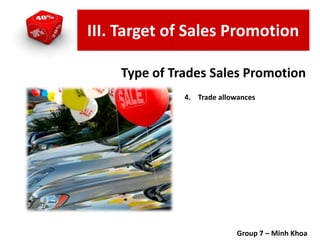
4. Trade allowances
Group 7 – Minh Khoa
Type of Trades Sales Promotion
III. Target of Sales Promotion
Nguyen Vu Quang Minh
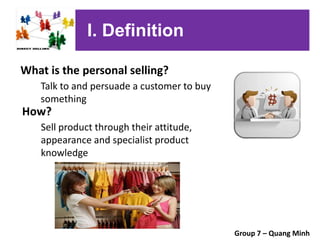
What is the personal selling?
How?
Talk to and persuade a customer to buy
something
Sell product through their attitude,
appearance and specialist product
knowledge
I. Definition
Group 7 – Quang Minh
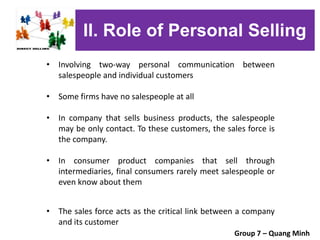
• Involving two-way personal communication between
salespeople and individual customers
• Some firms have no salespeople at all
• In company that sells business products, the salespeople
may be only contact. To these customers, the sales force is
the company.
• In consumer product companies that sell through
intermediaries, final consumers rarely meet salespeople or
even know about them
• The sales force acts as the critical link between a company
and its customer
Group 7 – Quang Minh
II. Role of Personal Selling
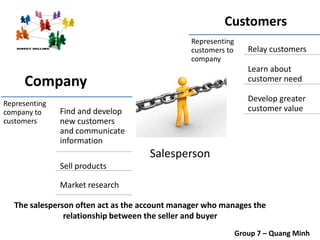
Representing
company to
customers
Find and develop
new customers
and communicate
information
Sell products
Market research
Representing
customers to
company
Relay customers
Learn about
customer need
Develop greater
customer value
The salesperson often act as the account manager who manages the
relationship between the seller and buyer
Company
Customers
Salesperson
Group 7 – Quang Minh
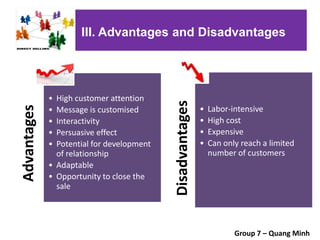
Advantages
• High customer attention
• Message is customised
• Interactivity
• Persuasive effect
• Potential for development
of relationship
• Adaptable
• Opportunity to close the
sale Disadvantages
• Labor-intensive
• High cost
• Expensive
• Can only reach a limited
number of customers
Group 7 – Quang Minh
III. Advantages and Disadvantages
Lam Thi Thanh Huyen
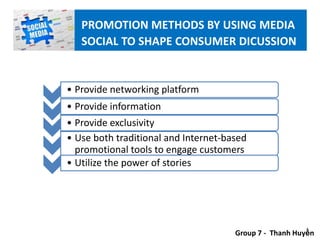
• Provide networking platform
• Provide information
• Provide exclusivity
• Use both traditional and Internet-based
promotional tools to engage customers
• Utilize the power of stories
Group 7 - Thanh Huyền
PROMOTION METHODS BY USING MEDIA
SOCIAL TO SHAPE CONSUMER DICUSSION
• Consumers like to network with people who have
the similar interests and desires
• Organizations can leverage this desire by creating
communities of like-minded individuals
• These communities center on shared information
through websites, social networking sites such as
Facebook, Myspace, forums, chat rooms…
• Individuals base on them to come to a decision
I. Provide networking platforms
Group 7 - Thanh Huyền
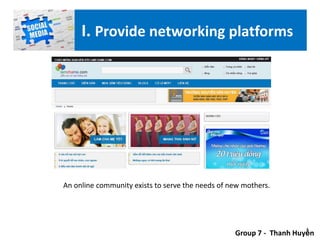
An online community exists to serve the needs of new mothers.
Group 7 - Thanh Huyền
I. Provide networking platforms
 It provides various types of information for mothers and
parent, along with opportunities for interaction through
message boards, forums and chat rooms
 Companies can benefit from communicating with moms.
 Their employees contribute to the conversations that are
occurring there and they can adverse for these products,
have customer information, even sale online.
Thanh Huyền Group 7 - Thanh Huyền
I. Provide networking platforms
 Consumers are more likely to talk about companies
and products when they feel they know a lot about
them
 Creating a website is replete with all information
about products which is categorized clearly and
best fix
Group 7 - Thanh Huyền
II. Provide Information
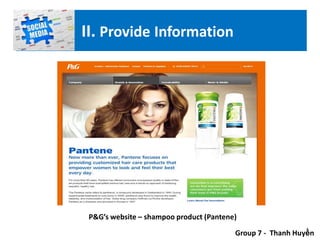
P&G’s website – shampoo product (Pantene)
Group 7 - Thanh Huyền
II. Provide Information
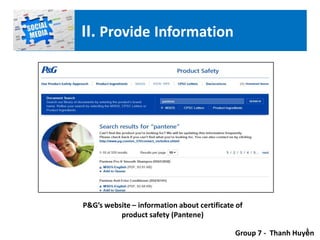
P&G’s website – information about certificate of
product safety (Pantene)
Group 7 - Thanh Huyền
II. Provide Information
People like to feel special
Feeling of being special can be produced
by offering products, information and
special deals that are available exclusively
to a subset of consumers
Group 7 - Thanh Huyền
III. Provide Exclusivity
Enabling customers to provide feedback on
product via companies’ blog, forum, website.
Creating online contest via social networking
sites, video sharing site (YouTube)…
Online voting via website
Create games online related to product or
service which need to be promoted
Group 7 - Thanh Huyền
IV. Use both traditional and Internet-based
promotional tools to engage customers
Stories can be memorable. The more memorable
they are, the more likely they are to be repeated
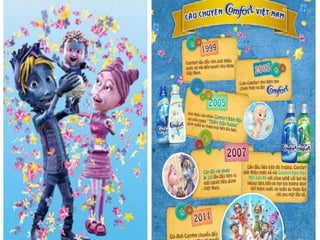
Telling a story related to product or creating a story
about product with personified characters
Group 7 - Thanh Huyền
IV. Utilise the power of stories
Nguyen Thi Ka Ly
Group 7 - Ka Ly
I. Introduction
Group 7 - Ka Ly
I. Introduction
How Apple use Promotion Mix?
 Advertising
 Public Relations
 Sales Promotion
 Personal Selling
Group 7 - Ka Ly
II. Analysis - Advertising
Group 7 - Ka Ly
II. Analysis – Advertising
Message
 Inspiration
 Communication
Media
 Television -> TVC
 YouTube
 Fanpage
Group 7 - Ka Ly
II. Analysis – Public Relations
Group 7 - Ka Ly
II. Analysis – Public Relations
Group 7 - Ka Ly
II. Analysis – Public Relations
Group 7 - Ka Ly
II. Analysis – Public Relations
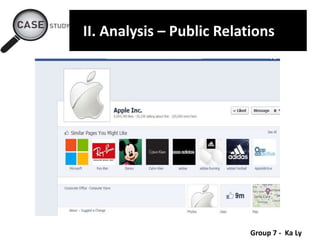
PR’s tool
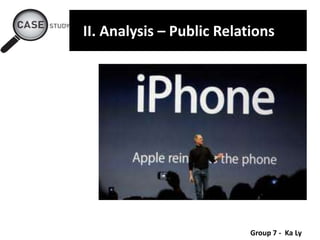
 Fanpage: to launch new product, listen to
customers’ feedback
 Event: to launch new products with the
presentation from Apple’s CEO
 Creating hyper
Group 7 - Ka Ly
II. Analysis – Sales Promotion
Sales Promotion
 Not many discount
Group 7 - Ka Ly
II. Analysis – Personal Selling
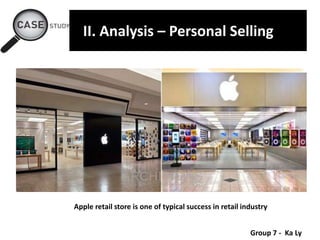
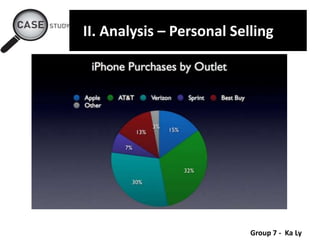
Apple retail store is one of typical success in retail industry
Group 7 - Ka Ly
II. Analysis – Personal Selling
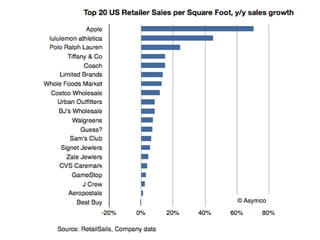
 In 2009, when retail sales declined around 2%, Apple’s
retail sales rose roughly 7%.
 In 2010, Apple’s retail sales, excluding online, jumped
70% to $11.7 billion, compared to the overall retail
industry’s sales growth of 4.5%
Group 7 - Ka Ly
II. Analysis – Personal Selling
Group 7 - Ka Ly
Group 7 - Ka Ly
II. Analysis – Personal Selling
All stores are the same
Building strong employees
 Young
 Have good understanding about new technology
 Customer oriented
Promotion Mix

Promotion Mix

  • 3.
    Advertising Public Relations Sales Promotion PersonalSelling Social Media and Promotion Case Study AGENDA
  • 4.
  • 5.
    Any paid formof non-personal presentation and promotion of ideas, goods or services through mass media such as newspapers, magazines, television or radio hy an identified sponsor. I. Definition Group 7 – Thanh Hieu
  • 6.
  • 7.
  • 8.
  • 9.
  • 10.
  • 11.
  • 12.
  • 13.
    II. Important Decisionsin Advertising Group 7 – Thanh Hieu
  • 14.
    1. Setting Objectives Anadvertising objective is a specific communication task to be accomplished with a specific target audience during a specific time Objectives are classified by primary purpose • Inform • Persuade • Remind II. Important Decisions in Advertising Group 7 – Thanh Hieu
  • 15.
    Group 7 –Thanh Hieu II. Important Decisions in Advertising
  • 16.
    Lexus is250c Group 7– Thanh Hieu II. Important Decisions in Advertising
  • 17.
    Mercedes Benz Group 7– Thanh Hieu II. Important Decisions in Advertising
  • 18.
    II. Important Decisionsin Advertising Group 7 – Thanh Hieu
  • 19.
    II. Important Decisionsin Advertising Group 7 – Thanh Hieu
  • 20.
    3. Setting theAdvertising Strategy Advertising strategy is the strategy by which the company accomplishes its advertising objectives and consists of:  Creating advertising messages  Selecting advertising media Group 7 – Thanh Hieu II. Important Decisions in Advertising
  • 21.
    Group 7 –Thanh Hieu II. Important Decisions in Advertising
  • 22.
    II. Important Decisionsin Advertising Group 7 – Thanh Hieu
  • 23.
    4. Selecting advertisingmedia Major steps include:  Impact  Effectiveness  Cost Group 7 – Thanh Hieu II. Important Decisions in Advertising
  • 24.
    MEDIUM ADVANTAGES LIMITATIONS Newspapers Flexibility;  Timeliness;  Local market coverage;  Broad acceptance;  High believability.  Short life;  Poor reproduction quality;  Small pass-along audience. Television  jombmes sight, sound and  Motion;  Appealing to the senses;  High attention;  High reach  TTigh absolute eost;  High clutter;  Fleeting exposure;  Less audience selectivity Group 7 – Thanh Hieu
  • 25.
    MEDIUM ADVANTAGES LIMITATIONS Radio Mass use;  high geographic and  demographic selectivity;  low cost  Audio presentation only, lower attention than TV;  fleeting exposure. Outdoor  Flexibility;  high repeat exposure;  No audience selectivity;  creative Group 7 – Thanh Hieu
  • 26.
    II. Important Decisionsin Advertising Group 7 – Thanh Hieu
  • 27.
    27  Advertising maychange a consumer’s negative attitude toward a product, or reinforce a positive attitude.  Advertising can affect consumer ranking of a brand’s attributes. Group 7 – Thanh Hieu III. The Effects of Advertising on Consumers
  • 28.
    28 Top Ten Leadersby U.S. Advertising Spending Group 7 – Thanh Hieu III. The Effects of Advertising on Consumers
  • 30.
    I. Definition Group 7- Phuong Loan
  • 31.
    I. Definition • ThePublic Relations Society of America (PRSA): Group 7 - Phuong Loan Strategic Communication Process Organizations Mutually beneficial relationships Their publics
  • 32.
    I. Definition The practiceof communication managing between an organization and its publics. Group 7 - Phuong Loan
  • 33.
    II. Functions Any orAll of the following functions: • Press relations • Employee Relations • Product Public Relations • Political and Government Relations • Financial Relations • Community relations • Development Group 7 - Phuong Loan
  • 34.
    III. Tools • News •Speeches • Special Events • Written Materials • Audio visual Materials • Corporate Identity Materials • Public Service Activities • Web Sites Group 7 - Phuong Loan
  • 35.
    IV. PR andAdvertising Group 7 - Phuong Loan
  • 36.
    1. Similarities • Designedto raise awareness of a company or product in a positive manner. • The company target its messages toward a particular audience. Group 7 - Phuong Loan IV. PR and Advertising
  • 37.
  • 38.
  • 39.
    Group 7 -Phuong Loan
  • 40.
  • 41.
    I. Definition An activityto boost the sales of product  Persuading a potential customer  Sort-term tactic  Not use to build long-term loyalty Group 7 – Minh Khoa
  • 42.
    Attract new customer Encourageuse product and make them brand loyal Counter a competitor’s promotion activities Introduce new product- penertrate the market II. Purpose Group 7 – Minh Khoa
  • 43.
    1. Consumer Promotion(Pull strategy) – Target at end customers – Encourages the customers to make a purchase III. Target of Sales Promotion Group 7 – Minh Khoa
  • 44.
  • 45.
    Type of ConsumerPromotion 1. Coupon  Encourage repurchase  Offer price break without retailers coop  Induce trial of new of exiting product  Coupon fraud  Difficult to determine the effective (for market research)  Often used by loyal customer who may purchase anyway Group 7 – Minh Khoa III. Target of Sales Promotion
  • 46.
    2. Sampling  Lowunit value  Purchase cycle is relatively short  Method: • Door to door • Direct mail • In store sampling • Through the internet… Group 7 – Minh Khoa Type of Consumer Promotion III. Target of Sales Promotion
  • 47.
    3. Lucky dip The awards usually very big for only a few person.  Attract customer to join the event, buy product. Group 7 – Minh Khoa Type of Consumer Promotion III. Target of Sales Promotion
  • 48.
    4. Price pack Price off deals- Induce switching and reinforces loyalty  Bonus pack- “more quantity”- For value enhancing items Group 7 – Minh Khoa Type of Consumer Promotion III. Target of Sales Promotion
  • 49.
    2. Trade salespromotion (Push strategy) – Target at distribution channel – Encourages the channel members to stock the product Group 7 – Minh Khoa III. Target of Sales Promotion
  • 50.
    Goal of trade sales promotion Stimulate instore Expand product distribution Inventory control Encourage retail promotion Group 7 – Minh Khoa III. Target of Sales Promotion
  • 51.
    Type of TradesSales Promotion 1. Point-of purchase displace Group 7 – Minh Khoa III. Target of Sales Promotion
  • 52.
    2. Cooperative Advertising Group7 – Minh Khoa Type of Trades Sales Promotion III. Target of Sales Promotion
  • 53.
    3. Sale trainingprogram Group 7 – Minh Khoa Type of Trades Sales Promotion III. Target of Sales Promotion
  • 54.
    4. Trade allowances Group7 – Minh Khoa Type of Trades Sales Promotion III. Target of Sales Promotion
  • 55.
  • 56.
    What is thepersonal selling? How? Talk to and persuade a customer to buy something Sell product through their attitude, appearance and specialist product knowledge I. Definition Group 7 – Quang Minh
  • 57.
    • Involving two-waypersonal communication between salespeople and individual customers • Some firms have no salespeople at all • In company that sells business products, the salespeople may be only contact. To these customers, the sales force is the company. • In consumer product companies that sell through intermediaries, final consumers rarely meet salespeople or even know about them • The sales force acts as the critical link between a company and its customer Group 7 – Quang Minh II. Role of Personal Selling
  • 58.
    Representing company to customers Find anddevelop new customers and communicate information Sell products Market research Representing customers to company Relay customers Learn about customer need Develop greater customer value The salesperson often act as the account manager who manages the relationship between the seller and buyer Company Customers Salesperson Group 7 – Quang Minh
  • 59.
    Advantages • High customerattention • Message is customised • Interactivity • Persuasive effect • Potential for development of relationship • Adaptable • Opportunity to close the sale Disadvantages • Labor-intensive • High cost • Expensive • Can only reach a limited number of customers Group 7 – Quang Minh III. Advantages and Disadvantages
  • 62.
  • 63.
    • Provide networkingplatform • Provide information • Provide exclusivity • Use both traditional and Internet-based promotional tools to engage customers • Utilize the power of stories Group 7 - Thanh Huyền PROMOTION METHODS BY USING MEDIA SOCIAL TO SHAPE CONSUMER DICUSSION
  • 64.
    • Consumers liketo network with people who have the similar interests and desires • Organizations can leverage this desire by creating communities of like-minded individuals • These communities center on shared information through websites, social networking sites such as Facebook, Myspace, forums, chat rooms… • Individuals base on them to come to a decision I. Provide networking platforms Group 7 - Thanh Huyền
  • 65.
    An online communityexists to serve the needs of new mothers. Group 7 - Thanh Huyền I. Provide networking platforms
  • 66.
     It providesvarious types of information for mothers and parent, along with opportunities for interaction through message boards, forums and chat rooms  Companies can benefit from communicating with moms.  Their employees contribute to the conversations that are occurring there and they can adverse for these products, have customer information, even sale online. Thanh Huyền Group 7 - Thanh Huyền I. Provide networking platforms
  • 67.
     Consumers aremore likely to talk about companies and products when they feel they know a lot about them  Creating a website is replete with all information about products which is categorized clearly and best fix Group 7 - Thanh Huyền II. Provide Information
  • 68.
    P&G’s website –shampoo product (Pantene) Group 7 - Thanh Huyền II. Provide Information
  • 69.
    P&G’s website –information about certificate of product safety (Pantene) Group 7 - Thanh Huyền II. Provide Information
  • 70.
    People like tofeel special Feeling of being special can be produced by offering products, information and special deals that are available exclusively to a subset of consumers Group 7 - Thanh Huyền III. Provide Exclusivity
  • 71.
    Enabling customers toprovide feedback on product via companies’ blog, forum, website. Creating online contest via social networking sites, video sharing site (YouTube)… Online voting via website Create games online related to product or service which need to be promoted Group 7 - Thanh Huyền IV. Use both traditional and Internet-based promotional tools to engage customers
  • 73.
    Stories can bememorable. The more memorable they are, the more likely they are to be repeated Telling a story related to product or creating a story about product with personified characters Group 7 - Thanh Huyền IV. Utilise the power of stories
  • 75.
  • 76.
    Group 7 -Ka Ly I. Introduction
  • 77.
    Group 7 -Ka Ly I. Introduction How Apple use Promotion Mix?  Advertising  Public Relations  Sales Promotion  Personal Selling
  • 78.
    Group 7 -Ka Ly II. Analysis - Advertising
  • 79.
    Group 7 -Ka Ly II. Analysis – Advertising Message  Inspiration  Communication Media  Television -> TVC  YouTube  Fanpage
  • 80.
    Group 7 -Ka Ly II. Analysis – Public Relations
  • 81.
    Group 7 -Ka Ly II. Analysis – Public Relations
  • 82.
    Group 7 -Ka Ly II. Analysis – Public Relations
  • 83.
    Group 7 -Ka Ly II. Analysis – Public Relations PR’s tool  Fanpage: to launch new product, listen to customers’ feedback  Event: to launch new products with the presentation from Apple’s CEO  Creating hyper
  • 84.
    Group 7 -Ka Ly II. Analysis – Sales Promotion Sales Promotion  Not many discount
  • 85.
    Group 7 -Ka Ly II. Analysis – Personal Selling Apple retail store is one of typical success in retail industry
  • 86.
    Group 7 -Ka Ly II. Analysis – Personal Selling  In 2009, when retail sales declined around 2%, Apple’s retail sales rose roughly 7%.  In 2010, Apple’s retail sales, excluding online, jumped 70% to $11.7 billion, compared to the overall retail industry’s sales growth of 4.5%
  • 87.
    Group 7 -Ka Ly II. Analysis – Personal Selling
  • 88.
    Group 7 -Ka Ly
  • 89.
    Group 7 -Ka Ly II. Analysis – Personal Selling All stores are the same Building strong employees  Young  Have good understanding about new technology  Customer oriented

Editor's Notes

  • #43 Get exiting customer buy moreIn troduce new product
  • #44 Direct at the ultimate user of the product
  • #51 Inventory control: Manufacturers use trade promotion to control their inventories, particularly by encouraging the retailer to keep more of the manufacturer’s product on hand. This can be important to the manufacturer for several reasons. For one thing, manufacturers may wish to transfer some of the product storage costs to the retailer. For another, manufacturers may want retailers to “stock up” on a particular product in advance of a consumer promotion, thereby avoiding stockouts. Finally, manufacturers may wish for retailers to build product inventories to reduce their ability to stock a competitor’s product, particularly if the competitor is about to offer a special promotional deal.