THE NEGOTIABLE INSTRUMENT
ACT 1881
Definition:
The word negotiable means ‘transferable by delivery,’ and the
word instrument means ‘a written document by which a right
is created in favour of some person.’
Thus, the term “negotiable instrument” literally means ‘a
written document which creates a right in favour of somebody
and is freely transferable by delivery.’
A negotiable instrument is a piece of paper which entitles a
person to a certain sum of money and which is transferable
from one to another person by a delivery or by endorsement
and delivery.
The law relating to negotiable instruments is contained in
the Negotiable Instruments Act, 1881 which applies and
extends to the whole of India.
1. Free transferability or easy negotiability
•Negotiable instrument is freely transferable from one
person to another without any formality.
•The property (right of ownership) in these instruments
passes by either endorsement and delivery (in case it is
payable to order) or by delivery merely (in case it is payable
to bearer) and no further evidence of transfer is needed.
2. Title of holder is free from all defects
•A person who takes negotiable instrument bona-fide and for
value gets the instrument free from all defects in the title.
The holder in due course is not affected by defective title of
the transferor or of any other party.
3. Transferee can sue in his own name without giving notice to the
debtor:
• A bill, note or a cheque represents a debt, i.e., an “actionable
claim” and implies the right of the creditor to recover something
from hid debtor
• The creditor can either recover this amount himself or can
transfer his right to another person
• In case he transfers his right, the transferee of a negotiable
instrument is entitled to sue on the instrument in his own name
in case of dishonor, without giving notice to the debtor of the
fact that he has become holder
• In case of transfer or assignment of an ordinary “actionable
claim” (i.e., a book debt evidenced by an entry by the creditor in
his account book, under the transfer of property act, notice to
the debtor is necessary in order to make the transferee entitled
to sue in his own name
4. Presumptions:
Certain presumptions apply to all negotiable instruments.
Section 118 and 119 lay down the following presumptions:
(a) For consideration : that every negotiable instrument, was
made, drawn, accepted, endorsed or transferred for
consideration.
(b) As to date : that every negotiable instrument bearing a date
was made or drawn on such date.
(c) As to time of acceptance : that every bill of exchange was
accepted within a reasonable time after its date and before
its maturity.
(d) As to transfer: that every transfer of a negotiable instrument
was made before its maturity
(e) As to time of endorsements : that the endorsements
appearing upon a negotiable instrument were made in the
order in which they appear thereon.
(f)As to stamps : that a lost promissory-note, bill of exchange or
cheque was duly stamped.
(g) As to a holder in due course: that every holder of a
negotiable instrument is holder in due course (this
presumption would not arise where it is proved that the
holder has obtained the instrument from its lawful owner, or
from any person in lawful custody thereof, by means of an
offence, fraud or for unlawful consideration and in such a case
the holder has to prove that he is a holder in due course
(h) As to dishonor: that the instrument was dishonored, in case
a suit upon a dishonored instrument is filed with the court and
the fact of protest is proved
TYPES OF NEGOTIABLE INSTRUMENTS
Negotiable instruments are of two types which are as
follows:
• Negotiable Instruments recognized by status:
e.g. Bills of exchange, cheque and promissory notes.
• Negotiable instruments recognized by usage or
customs of trade:
e.g. Bank notes, exchequer bills, share warrants, bearer
debentures, dividend warrants, share certificate
Definition:
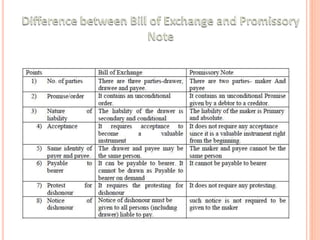
According to Section 4, “A promissory note is an instrument in
writing (not being a bank-note or a currency-note) containing
an unconditional undertaking, signed by the maker, to pay a
certain sum of money only to, or to the order of, a certain
person, or to the bearer of the instrument.”
There are primarily two parties involved in a promissory note. They are:
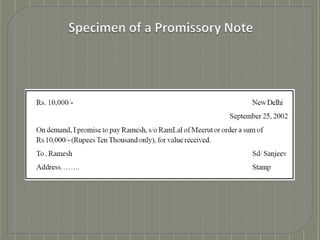
(i) The Maker or Drawer: The person who makes the note and promises to pay
the amount stated therein. In the above specimen, Sanjeev is the maker or
drawer.
(ii)The Payee – the person to whom the amount is payable. In the above
specimen it is Ramesh.
In course of transfer of a promissory note by payee and others, the parties
involved may be –
(a)The Endorser – the person who endorses the note in favour of another
person. In the above specimen if Ramesh endorses it in favour of Ranjan
and Ranjan also endorses it in favour of Puneet, then Ramesh and Ranjan
both are endorsers.
(b) The Endorsee – the person in whose favour the note is negotiated by
endorsement. In the above, it is Ranjan and then Puneet.
1. It must be in writing:
• A promissory note has to be in writing
• An oral promise to pay does not become a promissory note
• The writing may be on any paper or book
• Illustrations: A signs the instruments in the following terms:
🞄 “I promise to pay B or order Rs. 500”
🞄 “I acknowledge myself to be indebted to B in Rs. 1000 to be paid
on demand, for value received”
Both the above instruments are valid promissory notes.
22. It must contain a promise or undertaking to pay:
• There must be a promise or an undertaking to pay
• The undertaking to pay may be gathered either from express words or
by necessary implication
• A mere acknowledgement of indebtedness is not a promissory note,
although it is valid as an agreement and may be sued upon as such
• Illustrations: A signs the instruments in the following terms:
🞄
“Mr
. B I owe you Rs. 1000”
🞄
“I am liable to pay to B Rs. 500”
The above instruments are not promissory notes as there is no
undertaking or promise to pay. There is only an acknowledgement of
indebtedness.
• Where A signs the instrument in the following terms:
🞄“I acknowledge myself to be indebted to B in Rs. 1000, to be paid on
demand, for value received,” there is a valid promissory note
3. THE PROMISE TO PAY MUST BE UNCONDITIONAL:
 A promissory note must contain an unconditional
promise to pay
 The promise to pay must not depend upon the
happening of some uncertain event, i.e., a contingency
or the fulfillment of a condition Illustrations: A signs the
instruments in the following terms:
 🞄“I promise to pay B Rs. 500 seven days after my
marriage with C”
 🞄
“I promise to pay B Rs. 500 as soon as I can”
 The above instruments are not valid promissory notes
as the payment is made depending upon the happening
of an uncertain event which may never happen and as
a result the sum may never become payable.
4. It must be signed by the maker:
•
5. The maker must be a certain person:
⦿ The instrument must itself indicate with certainty who is the person or are
the persons engaging himself or themselves to pay
⦿ Alternative promisors are not permitted in law because of the general rule
that “where liability lies no ambiguity must lie”
6. The payee must be certain:
⦿ Like the maker the payee of a pronote must also be certain on the face of
the instrument
⦿ A note in favour of fictitious person is illegal and void
⦿ A pronote made payable to the maker himself is a nullity, the reason being
the same person is both the promisor and the promisee
• It is imperative that the promissory note should be duly authenticated
by the ‘signature’ of the maker
‘Signature’ means the writing or otherwise affixing a person’s name or
a mark to represent his name, by himself or by his authority with the
intention of authenticating a document
7. The sum payable must be certain:
⦿ For a valid pronote it is also essential that the sum of money promised to
be payable must be certain and definite
⦿ The amount payable must not be capable of contingent additions or
subtractions
⦿ Illustrations: A signs the instruments in the following terms:
• “I promise to pay B Rs. 500 and all other sums which shall be due to
him”
• “I promise to pay B Rs. 500, first deducting there out any money which
he may owe me”
⦿ The above instruments are invalid as promissory notes because the exact
amount to be paid by A is not certain
8. The amount payable must be in legal tender money of India:
⦿ A document containing a promise to pay a certain amount of foreign
money or to deliver a certain quantity of goods is not a pronote
⦿ Definition:
Section 5 of the Negotiable Instruments Act defines a Bill of Exchange as
follows:
“A bill of exchange is an instrument in writing containing an
unconditional order, signed by the maker, directing a certain person to
pay a certain sum of money only to, or to the order of, a certain person or
to the bearer of the instrument.”
Illustration:
Mr. X purchases goods from Mr. Y for Rs. 1000/-
Mr. Y buys goods from Mr. S for Rs. 1000/-
Then Mr. Y may order Mr. X to pay Rs. 1000/- Mr. S which will be nothing
but a bill of exchange.
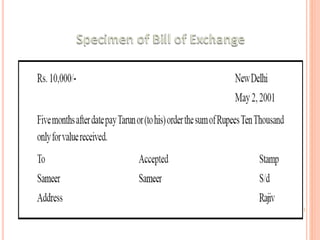
There are three parties involved in a bill of exchange
(i) The Drawer – The person who makes the order for making payment. In the
above specimen, Rajiv is the drawer.
(ii)The Drawee – The person to whom the order to pay is made. He is
generally a debtor of the drawer. It is Sameer in this case.
(iii)The Payee – The person to whom the payment is to be made. In this case
it is Tarun.
The drawer can also draw a bill in his own name thereby he himself becomes
the payee. Here the words in the bill would be Pay to us or order.
In a bill where a time period is mentioned, just like the above specimen, is
called a Time Bill.
But a bill may be made payable on demand also. This is called a Demand Bill.
1. IT MUST BE IN WRITING
2.
3.
4.
5.
6.
7.
8.
It must contain an order to pay. A mere request to pay on account, will not
amount to an order
The order to pay must be unconditional
It must be signed by the drawer
The drawer, drawee and payee must be certain. A bill cannot be drawn on
two or more drawees but may be made payable in the alternative to one of
two or more payees
The sum payable must be certain
The bill must contain an order to pay money only
It must comply with the formalities as regards date, consideration, stamps,
etc
A cheque is the means by which a person who has fund in the
hand of a bank withdraws the same or some part of it.
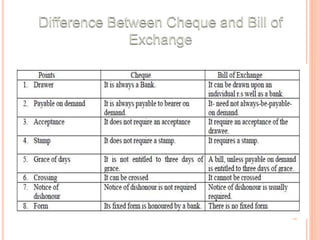
A cheque is a kind of bill of exchange but it has additional
qualification namely-
1 it is always drawn on a specified banker and
2 it is always payable on demand without any days of grace.
ONE OF THE ESSENTIALS FEATURE OF A NEGOTIABLE INSTRUMENT IS ITS
TRANSFERABILITY. A NEGOTIABLE INSTRUMENT MAY BE TRANSFERRED
FROM ONE PERSON TO ANOTHER IN EITHER OF THE FOLLOWINGS WAY-
1-BY NEGOTIATION
2-BY ASSIGNMENT
The transfer of an instrument by one party to another so as to
constitute the transferee a holder is called Negotiation.
Negotiation means as the process by which a third party is
constituted the holder of the instrument so as to entitle him
to the possession of the same and to receive the amount due
thereon in his own name.
⦿By delivery
⦿Ex-A the holder of a negotiable instrument payable to bearer ,
delivers it to B’s agent to keep it for B. The instrument has
negotiated.
⦿By endorsement
NOT HAVING POWER TO CONTRACT BUT HE MAY BECOME PROMISEE.
“Discharge means release from obligation”.
⦿By Payment
⦿By express waiver
⦿By cancellation
⦿By material alteration or lapse of time.
⦿It may be by non acceptance or non payment
⦿ A bill of exchange can be dishonored by non acceptance in the
following ways-
⦿Does not accept 48 hours from the time of presentment
drawee is fictitious person
⦿Drawee has become insolvent or dead
⦿Drawee is incompetent
⦿ OPEN CHEQUE OR BEARER CHEQUE
⦿CROSSED CHEQUE
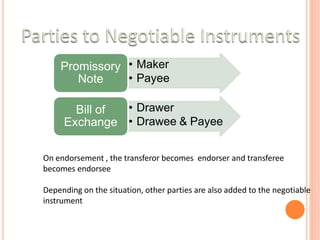
• Maker
• Payee
Promissory
Note
• Drawer
• Drawee & Payee
Bill of
Exchange
On endorsement , the transferor becomes endorser and transferee
becomes endorsee
Depending on the situation, other parties are also added to the negotiable
instrument
 Section 8
 any person entitled in his own name to the possession thereof
and to receive or recover the amount due thereon from the
parties thereto
Requirements
 He must be entitled in his own name to the possession of the
instrument
 He must be entitled to receive or recover the amount thereon
from the parties thereto
 Section 9
 any person who for consideration became the possessor of
promissory note, bill of exchange or cheque if payable to
bearer or the payee or endorsee thereof, if payable to order
before the amount mentioned in it became payable and
without having sufficient cause to believe that any defect
existed in the title of the person from whom he derived his
title
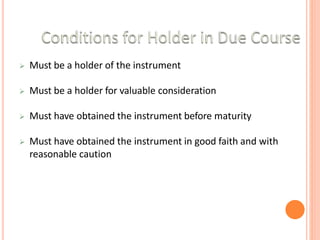
 Must be a holder of the instrument
 Must be a holder for valuable consideration
 Must have obtained the instrument before maturity
 Must have obtained the instrument in good faith and with
reasonable caution
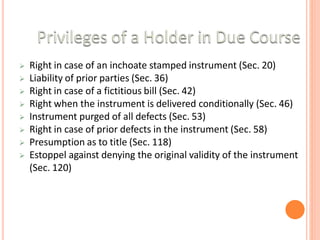
 Right in case of an inchoate stamped instrument (Sec. 20)
 Liability of prior parties (Sec. 36)
 Right in case of a fictitious bill (Sec. 42)
 Right when the instrument is delivered conditionally (Sec. 46)
 Instrument purged of all defects (Sec. 53)
 Right in case of prior defects in the instrument (Sec. 58)
 Presumption as to title (Sec. 118)
 Estoppel against denying the original validity of the instrument
(Sec. 120)
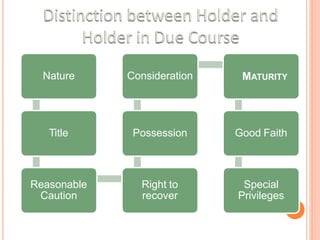
Nature
Title
Reasonable
Caution
Right to
recover
Possession
Consideration MATURITY
Good Faith
Special
Privileges
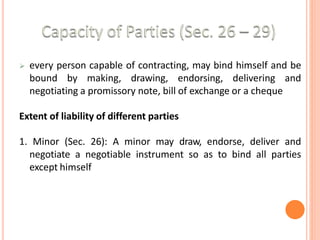
 every person capable of contracting, may bind himself and be
bound by making, drawing, endorsing, delivering and
negotiating a promissory note, bill of exchange or a cheque
Extent of liability of different parties
1. Minor (Sec. 26): A minor may draw, endorse, deliver and
negotiate a negotiable instrument so as to bind all parties
except himself
Person of unsound mind : Instruments made by persons of
unsound mind are void against them though the other parties
remain liable thereon
2. Joint Stock Company
3. Agent : every person capable of binding himself or of being
bound as mentioned in Sec. 26, may bind himself or be bound
by a duly authorized agent acting in his name
4. Partner
THANK
YOU

Negotiable instrument Act.pptx

  • 1.
  • 2.
    Definition: The word negotiablemeans ‘transferable by delivery,’ and the word instrument means ‘a written document by which a right is created in favour of some person.’ Thus, the term “negotiable instrument” literally means ‘a written document which creates a right in favour of somebody and is freely transferable by delivery.’ A negotiable instrument is a piece of paper which entitles a person to a certain sum of money and which is transferable from one to another person by a delivery or by endorsement and delivery. The law relating to negotiable instruments is contained in the Negotiable Instruments Act, 1881 which applies and extends to the whole of India.
  • 3.
    1. Free transferabilityor easy negotiability •Negotiable instrument is freely transferable from one person to another without any formality. •The property (right of ownership) in these instruments passes by either endorsement and delivery (in case it is payable to order) or by delivery merely (in case it is payable to bearer) and no further evidence of transfer is needed. 2. Title of holder is free from all defects •A person who takes negotiable instrument bona-fide and for value gets the instrument free from all defects in the title. The holder in due course is not affected by defective title of the transferor or of any other party.
  • 4.
    3. Transferee cansue in his own name without giving notice to the debtor: • A bill, note or a cheque represents a debt, i.e., an “actionable claim” and implies the right of the creditor to recover something from hid debtor • The creditor can either recover this amount himself or can transfer his right to another person • In case he transfers his right, the transferee of a negotiable instrument is entitled to sue on the instrument in his own name in case of dishonor, without giving notice to the debtor of the fact that he has become holder • In case of transfer or assignment of an ordinary “actionable claim” (i.e., a book debt evidenced by an entry by the creditor in his account book, under the transfer of property act, notice to the debtor is necessary in order to make the transferee entitled to sue in his own name
  • 5.
    4. Presumptions: Certain presumptionsapply to all negotiable instruments. Section 118 and 119 lay down the following presumptions: (a) For consideration : that every negotiable instrument, was made, drawn, accepted, endorsed or transferred for consideration. (b) As to date : that every negotiable instrument bearing a date was made or drawn on such date. (c) As to time of acceptance : that every bill of exchange was accepted within a reasonable time after its date and before its maturity. (d) As to transfer: that every transfer of a negotiable instrument was made before its maturity
  • 6.
    (e) As totime of endorsements : that the endorsements appearing upon a negotiable instrument were made in the order in which they appear thereon. (f)As to stamps : that a lost promissory-note, bill of exchange or cheque was duly stamped. (g) As to a holder in due course: that every holder of a negotiable instrument is holder in due course (this presumption would not arise where it is proved that the holder has obtained the instrument from its lawful owner, or from any person in lawful custody thereof, by means of an offence, fraud or for unlawful consideration and in such a case the holder has to prove that he is a holder in due course (h) As to dishonor: that the instrument was dishonored, in case a suit upon a dishonored instrument is filed with the court and the fact of protest is proved
  • 7.
    TYPES OF NEGOTIABLEINSTRUMENTS Negotiable instruments are of two types which are as follows: • Negotiable Instruments recognized by status: e.g. Bills of exchange, cheque and promissory notes. • Negotiable instruments recognized by usage or customs of trade: e.g. Bank notes, exchequer bills, share warrants, bearer debentures, dividend warrants, share certificate
  • 8.
    Definition: According to Section4, “A promissory note is an instrument in writing (not being a bank-note or a currency-note) containing an unconditional undertaking, signed by the maker, to pay a certain sum of money only to, or to the order of, a certain person, or to the bearer of the instrument.”
  • 10.
    There are primarilytwo parties involved in a promissory note. They are: (i) The Maker or Drawer: The person who makes the note and promises to pay the amount stated therein. In the above specimen, Sanjeev is the maker or drawer. (ii)The Payee – the person to whom the amount is payable. In the above specimen it is Ramesh. In course of transfer of a promissory note by payee and others, the parties involved may be – (a)The Endorser – the person who endorses the note in favour of another person. In the above specimen if Ramesh endorses it in favour of Ranjan and Ranjan also endorses it in favour of Puneet, then Ramesh and Ranjan both are endorsers. (b) The Endorsee – the person in whose favour the note is negotiated by endorsement. In the above, it is Ranjan and then Puneet.
  • 11.
    1. It mustbe in writing: • A promissory note has to be in writing • An oral promise to pay does not become a promissory note • The writing may be on any paper or book • Illustrations: A signs the instruments in the following terms: 🞄 “I promise to pay B or order Rs. 500” 🞄 “I acknowledge myself to be indebted to B in Rs. 1000 to be paid on demand, for value received” Both the above instruments are valid promissory notes.
  • 12.
    22. It mustcontain a promise or undertaking to pay: • There must be a promise or an undertaking to pay • The undertaking to pay may be gathered either from express words or by necessary implication • A mere acknowledgement of indebtedness is not a promissory note, although it is valid as an agreement and may be sued upon as such • Illustrations: A signs the instruments in the following terms: 🞄 “Mr . B I owe you Rs. 1000” 🞄 “I am liable to pay to B Rs. 500” The above instruments are not promissory notes as there is no undertaking or promise to pay. There is only an acknowledgement of indebtedness. • Where A signs the instrument in the following terms: 🞄“I acknowledge myself to be indebted to B in Rs. 1000, to be paid on demand, for value received,” there is a valid promissory note
  • 13.
    3. THE PROMISETO PAY MUST BE UNCONDITIONAL:  A promissory note must contain an unconditional promise to pay  The promise to pay must not depend upon the happening of some uncertain event, i.e., a contingency or the fulfillment of a condition Illustrations: A signs the instruments in the following terms:  🞄“I promise to pay B Rs. 500 seven days after my marriage with C”  🞄 “I promise to pay B Rs. 500 as soon as I can”  The above instruments are not valid promissory notes as the payment is made depending upon the happening of an uncertain event which may never happen and as a result the sum may never become payable. 4. It must be signed by the maker: •
  • 14.
    5. The makermust be a certain person: ⦿ The instrument must itself indicate with certainty who is the person or are the persons engaging himself or themselves to pay ⦿ Alternative promisors are not permitted in law because of the general rule that “where liability lies no ambiguity must lie” 6. The payee must be certain: ⦿ Like the maker the payee of a pronote must also be certain on the face of the instrument ⦿ A note in favour of fictitious person is illegal and void ⦿ A pronote made payable to the maker himself is a nullity, the reason being the same person is both the promisor and the promisee • It is imperative that the promissory note should be duly authenticated by the ‘signature’ of the maker ‘Signature’ means the writing or otherwise affixing a person’s name or a mark to represent his name, by himself or by his authority with the intention of authenticating a document
  • 15.
    7. The sumpayable must be certain: ⦿ For a valid pronote it is also essential that the sum of money promised to be payable must be certain and definite ⦿ The amount payable must not be capable of contingent additions or subtractions ⦿ Illustrations: A signs the instruments in the following terms: • “I promise to pay B Rs. 500 and all other sums which shall be due to him” • “I promise to pay B Rs. 500, first deducting there out any money which he may owe me” ⦿ The above instruments are invalid as promissory notes because the exact amount to be paid by A is not certain 8. The amount payable must be in legal tender money of India: ⦿ A document containing a promise to pay a certain amount of foreign money or to deliver a certain quantity of goods is not a pronote
  • 16.
    ⦿ Definition: Section 5of the Negotiable Instruments Act defines a Bill of Exchange as follows: “A bill of exchange is an instrument in writing containing an unconditional order, signed by the maker, directing a certain person to pay a certain sum of money only to, or to the order of, a certain person or to the bearer of the instrument.” Illustration: Mr. X purchases goods from Mr. Y for Rs. 1000/- Mr. Y buys goods from Mr. S for Rs. 1000/- Then Mr. Y may order Mr. X to pay Rs. 1000/- Mr. S which will be nothing but a bill of exchange.
  • 18.
    There are threeparties involved in a bill of exchange (i) The Drawer – The person who makes the order for making payment. In the above specimen, Rajiv is the drawer. (ii)The Drawee – The person to whom the order to pay is made. He is generally a debtor of the drawer. It is Sameer in this case. (iii)The Payee – The person to whom the payment is to be made. In this case it is Tarun. The drawer can also draw a bill in his own name thereby he himself becomes the payee. Here the words in the bill would be Pay to us or order. In a bill where a time period is mentioned, just like the above specimen, is called a Time Bill. But a bill may be made payable on demand also. This is called a Demand Bill.
  • 19.
    1. IT MUSTBE IN WRITING 2. 3. 4. 5. 6. 7. 8. It must contain an order to pay. A mere request to pay on account, will not amount to an order The order to pay must be unconditional It must be signed by the drawer The drawer, drawee and payee must be certain. A bill cannot be drawn on two or more drawees but may be made payable in the alternative to one of two or more payees The sum payable must be certain The bill must contain an order to pay money only It must comply with the formalities as regards date, consideration, stamps, etc
  • 21.
    A cheque isthe means by which a person who has fund in the hand of a bank withdraws the same or some part of it. A cheque is a kind of bill of exchange but it has additional qualification namely- 1 it is always drawn on a specified banker and 2 it is always payable on demand without any days of grace.
  • 22.
    ONE OF THEESSENTIALS FEATURE OF A NEGOTIABLE INSTRUMENT IS ITS TRANSFERABILITY. A NEGOTIABLE INSTRUMENT MAY BE TRANSFERRED FROM ONE PERSON TO ANOTHER IN EITHER OF THE FOLLOWINGS WAY- 1-BY NEGOTIATION 2-BY ASSIGNMENT
  • 23.
    The transfer ofan instrument by one party to another so as to constitute the transferee a holder is called Negotiation. Negotiation means as the process by which a third party is constituted the holder of the instrument so as to entitle him to the possession of the same and to receive the amount due thereon in his own name.
  • 24.
    ⦿By delivery ⦿Ex-A theholder of a negotiable instrument payable to bearer , delivers it to B’s agent to keep it for B. The instrument has negotiated. ⦿By endorsement
  • 25.
    NOT HAVING POWERTO CONTRACT BUT HE MAY BECOME PROMISEE.
  • 26.
    “Discharge means releasefrom obligation”. ⦿By Payment ⦿By express waiver ⦿By cancellation ⦿By material alteration or lapse of time.
  • 27.
    ⦿It may beby non acceptance or non payment ⦿ A bill of exchange can be dishonored by non acceptance in the following ways- ⦿Does not accept 48 hours from the time of presentment drawee is fictitious person ⦿Drawee has become insolvent or dead ⦿Drawee is incompetent
  • 28.
    ⦿ OPEN CHEQUEOR BEARER CHEQUE ⦿CROSSED CHEQUE
  • 30.
    • Maker • Payee Promissory Note •Drawer • Drawee & Payee Bill of Exchange On endorsement , the transferor becomes endorser and transferee becomes endorsee Depending on the situation, other parties are also added to the negotiable instrument
  • 31.
     Section 8 any person entitled in his own name to the possession thereof and to receive or recover the amount due thereon from the parties thereto Requirements  He must be entitled in his own name to the possession of the instrument  He must be entitled to receive or recover the amount thereon from the parties thereto
  • 32.
     Section 9 any person who for consideration became the possessor of promissory note, bill of exchange or cheque if payable to bearer or the payee or endorsee thereof, if payable to order before the amount mentioned in it became payable and without having sufficient cause to believe that any defect existed in the title of the person from whom he derived his title
  • 33.
     Must bea holder of the instrument  Must be a holder for valuable consideration  Must have obtained the instrument before maturity  Must have obtained the instrument in good faith and with reasonable caution
  • 34.
     Right incase of an inchoate stamped instrument (Sec. 20)  Liability of prior parties (Sec. 36)  Right in case of a fictitious bill (Sec. 42)  Right when the instrument is delivered conditionally (Sec. 46)  Instrument purged of all defects (Sec. 53)  Right in case of prior defects in the instrument (Sec. 58)  Presumption as to title (Sec. 118)  Estoppel against denying the original validity of the instrument (Sec. 120)
  • 35.
  • 36.
     every personcapable of contracting, may bind himself and be bound by making, drawing, endorsing, delivering and negotiating a promissory note, bill of exchange or a cheque Extent of liability of different parties 1. Minor (Sec. 26): A minor may draw, endorse, deliver and negotiate a negotiable instrument so as to bind all parties except himself
  • 37.
    Person of unsoundmind : Instruments made by persons of unsound mind are void against them though the other parties remain liable thereon 2. Joint Stock Company 3. Agent : every person capable of binding himself or of being bound as mentioned in Sec. 26, may bind himself or be bound by a duly authorized agent acting in his name 4. Partner
  • 38.