Prelabor rupture of the
membranes
Definitions
 Prelabor rupture of the membranes
(PROM) refers to rupture of the
chorioamniotic membranes before the
onset of labor
 latency period: interval between PROM
and the onset of labor.
 term PROM preterm PROM previable
PROM preterm PROM remote from term
PROM near term
Frequency
 Term PROM occurs in approximately
10% of patients, while the frequency of
preterm PROM is 2–3.5%
Consequences of premature
rupture of the membranes
 Preterm birth
in 50% of PPROM,labor occurs within 24 hours, and
in 80–90% within 7 days.
 Preterm delivery and complications of prematurity
are the most important causes of perinatal mortality
and morbidity; complications decrease with
advancing GA.
○ Respiratory distress syndrome (RDS),
○ intraventricular hemorrhage (IVH), and
○ periventricular leukomalacia (PVL),
○ infection
○ necrotizing enterocolitis (NEC).
 Infections: mother is at risk of chorioamnionitis,
endometritis, and sepsis. Serious maternal consequences
are uncommon. Mean incidence of chorioamnionitis is
about 3–15%. Major neonatal infectionsoccur in 5% of
PPROM, and 15–20% of cases develop chorioamnionitis.
 Fetal infection can precede clinically evident
chorioamnionitis, resulting in neonatal pulmonary and
cerebral morbidities.
 Ureaplasma urealyticum and Mycoplasma hominis) are
the most frequent isolates from the amniotic fluid,
followed by Streptococcus agalactiae (group B
streptococcus),
 abruptio placentae,
 cord prolapse, pulmonary hypoplasia
 increased need for cesarean delivery
 retained placenta
once an examination has been
performed,
the clock of infection starts to
tick
PROM ( After 37 weeks before onset of
labor )
Diagnosis
There is no reason to carry out a
speculum examination with a
certain history of rupture of the
membranes at term.
Women with an uncertain history of
rupture of the membranes should
be offered a speculum examination
to determine whether their
membranes have ruptured.
Digital vaginal examination in the absence of
contractions should be avoided.
 Complete medical and Obstetric history:
( special consideration to reach diagnosis of PROM).
 Complete general and obstetric examination:
Special consideration on signs of infection, maternal tachycardia, fever,
abdominal tenderness, foul odour vaginal discharge, fetal tachycardia)
 Sterile speculum examination if diagnosis is unclear.
 Avoid PV examination unless contractions are present.
 Perform Obstetric U/S with special consideration to confirm the diagnosis if
unclear.
 Admit patients diagnosed as PROM.
 Consult a senior resident if diagnosis is unclear.
PROM ( After 37 weeks before
onset of labor )
Labor Ward management:
Patient is in labor or signs of infection:
Deliver the patient: induction or
augmentation of vaginal birth or CS
according to obstetric indications.
PROM ( After 37 weeks before
onset of labor )
PROM ( After 37 weeks before
onset of labor )
Labor Ward management:
Patient is not in labor nor signs of
infection:
Expectant management for 12-24 hours.
 Prophylactic broad spectrum antibiotics.
Expectant management:
•Follow up maternal fever and foul odor vaginal discharge every 4
hours.
•Fetal surveillance ( NST and Kick charts) .
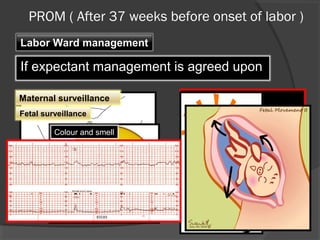
If expectant management is agreed upon
Lower vaginal swabs and maternal CRP should not be offered
Maternal surveillance
Every 4 hours
Colour and smell
Fetal surveillance
PROM ( After 37 weeks before onset of labor )
Labor Ward management
 If patient passed into labor : Deliver.
 If patient developed signs of infection:
Deliver.
 Deliver patient after 24 hours of expectant
management. (Induction, augmentation of
vaginal delivery or CS).
PROM ( After 37 weeks before
onset of labor )
Preterm- PROM
 Diagnosis
The diagnosis of spontaneous rupture of
the membranes is best achieved by
maternal history followed by a sterile
speculum examination. ( B)
Ultrasound examination is useful in some
cases to help confirm the diagnosis. ( B)
Preterm- PROM
 Diagnosis
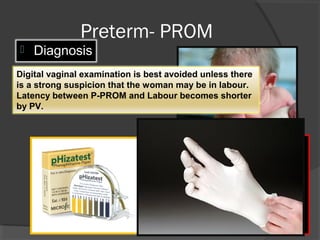
Digital vaginal examination is best avoided unless there
is a strong suspicion that the woman may be in labour.
Latency between P-PROM and Labour becomes shorter
by PV.
Should tocolytic agents be used?
Preterm- PROM
Tocolysis in women with PPROM is not recommended
because this treatment does not significantly improve
perinatal outcome ( A)
In the absence of clear evidence that tocolysis improves
neonatal outcome following PPROM, it is reasonable not to
use it.
Additionally, with PPROM in the presence of uterine
contractions, it is possible that tocolysis could have adverse
effects, such as delaying delivery from an infected
environment, since there is an association between
intrauterine infection, prostaglandin and cytokine release and
delivery.
Preterm- PROM
Are prophylactic antibiotics recommended?
Erythromycin should be given for 10 days
following the diagnosis of PPROM. ( A)
22 trials involving…. over 6000 women ….meta-analysis
This review shows that
•Routine antibiotic administration reduces maternal and neonatal
morbidity.
•Antibiotic therapy also delays delivery, thereby allowing sufficient
time for prophylactic prenatal corticosteroids to take effect.
•The data also showed that prenatal co-amoxiclav increased the risk
of neonatal necrotising enterocolitis and this antibiotic is best avoided.
•Erythromycin or penicillin appears the antibiotic of choice.
•Erythromycin may be used in women who are allergic to penicillin.
Evidence level Ia
PROM ( 34—37 weeks)
Same as above:
Give Corticosteroids.
Deliver after 24 hours from corticosteroid
intake, considering no signs of fetal or
maternal infection , nor labor occurs.
Deliver either by induction , augmentation, or
C.S depending on indication.
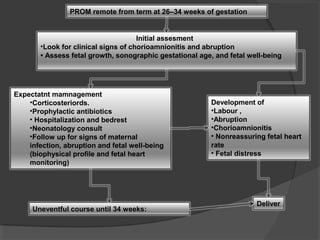
PROM remote from term at 26–34 weeks of gestation
Initial assesment
•Look for clinical signs of chorioamnionitis and abruption
• Assess fetal growth, sonographic gestational age, and fetal well-being
Development of
•Labour ,
•Abruption
•Chorioamnionitis
• Nonreassuring fetal heart
rate
• Fetal distress
Expectatnt mamnagement
•Corticosteriords.
•Prophylactic antibiotics
• Hospitalization and bedrest
•Neonatology consult
•Follow up for signs of maternal
infection, abruption and fetal well-being
(biophysical profile and fetal heart
monitoring)
Uneventful course until 34 weeks:
Deliver
PROM before 26
 Consider termination of pregnancy.
 If patient refused …..manage as 26- 34
weeks
Cervical Circlage and Preterm
PROM
 Occurs in 38% of women with cerclage in
place
 Retention of circlage for more than 24 hours
after PPROM was found to prolong pregnancy
for more than 48 hours, but also to increase
maternal chorioamnionitis and neonatal
mortality from sepsis,
 Immediate circlage removal as the usually
preferred therapeutic approach. Steroids for
fetal maturity before circlage removal can be
considered between 24 and 33 6/7 weeks
gestation
Thank You

Prom

  • 1.
    Prelabor rupture ofthe membranes
  • 2.
    Definitions  Prelabor ruptureof the membranes (PROM) refers to rupture of the chorioamniotic membranes before the onset of labor  latency period: interval between PROM and the onset of labor.  term PROM preterm PROM previable PROM preterm PROM remote from term PROM near term
  • 3.
    Frequency  Term PROMoccurs in approximately 10% of patients, while the frequency of preterm PROM is 2–3.5%
  • 4.
    Consequences of premature ruptureof the membranes  Preterm birth in 50% of PPROM,labor occurs within 24 hours, and in 80–90% within 7 days.  Preterm delivery and complications of prematurity are the most important causes of perinatal mortality and morbidity; complications decrease with advancing GA. ○ Respiratory distress syndrome (RDS), ○ intraventricular hemorrhage (IVH), and ○ periventricular leukomalacia (PVL), ○ infection ○ necrotizing enterocolitis (NEC).
  • 5.
     Infections: motheris at risk of chorioamnionitis, endometritis, and sepsis. Serious maternal consequences are uncommon. Mean incidence of chorioamnionitis is about 3–15%. Major neonatal infectionsoccur in 5% of PPROM, and 15–20% of cases develop chorioamnionitis.  Fetal infection can precede clinically evident chorioamnionitis, resulting in neonatal pulmonary and cerebral morbidities.  Ureaplasma urealyticum and Mycoplasma hominis) are the most frequent isolates from the amniotic fluid, followed by Streptococcus agalactiae (group B streptococcus),
  • 6.
     abruptio placentae, cord prolapse, pulmonary hypoplasia  increased need for cesarean delivery  retained placenta
  • 7.
    once an examinationhas been performed, the clock of infection starts to tick
  • 8.
    PROM ( After37 weeks before onset of labor ) Diagnosis There is no reason to carry out a speculum examination with a certain history of rupture of the membranes at term. Women with an uncertain history of rupture of the membranes should be offered a speculum examination to determine whether their membranes have ruptured. Digital vaginal examination in the absence of contractions should be avoided.
  • 9.
     Complete medicaland Obstetric history: ( special consideration to reach diagnosis of PROM).  Complete general and obstetric examination: Special consideration on signs of infection, maternal tachycardia, fever, abdominal tenderness, foul odour vaginal discharge, fetal tachycardia)  Sterile speculum examination if diagnosis is unclear.  Avoid PV examination unless contractions are present.  Perform Obstetric U/S with special consideration to confirm the diagnosis if unclear.  Admit patients diagnosed as PROM.  Consult a senior resident if diagnosis is unclear. PROM ( After 37 weeks before onset of labor )
  • 10.
    Labor Ward management: Patientis in labor or signs of infection: Deliver the patient: induction or augmentation of vaginal birth or CS according to obstetric indications. PROM ( After 37 weeks before onset of labor )
  • 11.
    PROM ( After37 weeks before onset of labor ) Labor Ward management: Patient is not in labor nor signs of infection: Expectant management for 12-24 hours.  Prophylactic broad spectrum antibiotics. Expectant management: •Follow up maternal fever and foul odor vaginal discharge every 4 hours. •Fetal surveillance ( NST and Kick charts) .
  • 12.
    If expectant managementis agreed upon Lower vaginal swabs and maternal CRP should not be offered Maternal surveillance Every 4 hours Colour and smell Fetal surveillance PROM ( After 37 weeks before onset of labor ) Labor Ward management
  • 13.
     If patientpassed into labor : Deliver.  If patient developed signs of infection: Deliver.  Deliver patient after 24 hours of expectant management. (Induction, augmentation of vaginal delivery or CS). PROM ( After 37 weeks before onset of labor )
  • 14.
    Preterm- PROM  Diagnosis Thediagnosis of spontaneous rupture of the membranes is best achieved by maternal history followed by a sterile speculum examination. ( B) Ultrasound examination is useful in some cases to help confirm the diagnosis. ( B)
  • 15.
    Preterm- PROM  Diagnosis Digitalvaginal examination is best avoided unless there is a strong suspicion that the woman may be in labour. Latency between P-PROM and Labour becomes shorter by PV.
  • 16.
    Should tocolytic agentsbe used? Preterm- PROM Tocolysis in women with PPROM is not recommended because this treatment does not significantly improve perinatal outcome ( A) In the absence of clear evidence that tocolysis improves neonatal outcome following PPROM, it is reasonable not to use it. Additionally, with PPROM in the presence of uterine contractions, it is possible that tocolysis could have adverse effects, such as delaying delivery from an infected environment, since there is an association between intrauterine infection, prostaglandin and cytokine release and delivery.
  • 17.
    Preterm- PROM Are prophylacticantibiotics recommended? Erythromycin should be given for 10 days following the diagnosis of PPROM. ( A) 22 trials involving…. over 6000 women ….meta-analysis This review shows that •Routine antibiotic administration reduces maternal and neonatal morbidity. •Antibiotic therapy also delays delivery, thereby allowing sufficient time for prophylactic prenatal corticosteroids to take effect. •The data also showed that prenatal co-amoxiclav increased the risk of neonatal necrotising enterocolitis and this antibiotic is best avoided. •Erythromycin or penicillin appears the antibiotic of choice. •Erythromycin may be used in women who are allergic to penicillin. Evidence level Ia
  • 18.
    PROM ( 34—37weeks) Same as above: Give Corticosteroids. Deliver after 24 hours from corticosteroid intake, considering no signs of fetal or maternal infection , nor labor occurs. Deliver either by induction , augmentation, or C.S depending on indication.
  • 19.
    PROM remote fromterm at 26–34 weeks of gestation Initial assesment •Look for clinical signs of chorioamnionitis and abruption • Assess fetal growth, sonographic gestational age, and fetal well-being Development of •Labour , •Abruption •Chorioamnionitis • Nonreassuring fetal heart rate • Fetal distress Expectatnt mamnagement •Corticosteriords. •Prophylactic antibiotics • Hospitalization and bedrest •Neonatology consult •Follow up for signs of maternal infection, abruption and fetal well-being (biophysical profile and fetal heart monitoring) Uneventful course until 34 weeks: Deliver
  • 20.
    PROM before 26 Consider termination of pregnancy.  If patient refused …..manage as 26- 34 weeks
  • 21.
    Cervical Circlage andPreterm PROM  Occurs in 38% of women with cerclage in place  Retention of circlage for more than 24 hours after PPROM was found to prolong pregnancy for more than 48 hours, but also to increase maternal chorioamnionitis and neonatal mortality from sepsis,  Immediate circlage removal as the usually preferred therapeutic approach. Steroids for fetal maturity before circlage removal can be considered between 24 and 33 6/7 weeks gestation
  • 22.

Editor's Notes

  • #16 In case of doubt, demonstration that vaginal fluid has an alkaline pH on Nitrazine yellow testing (the pH indicator turning black) is suggestive but not conclusive evidence of PROM. The normal vaginal pH is acidic and becomes neutral or alkaline owing to the presence of amniotic fluid.