Precision Conservation:
The Human Component
Linda Stalker Prokopy, Ph.D.
Purdue University
benziecd.org
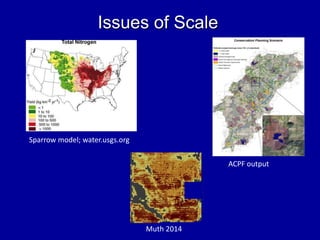
Sparrow model; water.usgs.org
ACPF output
Issues of Scale
Muth 2014
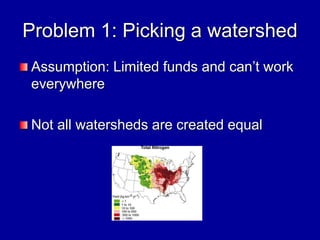
Problem 1: Picking a watershed
Assumption: Limited funds and can’t work
everywhere
Not all watersheds are created equal
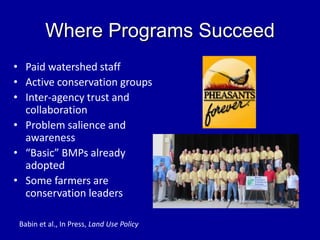
Where Programs Succeed
• Paid watershed staff
• Active conservation groups
• Inter-agency trust and
collaboration
• Problem salience and
awareness
• “Basic” BMPs already
adopted
• Some farmers are
conservation leaders
Babin et al., In Press, Land Use Policy
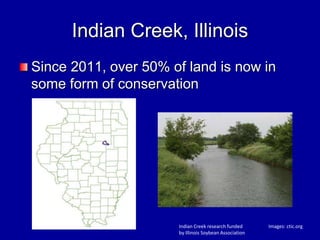
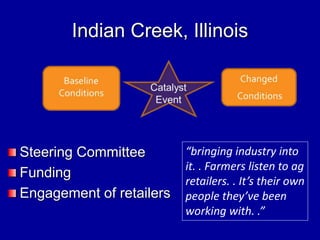
Indian Creek, Illinois
Since 2011, over 50% of land is now in
some form of conservation
Images: ctic.orgIndian Creek research funded
by Illinois Soybean Association
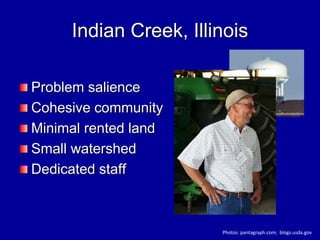
Indian Creek, Illinois
Problem salience
Cohesive community
Minimal rented land
Small watershed
Dedicated staff
Photos: pantagraph.com; blogs.usda.gov
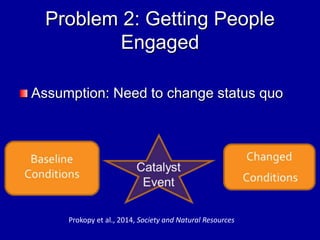
Problem 2: Getting People
Engaged
Assumption: Need to change status quo
Prokopy et al., 2014, Society and Natural Resources
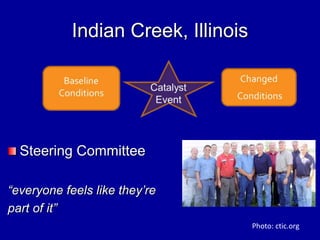
Indian Creek, Illinois
Photo: ctic.org
Steering Committee
“everyone feels like they’re
part of it”
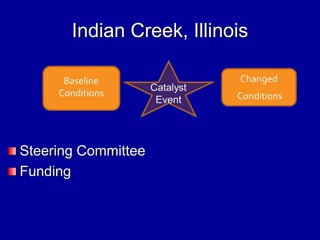
Indian Creek, Illinois
Steering Committee
Funding
Indian Creek, Illinois
Steering Committee
Funding
Engagement of retailers
“bringing industry into
it. . Farmers listen to ag
retailers. . It’s their own
people they’ve been
working with. .”
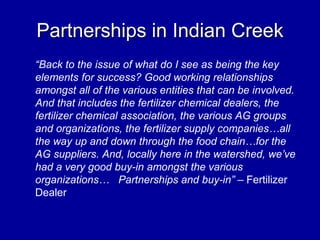
Partnerships in Indian Creek
“Back to the issue of what do I see as being the key
elements for success? Good working relationships
amongst all of the various entities that can be involved.
And that includes the fertilizer chemical dealers, the
fertilizer chemical association, the various AG groups
and organizations, the fertilizer supply companies…all
the way up and down through the food chain…for the
AG suppliers. And, locally here in the watershed, we’ve
had a very good buy-in amongst the various
organizations… Partnerships and buy-in” – Fertilizer
Dealer
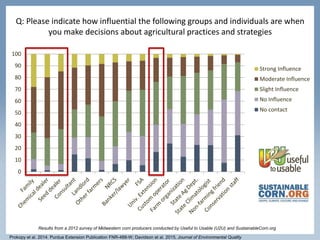
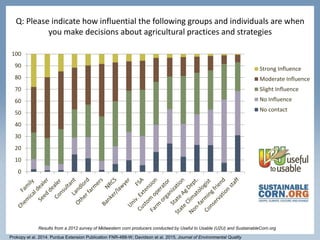
Q: Please indicate how influential the following groups and individuals are when
you make decisions about agricultural practices and strategies
Results from a 2012 survey of Midwestern corn producers conducted by Useful to Usable (U2U) and SustainableCorn.org
0
10
20
30
40
50
60
70
80
90
100
Strong Influence
Moderate Influence
Slight Influence
No Influence
No contact
Prokopy et al. 2014. Purdue Extension Publication FNR-488-W; Davidson et al. 2015, Journal of Environmental Quality
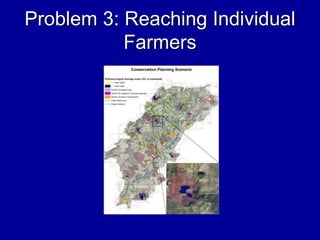
Problem 3: Reaching Individual
Farmers
social networks
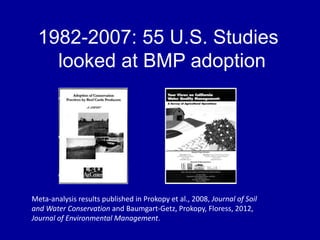
1982-2007: 55 U.S. Studies
looked at BMP adoption
Meta-analysis results published in Prokopy et al., 2008, Journal of Soil
and Water Conservation and Baumgart-Getz, Prokopy, Floress, 2012,
Journal of Environmental Management.
1982-2007: 55 U.S. Studies
Overall Finding:
– Very few generalizable trends
However 
Age
1982-2007: 55 U.S. Studies
Overall Finding:
– Very few generalizable trends
However 
Farm size
1982-2007: 55 U.S. Studies
Overall Finding:
– Very few generalizable trends
However 
Environmental
attitudes
Attitudes
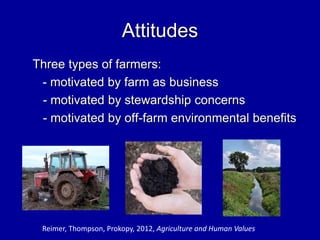
Three types of farmers:
- motivated by farm as business
- motivated by stewardship concerns
- motivated by off-farm environmental benefits
Reimer, Thompson, Prokopy, 2012, Agriculture and Human Values
1982-2007: 55 U.S. Studies
Overall Finding:
– Very few generalizable trends
However 
Q: Please indicate how influential the following groups and individuals are when
you make decisions about agricultural practices and strategies
Results from a 2012 survey of Midwestern corn producers conducted by Useful to Usable (U2U) and SustainableCorn.org
0
10
20
30
40
50
60
70
80
90
100
Strong Influence
Moderate Influence
Slight Influence
No Influence
No contact
Prokopy et al. 2014. Purdue Extension Publication FNR-488-W; Davidson et al. 2015, Journal of Environmental Quality
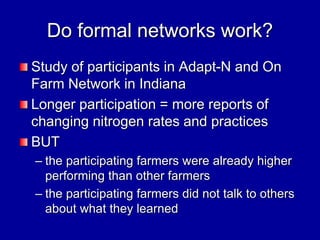
Do formal networks work?
Study of participants in Adapt-N and On
Farm Network in Indiana
Longer participation = more reports of
changing nitrogen rates and practices
BUT
– the participating farmers were already higher
performing than other farmers
– the participating farmers did not talk to others
about what they learned
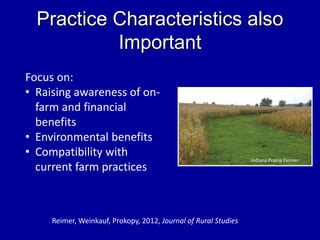
Practice Characteristics also
Important
Focus on:
• Raising awareness of on-
farm and financial
benefits
• Environmental benefits
• Compatibility with
current farm practices
Reimer, Weinkauf, Prokopy, 2012, Journal of Rural Studies
Indiana Prairie Farmer
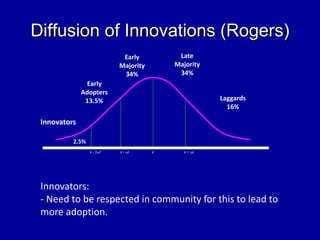
Diffusion of Innovations (Rogers)
Early
Majority
34%
Late
Majority
34%
Early
Adopters
13.5%
Innovators
2.5%
Laggards
16%
x - 2sd x - sd x x + sd
Innovators:
- Need to be respected in community for this to lead to
more adoption.
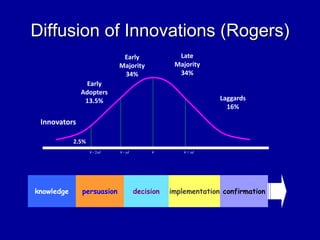
Diffusion of Innovations (Rogers)
Early
Majority
34%
Late
Majority
34%
Early
Adopters
13.5%
Innovators
2.5%
Laggards
16%
x - 2sd x - sd x x + sd
knowledge persuasion implementation confirmationdecision
What motivates maintenance?
Local networks – being connected to
community groups
– Social norm towards BMP maintenance?
Sense of ownership is important
– Hesitancy to participate in government
programs leads to longer term maintenance
Adam Baumgart-Getz, Ph.D. Dissertation, 2010
Early Adopters of Cover Crops
Likely to keep using:
– Years of experience
– Believe trial and error effective means of
learning
– Supportive landlords
Likely to discontinue: self-funders
Data Source: CTIC/SARE cover crop survey 2014
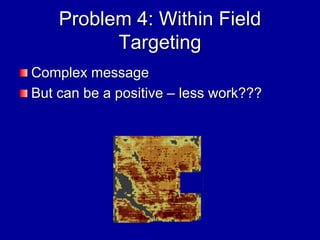
Problem 4: Within Field
Targeting
Complex message
But can be a positive – less work???
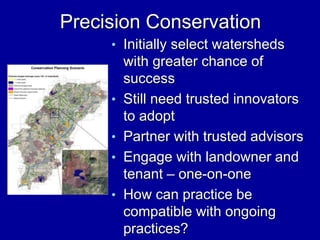
Precision Conservation
• Initially select watersheds
with greater chance of
success
• Still need trusted innovators
to adopt
• Partner with trusted advisors
• Engage with landowner and
tenant – one-on-one
• How can practice be
compatible with ongoing
practices?
Contact Information:
Linda Prokopy
lprokopy@purdue.edu
http://web.ics.purdue.edu/~lprokopy/
@lprokopy
Photo credit: nasa.gov
Questions?

Tuesday Plenary Panel - Prokopy

  • 1.
    Precision Conservation: The HumanComponent Linda Stalker Prokopy, Ph.D. Purdue University benziecd.org
  • 2.
    Sparrow model; water.usgs.org ACPFoutput Issues of Scale Muth 2014
  • 3.
    Problem 1: Pickinga watershed Assumption: Limited funds and can’t work everywhere Not all watersheds are created equal
  • 4.
    Where Programs Succeed •Paid watershed staff • Active conservation groups • Inter-agency trust and collaboration • Problem salience and awareness • “Basic” BMPs already adopted • Some farmers are conservation leaders Babin et al., In Press, Land Use Policy
  • 5.
    Indian Creek, Illinois Since2011, over 50% of land is now in some form of conservation Images: ctic.orgIndian Creek research funded by Illinois Soybean Association
  • 6.
    Indian Creek, Illinois Problemsalience Cohesive community Minimal rented land Small watershed Dedicated staff Photos: pantagraph.com; blogs.usda.gov
  • 7.
    Problem 2: GettingPeople Engaged Assumption: Need to change status quo Prokopy et al., 2014, Society and Natural Resources
  • 8.
    Indian Creek, Illinois Photo:ctic.org Steering Committee “everyone feels like they’re part of it”
  • 9.
  • 10.
    Indian Creek, Illinois SteeringCommittee Funding Engagement of retailers “bringing industry into it. . Farmers listen to ag retailers. . It’s their own people they’ve been working with. .”
  • 11.
    Partnerships in IndianCreek “Back to the issue of what do I see as being the key elements for success? Good working relationships amongst all of the various entities that can be involved. And that includes the fertilizer chemical dealers, the fertilizer chemical association, the various AG groups and organizations, the fertilizer supply companies…all the way up and down through the food chain…for the AG suppliers. And, locally here in the watershed, we’ve had a very good buy-in amongst the various organizations… Partnerships and buy-in” – Fertilizer Dealer
  • 12.
    Q: Please indicatehow influential the following groups and individuals are when you make decisions about agricultural practices and strategies Results from a 2012 survey of Midwestern corn producers conducted by Useful to Usable (U2U) and SustainableCorn.org 0 10 20 30 40 50 60 70 80 90 100 Strong Influence Moderate Influence Slight Influence No Influence No contact Prokopy et al. 2014. Purdue Extension Publication FNR-488-W; Davidson et al. 2015, Journal of Environmental Quality
  • 13.
    Problem 3: ReachingIndividual Farmers
  • 14.
  • 15.
    1982-2007: 55 U.S.Studies looked at BMP adoption Meta-analysis results published in Prokopy et al., 2008, Journal of Soil and Water Conservation and Baumgart-Getz, Prokopy, Floress, 2012, Journal of Environmental Management.
  • 16.
    1982-2007: 55 U.S.Studies Overall Finding: – Very few generalizable trends However  Age
  • 17.
    1982-2007: 55 U.S.Studies Overall Finding: – Very few generalizable trends However  Farm size
  • 18.
    1982-2007: 55 U.S.Studies Overall Finding: – Very few generalizable trends However  Environmental attitudes
  • 19.
    Attitudes Three types offarmers: - motivated by farm as business - motivated by stewardship concerns - motivated by off-farm environmental benefits Reimer, Thompson, Prokopy, 2012, Agriculture and Human Values
  • 20.
    1982-2007: 55 U.S.Studies Overall Finding: – Very few generalizable trends However 
  • 21.
    Q: Please indicatehow influential the following groups and individuals are when you make decisions about agricultural practices and strategies Results from a 2012 survey of Midwestern corn producers conducted by Useful to Usable (U2U) and SustainableCorn.org 0 10 20 30 40 50 60 70 80 90 100 Strong Influence Moderate Influence Slight Influence No Influence No contact Prokopy et al. 2014. Purdue Extension Publication FNR-488-W; Davidson et al. 2015, Journal of Environmental Quality
  • 22.
    Do formal networkswork? Study of participants in Adapt-N and On Farm Network in Indiana Longer participation = more reports of changing nitrogen rates and practices BUT – the participating farmers were already higher performing than other farmers – the participating farmers did not talk to others about what they learned
  • 23.
    Practice Characteristics also Important Focuson: • Raising awareness of on- farm and financial benefits • Environmental benefits • Compatibility with current farm practices Reimer, Weinkauf, Prokopy, 2012, Journal of Rural Studies Indiana Prairie Farmer
  • 24.
    Diffusion of Innovations(Rogers) Early Majority 34% Late Majority 34% Early Adopters 13.5% Innovators 2.5% Laggards 16% x - 2sd x - sd x x + sd Innovators: - Need to be respected in community for this to lead to more adoption.
  • 25.
    Diffusion of Innovations(Rogers) Early Majority 34% Late Majority 34% Early Adopters 13.5% Innovators 2.5% Laggards 16% x - 2sd x - sd x x + sd knowledge persuasion implementation confirmationdecision
  • 26.
    What motivates maintenance? Localnetworks – being connected to community groups – Social norm towards BMP maintenance? Sense of ownership is important – Hesitancy to participate in government programs leads to longer term maintenance Adam Baumgart-Getz, Ph.D. Dissertation, 2010
  • 27.
    Early Adopters ofCover Crops Likely to keep using: – Years of experience – Believe trial and error effective means of learning – Supportive landlords Likely to discontinue: self-funders Data Source: CTIC/SARE cover crop survey 2014
  • 28.
    Problem 4: WithinField Targeting Complex message But can be a positive – less work???
  • 29.
    Precision Conservation • Initiallyselect watersheds with greater chance of success • Still need trusted innovators to adopt • Partner with trusted advisors • Engage with landowner and tenant – one-on-one • How can practice be compatible with ongoing practices?
  • 30.