Physics 111: Mechanics
Lecture 3
Dale Gary
NJIT Physics Department
February 5-8, 2013
Motion in Two Dimensions
 Reminder of vectors and vector algebra
 Displacement and position in 2-D
 Average and instantaneous velocity in 2-D
 Average and instantaneous acceleration in 2-
D
 Projectile motion
 Uniform circular motion
 Relative velocity*
February 5-8, 2013
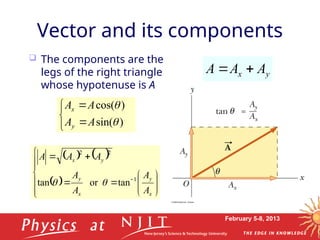
Vector and its components
 The components are the
legs of the right triangle
whose hypotenuse is A
y
x A
A
A





2 2 1
tan y
x y
x
A
A A A and
A
   
    
 
)
sin(
)
cos(







A
A
A
A
y
x
Or,
   
 




















x
y
x
y
y
x
A
A
A
A
A
A
A
1
2
2
tan
or
tan 


February 5-8, 2013
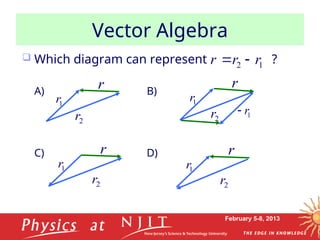
 Which diagram can represent ?
A) B)
C) D)
Vector Algebra
1
2 r
r
r





r

2
r

1
r

r

2
r

1
r

r

2
r

1
r
 r

2
r

1
r

1
r


February 5-8, 2013
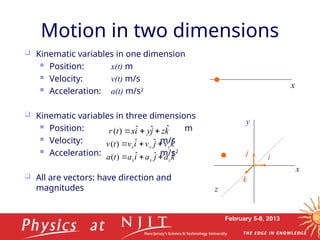
 Kinematic variables in one dimension
 Position: x(t) m
 Velocity: v(t) m/s
 Acceleration: a(t) m/s2
 Kinematic variables in three dimensions
 Position: m
 Velocity: m/s
 Acceleration: m/s2
 All are vectors: have direction and
magnitudes
Motion in two dimensions
k
v
j
v
i
v
t
v z
y
x
ˆ
ˆ
ˆ
)
( 



y
x
z
i
j
k
x
k
z
j
y
i
x
t
r ˆ
ˆ
ˆ
)
( 



k
a
j
a
i
a
t
a z
y
x
ˆ
ˆ
ˆ
)
( 



February 5-8, 2013
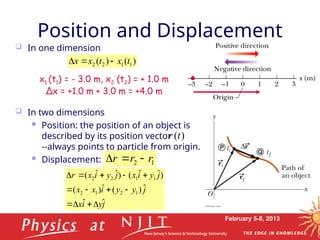
 In one dimension
 In two dimensions
 Position: the position of an object is
described by its position vector
--always points to particle from origin.
 Displacement:
x1 (t1) = - 3.0 m, x2 (t2) = + 1.0 m
Δx = +1.0 m + 3.0 m = +4.0 m
Position and Displacement
)
(t
r

1
2 r
r
r






j
y
i
x
j
y
y
i
x
x
j
y
i
x
j
y
i
x
r
ˆ
ˆ
ˆ
)
(
ˆ
)
(
)
ˆ
ˆ
(
)
ˆ
ˆ
(
1
2
1
2
1
1
2
2














)
(
)
( 1
1
2
2 t
x
t
x
x 


1
2 r
r
r






February 5-8, 2013
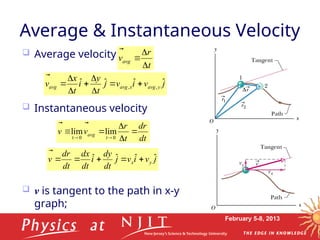
 Average velocity
 Instantaneous velocity
 v is tangent to the path in x-y
graph;
Average & Instantaneous Velocity
dt
r
d
t
r
v
v
t
avg










 0
0
t
lim
lim
j
v
i
v
j
t
y
i
t
x
v y
avg
x
avg
avg
ˆ
ˆ
ˆ
ˆ ,
, 








t
r
vavg





j
v
i
v
j
dt
dy
i
dt
dx
dt
r
d
v y
x
ˆ
ˆ
ˆ
ˆ 






February 5-8, 2013
Motion of a Turtle
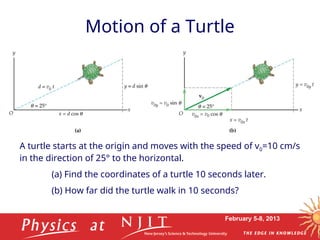
A turtle starts at the origin and moves with the speed of v0=10 cm/s
in the direction of 25° to the horizontal.
(a) Find the coordinates of a turtle 10 seconds later.
(b) How far did the turtle walk in 10 seconds?
February 5-8, 2013
Motion of a Turtle
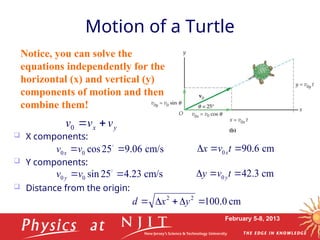
Notice, you can solve the
equations independently for the
horizontal (x) and vertical (y)
components of motion and then
combine them!
y
x v
v
v





0
0 0 cos25 9.06 cm/s
x
v v
 

 X components:
 Y components:
 Distance from the origin:
0 90.6 cm
x
x v t
  
0 0 sin 25 4.23 cm/s
y
v v
 

0 42.3 cm
y
y v t
  
cm
0
.
100
2
2




 y
x
d
February 5-8, 2013
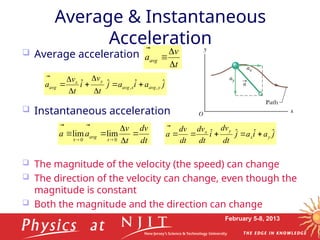
 Average acceleration
 Instantaneous acceleration
 The magnitude of the velocity (the speed) can change
 The direction of the velocity can change, even though the
magnitude is constant
 Both the magnitude and the direction can change
Average & Instantaneous
Acceleration
dt
v
d
t
v
a
a
t
avg










 0
0
t
lim
lim
j
a
i
a
j
t
v
i
t
v
a y
avg
x
avg
y
x
avg
ˆ
ˆ
ˆ
ˆ ,
, 








t
v
aavg





j
a
i
a
j
dt
dv
i
dt
dv
dt
v
d
a y
x
y
x ˆ
ˆ
ˆ
ˆ 






February 5-8, 2013
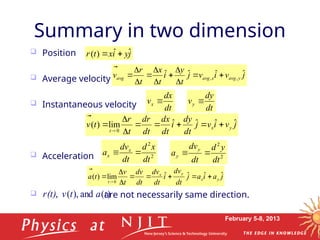
 Position
 Average velocity
 Instantaneous velocity
 Acceleration
 are not necessarily same direction.
Summary in two dimension
j
y
i
x
t
r ˆ
ˆ
)
( 


j
a
i
a
j
dt
dv
i
dt
dv
dt
v
d
t
v
t
a y
x
y
x
t
ˆ
ˆ
ˆ
ˆ
lim
)
(
0












j
v
i
v
j
t
y
i
t
x
t
r
v y
avg
x
avg
avg
ˆ
ˆ
ˆ
ˆ ,
, 












j
v
i
v
j
dt
dy
i
dt
dx
dt
r
d
t
r
t
v y
x
t
ˆ
ˆ
ˆ
ˆ
lim
)
(
0












dt
dx
vx 
dt
dy
vy 
2
2
dt
x
d
dt
dv
a x
x 
 2
2
dt
y
d
dt
dv
a
y
y 

)
(
and
),
(
, t
a
t
v
(t)
r



February 5-8, 2013
Motion in two dimensions
t
a
v
v




 0
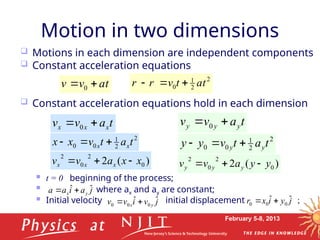
 Motions in each dimension are independent components
 Constant acceleration equations
 Constant acceleration equations hold in each dimension
 t = 0 beginning of the process;
 where ax and ay are constant;
 Initial velocity initial displacement ;
2
2
1
0 t
a
t
v
r
r







t
a
v
v y
y
y 
 0
2
2
1
0
0 t
a
t
v
y
y y
y 


)
(
2 0
2
0
2
y
y
a
v
v y
y
y 


t
a
v
v x
x
x 
 0
2
2
1
0
0 t
a
t
v
x
x x
x 


)
(
2 0
2
0
2
x
x
a
v
v x
x
x 


j
a
i
a
a y
x
ˆ
ˆ 


j
v
i
v
v y
x
ˆ
ˆ 0
0
0 


j
y
i
x
r ˆ
ˆ 0
0
0 


February 5-8, 2013
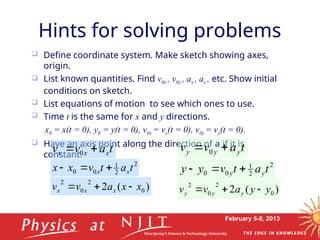
 Define coordinate system. Make sketch showing axes,
origin.
 List known quantities. Find v0x , v0y , ax , ay , etc. Show initial
conditions on sketch.
 List equations of motion to see which ones to use.
 Time t is the same for x and y directions.
x0 = x(t = 0), y0 = y(t = 0), v0x = vx(t = 0), v0y = vy(t = 0).
 Have an axis point along the direction of a if it is
constant.
Hints for solving problems
t
a
v
v y
y
y 
 0
2
2
1
0
0 t
a
t
v
y
y y
y 


)
(
2 0
2
0
2
y
y
a
v
v y
y
y 


t
a
v
v x
x
x 
 0
2
2
1
0
0 t
a
t
v
x
x x
x 


)
(
2 0
2
0
2
x
x
a
v
v x
x
x 


February 5-8, 2013
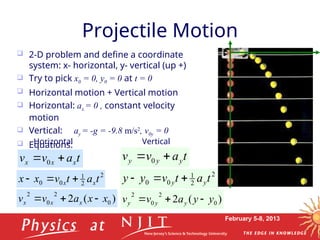
 2-D problem and define a coordinate
system: x- horizontal, y- vertical (up +)
 Try to pick x0 = 0, y0 = 0 at t = 0
 Horizontal motion + Vertical motion
 Horizontal: ax = 0 , constant velocity
motion
 Vertical: ay = -g = -9.8 m/s2
, v0y = 0
 Equations:
Projectile Motion
2
2
1
gt
t
v
y
y iy
i
f 


t
a
v
v y
y
y 
 0
2
2
1
0
0 t
a
t
v
y
y y
y 


)
(
2 0
2
0
2
y
y
a
v
v y
y
y 


t
a
v
v x
x
x 
 0
2
2
1
0
0 t
a
t
v
x
x x
x 


)
(
2 0
2
0
2
x
x
a
v
v x
x
x 


Horizontal Vertical
February 5-8, 2013
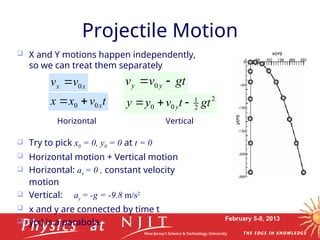
 X and Y motions happen independently,
so we can treat them separately
 Try to pick x0 = 0, y0 = 0 at t = 0
 Horizontal motion + Vertical motion
 Horizontal: ax = 0 , constant velocity
motion
 Vertical: ay = -g = -9.8 m/s2
 x and y are connected by time t
 y(x) is a parabola
Projectile Motion
gt
v
v y
y 
 0
2
2
1
0
0 gt
t
v
y
y y 


x
x v
v 0

t
v
x
x x
0
0 

Horizontal Vertical
February 5-8, 2013
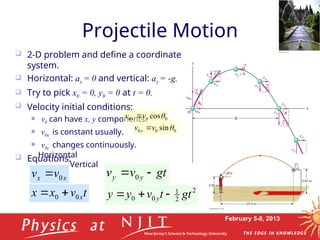
 2-D problem and define a coordinate
system.
 Horizontal: ax = 0 and vertical: ay = -g.
 Try to pick x0 = 0, y0 = 0 at t = 0.
 Velocity initial conditions:
 v0 can have x, y components.
 v0x is constant usually.
 v0y changes continuously.
 Equations:
Projectile Motion
0
0
0 cos
v
v x 
Horizontal
Vertical
0
0
0 sin
v
v x 
gt
v
v y
y 
 0
2
2
1
0
0 gt
t
v
y
y y 


x
x v
v 0

t
v
x
x x
0
0 

February 5-8, 2013
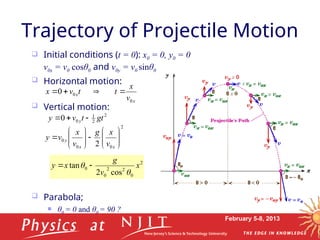
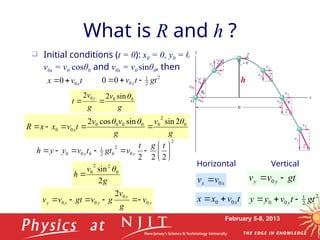
 Initial conditions (t = 0): x0 = 0, y0 = 0
v0x = v0 cosθ0 and v0y = v0 sinθ0
 Horizontal motion:
 Vertical motion:
 Parabola;
 θ0 = 0 and θ0 = 90 ?
Trajectory of Projectile Motion
2
2
1
0
0 gt
t
v
y y 


x
x
v
x
t
t
v
x
0
0
0 



2
0
0
0
2 

















x
x
y
v
x
g
v
x
v
y
2
0
2
2
0
0
cos
2
tan x
v
g
x
y

 

February 5-8, 2013
 Initial conditions (t = 0): x0 = 0, y0 = 0
v0x = v0 cosθ0 and v0x = v0 sinθ0, then
What is R and h ?
Horizontal Vertical
2
2
1
0
0
0 gt
t
v y 


t
v
x x
0
0 

g
v
g
v
v
t
v
x
x
R x
0
2
0
0
0
0
0
0
0
2
sin
sin
cos
2 







g
v
g
v
t y 0
0
0 sin
2
2 


2
0
2
2
1
0
0
2
2
2












t
g
t
v
gt
t
v
y
y
h y
h
h
y
g
v
h
2
sin 0
2
2
0 

y
y
y
y
y v
g
v
g
v
gt
v
v 0
0
0
0
2






h
gt
v
v y
y 
 0
2
2
1
0
0 gt
t
v
y
y y 


x
x v
v 0

t
v
x
x x
0
0 

February 5-8, 2013
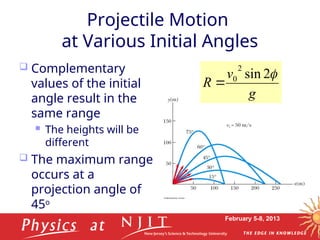
Projectile Motion
at Various Initial Angles
 Complementary
values of the initial
angle result in the
same range
 The heights will be
different
 The maximum range
occurs at a
projection angle of
45o
g
v
R

2
sin
2
0

February 5-8, 2013
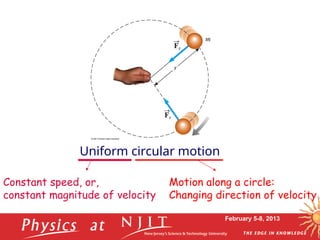
Uniform circular motion
Constant speed, or,
constant magnitude of velocity
Motion along a circle:
Changing direction of velocity
February 5-8, 2013
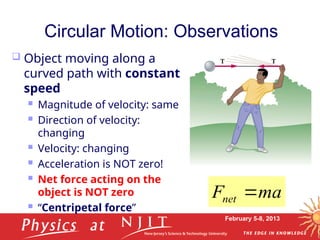
Circular Motion: Observations
 Object moving along a
curved path with constant
speed
 Magnitude of velocity: same
 Direction of velocity:
changing
 Velocity: changing
 Acceleration is NOT zero!
 Net force acting on the
object is NOT zero
 “Centripetal force”
a
m
Fnet



February 5-8, 2013
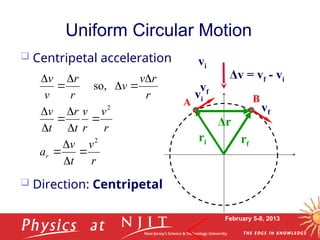
 Centripetal acceleration
 Direction: Centripetal
Uniform Circular Motion
r
v
t
v
a
r
v
r
v
t
r
t
v
r
r
v
v
r
r
v
v
r
2
2
so,
















O
x
y
ri
R
A B
vi
rf
vf
Δr
vi
vf
Δv = vf - vi
February 5-8, 2013
Uniform Circular Motion
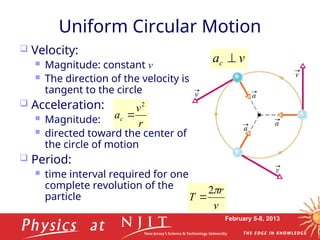
 Velocity:
 Magnitude: constant v
 The direction of the velocity is
tangent to the circle
 Acceleration:
 Magnitude:
 directed toward the center of
the circle of motion
 Period:
 time interval required for one
complete revolution of the
particle
r
v
ac
2

r
v
ac
2

v
r
T

2

v
ac



February 5-8, 2013
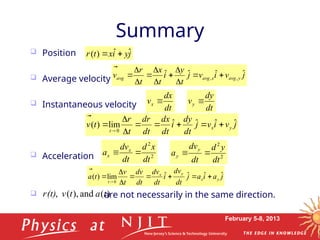
 Position
 Average velocity
 Instantaneous velocity
 Acceleration
 are not necessarily in the same direction.
Summary
j
y
i
x
t
r ˆ
ˆ
)
( 


j
a
i
a
j
dt
dv
i
dt
dv
dt
v
d
t
v
t
a y
x
y
x
t
ˆ
ˆ
ˆ
ˆ
lim
)
(
0












j
v
i
v
j
t
y
i
t
x
t
r
v y
avg
x
avg
avg
ˆ
ˆ
ˆ
ˆ ,
, 












j
v
i
v
j
dt
dy
i
dt
dx
dt
r
d
t
r
t
v y
x
t
ˆ
ˆ
ˆ
ˆ
lim
)
(
0












dt
dx
vx 
dt
dy
vy 
2
2
dt
x
d
dt
dv
a x
x 
 2
2
dt
y
d
dt
dv
a
y
y 

)
(
and
),
(
, t
a
t
v
(t)
r



February 5-8, 2013
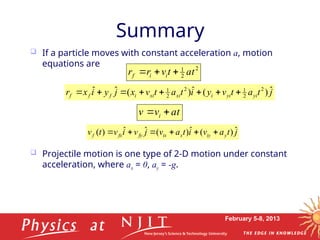
 If a particle moves with constant acceleration a, motion
equations are
 Projectile motion is one type of 2-D motion under constant
acceleration, where ax = 0, ay = -g.
Summary
j
t
a
t
v
y
i
t
a
t
v
x
j
y
i
x
r yi
yi
i
xi
xi
i
f
f
f
ˆ
)
(
ˆ
)
(
ˆ
ˆ 2
2
1
2
2
1









j
t
a
v
i
t
a
v
j
v
i
v
t
v y
iy
x
ix
fy
fx
f
ˆ
)
(
ˆ
)
(
ˆ
ˆ
)
( 






t
a
v
v i





2
2
1
t
a
t
v
r
r i
i
f








PROJECTILE AND PROJECTILE MOTION- PHYSICAL SCIENCE.ppt

  • 1.
    Physics 111: Mechanics Lecture3 Dale Gary NJIT Physics Department
  • 2.
    February 5-8, 2013 Motionin Two Dimensions  Reminder of vectors and vector algebra  Displacement and position in 2-D  Average and instantaneous velocity in 2-D  Average and instantaneous acceleration in 2- D  Projectile motion  Uniform circular motion  Relative velocity*
  • 3.
    February 5-8, 2013 Vectorand its components  The components are the legs of the right triangle whose hypotenuse is A y x A A A      2 2 1 tan y x y x A A A A and A            ) sin( ) cos(        A A A A y x Or,                           x y x y y x A A A A A A A 1 2 2 tan or tan   
  • 4.
    February 5-8, 2013 Which diagram can represent ? A) B) C) D) Vector Algebra 1 2 r r r      r  2 r  1 r  r  2 r  1 r  r  2 r  1 r  r  2 r  1 r  1 r  
  • 5.
    February 5-8, 2013 Kinematic variables in one dimension  Position: x(t) m  Velocity: v(t) m/s  Acceleration: a(t) m/s2  Kinematic variables in three dimensions  Position: m  Velocity: m/s  Acceleration: m/s2  All are vectors: have direction and magnitudes Motion in two dimensions k v j v i v t v z y x ˆ ˆ ˆ ) (     y x z i j k x k z j y i x t r ˆ ˆ ˆ ) (     k a j a i a t a z y x ˆ ˆ ˆ ) (    
  • 6.
    February 5-8, 2013 In one dimension  In two dimensions  Position: the position of an object is described by its position vector --always points to particle from origin.  Displacement: x1 (t1) = - 3.0 m, x2 (t2) = + 1.0 m Δx = +1.0 m + 3.0 m = +4.0 m Position and Displacement ) (t r  1 2 r r r       j y i x j y y i x x j y i x j y i x r ˆ ˆ ˆ ) ( ˆ ) ( ) ˆ ˆ ( ) ˆ ˆ ( 1 2 1 2 1 1 2 2               ) ( ) ( 1 1 2 2 t x t x x    1 2 r r r      
  • 7.
    February 5-8, 2013 Average velocity  Instantaneous velocity  v is tangent to the path in x-y graph; Average & Instantaneous Velocity dt r d t r v v t avg            0 0 t lim lim j v i v j t y i t x v y avg x avg avg ˆ ˆ ˆ ˆ , ,          t r vavg      j v i v j dt dy i dt dx dt r d v y x ˆ ˆ ˆ ˆ       
  • 8.
    February 5-8, 2013 Motionof a Turtle A turtle starts at the origin and moves with the speed of v0=10 cm/s in the direction of 25° to the horizontal. (a) Find the coordinates of a turtle 10 seconds later. (b) How far did the turtle walk in 10 seconds?
  • 9.
    February 5-8, 2013 Motionof a Turtle Notice, you can solve the equations independently for the horizontal (x) and vertical (y) components of motion and then combine them! y x v v v      0 0 0 cos25 9.06 cm/s x v v     X components:  Y components:  Distance from the origin: 0 90.6 cm x x v t    0 0 sin 25 4.23 cm/s y v v    0 42.3 cm y y v t    cm 0 . 100 2 2      y x d
  • 10.
    February 5-8, 2013 Average acceleration  Instantaneous acceleration  The magnitude of the velocity (the speed) can change  The direction of the velocity can change, even though the magnitude is constant  Both the magnitude and the direction can change Average & Instantaneous Acceleration dt v d t v a a t avg            0 0 t lim lim j a i a j t v i t v a y avg x avg y x avg ˆ ˆ ˆ ˆ , ,          t v aavg      j a i a j dt dv i dt dv dt v d a y x y x ˆ ˆ ˆ ˆ       
  • 11.
    February 5-8, 2013 Position  Average velocity  Instantaneous velocity  Acceleration  are not necessarily same direction. Summary in two dimension j y i x t r ˆ ˆ ) (    j a i a j dt dv i dt dv dt v d t v t a y x y x t ˆ ˆ ˆ ˆ lim ) ( 0             j v i v j t y i t x t r v y avg x avg avg ˆ ˆ ˆ ˆ , ,              j v i v j dt dy i dt dx dt r d t r t v y x t ˆ ˆ ˆ ˆ lim ) ( 0             dt dx vx  dt dy vy  2 2 dt x d dt dv a x x   2 2 dt y d dt dv a y y   ) ( and ), ( , t a t v (t) r   
  • 12.
    February 5-8, 2013 Motionin two dimensions t a v v      0  Motions in each dimension are independent components  Constant acceleration equations  Constant acceleration equations hold in each dimension  t = 0 beginning of the process;  where ax and ay are constant;  Initial velocity initial displacement ; 2 2 1 0 t a t v r r        t a v v y y y   0 2 2 1 0 0 t a t v y y y y    ) ( 2 0 2 0 2 y y a v v y y y    t a v v x x x   0 2 2 1 0 0 t a t v x x x x    ) ( 2 0 2 0 2 x x a v v x x x    j a i a a y x ˆ ˆ    j v i v v y x ˆ ˆ 0 0 0    j y i x r ˆ ˆ 0 0 0   
  • 13.
    February 5-8, 2013 Define coordinate system. Make sketch showing axes, origin.  List known quantities. Find v0x , v0y , ax , ay , etc. Show initial conditions on sketch.  List equations of motion to see which ones to use.  Time t is the same for x and y directions. x0 = x(t = 0), y0 = y(t = 0), v0x = vx(t = 0), v0y = vy(t = 0).  Have an axis point along the direction of a if it is constant. Hints for solving problems t a v v y y y   0 2 2 1 0 0 t a t v y y y y    ) ( 2 0 2 0 2 y y a v v y y y    t a v v x x x   0 2 2 1 0 0 t a t v x x x x    ) ( 2 0 2 0 2 x x a v v x x x   
  • 14.
    February 5-8, 2013 2-D problem and define a coordinate system: x- horizontal, y- vertical (up +)  Try to pick x0 = 0, y0 = 0 at t = 0  Horizontal motion + Vertical motion  Horizontal: ax = 0 , constant velocity motion  Vertical: ay = -g = -9.8 m/s2 , v0y = 0  Equations: Projectile Motion 2 2 1 gt t v y y iy i f    t a v v y y y   0 2 2 1 0 0 t a t v y y y y    ) ( 2 0 2 0 2 y y a v v y y y    t a v v x x x   0 2 2 1 0 0 t a t v x x x x    ) ( 2 0 2 0 2 x x a v v x x x    Horizontal Vertical
  • 15.
    February 5-8, 2013 X and Y motions happen independently, so we can treat them separately  Try to pick x0 = 0, y0 = 0 at t = 0  Horizontal motion + Vertical motion  Horizontal: ax = 0 , constant velocity motion  Vertical: ay = -g = -9.8 m/s2  x and y are connected by time t  y(x) is a parabola Projectile Motion gt v v y y   0 2 2 1 0 0 gt t v y y y    x x v v 0  t v x x x 0 0   Horizontal Vertical
  • 16.
    February 5-8, 2013 2-D problem and define a coordinate system.  Horizontal: ax = 0 and vertical: ay = -g.  Try to pick x0 = 0, y0 = 0 at t = 0.  Velocity initial conditions:  v0 can have x, y components.  v0x is constant usually.  v0y changes continuously.  Equations: Projectile Motion 0 0 0 cos v v x  Horizontal Vertical 0 0 0 sin v v x  gt v v y y   0 2 2 1 0 0 gt t v y y y    x x v v 0  t v x x x 0 0  
  • 17.
    February 5-8, 2013 Initial conditions (t = 0): x0 = 0, y0 = 0 v0x = v0 cosθ0 and v0y = v0 sinθ0  Horizontal motion:  Vertical motion:  Parabola;  θ0 = 0 and θ0 = 90 ? Trajectory of Projectile Motion 2 2 1 0 0 gt t v y y    x x v x t t v x 0 0 0     2 0 0 0 2                   x x y v x g v x v y 2 0 2 2 0 0 cos 2 tan x v g x y    
  • 18.
    February 5-8, 2013 Initial conditions (t = 0): x0 = 0, y0 = 0 v0x = v0 cosθ0 and v0x = v0 sinθ0, then What is R and h ? Horizontal Vertical 2 2 1 0 0 0 gt t v y    t v x x 0 0   g v g v v t v x x R x 0 2 0 0 0 0 0 0 0 2 sin sin cos 2         g v g v t y 0 0 0 sin 2 2    2 0 2 2 1 0 0 2 2 2             t g t v gt t v y y h y h h y g v h 2 sin 0 2 2 0   y y y y y v g v g v gt v v 0 0 0 0 2       h gt v v y y   0 2 2 1 0 0 gt t v y y y    x x v v 0  t v x x x 0 0  
  • 19.
    February 5-8, 2013 ProjectileMotion at Various Initial Angles  Complementary values of the initial angle result in the same range  The heights will be different  The maximum range occurs at a projection angle of 45o g v R  2 sin 2 0 
  • 20.
    February 5-8, 2013 Uniformcircular motion Constant speed, or, constant magnitude of velocity Motion along a circle: Changing direction of velocity
  • 21.
    February 5-8, 2013 CircularMotion: Observations  Object moving along a curved path with constant speed  Magnitude of velocity: same  Direction of velocity: changing  Velocity: changing  Acceleration is NOT zero!  Net force acting on the object is NOT zero  “Centripetal force” a m Fnet   
  • 22.
    February 5-8, 2013 Centripetal acceleration  Direction: Centripetal Uniform Circular Motion r v t v a r v r v t r t v r r v v r r v v r 2 2 so,                 O x y ri R A B vi rf vf Δr vi vf Δv = vf - vi
  • 23.
    February 5-8, 2013 UniformCircular Motion  Velocity:  Magnitude: constant v  The direction of the velocity is tangent to the circle  Acceleration:  Magnitude:  directed toward the center of the circle of motion  Period:  time interval required for one complete revolution of the particle r v ac 2  r v ac 2  v r T  2  v ac   
  • 24.
    February 5-8, 2013 Position  Average velocity  Instantaneous velocity  Acceleration  are not necessarily in the same direction. Summary j y i x t r ˆ ˆ ) (    j a i a j dt dv i dt dv dt v d t v t a y x y x t ˆ ˆ ˆ ˆ lim ) ( 0             j v i v j t y i t x t r v y avg x avg avg ˆ ˆ ˆ ˆ , ,              j v i v j dt dy i dt dx dt r d t r t v y x t ˆ ˆ ˆ ˆ lim ) ( 0             dt dx vx  dt dy vy  2 2 dt x d dt dv a x x   2 2 dt y d dt dv a y y   ) ( and ), ( , t a t v (t) r   
  • 25.
    February 5-8, 2013 If a particle moves with constant acceleration a, motion equations are  Projectile motion is one type of 2-D motion under constant acceleration, where ax = 0, ay = -g. Summary j t a t v y i t a t v x j y i x r yi yi i xi xi i f f f ˆ ) ( ˆ ) ( ˆ ˆ 2 2 1 2 2 1          j t a v i t a v j v i v t v y iy x ix fy fx f ˆ ) ( ˆ ) ( ˆ ˆ ) (        t a v v i      2 2 1 t a t v r r i i f       

Editor's Notes

  • #10 The average acceleration is defined as the rate at which the velocity changes. The instantaneous acceleration is the limit of the average acceleration as Δt approaches zero
  • #20 An object traveling in a circle, even though it moves with a constant speed, will have an acceleration The centripetal acceleration is due to the change in the direction of the velocity