Electromagnetic
spectrum
The big picture
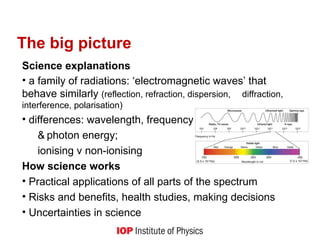
Science explanations
• a family of radiations: ‘electromagnetic waves’ that
behave similarly (reflection, refraction, dispersion, diffraction,
interference, polarisation)
• differences: wavelength, frequency
& photon energy;
ionising v non-ionising
How science works
• Practical applications of all parts of the spectrum
• Risks and benefits, health studies, making decisions
• Uncertainties in science
Main teaching challenges
The electromagnetic spectrum is
• mostly invisible
• an abstract idea
Students understand more when
• it is introduced carefully, by stages. Start with visible
light then extend through both UV & infrared.
• it is made perceptible (concrete)
• connects with students’ lives and interests
Prior learning
• sound (vibrations and waves)
• light
• source-journey-detector model of radiation
TASK:
How does the model apply to (1) sound? (2) light?
Source–journey–detector
A useful model: makes the invisible more concrete.
Task: Name at least 1 source and 1 detector for each
part of the full spectrum.
• gamma rays
• X-rays
• ultraviolet
• visible light
• infrared
• microwaves
• radio waves
Use sources & detectors, either as demonstration
experiments, or as a circus of class experiments.
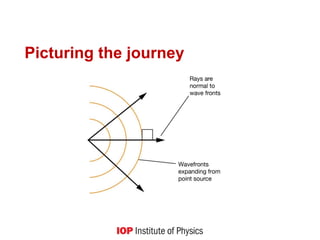
Picturing the journey
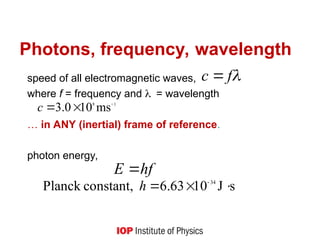
Photons, frequency, wavelength
speed of all electromagnetic waves,
where f = frequency and = wavelength
… in ANY (inertial) frame of reference.
photon energy,

f
c 
hf
E 
s
J
10
63
.
6
constant,
Planck 34


 
h
1
8
ms
10
0
.
3 


c
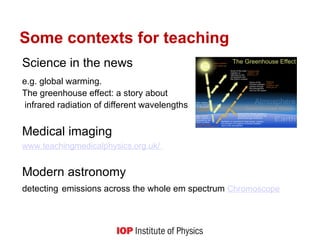
Some contexts for teaching
Science in the news
e.g. global warming.
The greenhouse effect: a story about
infrared radiation of different wavelengths
Medical imaging
www.teachingmedicalphysics.org.uk/
Modern astronomy
detecting emissions across the whole em spectrum Chromoscope
The visible spectrum
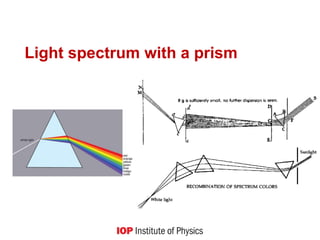
Light spectrum with a prism
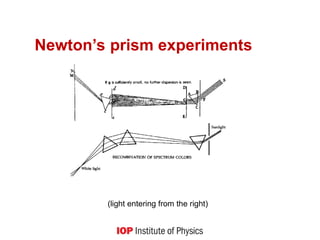
Newton’s prism experiments
(light entering from the right)
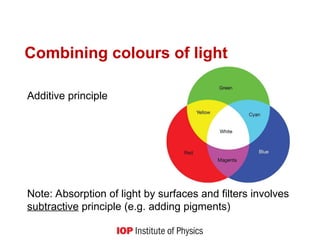
Combining colours of light
Additive principle
Note: Absorption of light by surfaces and filters involves
subtractive principle (e.g. adding pigments)
Combining colours of light
SEP Activity 2
with light emitting diodes (LEDs) as light sources
Power source: 3V lithium batteries (disc-shaped)
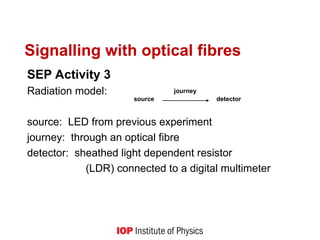
Signalling with optical fibres
SEP Activity 3
Radiation model:
source: LED from previous experiment
journey: through an optical fibre
detector: sheathed light dependent resistor
(LDR) connected to a digital multimeter
journey
source detector
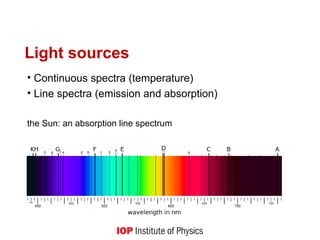
Light sources
• Continuous spectra (temperature)
• Line spectra (emission and absorption)
the Sun: an absorption line spectrum
Light sources
SEP Activity 1
Make a spectroscope.
Use your spectroscope to compare light sources.
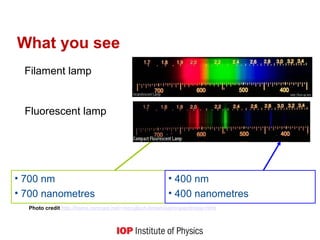
Photo credit http://home.comcast.net/~mcculloch-brown/astro/spectrostar.html
What you see
Filament lamp
• 700 nm
• 700 nanometres
• 400 nm
• 400 nanometres
Fluorescent lamp
Beyond the visible
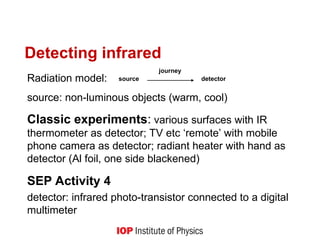
Detecting infrared
Radiation model:
source: non-luminous objects (warm, cool)
Classic experiments: various surfaces with IR
thermometer as detector; TV etc ‘remote’ with mobile
phone camera as detector; radiant heater with hand as
detector (Al foil, one side blackened)
SEP Activity 4
detector: infrared photo-transistor connected to a digital
multimeter
journey
source detector
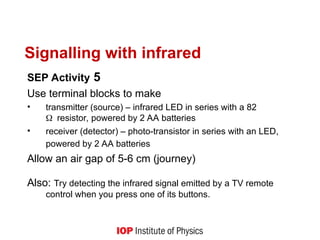
Signalling with infrared
SEP Activity 5
Use terminal blocks to make
• transmitter (source) – infrared LED in series with a 82
resistor, powered by 2 AA batteries
• receiver (detector) – photo-transistor in series with an LED,
powered by 2 AA batteries
Allow an air gap of 5-6 cm (journey)
Also: Try detecting the infrared signal emitted by a TV remote
control when you press one of its buttons.
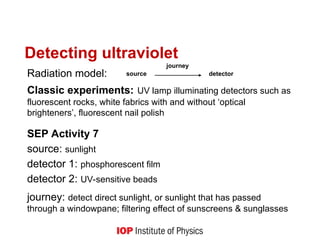
Radiation model:
Classic experiments: UV lamp illuminating detectors such as
fluorescent rocks, white fabrics with and without ‘optical
brighteners’, fluorescent nail polish
SEP Activity 7
source: sunlight
detector 1: phosphorescent film
detector 2: UV-sensitive beads
journey: detect direct sunlight, or sunlight that has passed
through a windowpane; filtering effect of sunscreens & sunglasses
Detecting ultraviolet
journey
source detector
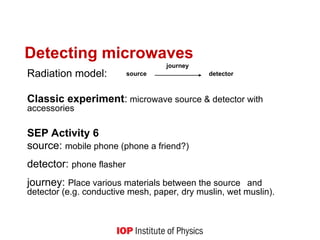
Detecting microwaves
Radiation model:
Classic experiment: microwave source & detector with
accessories
SEP Activity 6
source: mobile phone (phone a friend?)
detector: phone flasher
journey: Place various materials between the source and
detector (e.g. conductive mesh, paper, dry muslin, wet muslin).
journey
source detector
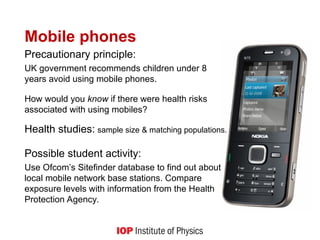
Mobile phones
Precautionary principle:
UK government recommends children under 8
years avoid using mobile phones.
How would you know if there were health risks
associated with using mobiles?
Health studies: sample size & matching populations.
Possible student activity:
Use Ofcom’s Sitefinder database to find out about
local mobile network base stations. Compare
exposure levels with information from the Health
Protection Agency.
Detecting radio waves
Radiation model:
source: SEP short-circuit kit, SEP ‘noisy motor’, AM broadcast
detector: simple AM radio
journey
source detector
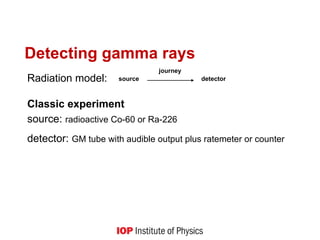
Detecting gamma rays
Radiation model:
Classic experiment
source: radioactive Co-60 or Ra-226
detector: GM tube with audible output plus ratemeter or counter
journey
source detector
Properties of em waves
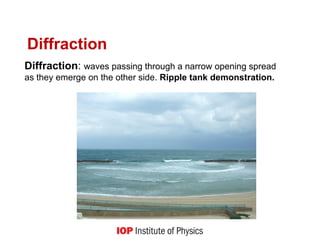
Diffraction
Diffraction: waves passing through a narrow opening spread
as they emerge on the other side. Ripple tank demonstration.
Diffraction grating
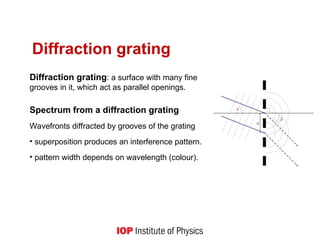
Diffraction grating: a surface with many fine
grooves in it, which act as parallel openings.
Spectrum from a diffraction grating
Wavefronts diffracted by grooves of the grating
• superposition produces an interference pattern.
• pattern width depends on wavelength (colour).
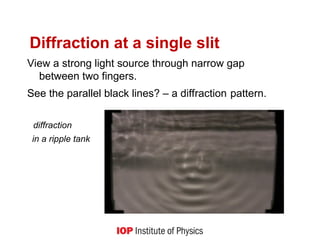
Diffraction at a single slit
View a strong light source through narrow gap
between two fingers.
See the parallel black lines? – a diffraction pattern.
diffraction
in a ripple tank
SEP diffraction grids
SEP Activity 8
Holding the grid close to your eye, view a point source of visible
light with grid of
• horizontal lines
• zigzag lines
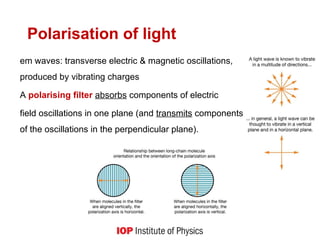
Polarisation of light
em waves: transverse electric & magnetic oscillations,
produced by vibrating charges
A polarising filter absorbs components of electric
field oscillations in one plane (and transmits components-
of the oscillations in the perpendicular plane).
Support, references
talkphysics.org
SPT 11-14 Light & sound
Gatsby SEP booklets … free @ National STEM Centre e.library
Radiation and communication
Seeing beyond the visible
Light and matter
Practical resources available from Mindsets
David Sang (ed, 2011) Teaching secondary physics ASE / Hodder

Electromagnetic-spectrum & Its Application.ppt

  • 1.
  • 2.
    The big picture Scienceexplanations • a family of radiations: ‘electromagnetic waves’ that behave similarly (reflection, refraction, dispersion, diffraction, interference, polarisation) • differences: wavelength, frequency & photon energy; ionising v non-ionising How science works • Practical applications of all parts of the spectrum • Risks and benefits, health studies, making decisions • Uncertainties in science
  • 3.
    Main teaching challenges Theelectromagnetic spectrum is • mostly invisible • an abstract idea Students understand more when • it is introduced carefully, by stages. Start with visible light then extend through both UV & infrared. • it is made perceptible (concrete) • connects with students’ lives and interests
  • 4.
    Prior learning • sound(vibrations and waves) • light • source-journey-detector model of radiation TASK: How does the model apply to (1) sound? (2) light?
  • 5.
    Source–journey–detector A useful model:makes the invisible more concrete. Task: Name at least 1 source and 1 detector for each part of the full spectrum. • gamma rays • X-rays • ultraviolet • visible light • infrared • microwaves • radio waves Use sources & detectors, either as demonstration experiments, or as a circus of class experiments.
  • 6.
  • 7.
    Photons, frequency, wavelength speedof all electromagnetic waves, where f = frequency and = wavelength … in ANY (inertial) frame of reference. photon energy,  f c  hf E  s J 10 63 . 6 constant, Planck 34     h 1 8 ms 10 0 . 3    c
  • 8.
    Some contexts forteaching Science in the news e.g. global warming. The greenhouse effect: a story about infrared radiation of different wavelengths Medical imaging www.teachingmedicalphysics.org.uk/ Modern astronomy detecting emissions across the whole em spectrum Chromoscope
  • 9.
  • 10.
  • 11.
    Newton’s prism experiments (lightentering from the right)
  • 12.
    Combining colours oflight Additive principle Note: Absorption of light by surfaces and filters involves subtractive principle (e.g. adding pigments)
  • 13.
    Combining colours oflight SEP Activity 2 with light emitting diodes (LEDs) as light sources Power source: 3V lithium batteries (disc-shaped)
  • 14.
    Signalling with opticalfibres SEP Activity 3 Radiation model: source: LED from previous experiment journey: through an optical fibre detector: sheathed light dependent resistor (LDR) connected to a digital multimeter journey source detector
  • 15.
    Light sources • Continuousspectra (temperature) • Line spectra (emission and absorption) the Sun: an absorption line spectrum
  • 16.
    Light sources SEP Activity1 Make a spectroscope. Use your spectroscope to compare light sources.
  • 17.
    Photo credit http://home.comcast.net/~mcculloch-brown/astro/spectrostar.html Whatyou see Filament lamp • 700 nm • 700 nanometres • 400 nm • 400 nanometres Fluorescent lamp
  • 18.
  • 19.
    Detecting infrared Radiation model: source:non-luminous objects (warm, cool) Classic experiments: various surfaces with IR thermometer as detector; TV etc ‘remote’ with mobile phone camera as detector; radiant heater with hand as detector (Al foil, one side blackened) SEP Activity 4 detector: infrared photo-transistor connected to a digital multimeter journey source detector
  • 20.
    Signalling with infrared SEPActivity 5 Use terminal blocks to make • transmitter (source) – infrared LED in series with a 82 resistor, powered by 2 AA batteries • receiver (detector) – photo-transistor in series with an LED, powered by 2 AA batteries Allow an air gap of 5-6 cm (journey) Also: Try detecting the infrared signal emitted by a TV remote control when you press one of its buttons.
  • 21.
    Radiation model: Classic experiments:UV lamp illuminating detectors such as fluorescent rocks, white fabrics with and without ‘optical brighteners’, fluorescent nail polish SEP Activity 7 source: sunlight detector 1: phosphorescent film detector 2: UV-sensitive beads journey: detect direct sunlight, or sunlight that has passed through a windowpane; filtering effect of sunscreens & sunglasses Detecting ultraviolet journey source detector
  • 22.
    Detecting microwaves Radiation model: Classicexperiment: microwave source & detector with accessories SEP Activity 6 source: mobile phone (phone a friend?) detector: phone flasher journey: Place various materials between the source and detector (e.g. conductive mesh, paper, dry muslin, wet muslin). journey source detector
  • 23.
    Mobile phones Precautionary principle: UKgovernment recommends children under 8 years avoid using mobile phones. How would you know if there were health risks associated with using mobiles? Health studies: sample size & matching populations. Possible student activity: Use Ofcom’s Sitefinder database to find out about local mobile network base stations. Compare exposure levels with information from the Health Protection Agency.
  • 24.
    Detecting radio waves Radiationmodel: source: SEP short-circuit kit, SEP ‘noisy motor’, AM broadcast detector: simple AM radio journey source detector
  • 25.
    Detecting gamma rays Radiationmodel: Classic experiment source: radioactive Co-60 or Ra-226 detector: GM tube with audible output plus ratemeter or counter journey source detector
  • 26.
  • 27.
    Diffraction Diffraction: waves passingthrough a narrow opening spread as they emerge on the other side. Ripple tank demonstration.
  • 28.
    Diffraction grating Diffraction grating:a surface with many fine grooves in it, which act as parallel openings. Spectrum from a diffraction grating Wavefronts diffracted by grooves of the grating • superposition produces an interference pattern. • pattern width depends on wavelength (colour).
  • 29.
    Diffraction at asingle slit View a strong light source through narrow gap between two fingers. See the parallel black lines? – a diffraction pattern. diffraction in a ripple tank
  • 30.
    SEP diffraction grids SEPActivity 8 Holding the grid close to your eye, view a point source of visible light with grid of • horizontal lines • zigzag lines
  • 31.
    Polarisation of light emwaves: transverse electric & magnetic oscillations, produced by vibrating charges A polarising filter absorbs components of electric field oscillations in one plane (and transmits components- of the oscillations in the perpendicular plane).
  • 32.
    Support, references talkphysics.org SPT 11-14Light & sound Gatsby SEP booklets … free @ National STEM Centre e.library Radiation and communication Seeing beyond the visible Light and matter Practical resources available from Mindsets David Sang (ed, 2011) Teaching secondary physics ASE / Hodder

Editor's Notes

  • #2 Two ways of thinking of em effects: as waves, or as particles (photons). Wave behaviour gives insight into the journey made from source to detector. The journey may involve reflection, refraction, diffraction or interference. Scattering and absorption can be seen as particle interactions, especially across the range from visible light (photosynthesis) to gamma where em interactions are triggered at the molecular level at the detector (or at a living organism) and it’s relevant to ask ‘is it ionising or non-ionising?’. Teachers need to grasp in what sense electromagnetic phenomena are WAVES. A simple demonstration: charge a balloon by rubbing, then bring it near the plate of an electroscope. The leaf rises. Take the balloon away; the balloon falls. This shows the electroscope detecting the electric field of the balloon. Now bring the balloon to a suitable distance and jiggle it slowly, making the leaf alternately rise and fall at the same rate. This shows the electric field of the balloon vibrating. The disturbance is carried to the electroscope, as a wave
  • #3 .
  • #5 This exercise gets teachers, preferably working in pairs, to use the model and clarify their thinking by recalling as many examples as they can of electromagnetic wave sources and detectors.
  • #8 In coming decades global warming will continue to be a major public concern and should therefore remain part of any compulsory science course. It can be understood as a story of infrared radiation, which any warm body radiates. However, the spectrum radiated depends on temperature, so its character when originating from the Sun or the Earth is different. The Earth’s atmosphere transmits a smaller proportion of the infrared radiated by Earth than infrared radiated by the Sun. There is always a radiation balance at the top of the atmosphere, between incoming solar radiation and outgoing radiation from several sources. https://upload.wikimedia.org/wikipedia/commons/thumb/d/d5/The_green_house_effect.svg/800px-The_green_house_effect.svg.png
  • #9 The starting point is tangible, everyday experience and, perhaps, science learned at KS3.
  • #12 There is common confusion between results of mixing of pigments (or combining of colour filters), where colours are removed from the reflected (or transmitted) light as compared to the incident light, and mixing coloured light sources, which is additive.
  • #13 This is an effective, low-cost alternative to special demonstration apparatus of different types, especially designed for schools.
  • #14 The sheath is used to shield the LDR from ambient (background) light. To isolate the effect of light arriving via the optical fibre alone, it may be necessary to provide additional shielding such as black paper.
  • #15 The spectrum of the Sun reveals its temperature to be about 6,000 K. It has thousands of absorption lines. https://commons.wikimedia.org/wiki/File:Fraunhofer_lines.svg To see (Fraunhofer) absorption lines in a spectrum, the spectrum must be considerably magnified. Here the width of spectrum is reduced by graphically cutting it into pieces, each of which has the same range of wavelengths, and then stacking the pieces. Absorption lines are produced by atoms in the solar atmosphere scattering light of particular energies (or wavelengths, or frequencies).
  • #16 This comparison leads to a distinction between light sources which produce line spectra and those that produce a continuous spectra. It takes a little while to assemble a spectroscope, so you may want to leave this exercise until the end of the session and instead concentrate on exploring teachers’ understanding of reasons for the two kinds of spectra.
  • #17 The pictures are from http://home.comcast.net/~mcculloch-brown/astro/spectrostar.html Note the range of wavelengths to which the eye is sensitive, a very small part of the electromagnetic spectrum as a whole but finely tuned to the solar spectrum, due to human evolution. A line spectrum is produced by discrete electron energy levels in atoms (here a gas at low pressure). A continuous spectrum is produced when atoms are close enough together to interact (e.g, in a solid), thereby spreading their electron energy bands.
  • #19 The aim here is to detect a source which is visible to the IR detector but not to human eyes.
  • #20 Infrared (IR) radiation is electromagnetic radiation whose wavelength is longer than that of visible light but shorter than that of terahertz radiation (100 µm - 1 mm). Infrared radiation spans roughly three orders of magnitude, between 750 nm and 100 µm. Near IR is commonly used for carrying signals through optical fibres. They are generally used instead of metal wires because signals travel along them with less loss, and they are also immune to electromagnetic interference.
  • #21 Just beyond visible light at shorter wavelengths is ultraviolet (UV), which carries sufficient energy per photon to be ionising. UV wavelengths are in the range 10 nm to 400 nm.
  • #22 Microwaves have wavelengths ranging from 1 mm to 1 m. The phone flasher circuit is very sensitive to microwave radiation.
  • #23 Most pupils have a mobile phone and are therefore interested to know about their safety. Radio waves, much used by radio and TV broadcasters, have wavelengths greater than 10 m.
  • #26 This part of the session looks at wave properties: diffraction, interference and polarisation. The other property common to all forms of electromagnetic radiation is the wave speed, the speed of light (300 000 km/s).
  • #27 These effects can be demonstrated clearly with a ripple tank. https://upload.wikimedia.org/wikipedia/commons/d/d3/BreakWaterDiffraction_Ashkelon1.jpg
  • #28 https://commons.wikimedia.org/wiki/File:Diffraction_grating_principle.png
  • #30 Experiments with visible light: The horizontal grid will produce spectral colours along a single line; the zig-zag lines produce an X pattern. X-ray crystallography is an analogous technique using X-rays. It is able to detect the arrangement of atoms at nanometre scale, and led to the discovery of the helical structure of DNA.
  • #31 The fact that electromagnetic radiation is a transverse wave means that light can be polarised, that is, be restricted to a single plane of vibration. This produces interesting natural effects (e.g. after reflection from a shiny surface) and technological possibilities (e.g. using polarised sunglasses to reduce glare).