Motion in a Plane
Physics Presentation
Introduction to Motion in a Plane
• Motion in a plane involves movement in two
dimensions, described using vectors.
Scalar and Vector Quantities
• Scalar: Only magnitude (e.g., speed, mass)
• Vector: Magnitude and direction (e.g.,
velocity, force)
Position and Displacement Vectors
• Position vector: Represents location relative to
origin.
• Displacement vector: Change in position.
General Vectors and Notations
• Vectors are represented using arrows.
Notations: , , etc.
A⃗ B⃗
Equality of Vectors
• Two vectors are equal if they have the same
magnitude and direction.
Multiplication of Vectors by a Real
Number
• Scaling a vector changes its magnitude but not
direction.
Addition and Subtraction of
Vectors
• Vectors are added using the triangle or
parallelogram law.
Unit Vector and Resolution of
Vectors
• Unit vector: Has magnitude 1.
• Resolution: Splitting a vector into
components.
Rectangular Components
• Any vector can be resolved into x and y
components.
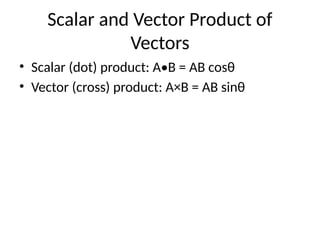
Scalar and Vector Product of
Vectors
• Scalar (dot) product: A•B = AB cosθ
• Vector (cross) product: A×B = AB sinθ
Motion in a Plane
• Motion with two-dimensional displacement,
velocity, and acceleration.
Uniform Velocity and Acceleration
• Uniform velocity: Constant speed and
direction.
• Uniform acceleration: Constant rate of velocity
change.
Projectile Motion
• Motion under gravity with horizontal and
vertical components.
Uniform Circular Motion
• Motion along a circular path with constant
speed but changing velocity.
Conclusion
• Motion in a plane is analyzed using vectors,
equations, and motion principles.
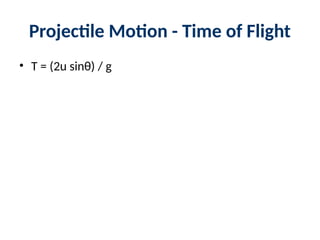
Projectile Motion - Time of Flight
• T = (2u sinθ) / g
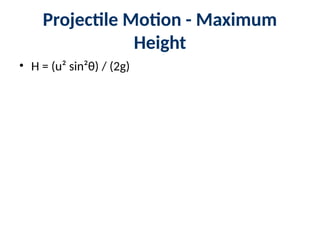
Projectile Motion - Maximum
Height
• H = (u² sin²θ) / (2g)
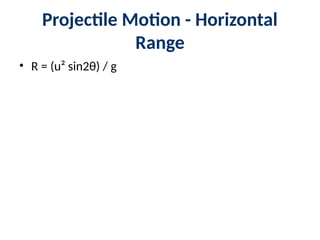
Projectile Motion - Horizontal
Range
• R = (u² sin2θ) / g
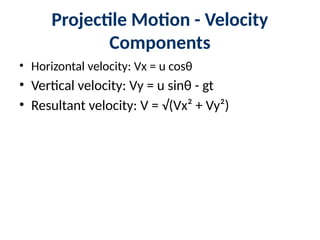
Projectile Motion - Velocity
Components
• Horizontal velocity: Vx = u cosθ
• Vertical velocity: Vy = u sinθ - gt
• Resultant velocity: V = √(Vx² + Vy²)
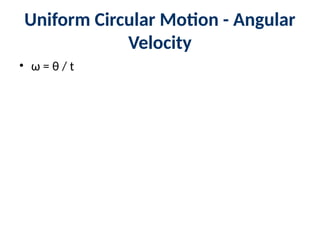
Uniform Circular Motion - Angular
Velocity
• ω = θ / t
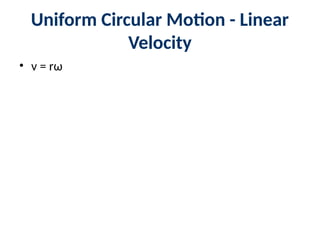
Uniform Circular Motion - Linear
Velocity
• v = rω
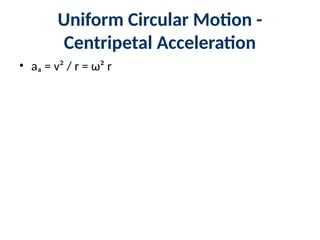
Uniform Circular Motion -
Centripetal Acceleration
• aₐ = v² / r = ω² r
Uniform Circular Motion -
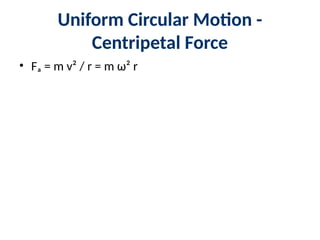
Centripetal Force
• Fₐ = m v² / r = m ω² r

Motion_in_a_Plane_Updated for school purpose