Introduction:
In this chapter,we derive the kinematic equations from fundamental
definitions of displacement, velocity, and acceleration vectors;
In two dimensions, two special cases are considered: motion with,
constant acceleration , , and UCM (uniform circular motion).
Displacement, velocity, and acceleration vectors:
05/20/25
Abdou Safari Kagabo
1
Motion in two dimensions
st
a C
r
x
y
v0
P, ti
O
Q, tf
i
r
f
r
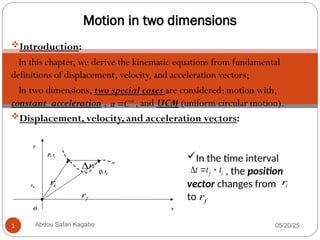
In the time interval
, the position
vector changes from
to
f i
t t t
i
r
f
r
2.
Displacement, velocity, andacceleration vectors (Cont’d)
05/20/25
Abdou Safari Kagabo
2
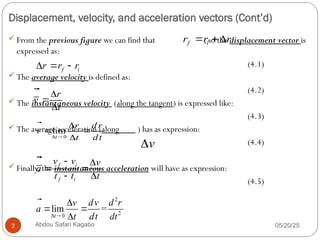
From the previous figure we can find that ; so the displacement vector is
expressed as:
(4.1)
The average velocity is defined as:
(4.2)
The instantaneous velocity (along the tangent) is expressed like:
(4.3)
The average acceleration (along ) has as expression:
(4.4)
Finally, the instantaneous acceleration will have as expression:
(4.5)
f i
r r r
f i
r r r
r
v
t
0
lim
t
r d r
v
t dt
v
f i
f i
v v v
a
t t t
2
2
0
lim =
t
v dv d r
a
t dt dt
3.
Motion in twodimensions with constant acceleration
05/20/25
Abdou Safari Kagabo
3
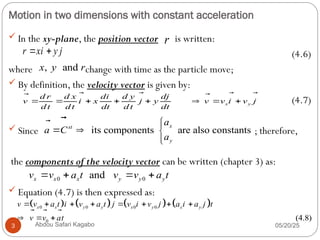
In the xy-plane, the position vector is written:
(4.6)
where change with time as the particle move;
By definition, the velocity vector is given by:
(4.7)
Since ; therefore,
the components of the velocity vector can be written (chapter 3) as:
Equation (4.7) is then expressed as:
r
r xi y j
, and
x y r
x y
d r d x di d y dj
v i x j y v v i v j
dt dt dt dt dt
its components are also constants
x
st
y
a
a C
a
0 0
and
x x x y y y
v v a t v v a t
0 0 0 0
0 (4.8)
x x y y x y x y
v v a t i v a t j v i v j a i a j t
v v at
4.
Motion in twodimensions with constant acceleration (Cont’d)
05/20/25
Abdou Safari Kagabo
4
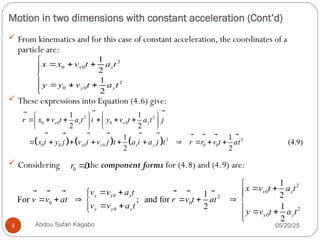
From kinematics and for this case of constant acceleration, the coordinates of a
particle are:
These expressions into Equation (4.6) give:
Considering , the component forms for (4.8) and (4.9) are:
2
0 0
2
0 0
1
2
1
2
x x
y y
x x v t a t
y y v t a t
2 2
0 0 0 0
2 2
0 0 0 0 0 0
1 1
2 2
1 1
(4.9)
2 2
x x y y
x y x y
r x v t a t i y v t a t j
x i y j v i v j t a i a j t r r v t at
0 0
r
2
0
0 2
0 0
2
0
0
1
1 2
For ; and for
1
2
2
x x
x x x
y y y
y y
x v t a t
v v a t
v v at r v t at
v v a t
y v t a t
5.
Projectile motion
05/20/25
5
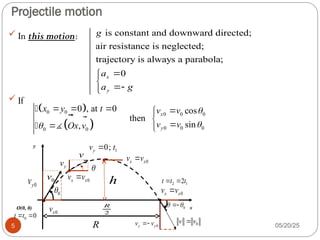
Inthis motion:
If
is constant and downward directed;
air resistance is neglected;
trajectory is always a parabola;
0
x
y
g
a
a g
0 0 0 0 0
0 0 0
0 0
0 , at 0 cos
then
sin
,
x
y
x y t v v
v v
Ox v
x
y
O(0, 0)
1
0;
y
v t
0
v
0
0
x
v
0
y
v
0
x x
v v
y
v
v
0
0
v v
R 0
y y
v v
0
x x
v v
0
x x
v v
h
0 0
t t
2 1
2
t t t
2
R
6.
Projectile motion (Cont’d1)
05/20/25
Abdou Safari Kagabo
6
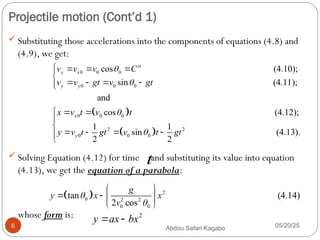
Substituting those accelerations into the components of equations (4.8) and
(4.9), we get:
Solving Equation (4.12) for time and substituting its value into equation
(4.13), we get the equation of a parabola:
whose form is:
0 0 0
0 0 0
0 0
cos (4.10);
sin (4.11);
and
st
x x
y y
x
v v v C
v v gt v gt
x v t v
0
2 2
0 0 0
cos (4.12);
1 1
sin (4.13).
2 2
y
t
y v t gt v t gt
t
2
0 2 2
0 0
tan (4.14)
2 cos
g
y x x
v
2
y ax bx
7.
Projectile motion (Cont’d2)
05/20/25
7
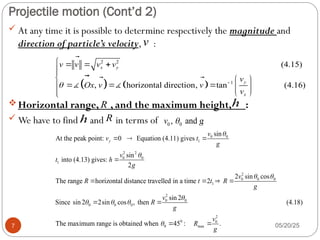
At any time it is possible to determine respectively the magnitude and
direction of particle’s velocity, :
Horizontal range, , and the maximum height, :
We have to find and in terms of :
v
2 2
1
(4.15)
, horizontal direction, tan (4.16)
x y
y
x
v v v v
v
Ox v v
v
R h
h R 0 0
, and
v g
0 0
1
2 2
0 0
1
2
0 0 0
1
0 0 0
sin
At the peak point: 0 Equation (4.11) gives
sin
into (4.13) gives:
2
2 sin cos
The range horizontal distance travelled in a time 2
Since sin 2 2sin cos ,
y
v
v t
g
v
t h
g
v
R t t R
g
2
0 0
2
0 0
0 max
sin 2
then (4.18)
The maximum range is obtained when 45 : .
v
R
g
v
R
g
8.
Uniform circular motion
05/20/25
AbdouSafari Kagabo
8
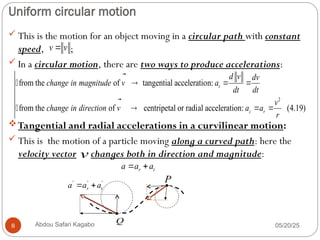
This is the motion for an object moving in a circular path with constant
speed, ;
In a circular motion, there are two ways to produce accelerations:
Tangential and radial accelerations in a curvilinear motion:
This is the motion of a particle moving along a curved path: here the
velocity vector changes both in direction and magnitude:
v v
2
from the of tangential acceleration:
from the of centripetal or radial acceleration: (4.19)
t
c r
d v dv
change in magnitude v a
dt dt
v
change in direction v a a
r
v
P
Q
r t
a a a
' ' '
r t
a a a
9.
Motion in twodimensions (Cont’d)
05/20/25
Abdou Safari Kagabo
9
Tangential and radial accelerations in curvilinear motion (Cont’d):
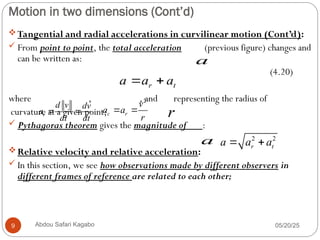
From point to point, the total acceleration (previous figure) changes and
can be written as:
(4.20)
where , , and representing the radius of
curvature at a given point;
Pythagoras theorem gives the magnitude of :
Relative velocity and relative acceleration:
In this section, we see how observations made by different observers in
different frames of reference are related to each other;
r t
a a a
a
t
d v dv
a
dt dt
2
c r
v
a a
r
r
a
2 2
r t
a a a
10.
Relative velocity andrelative acceleration (Cont’d)
05/20/25
10
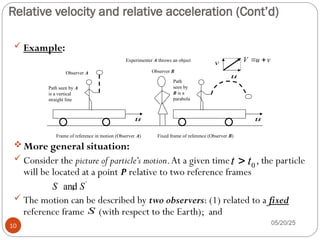
Example:
More general situation:
Consider the picture of particle’s motion.At a given time , the particle
will be located at a point P relative to two reference frames
;
The motion can be described by two observers: (1) related to a fixed
reference frame (with respect to the Earth); and
Observer A
Path seen by A
is a vertical
straight line
Experimenter A throws an object
Observer B
Path
seen by
B is a
parabola
Frame of reference in motion (Observer A) Fixed frame of reference (Observer B)
u
v
V u v
u
u
0
t t
'
and
S S
S
11.
05/20/25
Abdou Safari Kagabo
11
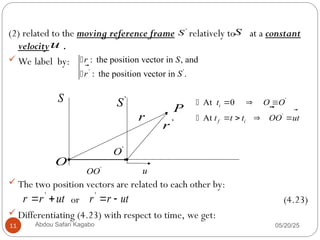
(2)related to the moving reference frame relatively to at a constant
velocity .
We label by:
The two position vectors are related to each other by:
or (4.23)
Differentiating (4.23) with respect to time, we get:
'
S S
u
' '
: the position vector in , and
: the position vector in .
r S
r S
'
'
At 0
At
i
f i
t O O
t t t OO ut
u
'
OO
r
'
r
S '
S
O
'
O
P
'
r r ut
'
r r ut
12.
More general situation(Cont’d 2)
05/20/25
Abdou Safari Kagabo
12
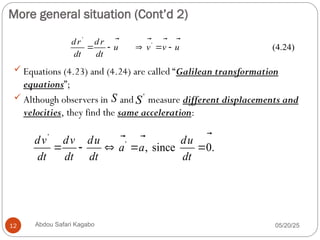
Equations (4.23) and (4.24) are called “Galilean transformation
equations”;
Although observers in and measure different displacements and
velocities, they find the same acceleration:
'
'
(4.24)
dr d r
u v v u
dt dt
S '
S
'
'
, since 0.
dv dv du du
a a
dt dt dt dt
13.
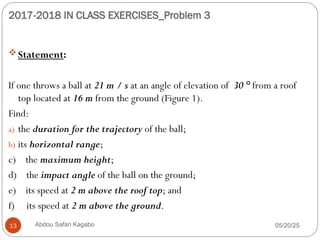
2017-2018 IN CLASSEXERCISES_Problem 3
05/20/25
Abdou Safari Kagabo
13
Statement:
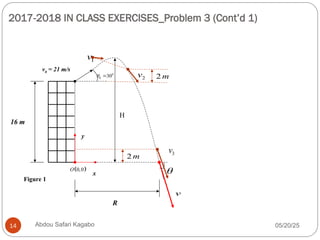
If one throws a ball at 21 m / s at an angle of elevation of 30 ° from a roof
top located at 16 m from the ground (Figure 1).
Find:
a) the duration for the trajectory of the ball;
b) its horizontal range;
c) the maximum height;
d) the impact angle of the ball on the ground;
e) its speed at 2 m above the roof top; and
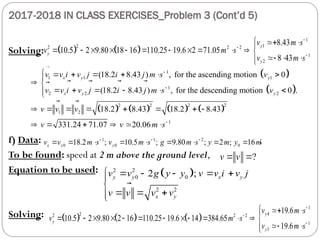
f) its speed at 2 m above the ground.
14.
2017-2018 IN CLASSEXERCISES_Problem 3 (Cont’d 1)
05/20/25
Abdou Safari Kagabo
14
y
x
16 m
v0
= 21 m/s
R
H
Figure 1
0
0 30
v
3
v
1
v
2
v
2 m
2 m
0,0
O
15.
2017-2018 IN CLASSEXERCISES_Problem 3 (Cont’d 2)
05/20/25
Abdou Safari Kagabo
15
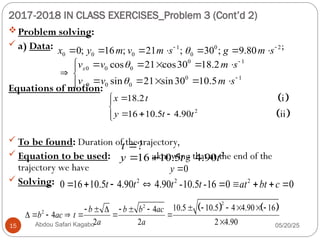
Problem solving:
a) Data: ;
Equations of motion:
To be found: Duration of the trajectory,
Equation to be used: ; knowing that at the end of the
trajectory we have
Solving:
1 0 2
0 0 0 0
0; 16 ; 21 ; 30 ; 9.80
x y m v m s g m s
2
18.2 i
16 10.5 4.90 ii
x t
y t t
0 1
0 0 0
0 1
0 0 0
cos 21 cos30 18.2
sin 21 sin30 10.5
x
y
v v m s
v v m s
?
t
2
16 10.5 4.90
y t t
0
y
2 2 2
0 16 10.5 4.90 4.90 -10.5 -16 0 0
t t t t at bt c
2
2
2
10.5 10.5 4 4.90 16
4
4
2 2 2 4.90
b b b ac
b ac t
a a
16.
2017-2018 IN CLASSEXERCISES_Problem 3 (Cont’d 3)
05/20/25
Abdou Safari Kagabo
16
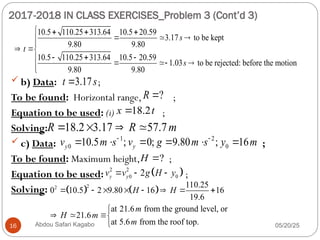
b) Data: ;
To be found: Horizontal range, ;
Equation to be used: (i) ;
Solving:
c) Data: ;
To be found: Maximum height, ;
Equation to be used: ;
Solving:
10.5 110.25 313.64 10.5 20.59
3.17 to be kept
9.80 9.80
10.5 110.25 313.64 10.5 20.59
1.03 to be rejected: before the motion
9.80 9.80
s
t
s
3.17
t s
?
R
18.2
x t
18.2 3.17 57.7
R R m
1 2
0 0
10.5 ; 0; 9.80 ; 16
y y
v m s v g m s y m
?
H
2 2
0 0
2
y y
v v g H y
2
2 110.25
0 10.5 2 9.80 16 16
19.6
at 21.6 from the ground level, or
21.6
at 5.6 from the roof top.
H H
m
H m
m
17.
2017-2018 IN CLASSEXERCISES_Problem 3 (Cont’d 4)
05/20/25
Abdou Safari Kagabo
17
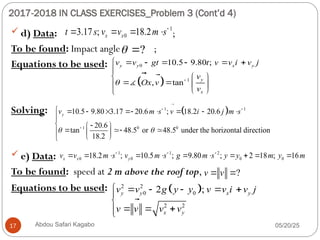
d) Data: ;
To be found: Impact angle ;
Equations to be used:
Solving:
e) Data:
To be found: speed at 2 m above the roof top,
Equations to be used:
1
0
3.17 ; 18.2
x x
t s v v m s
?
0
1
10.5 9.80 ;
, tan
y y x y
y
x
v v gt t v v i v j
v
Ox v
v
1 1
1 0 0
10.5 9.80 3.17 20.6 ; 18.2 20.6
20.6
tan 48.5 or 48.5 under the horizontal direction
18.2
y
v m s v i j m s
1 1 2
0 0 0 0
18.2 ; 10.5 ; 9.80 ; 2 18 ; 16
x x y
v v m s v m s g m s y y m y m
?
v v
2 2
0 0
2 2
2 ;
y y x y
x y
v v g y y v v i v j
v v v v
18.
2017-2018 IN CLASSEXERCISES_Problem 3 (Cont’d 5)
Solving:
f) Data: ;
To be found: speed at 2 m above the ground level,
Equation to be used:
Solving:
1
1
2
2 2 2
1
2
8.43
10.5 2 9.80 18 16 110.25 19.6 2 71.05
8 43
y
y
y
v m s
v m s
v m s
1
1 1 1
1
2 2 2
2 2 2 2
1 2
(18.2 8.43 ) , for the ascending motion 0
(18.2 8.43 ) , for the descending motion 0 .
18.2 8.43 18.2 8.43
331.24 71.07 20.06
x y y
x y y
v v i v j i j m s v
v v i v j i j m s v
v v v
v v
1
m s
1 1 2
0 0 0
18.2 ; 10.5 ; 9.80 ; 2 ; 16
x x y
v v m s v m s g m s y m y m
?
v v
2 2
0 0
2 2
2 ;
y y x y
x y
v v g y y v v i v j
v v v v
1
4
2
2 2 2
1
3
19.6
10.5 2 9.80 2 16 110.25 19.6 14 384.65
19.6
y
y
y
v m s
v m s
v m s
19.
2017-2018 IN CLASSEXERCISES_Problem 3 (Cont’d 6)
05/20/25
Abdou Safari Kagabo
19
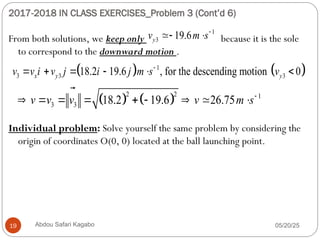
From both solutions, we keep only because it is the sole
to correspond to the downward motion .
Individual problem: Solve yourself the same problem by considering the
origin of coordinates O(0, 0) located at the ball launching point.
1
3 19.6
y
v m s
1
3 3 3
18.2 19.6 , for the descending motion 0
x y y
v v i v j i j m s v
2 2 1
3 3 18.2 19.6 26.75
v v v v m s
Editor's Notes
#4 Please, look at Example 4.1 from Raymond A. Serway
#5 Question 4.1: What are the assumptions made for a simple analysis of a projectile motion?
#7 Please, look at examples 4.2 and 4.4 from Raymond A. Serway
Question 4.2: For the projectile motion, what do you understand by “horizontal range” if at the starting time, the projectile is located at the origin?
#8 Question 4.3: In a circular motion, give two ways with which you can produce acceleration, the type of acceleration, and the mathematical expression of each acceleration produced.
Question 4.4: Can a particle accelerate if its speed is constant? Can it accelerate if its velocity is constant? Explain.
#12 Please, look at examples 4.8, 4.9, and 4.10 from Raymond A. Serway