


TRAINING 
ON 
ADR TEACHING/PRACTICE
Presentation 
by 
Maj. Gen. Nilendra Kumar, 
Director, 
Amity Law School, Noida
LLB CURRICULUM AND LEARNING OBJECTIVES
INTRODUCTION 
TO 
CLINICAL TEACHING
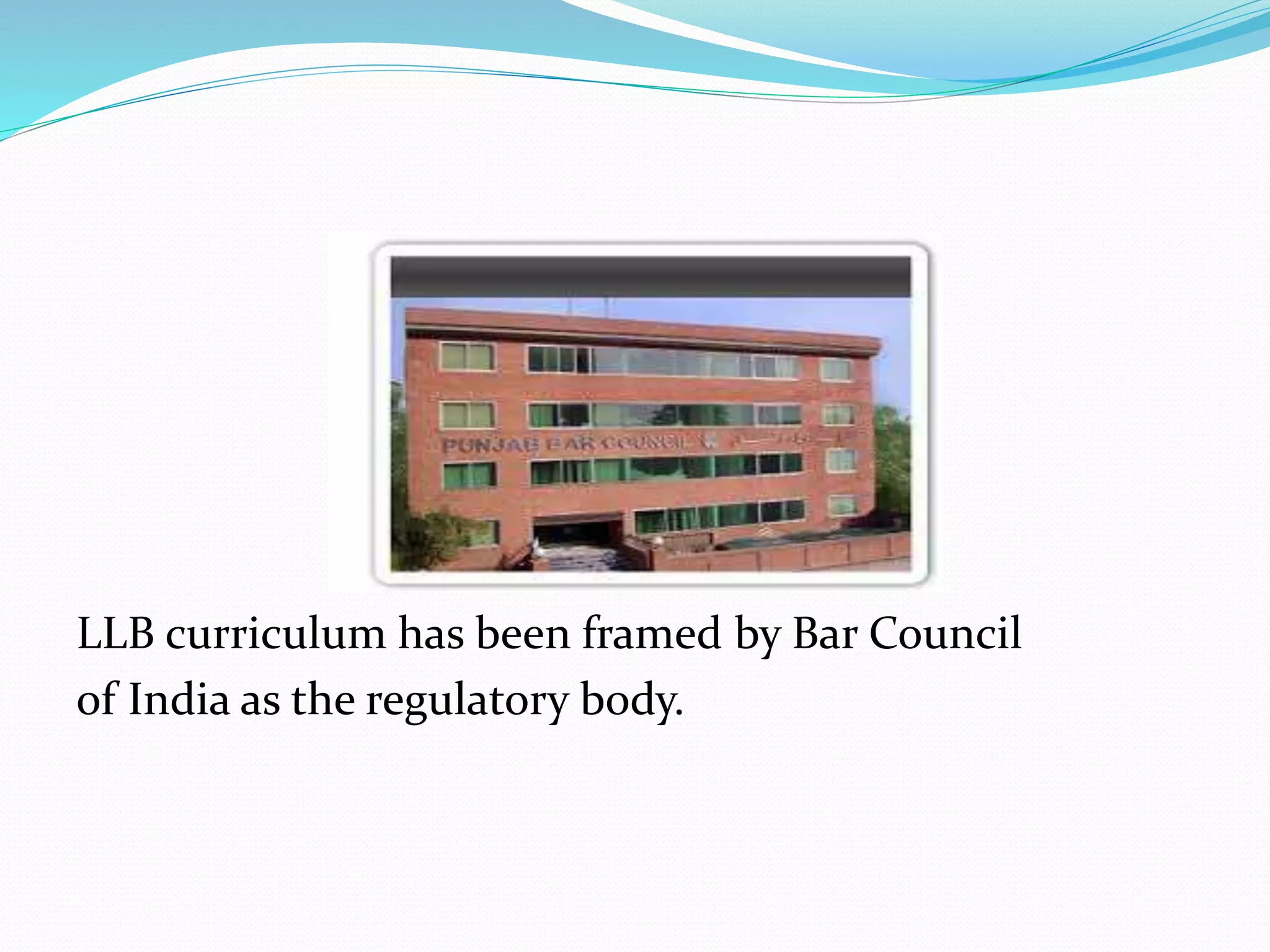
LLB curriculum has been framed by Bar Council 
of India as the regulatory body.
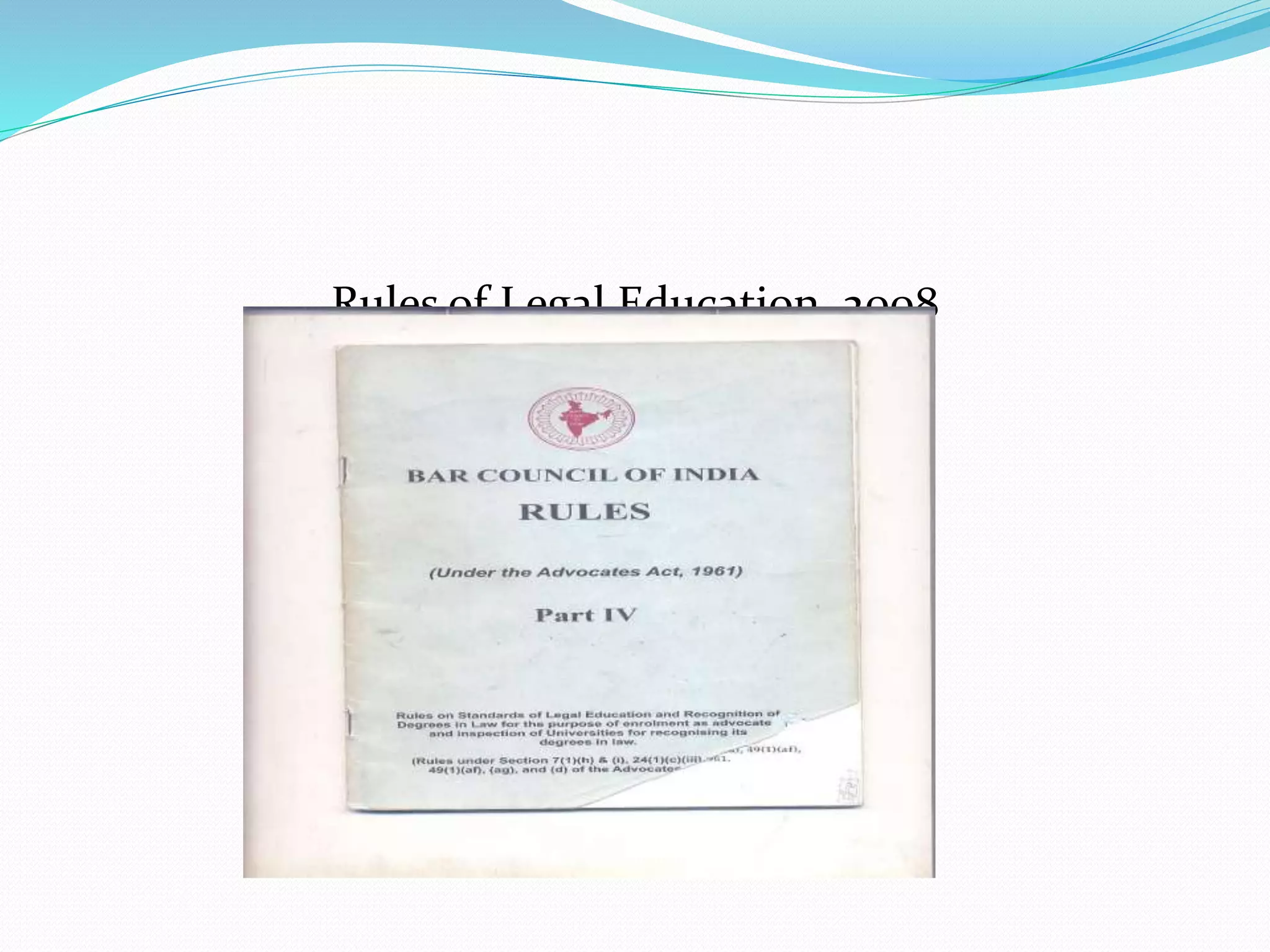
Rules of Legal Education, 2008
Common to both streams viz. three year and 
five year programmes.
BCI has specified the courses to be taught for 
both the streams.
Part II (B) compulsory clinical courses is the 
relevant document for this presentation.
Papers 21 to 24 pertain to clinical courses
PAPER NUMBER 23 
OUTLINE OF THE COURSE 
(i) Negotiation skills to be learned with simulated 
program. 
(ii) Conciliation skills. 
(iii) Arbitration law and practice including 
International Arbitration and arbitration rules.
STATUTORY LAW 
1. The Arbitration and Conciliation Act, 1996 
2. Industrial Disputes Act, 1947 
Section 23 of Hindu Marriage Act, 1955. 
Section 9 of the Family Courts Act, 1984. 
Sections 80, 89 and Order 23 Rule 3, Order 27 
Rule 5B and 32A of the Civil Procedure 
Code. 
Legal Services Authority Act, 1997
Obligatory for the court to give a fair chance to a 
conciliated or negotiated settlement before 
adjudication is embared upon.
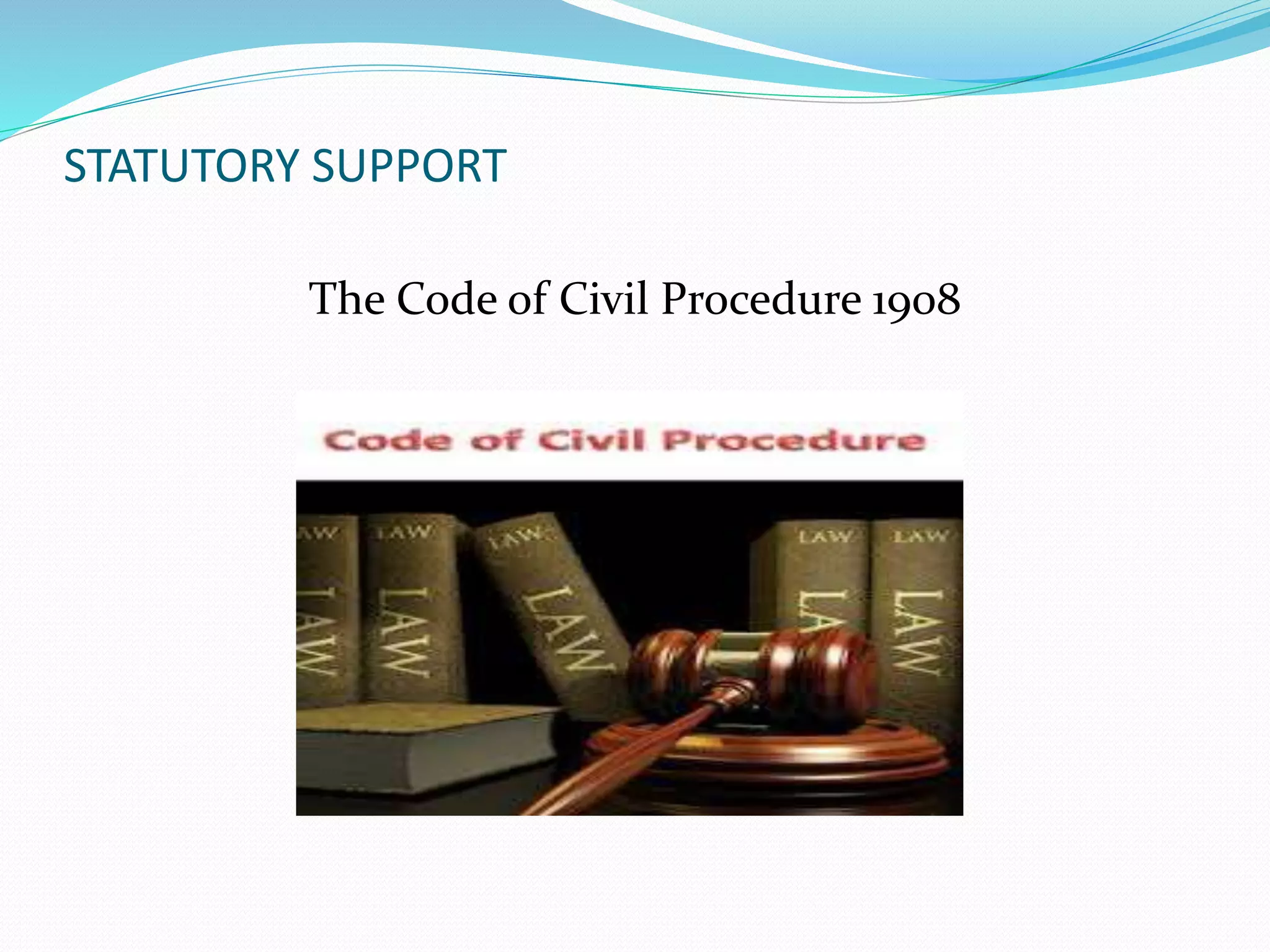
STATUTORY SUPPORT 
The Code of Civil Procedure 1908
Part V 
Special Proceedings Arbitration
Section 89. Settlement of Disputes outside the 
Court. 
Resolution of disputes outside the court may be 
by : 
Arbitration 
Conciliation 
Judicial settlement including settlement through 
Lok Adalat 
Mediation
ALTERNATIVE DISPUTES RESOLUTION 
A process for settlement of legal disputes 
without resorting to judicial processes and 
courts.
COMMON MODES OF ADR 
1. Negotiation 
2. Conciliation 
3. Arbitration 
4. Mediation
NEGOTIATION 
Strictly, negotiation by itself is not an ADR 
procedure because it is a bipartite process and 
does not require a third person for facilitating 
the resolution of the dispute by settlement.
Negotiation is the simplest and most purposeful 
method of settling commercial disputes 
between the parties or their advisers.
MAHATMA GANDHI ON ADR 
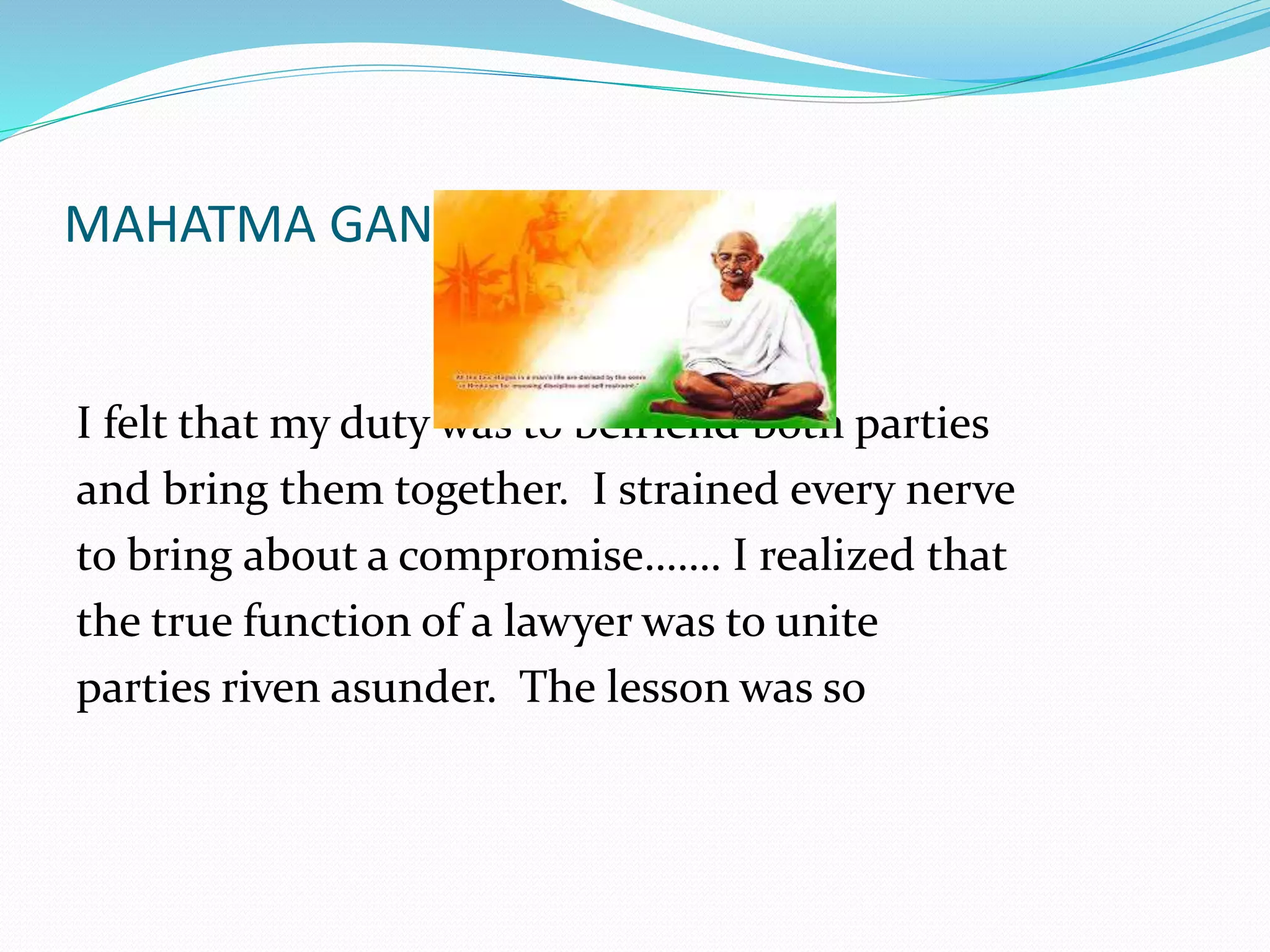
I felt that my duty was to befriend both parties 
and bring them together. I strained every nerve 
to bring about a compromise……. I realized that 
the true function of a lawyer was to unite 
parties riven asunder. The lesson was so
indelibly burnt into me, that a large part of my 
time during the twenty years of my practice as a 
lawyer was occupied in bringing about private 
compromises of hundreds of cases. I lost 
nothing thereby – not even money certainly not 
my soul. 
The Law and The Lawyer, MK Gandhi, Page 48
NEGOTIATION 
Negotiation is a dialogue between two more 
people or parties intended to reach an 
understanding, resolve points of difference, to 
craft outcomes to satisfy various interests.
Negotiation can be contrasted with mediation 
where a neutral third party listens to each side 
arguments and attempts to help craft an 
agreement between the parties.
A skilled negotiator may serve as an advocate 
for one party to the negotiation. The advocate 
attempts to obtain the most favourable 
outcomes for that party.
AAR dBeIvTiRceA wThIOerNeby the settlement of a question, 
which is of interest for two or more persons, is 
entrusted to one or more persons - the 
arbitrator or arbitrators – who derive their 
powers from a private agreement, not from the 
authorities of a State, and who are to proceed 
and decide the case on the basis of such an 
agreement.
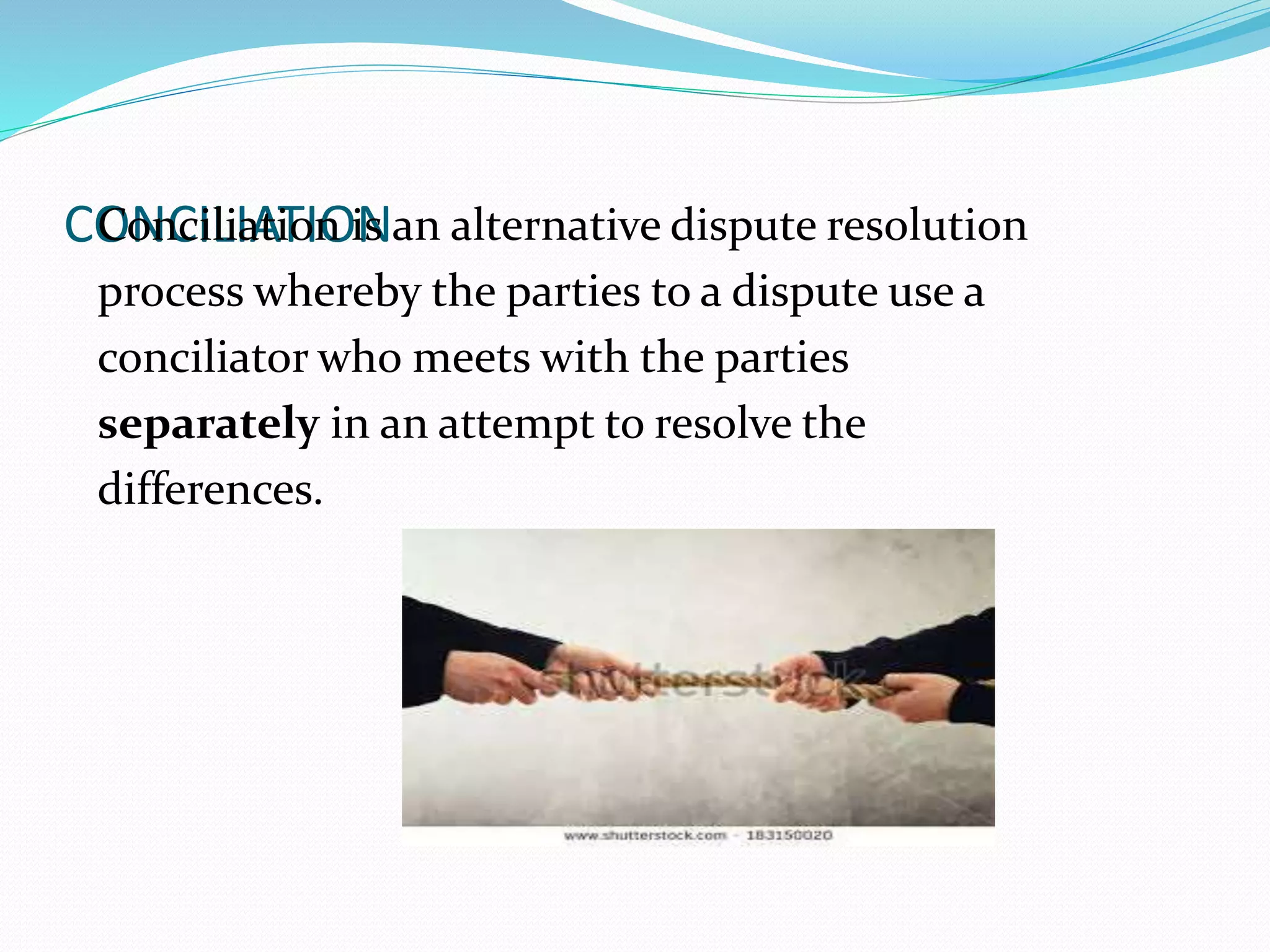
COCoNnCcIiLliIaAtiToInO iNs an alternative dispute resolution 
process whereby the parties to a dispute use a 
conciliator who meets with the parties 
separately in an attempt to resolve the 
differences.
MEDIATION 
It is a form of alternative dispute resolution, a 
way of resolving disputes between two or more 
parties with concrete effects. A third party, a 
mediator assists the parties to negotiate a 
settlement.
DIFFERENCE BETWEEN 
CONCILIATION AND MEDIATION 
The role of a mediator is not pro-active and is 
somewhat less than the role of a conciliator. 
The conciliator can make proposals for 
settlement while a mediator would not do so 
but would merely facilitate a settlement.
COMPROMISE 
An agreement or settlement of a dispute that is 
reached by each side making concession.
Who will teach and how?
Purely academics with no practical exposure to 
ADR practice may not succeed in imparting 
practical skills needed for the profession.
The course is required to be conducted by senior 
legal practitioners.
This could in the next stage be taken up with law 
Professionals with adequate experience of 
ADR practice.
A major portion of the course would require to 
be taught by examples and illustrations.
Also through simulation and case studies
SIMULATION 
Simulation is the imitation of a real world 
process or system over time. It may be used 
when the real system cannot be engaged, 
because it may not be accessible.
Simulation in education focus on specific tasks
Case law are as useful to indicate do’s & don’ts. 
Also there can be used to explain a statutory 
provision.
Enumerate prescribed and recommended 
literature.
Prescribed literature may be the legislations 
indicated.
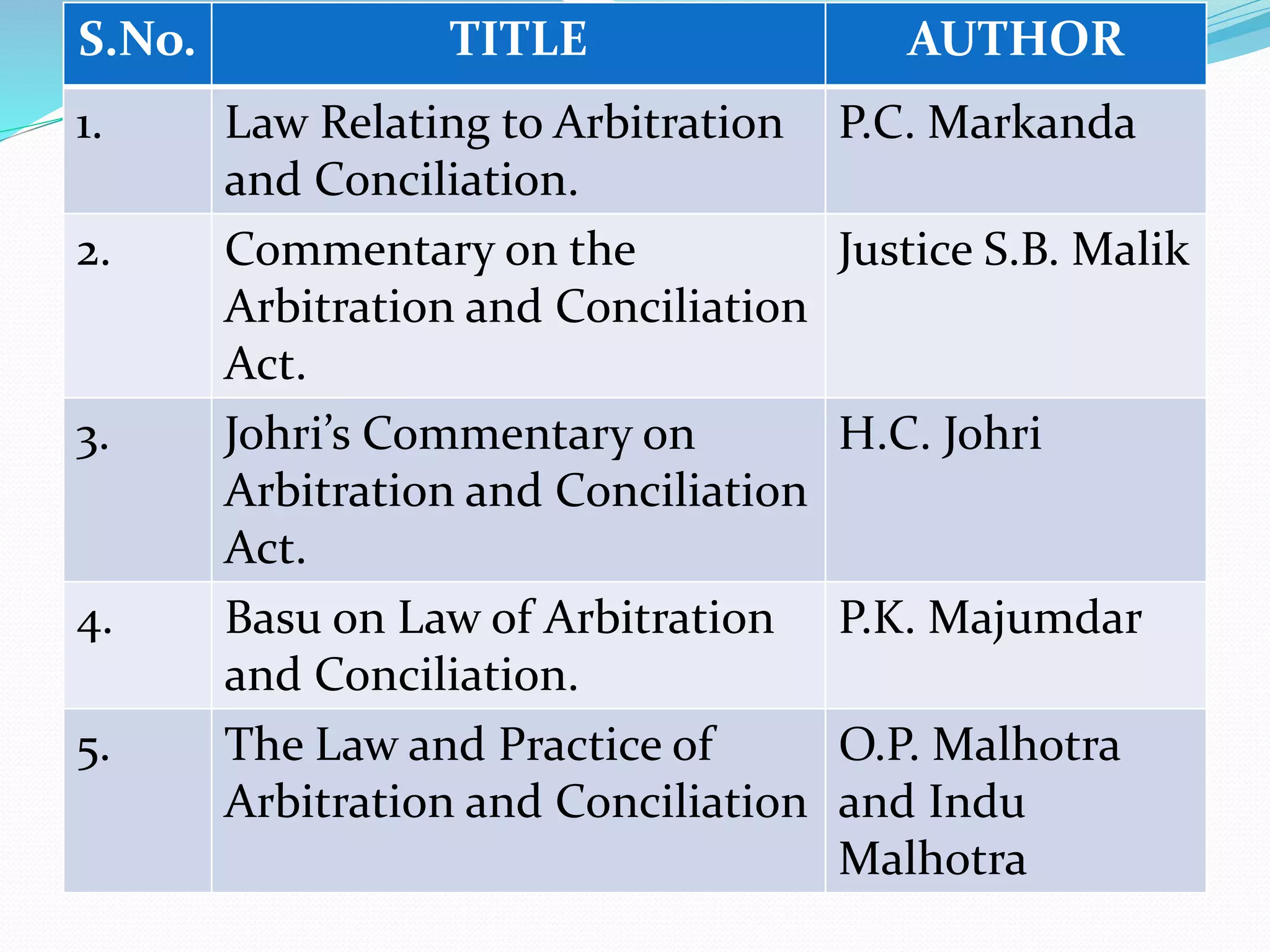
Recommended literature
S.No. TITLE AUTHOR 
1. Law Relating to Arbitration 
and Conciliation. 
P.C. Markanda 
2. Commentary on the 
Arbitration and Conciliation 
Act. 
Justice S.B. Malik 
3. Johri’s Commentary on 
Arbitration and Conciliation 
Act. 
H.C. Johri 
4. Basu on Law of Arbitration 
and Conciliation. 
P.K. Majumdar 
5. The Law and Practice of 
Arbitration and Conciliation 
O.P. Malhotra 
and Indu 
Malhotra
S.No. TITLE AUTHOR 
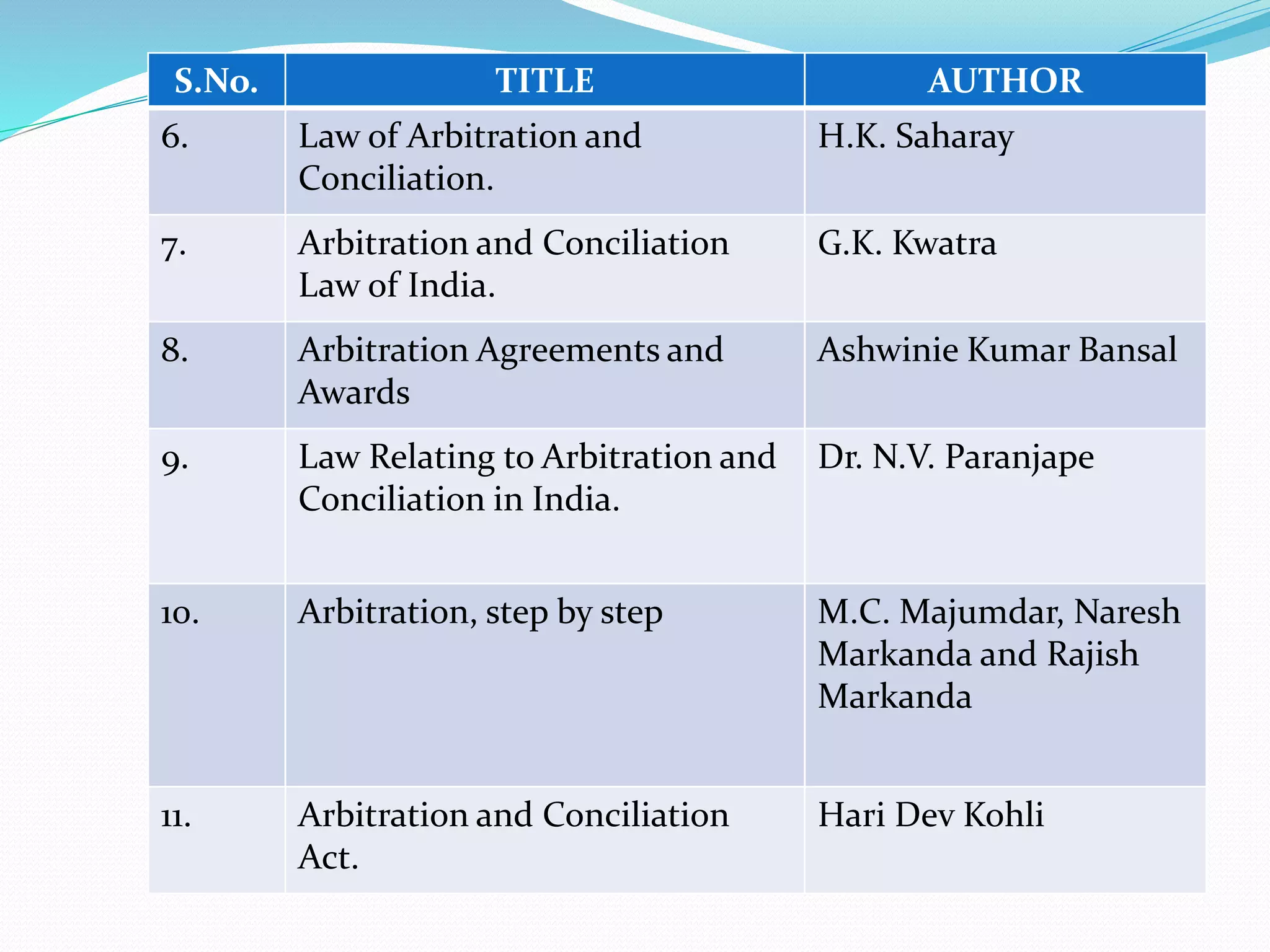
6. Law of Arbitration and 
Conciliation. 
H.K. Saharay 
7. Arbitration and Conciliation 
Law of India. 
G.K. Kwatra 
8. Arbitration Agreements and 
Awards 
Ashwinie Kumar Bansal 
9. Law Relating to Arbitration and 
Conciliation in India. 
Dr. N.V. Paranjape 
10. Arbitration, step by step M.C. Majumdar, Naresh 
Markanda and Rajish 
Markanda 
11. Arbitration and Conciliation 
Act. 
Hari Dev Kohli
S.No. TITLE AUTHOR 
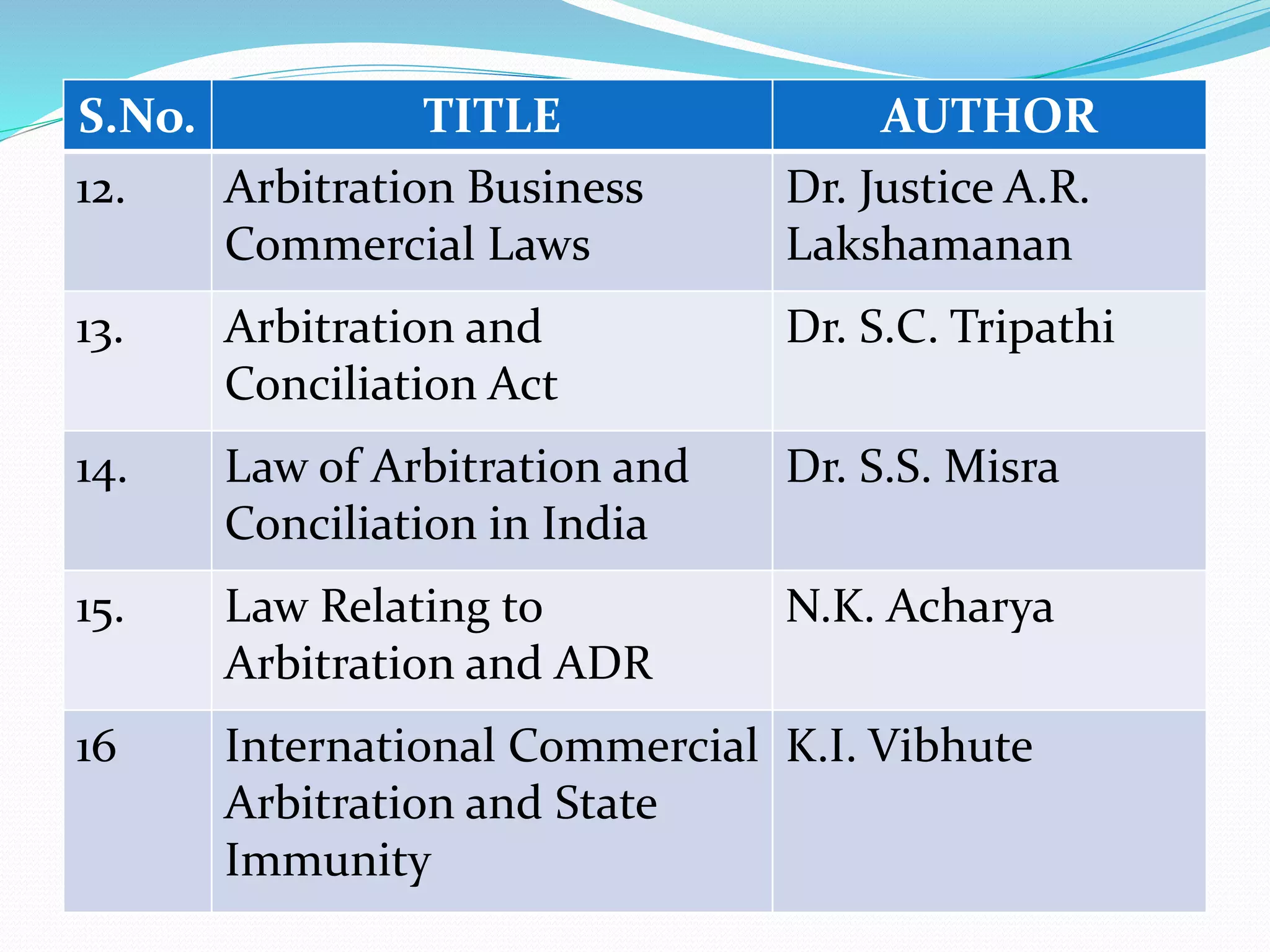
12. Arbitration Business 
Commercial Laws 
Dr. Justice A.R. 
Lakshamanan 
13. Arbitration and 
Conciliation Act 
Dr. S.C. Tripathi 
14. Law of Arbitration and 
Conciliation in India 
Dr. S.S. Misra 
15. Law Relating to 
Arbitration and ADR 
N.K. Acharya 
16 International Commercial 
Arbitration and State 
Immunity 
K.I. Vibhute
S.No. TITLE AUTHOR 
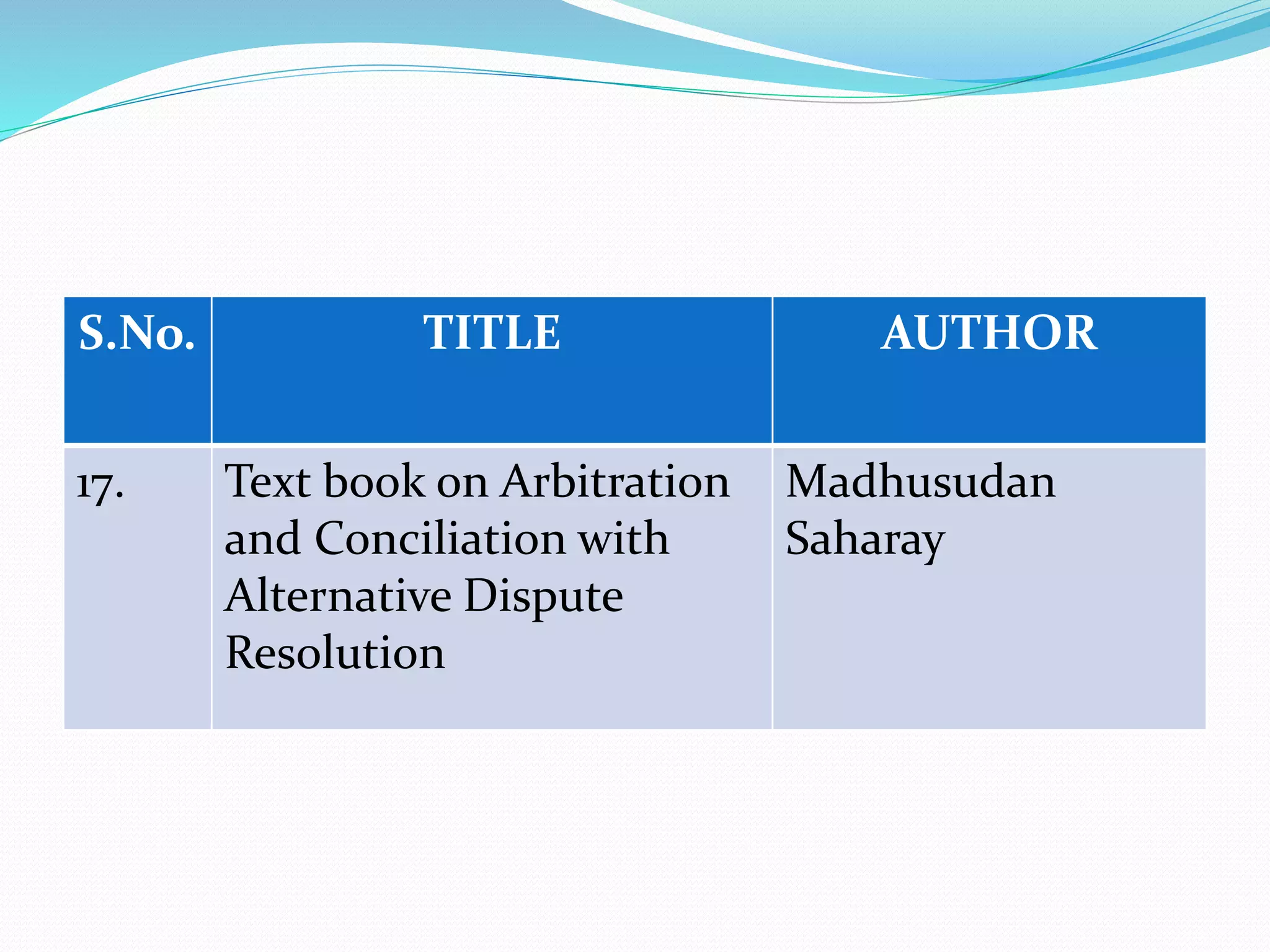
17. Text book on Arbitration 
and Conciliation with 
Alternative Dispute 
Resolution 
Madhusudan 
Saharay
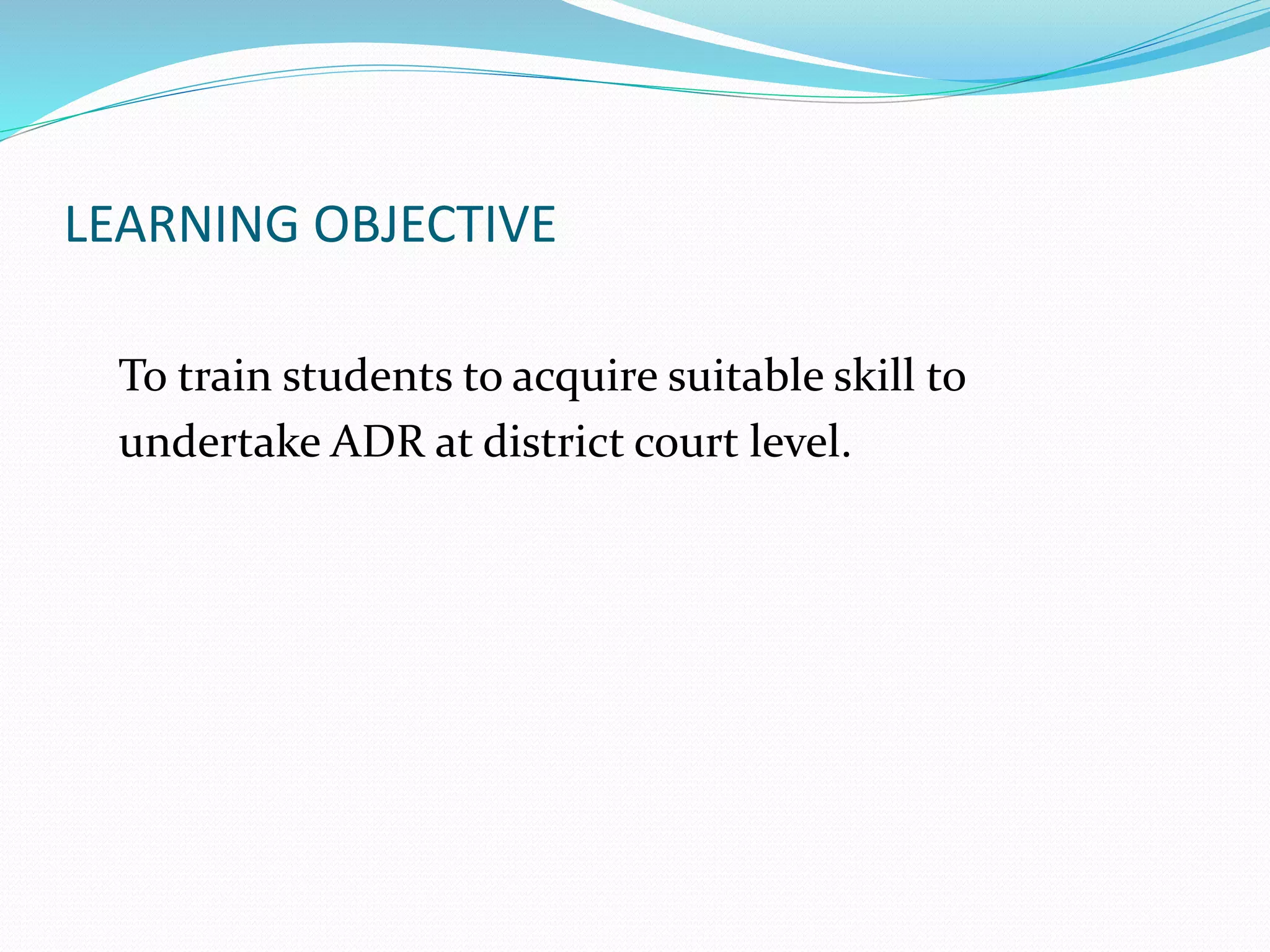
LEARNING OBJECTIVE 
To train students to acquire suitable skill to 
undertake ADR at district court level.
The word ‘train’ has been preferred over ‘teach’
What are Learning Objectives? 
A Learning Objective describes what 
students should know or be able to do at the 
end of the course that they couldn’t do before.
Learning Objective should be about student 
performance.
To decide Learning Objective, one has to 
begin with the end in mind.
Simply put, what is the aim or objective of the 
course. 
Something like, end would decide the means to 
be followed.
EVALUATION 
To be carried out in practical exercises at least 
for a significant part of evaluation.
CONCLUSION 
ADR teaching and practice would involve an 
innovative approach by the faculty as well as 
formulated recourse to internship. 
Clinical teaching may be utilized as one of the 
major modes for teaching in law schools for 
suitable imparting of professional skills.

Training on ADR Teaching Practice

  • 1.
    TRAINING ON ADRTEACHING/PRACTICE
  • 2.
    Presentation by Maj.Gen. Nilendra Kumar, Director, Amity Law School, Noida
  • 3.
    LLB CURRICULUM ANDLEARNING OBJECTIVES
  • 4.
  • 5.
    LLB curriculum hasbeen framed by Bar Council of India as the regulatory body.
  • 6.
    Rules of LegalEducation, 2008
  • 7.
    Common to bothstreams viz. three year and five year programmes.
  • 8.
    BCI has specifiedthe courses to be taught for both the streams.
  • 9.
    Part II (B)compulsory clinical courses is the relevant document for this presentation.
  • 10.
    Papers 21 to24 pertain to clinical courses
  • 11.
    PAPER NUMBER 23 OUTLINE OF THE COURSE (i) Negotiation skills to be learned with simulated program. (ii) Conciliation skills. (iii) Arbitration law and practice including International Arbitration and arbitration rules.
  • 12.
    STATUTORY LAW 1.The Arbitration and Conciliation Act, 1996 2. Industrial Disputes Act, 1947 Section 23 of Hindu Marriage Act, 1955. Section 9 of the Family Courts Act, 1984. Sections 80, 89 and Order 23 Rule 3, Order 27 Rule 5B and 32A of the Civil Procedure Code. Legal Services Authority Act, 1997
  • 13.
    Obligatory for thecourt to give a fair chance to a conciliated or negotiated settlement before adjudication is embared upon.
  • 14.
    STATUTORY SUPPORT TheCode of Civil Procedure 1908
  • 15.
    Part V SpecialProceedings Arbitration
  • 16.
    Section 89. Settlementof Disputes outside the Court. Resolution of disputes outside the court may be by : Arbitration Conciliation Judicial settlement including settlement through Lok Adalat Mediation
  • 17.
    ALTERNATIVE DISPUTES RESOLUTION A process for settlement of legal disputes without resorting to judicial processes and courts.
  • 18.
    COMMON MODES OFADR 1. Negotiation 2. Conciliation 3. Arbitration 4. Mediation
  • 19.
    NEGOTIATION Strictly, negotiationby itself is not an ADR procedure because it is a bipartite process and does not require a third person for facilitating the resolution of the dispute by settlement.
  • 20.
    Negotiation is thesimplest and most purposeful method of settling commercial disputes between the parties or their advisers.
  • 21.
    MAHATMA GANDHI ONADR I felt that my duty was to befriend both parties and bring them together. I strained every nerve to bring about a compromise……. I realized that the true function of a lawyer was to unite parties riven asunder. The lesson was so
  • 22.
    indelibly burnt intome, that a large part of my time during the twenty years of my practice as a lawyer was occupied in bringing about private compromises of hundreds of cases. I lost nothing thereby – not even money certainly not my soul. The Law and The Lawyer, MK Gandhi, Page 48
  • 23.
    NEGOTIATION Negotiation isa dialogue between two more people or parties intended to reach an understanding, resolve points of difference, to craft outcomes to satisfy various interests.
  • 24.
    Negotiation can becontrasted with mediation where a neutral third party listens to each side arguments and attempts to help craft an agreement between the parties.
  • 25.
    A skilled negotiatormay serve as an advocate for one party to the negotiation. The advocate attempts to obtain the most favourable outcomes for that party.
  • 26.
    AAR dBeIvTiRceA wThIOerNebythe settlement of a question, which is of interest for two or more persons, is entrusted to one or more persons - the arbitrator or arbitrators – who derive their powers from a private agreement, not from the authorities of a State, and who are to proceed and decide the case on the basis of such an agreement.
  • 27.
    COCoNnCcIiLliIaAtiToInO iNs analternative dispute resolution process whereby the parties to a dispute use a conciliator who meets with the parties separately in an attempt to resolve the differences.
  • 28.
    MEDIATION It isa form of alternative dispute resolution, a way of resolving disputes between two or more parties with concrete effects. A third party, a mediator assists the parties to negotiate a settlement.
  • 29.
    DIFFERENCE BETWEEN CONCILIATIONAND MEDIATION The role of a mediator is not pro-active and is somewhat less than the role of a conciliator. The conciliator can make proposals for settlement while a mediator would not do so but would merely facilitate a settlement.
  • 30.
    COMPROMISE An agreementor settlement of a dispute that is reached by each side making concession.
  • 31.
  • 32.
    Purely academics withno practical exposure to ADR practice may not succeed in imparting practical skills needed for the profession.
  • 33.
    The course isrequired to be conducted by senior legal practitioners.
  • 34.
    This could inthe next stage be taken up with law Professionals with adequate experience of ADR practice.
  • 35.
    A major portionof the course would require to be taught by examples and illustrations.
  • 36.
    Also through simulationand case studies
  • 37.
    SIMULATION Simulation isthe imitation of a real world process or system over time. It may be used when the real system cannot be engaged, because it may not be accessible.
  • 38.
    Simulation in educationfocus on specific tasks
  • 39.
    Case law areas useful to indicate do’s & don’ts. Also there can be used to explain a statutory provision.
  • 40.
    Enumerate prescribed andrecommended literature.
  • 41.
    Prescribed literature maybe the legislations indicated.
  • 42.
  • 43.
    S.No. TITLE AUTHOR 1. Law Relating to Arbitration and Conciliation. P.C. Markanda 2. Commentary on the Arbitration and Conciliation Act. Justice S.B. Malik 3. Johri’s Commentary on Arbitration and Conciliation Act. H.C. Johri 4. Basu on Law of Arbitration and Conciliation. P.K. Majumdar 5. The Law and Practice of Arbitration and Conciliation O.P. Malhotra and Indu Malhotra
  • 44.
    S.No. TITLE AUTHOR 6. Law of Arbitration and Conciliation. H.K. Saharay 7. Arbitration and Conciliation Law of India. G.K. Kwatra 8. Arbitration Agreements and Awards Ashwinie Kumar Bansal 9. Law Relating to Arbitration and Conciliation in India. Dr. N.V. Paranjape 10. Arbitration, step by step M.C. Majumdar, Naresh Markanda and Rajish Markanda 11. Arbitration and Conciliation Act. Hari Dev Kohli
  • 45.
    S.No. TITLE AUTHOR 12. Arbitration Business Commercial Laws Dr. Justice A.R. Lakshamanan 13. Arbitration and Conciliation Act Dr. S.C. Tripathi 14. Law of Arbitration and Conciliation in India Dr. S.S. Misra 15. Law Relating to Arbitration and ADR N.K. Acharya 16 International Commercial Arbitration and State Immunity K.I. Vibhute
  • 46.
    S.No. TITLE AUTHOR 17. Text book on Arbitration and Conciliation with Alternative Dispute Resolution Madhusudan Saharay
  • 47.
    LEARNING OBJECTIVE Totrain students to acquire suitable skill to undertake ADR at district court level.
  • 48.
    The word ‘train’has been preferred over ‘teach’
  • 49.
    What are LearningObjectives? A Learning Objective describes what students should know or be able to do at the end of the course that they couldn’t do before.
  • 50.
    Learning Objective shouldbe about student performance.
  • 51.
    To decide LearningObjective, one has to begin with the end in mind.
  • 52.
    Simply put, whatis the aim or objective of the course. Something like, end would decide the means to be followed.
  • 53.
    EVALUATION To becarried out in practical exercises at least for a significant part of evaluation.
  • 54.
    CONCLUSION ADR teachingand practice would involve an innovative approach by the faculty as well as formulated recourse to internship. Clinical teaching may be utilized as one of the major modes for teaching in law schools for suitable imparting of professional skills.