Universityof waterloo
NC Programming of
Machine Tools
ME548 Numerical Control of Machine Tools
Chen, Qing Ge (20400887)
10/23/2014
I
Table of Contents
List of Figures.................................................................................................................................... II
List of Tables .................................................................................................................................... III
1.1 Specifications............................................................................................................................1
2.0 MasterCAM ..................................................................................................................................3
2.1 Facing.......................................................................................................................................3
2.2 Contouring of the Outer Edges...................................................................................................3
2.3 Shield.......................................................................................................................................5
2.4 Engraving..................................................................................................................................6
2.5 Scallops ....................................................................................................................................7
3.0 FinishedProduct...........................................................................................................................8
4.0 Conclusions and Recommendations...............................................................................................9
5.0 References..................................................................................................................................10
II
List of Figures
Figure 1 Work piece to be CNC machined (Project #1 NC Programming of Machine Tools, 2014) .............2
Figure 2 Facing Operation ...................................................................................................................3
Figure 3 Climb vs. Conventional Cutting[ (Cutting Tool Fundamentals - Rotation Direction, 2012)]..........4
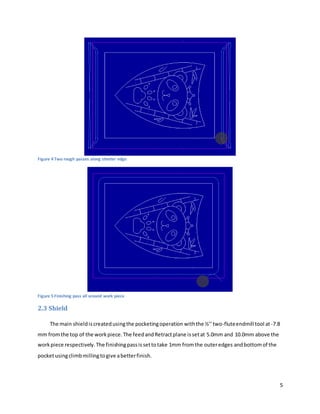
Figure 4 Two rough passes along shorteredge .....................................................................................5
Figure 5 Finishing pass all around work piece .......................................................................................5
Figure 6 Pocketing operation: Top View...............................................................................................6
Figure 7 Pocketing operation: Side View ..............................................................................................6
Figure 8 Engraving Operation..............................................................................................................7
Figure 9 Scalloping of the shield ..........................................................................................................7
Figure 10 Scalloping of the Base ..........................................................................................................7
Figure 11 Finished Shield TopView......................................................................................................8
Figure 12 Finished Shield Side View .....................................................................................................8
III
List of Tables
Table 1 Feed rates for Foam and Aluminum [ (Project #1 NC Programming of Machine Tools, 2014)] ......2
1
1.0 Introduction
The shieldprojectisthe firstprojectinthe course ME 548 CNCmachiningatthe Universityof
Waterloo,the goal isto successfullydesignandmachine ashieldoutof aluminum2024 T3 blankthatis
20mm innominal thickness.The final productwillbe 110mm x 86mm in size and19 mm inthickness.
The designof the part and selectionof toolsandtool pathsisperformedinMasterCAM,andthe
actual blankandNC machine will be providedbythe University.
There are multiplerequirementsthatmustbe completedforthe successof the project.The three
maincomponentsare:
 The contouringof the sidesandthe mainshield
 The engravingof a patternon the shieldsurface
 Scallopingaroundthe edgesforvisual effect
1.1 Specifications
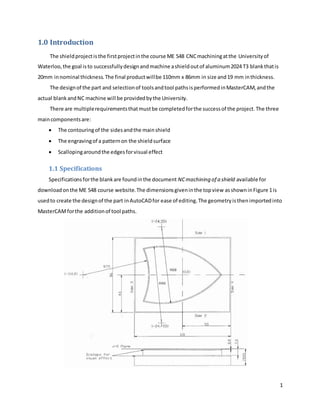
Specificationsforthe blankare foundinthe document NCmachining of a shield available for
downloadonthe ME 548 course website.The dimensionsgiveninthe topview asshowninFigure 1is
usedto create the designof the part inAutoCADfor ease of editing.The geometryisthenimportedinto
MasterCAMforthe additionof tool paths.
2
Figure 1 Work piece to be CNC machined (Project #1 NC Programming of Machine Tools, 2014)
In orderto achieve these featuresabove andasmentionedinthe Introduction,threetoolsare
allowedtobe usedincombination:
 ½” (12.7 [mm]) 2-flutedEndmill
 ¼” (6.35 [mm]) ball nose Endmill
 EngravingTool,<1 [mm] diameter
The spindle speed,plungerate andx,y axisfeedforeachof the toolsare specifiedinTable 1below
for aluminum. The plungerate ischangedto500mm/min inthe actual machinine processtospeedup
the completionof the shield.
Table 1 Feed rates for Foam and Aluminum [ (Project #1 NC Programming of Machine Tools, 2014)]
3
2.0 MasterCAM
2.1 Facing
The purpose of the facingoperationistotake off a thinlayerof material atthe topof the surface,
where the piece hasbeenexposedtothe environment.
The facingoperationisperformed usingthe ½’’two-flute endmillata depthof -0.4mm fromthe
surface of the stockpiece usinga zigzagpattern. The feedandretract plane issetat 10.0 mmabove the
workpiece andthe clearance issetat 15.0mm. The tool path isshowninFigure 2.
Figure 2 Facing Operation
2.2 Contouring of the Outer Edges
The contouringoperationisperformedbyusingthe ½’’two-flute endmill atdepth-20.0mm to
ensure thatthe tool cuts all the wayto the bottomof the stock.The feedandretract planesare setat
5.0mm and 10.0mm respectively,the clearance issetat50.0 mmabove the work piece.
To conformto directionsinthe projectoutline,the contouringof the outersidesare done in3
steps:
 Long Edges
o 1 roughingpass usingconventionalmilling
o Depthcuts at maximum 10 mm each
o 0.65mm stockto leave onwalls
 Short Edges
o 2 roughingpassesusingconventionalmilling
4
o Depthcut at maximum 10 mmeach
o 0.65 mm stock to leave onwalls
 Finishing
o One pass to take off the 0.65 stock usingclimb milling
The rough passesuse conventionalcutting,since the tool isunderlessstresswhencominginto
contact withthe material at the thinneredge,and istherefore abletocutthickeramountof materials
quickly.
Whenfinishingthe edges,climbmillingisusedinordertogive abettersurface finish;the smaller
amountof materialsremovedmitigatesthe initial jumpinstresswhenthe tool firstcomesintocontact
withthe workpiece.
The figuresbelowshowthe difference betweenclimbandconventional milling,andthe generated
tool path forthisoperationinMasterCAM.
Figure 3 Climb vs.Conventional Cutting [ (Cutting Tool Fundamentals - Rotation Direction, 2012)]
5
Figure 4 Two rough passes along shorter edge
Figure 5 Finishing pass all around work piece
2.3 Shield
The main shieldiscreatedusingthe pocketingoperation withthe ½’’two-fluteendmilltool at-7.8
mm fromthe top of the workpiece.The feedandRetractplane issetat 5.0mm and 10.0mm above the
workpiece respectively.The finishingpassissettotake 1mm fromthe outeredges andbottomof the
pocketusingclimbmillingtogive abetterfinish.
6
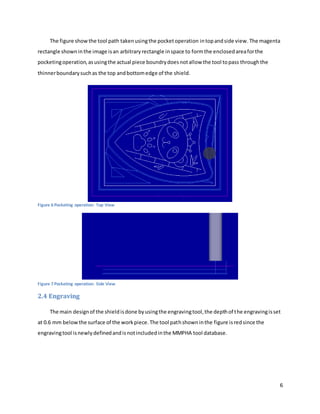
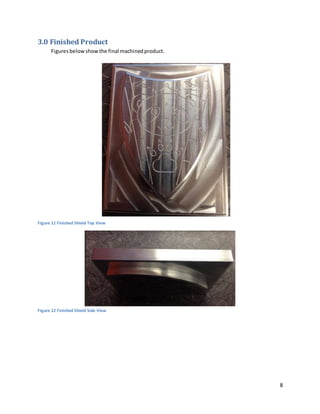
The figure showthe tool path takenusingthe pocketoperation intopandside view.The magenta
rectangle showninthe image isan arbitrary rectangle inspace to formthe enclosedareaforthe
pocketingoperation,asusingthe actual piece boundrydoesnotallow the tool topass throughthe
thinnerboundarysuchas the top andbottomedge of the shield.
Figure 6 Pocketing operation: Top View
Figure 7 Pocketing operation: Side View
2.4 Engraving
The main designof the shieldisdone byusingthe engravingtool,the depthof the engravingisset
at 0.6 mm belowthe surface of the workpiece.The tool pathshowninthe figure isredsince the
engravingtool isnewlydefinedandisnotincludedinthe MMPHA tool database.
7
Figure 8 Engraving Operation
2.5 Scallops
The scallopsare addedto the shieldforvisual appearancesonly.The tool usedisthe ¼”(6.35
[mm]) ball nose endmill,andthe cuttingdepthis -0.9 mm and-8.3 mm showninFigure 9 forthe shield
and base edges.The depthisarbitrarilydefined asthe operationisforvisual purposesonly.
Figure 9 Scalloping of the shield
Figure 10 Scalloping of the Base
8
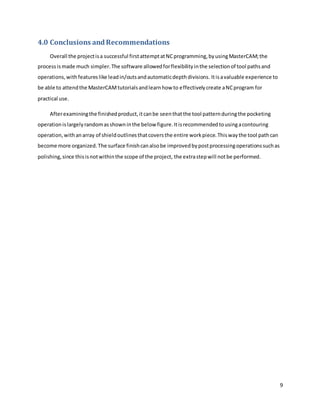
3.0 Finished Product
Figuresbelowshowthe final machinedproduct.
Figure 11 Finished Shield Top View
Figure 12 Finished Shield Side View
9
4.0 Conclusions andRecommendations
Overall the projectisa successful firstattemptatNCprogramming,byusingMasterCAM;the
processismade much simpler.The software allowedforflexibilityinthe selectionof tool pathsand
operations,withfeatureslike leadin/outsandautomaticdepthdivisions. Itisavaluable experience to
be able to attendthe MasterCAMtutorialsandlearnhow to effectivelycreate aNCprogram for
practical use.
Afterexaminingthe finishedproduct,itcanbe seenthatthe tool patternduringthe pocketing
operationislargelyrandomasshowninthe below figure.Itisrecommendedtousingacontouring
operation,withanarray of shieldoutlinesthatcoversthe entire workpiece.Thiswaythe tool pathcan
become more organized.The surface finishcanalsobe improvedbypostprocessingoperationssuchas
polishing,since thisisnotwithinthe scope of the project, the extrastepwill notbe performed.
10
5.0 References
Cutting Tool Fundamentals - Rotation Direction. (2012). Retrieved1021, 2014, from AUTODESKCAM:
http://cam.autodesk.com/docs/cncbook/en/#Ch03_CuttingToolFundamentals
Project#1 NCProgrammingof Machine Tools.(2014). ME548 - NumericalControlof MachineTools.
http://www.me.uwaterloo.ca/~me548/handouts/Project01.pdf.

Project report 1

  • 1.
    Universityof waterloo NC Programmingof Machine Tools ME548 Numerical Control of Machine Tools Chen, Qing Ge (20400887) 10/23/2014
  • 2.
    I Table of Contents Listof Figures.................................................................................................................................... II List of Tables .................................................................................................................................... III 1.1 Specifications............................................................................................................................1 2.0 MasterCAM ..................................................................................................................................3 2.1 Facing.......................................................................................................................................3 2.2 Contouring of the Outer Edges...................................................................................................3 2.3 Shield.......................................................................................................................................5 2.4 Engraving..................................................................................................................................6 2.5 Scallops ....................................................................................................................................7 3.0 FinishedProduct...........................................................................................................................8 4.0 Conclusions and Recommendations...............................................................................................9 5.0 References..................................................................................................................................10
  • 3.
    II List of Figures Figure1 Work piece to be CNC machined (Project #1 NC Programming of Machine Tools, 2014) .............2 Figure 2 Facing Operation ...................................................................................................................3 Figure 3 Climb vs. Conventional Cutting[ (Cutting Tool Fundamentals - Rotation Direction, 2012)]..........4 Figure 4 Two rough passes along shorteredge .....................................................................................5 Figure 5 Finishing pass all around work piece .......................................................................................5 Figure 6 Pocketing operation: Top View...............................................................................................6 Figure 7 Pocketing operation: Side View ..............................................................................................6 Figure 8 Engraving Operation..............................................................................................................7 Figure 9 Scalloping of the shield ..........................................................................................................7 Figure 10 Scalloping of the Base ..........................................................................................................7 Figure 11 Finished Shield TopView......................................................................................................8 Figure 12 Finished Shield Side View .....................................................................................................8
  • 4.
    III List of Tables Table1 Feed rates for Foam and Aluminum [ (Project #1 NC Programming of Machine Tools, 2014)] ......2
  • 5.
    1 1.0 Introduction The shieldprojectisthefirstprojectinthe course ME 548 CNCmachiningatthe Universityof Waterloo,the goal isto successfullydesignandmachine ashieldoutof aluminum2024 T3 blankthatis 20mm innominal thickness.The final productwillbe 110mm x 86mm in size and19 mm inthickness. The designof the part and selectionof toolsandtool pathsisperformedinMasterCAM,andthe actual blankandNC machine will be providedbythe University. There are multiplerequirementsthatmustbe completedforthe successof the project.The three maincomponentsare:  The contouringof the sidesandthe mainshield  The engravingof a patternon the shieldsurface  Scallopingaroundthe edgesforvisual effect 1.1 Specifications Specificationsforthe blankare foundinthe document NCmachining of a shield available for downloadonthe ME 548 course website.The dimensionsgiveninthe topview asshowninFigure 1is usedto create the designof the part inAutoCADfor ease of editing.The geometryisthenimportedinto MasterCAMforthe additionof tool paths.
  • 6.
    2 Figure 1 Workpiece to be CNC machined (Project #1 NC Programming of Machine Tools, 2014) In orderto achieve these featuresabove andasmentionedinthe Introduction,threetoolsare allowedtobe usedincombination:  ½” (12.7 [mm]) 2-flutedEndmill  ¼” (6.35 [mm]) ball nose Endmill  EngravingTool,<1 [mm] diameter The spindle speed,plungerate andx,y axisfeedforeachof the toolsare specifiedinTable 1below for aluminum. The plungerate ischangedto500mm/min inthe actual machinine processtospeedup the completionof the shield. Table 1 Feed rates for Foam and Aluminum [ (Project #1 NC Programming of Machine Tools, 2014)]
  • 7.
    3 2.0 MasterCAM 2.1 Facing Thepurpose of the facingoperationistotake off a thinlayerof material atthe topof the surface, where the piece hasbeenexposedtothe environment. The facingoperationisperformed usingthe ½’’two-flute endmillata depthof -0.4mm fromthe surface of the stockpiece usinga zigzagpattern. The feedandretract plane issetat 10.0 mmabove the workpiece andthe clearance issetat 15.0mm. The tool path isshowninFigure 2. Figure 2 Facing Operation 2.2 Contouring of the Outer Edges The contouringoperationisperformedbyusingthe ½’’two-flute endmill atdepth-20.0mm to ensure thatthe tool cuts all the wayto the bottomof the stock.The feedandretract planesare setat 5.0mm and 10.0mm respectively,the clearance issetat50.0 mmabove the work piece. To conformto directionsinthe projectoutline,the contouringof the outersidesare done in3 steps:  Long Edges o 1 roughingpass usingconventionalmilling o Depthcuts at maximum 10 mm each o 0.65mm stockto leave onwalls  Short Edges o 2 roughingpassesusingconventionalmilling
  • 8.
    4 o Depthcut atmaximum 10 mmeach o 0.65 mm stock to leave onwalls  Finishing o One pass to take off the 0.65 stock usingclimb milling The rough passesuse conventionalcutting,since the tool isunderlessstresswhencominginto contact withthe material at the thinneredge,and istherefore abletocutthickeramountof materials quickly. Whenfinishingthe edges,climbmillingisusedinordertogive abettersurface finish;the smaller amountof materialsremovedmitigatesthe initial jumpinstresswhenthe tool firstcomesintocontact withthe workpiece. The figuresbelowshowthe difference betweenclimbandconventional milling,andthe generated tool path forthisoperationinMasterCAM. Figure 3 Climb vs.Conventional Cutting [ (Cutting Tool Fundamentals - Rotation Direction, 2012)]
  • 9.
    5 Figure 4 Tworough passes along shorter edge Figure 5 Finishing pass all around work piece 2.3 Shield The main shieldiscreatedusingthe pocketingoperation withthe ½’’two-fluteendmilltool at-7.8 mm fromthe top of the workpiece.The feedandRetractplane issetat 5.0mm and 10.0mm above the workpiece respectively.The finishingpassissettotake 1mm fromthe outeredges andbottomof the pocketusingclimbmillingtogive abetterfinish.
  • 10.
    6 The figure showthetool path takenusingthe pocketoperation intopandside view.The magenta rectangle showninthe image isan arbitrary rectangle inspace to formthe enclosedareaforthe pocketingoperation,asusingthe actual piece boundrydoesnotallow the tool topass throughthe thinnerboundarysuchas the top andbottomedge of the shield. Figure 6 Pocketing operation: Top View Figure 7 Pocketing operation: Side View 2.4 Engraving The main designof the shieldisdone byusingthe engravingtool,the depthof the engravingisset at 0.6 mm belowthe surface of the workpiece.The tool pathshowninthe figure isredsince the engravingtool isnewlydefinedandisnotincludedinthe MMPHA tool database.
  • 11.
    7 Figure 8 EngravingOperation 2.5 Scallops The scallopsare addedto the shieldforvisual appearancesonly.The tool usedisthe ¼”(6.35 [mm]) ball nose endmill,andthe cuttingdepthis -0.9 mm and-8.3 mm showninFigure 9 forthe shield and base edges.The depthisarbitrarilydefined asthe operationisforvisual purposesonly. Figure 9 Scalloping of the shield Figure 10 Scalloping of the Base
  • 12.
    8 3.0 Finished Product Figuresbelowshowthefinal machinedproduct. Figure 11 Finished Shield Top View Figure 12 Finished Shield Side View
  • 13.
    9 4.0 Conclusions andRecommendations Overallthe projectisa successful firstattemptatNCprogramming,byusingMasterCAM;the processismade much simpler.The software allowedforflexibilityinthe selectionof tool pathsand operations,withfeatureslike leadin/outsandautomaticdepthdivisions. Itisavaluable experience to be able to attendthe MasterCAMtutorialsandlearnhow to effectivelycreate aNCprogram for practical use. Afterexaminingthe finishedproduct,itcanbe seenthatthe tool patternduringthe pocketing operationislargelyrandomasshowninthe below figure.Itisrecommendedtousingacontouring operation,withanarray of shieldoutlinesthatcoversthe entire workpiece.Thiswaythe tool pathcan become more organized.The surface finishcanalsobe improvedbypostprocessingoperationssuchas polishing,since thisisnotwithinthe scope of the project, the extrastepwill notbe performed.
  • 14.
    10 5.0 References Cutting ToolFundamentals - Rotation Direction. (2012). Retrieved1021, 2014, from AUTODESKCAM: http://cam.autodesk.com/docs/cncbook/en/#Ch03_CuttingToolFundamentals Project#1 NCProgrammingof Machine Tools.(2014). ME548 - NumericalControlof MachineTools. http://www.me.uwaterloo.ca/~me548/handouts/Project01.pdf.