Sreeremya.s
• For the past two decades, an increasing number of studies 
have focused and been published on biodiversity. This is 
principally due to the fact that the world’s flora and fauna 
are disappearing at rates greater than the historical mass 
extinction events (Chapin III et al., 2001). As recently 
suggested by Thomas et al. (2004), there is an 18% to 40% 
risk of species-level extinction resulting majorly from global 
warming and drastic change happening in the climatic 
conditions. Moreover, other processes such as agricultural 
expansion, for example, in response to an increasing 
demand for food have a negative impact on biodiversity as 
a result of habitat destruction (Tilman et al., 2001).
• Biodiversity is the variety of all life forms: the 
different plants, animals and micro-organisms, 
their genes and the ecosystems of which they 
are a part.
• Genetic diversity-the total genetic 
information contained in the genes of all species. 
• Species Diversity-The variety of species, 
refers to the number of species and the number 
of individuals in a species. 
• Ecosystem Diversity- the variety of 
habitats natural communities and ecological 
processes.
• The National Strategy for the Conservation of 
Australia’s Biological Diversity 
• Natural Heritage Trust 
• Wild life reserves- e.g. National Parks. 
• Flora and Fauna guarantee act 
• Endangered species Program 
• Quarantine 
• Education 
• Breeding Programs
• Biodiversity is one of the earth’s greatest treasures. Microorganisms represent a 
largely untapped source of novel bioactive compounds and metabolic pathways 
which could be exploited for new biotechnological applications and products. 
Microbes and their activities may also promote or alleviate climate change apart 
from its application in pharmacy, agriculture and industrial fields. Microbes can 
perform numerous functions essential for biosphere like nutrient recycling and 
environmental detoxification. Exploitation of microbial diversity has an important 
role in sustainable development worth millions of rupees. 
• Compared to plants and animals, microbes are least explored since they are 
mostly considered as pathogens and very little is known about their beneficial 
potentiality. There is a lack of understanding especially in microbial interaction 
with the environment [2]. Hence, there arises an urgent need to raise the public 
awareness about its economic value by taking effective measures in exploiting and 
conserving the microbial diversity. 
• An attempt has been made to discuss about the strategy of microbial screening 
and its applications along with future innovative practices that has to be 
undertaken in order to conserve its diversity.
II. PURPOSE 
• Research in microbial biodiversity helps in exploiting 
the limitations of microbes that are in extreme 
conditions. Studies about their diversities can be used 
to monitor environmental changes and conservation of 
higher organisms. As mentioned in Fig 1, the microbes 
are the major sources of beneficial potential. 
• Discovery of several novel genes isolated from new 
microbes provided phylogenetic similarities and 
evolutionary relationship among divergent groups of 
microorganisms which nurture the environment on 
which human society depend

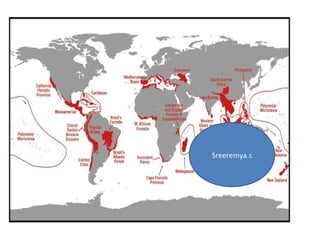
Biodiversityyy,its types,what is biodiversity,how to preserve biodiversity,innovations happening

  • 1.
  • 2.
    • For thepast two decades, an increasing number of studies have focused and been published on biodiversity. This is principally due to the fact that the world’s flora and fauna are disappearing at rates greater than the historical mass extinction events (Chapin III et al., 2001). As recently suggested by Thomas et al. (2004), there is an 18% to 40% risk of species-level extinction resulting majorly from global warming and drastic change happening in the climatic conditions. Moreover, other processes such as agricultural expansion, for example, in response to an increasing demand for food have a negative impact on biodiversity as a result of habitat destruction (Tilman et al., 2001).
  • 3.
    • Biodiversity isthe variety of all life forms: the different plants, animals and micro-organisms, their genes and the ecosystems of which they are a part.
  • 4.
    • Genetic diversity-thetotal genetic information contained in the genes of all species. • Species Diversity-The variety of species, refers to the number of species and the number of individuals in a species. • Ecosystem Diversity- the variety of habitats natural communities and ecological processes.
  • 5.
    • The NationalStrategy for the Conservation of Australia’s Biological Diversity • Natural Heritage Trust • Wild life reserves- e.g. National Parks. • Flora and Fauna guarantee act • Endangered species Program • Quarantine • Education • Breeding Programs
  • 6.
    • Biodiversity isone of the earth’s greatest treasures. Microorganisms represent a largely untapped source of novel bioactive compounds and metabolic pathways which could be exploited for new biotechnological applications and products. Microbes and their activities may also promote or alleviate climate change apart from its application in pharmacy, agriculture and industrial fields. Microbes can perform numerous functions essential for biosphere like nutrient recycling and environmental detoxification. Exploitation of microbial diversity has an important role in sustainable development worth millions of rupees. • Compared to plants and animals, microbes are least explored since they are mostly considered as pathogens and very little is known about their beneficial potentiality. There is a lack of understanding especially in microbial interaction with the environment [2]. Hence, there arises an urgent need to raise the public awareness about its economic value by taking effective measures in exploiting and conserving the microbial diversity. • An attempt has been made to discuss about the strategy of microbial screening and its applications along with future innovative practices that has to be undertaken in order to conserve its diversity.
  • 7.
    II. PURPOSE •Research in microbial biodiversity helps in exploiting the limitations of microbes that are in extreme conditions. Studies about their diversities can be used to monitor environmental changes and conservation of higher organisms. As mentioned in Fig 1, the microbes are the major sources of beneficial potential. • Discovery of several novel genes isolated from new microbes provided phylogenetic similarities and evolutionary relationship among divergent groups of microorganisms which nurture the environment on which human society depend