Exergetic and Thermoeconomic analysis
Presented by :-
Govind Kumar Mishra
Roll No. – 14/ME/32
Source :- International Journal of Thermal Science
by :- Cuneyt Uysal and Huseyin Kurt
Contents :
1. Exergy
2. Energy analysis and Exergy analysis
3.Thermoeconomic analysis
4. Description of a coal fired power plant based on
thermoeconomic analysis
5. Results and conclusions
2
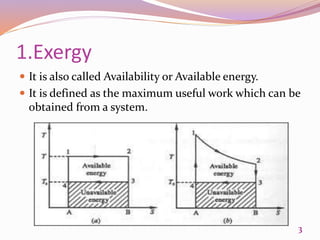
1.Exergy
 It is also called Availability or Available energy.
 It is defined as the maximum useful work which can be
obtained from a system.
3
Energy types
High grade energy Low grade energy
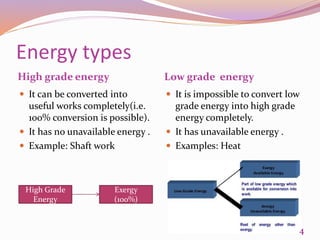
 It can be converted into
useful works completely(i.e.
100% conversion is possible).
 It has no unavailable energy .
 Example: Shaft work
 It is impossible to convert low
grade energy into high grade
energy completely.
 It has unavailable energy .
 Examples: Heat
High Grade
Energy
Exergy
(100%)
4
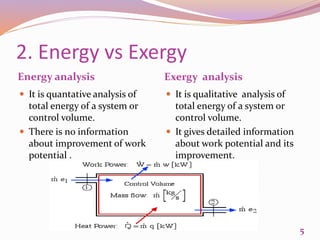
2. Energy vs Exergy
Energy analysis Exergy analysis
 It is quantative analysis of
total energy of a system or
control volume.
 There is no information
about improvement of work
potential .
 It is qualitative analysis of
total energy of a system or
control volume.
 It gives detailed information
about work potential and its
improvement.
5
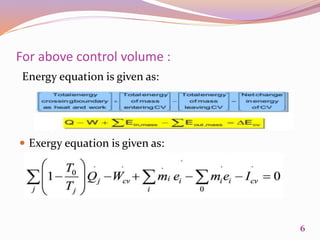
For above control volume :
Energy equation is given as:
 Exergy equation is given as:
6
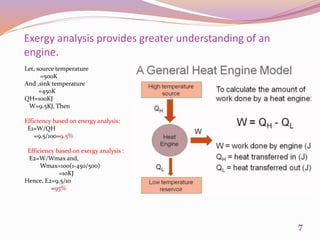
Let, source temperature
=500K
And ,sink temperature
=450K
QH=100KJ
W=9.5KJ, Then
Efficiency based on energy analysis:
E1=W/QH
=9.5/100=9.5%
Efficiency based on exergy analysis :
E2=W/Wmax and,
Wmax=100(1-450/500)
=10KJ
Hence, E2=9.5/10
=95%
Exergy analysis provides greater understanding of an
engine.
7
3.Thermoeconomic analysis
 Thermoeconomic analysis is the method that combines exergy analysis
and economic analysis.
 It informs for the design and operation of a system with relevant cost.
 There are many thermoeconomic analysis method as:
 Engineering Functional Analysis (EFA)
 Exergy-Cost-Energy-Mass-Analysis(EXCEM)
 Exergy Economic Approach(EEA)
 Last-In-First-Out Principle(LIFO)
 Modified Productive Structural Analysis(MOPSA)
 Specific Energy Costing(SPECO)
 Structural Theory of Thermoeconomics(STT)
 Theory of Exergetic Cost(TEC)
 Thermoeconomic Functional Analysis(TFA)
8
i.Specific Exergy Costing(SPECO)
 SPECO was first introduced by Lazzareto & Tsatsorins
to determine the changes in design parameters of a
copper-chlorine(cu-cl) thermochemical cycle for
hydrogen production and to improve the effectiveness
of cu-cl cycle.
 In this methodology,the fuel and product of an
equipment are defined by taking record of all exergy
additons and exergy removals from exergy streams and
cost are calculated from basic principles from business
administration.
9
SPECO
 It proposes the calculation of unit exergy cost of each
exergy stream belonging to the analysed system.
 Hence, number of equations required for calculation
of unit exergy cost of each exergy streams is equal to
the number of exergy streams in the system.
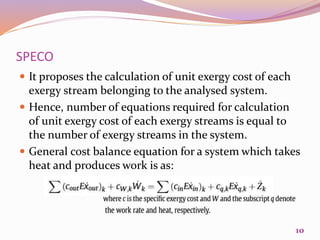
 General cost balance equation for a system which takes
heat and produces work is as:
10
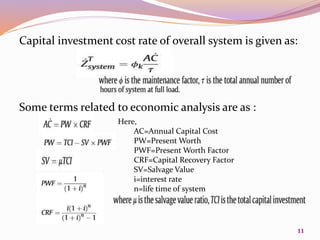
Capital investment cost rate of overall system is given as:
Some terms related to economic analysis are as :
Here,
AC=Annual Capital Cost
PW=Present Worth
PWF=Present Worth Factor
CRF=Capital Recovery Factor
SV=Salvage Value
i=interest rate
n=life time of system
11
ii. Modified Production Structural Analysis(MOPSA)
 MOPSA was firstly introduced by Kimet al to provide
information on decisions about the design and operation of
the cogeneration system for the first time at different load
conditions and and calculated the unit exergy costs for
these conditions.
 In this method, exergy costing is done without flow stream
cost calculations
 Actually in this method, exergy of any state in system is
divided into their components(i.e.Thermal, mechanical
and chemical) and a unit exergy costing is assigned to each
exergy components.
12
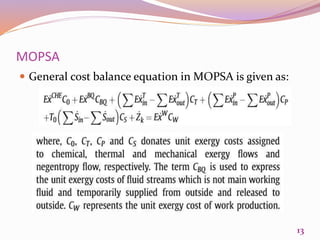
MOPSA
 General cost balance equation in MOPSA is given as:
13
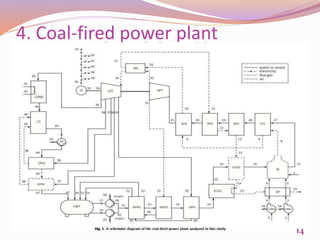
4. Coal-fired power plant
14
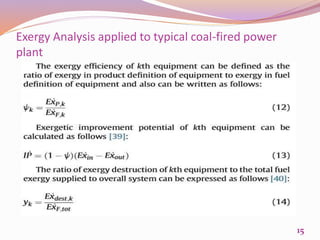
Exergy Analysis applied to typical coal-fired power
plant
15
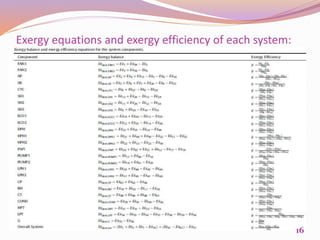
Exergy equations and exergy efficiency of each system:
16
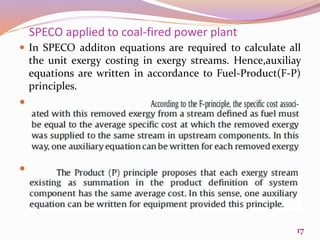
SPECO applied to coal-fired power plant
 In SPECO additon equations are required to calculate all
the unit exergy costing in exergy streams. Hence,auxiliay
equations are written in accordance to Fuel-Product(F-P)
principles.


17
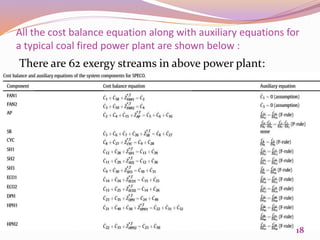
All the cost balance equation along with auxiliary equations for
a typical coal fired power plant are shown below :
There are 62 exergy streams in above power plant:
18
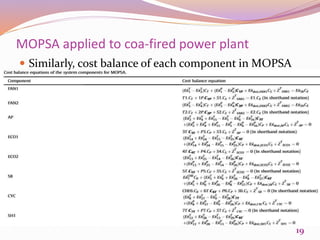
MOPSA applied to coa-fired power plant
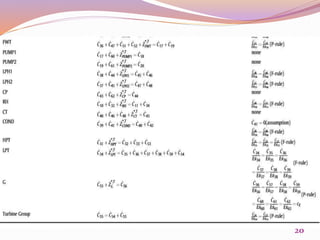
 Similarly, cost balance of each component in MOPSA
method is given as:
19
20
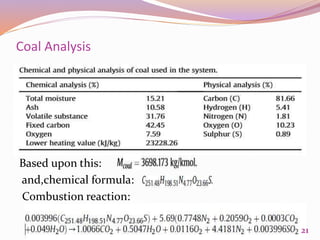
Coal Analysis
Based upon this:
and,chemical formula:
Combustion reaction:
21
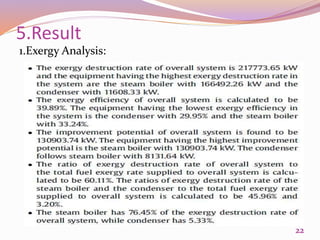
5.Result
1.Exergy Analysis:
22
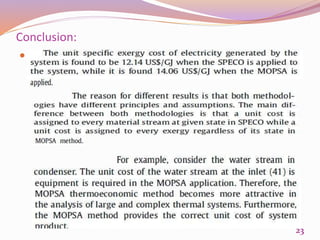
Conclusion:

23
Thank you!
24

Project power plant

  • 1.
    Exergetic and Thermoeconomicanalysis Presented by :- Govind Kumar Mishra Roll No. – 14/ME/32 Source :- International Journal of Thermal Science by :- Cuneyt Uysal and Huseyin Kurt
  • 2.
    Contents : 1. Exergy 2.Energy analysis and Exergy analysis 3.Thermoeconomic analysis 4. Description of a coal fired power plant based on thermoeconomic analysis 5. Results and conclusions 2
  • 3.
    1.Exergy  It isalso called Availability or Available energy.  It is defined as the maximum useful work which can be obtained from a system. 3
  • 4.
    Energy types High gradeenergy Low grade energy  It can be converted into useful works completely(i.e. 100% conversion is possible).  It has no unavailable energy .  Example: Shaft work  It is impossible to convert low grade energy into high grade energy completely.  It has unavailable energy .  Examples: Heat High Grade Energy Exergy (100%) 4
  • 5.
    2. Energy vsExergy Energy analysis Exergy analysis  It is quantative analysis of total energy of a system or control volume.  There is no information about improvement of work potential .  It is qualitative analysis of total energy of a system or control volume.  It gives detailed information about work potential and its improvement. 5
  • 6.
    For above controlvolume : Energy equation is given as:  Exergy equation is given as: 6
  • 7.
    Let, source temperature =500K And,sink temperature =450K QH=100KJ W=9.5KJ, Then Efficiency based on energy analysis: E1=W/QH =9.5/100=9.5% Efficiency based on exergy analysis : E2=W/Wmax and, Wmax=100(1-450/500) =10KJ Hence, E2=9.5/10 =95% Exergy analysis provides greater understanding of an engine. 7
  • 8.
    3.Thermoeconomic analysis  Thermoeconomicanalysis is the method that combines exergy analysis and economic analysis.  It informs for the design and operation of a system with relevant cost.  There are many thermoeconomic analysis method as:  Engineering Functional Analysis (EFA)  Exergy-Cost-Energy-Mass-Analysis(EXCEM)  Exergy Economic Approach(EEA)  Last-In-First-Out Principle(LIFO)  Modified Productive Structural Analysis(MOPSA)  Specific Energy Costing(SPECO)  Structural Theory of Thermoeconomics(STT)  Theory of Exergetic Cost(TEC)  Thermoeconomic Functional Analysis(TFA) 8
  • 9.
    i.Specific Exergy Costing(SPECO) SPECO was first introduced by Lazzareto & Tsatsorins to determine the changes in design parameters of a copper-chlorine(cu-cl) thermochemical cycle for hydrogen production and to improve the effectiveness of cu-cl cycle.  In this methodology,the fuel and product of an equipment are defined by taking record of all exergy additons and exergy removals from exergy streams and cost are calculated from basic principles from business administration. 9
  • 10.
    SPECO  It proposesthe calculation of unit exergy cost of each exergy stream belonging to the analysed system.  Hence, number of equations required for calculation of unit exergy cost of each exergy streams is equal to the number of exergy streams in the system.  General cost balance equation for a system which takes heat and produces work is as: 10
  • 11.
    Capital investment costrate of overall system is given as: Some terms related to economic analysis are as : Here, AC=Annual Capital Cost PW=Present Worth PWF=Present Worth Factor CRF=Capital Recovery Factor SV=Salvage Value i=interest rate n=life time of system 11
  • 12.
    ii. Modified ProductionStructural Analysis(MOPSA)  MOPSA was firstly introduced by Kimet al to provide information on decisions about the design and operation of the cogeneration system for the first time at different load conditions and and calculated the unit exergy costs for these conditions.  In this method, exergy costing is done without flow stream cost calculations  Actually in this method, exergy of any state in system is divided into their components(i.e.Thermal, mechanical and chemical) and a unit exergy costing is assigned to each exergy components. 12
  • 13.
    MOPSA  General costbalance equation in MOPSA is given as: 13
  • 14.
  • 15.
    Exergy Analysis appliedto typical coal-fired power plant 15
  • 16.
    Exergy equations andexergy efficiency of each system: 16
  • 17.
    SPECO applied tocoal-fired power plant  In SPECO additon equations are required to calculate all the unit exergy costing in exergy streams. Hence,auxiliay equations are written in accordance to Fuel-Product(F-P) principles.   17
  • 18.
    All the costbalance equation along with auxiliary equations for a typical coal fired power plant are shown below : There are 62 exergy streams in above power plant: 18
  • 19.
    MOPSA applied tocoa-fired power plant  Similarly, cost balance of each component in MOPSA method is given as: 19
  • 20.
  • 21.
    Coal Analysis Based uponthis: and,chemical formula: Combustion reaction: 21
  • 22.
  • 23.
  • 24.