Project Planning
& Development
The Production Process
What is The Production Process?
The stages needed to complete a media production from
inception to distribution.
Applies to any form of media, including:
● Video/Television
● Film
● Audio/Radio
● Multimedia
● Online
● Photography
● Print
● Games
● Animation
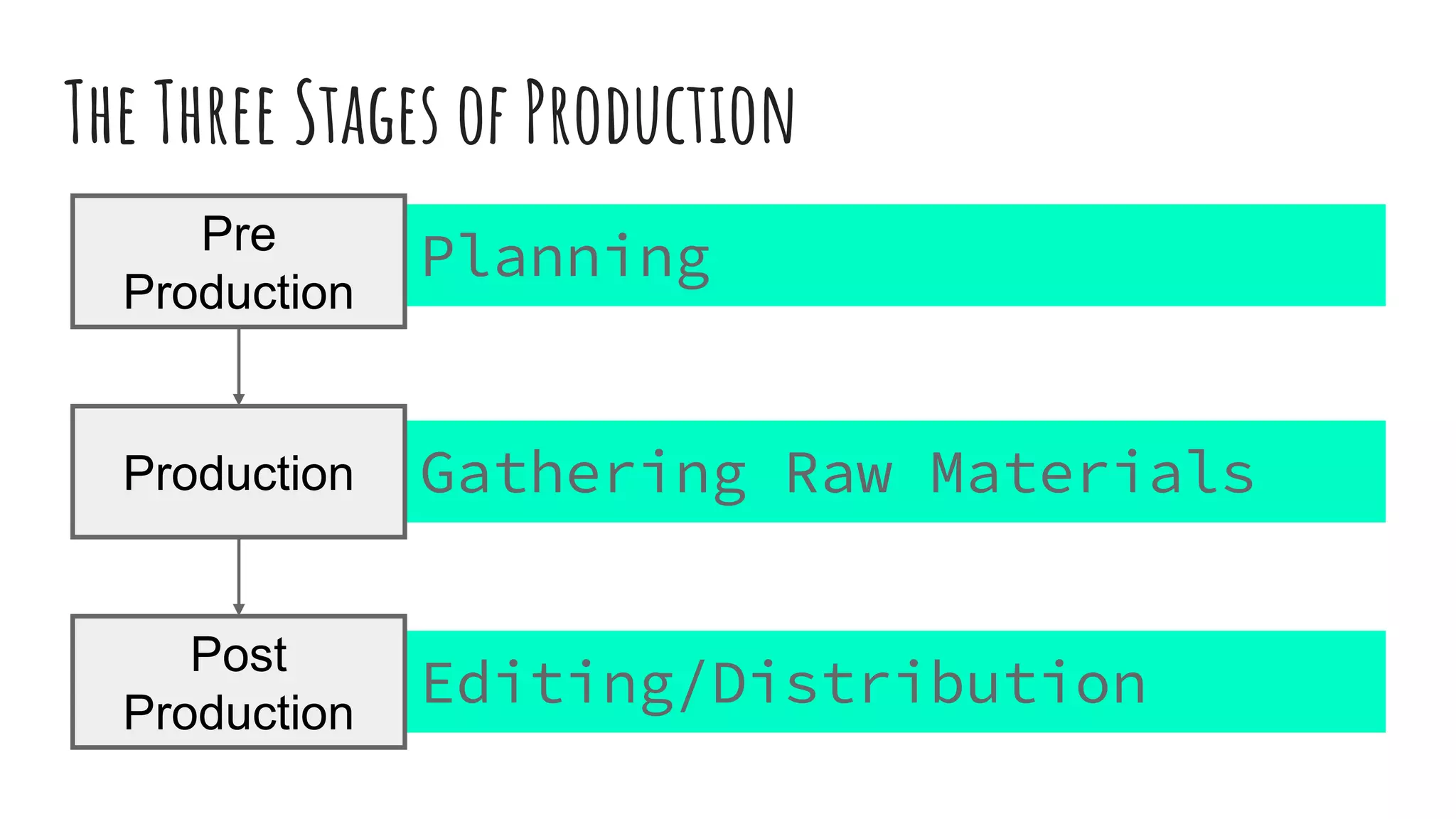
Gathering Raw Materials
Editing/Distribution
Planning
The Three Stages of Production
Pre
Production
Production
Post
Production
Getting Started:
Pre-Production
Proposal: Used to sell the
work
Premise/Log Line/Elevator
Pitch: A one-liner that sums
up your work
Synopsis: One-paragraph that
summarizes the work
Treatment: Longer description
of the work in the form of a
short story
Script: Complete description
of the final product that
includes what will be seen
and/or heard
You start with an IDEA.
From there, you develop a
combination of written
documents.
Things to Consider When Developing Your Idea
Purpose - Why am I doing this? To persuade someone? To get
them to act? To change the world? Because Professor Bauer
made me?
Format - What’s the best way to get across my message? Text?
Images? Video? Sound? Graphics? Animation?
Audience - Who do I want to see/hear my message? Why them?
Who am I not reaching?
Resources - What do I have to help me create my idea? $$$$?
Time? Equipment? Help? What don’t I have, and how will that
limit me?
Pre-Production: Next Steps
You’ve got a script/treatment - what next?
Unless you’re doing an audio-only project,
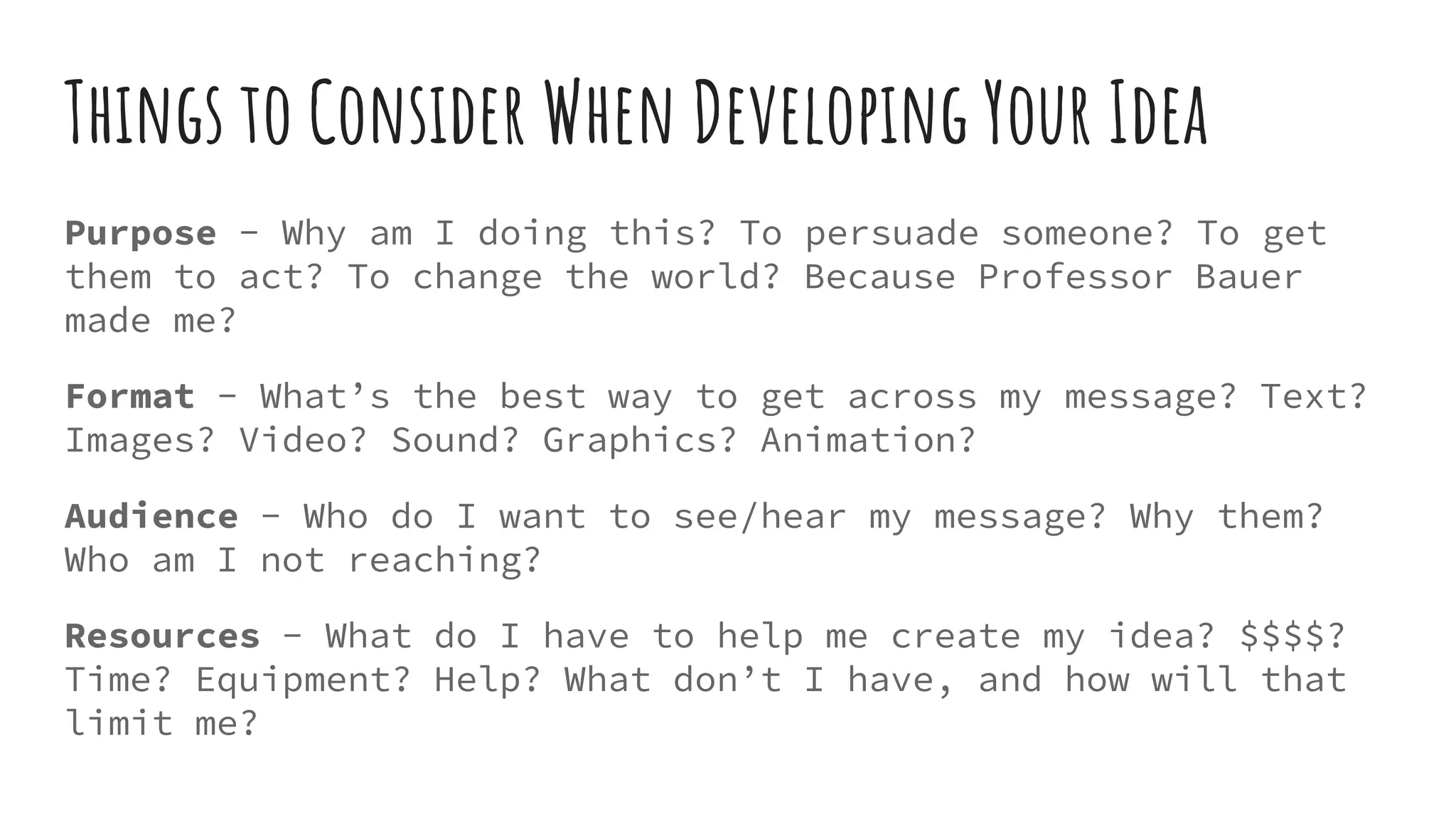
you need to create a Storyboard - a visual
representation of the script/treatment.
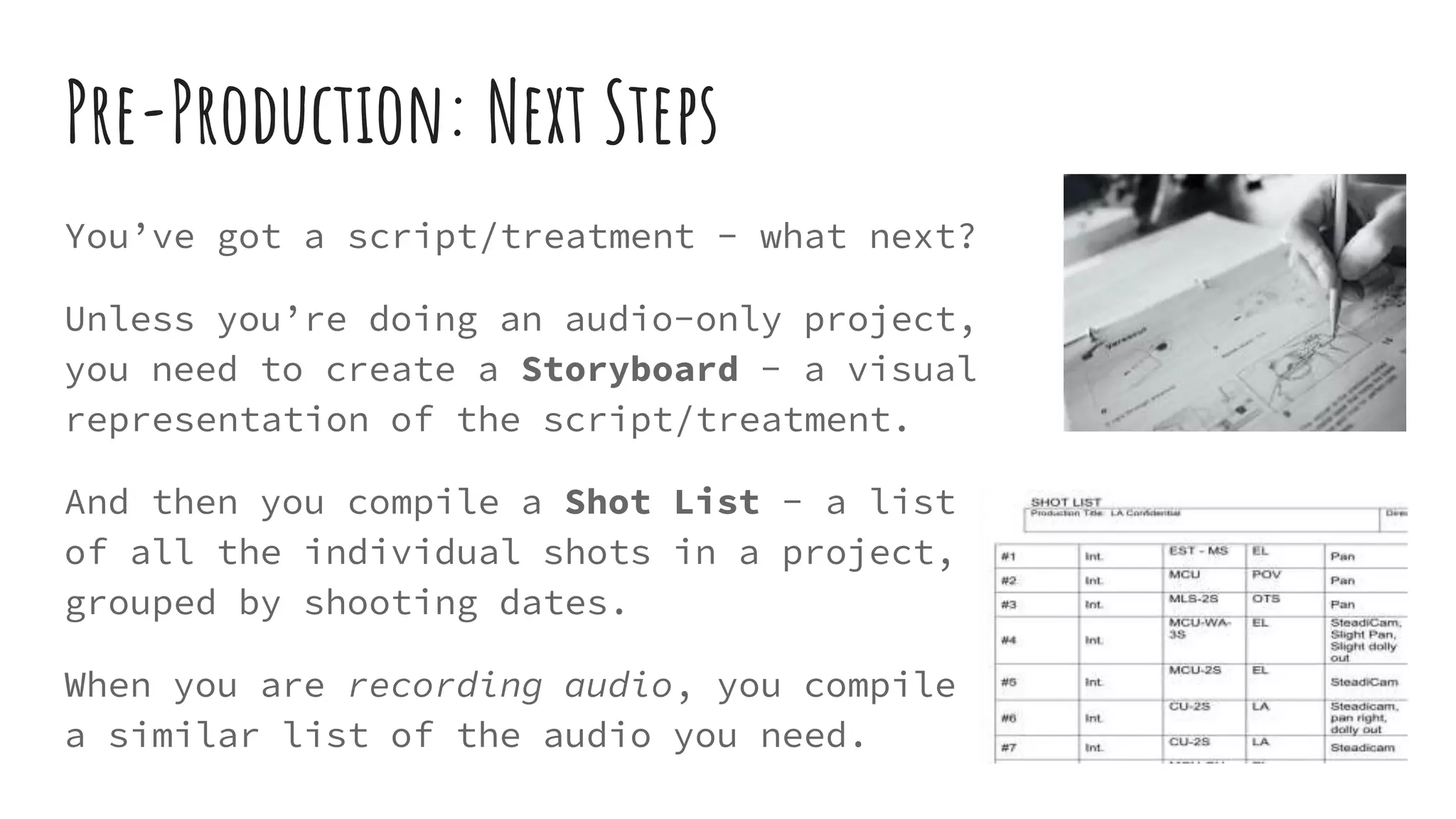
And then you compile a Shot List - a list
of all the individual shots in a project,
grouped by shooting dates.
When you are recording audio, you compile
a similar list of the audio you need.
Pre-Production - Nitty-Gritty
To help you plan and calculate costs,
you need a Script Breakdown - a list of
all the cast, crew, equipment and
supplies needed for the project.
From there you can:
1. Develop a budget
2. Raise Money $$$
3. Scout Locations
4. Develop a Production Schedule
5. Hire a Production Crew
6. Hire Talent
7. Rent Equipment
Production
Photographs
Illustrations
Graphics
Audio
Video
Text
Gather your raw materials.
Will vary depending on your
medium!
Post-Production
Distribution & Promotion:
Getting your work out
there and convincing
people to view it and
support it.
● Exhibit at a Gallery
● Post via Social Media
● Screen at a Film Fest
● Publish in print or
online
● Play on the radio or TV
(Some people consider
distribution and promotion
a fourth step in the
production process.)
Transform your materials
into a final product though
a series of edits/revisions.
Production Timelines by Medium
https://jasondaponte.wordpress.com/tag/production
/
Schram’s S-M-C-R Model of Communication
= source, message, channel, receiver
This is a linear model of communication that is more suited
to mass media (old media!).
User-Centered Design
6 Fundamental Principles of Human-Centered Design
1. The design is based upon an explicit understanding of
users, tasks, and environments.
2. Users are involved throughout design and development.
3. The design is driven and refined by user-centered
evaluation.
4. The process is iterative.
5. The design addresses the whole user experience.
6. The design team includes multidisciplinary skills and
perspectives.
(Costello, ch. 3)
Putting Principles into Practice (Costello, ch. 3)
Phase One — Analysis
● Needs Assessment, Fact Gathering, and Research
● Identify Target Users
● Specify Project Requirements
● Conduct Research and Assimilate Data
Phase Two — Design
● Mockups and/or Prototypes
Phase Three — Implementation
Phase Four — Deployment

Project Planning & Development

  • 1.
  • 2.
  • 3.
    What is TheProduction Process? The stages needed to complete a media production from inception to distribution. Applies to any form of media, including: ● Video/Television ● Film ● Audio/Radio ● Multimedia ● Online ● Photography ● Print ● Games ● Animation
  • 4.
    Gathering Raw Materials Editing/Distribution Planning TheThree Stages of Production Pre Production Production Post Production
  • 5.
    Getting Started: Pre-Production Proposal: Usedto sell the work Premise/Log Line/Elevator Pitch: A one-liner that sums up your work Synopsis: One-paragraph that summarizes the work Treatment: Longer description of the work in the form of a short story Script: Complete description of the final product that includes what will be seen and/or heard You start with an IDEA. From there, you develop a combination of written documents.
  • 6.
    Things to ConsiderWhen Developing Your Idea Purpose - Why am I doing this? To persuade someone? To get them to act? To change the world? Because Professor Bauer made me? Format - What’s the best way to get across my message? Text? Images? Video? Sound? Graphics? Animation? Audience - Who do I want to see/hear my message? Why them? Who am I not reaching? Resources - What do I have to help me create my idea? $$$$? Time? Equipment? Help? What don’t I have, and how will that limit me?
  • 7.
    Pre-Production: Next Steps You’vegot a script/treatment - what next? Unless you’re doing an audio-only project, you need to create a Storyboard - a visual representation of the script/treatment. And then you compile a Shot List - a list of all the individual shots in a project, grouped by shooting dates. When you are recording audio, you compile a similar list of the audio you need.
  • 8.
    Pre-Production - Nitty-Gritty Tohelp you plan and calculate costs, you need a Script Breakdown - a list of all the cast, crew, equipment and supplies needed for the project. From there you can: 1. Develop a budget 2. Raise Money $$$ 3. Scout Locations 4. Develop a Production Schedule 5. Hire a Production Crew 6. Hire Talent 7. Rent Equipment
  • 9.
  • 10.
    Post-Production Distribution & Promotion: Gettingyour work out there and convincing people to view it and support it. ● Exhibit at a Gallery ● Post via Social Media ● Screen at a Film Fest ● Publish in print or online ● Play on the radio or TV (Some people consider distribution and promotion a fourth step in the production process.) Transform your materials into a final product though a series of edits/revisions.
  • 11.
    Production Timelines byMedium https://jasondaponte.wordpress.com/tag/production /
  • 12.
    Schram’s S-M-C-R Modelof Communication = source, message, channel, receiver This is a linear model of communication that is more suited to mass media (old media!).
  • 13.
  • 14.
    6 Fundamental Principlesof Human-Centered Design 1. The design is based upon an explicit understanding of users, tasks, and environments. 2. Users are involved throughout design and development. 3. The design is driven and refined by user-centered evaluation. 4. The process is iterative. 5. The design addresses the whole user experience. 6. The design team includes multidisciplinary skills and perspectives. (Costello, ch. 3)
  • 15.
    Putting Principles intoPractice (Costello, ch. 3) Phase One — Analysis ● Needs Assessment, Fact Gathering, and Research ● Identify Target Users ● Specify Project Requirements ● Conduct Research and Assimilate Data Phase Two — Design ● Mockups and/or Prototypes Phase Three — Implementation Phase Four — Deployment