Job Search Boot CampCareer Development CenterMIT 12-170
Welcome!Building the FoundationJob Search ProcessGoalsMarketing and Connecting to EmployersInformational InterviewsNetworkingDeveloping Your ToolsResumesCover LettersInterviewing
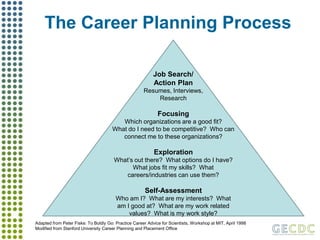
The Career Planning ProcessJob Search/Action PlanResumes, Interviews, ResearchFocusingWhich organizations are a good fit?  What do I need to be competitive?  Who can connect me to these organizations?ExplorationWhat’s out there?  What options do I have?What jobs fit my skills?  What careers/industries can use them?Self-AssessmentWho am I?  What are my interests?  What am I good at?  What are my work related values?  What is my work style?Adapted from Peter Fiske: To Boldly Go: Practice Career Advice for Scientists, Workshop at MIT, April 1998Modified from Stanford University Career Planning and Placement Office
Plan and Organize Your Search1.What kind of job do you want?2.How do you look for a job?3.What are the elements of a job search?
What Kind of Job Would You Like?Imagine Your Ideal Job:What is the environment like?What responsibilities do you have?What kind of people do you work with and/or for?What products or services do you provide?What are you wearing?What is your work schedule?
Do We Ever Find Ideal Jobs?Most jobs involve some compromise on both sides – employer and potential employee.Employers seek candidates with skills and experience that they imagine would make an ideal employee – that ideal employee probably doesn’t exist.Develop a sense of your priorities and look for a good fit.
Job Goal StatementJob Goal StatementHelps you to identify how you plan to incorporate the following into your work:EducationExperiencesInterestsSkillsValues“Heart and Soul”
A Job Goal Statement Includes:Job Functions (tasks and responsibilities)EducationOrganizational CultureFinancial NeedsGeographical PreferenceSupporting Resources
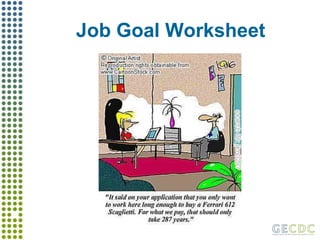
Job Goal Worksheet
Ways to Look for a JobTraditional Search MethodsHidden Job MarketNetworking
Job Search: TraditionalSend a resume and cover letter inresponse to an advertised vacancy.Where to Find Advertised Vacancies:On-campus Recruiting – CareerBridgeNewspapers, journals, publicationsCompany websites, professional associationsOnline job sites, Internet bulletin boardsList-servs, departmental notices Employment agencies
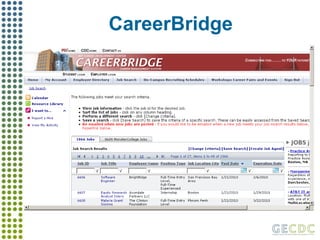
CareerBridge
Find a Job ActivityFind a job opening that appeals to you using any of the resources that we have discussed.CareerBridgeIndeed.comiNet (internships)Company Websites
Job Search: Hidden Job MarketTarget employers of interest, approach them.Make contacts in the industry of your choice.Do any MIT alumni/ae work for the company?ICAN DatabaseDoes your network know anyone in the company?Do library/online/news research to find people.Conduct informational interviews and network.
ICAN
Job Search: NetworkingNetworking: discovering and utilizing connections between people.Networking is the most successful method of searching for a job!Move beyond your own network of acquaintances, tap into other people's networks.Talk to people about your job search. Ask for advice, suggestions, other people to talk to.Networking is a two-way street -offer to help them!
Who to Network With:List people you know who you might talk to:FamilyFriends Classmates / HousematesCo-workers Faculty StaffMembers of organizations to which you belongICAN –alumni/aeof MITService professionals
How to Make ContactMake a list of a questions you’d like to askWrite a brief script to introduce yourself:Your nameHow you heard about them/who referred you Why you are calling or writing A brief summary of your related skills/experience Rehearse your script (if via phone)Set up a brief meeting (15-30 minutes) to ask your questionsInformational Interview
ExampleDear Mr. XXXX,Professor XXXX, a faculty member in the Electrical Engineering and Computer\ScienceDepartment at MIT, suggested that I contact you.  I have been meeting with Professor XXXX as ameans of exploring the field of Speech Systems Technology as a potential career option.He thought you would be a great resource to help me gain insight into the field and focus my jobsearch efforts.  I realize your time is very valuable so I am requesting to setup a brief  20-30minute meeting at your convenience.  I would enjoy a chance to ask you some questions.I have enclosed my resume for your review.  I thought it might be useful as a way of informing youof my educational background and experience.  I can be reached at mitstudent@mit.edu or (XXX)XXX-XXXX.Thank you in advance for your time and effort.Sincereley,Your Name
Informational InterviewsAn opportunity to speak with a person who has experience in your field of interest.5 R’s of Informational InterviewingEncourage your prospect to:Reveal useful information and adviceRefer you to other for additional information and adviceReading and Revising your resumeRemember you for future reference
Find an Alum ActivityUsing the ICAN database, find someone you want to contact and draft an email.http://alum.mit.edu/benefits/CareerGuidance/ICAN/If you don’t have an account use:Username: ans_jkohenPassword: mitjkoh1
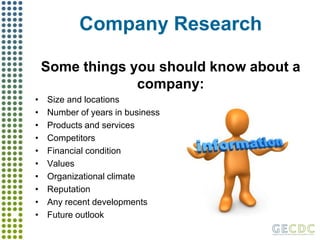
Company ResearchSome things you should know about a company:Size and locationsNumber of years in business Products and servicesCompetitorsFinancial conditionValues Organizational climate Reputation Any recent developmentsFuture outlook
Company Research ResourcesMIT LibrariesWetFeet Guides – via CareerBridgeCompany WebsitesGoogleUsing these resources, research a company of interest.
Written MaterialsResumesTargeted to specific companiesReviewed by a counselor, other professionalsCover LettersWhy you are a good candidate for a particular positionWhy they should hire you“Thank You” LettersWhenever you meet/interview with someone regarding career path or a jobOther PossibilitiesTranscriptPortfolio items
RESUME WRITING:How to Get StartedJob Search Boot CampIAP Workshop 2010MIT Career Development Center 12-170 617-253-4733http://web.mit.edu/career/www/
What Will I Get Out Of This Presentation?You will learn:Why resumes are importantHow to format your resumeWhat content is importantWhat sections you may include on your resume
Why Do I Need A Resume?To make a first impressionTo provide an overview of your skills, experience and educationTo make a strong first impressionTo get an interview.  Remember, the interview gets you the job not the resume
General Resume RulesContent should be directed to targeted audienceEach resume needs to be written specifically for the position to which you are applyingMake sure you are addressing the key qualities expressed in the job posting (or, if there is no posting, a listing for a similar position)Ask yourself, “Who is my target audience?” before beginningEmployers take only 15-30 seconds to review a resumeLimit resume to 1 pageUtilize samples to help you create your resumeVisit the Career Development Center Website for exampleshttp://careers.mit.edu
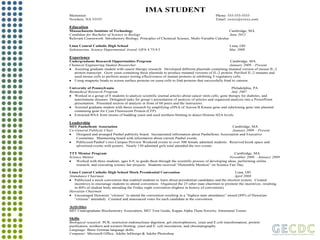
What Information Should A Resume Include?Contact InformationEducationExperience (work, research, etc.)Skills (computer/programming, language, etc.)Leadership/Awards/Honors- optionalInterests- optional
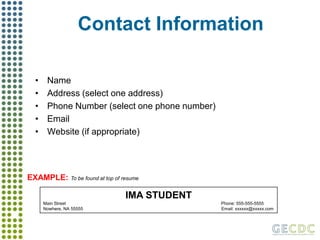
Contact InformationNameAddress (select one address)Phone Number (select one phone number)EmailWebsite (if appropriate)EXAMPLE: To be found at top of resumeIMA STUDENTMain Street                                                                                                                               Phone: 555-555-5555                                                              Nowhere, NA 55555 			                                         Email: xxxxxx@xxxxx.com
What Do I Put In My Education Section?Important Items to Include :Name of InstitutionLocation of InstitutionTitle of degree obtained or in process of obtainingYear of Graduation or expected graduationOptional ItemsGPARelevant CourseworkStudy Abroad InformationEXAMPLE: To be found after contact information
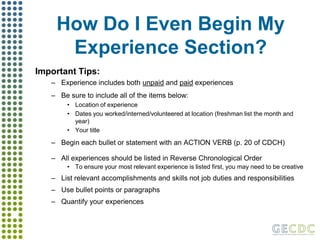
How Do I Even Begin My Experience Section?Important Tips:Experience includes both unpaid and paid experiencesBe sure to include all of the items below:Location of experienceDates you worked/interned/volunteered at location (freshman list the month and year)Your titleBegin each bullet or statement with an ACTION VERB (p. 20 of CDCH)All experiences should be listed in Reverse Chronological OrderTo ensure your most relevant experience is listed first, you may need to be creativeList relevant accomplishments and skills not job duties and responsibilitiesUse bullet points or paragraphsQuantify your experiences
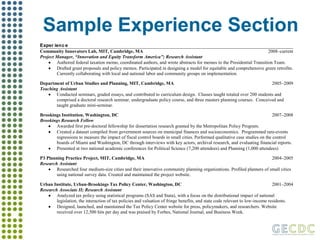
How Do I Describe My Experiences?Use PAR statements to describe your experienceProjectAction(s)ResultProject: Delivered sustainable technology assessment to compliment MIT’s low-carbon design strategy. Action(s):  Managed the design development of the utility system; wrote 4 chapters of 13 chapter report. Coordinated submittal of design report and associated CAD drawings. Result: Presented findings to 50 employees through teleconference.EXPERIENCE		Camp Dresser & McKee (CDM) – Cambridge, MA                                                                                                             Environmental Engineer                                                                                                                                                                                      2005-2008Delivered sustainable technology assessment to compliment the campus’s low-carbon design strategy.
Managed the design development of the utility system; wrote 4 chapters of 13 chapter report. Coordinated submittal of design report and associated CAD drawings.
Facilitated a multi-discipline (6), multi-consultant (15) project team; led client, agency and subcontractor communications; developed technical reports and $300,000 budget; managed staff of lower grade levels.
Presented findings to 50 employees through teleconference.
One of 15 chosen from 4,000 employees to be featured in the company’s annual report. Sample Experience Section
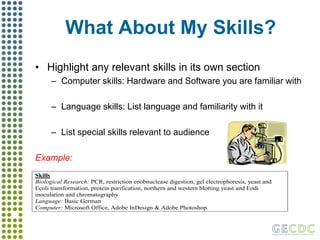
What About My Skills?Highlight any relevant skills in its own sectionComputer skills: Hardware and Software you are familiar withLanguage skills: List language and familiarity with itList special skills relevant to audienceExample:
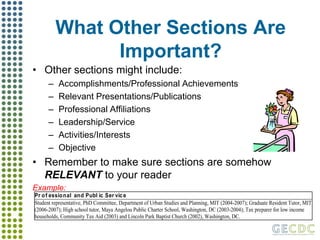
What Other Sections Are Important?Other sections might include:Accomplishments/Professional AchievementsRelevant Presentations/PublicationsProfessional AffiliationsLeadership/ServiceActivities/InterestsObjectiveRemember to make sure sections are somehow RELEVANTto your readerExample:
IMPORTANT FINAL RESUME TIPSKeep your resume to 1 pageBe consistent with your formatUse 10-12 point fontUse an easy to read fontUse bolding, italics, underlining and capitalization (minimally and consistently)Proofread, have it reviewed by counselor, friend, peer, etc.Update often (tailor for each opportunity)Use white space for easy reading (.5 – 1 inch margins)
Additional ResourcesFor more sample resumes and other helpful tips, please go to the MIT Career Development Center Website at:http://careers.mit.edu
Cover LettersOverview: Purpose of a Cover Letter A cover letter is a brief letter that introduces your resume to the company or organization to which you are applying. Your cover letter should emphasize why you want to work for that particular organization and why you would be a good fit. An effective cover letter engages the reader and encourages him or her to invite you for an interview.  A resume should always be accompanied by cover letter. It serves as the first sample of your writing ability and attention to detail. Getting Started: What to Include in your Cover Letter Formatting Address your cover letter to a named individual, whenever possible. Make it brief - one page or less, with ample margins. Use an adequate font size – no smaller than font size 10. Include pertinent personal data: name, address, email and phone number. Proofread for spelling or grammatical errors. Content State why you are writing and for what position you are applying. Demonstrate energy and enthusiasm for the position. Highlight or expand on key information from your resume, but do not simply repeat what is listed.  Actively sell your unique qualities and tell the reader why he or she should choose you. Target your skills, interests and experience to the needs of the organization. Show you have done your homework; emphasize why you want to work for that particular organization. Encourage the reader to take a closer look at your resume. Writing Style Be clear and concise. Use powerful action verbs and phrases to describe your skills, interests, and abilities.
ExampleStreet Address City, State and Zip Code Date Mr./Ms. _____________ Title Company or Organization Street Address City, State and Zip Code Dear _________: First Paragraph: Introduce yourself by stating your degree program and the year in which you will graduate. Specify whether you are seeking a permanent or summer position. Tell why you are writing, and name the position, field, or general vocational area in which you are interested. Tell how you heard of the opening or organization (e.g. job notices on CareerBridge, ad in the newspaper, etc.). If someone referred you, include that information. Second Paragraph: Mention a few qualifications you think would be of greatest interest to the employer. Tell why you are particularly interested in the company, type of work, or location. If you have related experience or specialized training, you may point it out. Refer the reader to the enclosed resume, which will give additional information concerning your background and interests. Third Paragraph: Close by stating your desire for an interview. You may state that you will phone or email in a week or so. If you say that, make sure that you follow through. You may want to include your contact information (phone and email) so the reader knows how you can be reached. Sincerely, Applicant Signature Applicant Name
InterviewingAre You Prepared For Small Talk?Topics may range from the current weather outside to favorite vacation spots and will rarely focus on anything that brings out your relevant experience. Recruiters are trained to evaluate candidates on many different points.
How to Talk the TalkStrategy for Discussing Your CredentialsMany times recruiters will ask why you chose the major you did or what your career goals are. These questions are designed to determine your goal direction. As the interview turns to talk about your qualifications, be prepared to deal with aspects of your background that could be construed as negative, i.e., low grade point average, no participation in outside activities, no related work experience.

Job search boot camp

  • 1.
    Job Search BootCampCareer Development CenterMIT 12-170
  • 2.
    Welcome!Building the FoundationJobSearch ProcessGoalsMarketing and Connecting to EmployersInformational InterviewsNetworkingDeveloping Your ToolsResumesCover LettersInterviewing
  • 3.
    The Career PlanningProcessJob Search/Action PlanResumes, Interviews, ResearchFocusingWhich organizations are a good fit? What do I need to be competitive? Who can connect me to these organizations?ExplorationWhat’s out there? What options do I have?What jobs fit my skills? What careers/industries can use them?Self-AssessmentWho am I? What are my interests? What am I good at? What are my work related values? What is my work style?Adapted from Peter Fiske: To Boldly Go: Practice Career Advice for Scientists, Workshop at MIT, April 1998Modified from Stanford University Career Planning and Placement Office
  • 4.
    Plan and OrganizeYour Search1.What kind of job do you want?2.How do you look for a job?3.What are the elements of a job search?
  • 5.
    What Kind ofJob Would You Like?Imagine Your Ideal Job:What is the environment like?What responsibilities do you have?What kind of people do you work with and/or for?What products or services do you provide?What are you wearing?What is your work schedule?
  • 6.
    Do We EverFind Ideal Jobs?Most jobs involve some compromise on both sides – employer and potential employee.Employers seek candidates with skills and experience that they imagine would make an ideal employee – that ideal employee probably doesn’t exist.Develop a sense of your priorities and look for a good fit.
  • 7.
    Job Goal StatementJobGoal StatementHelps you to identify how you plan to incorporate the following into your work:EducationExperiencesInterestsSkillsValues“Heart and Soul”
  • 8.
    A Job GoalStatement Includes:Job Functions (tasks and responsibilities)EducationOrganizational CultureFinancial NeedsGeographical PreferenceSupporting Resources
  • 9.
  • 10.
    Ways to Lookfor a JobTraditional Search MethodsHidden Job MarketNetworking
  • 11.
    Job Search: TraditionalSenda resume and cover letter inresponse to an advertised vacancy.Where to Find Advertised Vacancies:On-campus Recruiting – CareerBridgeNewspapers, journals, publicationsCompany websites, professional associationsOnline job sites, Internet bulletin boardsList-servs, departmental notices Employment agencies
  • 12.
  • 13.
    Find a JobActivityFind a job opening that appeals to you using any of the resources that we have discussed.CareerBridgeIndeed.comiNet (internships)Company Websites
  • 14.
    Job Search: HiddenJob MarketTarget employers of interest, approach them.Make contacts in the industry of your choice.Do any MIT alumni/ae work for the company?ICAN DatabaseDoes your network know anyone in the company?Do library/online/news research to find people.Conduct informational interviews and network.
  • 15.
  • 16.
    Job Search: NetworkingNetworking:discovering and utilizing connections between people.Networking is the most successful method of searching for a job!Move beyond your own network of acquaintances, tap into other people's networks.Talk to people about your job search. Ask for advice, suggestions, other people to talk to.Networking is a two-way street -offer to help them!
  • 17.
    Who to NetworkWith:List people you know who you might talk to:FamilyFriends Classmates / HousematesCo-workers Faculty StaffMembers of organizations to which you belongICAN –alumni/aeof MITService professionals
  • 18.
    How to MakeContactMake a list of a questions you’d like to askWrite a brief script to introduce yourself:Your nameHow you heard about them/who referred you Why you are calling or writing A brief summary of your related skills/experience Rehearse your script (if via phone)Set up a brief meeting (15-30 minutes) to ask your questionsInformational Interview
  • 19.
    ExampleDear Mr. XXXX,ProfessorXXXX, a faculty member in the Electrical Engineering and Computer\ScienceDepartment at MIT, suggested that I contact you. I have been meeting with Professor XXXX as ameans of exploring the field of Speech Systems Technology as a potential career option.He thought you would be a great resource to help me gain insight into the field and focus my jobsearch efforts. I realize your time is very valuable so I am requesting to setup a brief 20-30minute meeting at your convenience. I would enjoy a chance to ask you some questions.I have enclosed my resume for your review. I thought it might be useful as a way of informing youof my educational background and experience. I can be reached at mitstudent@mit.edu or (XXX)XXX-XXXX.Thank you in advance for your time and effort.Sincereley,Your Name
  • 20.
    Informational InterviewsAn opportunityto speak with a person who has experience in your field of interest.5 R’s of Informational InterviewingEncourage your prospect to:Reveal useful information and adviceRefer you to other for additional information and adviceReading and Revising your resumeRemember you for future reference
  • 21.
    Find an AlumActivityUsing the ICAN database, find someone you want to contact and draft an email.http://alum.mit.edu/benefits/CareerGuidance/ICAN/If you don’t have an account use:Username: ans_jkohenPassword: mitjkoh1
  • 22.
    Company ResearchSome thingsyou should know about a company:Size and locationsNumber of years in business Products and servicesCompetitorsFinancial conditionValues Organizational climate Reputation Any recent developmentsFuture outlook
  • 23.
    Company Research ResourcesMITLibrariesWetFeet Guides – via CareerBridgeCompany WebsitesGoogleUsing these resources, research a company of interest.
  • 24.
    Written MaterialsResumesTargeted tospecific companiesReviewed by a counselor, other professionalsCover LettersWhy you are a good candidate for a particular positionWhy they should hire you“Thank You” LettersWhenever you meet/interview with someone regarding career path or a jobOther PossibilitiesTranscriptPortfolio items
  • 25.
    RESUME WRITING:How toGet StartedJob Search Boot CampIAP Workshop 2010MIT Career Development Center 12-170 617-253-4733http://web.mit.edu/career/www/
  • 26.
    What Will IGet Out Of This Presentation?You will learn:Why resumes are importantHow to format your resumeWhat content is importantWhat sections you may include on your resume
  • 27.
    Why Do INeed A Resume?To make a first impressionTo provide an overview of your skills, experience and educationTo make a strong first impressionTo get an interview. Remember, the interview gets you the job not the resume
  • 28.
    General Resume RulesContentshould be directed to targeted audienceEach resume needs to be written specifically for the position to which you are applyingMake sure you are addressing the key qualities expressed in the job posting (or, if there is no posting, a listing for a similar position)Ask yourself, “Who is my target audience?” before beginningEmployers take only 15-30 seconds to review a resumeLimit resume to 1 pageUtilize samples to help you create your resumeVisit the Career Development Center Website for exampleshttp://careers.mit.edu
  • 29.
    What Information ShouldA Resume Include?Contact InformationEducationExperience (work, research, etc.)Skills (computer/programming, language, etc.)Leadership/Awards/Honors- optionalInterests- optional
  • 30.
    Contact InformationNameAddress (selectone address)Phone Number (select one phone number)EmailWebsite (if appropriate)EXAMPLE: To be found at top of resumeIMA STUDENTMain Street Phone: 555-555-5555 Nowhere, NA 55555 Email: xxxxxx@xxxxx.com
  • 31.
    What Do IPut In My Education Section?Important Items to Include :Name of InstitutionLocation of InstitutionTitle of degree obtained or in process of obtainingYear of Graduation or expected graduationOptional ItemsGPARelevant CourseworkStudy Abroad InformationEXAMPLE: To be found after contact information
  • 32.
    How Do IEven Begin My Experience Section?Important Tips:Experience includes both unpaid and paid experiencesBe sure to include all of the items below:Location of experienceDates you worked/interned/volunteered at location (freshman list the month and year)Your titleBegin each bullet or statement with an ACTION VERB (p. 20 of CDCH)All experiences should be listed in Reverse Chronological OrderTo ensure your most relevant experience is listed first, you may need to be creativeList relevant accomplishments and skills not job duties and responsibilitiesUse bullet points or paragraphsQuantify your experiences
  • 33.
    How Do IDescribe My Experiences?Use PAR statements to describe your experienceProjectAction(s)ResultProject: Delivered sustainable technology assessment to compliment MIT’s low-carbon design strategy. Action(s): Managed the design development of the utility system; wrote 4 chapters of 13 chapter report. Coordinated submittal of design report and associated CAD drawings. Result: Presented findings to 50 employees through teleconference.EXPERIENCE Camp Dresser & McKee (CDM) – Cambridge, MA Environmental Engineer 2005-2008Delivered sustainable technology assessment to compliment the campus’s low-carbon design strategy.
  • 34.
    Managed the designdevelopment of the utility system; wrote 4 chapters of 13 chapter report. Coordinated submittal of design report and associated CAD drawings.
  • 35.
    Facilitated a multi-discipline(6), multi-consultant (15) project team; led client, agency and subcontractor communications; developed technical reports and $300,000 budget; managed staff of lower grade levels.
  • 36.
    Presented findings to50 employees through teleconference.
  • 37.
    One of 15chosen from 4,000 employees to be featured in the company’s annual report. Sample Experience Section
  • 38.
    What About MySkills?Highlight any relevant skills in its own sectionComputer skills: Hardware and Software you are familiar withLanguage skills: List language and familiarity with itList special skills relevant to audienceExample:
  • 39.
    What Other SectionsAre Important?Other sections might include:Accomplishments/Professional AchievementsRelevant Presentations/PublicationsProfessional AffiliationsLeadership/ServiceActivities/InterestsObjectiveRemember to make sure sections are somehow RELEVANTto your readerExample:
  • 40.
    IMPORTANT FINAL RESUMETIPSKeep your resume to 1 pageBe consistent with your formatUse 10-12 point fontUse an easy to read fontUse bolding, italics, underlining and capitalization (minimally and consistently)Proofread, have it reviewed by counselor, friend, peer, etc.Update often (tailor for each opportunity)Use white space for easy reading (.5 – 1 inch margins)
  • 42.
    Additional ResourcesFor moresample resumes and other helpful tips, please go to the MIT Career Development Center Website at:http://careers.mit.edu
  • 43.
    Cover LettersOverview: Purposeof a Cover Letter A cover letter is a brief letter that introduces your resume to the company or organization to which you are applying. Your cover letter should emphasize why you want to work for that particular organization and why you would be a good fit. An effective cover letter engages the reader and encourages him or her to invite you for an interview. A resume should always be accompanied by cover letter. It serves as the first sample of your writing ability and attention to detail. Getting Started: What to Include in your Cover Letter Formatting Address your cover letter to a named individual, whenever possible. Make it brief - one page or less, with ample margins. Use an adequate font size – no smaller than font size 10. Include pertinent personal data: name, address, email and phone number. Proofread for spelling or grammatical errors. Content State why you are writing and for what position you are applying. Demonstrate energy and enthusiasm for the position. Highlight or expand on key information from your resume, but do not simply repeat what is listed. Actively sell your unique qualities and tell the reader why he or she should choose you. Target your skills, interests and experience to the needs of the organization. Show you have done your homework; emphasize why you want to work for that particular organization. Encourage the reader to take a closer look at your resume. Writing Style Be clear and concise. Use powerful action verbs and phrases to describe your skills, interests, and abilities.
  • 44.
    ExampleStreet Address City,State and Zip Code Date Mr./Ms. _____________ Title Company or Organization Street Address City, State and Zip Code Dear _________: First Paragraph: Introduce yourself by stating your degree program and the year in which you will graduate. Specify whether you are seeking a permanent or summer position. Tell why you are writing, and name the position, field, or general vocational area in which you are interested. Tell how you heard of the opening or organization (e.g. job notices on CareerBridge, ad in the newspaper, etc.). If someone referred you, include that information. Second Paragraph: Mention a few qualifications you think would be of greatest interest to the employer. Tell why you are particularly interested in the company, type of work, or location. If you have related experience or specialized training, you may point it out. Refer the reader to the enclosed resume, which will give additional information concerning your background and interests. Third Paragraph: Close by stating your desire for an interview. You may state that you will phone or email in a week or so. If you say that, make sure that you follow through. You may want to include your contact information (phone and email) so the reader knows how you can be reached. Sincerely, Applicant Signature Applicant Name
  • 45.
    InterviewingAre You PreparedFor Small Talk?Topics may range from the current weather outside to favorite vacation spots and will rarely focus on anything that brings out your relevant experience. Recruiters are trained to evaluate candidates on many different points.
  • 46.
    How to Talkthe TalkStrategy for Discussing Your CredentialsMany times recruiters will ask why you chose the major you did or what your career goals are. These questions are designed to determine your goal direction. As the interview turns to talk about your qualifications, be prepared to deal with aspects of your background that could be construed as negative, i.e., low grade point average, no participation in outside activities, no related work experience.