The Project Management Paradigm
Carnegie Mellon University, Silicon Valley
The term Project Management means many things to many people. For
software development, managing the project means having the
customer agree you are Done in measures meaningful to the customer.
1/27
Deliverables Based Planning Handbook for A&D, Copyright © 2008, 2009, Lewis & Fowler 2/27
What are the Primary
Measures of Success for a
Project?
Are We Done?
When will we be Done?
What will it cost to be
Done?
 What does Done look like for
the customer?
 How can we recognize Done
when it arrives?
 How can we be sure we can
get to from hereDone?
 What are the impediments to
getting to done?
Deliverables Based Planning Handbook for A&D, Copyright © 2008, 2009, Lewis & Fowler
What Others Have Seen
If you can't describe what you are doing as
a process, you don't know what you're
doing.
— W. Edwards Deming
The quality of a software system is
governed by the quality of the process used
to develop it.”
— Watts Humphrey
When you can measure what you are
speaking about, and express it in numbers,
you know something about it; but when you
cannot measure it, when you cannot
express it in numbers, your knowledge is of
a meager and unsatisfactory kind; it may be
the beginning of knowledge, but you have
scarcely in your thoughts advanced to the
stage of science.
— Lord Kelvin
In theory there is no difference between
theory and practice. In practice there is.
— Yogi Berra
3/27
Deliverables Based Planning Handbook for A&D, Copyright © 2008, 2009, Lewis & Fowler
Frameworks
for PM
 PMI PMBOK®
– This is not a
method
 CMMI–DEV
– This is not a
method
 Prince2
– This is a
method
• Scrum
– Project
Management
of Software
Development?
4/27
PMI’s PMBOK Structure
5
Copyright © 2008, Lewis & Fowler
Groups
Knowledge Areas 
Initiating Planning Executing
Monitoring &
Controlling
Close Out
Integration  Charter
 Project
Management Plan
 Manage Execution
 Monitor and Control
Work
 Integrated Change
Control
 Close project or
phase
Scope
 Collect
Requirements
 Define Scope
 Create WBS
 Verify Scope
 Control Scope
Time
 Define activities
 Sequence Activities
 Estimate
Resources
 Estimate Duration
 Develop Schedule
 Control Schedule
Cost
 Estimate Costs
 Determine Budget
 Control costs
Quality  Plan Quality
 Perform Quality
Assurance
 Perform Quality
Control
Human Resources  Develop HR Plan
 Acquire Team
 Develop Team
 Manage Team
Communications
 Identify
Stakeholders
Risk
 Risk Plan
 Identify Risk
 Qualitative Risk
 Quantitative Risk
 Risk Responses
 Monitor and Control
Risks
Procurement
 Plan procurement
 Conduct
procurement
 Administer
procurement
 Close
procurements 5/27
The CMMI–DEV Model
Copyright © 2008, Lewis & Fowler
Maturity Level Process Areas
5 – Optimizing Organizational
Innovation &
Deployment
(OID)
Causal Analysis
and Resolution
(CAR)
4 – Quantitatively
Managed
Organizational
Process
Performance
(OPF)
Quantitative
Project
Management
(QPM)
3 – Defined Organizational
Process Focus
(OPF)
Organizational
Process
Definition
(OPD)
Organizational
Training
(OT)
Integrated
Project
Management
(IPM)
Risk
Management
(RSKM)
Decision
Analysis and
Resolution
(DAR)
Requirements
Development
(RD)
Technical
Solution
(TS)
Product
Integration
(PI)
Verification
(VER)
Validation
(VAL)
2 – Managed Requirements
Management
(RM)
Project
Planning
(PP)
Project
Monitoring and
Control
(PMC)
Supplier
Agreement
Management
(SAM)
Measurement
and Analysis
(MA)
Process and
Product Quality
Assurance
(PPQA)
Configuration
Management
(CM)
6/27
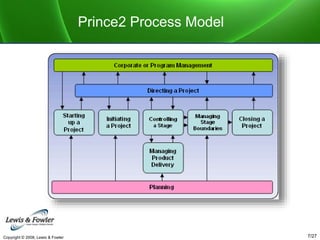
Prince2 Process Model
Copyright © 2008, Lewis & Fowler 7/27
Deliverables Based Planning Handbook for A&D, Copyright © 2008, 2009, Lewis & Fowler 8/27
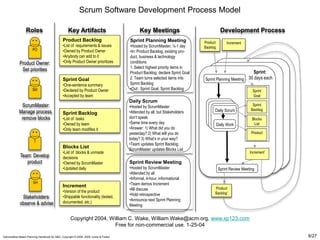
Daily Scrum
•Hosted by ScrumMaster
•Attended by all, but Stakeholders
don’t speak
•Same time every day
•Answer: 1) What did you do
yesterday? 2) What will you do
today? 3) What’s in your way?
•Team updates Sprint Backlog;
ScrumMaster updates Blocks List
PO
Product Owner:
Set priorities
Roles
SM
ScrumMaster:
Manage process,
remove blocks
T
Team: Develop
product
SH
Stakeholders:
observe & advise
Key Artifacts
Product Backlog
•List of requirements & issues
•Owned by Product Owner
•Anybody can add to it
•Only Product Owner prioritizes
Sprint Goal
•One-sentence summary
•Declared by Product Owner
•Accepted by team
Sprint Backlog
•List of tasks
•Owned by team
•Only team modifies it
Blocks List
•List of blocks & unmade
decisions
•Owned by ScrumMaster
•Updated daily
Increment
•Version of the product
•Shippable functionality (tested,
documented, etc.)
Key Meetings
Sprint Planning Meeting
•Hosted by ScrumMaster; ½-1 day
•In: Product Backlog, existing pro-
duct, business & technology
conditions
1. Select highest priority items in
Product Backlog; declare Sprint Goal
2. Team turns selected items into
Sprint Backlog
•Out:: Sprint Goal, Sprint Backlog
Sprint Review Meeting
•Hosted by ScrumMaster
•Attended by all
•Informal, 4-hour, informational
•Team demos Increment
•All discuss
•Hold retrospective
•Announce next Sprint Planning
Meeting
Product
Backlog
Development Process
Increment
Sprint Planning Meeting
Daily Scrum
Daily Work
Sprint
Goal
Sprint
Backlog
Blocks
List
Product
Sprint Review Meeting
Sprint:
30 days each
Product
Backlog’
Increment’
Copyright 2004, William C. Wake, William.Wake@acm.org, www.xp123.com
Free for non-commercial use. 1-25-04
Scrum Software Development Process Model
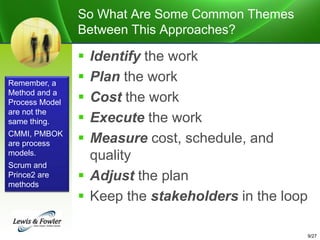
So What Are Some Common Themes
Between This Approaches?
 Identify the work
 Plan the work
 Cost the work
 Execute the work
 Measure cost, schedule, and
quality
 Adjust the plan
 Keep the stakeholders in the loop
Remember, a
Method and a
Process Model
are not the
same thing.
CMMI, PMBOK
are process
models.
Scrum and
Prince2 are
methods
9/27
A Core Question:
What’s the Difference Between Project
Management and Agile Project Management?
10/27
11/27
Agile (verb): The ability to rapidly respond to change
Characterized by:
 Quickness, lightness, and ease of movement;
 Nimble;
 Moving quickly and lightly;
11/27
Deliverables Based Planning Handbook for A&D, Copyright © 2008, 2009, Lewis & Fowler 12/27
Some Notions of Agile
 Self Organizing
 Limits on external control
 Collective abilities
 Unpredictability
 Changing conditions
Adaptive is a repeated theme.
Agile project management needs
to adapt to the changing aspects
of the project, in some self
organizing way to address
unpredictability.
Deliverables Based Planning Handbook for A&D, Copyright © 2008, 2009, Lewis & Fowler
The Problem with
the Agile Project
Management
Discussion
Agile software development
is about “engineering” the
product.
Project management is about
the “processes” around
engineering the product.
13/27
Deliverables Based Planning Handbook for A&D, Copyright © 2008, 2009, Lewis & Fowler 14/27
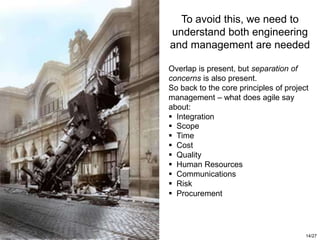
To avoid this, we need to
understand both engineering
and management are needed
Overlap is present, but separation of
concerns is also present.
So back to the core principles of project
management – what does agile say
about:
 Integration
 Scope
 Time
 Cost
 Quality
 Human Resources
 Communications
 Risk
 Procurement
A General Framework for Managing
Projects of all Types
Deliverables Based Planning, identifies, plans, costs, executes,
measures, adjusts and engages the stakeholders in the production of
deliverables
15/27
But First an Observation about the
“method” discussion
 The theme of simplicity and parsimony
gets mangled
 Methods and process frameworks are
confused
 When “agile” speaks about project
management, they usually speak about
activities around developing software
 Some of these are project
management, some are engineering
activities
When we talk
about project
management
and especially
Agile project
management
16/27
Deliverables Based Planning Handbook for A&D, Copyright © 2008, 2009, Lewis & Fowler 17/27
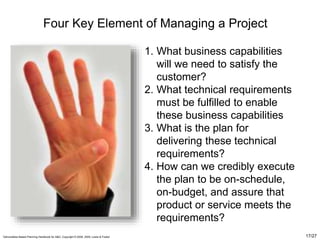
Four Key Element of Managing a Project
1. What business capabilities
will we need to satisfy the
customer?
2. What technical requirements
must be fulfilled to enable
these business capabilities
3. What is the plan for
delivering these technical
requirements?
4. How can we credibly execute
the plan to be on-schedule,
on-budget, and assure that
product or service meets the
requirements?
Deliverables Based Planning Handbook for A&D, Copyright © 2008, 2009, Lewis & Fowler 18/27
Capabilities provide the business with the “ability” to perform a function
These capabilities should be described in business process terms, not technical
requirements terms:
 We need the capability to integrate our top 10% suppliers in the Accounts Payable
system, 90 after merging two business units.
 We need the capability to scale our claims processing system 250% in 4 calendar
weeks during a national disaster.
 We need the capability of providing a 200% increase in bandwidth during a major
sporting event.
Deliverables Based Planning Handbook for A&D, Copyright © 2008, 2009, Lewis & Fowler 19/27
The Plan Is A Strategy For The
Successful Completion Of The Project
The Plan describes where we are going, the various paths we can take to
reach our destination, and the assessment points along the way to assure we
are making progress.
These assessment points measures the “maturity” of the product or service
against the planned maturity. This is the measure of progress – not the
passage of time or consumption of money.
Deliverables Based Planning Handbook for A&D, Copyright © 2008, 2009, Lewis & Fowler 20/27
The Performance Measurement Baseline is a time–phased schedule of all
the work to be performed, the budgeted cost for this work, and the
organizational elements that produce the deliverables from this work.
Deliverables Based Planning Handbook for A&D, Copyright © 2008, 2009, Lewis & Fowler 21/27
Execution is about performing the planned work, while assuring all
performance assessment represent physical percent complete.
Delivering On-Time, On-Budget, and On-Specification is the core concept for
successful execution.
Deliverables Based Planning Handbook for A&D, Copyright © 2008, 2009, Lewis & Fowler
So What Are The
Common Themes?
 Identify the work
 Schedule the work
 Cost the work
 Execute the work
 Measure cost, schedule,
and quality (Technical
Performance)
 Adjustments the plan
with these
measurements
 Keep the everyone in the
loop
22/27
Deliverables Based Planning Handbook for A&D, Copyright © 2008, 2009, Lewis & Fowler 23/27
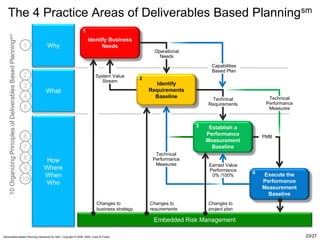
The 4 Practice Areas of Deliverables Based Planningsm
How
Where
When
Who
Why
What
Identify Business
Needs
Establish a
Performance
Measurement
Baseline
Execute the
Performance
Measurement
Baseline
Capabilities
Based Plan
Operational
Needs
Earned Value
Performance
0% /100%
Technical
Performance
Measures
System Value
Stream
Technical
Requirements
Identify
Requirements
Baseline
1
2
3
4
Technical
Performance
Measures
PMB
Embedded Risk Management
Changes to
business strategy
Changes to
requirements
Changes to
project plan
1
2
3
4
5
6
7
8
9
10
10OrganizingPrinciplesofDeliverablesBasedPlanningsm
Deliverables Based Planning Handbook for A&D, Copyright © 2008, 2009, Lewis & Fowler
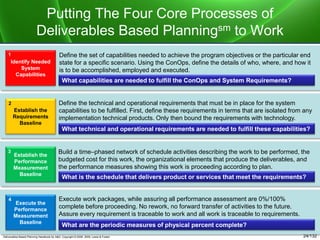
Putting The Four Core Processes of
Deliverables Based Planningsm to Work
24/132
Define the set of capabilities needed to achieve the program objectives or the particular end
state for a specific scenario. Using the ConOps, define the details of who, where, and how it
is to be accomplished, employed and executed.
Identify Needed
System
Capabilities
Define the technical and operational requirements that must be in place for the system
capabilities to be fulfilled. First, define these requirements in terms that are isolated from any
implementation technical products. Only then bound the requirements with technology.
Establish the
Requirements
Baseline
Build a time–phased network of schedule activities describing the work to be performed, the
budgeted cost for this work, the organizational elements that produce the deliverables, and
the performance measures showing this work is proceeding according to plan.
Establish the
Performance
Measurement
Baseline
Execute work packages, while assuring all performance assessment are 0%/100%
complete before proceeding. No rework, no forward transfer of activities to the future.
Assure every requirement is traceable to work and all work is traceable to requirements.
Execute the
Performance
Measurement
Baseline
What capabilities are needed to fulfill the ConOps and System Requirements?
What technical and operational requirements are needed to fulfill these capabilities?
What is the schedule that delivers product or services that meet the requirements?
What are the periodic measures of physical percent complete?
1
2
3
4
Deliverables Based Planning Handbook for A&D, Copyright © 2008, 2009, Lewis & Fowler
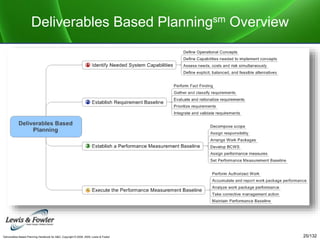
Deliverables Based Planningsm Overview
25/132
Deliverables Based Planning Handbook for A&D, Copyright © 2008, 2009, Lewis & Fowler 26/27
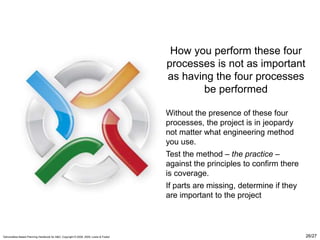
How you perform these four
processes is not as important
as having the four processes
be performed
Without the presence of these four
processes, the project is in jeopardy
not matter what engineering method
you use.
Test the method – the practice –
against the principles to confirm there
is coverage.
If parts are missing, determine if they
are important to the project
Deliverables Based Planning Handbook for A&D, Copyright © 2008, 2009, Lewis & Fowler 27/27
Project Management is
about answering these
questions with
confidence
 Do we know what done looks like
in terms meaningful to the
customer? «Capabilities»
 What are the technical aspects of
being done? «Requirements»
 What is the path to getting to
done? «Performance
Measurement Baseline»
 How long will it take to get to
done? «Project Execution»
 What are the impediments to
getting done? «Continuous Risk
Management»

Project management paradigm

  • 1.
    The Project ManagementParadigm Carnegie Mellon University, Silicon Valley The term Project Management means many things to many people. For software development, managing the project means having the customer agree you are Done in measures meaningful to the customer. 1/27
  • 2.
    Deliverables Based PlanningHandbook for A&D, Copyright © 2008, 2009, Lewis & Fowler 2/27 What are the Primary Measures of Success for a Project? Are We Done? When will we be Done? What will it cost to be Done?  What does Done look like for the customer?  How can we recognize Done when it arrives?  How can we be sure we can get to from hereDone?  What are the impediments to getting to done?
  • 3.
    Deliverables Based PlanningHandbook for A&D, Copyright © 2008, 2009, Lewis & Fowler What Others Have Seen If you can't describe what you are doing as a process, you don't know what you're doing. — W. Edwards Deming The quality of a software system is governed by the quality of the process used to develop it.” — Watts Humphrey When you can measure what you are speaking about, and express it in numbers, you know something about it; but when you cannot measure it, when you cannot express it in numbers, your knowledge is of a meager and unsatisfactory kind; it may be the beginning of knowledge, but you have scarcely in your thoughts advanced to the stage of science. — Lord Kelvin In theory there is no difference between theory and practice. In practice there is. — Yogi Berra 3/27
  • 4.
    Deliverables Based PlanningHandbook for A&D, Copyright © 2008, 2009, Lewis & Fowler Frameworks for PM  PMI PMBOK® – This is not a method  CMMI–DEV – This is not a method  Prince2 – This is a method • Scrum – Project Management of Software Development? 4/27
  • 5.
    PMI’s PMBOK Structure 5 Copyright© 2008, Lewis & Fowler Groups Knowledge Areas  Initiating Planning Executing Monitoring & Controlling Close Out Integration  Charter  Project Management Plan  Manage Execution  Monitor and Control Work  Integrated Change Control  Close project or phase Scope  Collect Requirements  Define Scope  Create WBS  Verify Scope  Control Scope Time  Define activities  Sequence Activities  Estimate Resources  Estimate Duration  Develop Schedule  Control Schedule Cost  Estimate Costs  Determine Budget  Control costs Quality  Plan Quality  Perform Quality Assurance  Perform Quality Control Human Resources  Develop HR Plan  Acquire Team  Develop Team  Manage Team Communications  Identify Stakeholders Risk  Risk Plan  Identify Risk  Qualitative Risk  Quantitative Risk  Risk Responses  Monitor and Control Risks Procurement  Plan procurement  Conduct procurement  Administer procurement  Close procurements 5/27
  • 6.
    The CMMI–DEV Model Copyright© 2008, Lewis & Fowler Maturity Level Process Areas 5 – Optimizing Organizational Innovation & Deployment (OID) Causal Analysis and Resolution (CAR) 4 – Quantitatively Managed Organizational Process Performance (OPF) Quantitative Project Management (QPM) 3 – Defined Organizational Process Focus (OPF) Organizational Process Definition (OPD) Organizational Training (OT) Integrated Project Management (IPM) Risk Management (RSKM) Decision Analysis and Resolution (DAR) Requirements Development (RD) Technical Solution (TS) Product Integration (PI) Verification (VER) Validation (VAL) 2 – Managed Requirements Management (RM) Project Planning (PP) Project Monitoring and Control (PMC) Supplier Agreement Management (SAM) Measurement and Analysis (MA) Process and Product Quality Assurance (PPQA) Configuration Management (CM) 6/27
  • 7.
    Prince2 Process Model Copyright© 2008, Lewis & Fowler 7/27
  • 8.
    Deliverables Based PlanningHandbook for A&D, Copyright © 2008, 2009, Lewis & Fowler 8/27 Daily Scrum •Hosted by ScrumMaster •Attended by all, but Stakeholders don’t speak •Same time every day •Answer: 1) What did you do yesterday? 2) What will you do today? 3) What’s in your way? •Team updates Sprint Backlog; ScrumMaster updates Blocks List PO Product Owner: Set priorities Roles SM ScrumMaster: Manage process, remove blocks T Team: Develop product SH Stakeholders: observe & advise Key Artifacts Product Backlog •List of requirements & issues •Owned by Product Owner •Anybody can add to it •Only Product Owner prioritizes Sprint Goal •One-sentence summary •Declared by Product Owner •Accepted by team Sprint Backlog •List of tasks •Owned by team •Only team modifies it Blocks List •List of blocks & unmade decisions •Owned by ScrumMaster •Updated daily Increment •Version of the product •Shippable functionality (tested, documented, etc.) Key Meetings Sprint Planning Meeting •Hosted by ScrumMaster; ½-1 day •In: Product Backlog, existing pro- duct, business & technology conditions 1. Select highest priority items in Product Backlog; declare Sprint Goal 2. Team turns selected items into Sprint Backlog •Out:: Sprint Goal, Sprint Backlog Sprint Review Meeting •Hosted by ScrumMaster •Attended by all •Informal, 4-hour, informational •Team demos Increment •All discuss •Hold retrospective •Announce next Sprint Planning Meeting Product Backlog Development Process Increment Sprint Planning Meeting Daily Scrum Daily Work Sprint Goal Sprint Backlog Blocks List Product Sprint Review Meeting Sprint: 30 days each Product Backlog’ Increment’ Copyright 2004, William C. Wake, William.Wake@acm.org, www.xp123.com Free for non-commercial use. 1-25-04 Scrum Software Development Process Model
  • 9.
    So What AreSome Common Themes Between This Approaches?  Identify the work  Plan the work  Cost the work  Execute the work  Measure cost, schedule, and quality  Adjust the plan  Keep the stakeholders in the loop Remember, a Method and a Process Model are not the same thing. CMMI, PMBOK are process models. Scrum and Prince2 are methods 9/27
  • 10.
    A Core Question: What’sthe Difference Between Project Management and Agile Project Management? 10/27
  • 11.
    11/27 Agile (verb): Theability to rapidly respond to change Characterized by:  Quickness, lightness, and ease of movement;  Nimble;  Moving quickly and lightly; 11/27
  • 12.
    Deliverables Based PlanningHandbook for A&D, Copyright © 2008, 2009, Lewis & Fowler 12/27 Some Notions of Agile  Self Organizing  Limits on external control  Collective abilities  Unpredictability  Changing conditions Adaptive is a repeated theme. Agile project management needs to adapt to the changing aspects of the project, in some self organizing way to address unpredictability.
  • 13.
    Deliverables Based PlanningHandbook for A&D, Copyright © 2008, 2009, Lewis & Fowler The Problem with the Agile Project Management Discussion Agile software development is about “engineering” the product. Project management is about the “processes” around engineering the product. 13/27
  • 14.
    Deliverables Based PlanningHandbook for A&D, Copyright © 2008, 2009, Lewis & Fowler 14/27 To avoid this, we need to understand both engineering and management are needed Overlap is present, but separation of concerns is also present. So back to the core principles of project management – what does agile say about:  Integration  Scope  Time  Cost  Quality  Human Resources  Communications  Risk  Procurement
  • 15.
    A General Frameworkfor Managing Projects of all Types Deliverables Based Planning, identifies, plans, costs, executes, measures, adjusts and engages the stakeholders in the production of deliverables 15/27
  • 16.
    But First anObservation about the “method” discussion  The theme of simplicity and parsimony gets mangled  Methods and process frameworks are confused  When “agile” speaks about project management, they usually speak about activities around developing software  Some of these are project management, some are engineering activities When we talk about project management and especially Agile project management 16/27
  • 17.
    Deliverables Based PlanningHandbook for A&D, Copyright © 2008, 2009, Lewis & Fowler 17/27 Four Key Element of Managing a Project 1. What business capabilities will we need to satisfy the customer? 2. What technical requirements must be fulfilled to enable these business capabilities 3. What is the plan for delivering these technical requirements? 4. How can we credibly execute the plan to be on-schedule, on-budget, and assure that product or service meets the requirements?
  • 18.
    Deliverables Based PlanningHandbook for A&D, Copyright © 2008, 2009, Lewis & Fowler 18/27 Capabilities provide the business with the “ability” to perform a function These capabilities should be described in business process terms, not technical requirements terms:  We need the capability to integrate our top 10% suppliers in the Accounts Payable system, 90 after merging two business units.  We need the capability to scale our claims processing system 250% in 4 calendar weeks during a national disaster.  We need the capability of providing a 200% increase in bandwidth during a major sporting event.
  • 19.
    Deliverables Based PlanningHandbook for A&D, Copyright © 2008, 2009, Lewis & Fowler 19/27 The Plan Is A Strategy For The Successful Completion Of The Project The Plan describes where we are going, the various paths we can take to reach our destination, and the assessment points along the way to assure we are making progress. These assessment points measures the “maturity” of the product or service against the planned maturity. This is the measure of progress – not the passage of time or consumption of money.
  • 20.
    Deliverables Based PlanningHandbook for A&D, Copyright © 2008, 2009, Lewis & Fowler 20/27 The Performance Measurement Baseline is a time–phased schedule of all the work to be performed, the budgeted cost for this work, and the organizational elements that produce the deliverables from this work.
  • 21.
    Deliverables Based PlanningHandbook for A&D, Copyright © 2008, 2009, Lewis & Fowler 21/27 Execution is about performing the planned work, while assuring all performance assessment represent physical percent complete. Delivering On-Time, On-Budget, and On-Specification is the core concept for successful execution.
  • 22.
    Deliverables Based PlanningHandbook for A&D, Copyright © 2008, 2009, Lewis & Fowler So What Are The Common Themes?  Identify the work  Schedule the work  Cost the work  Execute the work  Measure cost, schedule, and quality (Technical Performance)  Adjustments the plan with these measurements  Keep the everyone in the loop 22/27
  • 23.
    Deliverables Based PlanningHandbook for A&D, Copyright © 2008, 2009, Lewis & Fowler 23/27 The 4 Practice Areas of Deliverables Based Planningsm How Where When Who Why What Identify Business Needs Establish a Performance Measurement Baseline Execute the Performance Measurement Baseline Capabilities Based Plan Operational Needs Earned Value Performance 0% /100% Technical Performance Measures System Value Stream Technical Requirements Identify Requirements Baseline 1 2 3 4 Technical Performance Measures PMB Embedded Risk Management Changes to business strategy Changes to requirements Changes to project plan 1 2 3 4 5 6 7 8 9 10 10OrganizingPrinciplesofDeliverablesBasedPlanningsm
  • 24.
    Deliverables Based PlanningHandbook for A&D, Copyright © 2008, 2009, Lewis & Fowler Putting The Four Core Processes of Deliverables Based Planningsm to Work 24/132 Define the set of capabilities needed to achieve the program objectives or the particular end state for a specific scenario. Using the ConOps, define the details of who, where, and how it is to be accomplished, employed and executed. Identify Needed System Capabilities Define the technical and operational requirements that must be in place for the system capabilities to be fulfilled. First, define these requirements in terms that are isolated from any implementation technical products. Only then bound the requirements with technology. Establish the Requirements Baseline Build a time–phased network of schedule activities describing the work to be performed, the budgeted cost for this work, the organizational elements that produce the deliverables, and the performance measures showing this work is proceeding according to plan. Establish the Performance Measurement Baseline Execute work packages, while assuring all performance assessment are 0%/100% complete before proceeding. No rework, no forward transfer of activities to the future. Assure every requirement is traceable to work and all work is traceable to requirements. Execute the Performance Measurement Baseline What capabilities are needed to fulfill the ConOps and System Requirements? What technical and operational requirements are needed to fulfill these capabilities? What is the schedule that delivers product or services that meet the requirements? What are the periodic measures of physical percent complete? 1 2 3 4
  • 25.
    Deliverables Based PlanningHandbook for A&D, Copyright © 2008, 2009, Lewis & Fowler Deliverables Based Planningsm Overview 25/132
  • 26.
    Deliverables Based PlanningHandbook for A&D, Copyright © 2008, 2009, Lewis & Fowler 26/27 How you perform these four processes is not as important as having the four processes be performed Without the presence of these four processes, the project is in jeopardy not matter what engineering method you use. Test the method – the practice – against the principles to confirm there is coverage. If parts are missing, determine if they are important to the project
  • 27.
    Deliverables Based PlanningHandbook for A&D, Copyright © 2008, 2009, Lewis & Fowler 27/27 Project Management is about answering these questions with confidence  Do we know what done looks like in terms meaningful to the customer? «Capabilities»  What are the technical aspects of being done? «Requirements»  What is the path to getting to done? «Performance Measurement Baseline»  How long will it take to get to done? «Project Execution»  What are the impediments to getting done? «Continuous Risk Management»