OpenTuition Lecture Notes can be downloaded FREE from https://opentuition.com
Copyright belongs to OpenTuition.com - please do not support piracy by downloading from other websites.
Septem
ber2020
to
June
2021
exam
s
Financial
Reporting (FR)
ACCA OpenTuition
O
Spread the word about OpenTuition,
so that all ACCA students can benefit.
How to use OpenTuition:
1) Register & download the latest notes
2) Watch ALL OpenTuition free lectures
3) Attempt free tests online
4) Question practice is vital - you must obtain
also Exam Kit from BPP or Kaplan
The best things
in life are free
To benefit from these notes you must watch the free lectures on the
OpenTuition website in which we explain and expand on the topics covered.
In addition question practice is vital!!
You must obtain a current edition of a Revision / Exam Kit. It contains a great
number of exam standard questions (and answers) to practice on.
If you order on line, you can buy study materials from BPP with our 20%
discount code: bppacca20optu
You should also use the free“Online Multiple Choice Tests”which you can find
on the OpenTuition website:
https://opentuition.com/acca/
IMPORTANT!!! PLEASE READ CAREFULLY
Only on OpenTuition you can find: Free ACCA notes • Free ACCA lectures • Free ACCA tests • Free ACCA tutor support • The largest ACCA community
ACCA Financial Reporting (FR)
CONCEPTUAL AND REGULATORY FRAMEWORK 3
1. IASB Conceptual Framework 3
2. Regulatory Framework 9
PUBLISHED COMPANY ACCOUNTS 11
3. Presentation of Financial Statements (IAS 1) 11
4. Statement of cash flows (IAS 7) 17
ACCOUNTING STANDARDS 23
5. Non-current assets 23
6. Intangible assets (IAS 38) 29
7. Impairments (IAS 36) 31
8. Non-current assets held for sale and discontinued operations (IFRS 5) 33
9. Accounting policies, changes in accounting estimate and errors (IAS 8) 37
10. Inventory (IAS 2) and Agriculture (IAS 41) 41
11. Financial instruments (IFRS 9) 45
12. Leases (IFRS 16) 49
13. Provisions, contingent assets and liabilities (IAS 37) 53
14. Events after the reporting date (IAS 10) 59
15. Income taxes (IAS 12) 61
16. Revenue from contracts with customers (IFRS 15) 67
17. Foreign currency (IAS 21) 73
18. Fair Value (IFRS 13) 75
19. Earnings per share (IAS 33) 77
ANALYSIS AND INTERPRETATION 79
20. Financial performance (profitability) 79
21. Financial position 83
22. Investor analysis 87
GROUP ACCOUNTS 89
23. Consolidated statement of financial position 91
24. Group statement of profit and loss 105
25. Associates (IAS 28) 111
SOLUTIONS 113
September 2020 to June 2021 exams Watch free ACCA FR lectures 1
Only on OpenTuition you can find: Free ACCA notes • Free ACCA lectures • Free ACCA tests • Free ACCA tutor support • The largest ACCA community
September 2020 to June 2021 exams Watch free ACCA FR lectures 2
Only on OpenTuition you can find: Free ACCA notes • Free ACCA lectures • Free ACCA tests • Free ACCA tutor support • The largest ACCA community
CONCEPTUAL AND REGULATORY FRAMEWORK
Chapter 1
IASB CONCEPTUAL FRAMEWORK
The IASB Framework provides the underlying rules, conventions and definitions that underpin the
preparation of all financial statements prepared under International Financial Reporting Standards (IFRS).
๏ Ensures standards developed within a conceptual framework
๏ Provide guidance on areas where no standard exists
๏ Aids process to improve existing standards
๏ Ensures financial statements contain information that is useful to users
๏ Helps prevent creative accounting
The revised IASB Conceptual Framework was issued in March 2018 and the new areas included are as
follows:
๏ Measurement basis
๏ Presentation and disclosure
๏ Derecognition
Whilst updates have been made to the following:
๏ Definitions of assets/liabilities
๏ Recognition of assets/liabilities
And clarification on:
๏ Measurement uncertainty
๏ Prudence
๏ Stewardship
๏ Substance over form
September 2020 to June 2021 exams Watch free ACCA FR lectures 3
Only on OpenTuition you can find: Free ACCA notes • Free ACCA lectures • Free ACCA tests • Free ACCA tutor support • The largest ACCA community
1. Objective of financial reporting
‘Provide information that is useful to existing and potential investors, lenders and other creditors in making
decisions about providing resources to the entity’
The decisions made by users will involve:
๏ Investment decisions
๏ Financing decisions
๏ Voting, or influencing management actions
The users will be assessing the management’s stewardship of the entity alongside its prospects for the
future, which will require the following information:
๏ Economic resources of the entity
๏ Claims against the entity
๏ Changes in the entity’s economic resources and claims.
๏ Efficiency and effectiveness of management
2. Qualitative characteristics – make information useful
Fundamental qualitative characteristics
๏ Relevance – information that makes a difference to decisions made by users (nature and materiality)
๏ Faithful information – must faithfully represent the substance of what it represents, and is therefore
complete (helps understand and includes descriptions and explanations), neutral (no bias, and
therefore supported by the exercise of prudence) and free from error. Measurement uncertainty will
impact the level of faithful representation.
Enhancing qualitative characteristics
๏ Comparability – identify similarities/differences between entities and year-on-year
๏ Verifiability – assures the information represents the economic phenomena it represents
๏ Timeliness – information is less useful the longer it takes to report it
๏ Understandability – user have a reasonable knowledge of business and activities
A cost constraint applies in ensuing that the information is useful, in that the benefit of obtaining the
information should outweigh the cost of obtaining it.
September 2020 to June 2021 exams Watch free ACCA FR lectures 4
Only on OpenTuition you can find: Free ACCA notes • Free ACCA lectures • Free ACCA tests • Free ACCA tutor support • The largest ACCA community
3. Financial statements and the reporting entity
Reporting entity
Is the entity that is required to prepare financial statements and does not necessarily have to be a legal
entity.
Financial statements
Report the entities assets, liabilities, income and expenses for:
๏ Consolidated financial statements
๏ Un-consolidated financial statements
๏ Combined financial statements
‣ Prepared for the entity as a whole
‣ Entity is a going concern and will continue to do so
4. Elements of financial statements
๏ Assets
‣ Present economic resource
‣ Controlled
‣ Past events
๏ Liabilities
‣ Present obligation
‣ Transfer an economic resource
‣ Past event
๏ Equity
‣ Residual interest in assets less liabilities
๏ Income
‣ Increase in asset
‣ Reduction in liability
๏ Expense
‣ Reduction in asset
‣ Increase in liability
5. Recognition and derecognition
Recognition – the process of including an item in the financial statements and is appropriate if it results in
relevant and faithful representation
Derecognition – the removal of all or part of an asset (loss of control)/liability (no obligation)
September 2020 to June 2021 exams Watch free ACCA FR lectures 5
Only on OpenTuition you can find: Free ACCA notes • Free ACCA lectures • Free ACCA tests • Free ACCA tutor support • The largest ACCA community
6. Measurement
Historical cost Current value
Price of the transaction that gave rise to the item Provides updated information to reflect conditions at
the measurement date
๏ Fair value
๏ Value in use (assets)/Fulfilment value (liabilities)
๏ Current cost
7. Presentation and disclosure
Statement of profit or loss is the primary source of information for a company’s performance, which includes
all income and expense. If the income and expense arises from changes in current value then it can be
recognised though other comprehensive income.
Reclassification of other comprehensive to profit or loss is allowable if it gives more relevant information.
8. Capital maintenance
๏ Financial capital maintenance
๏ Operating (physical) capital maintenance
Example 1 – Qualitative characteristics
The IASB’s Conceptual Framework for Financial Reporting identifies characteristics which make financial
information faithfully represent what it purports to represent.
Which of the following are examples of those characteristics?
1. Accruals
2. Completeness
3. Going concern
4. Neutrality
A (1) and (2)
B (2) and (4)
C (2) and (3)
D (1) and (4)
September 2020 to June 2021 exams Watch free ACCA FR lectures 6
Only on OpenTuition you can find: Free ACCA notes • Free ACCA lectures • Free ACCA tests • Free ACCA tutor support • The largest ACCA community
Example 2 - Framework
The following accounting standards were examined in Financial Accounting:
• IAS 2 Inventories
• IAS 16 Property, plant and equipment
Apply the principles outlined in the IASB Framework to the accounting standards above.
Example 3 - Measurement
In a country where the economy is growing and prices are subject to regular increases, which of the
following are false when using historical cost accounting compared to current value accounting?
1. Historical cost profits are understated in comparison to current value profits
2. Capital employed which is calculated using historical cost is understated compared to current value
capital employed
3. Historical cost profits are overstated in comparison to current value profits
4. Capital employed which is calculated using historical costs is overstated compared to current value
capital employed
A (1) and (2)
B (1) and (4)
C (2) and (3)
D (2) and (4)
September 2020 to June 2021 exams Watch free ACCA FR lectures 7
Only on OpenTuition you can find: Free ACCA notes • Free ACCA lectures • Free ACCA tests • Free ACCA tutor support • The largest ACCA community
September 2020 to June 2021 exams Watch free ACCA FR lectures 8
Only on OpenTuition you can find: Free ACCA notes • Free ACCA lectures • Free ACCA tests • Free ACCA tutor support • The largest ACCA community
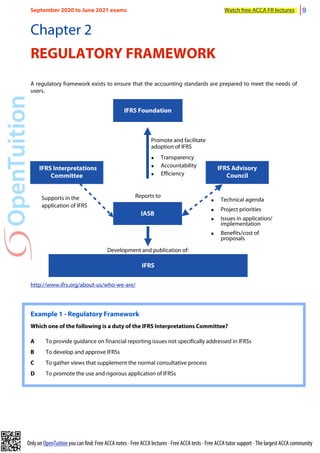
Chapter 2
REGULATORY FRAMEWORK
A regulatory framework exists to ensure that the accounting standards are prepared to meet the needs of
users.
IFRS Foundation
IASB
IFRS Interpretations
Committee
IFRS Advisory
Council
Supports in the
application of IFRS
• Technical agenda
• Project priorities
• Issues in application/
implementation
• Benefits/cost of
proposals
IFRS
Development and publication of:
Promote and facilitate
adoption of IFRS
• Transparency
• Accountability
• Efficiency
Reports to
http://www.ifrs.org/about-us/who-we-are/
Example 1 - Regulatory Framework
Which one of the following is a duty of the IFRS Interpretations Committee?
A To provide guidance on financial reporting issues not specifically addressed in IFRSs
B To develop and approve IFRSs
C To gather views that supplement the normal consultative process
D To promote the use and rigorous application of IFRSs
September 2020 to June 2021 exams Watch free ACCA FR lectures 9
Only on OpenTuition you can find: Free ACCA notes • Free ACCA lectures • Free ACCA tests • Free ACCA tutor support • The largest ACCA community
Example 2 – Regulatory bodies
Which one of the following would NOT be regarded as a responsibility of the IASB?
A Responsible for all IFRS technical matters
B Publish IFRSs
C Overall supervisory body of the IFRS organisations
D Final approval of interpretations by the IFRS Interpretations Committee
1. IASB work plan
Technical projects (e.g. revenue/leases/financial instruments) are all set out in the work plan (http://
www.ifrs.org/projects/work-plan/), however it does not include just standard setting projects. It also
includes research (evidence gathering) and maintenance (narrow scope amendments and interpretations)
projects.
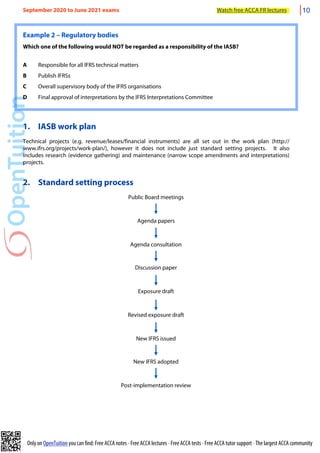
2. Standard setting process
Public Board meetings
Agenda papers
Agenda consultation
Discussion paper
Exposure draft
Revised exposure draft
New IFRS issued
New IFRS adopted
Post-implementation review
September 2020 to June 2021 exams Watch free ACCA FR lectures 10
Only on OpenTuition you can find: Free ACCA notes • Free ACCA lectures • Free ACCA tests • Free ACCA tutor support • The largest ACCA community
PUBLISHED COMPANY ACCOUNTS
Chapter 3
PRESENTATION OF FINANCIAL
STATEMENTS (IAS 1)
The purpose of IAS 1 (revised) is to ensure greater clarity and understandability of financial statements.
Financial statements will present to the users of accounts:
๏ Statement of financial position
๏ Statement of profit or loss and other comprehensive income
๏ Statement of changes in equity
๏ Statement of cash flows
๏ Notes to the accounts (accounting policies and explanations)
๏ Comparatives
Financial statements should provide a fair presentation of the results, which is achieved by compliance with
IFRSs.
Additionally, the entity should also disclose the following to make the financial statements more
understandable:
๏ The name of the reporting entity
๏ Whether the financial statements are the individual or group financial statements
๏ The reporting date and the period covered by the financial statements
๏ The presentation currency
๏ The level of rounding used in presenting the amounts within the financial statements
September 2020 to June 2021 exams Watch free ACCA FR lectures 11
Only on OpenTuition you can find: Free ACCA notes • Free ACCA lectures • Free ACCA tests • Free ACCA tutor support • The largest ACCA community
Statement of financial position as at [date]
$’000s $’000s
ASSETS
Non-current assets
Property, plant and equipment X
Intangibles X
Financial assets X
X
Current assets
Inventories X
Trade and other receivables X
Financial assets X
Cash and cash equivalents X
X
Non-current assets held for sale X
X
Total assets X
EQUITY AND LIABILITIES
Equity
Equity shares ($1) X
Retained earnings X
Other components of equity X
Total equity X
Non-current liabilities
Long term borrowings X
Deferred tax X
X
Current liabilities
Trade and other payables X
Dividends payable X
Tax payable X
X
Total equity and liabilities X
September 2020 to June 2021 exams Watch free ACCA FR lectures 12
Only on OpenTuition you can find: Free ACCA notes • Free ACCA lectures • Free ACCA tests • Free ACCA tutor support • The largest ACCA community
Statement of profit and loss and other comprehensive income for the year ended [date]
Continuing operations $’000s
Revenue X
Cost of sales (X)
Gross profit X
Distribution expenses (X)
Administrative expenses (X)
Operating profit X
Finance costs (X)
Investment income X
Profit before tax X
Income tax expense (X)
Profit from continuing operations for the period X
Discontinued operations
Profit/(loss) for the period from discontinued operations X
Profit/(loss) for the period X
Other comprehensive income for the year (after tax):
Items that will not be reclassified to profit or loss:
Gain on non-current asset revaluations X
Gain/(loss) on fair value through other comprehensive income investment X/(X)
Income tax on items that will not be reclassified X/(X)
Other comprehensive income, net of tax X
Total comprehensive income for the period X
September 2020 to June 2021 exams Watch free ACCA FR lectures 13
Only on OpenTuition you can find: Free ACCA notes • Free ACCA lectures • Free ACCA tests • Free ACCA tutor support • The largest ACCA community
Example 1 – Statement of profit and loss, and statement of financial position
You are the accountant of Trott Ltd, a business that buys and sells cricket equipment.
The trial balance at 31 December 2017 was as follows:
$ $
Equity share capital ($1) 5,000
Retained earnings at 1 January 2017 5,835
Revenue 66,980
Staff costs 5,400
Inventory at 1 January 2017 3,930
Purchases 38,760
Distribution costs 3,130
Administrative expenses 3,790
Loan interest 200
Investment income 250
Tax 200
Receivables and payables 9,290 2,360
Bank 3,125
Motor vehicles – cost 5,000
Buildings – cost 12,000
Motor vehicles – accumulated depreciation 1 January
2017
1,000
Buildings - accumulated depreciation 1 January 2017 2,400
Debentures (2020) 1,000
84,825 84,825
Additional information:
1. Trott has not made any additions or disposals of tangible non-current assets in the year. Its
depreciation policy is as follows:
Motor vehicles – 20% reducing balance
Buildings – 25 years straight line
The depreciation expense for the year is charged to cost of sales.
2. Inventory at the end of the year was valued as follows:
Cost ($) NRV ($)
Bats 2,500 4,000
Gloves 650 500
Pads 1,000 2,000
Total 4,150 6,500
3. Staff costs are to be apportioned equally across cost of sales, distribution costs and administrative
expense.
4. The balance of tax on the tax account represents the over/under provision for the prior year. An
estimate of $1,500 has been made for the tax payable at the year-end.
Prepare in a statement of profit or loss for the year-ended 31 December 2017 and a statement of
financial position at that date.
September 2020 to June 2021 exams Watch free ACCA FR lectures 14
Only on OpenTuition you can find: Free ACCA notes • Free ACCA lectures • Free ACCA tests • Free ACCA tutor support • The largest ACCA community
Statement of changes in equity for the year ended [date]
Equity
shares
Retained
earnings
Revaluation
surplus
Total
$’000s $’000s $’000s $’000s
B/f (as previously stated) X X X X
Change in policy/error – X/(X) – X/(X)
B/f (restated) X X X X
Issue of share capital X – – X
Dividends – (X) – (X)
Total comprehensive income for the year – X X X
Transfer to retained earnings – X (X) –
C/f X X X X
Example 2 – Statement of changes in equity (1)
Which of the following should appear in a company’s statement of changes in equity?
1. Total comprehensive income for the year
2. Amortisation of capitalised development costs
3. Surplus on revaluation of non-current assets
A 1, 2 and 3
B 2 and 3 only
C 1 and 3 only
D 1 and 2 only
September 2020 to June 2021 exams Watch free ACCA FR lectures 15
Only on OpenTuition you can find: Free ACCA notes • Free ACCA lectures • Free ACCA tests • Free ACCA tutor support • The largest ACCA community
Example 3 – Statement of changes in equity (2)
Extracts from Ball’s nominal ledger for the year ended 31 December 2017 are as follows:
$’000
Profit for the year 421
Dividend (98)
323
During the year the following important events took place:
(i) Properties were revalued by $105,000 increase.
(ii) 200,000 equity shares of $1 were issued during the year at a 25c premium
The opening equity balances were as follows:
$
Issued capital 400,000
Share premium 50,000
Revaluation surplus 165,000
Retained earnings 310,000
925,000
Prepare the statement of changes in equity for the year-ended 31 December 2017.
September 2020 to June 2021 exams Watch free ACCA FR lectures 16
Only on OpenTuition you can find: Free ACCA notes • Free ACCA lectures • Free ACCA tests • Free ACCA tutor support • The largest ACCA community
Chapter 4
STATEMENT OF CASH FLOWS (IAS 7)
Statement of cash flows for the year ended [date]
$'000s $'000s
Cash flows from operating activities
Profit before tax X
Finance cost X
Investment income (X)
Depreciation/amortisation X
(Profit)/loss on disposal of PPE (X)/X
Increase in inventory (X)
Increase in receivables (X)
Increase in payables X
Cash generated from operations X
Interest paid (X)
Income taxes paid (X)
Net cash generated from operating activities X
Cash flows from investing activities
Proceeds from sale of PPE X
Purchase of PPE (X)
Interest received X
Dividends received X
Net cash used in investing activities (X)
Cash flows from financing activities
Issue of equity shares X
Repayment of loan-term borrowings (X)
Proceeds from issue of long-term borrowings X
Dividend paid (X)
Net cash generated from financing activities (X)
Net increase/(decrease) in cash and cash equivalents X
Cash and cash equivalents at the beginning of the period X
Cash and cash equivalents at the end of the period X
September 2020 to June 2021 exams Watch free ACCA FR lectures 17
Only on OpenTuition you can find: Free ACCA notes • Free ACCA lectures • Free ACCA tests • Free ACCA tutor support • The largest ACCA community
Interest paid
Interest payable
Interest payable
Interest payable
B/f X
Bank (β) X Finance cost (SPL) X
C/f X
X X
Tax paid
Tax payable
Tax payable
Tax payable
B/f – current tax X
– deferred tax X
Bank (β) X Tax expense (SPL) X
C/f – current tax X
– deferred tax X
X X
Property, plant and equipment (PPE)
PPE (CV)
PPE (CV)
PPE (CV)
B/f X
Depreciation X
Revaluation X
Disposal X
Cash - additions (β) X
C/f X
X X
And,
π/λ on disposal = Proceeds less Carrying value
September 2020 to June 2021 exams Watch free ACCA FR lectures 18
Only on OpenTuition you can find: Free ACCA notes • Free ACCA lectures • Free ACCA tests • Free ACCA tutor support • The largest ACCA community
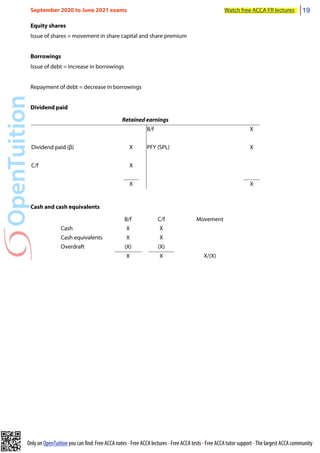
Equity shares
Issue of shares = movement in share capital and share premium
Borrowings
Issue of debt = increase in borrowings
Repayment of debt = decrease in borrowings
Dividend paid
Retained earnings
Retained earnings
Retained earnings
Retained earnings
B/f X
Dividend paid (β) X PFY (SPL) X
C/f X
X X
Cash and cash equivalents
B/f C/f Movement
Cash X X
Cash equivalents X X
Overdraft (X) (X)
X X X/(X)
September 2020 to June 2021 exams Watch free ACCA FR lectures 19
Only on OpenTuition you can find: Free ACCA notes • Free ACCA lectures • Free ACCA tests • Free ACCA tutor support • The largest ACCA community
4. Approach
1. Read the requirement, noting the year-end date, and allocate the timings
2. Statement of cash flow headings
‣ Operating
‣ Investing
‣ Financing
‣ Cash and cash equivalents
‣ Workings
3. Cash and cash equivalents (b/f, c/f and movement)
4. Statement of profit or loss
‣ PBT
“Look up”
‣ Finance costs (interest paid)
‣ Investment income (dividends received)
“Look down”
‣ Tax (tax paid)
‣ Profit for the year (dividend paid)
5. Statement of financial position
‣ Working capital (inventory/receivables/payables)
‣ Borrowings
‣ Share capital and share premium
6. Additional information
‣ Cash inflow/outflow (sale of PPE)
‣ Non-cash items (depreciation)
7. Complete the workings and statement of cash flows in the time available
September 2020 to June 2021 exams Watch free ACCA FR lectures 20
Only on OpenTuition you can find: Free ACCA notes • Free ACCA lectures • Free ACCA tests • Free ACCA tutor support • The largest ACCA community
Example 1 – Statement of cash flows
The following information relates to Geofrost, a limited liability company, for the year ended 31 October
20X7.
Extracts from the statement of profit or loss for the year ended 31 October 20X7
$’000
Finance costs (400)
Investment income 180
Profit before tax 15,000
Less tax 4,350
Profit for the year 10,650
Statement of financial position as at 31 October 20X7
20X7
$000s
20X6
$000s
Assets
Non-current assets 43,282 26,574
Current assets
Inventory 3,560 9,635
Receivables 6,405 4,542
Cash 2,045 1,063
12,010 15,240
Total assets 55,292 41,814
Equity and liabilities
Capital and liabilities
Ordinary share capital 19,365 17,496
Retained earnings 16,115 6,465
35,480 23,961
Non-current liabilities
Loan 8,000 10,300
Current liabilities
Bank overdraft 1,230 429
Trade payables 7,562 4,364
Taxation 3,020 2,760
11,812 7,553
Total equity and liabilities 55,292 41,814
Additional information:
1. Depreciation expense for the year was $4,658,000
2. Assets with a carrying value of $1,974,000 were disposed of at a profit of $720,000
Prepare the statement of cash flows for the year ended 31 October 20X7 for Geofrost.
September 2020 to June 2021 exams Watch free ACCA FR lectures 21
Only on OpenTuition you can find: Free ACCA notes • Free ACCA lectures • Free ACCA tests • Free ACCA tutor support • The largest ACCA community
September 2020 to June 2021 exams Watch free ACCA FR lectures 22
Only on OpenTuition you can find: Free ACCA notes • Free ACCA lectures • Free ACCA tests • Free ACCA tutor support • The largest ACCA community
ACCOUNTING STANDARDS
Chapter 5
NON-CURRENT ASSETS
Tangible non-current assets
IAS 16
Property, plant and
equipment
IAS 23
Borrowing costs
IAS 20
Government grants
IAS 40
Investment property
1. Property, plant and equipment (IAS 16)
1.1. Measurement at recognition
๏ At cost
‣ Purchase price
‣ Directly attributable costs in bringing asset to its location and condition
‣ Costs to dismantle/restore (@ present value)
Revaluations
Cost Model
Carried at cost less
accumulated depreciation
and impairment losses
Revaluation Model
Carried at revalued amount
(fair value less accumulated
depreciation and impairment
losses)
If the asset is carried under the revaluation model, the following must be applied:
๏ Review periodically and keep revaluations up to date
๏ Consistent policy for each class of asset (avoids cherry-picking of assets)
๏ Depreciate the revalued asset less residual value over its remaining useful life
September 2020 to June 2021 exams Watch free ACCA FR lectures 23
Only on OpenTuition you can find: Free ACCA notes • Free ACCA lectures • Free ACCA tests • Free ACCA tutor support • The largest ACCA community
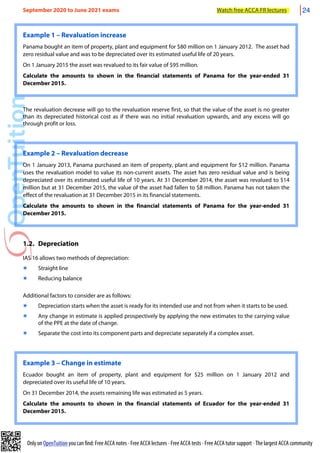
Example 1 – Revaluation increase
Panama bought an item of property, plant and equipment for $80 million on 1 January 2012. The asset had
zero residual value and was to be depreciated over its estimated useful life of 20 years.
On 1 January 2015 the asset was revalued to its fair value of $95 million.
Calculate the amounts to shown in the financial statements of Panama for the year-ended 31
December 2015.
The revaluation decrease will go to the revaluation reserve first, so that the value of the asset is no greater
than its depreciated historical cost as if there was no initial revaluation upwards, and any excess will go
through profit or loss.
Example 2 – Revaluation decrease
On 1 January 2013, Panama purchased an item of property, plant and equipment for $12 million. Panama
uses the revaluation model to value its non-current assets. The asset has zero residual value and is being
depreciated over its estimated useful life of 10 years. At 31 December 2014, the asset was revalued to $14
million but at 31 December 2015, the value of the asset had fallen to $8 million. Panama has not taken the
effect of the revaluation at 31 December 2015 in its financial statements.
Calculate the amounts to shown in the financial statements of Panama for the year-ended 31
December 2015.
1.2. Depreciation
IAS 16 allows two methods of depreciation:
๏ Straight line
๏ Reducing balance
Additional factors to consider are as follows:
๏ Depreciation starts when the asset is ready for its intended use and not from when it starts to be used.
๏ Any change in estimate is applied prospectively by applying the new estimates to the carrying value
of the PPE at the date of change.
๏ Separate the cost into its component parts and depreciate separately if a complex asset.
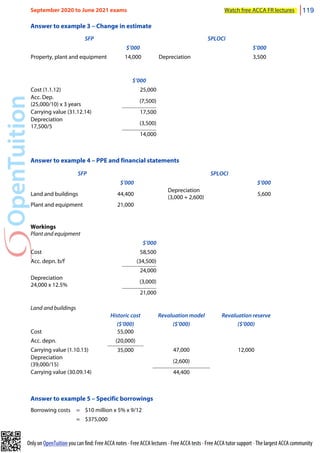
Example 3 – Change in estimate
Ecuador bought an item of property, plant and equipment for $25 million on 1 January 2012 and
depreciated over its useful life of 10 years.
On 31 December 2014, the assets remaining life was estimated as 5 years.
Calculate the amounts to shown in the financial statements of Ecuador for the year-ended 31
December 2015.
September 2020 to June 2021 exams Watch free ACCA FR lectures 24
Only on OpenTuition you can find: Free ACCA notes • Free ACCA lectures • Free ACCA tests • Free ACCA tutor support • The largest ACCA community
Example 4 – PPE and financial statements
The extracts from the trial balance of Kandy as at 30 September 2014 are:
$’000 $’000
Land ($5 million) and buildings – at cost 55,000
Plant and equipment – at cost 58,500
Accumulated depreciation at 1 October 2013
: buildings 20,000
: plant and equipment 34,500
The following notes are relevant:
Non-current assets:
The price of property has increased significantly in recent years and on 1 October 2013, the directors
decided to revalue the land and buildings. The directors accepted the report of an independent surveyor
who valued the land at $8 million and the buildings at $39 million on that date. The remaining life of the
buildings at 1 October 2013 was 15 years. Kandy does not make an annual transfer to retained profits to
reflect the realisation of the revaluation gain.
Plant and equipment is depreciated at 12½% per annum using the reducing balance method.
No depreciation has yet been charged on any non-current asset for the year ended 30 September 2014.
Depreciation is charged to cost of sales.
Prepare extracts from the statement of profit or loss and other comprehensive income for Kandy for
the year ended 30 September 2014 and from the statement of financial position as at the same date
with regards property, plant and equipment.
2. Borrowing costs (IAS 23)
Borrowing costs, net of income received from the investment of the money borrowed, on a qualifying asset
must be capitalised over the period of construction.
Capitalisation starts when:
๏ Expenditure on the asset commences
๏ Borrowing costs are being incurred
๏ Activities necessary to prepare the asset are in progress
Capitalisation must stop when the asset is ready for its use (whether or not it is being used) or when there is
no active construction.
Capitalisation for specific borrowings is capitalised using the effective rate of interest.
Example 5 – Specific borrowings
Columbia commenced the construction of an item of property, plant and equipment on 1 March 2015 and
funded it with a $10 million loan. The rate of interest on the borrowings was 5%.
Due to a strike no construction took place between 1 October and 1 November.
Calculate the amount of interest to be capitalised as par to of non-current assets if Columbia’s
reporting date is 31 December 2015.
September 2020 to June 2021 exams Watch free ACCA FR lectures 25
Only on OpenTuition you can find: Free ACCA notes • Free ACCA lectures • Free ACCA tests • Free ACCA tutor support • The largest ACCA community
Illustration – Net borrowing costs
Ecuador has a loan facility of $300 million upon which interest is charged at 6%. It is also allowed to invest
funds and earn a return of 4%.
On 1 March 2018, $100m was borrowed to construct a new indoor velodrome, of which $20 million was
invested immediately for use later on the project.
On 1 May 2018, work on the construction stopped due to strike action, but work restarted on 1 June 2018
and continued up to the 30 June 2018 reporting date.
The borrowing costs on the $100 million must be capitalised for three months, from 1 March 2018 to 30 April
2018, and for 1 June 2018 to 30 June 2018. The borrowing costs cannot be capitalised for the month of May
due to the strike action where no construction took place. Therefore, borrowing costs of $1.5 million ($100
million x 6% x 3/12) will be capitalised before any investment income is net-off.
The investment income received of $0.2 million ($20 million x 4% x 3/12) will be net-off the $1.5 million, to
give net borrowing costs capitalised of $1.3 million.
The interest expense for May of $0.5 million ($100 million x 6% x 1/12) and interest income of $0.07 million
will both be recognised through profit or loss.
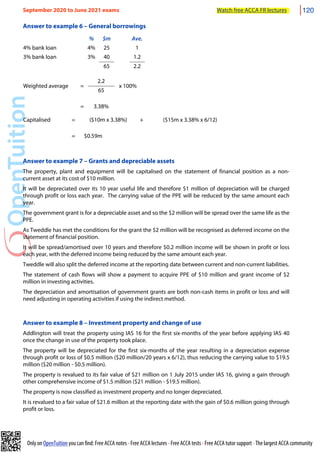
Example 6 – General borrowings
Venezuela had the following bank loans in issue during 2015.
$m
4% bank loan 25
3% bank loan 40
Venezuela commenced the construction of an item of property, plant and equipment on 1 January 2015 for
which it used its existing borrowings. $10 million of expenditure was used on 1 January and $15 million was
used on 1 July.
Calculate the amount of interest to be capitalised as part of the non-current assets during 2015.
September 2020 to June 2021 exams Watch free ACCA FR lectures 26
Only on OpenTuition you can find: Free ACCA notes • Free ACCA lectures • Free ACCA tests • Free ACCA tutor support • The largest ACCA community
3. Government grants (IAS 20)
Recognise the grant when the:
๏ Entity will comply with the conditions attached to the grant
๏ Entity will actually receive the grant
Grants should be recognised according to the deferred income approach, using a systematic basis. This
spreads the income over the period in which the related expenditure is recognised.
If the grant is used to buy depreciating assets, the grant must be spread over the same life and using the
same method.
Example 7 – Grants and depreciable assets
Tweddle bought an item of property, plant and equipment for $10 million and received a government grant
of $2 million. The PPE has a useful life of 10 years and has no residual value.
Explain how the purchase of the property, plant and equipment and government grant would be
dealt with in the financial statements of Tweddle.
Note: If a government grant becomes repayable, it is treated as a change in accounting estimate.
The payment is first shown against any remaining deferred income balance.
If the payment exceeds the deferred income balance then the excess payment is treated as an expense.
September 2020 to June 2021 exams Watch free ACCA FR lectures 27
Only on OpenTuition you can find: Free ACCA notes • Free ACCA lectures • Free ACCA tests • Free ACCA tutor support • The largest ACCA community
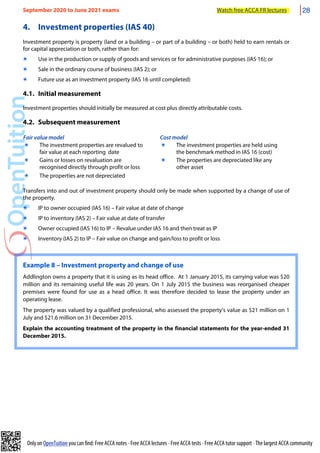
4. Investment properties (IAS 40)
Investment property is property (land or a building – or part of a building – or both) held to earn rentals or
for capital appreciation or both, rather than for:
๏ Use in the production or supply of goods and services or for administrative purposes (IAS 16); or
๏ Sale in the ordinary course of business (IAS 2); or
๏ Future use as an investment property (IAS 16 until completed)
4.1. Initial measurement
Investment properties should initially be measured at cost plus directly attributable costs.
4.2. Subsequent measurement
Fair value model Cost model
๏ The investment properties are revalued to
fair value at each reporting date
๏ The investment properties are held using
the benchmark method in IAS 16 (cost)
๏ Gains or losses on revaluation are
recognised directly through profit or loss
๏ The properties are depreciated like any
other asset
๏ The properties are not depreciated
Transfers into and out of investment property should only be made when supported by a change of use of
the property.
๏ IP to owner occupied (IAS 16) – Fair value at date of change
๏ IP to inventory (IAS 2) – Fair value at date of transfer
๏ Owner occupied (IAS 16) to IP – Revalue under IAS 16 and then treat as IP
๏ Inventory (IAS 2) to IP – Fair value on change and gain/loss to profit or loss
Example 8 – Investment property and change of use
Addlington owns a property that it is using as its head office. At 1 January 2015, its carrying value was $20
million and its remaining useful life was 20 years. On 1 July 2015 the business was reorganised cheaper
premises were found for use as a head office. It was therefore decided to lease the property under an
operating lease.
The property was valued by a qualified professional, who assessed the property’s value as $21 million on 1
July and $21.6 million on 31 December 2015.
Explain the accounting treatment of the property in the financial statements for the year-ended 31
December 2015.
September 2020 to June 2021 exams Watch free ACCA FR lectures 28
Only on OpenTuition you can find: Free ACCA notes • Free ACCA lectures • Free ACCA tests • Free ACCA tutor support • The largest ACCA community
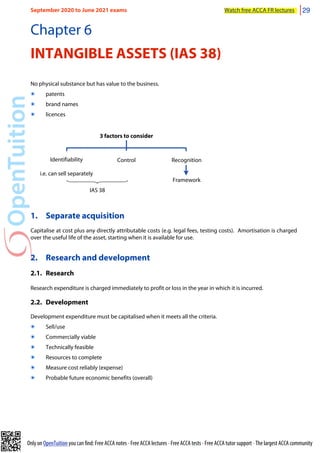
Chapter 6
INTANGIBLE ASSETS (IAS 38)
No physical substance but has value to the business.
๏ patents
๏ brand names
๏ licences
3 factors to consider
Identifiability
i.e. can sell separately
Recognition
Control
Framework
IAS 38
1. Separate acquisition
Capitalise at cost plus any directly attributable costs (e.g. legal fees, testing costs). Amortisation is charged
over the useful life of the asset, starting when it is available for use.
2. Research and development
2.1. Research
Research expenditure is charged immediately to profit or loss in the year in which it is incurred.
2.2. Development
Development expenditure must be capitalised when it meets all the criteria.
๏ Sell/use
๏ Commercially viable
๏ Technically feasible
๏ Resources to complete
๏ Measure cost reliably (expense)
๏ Probable future economic benefits (overall)
September 2020 to June 2021 exams Watch free ACCA FR lectures 29
Only on OpenTuition you can find: Free ACCA notes • Free ACCA lectures • Free ACCA tests • Free ACCA tutor support • The largest ACCA community
3. Internally generated
Internally generate brands, mastheads cannot be capitalised as their cost cannot be separated from the
overall cost of developing the business.
Example 1 – Intangibles (1)
Which of the following statements are correct?
1. Capitalised development expenditure must be amortised over a period not exceeding five years.
2. Capitalised development costs are shown in the statement of financial position under the heading of
non-current assets
3. If certain criteria are met, research expenditure must be recognised as an intangible asset.
A 2 only
B 2 and 3 only
C 1 only
D 1 and 3 only
Example 2 – Intangibles (2)
Booker is involved in developing new products and has spent $15 million on acquiring a patent to aid in this
development. The initial investigative phase of the project cost an additional $6 million, whereby it was
determined that the future feasibility of the product was guaranteed.
Subsequent expenditure incurred on the product was $8 million, of which $5 million was spent on the
functioning prototype and the remainder on getting the product into a safe and saleable condition.
A further $1 million was spent on marketing and $0.5 million on training sales staff on how to demonstrate
the use of the product.
At the reporting date the product had not yet been completed.
Explain how Booker should account for the expenditure in its financial statements.
Example 3 – Intangibles (3)
GSK is a large pharmaceutical business involved in the research and development of viable new drugs. It
commenced initial investigation into the viability of a new drug on 1 February 20X5 at a cost of $40,000 per
month. On 1 August 20X5 GSK were able to demonstrate the commercial viability of the new drug and
intend to sell it on the open market once fully complete.
Costs subsequent to 1 August 20X5 remained at $40,000 per month. At 31 December 20X5, GSK’s reporting
date, the drug was not yet complete but it is believed that by mid-20X6 the drug will be available for sale.
The finance director is confident of the success of the drug’s sales that he wishes to revalue the intangible at
the reporting date, using a discounted future cash flow model to establish the fair value.
Explain the treatment of the above costs in GSK’s financial statements for the year-ended 31
December 20X5.
September 2020 to June 2021 exams Watch free ACCA FR lectures 30
Only on OpenTuition you can find: Free ACCA notes • Free ACCA lectures • Free ACCA tests • Free ACCA tutor support • The largest ACCA community
Chapter 7
IMPAIRMENTS (IAS 36)
1. Identify possible impairment indicators (external vs. internal)
2. Perform impairment review (if identified possible impairments)
3. Record the impairment
1. Indicators of Impairment
External sources
๏ A significant decline in the asset’s market value more than expected by normal use or passage of time
๏ A significant adverse change in the technological, economic or legal environment
Internal sources
๏ Obsolescence or physical damage
๏ Significant changes, in the period or expected, in the way the asset is being used e.g. asset becoming
idle, plans for early disposal or discontinuing/ restructuring the operation where the asset is used
๏ Evidence that asset’s economic performance will be worse than expected
๏ Operating losses or net cash outflows for the asset
๏ Loss of key employee
2. Impairment review
If the carrying value of the asset is greater than its recoverable amount, it is impaired and should be written
down to its recoverable amount.
๏ Recoverable amount - the greater of fair value less cost to sell and value in use.
๏ Fair value less costs to sell - the amount receivable from the sale of the asset less the costs of
disposal.
๏ Value in use - the present value of the future cash flows from the asset.
Example 1 – Impairment
A machine was acquired on 1 January 20X5 at a cost of $50,000 and has a useful economic life of ten years.
At 31 December 20X9 an impairment review was performed. The fair value of the machine is $26,000 and
the selling costs are $2,000.
The expected future cash flows are $5,000 per annum for the next five years. The current cost of capital is
10%. An annuity factor for this rate over this period is 3.791
Prepare extract from the financial statement for the year-ended 31 December 20X9.
September 2020 to June 2021 exams Watch free ACCA FR lectures 31
Only on OpenTuition you can find: Free ACCA notes • Free ACCA lectures • Free ACCA tests • Free ACCA tutor support • The largest ACCA community
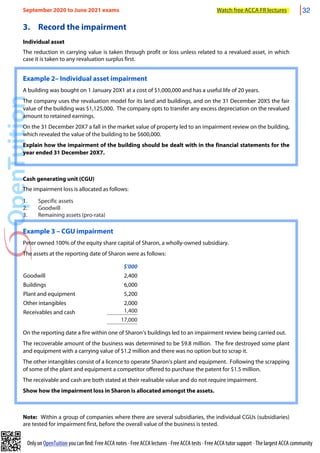
3. Record the impairment
Individual asset
The reduction in carrying value is taken through profit or loss unless related to a revalued asset, in which
case it is taken to any revaluation surplus first.
Example 2– Individual asset impairment
A building was bought on 1 January 20X1 at a cost of $1,000,000 and has a useful life of 20 years.
The company uses the revaluation model for its land and buildings, and on the 31 December 20X5 the fair
value of the building was $1,125,000. The company opts to transfer any excess depreciation on the revalued
amount to retained earnings.
On the 31 December 20X7 a fall in the market value of property led to an impairment review on the building,
which revealed the value of the building to be $600,000.
Explain how the impairment of the building should be dealt with in the financial statements for the
year ended 31 December 20X7.
Cash generating unit (CGU)
The impairment loss is allocated as follows:
1. Specific assets
2. Goodwill
3. Remaining assets (pro-rata)
Example 3 – CGU impairment
Peter owned 100% of the equity share capital of Sharon, a wholly-owned subsidiary.
The assets at the reporting date of Sharon were as follows:
$’000
Goodwill 2,400
Buildings 6,000
Plant and equipment 5,200
Other intangibles 2,000
Receivables and cash 1,400
17,000
On the reporting date a fire within one of Sharon’s buildings led to an impairment review being carried out.
The recoverable amount of the business was determined to be $9.8 million. The fire destroyed some plant
and equipment with a carrying value of $1.2 million and there was no option but to scrap it.
The other intangibles consist of a licence to operate Sharon’s plant and equipment. Following the scrapping
of some of the plant and equipment a competitor offered to purchase the patent for $1.5 million.
The receivable and cash are both stated at their realisable value and do not require impairment.
Show how the impairment loss in Sharon is allocated amongst the assets.
Note: Within a group of companies where there are several subsidiaries, the individual CGUs (subsidiaries)
are tested for impairment first, before the overall value of the business is tested.
September 2020 to June 2021 exams Watch free ACCA FR lectures 32
Only on OpenTuition you can find: Free ACCA notes • Free ACCA lectures • Free ACCA tests • Free ACCA tutor support • The largest ACCA community
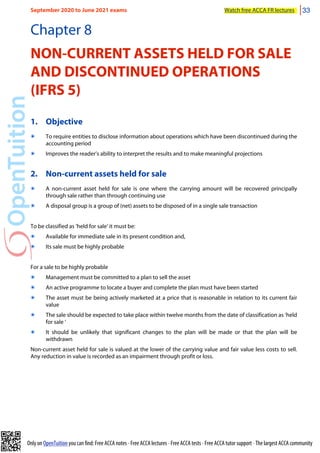
Chapter 8
NON-CURRENT ASSETS HELD FOR SALE
AND DISCONTINUED OPERATIONS
(IFRS 5)
1. Objective
๏ To require entities to disclose information about operations which have been discontinued during the
accounting period
๏ Improves the reader’s ability to interpret the results and to make meaningful projections
2. Non-current assets held for sale
๏ A non-current asset held for sale is one where the carrying amount will be recovered principally
through sale rather than through continuing use
๏ A disposal group is a group of (net) assets to be disposed of in a single sale transaction
To be classified as ‘held for sale’ it must be:
๏ Available for immediate sale in its present condition and,
๏ Its sale must be highly probable
For a sale to be highly probable
๏ Management must be committed to a plan to sell the asset
๏ An active programme to locate a buyer and complete the plan must have been started
๏ The asset must be being actively marketed at a price that is reasonable in relation to its current fair
value
๏ The sale should be expected to take place within twelve months from the date of classification as ‘held
for sale ‘
๏ It should be unlikely that significant changes to the plan will be made or that the plan will be
withdrawn
Non-current asset held for sale is valued at the lower of the carrying value and fair value less costs to sell.
Any reduction in value is recorded as an impairment through profit or loss.
September 2020 to June 2021 exams Watch free ACCA FR lectures 33
Only on OpenTuition you can find: Free ACCA notes • Free ACCA lectures • Free ACCA tests • Free ACCA tutor support • The largest ACCA community
IFRS 5
Cost Model Revaluation Model
Asset is revalued to fair value immediately
before classification as held for sale
๏ Once classified as a non-current asset held for sale it is no longer depreciated.
๏ The subsequent sale of the asset will give rise to a profit/loss on disposal.
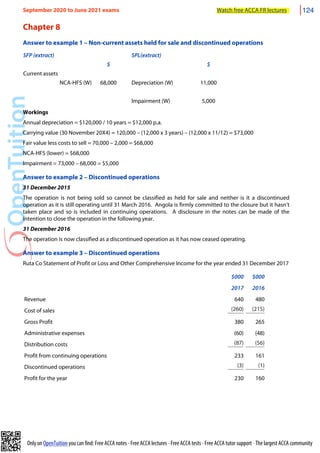
Example 1 – NCA-HFS
York bought an asset at a cost of $120,000 on 1 January 20X1 and depreciated it straight line over 10 years.
The asset’s residual value is nil and depreciation is charged pro-rate on a monthly basis.
On 30 November 20X4, York classified the asset as a non-current asset held for sale in accordance with the
rules of IFRS 5 Discontinued operations and non-current assets held for sale. At that date the fair value of
the asset was $70,000 and the costs to sell were $2,000.
The asset had not been sold by the 31 December 20X4 reporting date.
Prepare extracts from the financial statements for the year-ended 31 December 20X4.
September 2020 to June 2021 exams Watch free ACCA FR lectures 34
Only on OpenTuition you can find: Free ACCA notes • Free ACCA lectures • Free ACCA tests • Free ACCA tutor support • The largest ACCA community
3. Discontinued operations
Disclosure
P or L
PFY → face
Revenue, expenses,
pre-tax profit, tax
expense → face or
notes
SFP
Fully disposed of → none
Not fully disposed of →
‘assets held for sale’
SCF
Net cash flows → face or notes
Discontinued
Disposed of in the year Held for sale
Disclose in year of
disposal
Disclose in year
held for sale
Definition
๏ Disposed of, or
๏ Held for sale, and:
Separate major
line of business or
geographical area
of operations
Is a subsidiary
acquired exclusively
with a view to re-sale
Single co-ordinated plan
to dispose of a separate
line of business/
geographical area
IFRS 5
Discontinued Operations
Definition Disclosure
When discontinued
September 2020 to June 2021 exams Watch free ACCA FR lectures 35
Only on OpenTuition you can find: Free ACCA notes • Free ACCA lectures • Free ACCA tests • Free ACCA tutor support • The largest ACCA community
Example 2 – Discontinued operations
Angola’s car manufacturing operation has been making substantial losses. Following a meeting of the
board of directors, it was decided to close down the car manufacturing operation on 31 March 20X6. The
company’s reporting date is 31 December and the car manufacturing operation is treated as a separate
operating segment.
Explain how the decision to close the car manufacturing operation should be treated in Angola’s
financial statements for the years ending 31 December 20X5 and 20X6.
Example 3 – Discontinued operations
Ruta Co Statement of Profit or Loss and Other Comprehensive Income for the year ended 31 December 2017
$000 $000
2017 2016
Revenue 700 550
Cost of sales (300) (260)
Gross profit 400 290
Distribution costs (100) (70)
Administrative expenses (70) (60)
Profit from operations 230 160
During the year the entity ran down a material business operation with all activities ceasing on 30 March
2017
The results of the operation for 2017 and 2016 were as follows:
$000 $000
2017 2016
Revenue 60 70
Cost of sales (40) (45)
Distribution costs (13) (14)
Administrative expenses (10) (12)
Loss from operations (3) (1)
The entity made gains of $7,000 on the disposal of non-current assets of the discontinued operation. These
have been netted off against administrative expenses.
Prepare the Statement of Profit or Loss and Other Comprehensive Income for the year ended 31
December, 2017 for Ruta Co, complying with the provisions of IFRS 5, disclosing the information on
the face of the Statement of Profit or Loss and Other Comprehensive Income. Ignore taxation.
September 2020 to June 2021 exams Watch free ACCA FR lectures 36
Only on OpenTuition you can find: Free ACCA notes • Free ACCA lectures • Free ACCA tests • Free ACCA tutor support • The largest ACCA community
Chapter 9
ACCOUNTING POLICIES, CHANGES IN
ACCOUNTING ESTIMATE AND ERRORS
(IAS 8)
IAS 8
Accounting Estimates Prior Period Errors
Accounting Policies
1. Accounting policies
Selection
Apply the standard that
specifically deals with the
transaction
Apply a policy that gives relevant
and reliable information
๏ Standard of a similar item
๏ IASB Framework definitions
Change in accounting policy
New IFRS Apply a new policy that gives more
relevant and reliable information
Follow treatment given in new IFRS Voluntary change
Retrospective application
๏ Adjust b/f figures
๏ Restate comparatives
September 2020 to June 2021 exams Watch free ACCA FR lectures 37
Only on OpenTuition you can find: Free ACCA notes • Free ACCA lectures • Free ACCA tests • Free ACCA tutor support • The largest ACCA community
Example 1 – Error
Adomas Co Statement of Profit or Loss and Other Comprehensive Income extract and summarised
Statement of Financial Position for the year ended 31 December, 2008
$’000
Revenue 2,500
Cost of sales and expenses (1,200)
Profit for the year 1,300
Statement of Financial Position at 31 December, 2008
Non-current assets 2,000
Current assets 800
2,800
Share capital 600
Reserves 2,000
2,600
Current liabilities 200
2,800
During 2009 it was discovered that certain non-current assets had been included in the records at 31
December 2008 at $500,000 in excess of their recoverable amount and that this situation was unlikely to
change.
Prior to making any adjustment for the above the results and summarised Statement of Financial Position of
Adomas Co for 2009 was as follows:
Statement of Profit or Loss (extract) for the year ended 31 December 2009
$’000
Revenue 2,600
Costs and expenses (1,400)
Profit for the year 1,200
Statement of Financial Position at 31 December 2009
$’000
Non-current assets 2,800
Current assets 1,700
4,500
Share capital 600
Retained earnings 3,500
4,100
Current liabilities 400
4,500
During 2009 some other items of property had been revalued by $300,000 (included in the above retained
earnings figure).
Prepare extracts from Adomas Co’s financial statements for the year ended 31 December, 2009.
September 2020 to June 2021 exams Watch free ACCA FR lectures 38
Only on OpenTuition you can find: Free ACCA notes • Free ACCA lectures • Free ACCA tests • Free ACCA tutor support • The largest ACCA community
2. Accounting estimates
Changes in accounting estimate are recognised prospectively:
๏ Period of change
๏ Period of change and future periods
Example 2 – Accounting Estimates
Would the following be a change in accounting policy or revision of an estimate?
1. If a company decides to change its method of depreciation from straight line method to reducing
balance method.
2. If a company decides to change from capitalising finance costs to immediate write off.
3. Prior period error
Accounting errors (omissions and misstatements) include:
๏ Errors in applying accounting policies
๏ Oversights
๏ Fraud and the effects of fraud
Material errors are corrected retrospectively, the same as for a change in accounting policy.
Example 3 – Prior year error
Fraudulent financial reporting has been found within the accounts of Dodgy Co, which amounts to $3.4m of
trade receivables that need to be written off. Of the total $3.4m, $1.0m relates to the current reporting
period, and the remaining $2.4m relates to pervious period.
Explain the accounting treatment of the fraudulent financial reporting in the financial statements of
Dodgy Co.
September 2020 to June 2021 exams Watch free ACCA FR lectures 39
Only on OpenTuition you can find: Free ACCA notes • Free ACCA lectures • Free ACCA tests • Free ACCA tutor support • The largest ACCA community
September 2020 to June 2021 exams Watch free ACCA FR lectures 40
Only on OpenTuition you can find: Free ACCA notes • Free ACCA lectures • Free ACCA tests • Free ACCA tutor support • The largest ACCA community
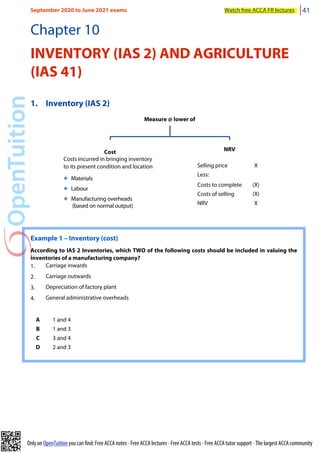
Chapter 10
INVENTORY (IAS 2) AND AGRICULTURE
(IAS 41)
1. Inventory (IAS 2)
Measure @ lower of
Cost
Costs incurred in bringing inventory
to its present condition and location
๏ Materials
๏ Labour
๏ Manufacturing overheads
(based on normal output)
NRV
Selling price X
Less:
Costs to complete (X)
Costs of selling (X)
NRV X
Example 1 – Inventory (cost)
According to IAS 2 Inventories, which TWO of the following costs should be included in valuing the
inventories of a manufacturing company?
1. Carriage inwards
2. Carriage outwards
3. Depreciation of factory plant
4. General administrative overheads
A 1 and 4
B 1 and 3
C 3 and 4
D 2 and 3
September 2020 to June 2021 exams Watch free ACCA FR lectures 41
Only on OpenTuition you can find: Free ACCA notes • Free ACCA lectures • Free ACCA tests • Free ACCA tutor support • The largest ACCA community
Example 2 – Inventory (valuation)
Neil paid $3 per unit for the raw materials of its products. To complete each unit incurred $2 per unit in
direct labour.
Production overheads for the year based on normal output of 12,000 units was $72,000.
Due to industrial action only 10,000 units were produced and 1,000 units were in inventory at the end of the
year.
As a result of the industrial action some units were badly stored and became damaged. It’s is estimated that
200 of the units will now only be sold for $12 each after minor repairs of $2 each
What figure for closing inventory would be shown in the Statement of Financial Position?
September 2020 to June 2021 exams Watch free ACCA FR lectures 42
Only on OpenTuition you can find: Free ACCA notes • Free ACCA lectures • Free ACCA tests • Free ACCA tutor support • The largest ACCA community
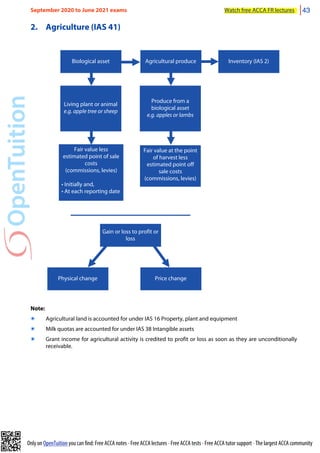
2. Agriculture (IAS 41)
Biological asset Agricultural produce Inventory (IAS 2)
Living plant or animal
e.g. apple tree or sheep
Produce from a
biological asset
e.g. apples or lambs
Fair value less
estimated point of sale
costs
(commissions, levies)
• Initially and,
• At each reporting date
Fair value at the point
of harvest less
estimated point off
sale costs
(commissions, levies)
Gain or loss to profit or
loss
Physical change Price change
Note:
๏ Agricultural land is accounted for under IAS 16 Property, plant and equipment
๏ Milk quotas are accounted for under IAS 38 Intangible assets
๏ Grant income for agricultural activity is credited to profit or loss as soon as they are unconditionally
receivable.
September 2020 to June 2021 exams Watch free ACCA FR lectures 43
Only on OpenTuition you can find: Free ACCA notes • Free ACCA lectures • Free ACCA tests • Free ACCA tutor support • The largest ACCA community
September 2020 to June 2021 exams Watch free ACCA FR lectures 44
Only on OpenTuition you can find: Free ACCA notes • Free ACCA lectures • Free ACCA tests • Free ACCA tutor support • The largest ACCA community
Chapter 11
FINANCIAL INSTRUMENTS (IFRS 9)
Company A Company B
Financial asset Financial liability, or equity
Purchase shares in co. B Issues shares
Purchase co. B debt Issues debt
Sells goods to B Buys good from A
1. Financial assets
1.1. Initial measurement
๏ Initially recognise at fair value including transaction costs, unless classified as fair value through profit
or loss
1.2. Subsequent measurement
1.2.1 Equity instruments
Fair value through profit or loss (default)
๏ Transaction costs are recognised immediately through profit or loss
๏ Re-measure to fair value at the reporting date, with gains or losses through profit or loss
Fair value through other comprehensive income
If there is a strategic intent to hold the asset the option to hold at fair value through other comprehensive
income is available. Re-measure to fair value at reporting date, with gains or losses through other
comprehensive income.
1.2.2 Debt instruments
Amortised cost
A financial asset is measured at amortised cost if it fulfils both of the following tests:
๏ Business model test – intent to hold the asset until its maturity date; and,
๏ Contractual cash flow test – contractual cash receipts on holding the asset.
Fair value through other comprehensive income
The investment in debt can be classified as FVTOCI if the objective of the business model is to instead collect
the cash receipts and sell the financial asset.
September 2020 to June 2021 exams Watch free ACCA FR lectures 45
Only on OpenTuition you can find: Free ACCA notes • Free ACCA lectures • Free ACCA tests • Free ACCA tutor support • The largest ACCA community
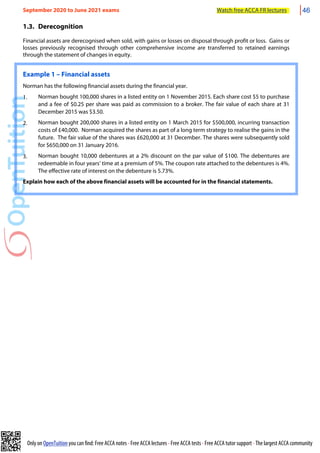
1.3. Derecognition
Financial assets are derecognised when sold, with gains or losses on disposal through profit or loss. Gains or
losses previously recognised through other comprehensive income are transferred to retained earnings
through the statement of changes in equity.
Example 1 – Financial assets
Norman has the following financial assets during the financial year.
1. Norman bought 100,000 shares in a listed entity on 1 November 2015. Each share cost $5 to purchase
and a fee of $0.25 per share was paid as commission to a broker. The fair value of each share at 31
December 2015 was $3.50.
2. Norman bought 200,000 shares in a listed entity on 1 March 2015 for $500,000, incurring transaction
costs of £40,000. Norman acquired the shares as part of a long term strategy to realise the gains in the
future. The fair value of the shares was £620,000 at 31 December. The shares were subsequently sold
for $650,000 on 31 January 2016.
3. Norman bought 10,000 debentures at a 2% discount on the par value of $100. The debentures are
redeemable in four years’ time at a premium of 5%. The coupon rate attached to the debentures is 4%.
The effective rate of interest on the debenture is 5.73%.
Explain how each of the above financial assets will be accounted for in the financial statements.
September 2020 to June 2021 exams Watch free ACCA FR lectures 46
Only on OpenTuition you can find: Free ACCA notes • Free ACCA lectures • Free ACCA tests • Free ACCA tutor support • The largest ACCA community
2. Financial liabilities
2.1. Initial measurement
๏ Initially recognise at fair value less transaction costs (‘net proceeds’)
2.2. Subsequent measurement
๏ Amortised cost
๏ Fair value though profit or loss
2.3. Derecognition
๏ Financial liabilities are derecognised when they have been paid in full or transferred to another party.
Example 2 – Financial liabilities
Norma issues 20,000 redeemable debentures at their $100 par value, incurring issue costs of $100,000. The
debentures are redeemable at a 5% premium in 4 years’ time and carry a coupon rate of 2%. The effective
rate on the debenture is 4.58%.
Calculate the amounts to be shown in the statement of financial position and statement of profit or
loss for each of the four years of the debenture.
3. Convertible debentures
If a convertible instrument is issued, the economic substance is a combination of equity and liability and is
accounted for using split equity accounting.
The liability element is calculated by discounting back the maximum possible amount of cash that will be
repaid assuming that the conversion doesn’t take place. The discount rate to be used is that of the interest
rate on similar debt without and conversion option.
The equity element is the difference between the proceeds on issue and the initial liability element.
The liability element is subsequently measured at amortised cost, using the interest rate on similar debt
without the conversion option as the effective rate. The equity element is not subsequently changed.
Example 3 – Convertible debentures
Alice issued one million 4% convertible debentures at the start of the accounting year at par value of $100
million.
The rate of interest on similar debt without the conversion option is 6%.
Explain how Alice should account for the convertible debenture in its financial statements for each of
the three years.
September 2020 to June 2021 exams Watch free ACCA FR lectures 47
Only on OpenTuition you can find: Free ACCA notes • Free ACCA lectures • Free ACCA tests • Free ACCA tutor support • The largest ACCA community
4. Disclosure (IFRS 7)
Financial instruments, particularly derivatives, often require little initial investment, though may result in
substantial losses or gains and as such stakeholders need to be informed of their existence. The objective of
IFRS7 is to allow users of the accounts to evaluate:
๏ The significance of the financial instruments for the entity’s financial position and performance
๏ The nature and extent of risks arising from financial instruments
๏ The management of the risks arising from financial instruments
Nature and extent of financial risks
Financial risk arising from the use of financial instruments can be defined as:
๏ Credit risk
๏ Liquidity risk
๏ Market risk
Disclosures with regards to these risks need to be both qualitative and quantitative.
September 2020 to June 2021 exams Watch free ACCA FR lectures 48
Only on OpenTuition you can find: Free ACCA notes • Free ACCA lectures • Free ACCA tests • Free ACCA tutor support • The largest ACCA community
Chapter 12
LEASES (IFRS 16)
IFRS 16 Leases is to be adopted for accounting periods starting on or after 1 January 2019. It can be adopted
earlier but only if the entity has already adopted IFRS 15 Revenue from contracts with customers.
The new standard on leases is replacing the old standard (IAS 17) where the existence of operating leases
meant that significant amounts of finance were held off the balance sheet. In adopting the new standard all
leases will now be brought on to the statement of financial position, except in the following circumstances:
๏ leases with a lease term of 12 months or less and containing no purchase options – this election is
made by class of underlying asset; and
๏ leases where the underlying asset has a low value when new (such as personal computers or small
items of office furniture) – this election can be made on a lease-by-lease basis.
The accounting for low value or short-term leases is done through expensing the rental through profit or
loss on a straight-line basis.
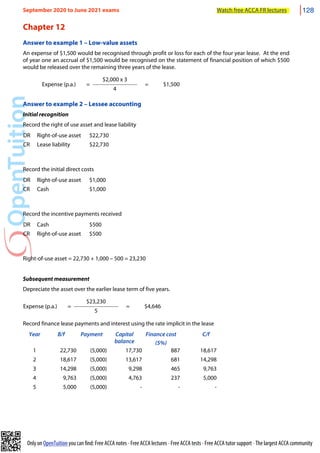
Example 1 – Low-value assets
Banana leases out a machine to Mango under a four year lease and Mango elects to apply the low-value
exemption. The terms of the lease are that the annual lease rentals are $2,000 payable in arrears. As an
incentive, Banana grants Mango a rent-free period in the first year.
Explain how Mango would account for the lease in the financial statements.
September 2020 to June 2021 exams Watch free ACCA FR lectures 49
Only on OpenTuition you can find: Free ACCA notes • Free ACCA lectures • Free ACCA tests • Free ACCA tutor support • The largest ACCA community
1. Lessee accounting
1.1. Initial recognition
At the start of the lease the lessee initially recognises a right-of-use asset and a lease liability. [IFRS 16:22]
Right of use asset Lease liability
Measured at the amount of the lease liability plus
any initial direct costs incurred by the lessee.
Measured at the present value of the lease payments
payable over the lease term, discounted at the rate
implicit in the lease
๏ Lease liability
๏ Initial direct costs
๏ Estimated costs for dismantling
๏ Payments less incentives before
commencement date
๏ Fixed payments less incentives
๏ Variable payments (e.g. CPI/rate)
๏ Expected residual value guarantee
๏ Penalty for terminating (if reasonably certain)
๏ Exercise price of purchase option (if
reasonably certain)
Note: if the rate implicit in the lease cannot be
determined the lessee shall use their incremental
borrowing rate
1.2. Subsequent measurement
Right of use asset Lease liability
Cost less accumulated depreciation Financial liability at amortised cost
Note: Depreciation is based on the earlier of the
useful life and lease term, unless ownership
transfers, in which case use the useful life.
Example 2 – Lessee accounting
On 1 January 2015, Plum entered into a five year lease of machinery. The machinery has a useful life of six
years. The annual lease payments are $5,000 per annum, with the first payment made on 1 January 2015. To
obtain the lease Plum incurs initial direct costs of $1,000 in relation to the arrangement of the lease but the
lessor agrees to reimburse Pear $500 towards the costs of the lease.
The rate implicit in the lease is 5%. The present value of the minimum lease payments is $22,730.
Demonstrate how the lease will be accounted in the financial statements over the five year period.
September 2020 to June 2021 exams Watch free ACCA FR lectures 50
Only on OpenTuition you can find: Free ACCA notes • Free ACCA lectures • Free ACCA tests • Free ACCA tutor support • The largest ACCA community
2. Sale and leaseback
A sale and leaseback transaction occurs when one entity (seller) transfers an asset to another entity (buyer)
who then leases the asset back to the original seller (lessee).
The companies are required to account for the transfer contract and the lease applying IFRS 16, however
consideration is first given to whether the initial sale of the transferred asset is a performance obligation
under IFRS 15.
If the transfer of the asset is not a sale then the following rules apply:
Seller-Lessee Buyer-Lessor
๏ Continue to recognise the asset ๏ Do not recognise the asset
๏ Recognise a financial liability (= proceeds) ๏ Recognise a financial asset (= proceeds)
If the transfer of the asset is a sale then the following rules apply:
Seller-Lessee Buyer-Lessor
๏ Derecognise the asset
๏ Recognise the sale at fair value
๏ Recognise purchase of the asset
๏ Recognise lease liability (PV of lease rentals) ๏ Apply lessor accounting
๏ Recognise a right-of-use asset, as a proportion
of the previous carrying value of underlying
asset
๏ Gain/loss on rights transferred to the buyer
Example 3 – Sale and leaseback (1)
Apple required funds to finance a new ambitious rebranding exercise. It’s only possible way of raising
finance is through the sale and leaseback of its head office building for a period of 10 years. The lease
payments of $1 million are to be made at the end of the lease period
The current fair value of the building is $10 million and the carrying value is $8.4 million. The interest rate
implicit in the lease is 5%.
Advise Apple on how to account for the sale and leaseback in its financial statements if the office
building were to be sold at the fair value of $10 million and:
(a) Performance obligations are not satisfied; or,
(b) Performance obligations are satisfied.
Note: If the proceeds are less than the fair value of the asset or the lease payments are less than market
rental the following adjustments to sales proceeds apply:
๏ Any below-market terms should be accounted for as a prepayment of the lease payments; and,
๏ Any above-market terms should be accounted for as additional financing provided to the lessee.
September 2020 to June 2021 exams Watch free ACCA FR lectures 51
Only on OpenTuition you can find: Free ACCA notes • Free ACCA lectures • Free ACCA tests • Free ACCA tutor support • The largest ACCA community
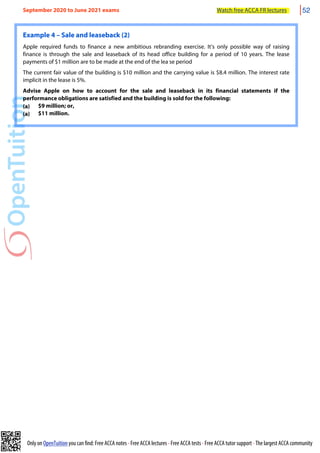
Example 4 – Sale and leaseback (2)
Apple required funds to finance a new ambitious rebranding exercise. It’s only possible way of raising
finance is through the sale and leaseback of its head office building for a period of 10 years. The lease
payments of $1 million are to be made at the end of the lea se period
The current fair value of the building is $10 million and the carrying value is $8.4 million. The interest rate
implicit in the lease is 5%.
Advise Apple on how to account for the sale and leaseback in its financial statements if the
performance obligations are satisfied and the building is sold for the following:
(a) $9 million; or,
(a) $11 million.
September 2020 to June 2021 exams Watch free ACCA FR lectures 52
Only on OpenTuition you can find: Free ACCA notes • Free ACCA lectures • Free ACCA tests • Free ACCA tutor support • The largest ACCA community
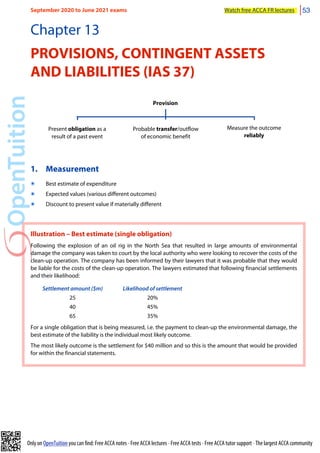
Chapter 13
PROVISIONS, CONTINGENT ASSETS
AND LIABILITIES (IAS 37)
Provision
Present obligation as a
result of a past event
Measure the outcome
reliably
Probable transfer/outflow
of economic benefit
1. Measurement
๏ Best estimate of expenditure
๏ Expected values (various different outcomes)
๏ Discount to present value if materially different
Illustration – Best estimate (single obligation)
Following the explosion of an oil rig in the North Sea that resulted in large amounts of environmental
damage the company was taken to court by the local authority who were looking to recover the costs of the
clean-up operation. The company has been informed by their lawyers that it was probable that they would
be liable for the costs of the clean-up operation. The lawyers estimated that following financial settlements
and their likelihood:
Settlement amount ($m) Likelihood of settlement
25 20%
40 45%
65 35%
For a single obligation that is being measured, i.e. the payment to clean-up the environmental damage, the
best estimate of the liability is the individual most likely outcome.
The most likely outcome is the settlement for $40 million and so this is the amount that would be provided
for within the financial statements.
September 2020 to June 2021 exams Watch free ACCA FR lectures 53
Only on OpenTuition you can find: Free ACCA notes • Free ACCA lectures • Free ACCA tests • Free ACCA tutor support • The largest ACCA community
Illustration – Best estimate (large population)
A company sells second hand cars with a six-month warranty that promises to repair the cars if any faults
occur following the sale. The company has estimated that 80% of the cars sold in the last six-months will
require no repairs, however 15% will require minor repairs and the remaining 5% will require major repairs.
The company has estimated that if all the cars were to have minor repairs then this would cost $100,000 and
if all the cars were to have major repairs then this would cost $500,000.
For a large population of items, the best estimate of the provision is based on an expected value of the
possible outcomes. The expected value of the repair costs is $40,000 [(80% x $nil) + (15% x $100,000) + (5%
x $500,000)] and so this is the amount that would be provided for within the financial statements.
Example 1 – Discounting and provisions
HR Co has a year end of 31 December 2018, and it was notified that on the 1 July 2018 a former employee
brought about a legal claim for unfair dismissal. HR Co’s legal team have said that it is probable that that HR
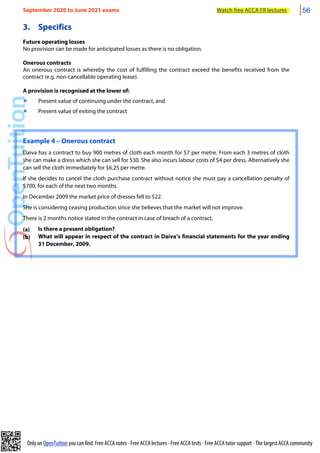
Co would lose the case, resulting in a payment of $495,000 on 30 June 2019.
HR Co has a cost of capital of 10% per annum. A one year discount factor at 10% is 0.9091.
Calculate the amounts to be recognised in the financial statements of HR Co for the year ended 31
December 2018
2. Subsequent treatment
๏ Review the provision annually
๏ Only use the provision for expense originally created
Contingent liability
Possible obligation Present obligation
๏ Possible transfer, or
๏ Cannot measure reliably
(rare)
September 2020 to June 2021 exams Watch free ACCA FR lectures 54
Only on OpenTuition you can find: Free ACCA notes • Free ACCA lectures • Free ACCA tests • Free ACCA tutor support • The largest ACCA community
Example 2 – Provisions and contingencies (1)
The following items have to be considered when finalising the financial statements of G-Star Co, a limited
liability company:
The company gives warranties on its products. The company’s statistics show that about 5% of sales give rise
to a warranty claim.
The company has guaranteed the overdraft of another company. The likelihood of a liability arising under
the guarantee is assessed as possible.
What is the correct action to be taken in the financial statement for these items?
Item 1 Item 2
A Create a provision Disclose by note only
B Disclose by note only No action
C Create a provision Create a provision
D Disclose by note only Disclose by note only
Example 3 – Provisions and contingencies (2)
Justina supplies fish to a local restaurant. In August 2009 she supplied the restaurant with some shell-fish,
and now she has heard that some of the restaurant’s customers have suffered attacks of food-poisoning. The
restaurant has claimed that this is because of Justina’s shell-fish, and has commenced a legal action against
her.
Algirdas, a local solicitor who specialises in food-poisoning cases, has advised Justina that she has a 42%
chance of losing the case, and that, if she does lose, she will probably have to pay $300,000 to settle the
liability.
What is the nature of Justina’s liability, if any, and how should it be treated in her financial statements
for the year ended 31 August, 2009?
September 2020 to June 2021 exams Watch free ACCA FR lectures 55
Only on OpenTuition you can find: Free ACCA notes • Free ACCA lectures • Free ACCA tests • Free ACCA tutor support • The largest ACCA community
3. Specifics
Future operating losses
No provision can be made for anticipated losses as there is no obligation.
Onerous contracts
An onerous contract is whereby the cost of fulfilling the contract exceed the benefits received from the
contract (e.g. non-cancellable operating lease).
A provision is recognised at the lower of:
๏ Present value of continuing under the contract, and
๏ Present value of exiting the contract
Example 4 – Onerous contract
Daiva has a contract to buy 900 metres of cloth each month for $7 per metre. From each 3 metres of cloth
she can make a dress which she can sell for $30. She also incurs labour costs of $4 per dress. Alternatively she
can sell the cloth immediately for $6.25 per metre.
If she decides to cancel the cloth purchase contract without notice she must pay a cancellation penalty of
$700, for each of the next two months.
In December 2009 the market price of dresses fell to $22.
She is considering ceasing production since she believes that the market will not improve.
There is 2 months notice stated in the contract in case of breach of a contract.
(a) Is there a present obligation?
(b) What will appear in respect of the contract in Daiva’s financial statements for the year ending
31 December, 2009.
September 2020 to June 2021 exams Watch free ACCA FR lectures 56
Only on OpenTuition you can find: Free ACCA notes • Free ACCA lectures • Free ACCA tests • Free ACCA tutor support • The largest ACCA community
Restructuring
๏ Sale or closure of a line of business
๏ Ceasing activities in a geographical location
๏ Relocating activities
๏ Re-organisation (management or focus of operations)
A provision is recognised if there is a detailed formal plan and the plan has been announced.
The provision only includes costs which are necessarily to be incurred and not associated with continuing
activities.
Example 5 – Restructuring
On 18 August 2017 the directors of Paulius decided to close the Kaunas Factory.
(a) Assuming that no steps were taken to implement the decision and the decision was not
communicated to any of those affected by the Statement of Financial Position date of 31
August, 2017 what is the appropriate accounting treatment?
(b) What would be the appropriate accounting treatment for the closure if a detailed plan had been
agreed by the board on 26 August 2017, and letters sent to notify suppliers? The workforce in
Kaunas has been sent redundancy notices.
Contingent asset
Remote/Possible Virtually certain
Recognise an asset
Probable
Disclose
Ignore
Illustration – Contingent asset
A business has a reporting date of 31 December and inventory worth $100,000 was stolen just prior to the
reporting date. The business has made a claim on its insurance and has heard from the insurers who have
said that it is probable that the full amount will be reimbursed, but no further confirmation of when any
payment will be made has been received.
The business will disclose a contingent asset within the notes to the accounts as it is probable that the
$100,000 will be received, however an asset cannot be recognised as it is not yet virtually certain as the final
confirmation has not been received of when the payment will be received.
September 2020 to June 2021 exams Watch free ACCA FR lectures 57
Only on OpenTuition you can find: Free ACCA notes • Free ACCA lectures • Free ACCA tests • Free ACCA tutor support • The largest ACCA community
September 2020 to June 2021 exams Watch free ACCA FR lectures 58
Only on OpenTuition you can find: Free ACCA notes • Free ACCA lectures • Free ACCA tests • Free ACCA tutor support • The largest ACCA community
Chapter 14
EVENTS AFTER THE REPORTING DATE
(IAS 10)
IAS 10
Adjusting
Information relating to a condition that existed at
the reporting date
๏ Settlement of outstanding court case
๏ Bankruptcy of a customer
๏ Sale of inventory at below cost
๏ Determination of purchase/sale price of PPE
Non-adjusting
Doesn’t reflect conditions that existed at the
reporting date
๏ Fall in value of investments
๏ Major purchase of assets
๏ Announcing a discontinued operation
๏ Announcing a restructuring
Example 1 – Events after the reporting period
Which of the following material events after the reporting date and before the financial statements
are approved are adjusting events?
1. A valuation of property providing evidence of impairment in value at the reporting date.
2. Sale of inventory held at the reporting date for less than cost.
3. Discovery of fraud or error affecting the financial statements.
4. The insolvency of a customer with a debt owing at the reporting date which is still outstanding.
A 1, 2 and 4 only
B 1, 2, 3 and 4
C 1 and 4 only
D 2 and 3 only
September 2020 to June 2021 exams Watch free ACCA FR lectures 59
Only on OpenTuition you can find: Free ACCA notes • Free ACCA lectures • Free ACCA tests • Free ACCA tutor support • The largest ACCA community
Example 2– Events after the reporting period
The following events took place between the 31 December 2017 reporting date and the date the financial
statements were authorised for issue.
• The company makes an issue of 100,000 shares which raises $200,000 shortly after the Statement of
Financial Position date.
• A legal action had been brought against the company for breach of contract prior to the year end. The
outcome was decided shortly after the Statement of Financial Position date, and as a result the company
will have to pay costs and damages totalling $80,000. No provision has currently been made for this
event.
• Inventory included in the accounts at the year end at cost $25,000 was subsequently sold for $15,000.
• A building in use at the Statement of Financial Position date and valued at $500,000 was completely
destroyed by fire. Unfortunately, only half of the value was covered by insurance
Which of the above events are adjusting events in the financial statements.
September 2020 to June 2021 exams Watch free ACCA FR lectures 60
Only on OpenTuition you can find: Free ACCA notes • Free ACCA lectures • Free ACCA tests • Free ACCA tutor support • The largest ACCA community
Chapter 15
INCOME TAXES (IAS 12)
1. Current tax
Current tax is the amount of income taxes payable (recoverable) in respect of the taxable profit (tax loss) for
a period.
2. Recognition
Current tax should be recognised based on the year-end estimate of the tax payable. The income tax
expense though profit or loss is adjusted for any under/over provision from the prior year.
Example 1 – Current tax
The following trail balance (extract) relates to Clarion as at 31 March 2015:
$’000 $’000
Current tax 400
The following notes are also relevant:
A provision for current tax for the year ended 31 March 2015 of $3.5 million is required.
The balance on current tax in the trial balance represents the under/over provision of the tax liability for the
year ended 31 March 2014.
Prepare extracts from the statement of profit or loss for Clarion for the year ended 31 March 2015 and
from the statement of financial position as at the same date with regards tax.
September 2020 to June 2021 exams Watch free ACCA FR lectures 61
Only on OpenTuition you can find: Free ACCA notes • Free ACCA lectures • Free ACCA tests • Free ACCA tutor support • The largest ACCA community
3. Deferred tax
Deferred tax arises because;
Accounting profit (PFY) ≠ Taxable profit (PCTCT)
The reasons for this can be split into two categories:
๏ Permanent differences
Items that would have been used in calculating accounting profit but would NOT be used in
calculating taxable profit e.g. some entertaining expenses
๏ Temporary differences
Items that would have been used in calculating accounting profit and taxable profit but in
different accounting periods e.g. depreciation/tax allowances.
IAS 12 considers only temporary differences and it arises on temporary differences between the
carrying value of an asset or liability and its tax base.
Example 2 – Tracy (ignoring deferred tax)
Tracy purchased an item of property, plant and equipment on 1 January 20X5 for $5 million. It was
estimated that it had a useful economic life of 5 years but according to the tax authority had a 50% tax
allowance in its first year and 20% reducing balance there after.
Tracy made an accounting profit of $2m for the year, which is expected to continue unchanged for the next
two years.
Income tax rate 20%
Ignoring deferred tax calculate the profits after tax for Tracy for each of the three years ending 31
December 20X5 to 20X7.
September 2020 to June 2021 exams Watch free ACCA FR lectures 62
Only on OpenTuition you can find: Free ACCA notes • Free ACCA lectures • Free ACCA tests • Free ACCA tutor support • The largest ACCA community
4. Calculating deferred tax
1. Calculate the the temporary difference, as being the difference between the carrying vale of the
asset or liability and its tax base.
$’000s
Carrying value X
Tax base X
Temporary difference X
2. Calculate the deferred tax position by multiplying the temporary difference by the income tax
rate at which the asset or liability will be settled at.
X% x temporary difference = closing deferred tax provision
3. The closing deferred tax position is either a deferred tax asset or a liability.
A deferred tax liability arises if:
Carrying value > Tax base – taxable temporary difference
A deferred tax asset arises if:
Carrying value < Tax base – tax deductible temporary difference
4. The movement in the deferred tax position goes through profit or loss.
$’000s
Closing position X
Opening position X
Movement X/(X)
Increase in deferred tax
Dr Income tax expense (SPL)
Cr Deferred tax provision
Decrease in deferred tax
Dr Deferred tax
Cr Income tax expense (SPL)
Example 3 – Tracy (incl. deferred tax)
Tracy purchased an item of property, plant and equipment on 1 January 20X5 for $5 million. It was
estimated that it had a useful economic life of 5 years but according to the tax authority had a 50% tax
allowance in its first year and 20% reducing balance there after.
Tracy made an accounting profit of $2m for the year, which is expected to continue unchanged for the next
two years.
Income tax rate 20%
Calculate the profits after tax for Tracy for each of the three years ending 31 December 20X5 to 20X7.
September 2020 to June 2021 exams Watch free ACCA FR lectures 63
Only on OpenTuition you can find: Free ACCA notes • Free ACCA lectures • Free ACCA tests • Free ACCA tutor support • The largest ACCA community
20X5 20X6 20X7
$’000s $’000s $’000s
Carrying value
Tax base
Temporary difference
Closing deferred tax
Opening deferred tax
Movement
Statement of profit or loss (extracts)
20X5 20X6 20X7
$’000s $’000s $’000s
Profit before tax
Income tax expense
Current tax
Deferred tax movement
Profit for the year
Statements of financial position (extracts)
20X5 20X6 20X7
$’000s $’000s $’000s
Non-current liabilities
Deferred tax
Current liabilities
Tax payable
September 2020 to June 2021 exams Watch free ACCA FR lectures 64
Only on OpenTuition you can find: Free ACCA notes • Free ACCA lectures • Free ACCA tests • Free ACCA tutor support • The largest ACCA community
Example 4 – Accelerated capital allowances
Osborne buys an asset for $150,000 at the start of the financial year.
The asset has an estimated life of 6 years and an estimated residual value of $30,000.
Capital allowances are available at a rate of 25% reducing balance and the tax rate is 20%.
Calculate the deferred tax asset/liability to appear in the statement of financial position for the next
three years and the debit/credit charged to the tax expense in the statement of profit or loss for the
same period.
Example 5 – Revaluations
Clarke bought a property for $500,000 on 1 January 2013.
On 31 December 2015 the property had a carrying value of $470,000 and was revalued to $800,000.
The tax written down value at 31 December 2015 was $420,000 and the tax rate is 20%.
Explain how the revaluation, including any deferred tax impact, should be dealt with in Clarke’s
financial statements for the year-ended 31 December 2015.
Losses
If an entity has unused tax losses to carry forward, a deferred tax asset should be recognised to the extent
that it is possible that future taxable profits will be available against which the losses will be offset.
September 2020 to June 2021 exams Watch free ACCA FR lectures 65
Only on OpenTuition you can find: Free ACCA notes • Free ACCA lectures • Free ACCA tests • Free ACCA tutor support • The largest ACCA community
September 2020 to June 2021 exams Watch free ACCA FR lectures 66
Only on OpenTuition you can find: Free ACCA notes • Free ACCA lectures • Free ACCA tests • Free ACCA tutor support • The largest ACCA community
Chapter 16
REVENUE FROM CONTRACTS WITH
CUSTOMERS (IFRS 15)
IFRS 15 has replaced the previous IFRS on revenue recognition, IAS 18 Revenue and IAS 11 Construction
Contracts. It uses a principles-based 5-step approach to apply to contact with customers.
The five steps are as follows:
1. Identification of contracts
2. Identification of performance obligations (goods, services or a bundle of goods and services)
3. Determination of transaction price
4. Allocation of the price to performance obligations
5. Recognition of revenue when/as performance obligations are satisfied
1. Identification of contracts
The contract does not have to be a written one, it can be verbal or implied. In order for IFRS 15 to apply the
following must all be met:
๏ The contract is approved by all parties
๏ The rights and payment terms can be identified
๏ The contract has commercial substance
๏ It is probable that revenue will be collected
2. Identification of performance obligations
If the goods or services that have agreed to be exchanged under the contract are distinct (i.e. could be sold
alone) then they should be accounted for separately.
If a series of goods or services are substantially the same they are treated as a single performance obligation.
Illustration – Performance obligations
LiverTech is a computer business that primarily sells computer hardware. As well as selling computers, it
also supplies and installs the software to its customers and provides a technical support package over a
number of years. The business commonly sells the supply and installation, and technical support in a
combined goods and services contract.
The combined goods and services contract has two separate performance obligations, which would need to
be separated out and recognised separately.
The installation of software would be recognised once complete and the provision of technical services over
the period of the support service.
September 2020 to June 2021 exams Watch free ACCA FR lectures 67
Only on OpenTuition you can find: Free ACCA notes • Free ACCA lectures • Free ACCA tests • Free ACCA tutor support • The largest ACCA community
3. Determination of transaction price
The amount the selling party expects to receive is the transaction price. This should consider the following:
๏ Significant financing components
๏ Variable consideration
๏ Refunds ad rebates (paid to the customer!)
Example 1 – Transaction price
Luckers Co. sells a car to a customer for $10,000, offering interest-free credit for a three-year period. The car
is delivered to the customer immediately. The annual market rate of interest on the provision of consumer
credit to similar customers is 5%.
What is the transaction price?
4. Allocation of the price
The price is allocated proportionately to the separate performance obligations based upon the stand-alone
selling price.
Example 2 – Allocation of price
Richer Co. sells home entertainment systems including a two-year repair and maintenance package for
$10,000. The price of a home entertainment system without the repair and maintenance contract is $9,000
and the price to renew a two-year maintenance package is $2,000.
How is the $10,000 contract price allocated to the separate performance obligations?
Note: Ignore any discounting and time value of money.
September 2020 to June 2021 exams Watch free ACCA FR lectures 68
Only on OpenTuition you can find: Free ACCA notes • Free ACCA lectures • Free ACCA tests • Free ACCA tutor support • The largest ACCA community
5. Recognition of revenue
Once control of goods or services transfers to the customer, the performance obligation is satisfied and
revenue is recognised. This may occur at a single point in time, or over a period of time.
If a performance obligation is satisfied at a single point in time, we should consider the following in
assessing the transfer of control:
๏ Present right to payment for the asset
๏ Transferred legal title to the asset
๏ Transferred physical possession of the asset
๏ Transferred the risks and rewards of ownership to the customer
๏ Customer has accepted the asset.
Example 3 – IFRS 15 (1)
Telephonica sells mobile phones, selling them for “free” when a customer signs up for a 12 month contract.
The contract costs the customer $45 per month.
Explain how the revenue should be recognised in Telephonica’s financial statements
Note: Vodaphone sells mobile phones without a monthly contract, selling the handset for $480. Call and
data charges are $20 per month. Ignore discounting and the time value of money
Example 4 – IFRS 15 (2)
LiverTech is a computer business that primarily sells computer hardware. As well as selling computers, it
also supplies and installs the software to its customers and provides a technical support package over two
years. The business commonly sells the supply and installation, and technical support in a combined goods
and services contract.
The combined goods and services contract sells for $1,600, but if sold separately the supply and installation
is sold for $1,500 and the technical support for $500.
If LiverTech sold a combined contract on 1 July 20X7, demonstrate how the transaction would be
presented in the financial statements for the year ended 31 December 20X7.
If a performance obligation is transferred over time, the completion of the performance obligation is
measured using either of the following methods:
๏ Output method – revenue is recognised based upon the value to the customer, i.e. work certified.
Output method =
Work certified to date
Output method =
Total contract revenue
๏ Input method – revenue is recognised based upon the amounts the entity has used, i.e. costs incurred
or labour hours.
Input method (cost based) =
Costs to date
Input method (cost based) =
Total estimated costs
September 2020 to June 2021 exams Watch free ACCA FR lectures 69
Only on OpenTuition you can find: Free ACCA notes • Free ACCA lectures • Free ACCA tests • Free ACCA tutor support • The largest ACCA community
Example 5 – Performance obligations over time and the statement of profit or loss (1)
Alex commenced a three year building contract during the year-ended 31 December 20X4 and continued
the contract during 20X5. The details of the contract are as follows:
$m
Total contract value 45
Costs incurred to date @ 20X5 20
Estimated costs to completion 12
Work certified as completed in 20X5 15
Stage of completion @ 20X5 70%
Profit recognised to date @ 20X4 3.3
Show how this contract would be dealt with in the statement of profit or loss for the year ended 31
December 20X5.
Where not profit can be calculated if contracts spanning more than one accounting period, i.e. it is
loss making, then the revenue is limited to the recoverable costs.
Example 6 – Performance obligations over time and the statement of profit or loss (2)
Evelyn commenced a building contract in 20X5 that has seen large increases in future costs to complete.
The contract will still be completed on schedule in 20X6. The details from the year ended 31 December 20X5
are as follows:
$m
Total contract value 40
Costs incurred to date 25
Estimated costs to completion 20
Stage of completion 45%
Show how this contract would be accounted for in the statement of profit or loss for the year ended
31 December 20X5.
September 2020 to June 2021 exams Watch free ACCA FR lectures 70
Only on OpenTuition you can find: Free ACCA notes • Free ACCA lectures • Free ACCA tests • Free ACCA tutor support • The largest ACCA community
As contracts that span more than one accounting period progress, the company is creating an asset for the
customer that needs to be recognised in the statement of financial position. The amount to be recognised is
as follows:
$
Costs incurred to date X
Recognised profits X
Recognised losses (X)
Receivables (amounts invoiced) (X)
Contract asset/(liability) X/(X)
Example 7 – Performance obligations over time and the statement of financial
position
Noah has a three year contract which commenced on 1 January 20X5. At 31 December 20X5 Noah extracted
the following balances from its ledger relating to the contract:
$000 $000
Total contract value 140,000
Cost incurred up to 31 December 20X5:
Attributable to work completed 52,000
Inventory purchased for use in future years 8,000 60,000
Progress billing to date 45,000
Cash received 26,500
Other information:
Expected further costs to completion 48,000
At 31 December 20X5, the contract was certified as 40% complete.
Prepare extracts from the statement of profit or loss and statement of financial position for the year-
ended 31 December 20X5.
September 2020 to June 2021 exams Watch free ACCA FR lectures 71
Only on OpenTuition you can find: Free ACCA notes • Free ACCA lectures • Free ACCA tests • Free ACCA tutor support • The largest ACCA community
6. Specifics
Principal vs agent - When a third party is involved in providing goods or services to a customer, the seller is
required to determine whether the nature of its promise is a performance obligation to:
๏ Provide the specified goods or services itself (principal) or
๏ Arrange for a third party to provide those goods or services (agent)
Repurchase agreements - When a vendor sells an asset to a customer and is either required, or has an
option, to repurchase the asset. The legal form here is always a sale followed by a purchase at a later date.
The economic substance is more likely to be a loan secured against an asset that is never actually being sold.
Bill and hold arrangements - an entity bills a customer for a product but the entity retains physical
possession of the product until it is transferred to the customer at a point in time in the future
Consignments – arises where a vendor delivers a product to another party, such as a dealer or retailer, for
sale to end customers. The inventory is recognised in the books of the entity that bears the significant risk
and reward of ownership (e.g. risk of damage, obsolescence, lack of demand for vehicles, no opportunity to
return them, the showroom-owner must buy within a specified time if not sold to public)
September 2020 to June 2021 exams Watch free ACCA FR lectures 72
Only on OpenTuition you can find: Free ACCA notes • Free ACCA lectures • Free ACCA tests • Free ACCA tutor support • The largest ACCA community
Chapter 17
FOREIGN CURRENCY (IAS 21)
1. Functional currency
If an entity has transactions that are denominated in a currency other than its functional currency then the
amount will need to be translated into the functional currency before it is recorded within the general
ledger.
The functional currency is the currency of the primary economic environment in which the entity operates.
This is deemed to be where the entity generates and expends cash.
Management should consider the following factors in determining the functional currency:
๏ The currency that dominates the determination of the sales prices
๏ The currency that most influences operating costs
๏ The currency in which an entity’s finances are denominated is also considered.
2. Recognition and measurement
Record the transaction at the exchange rate in place on the date the transaction occurs (historic rate – HR).
Monetary assets and liabilities are retranslated using the closing rate (CR) at the reporting date, with any
gains or losses going through profit or loss.
Non-monetary assets and liabilities are not retranslated at the reporting date, unless carried at fair value,
whereby translate at the rate when fair value was established.
Note: No specific guidance is given as to where any exchange differences are recorded within profit or loss.
The general accepted practice is:
๏ Trading transaction – operating costs
๏ Financing transaction – financing costs
Example 1 – Functional currency (1)
Jones Inc. has its functional currency as the $USD.
It trades with several suppliers overseas and bought goods costing 400,000 Dinar on 1 December 2017.
Jones paid for the goods on 10 January 2018. Flower’s year-end is 31 December.
The exchange rates were as follows:
1 December 2017 4.1 Dinar : $1USD
31 December 2017 4.3 Dinar : $1USD
10 January 2018 4.4 Dinar : $1USD
Show how the transaction would be recorded in Jones’s financial statements.
September 2020 to June 2021 exams Watch free ACCA FR lectures 73
Only on OpenTuition you can find: Free ACCA notes • Free ACCA lectures • Free ACCA tests • Free ACCA tutor support • The largest ACCA community
September 2020 to June 2021 exams Watch free ACCA FR lectures 74
Only on OpenTuition you can find: Free ACCA notes • Free ACCA lectures • Free ACCA tests • Free ACCA tutor support • The largest ACCA community
Chapter 18
FAIR VALUE (IFRS 13)
IASB has adopted a fair value method to measure assets and liabilities in its IFRS accounting standards
because the historic cost convention was not consistent with the underlying qualitative characteristic of
relevance.
The issue was the there was no definition of what fair value actually was, until IFRS 13 was created.
Fair value – The price that would be received to sell an asset or paid to transfer a liability in an orderly
transaction between market participants at the measurement date.
IFRS 13 adopts a hierarchical approach to measuring fair value, whilst giving consideration to the principal
market, being the largest market in which an asset/liability is traded. It also considers the highest and best
use of an asset.
Level 1 inputs
Level 1 inputs are quoted prices in active markets (frequency and volume) for identical assets or liabilities
that the entity can access at the measurement date.
A quoted market price in an active market provides the most reliable evidence of fair value and is used
without adjustment to measure fair value whenever available, with limited exceptions.
Level 2 inputs
Level 2 inputs are inputs other than quoted market prices included within Level 1 that are observable for the
asset or liability, either directly or indirectly.
Level 2 inputs include:
quoted prices for similar assets or liabilities in active markets
quoted prices for identical or similar assets or liabilities in markets that are not active
inputs other than quoted prices that are observable for the asset or liability, for example interest rates and
yield curves observable at commonly quoted intervals
Level 3 inputs
Level 3 inputs are unobservable inputs for the asset or liability and covers the scenarios whereby there is
little, if any, market activity.
An entity develops unobservable inputs using the best information available in the circumstances, which
might include the entity's own data, taking into account all information about market participant
assumptions that is reasonably available.
September 2020 to June 2021 exams Watch free ACCA FR lectures 75
Only on OpenTuition you can find: Free ACCA notes • Free ACCA lectures • Free ACCA tests • Free ACCA tutor support • The largest ACCA community
September 2020 to June 2021 exams Watch free ACCA FR lectures 76
Only on OpenTuition you can find: Free ACCA notes • Free ACCA lectures • Free ACCA tests • Free ACCA tutor support • The largest ACCA community
Chapter 19
EARNINGS PER SHARE (IAS 33)
1. Basic Earnings per Share
Basic EPS =
Profit attributable to ordinary shareholders of the parent
Basic EPS =
Weighted average number of shares
If the number of shares has changed during the period the following assumptions are made regarding the
weighted average number of shares:
Full price issue Normal weighted average calculation
Bonus issues Assume that the bonus shares have always been in issue (and therefore alter the
comparative EPS amount)
Rights issue Assume that the shares issued are a mix of bonus and full price shares. For the
bonus element assume that they have always been in issue and therefore adjust
the comparative
If bonus issues or rights issues occur after the reporting date, but before the date of approval of the accounts
the EPS should be calculated based on the number of shares following the issue.
Example 1 – Basic EPS
Ruth makes up its accounts to 30 June each year. On 1 July 20X5 Ruth has 500 million ordinary shares in
issue.
Profits for the year to 30 June 20X6 were $250m. There were no preference shares in issue.
Calculate the basic earnings per share assuming:
(a) Share capital has not changed during the year
(b) An issue of 50 million new shares at full market price on 1 August 20X5.
(c) A 1 for 4 bonus issue occurring on 1 November 20X5.
(d) A 1 for 5 rights issue on 1 February 20X6 held at $1.25. The price of a share immediately before
the rights issue was $1.40.
Example 2 – Multiple share issues and prior year comparatives
Ernie had earnings of $750,000 for the year-ended 31 March 2019. There were 2,000,000 $1 equity shares in
issue on 1 April 2018, and a new issue of 3,000,000 shares at full market price was carried out on 30
September 2018. A bonus issue of one new share for every two shares held was issued on 1 December 2018.
The EPS figure reported for the year-ended 31 March 2018 was 15.5c.
Calculate the basic EPS for Ernie for the year-ended 31 March 2019, and restate the comparative
figure for 31 March 2018.
September 2020 to June 2021 exams Watch free ACCA FR lectures 77
Only on OpenTuition you can find: Free ACCA notes • Free ACCA lectures • Free ACCA tests • Free ACCA tutor support • The largest ACCA community
2. Diluted earnings per share
This is calculated where potential ordinary shares have been outstanding during the period which would
cause EPS to fall if exercised (dilutive instruments).
The earnings should be adjusted by adding back any costs that will not be incurred once the dilutive
instruments have been exercised. This will include for post-tax interest saved on convertible debt.
The number of shares will be adjusted to take account of the exercise of the dilutive instrument. This means
that adjustment is made:
For convertible instruments By adding the maximum number of shares to be issued in the future
For options By adding the number of effectively “free” shares to be issued when
the options are exercised
Example 3 – Diluted EPS
Flanagan makes up his accounts to 31 December each year and has calculated the basic EPS based on actual
shares of 1,000 million and earnings of $500m, for the year ended 31 Dec 20X5.
Convertible debentures
On 31 December 20X6 Flanagan had in issue of $10m of 5% convertible loan stock.
The loan stock is convertible at the following dates with the following terms:
31 Dec 20X6 125 shares for every $100 of loan stock
31 Dec 20X7 120 shares for every $100 of loan stock
The tax rate is 20%
Share options
Flanagan also granted 100m options at the same date. The option price is $2.50 but the average fair value of
a share is $4.00.
Calculate the fully diluted EPS for the year to 31 December 20X5.
September 2020 to June 2021 exams Watch free ACCA FR lectures 78
Only on OpenTuition you can find: Free ACCA notes • Free ACCA lectures • Free ACCA tests • Free ACCA tutor support • The largest ACCA community
ANALYSIS AND INTERPRETATION
Chapter 20
FINANCIAL PERFORMANCE
(PROFITABILITY)
Gross profit margin
Gross margin (%)
Gross profit
x 100%
Gross margin (%)
Revenue
x 100%
An increase in gross profit margin indicates that variable costs, raw materials, labour, power etc are not
rising as quickly as selling prices, whilst a decrease will indicate the opposite.
Changes in the gross profit margin over time should be analysed further to identify the cause: has the
company introduced new products? Is it cutting prices to increase market share? Was it unable to pass on
inflationary price increases?
Operating profit margin
Operating profit margin (%)
PBIT
x 100%
Operating profit margin (%)
Revenue
x 100%
This will differ from the gross profit margin in that selling, general and administrative expenses and
depreciation are deducted. An analysis of the causes of changes in this percentage might reveal that the
company's other costs are increasing/decreasing at a greater rate than sales.
Return on capital employed
Return on capital employed (%)
PBIT
x 100%
Return on capital employed (%)
Net debt + equity
x 100%
This measures the level of returns a business has made using the capital it has within it. It allows for
comparison of overall performance year on year as well as allowing comparison to an entity in a similar
industry of different size.
Net asset turnover
Asset turnover (# times)
Revenue
Asset turnover (# times)
Capital employed*
* Capital employed = shareholders’ funds + interest bearing debt.
September 2020 to June 2021 exams Watch free ACCA FR lectures 79
Only on OpenTuition you can find: Free ACCA notes • Free ACCA lectures • Free ACCA tests • Free ACCA tutor support • The largest ACCA community
Non-current asset turnover
Revenue
Non-current assets
This is the overall measure of the efficiency of a company in generating sales from its investment in non-
current assets. The minimum investment in assets to generate the maximum revenue is an indication of
efficiency. However, it may in fact deteriorate in the short term if a company is replacing heavily depreciated
assets with new equipment.
Some factors to consider:
๏ Timing of Sales
๏ Asset efficiency vs profitability
๏ Asset valuation policies
Example 1 – ROCE
The following extracts are from Hassan’s financial statements:
$
Profit before interest and tax 10,200
Interest (1,600)
Tax (3,300)
Profit after tax 5,300
Share capital 20,000
Reserves 15,600
35,600
Loan liability 6,900
42,500
What is Hassan’s return on capital employed?
A 15%
B 29%
C 24%
D 12%
September 2020 to June 2021 exams Watch free ACCA FR lectures 80
Only on OpenTuition you can find: Free ACCA notes • Free ACCA lectures • Free ACCA tests • Free ACCA tutor support • The largest ACCA community
Example 2 – Financial performance
Archer Co is a retailer and trades through its stores on the high street, selling high quality goods. The
company has recently been suffering from rising costs, that it has been unable to pass on to its customers.
In response to the number of people shopping via the Internet, Archer Co has implemented a cost cutting
strategy in the prior year, and in the current year asked shareholders for funds to help reduce it debt burden.
The following financial information for the current year is available:
Statement of profit and loss for the year ended 31 March 2019
2019
$’000s
2018
$’000s
Revenue 42,000 45,000
Cost of sales (19,000) (17,000)
Gross profit 23,000 28,000
Operating expenses (10,000) (17,000)
Operating profit 13,000 11,000
Finance costs (700) (1,000)
Profit before tax 12,600 10,000
Income tax expense (3,150) (2,500)
Profit for the year 9,450 7,500
(a) Calculate the following ratios for the years ending 31 May 2019 and 31 May 2018:
Gross margin
Operating margin
(b) Using the information provided and the ratios calculated above, comment on the comparative
performance for the two years ended 31 May 2019 and 2018.
September 2020 to June 2021 exams Watch free ACCA FR lectures 81
Only on OpenTuition you can find: Free ACCA notes • Free ACCA lectures • Free ACCA tests • Free ACCA tutor support • The largest ACCA community
September 2020 to June 2021 exams Watch free ACCA FR lectures 82
Only on OpenTuition you can find: Free ACCA notes • Free ACCA lectures • Free ACCA tests • Free ACCA tutor support • The largest ACCA community
Chapter 21
FINANCIAL POSITION
1. Liquidity
The ability of a company to pay its obligations as and when they fall due (its liquidity) is a major concern of
any credit analysis. Short term liquidity can be assessed by comparing current assets with current liabilities
in a variety of forms:
Working Capital = Current Assets - Current Liabilities.
A working capital surplus represents a cushion of protection for current creditors; it indicates the amount by
which the value of current assets could decrease still leaving enough to repay current liabilities from the sale
of current assets.
The optimum amount of working capital varies considerably from company to company and from industry
to industry, thus the nature of the company's business and the quality of its assets must be considered.
Companies functioning within industry sectors with short production/sales cycles (e.g. supermarkets) can
generally function satisfactorily with a much smaller amount of working capital than those with a long
production cycle (e.g. heavy engineering).
2. Current ratio
Current assets
Current liabilities
A current ratio of over one indicates that a company has a higher level of current assets than current
liabilities and should, therefore, be in a position to meet its short term obligations as and when they fall due.
However, some companies function adequately on current ratios of less than one whilst others need a much
higher ratio. Generally the more liquid the current assets are the higher this ratio will be.
Trends are difficult to analyse but generally higher ratios indicate greater liquidity. However, an increase
may reflect a high level of unsaleable stock or overdue receivables whereas a decrease may result from
greater efficiency.
Some factors to consider:
๏ Asset quality
๏ Seasonality
September 2020 to June 2021 exams Watch free ACCA FR lectures 83
Only on OpenTuition you can find: Free ACCA notes • Free ACCA lectures • Free ACCA tests • Free ACCA tutor support • The largest ACCA community
3. Quick ratio (acid test)
Current assets - inventory
Current liabilities
This quick ratio shows how easily a company can meet its current obligations using funds raised from quick
assets (those assets which can be converted quickly into cash).
A comparison of the quick ratio and current ratios which shows increases in both, but with the current ratio
increasing more, would indicate that the company has been building up stock.
4. Working capital
Inventory days
Inventory
x 365
Cost of sales
x 365
Shows how long a business is holding its inventory. A higher number of days inventory might indicate
holdings of obsolete or unsaleable inventory, but it might also signify a purchase of raw materials now in
anticipation of an increase in price later.
Trade receivables collection period
Trade receivables
x 365
Revenue
x 365
Providing revenue is evenly spread throughout the year the ratio will indicate how effectively debts are
being collected.
An increase in the ratio of receivables to revenue could, providing the proportion of cash sales has not
increased, indicate one of the following:-
Receivables are being given or are taking longer to pay. What are the terms of trade?
The total receivables figure includes long outstanding debts. Should provisions be made?
Trade payables payment period
Trade payables
x 365
Cost of sales
x 365
If purchases are spread evenly throughout the year, this ratio will show the length of credit the company is
taking. An increase in the ratio may indicate that more reliance is being placed upon the payables to finance
the business. A drop in days may indicate that a company is taking cash discounts or may indicate suppliers
are cutting credit terms because of the company's decreased creditworthiness.
September 2020 to June 2021 exams Watch free ACCA FR lectures 84
Only on OpenTuition you can find: Free ACCA notes • Free ACCA lectures • Free ACCA tests • Free ACCA tutor support • The largest ACCA community
5. Solvency/gearing/risk
Gearing ratio
Net debt
Equity
An increase in the gearing ratio indicates that either borrowings are increasing faster than equity, or equity
is falling more quickly than borrowings. In extreme cases, borrowings may be increasing while equity falls.
In the first case, this may be simply because the profit potential of any increased borrowing has not yet been
realised, or that the increase in profitability arising from the use or the increase in borrowings is not being
retained within the business.
Interest cover
PBIT
Interest payable
Indicates the number of times profits exceed interest expense. This may indicate severe financial difficulties
or that borrowings are too high for the company to support. Is the current year's profitability exceptional?
It is important to note that this is a ratio based on profitability not cashflow which would be a better
indicator of company’s ability to pay interest.
Example 1 – Working capital
Xena has the following working capital ratios:
20X9 20X8
Current ratio 1.2:1 1.5:1
Receivables days 75 days 50 days
Payables days 30 days 45 days
Inventory turnover 42 days 35 days
Which of the following statements is correct?
A Xena’s liquidity and working capital has improved in 20X9
B Xena is receiving cash from customers more quickly in 20X9 than in 20X8
C Xena is suffering from a worsening liquidity position in 20X9
D Xena is taking longer to pay suppliers in 20X9 than in 20X8
September 2020 to June 2021 exams Watch free ACCA FR lectures 85
Only on OpenTuition you can find: Free ACCA notes • Free ACCA lectures • Free ACCA tests • Free ACCA tutor support • The largest ACCA community
Example 2 – Financial performance and working capital
SAF has experienced a period of rapid expansion in the last 6 months following the launch of a new product
on 1 July 20X2. The following information is available from the management accounts of SAF:
6 months to
31 December
20X2
6 months to
30 June 20X2
$000 $000
Inventories at period end 1,220 460
Receivables at period end 1,715 790
Cash and cash equivalents at period end - 150
Trade payables at period end 1,190 580
Short-term borrowing at period end 250 -
Revenue for the period 3,100 2,000
Cost of sales for the period 2,420 1,450
Analyse the financial performance and working capital position of SAF, including the calculation of
five relevant ratios.
September 2020 to June 2021 exams Watch free ACCA FR lectures 86
Only on OpenTuition you can find: Free ACCA notes • Free ACCA lectures • Free ACCA tests • Free ACCA tutor support • The largest ACCA community
Chapter 22
INVESTOR ANALYSIS
Dividend Cover
Profit for the year
(# times)
Dividends
(# times)
Dividend Yield
Dividends x 100%
(%)
Share price
(%)
Price/earnings ratio
Price per share
Earnings per share
Note: EPS can also be calculated but that is dealt with in a previous chapter because it is a ratio with its own
accounting standard.
Example 1 – Investor ratios
Morgan Co is a listed company and has 50c equity share capital of $20m in issue.
The company paid a dividend per share of 10.5c in its most recent financial year and the share price at the
reporting date was $1.20. The additional financial information is also available to investors:
Statement of profit and loss
2019
$’000s
Profit before tax 28,350
Income tax expense (4,600)
Profit for the year 22,680
Calculate each of the following investor ratios for Morgan Co:
Dividend cover
Dividend yield
P/E ratio
EPS
September 2020 to June 2021 exams Watch free ACCA FR lectures 87
Only on OpenTuition you can find: Free ACCA notes • Free ACCA lectures • Free ACCA tests • Free ACCA tutor support • The largest ACCA community
September 2020 to June 2021 exams Watch free ACCA FR lectures 88
Only on OpenTuition you can find: Free ACCA notes • Free ACCA lectures • Free ACCA tests • Free ACCA tutor support • The largest ACCA community
GROUP ACCOUNTS
Single entity concept
๏ P Ltd and S Ltd – separate legal entities
๏ P Group Ltd – one single entity, prepare
accounts using substance
Control and ownership
๏ Control (power to direct activities) –
100%P + 100%S
๏ NCI - Ownership
Basic principles
A parent is an entity that has one or more subsidiaries.
A subsidiary is an entity which is controlled by another entity (known as the parent).
The key concept in determining whether or not an investment constitutes a subsidiary is that of control.
Control is the power to govern the financial and operating policies of an entity so as to obtain benefit from
its activities.
Control is usually achieved by the purchase of more than 50% of a company’s equity share capital.
IFRS 10 Consolidated Financial Statements defines control and tells us how to consolidate.
A parent/subsidiary relationship can exist even where the parent owns less than 50% of the voting power of
the subsidiary since the key to the relationship is control and the power to direct the activities. Other
situations where control exists are when the investor:
๏ Can exercise the majority of the voting rights in the investee
๏ Is in a contractual arrangement with others giving control
๏ Holds < 50% of the voting rights, but the remainder are widely distributed
๏ Holds potential voting rights which will give control
September 2020 to June 2021 exams Watch free ACCA FR lectures 89
Only on OpenTuition you can find: Free ACCA notes • Free ACCA lectures • Free ACCA tests • Free ACCA tutor support • The largest ACCA community
September 2020 to June 2021 exams Watch free ACCA FR lectures 90
Only on OpenTuition you can find: Free ACCA notes • Free ACCA lectures • Free ACCA tests • Free ACCA tutor support • The largest ACCA community
Chapter 23
CONSOLIDATED STATEMENT OF
FINANCIAL POSITION
1. Subsidiary
A subsidiary is an entity that is controlled by another entity (parent).
An entity has control over an entity when it has the power to direct the activities, which is assumed to be
when the entity has > 50% of the voting rights.
The parent company must prepare consolidated financial statement if it has control over one or more
subsidiaries.
The underlying principles of consolidation are:
๏ Substance over legal form
๏ Control and ownership
2. Basic consolidation
2.1. Basic steps
100% P + 100% S assets and liabilities, ignoring the investments in subsidiary
100% P share capital and share premium only (reporting to parent’s shareholders)
Retained earnings (balancing figure)
Example 1 – Basic consolidation
Peter acquired 100% of the equity share capital of Steven on 31 December 20X4 for $1,000,000.
The financial statements of the two companies at that date were as follows:
Peter
$000
Steven
$000
Investment in Steven Co 1,000 -
Other assets 1,500 1,200
Total assets 2,500 1,200
Equity share capital 1,000 250
Retained earnings 1,100 750
2,100 1,000
Liabilities 400 200
Total equity and liabilities 2,500 1,200
Prepare the consolidated statement of financial position for the Peter Group at 31 December 20X4.
September 2020 to June 2021 exams Watch free ACCA FR lectures 91
Only on OpenTuition you can find: Free ACCA notes • Free ACCA lectures • Free ACCA tests • Free ACCA tutor support • The largest ACCA community
Example 2 – Basic consolidation (continued)
Following Peter’s acquisition of the 100% of Steven’s equity share capital of Steven on 31 December 20X4,
both companies continued to trade. The financial statements of the two companies at the end of the
following year 31 December 20X5 were as follows:
Peter
$000
Steven
$000
Investment in Steven Co 1,000 -
Other assets 1,900 1,450
Total assets 2,900 1,450
Equity share capital 1,000 250
Retained earnings 1,400 900
2,400 1,150
Liabilities 500 300
Total equity and liabilities 2,900 1,450
Prepare the consolidated statement of financial position for the Peter Group at 31 December 20X5.
3. Non-controlling interest
Control is exerted through a shareholding of greater than 50%, so therefore it is not always necessary to fully
own a subsidiary.
Shareholdings of 75% will still give the parent the power to direct the activities of the subsidiary and
therefore it must prepare consolidated financial statements.
As the parent’s 75% holding still maintains control, the assets and liabilities of the subsidiary are
consolidated 100% on a line-by-line basis.
It is necessary to account for 25% ownership interest in the subsidiary which is referred to as the non-
controlling interest. It is shown in the equity section of the consolidated statement of financial position.
The non-controlling interest is measured using either of the following methods:
๏ Proportionate share of net assets
๏ Fair value
September 2020 to June 2021 exams Watch free ACCA FR lectures 92
Only on OpenTuition you can find: Free ACCA notes • Free ACCA lectures • Free ACCA tests • Free ACCA tutor support • The largest ACCA community
Example 3 – Non-controlling interest
Pierre acquired 80% of Stefan’s equity share capital on 31 December 20X4 when Stefan’s retained earnings
were $750,000.
The financial statements of the two companies at the end 31 December 20X5 were as follows:
Pierre
$000
Stefan
$000
Investment in Stefan Co 800 -
Other assets 1,900 1,450
Total assets 2,700 1,450
Equity share capital 1,000 250
Retained earnings 1,200 900
2,200 1,150
Liabilities 500 300
Total equity and liabilities 2,700 1,450
Prepare the consolidated statement of financial position for the Pierre Group at 31 December 20X5
assuming the non-controlling interest is measured using the proportionate share of net assets
method
4. Goodwill
On acquisition of a subsidiary, the parent will usually pay more for the subsidiary than the value of the net
assets (assets less liabilities). Why?
๏ Customer loyalty
๏ Good reputation
The difference between what the parent pays and what the net assets are truly worth is referred to as
goodwill.
Example 4 – Goodwill
A parent company buys 75% of the equity shares in a subsidiary company for $156,000.
The remaining shares were valued at $52,000 and the net assets at acquisition were $170,000.
Calculate the goodwill arising on acquisition assuming that:
• Non-controlling interest is measured using the proportionate share of net assets method
• Non-controlling interest is measured using the fair value method.
September 2020 to June 2021 exams Watch free ACCA FR lectures 93
Only on OpenTuition you can find: Free ACCA notes • Free ACCA lectures • Free ACCA tests • Free ACCA tutor support • The largest ACCA community
Example 5 – Basic consolidation (revision)
On 1 January 20X3 Gasta Co acquired 75% of the share capital of Erica Co for $1,380,000. The retained
earnings of Erica Co at that date were $480,000. Erica Co's share capital has remained unchanged since the
acquisition.
The following draft statements of financial position for the two companies have been prepared at 31
December 20X9.
Gasta Co
$000
Erica Co
$000
Investment in Erica Co 1,380 0
Other assets 4,500 2,400
Total assets 5,880 2,400
Equity share capital 2,000 1,000
Retained earnings 2,040 660
4,040 1,660
Liabilities 1,840 740
Total equity and liabilities 5,880 2,400
The non-controlling interest (NCI) was valued at $450,000 as at 1 January 20X3.
Required:
(a) Calculate the goodwill arising on acquisition of Erica
(b) Calculate the non-controlling interest at 31 December 20X9
(c) Calculate the following figures which will be reported in Gasta’s consolidated statement of
financial position as at 31 December 20X9.
(i) Investment
(ii) Other assets
(iii) Share capital
(iv) Retained earnings
(v) Liabilities
4. Other reserves (e.g. revaluation reserve)
Each reserve has a separate calculation still based on ownership so the calculation is the same as for group
retained earnings
Group revaluation reserve
100% P X
Add: P’s % of S’s post acqn revaluation reserve X
X
September 2020 to June 2021 exams Watch free ACCA FR lectures 94
Only on OpenTuition you can find: Free ACCA notes • Free ACCA lectures • Free ACCA tests • Free ACCA tutor support • The largest ACCA community
5. Workings
W1) Group Structure
P
S
>50%
A
20-50%
W2) Net assets of subsidiary
At reporting
date
At
acquisition
Post
acquisition
Equity shares X X
SP X X
Ret. earnings X X
X X X
W3) Goodwill
FV of consideration (shares/cash) X
NCI at acquisition X
X
FV of net assets at acquisition (W2) (X)
Goodwill at acquisition X
W4) Non-controlling interests
NCI @ acquisition (W3) X
Add: NCI% x S’s post-acqn profits (W2) X
X
W5) Group retained earnings
100% P X
Add: P’s % of S’s post acqn retained earnings (P’s% x (W2)) X
X
September 2020 to June 2021 exams Watch free ACCA FR lectures 95
Only on OpenTuition you can find: Free ACCA notes • Free ACCA lectures • Free ACCA tests • Free ACCA tutor support • The largest ACCA community
Example 6 – Workings
Matthews purchased 80% of Jones for $600,000 two years ago when Jones’s retained earnings
showed a balance of $100,000.
Matthews
$000
Jones
$000
Non-current assets 1,000 500
Investment in Jones 600 -
Current assets 800 600
Total assets 2,400 1,100
Equity share capital ($1) 500 200
Retained earnings 800 400
1,300 600
Liabilities 1,100 500
Total equity and liabilities 2,400 1,100
Additional information:
Matthews measures the non-controlling interest using the fair value method.
The fair value of Jones’s equity shares acquired was $200,000 at acquisition
Prepare the consolidated statement of financial position for the Matthews group for the
year-ended 31 December 20X5.
September 2020 to June 2021 exams Watch free ACCA FR lectures 96
Only on OpenTuition you can find: Free ACCA notes • Free ACCA lectures • Free ACCA tests • Free ACCA tutor support • The largest ACCA community
6. Adjustments – group and subsidiary
6.1. Intra-company balances
๏ Remove the payable
๏ Remove the receivable
6.2. Cash in transit
Step 1 Deal with cash in transit first (adjust receiver’s books to assume they have recorded the cash)
Step 2 Remove the intra-company trade receivable and payable
Illustration – Cash in transit
P has an intra-company trade receivable of $1,500 at the year-end due form S. This does not agree with the
corresponding $1,000 trade payable in S due to a cheque of $500 sent by S immediately prior to the year-
end, which P did not receive until after the start of the new accounting year.
To account for the cash in transit and intra-company balances we need to:
1) Record the cash in transit in the group accounts
DR Bank $500
CR Receivables $500
2) Eliminate the equal intra-company balances
DR Payables $1,000
CR Receivables $1,000
6.3. Inventory in transit
Dr Inventory (SFP) X
Cr Payables (SFP) X
6.4. Unrealised profits
Inventory PUP - Need to remove the intra-group profit included in inventory held @ year-end (cost
structures)
Cr Inventory (SFP) X
Dr Retained earnings (of seller) X
If S is seller → Adjust (W2)
If P is seller → Adjust (W5)
September 2020 to June 2021 exams Watch free ACCA FR lectures 97
Only on OpenTuition you can find: Free ACCA notes • Free ACCA lectures • Free ACCA tests • Free ACCA tutor support • The largest ACCA community
Illustration – Unrealised profits
P sells $100 goods to S at $125 and S has not sold the goods on by the end of the year.
September 2020 to June 2021 exams Watch free ACCA FR lectures 98
Only on OpenTuition you can find: Free ACCA notes • Free ACCA lectures • Free ACCA tests • Free ACCA tutor support • The largest ACCA community
Example 7 – Unrealised profits
Statements of financial position as at 31 December 20X5
James Molly
$’000 $’000
Non-current assets
PPE 900 500
Investment in Molly 800 -
Current Assets 700 600
2,400 1,100
Share Capital 500 200
Retained earnings 800 400
Current liabilities 1,100 500
2,400 1,100
Additional information:
James bought 80% of the equity shares in Molly for $800,000 when the retained earnings were $150,000.
Non-controlling interest is measured using the fair value method.
The fair value of the non-controlling interest was $200,000 at the acquisition date.
During the year Molly sold goods to James at $120,000 based on a mark-up of 20%. Half of the goods
remain in inventory at the year-end.
Prepare the James Group consolidated statement of financial position as at 31 December 20X5.
September 2020 to June 2021 exams Watch free ACCA FR lectures 99
Only on OpenTuition you can find: Free ACCA notes • Free ACCA lectures • Free ACCA tests • Free ACCA tutor support • The largest ACCA community
Non-current asset PUP - Need to remove the intra group profit on intra -company transfers of non-current assets
Cr PPE (CSFP) X
Dr Retained earnings (of seller) X
If S is seller → Adjust (W2)
If P is seller → Adjust (W5)
Illustration – Non-current assets PUPs
A parent company sold an item of PPE for $250,000 to its subsidiary on the last day of the reporting period,
when its carrying value was $200,000.
The intra-group profit of $50,000 needs to be removed so that the PPE is held at the carrying value to the
group of £200,000. An adjustment would be required as follows:
DR Retained earnings (parent – (W5)) $50,000
CR PPE (CSFP) $50,000
Fair value adjustments (IFRS 3)
Bring in FV of identifiable assets and liabilities on a line by line basis into the group SFP (PPE, inventory,
contingent liabilities)
Adjust S’s net assets (W2) @ SFP date and @ acquisition column.
Adjust S’s net assets (W2) @ acqn column (extra depn, sale of inventory)
Illustration – Fair value adjustment (PPE)
A parent company acquires a subsidiary at the start of the reporting period, where the fair value of the PPE is
$50,000 higher than its book value and the remaining life of the PPE is 10 years.
The fair value adjustment is recorded within the workings at the end of the first year as follows:
(W2) Net assets of the subsidiary
At reporting
date
At
acquisition
Post
acquisition
Equity shares X X
Ret. earnings X X
FV (PPE) 50 50
Extra depn. (5)
X X X
And the fair value is also reflected on the face of the statement of financial position as follows:
Non-current assets
$000s
Property, plant and equipment (100% P + 100% S + 50 – 5) X
September 2020 to June 2021 exams Watch free ACCA FR lectures 100
Only on OpenTuition you can find: Free ACCA notes • Free ACCA lectures • Free ACCA tests • Free ACCA tutor support • The largest ACCA community
Illustration – Fair value adjustment (contingent liability)
A parent company acquires a subsidiary at the start of the reporting period, and there is a contingent
liability of $100,000 disclosed in the notes to the subsidiary’s accounts.
The contingent liability is recorded at fair value within the workings at the end of the first year as follows:
(W2) Net assets of the subsidiary
At reporting
date
At
acquisition
Post
acquisition
Equity shares X X
Ret. earnings X X
Contingent liability (100) (100)
X X X
And the fair value is also reflected on the face of the statement of financial position as follows:
Current liabilities
$000s
Contingent liability 100
7. Other issues
7.1. Consideration
A parent may acquire a controlling interest in a subsidiary in other fashions as opposed to just a cash
payment. Other considerations are as follows:
๏ Share for share exchange
๏ Deferred cash consideration
๏ Contingent consideration
7.2. Share for share exchange
๏ Calculate the number of subsidiary shares acquired
๏ Calculate the number of P shares issued
๏ Value the P shares issued
๏ Record the journal entry
September 2020 to June 2021 exams Watch free ACCA FR lectures 101
Only on OpenTuition you can find: Free ACCA notes • Free ACCA lectures • Free ACCA tests • Free ACCA tutor support • The largest ACCA community
Example 8 – Share exchange
Harry acquired 80% of the 10 million ordinary $1 shares of Sally by offering a share exchange of one for
every four shares acquired. The fair value of Harry’s shares is $3 per share.
Calculate the cost of investment for the acquisition and prepare the journal entry to record the share
issue.
7.3. Deferred consideration
A parent may agree to pay cash in the future following the acquisition of the subsidiary. This deferred
consideration is recorded on acquisition at present value.
Example 9 – Deferred consideration
Pony acquired 80% of the 30 million $1 equity shares of Star on 1 January 20X5. The consideration was
through the offer of a share exchange of two shares issued for every three shares acquired and a cash
payment of $1 per share payable on 31 December 20X5. The fair value of the Pany’s equity shares was $2 at
1 January 20X5.
The present value of $1 received in one year’s time is $0.91 at a rate of 10%.
Calculate the cost of the investment in Star at 1 January 20X5
The deferred consideration needs to be unwound to its final value and is done so using the interest rate
originally applied to discount back the original entry and is recorded as follows:
Dr Finance cost
Cr Deferred consideration liability
NOTE: The adjustment does not impact the fair value of consideration.
September 2020 to June 2021 exams Watch free ACCA FR lectures 102
Only on OpenTuition you can find: Free ACCA notes • Free ACCA lectures • Free ACCA tests • Free ACCA tutor support • The largest ACCA community
7.4. Mid-year acquisitions
Calculate the subsidiary’s retained earnings at acquisition, assuming subsidiary profits in the year accrue
evenly.
Illustration – Mid-year acquisition
Richard acquired 80% of Andy’s equity share capital on 1 August 20X5. Both have a year end of 31 December
20X5.
Andy’s retained earnings at the end of the year were $600,000 and its profit for the year was $120,000.
Assuming the profit accrued evenly during the year then the Andy’s retained earnings figure at 1 August
20X5 is calculated as follows:
$600,000 − (5/12 x $120,000) = $540,000
7.5. Uniform accounting policies
Subsidiary must adopt the parents accounting policies in the group accounts. Accounted for by adjusting
the value of assets/liabilities and (W2).
7.6. Coterminous year-ends
Financial statements within three months of the parents year-end can be used and adjusted for any
significant events.
7.7. Non-consolidation
Subsidiaries are not consolidated if it is:
๏ Held for sale in accordance with IFRS 5 and
๏ Operating under long-term restrictions such that the parent company cannot exercise control
September 2020 to June 2021 exams Watch free ACCA FR lectures 103
Only on OpenTuition you can find: Free ACCA notes • Free ACCA lectures • Free ACCA tests • Free ACCA tutor support • The largest ACCA community
September 2020 to June 2021 exams Watch free ACCA FR lectures 104
Only on OpenTuition you can find: Free ACCA notes • Free ACCA lectures • Free ACCA tests • Free ACCA tutor support • The largest ACCA community
Chapter 24
GROUP STATEMENT OF PROFIT AND
LOSS
1. Basic consolidation
Example 1 – Basic consolidation (revision)
Keswick Co acquired 80% of the share capital of Derwent Co on 1 June 20X5.
The summarised draft statements of profit or loss for Keswick Co and Derwent Co for the year ended 31 May
20X6 are shown below:
Keswick
$000
Derwent
$000
Revenue 8,400 3,200
Cost of sales (4,600) (1,700)
Gross profit 3,800 1,500
Operating expenses (2,200) (960)
Profit before tax 1,600 540
Tax (600) (140)
Profit for the year 1,000 400
Prepare the Keswick group consolidated statement of profit or loss for the year ended 31 May 20X6.
September 2020 to June 2021 exams Watch free ACCA FR lectures 105
Only on OpenTuition you can find: Free ACCA notes • Free ACCA lectures • Free ACCA tests • Free ACCA tutor support • The largest ACCA community
Consolidated statement of profit and loss and other comprehensive income
X/12
P S Adj. Group
Revenue X X (X) X
COS (X) (X) X
-PUP (Inventory ) (X) (X) (X)
-FV adj (extra depn) (X)
Gross profit X
Dist costs (X) (X) (X)
Admin exp. (X) (X)
-Impairment (X) (X)
Finance cost (X) (X) X (X)
Investment income X X (X) X
-Dividend from S/A (X)
Associate (P’s % x A’s PFY) - impairment
Associate (P’s % x A’s PFY) - impairment X
Profit before tax X
Taxation (X) (X) (X)
PFY X X
Revaluation gain X X X
Associate X
TCI X X
Parent (β)
Parent (β) X
NCI = NCI% x S’s TCI
NCI = NCI% x S’s TCI X
September 2020 to June 2021 exams Watch free ACCA FR lectures 106
Only on OpenTuition you can find: Free ACCA notes • Free ACCA lectures • Free ACCA tests • Free ACCA tutor support • The largest ACCA community
2. Basic consolidation (mid-year acquisition)
Example 2 – Basic consolidation (mid-year acquisition)
Statements of profit or loss for the year-ended 31 December 20X5
Vader
$’000
Maul
$’000
Revenue 1,645 1,280
Cost of sales (1,205) (990)
Gross profit 440 290
Distribution costs (100) (70)
Administrative expenses (90) (50)
Profit before interest and tax 250 170
Finance costs (55) (30)
Investment income 10
Profit before tax 205 140
Taxation (35) (28)
Profit for the year 170 112
Additional information:
1. On 1 July 20X5, Vader acquired 80% of the equity shares of Maul. It is the group policy to measure the
non-controlling interest at acquisition at fair value.
2. Maul declared a dividend during the year of $10,000.
3. An impairment review at the reporting date revealed the goodwill in Maul to be impaired by $20,000
4. Assume that the profits accrue evenly.
Prepare a consolidated statement of profit or loss for the Vader group for the year-ended 31
December 20X5
September 2020 to June 2021 exams Watch free ACCA FR lectures 107
Only on OpenTuition you can find: Free ACCA notes • Free ACCA lectures • Free ACCA tests • Free ACCA tutor support • The largest ACCA community
3. Adjustments
Intra-group trading transactions
E.g. sales, loans/debenture interest and management charges
๏ Remove the expense – adjustment column
๏ Remove the income – adjustment column
Unrealised profits
PUP adjustment on goods unsold at year-end (cost structures) by increasing C’o’S in seller’s column.
Fair value adjustment
Any additional, annual deprecation on the fair value increase of S’s net assets is adjusted through C’o’S in S’s
column.
Example 3 – Unrealised profits
Statement of profit or loss for the year ended 31 December 20X5
Gary Nick
$000 $000
Revenue 120,000 90,000
Cost of sales (70,000) (40,000)
Gross profit 50,000 50,000
Operating expenses (20,000) (35,000)
Profit from operations 30,000 15,000
Finance cost (2,000) (500)
Profit before tax 28,000 14,500
Income tax expense (6,000) (3,000)
Profit for the year 22,000 11,500
Additional information:
• Gary acquired 80% of Nick on 1 January 20X5. Goodwill on acquisition has been impaired by $1m during
the year and should be charged to operating expenses. Full goodwill method
• During the year Nick sold $10m goods to Gary at a mark-up of 25% on cost. One quarter of those goods
are in inventory at the year end.
Prepare the Gary Group consolidated statement of profit or loss for the year to 31 December 20X5.
September 2020 to June 2021 exams Watch free ACCA FR lectures 108
Only on OpenTuition you can find: Free ACCA notes • Free ACCA lectures • Free ACCA tests • Free ACCA tutor support • The largest ACCA community
4. Group disposals
A group structure can change if the parent company sells the shares in an entity (subsidiary). At this level
only the full disposal of a subsidiary is examinable, whereby the parent has control and then following the
disposal of shares no longer owns any further shares.
Control -> no control
1. Calculate a group profit or loss on disposal of the subsidiary.
2. The revenues and costs of the subsidiary must be consolidated up to the date of the disposal
(W) Group profit/loss on disposal
$m
Proceeds X
Add: non-controlling interest X
Less: net assets at disposal (X)
Less: goodwill (X)
Group profit or loss on disposal X
Example 4
Socks owned 90% of Mogs before it decided to sell all of its investment on 31 December 2017 for $200
million. The non-controlling interest at that date was $15 million.
The goodwill on acquisition was $38 million and the net assets at the date of disposal were $150 million.
Calculate the group profit on disposal that will appear in the group financial statements of Socks
group for the year-ended 31 December 2017.
September 2020 to June 2021 exams Watch free ACCA FR lectures 109
Only on OpenTuition you can find: Free ACCA notes • Free ACCA lectures • Free ACCA tests • Free ACCA tutor support • The largest ACCA community
September 2020 to June 2021 exams Watch free ACCA FR lectures 110
Only on OpenTuition you can find: Free ACCA notes • Free ACCA lectures • Free ACCA tests • Free ACCA tutor support • The largest ACCA community
Chapter 25
ASSOCIATES (IAS 28)
An associate is where an entity has significant influence over the associated company.
Significant influence is the power to participate in the financial and operating policy decisions. It is
presumed that an investment of between 20% and 50% indicates the ability to significantly influence the
investee.
1. Group Statement of financial position – ‘Investment in associate’
The investment in associate is calculated as follows:
$
Cost of investment in A X
Add: % of A’s post acquisition reserves X
Less: impairment of goodwill (X)
X
Example 1 – Associate (SFP)
Penny bought 30% of the equity share capital of Alex on 1 January 20X5 for $250,000. Alex’s profits for the
year were $170,000.
An impairment review was carried out at the end of the year and the investment in Alex was found to be
impaired by $20,000.
Calculate the investment in associate to appear in Penny’s financial statements at 31 December 20X5.
2. Group Statement of profit or loss – ‘Share of profit of associate’
A share of profit of associate is calculated as shown below and shown immediately before profit before tax.
% of A’s profit for the year X
Less: goodwill impaired during the year (X)
X
3. Adjustments - group and associate
Trading transactions – do not eliminate the balances
Unrealised profits – adjust for P’s% of any PUP
September 2020 to June 2021 exams Watch free ACCA FR lectures 111
Only on OpenTuition you can find: Free ACCA notes • Free ACCA lectures • Free ACCA tests • Free ACCA tutor support • The largest ACCA community
4. IAS 28 Associates
Other situations where significant influence exists are when the investor:
๏ Representation on the board
๏ Participation in policy making process
๏ Material transaction between the two entities
๏ Interchange of managerial personnel
๏ Provision of essential technical information
September 2020 to June 2021 exams Watch free ACCA FR lectures 112
Only on OpenTuition you can find: Free ACCA notes • Free ACCA lectures • Free ACCA tests • Free ACCA tutor support • The largest ACCA community
SOLUTIONS
Chapter 1
Answer to example 1 – Qualitative characteristics
Answer B – For information to faithfully represent the transaction it needs to be complete, free from bias
and neutral.
Answer to example 2 – Framework
IAS 2 Inventories
Definition (asset) - A present economic resource controlled by the entity as a result of past events An
economic resource is a right that has the potential to produce economic benefits.
Measurement - Valued at lower of cost and net realisable value
IAS 16 Property, plant and equipment
Definition (asset) - A present economic resource controlled by the entity as a result of past events An
economic resource is a right that has the potential to produce economic benefits.
Definition (depreciation) - Decreases in assets, or increases in liabilities, that result in decreases in equity,
other than those relating to distributions to holders of equity claims
Measurement – Historic cost or fair value (revaluation model)
Disclosure – Gains on revaluation recognised though profit or loss (prudence)
Answer to example 3 - Measurement
Answer B
Chapter 2
Answer to example 1 - Regulatory Framework
Answer A
Answer to example 2 – Regulatory bodies
Answer C
September 2020 to June 2021 exams Watch free ACCA FR lectures 113
Only on OpenTuition you can find: Free ACCA notes • Free ACCA lectures • Free ACCA tests • Free ACCA tutor support • The largest ACCA community
Chapter 3
Answer to example 1 – Statement of profit and loss, and statement of financial position
Statement of financial position as at 31st December 2017
$ $
ASSETS
Non-current assets
Property, plant and equipment (W) 12,320
Current assets
Inventories (W) 4,000
Trade and other receivables 9,290
Cash and cash equivalents 3,125
16,415
Total assets 28,735
EQUITY AND LIABILITIES
Equity
Equity shares ($1) 5,000
Retained earnings (5,835 + 13,040) 18,875
Total equity 23,875
Non-current liabilities
Debentures 1,000
Current liabilities
Trade and other payables 2,360
Tax payable 1,500
3,860
Total equity and liabilities 28,735
Statement of profit and loss for the year ended 31st December 2017
$
Revenue 66,980
Cost of sales (1,800 + 3,930 + 38,760 + 800 (W) + 480 (W) – 4,000 (W)) (41,770)
Gross profit 25,210
Distribution expenses (1,800 + 3,130) (4,930)
Administrative expenses (1,800 + 3,790) (5,590)
Operating profit 14,690
Finance costs (200) (200)
Investment income 250
Profit before tax 14,740
Income tax expense (200 + 1,500) (1,700)
Profit for the year 13,040
September 2020 to June 2021 exams Watch free ACCA FR lectures 114
Only on OpenTuition you can find: Free ACCA notes • Free ACCA lectures • Free ACCA tests • Free ACCA tutor support • The largest ACCA community
WORKINGS
Motor vehicles
Cost 5,000
Acc. Dep. (1,000)
4,000
Dep. @ 20% red. bal.
(0.2 x 4,000)
(800)
3,200
Buildings
Cost 12,000
Acc. Dep. (2,400)
9,600
Dep. (12,000 / 25) (480)
9,120
PPE = 3,200 (MV) + 9,120 (L+B) = 12,320
Inventory = 2,500 + 500 + 1,000 = 4,000
Answer to example 2 – Statement of changes in equity (1)
Answer C – Amortisation is an expense that is charged through the statement of profit and loss, it is not
shown in the statement of comprehensive income.
Answer to example 3 – Statement of changes in equity (2)
Equity
shares
Share
premium
Retained
earnings
Other
components
of equity
Total
$’000s $’000s $’000s $’000s $’000s
B/f 400 50 310 165 925
Issue of share capital 200 50 - - 250
Dividends - - (98) - (98)
Total comprehensive income for the year - - 421 105 526
C/f 600 100 633 270 1,603
September 2020 to June 2021 exams Watch free ACCA FR lectures 115
Only on OpenTuition you can find: Free ACCA notes • Free ACCA lectures • Free ACCA tests • Free ACCA tutor support • The largest ACCA community
Chapter 4
Answer to example 1 – Statement of cash flows
Statement of cash flows for the year ended [date]
$’000s $’000s
Cash flows from operating activities
Profit before tax 15,000
Finance cost 400
Investment income (180)
Depreciation 4,658
Profit on disposal of PPE (720)
Decrease in inventory (3,560 - 9,635) 6,075
Increase in receivables (6,405 - 4,542) (1,863)
Increase in payables (7,562 - 4,364) 3,198
Cash generated from operations 26,568
Interest paid (400)
Income taxes paid (W) (4,090)
Net cash from operating activities
Net cash from operating activities 22,078
Cash flows from investing activities
Purchase of property, plant and equipment (W) (23,340)
Proceeds from sale of property, plant and equipment (1,974 + 720) 2,694
Dividends received 180
Net cash used in investing activities
Net cash used in investing activities (20,466)
Cash flows from financing activities
Issue of equity shares 1,869
Repayment of long-term borrowings (2,300)
Dividends paid (6,465 + 10,650 - 16,115) (1,000)
Net cash used in financing activities
Net cash used in financing activities (1,431)
Net increase/(decrease) in cash and cash equivalents
Net increase/(decrease) in cash and cash equivalents 181
Cash and cash equivalents at beginning of period (1,063 - 429)
Cash and cash equivalents at beginning of period (1,063 - 429) 634
Cash and cash equivalents at end of period (2,045 - 1,230)
Cash and cash equivalents at end of period (2,045 - 1,230) 815
September 2020 to June 2021 exams Watch free ACCA FR lectures 116
Only on OpenTuition you can find: Free ACCA notes • Free ACCA lectures • Free ACCA tests • Free ACCA tutor support • The largest ACCA community
WORKINGS
Tax paid
Tax payable
Tax payable
Tax payable
B/f – current tax 2,760
Bank (β) 4,090 Tax expense (SPL) 4,350
C/f – current tax 3,020
7,110 7,110
Property, plant and equipment (PPE)
PPE (CV)
PPE (CV)
PPE (CV)
B/f 26,574
Depreciation 4,658
Cash - additions (β) 23,340 Disposal 1,974
C/f 43,282
49,914 49,914
September 2020 to June 2021 exams Watch free ACCA FR lectures 117
Only on OpenTuition you can find: Free ACCA notes • Free ACCA lectures • Free ACCA tests • Free ACCA tutor support • The largest ACCA community
Chapter 5
Answer to example 1 – Revaluation increase
SFP SPLOCI
$’000 $’000
Property, plant and equipment 89,412 Depreciation 5,588
Revaluation reserve 25,412 Gain 27,000
Historic cost Revaluation
model
Revaluation reserve
($’000) ($’000) ($’000)
Cost (1.1.12) 80,000
Acc. Depn.
(80,000/20) x 3 years
(12,000)
Carrying value (31.12.14) 68,000 95,000 27,000
Depreciation
(95,000/17)
(4,000) (5,588) (1,588)
89,412 25,412
Answer to example 2 – Revaluation decrease
SFP SPLOCI
$’000 $’000
Property, plant and
equipment
8,000 Depreciation 1,750
Impairment (PL) 400
Impairment (OCI) 3,850
Historic cost
($’000)
Revaluation model
($’000)
Revaluation reserve
($’000)
Cost (1.1.13) 12,000
Acc. Depn.
(12,000/10) x 2 years
(2,400)
Carrying value (31.12.14) 9,600 14,000 4,400
Depreciation
(14,000/8)
(1,200) (1,750) (550)
Carrying value (before) 8,400 12,250 3,850
Impairment (400) (4,250) (3,850)
Carrying value
(after)
8,000 Nil
September 2020 to June 2021 exams Watch free ACCA FR lectures 118
Only on OpenTuition you can find: Free ACCA notes • Free ACCA lectures • Free ACCA tests • Free ACCA tutor support • The largest ACCA community
Answer to example 3 – Change in estimate
SFP SPLOCI
$’000 $’000
Property, plant and equipment 14,000 Depreciation 3,500
$’000
Cost (1.1.12) 25,000
Acc. Dep.
(25,000/10) x 3 years
(7,500)
Carrying value (31.12.14) 17,500
Depreciation
17,500/5
(3,500)
14,000
Answer to example 4 – PPE and financial statements
SFP SPLOCI
SPLOCI
$’000 $’000
Land and buildings 44,400
Depreciation
(3,000 + 2,600)
5,600
Plant and equipment 21,000
Workings
Plant and equipment
$’000
Cost 58,500
Acc. depn. b/f (34,500)
24,000
Depreciation
24,000 x 12.5%
(3,000)
21,000
Land and buildings
Historic cost
($’000)
Revaluation model
($’000)
Revaluation reserve
($’000)
Cost 55,000
Acc. depn. (20,000)
Carrying value (1.10.13) 35,000 47,000 12,000
Depreciation
(39,000/15)
(2,600)
Carrying value (30.09.14) 44,400
Answer to example 5 – Specific borrowings
Borrowing costs = $10 million x 5% x 9/12
= $375,000
September 2020 to June 2021 exams Watch free ACCA FR lectures 119
Only on OpenTuition you can find: Free ACCA notes • Free ACCA lectures • Free ACCA tests • Free ACCA tutor support • The largest ACCA community
Answer to example 6 – General borrowings
% $m Ave.
4% bank loan 4% 25 1
3% bank loan 3% 40 1.2
65 2.2
Weighted average =
2.2
x 100%
Weighted average =
65
x 100%
= 3.38%
Capitalised = ($10m x 3.38%) + ($15m x 3.38% x 6/12)
= $0.59m
Answer to example 7 – Grants and depreciable assets
The property, plant and equipment will be capitalised on the statement of financial position as a non-
current asset at its cost of $10 million.
It will be depreciated over its 10 year useful life and therefore $1 million of depreciation will be charged
through profit or loss each year. The carrying value of the PPE will be reduced by the same amount each
year.
The government grant is for a depreciable asset and so the $2 million will be spread over the same life as the
PPE.
As Tweddle has met the conditions for the grant the $2 million will be recognised as deferred income on the
statement of financial position.
It will be spread/amortised over 10 years and therefore $0.2 million income will be shown in profit or loss
each year, with the deferred income being reduced by the same amount each year.
Tweddle will also split the deferred income at the reporting date between current and non-current liabilities.
The statement of cash flows will show a payment to acquire PPE of $10 million and grant income of $2
million in investing activities.
The depreciation and amortisation of government grants are both non-cash items in profit or loss and will
need adjusting in operating activities if using the indirect method.
Answer to example 8 – Investment property and change of use
Addlington will treat the property using IAS 16 for the first six-months of the year before applying IAS 40
once the change in use of the property took place.
The property will be depreciated for the first six-months of the year resulting in a depreciation expense
through profit or loss of $0.5 million ($20 million/20 years x 6/12), thus reducing the carrying value to $19.5
million ($20 million - $0.5 million).
The property is revalued to its fair value of $21 million on 1 July 2015 under IAS 16, giving a gain through
other comprehensive income of $1.5 million ($21 million - $19.5 million).
The property is now classified as investment property and no longer depreciated.
It is revalued to a fair value of $21.6 million at the reporting date with the gain of $0.6 million going through
profit or loss.
September 2020 to June 2021 exams Watch free ACCA FR lectures 120
Only on OpenTuition you can find: Free ACCA notes • Free ACCA lectures • Free ACCA tests • Free ACCA tutor support • The largest ACCA community
Chapter 6
Answer to example 1 – Intangibles (1)
A
A Incorrect – Development expenditure is amortised over its useful economic life, if it is has a finite life,
otherwise annual impairments are required.
B Correct – Development costs are recognised on the statement of financial position as an intangible
non-current asset.
C Incorrect – Research expenditure cannot be capitalised, and is expensed through profit or loss.
Answer to example 2 – Intangibles (2)
The purchase of the patent should be capitalised at $15 million and amortised over its useful life.
The $6 million spent on the investigative phase is essentially research and should be expensed through
profit or loss as incurred.
The $8 million subsequently spent after completion of the research phase is development expenditure and
is capitalised as an intangible non-current asset on the statement of financial position.
It is not yet amortised as the project is not yet complete but an impairment review should be carried out to
see if the asset has lost value.
The $1.5 million spent on marketing and training should both be expensed through profit or loss
immediately.
Answer to example 3 – Intangibles (3)
The initial investigation into the viability of the new drug is research and is expensed through profit
or loss at $40,000 per month. A total of $240,000 ($40,000 x 6 months) will be expensed from 1
February 20X5 to 1 August 20X5 (6 months).
The commercial viability of the new drug and subsequent costs constitute as development costs as
probable future economic benefits can be identified and there is a market for the drug. The costs
are capitalised as an intangible non-current asset on the statement of financial position. A total of
$200,000 ($40,000 x 5 months) is capitalised from 1 August 20X5 to 31 December 20X5 (5 months).
The intangible is not amortised as it would have an indefinite life, so annual impairment reviews are
performed instead, to see if the asset has fallen in value.
The finance director cannot revalue the intangible as there is no active market, however the
discounted future cash flows would indicate that the intangible is not impaired.
September 2020 to June 2021 exams Watch free ACCA FR lectures 121
Only on OpenTuition you can find: Free ACCA notes • Free ACCA lectures • Free ACCA tests • Free ACCA tutor support • The largest ACCA community
Chapter 7
Answer to example 1 – Impairment
SFP (extract) SPLOCI(extract)
$ $
Non-current assets
PPE (W) 24,000 Depreciation (W) 5,000
Impairment (W) 1,000
WORKINGS
Annual depreciation =
$50,000
= $5,000 per annum
Annual depreciation =
10 years
= $5,000 per annum
Carrying value @ 31 December 20X9 = $50,000 − ($5,000 x 5 years)
= $25,000
Fair value less costs to sell
($26,000 - $2,000)
= $24,000
Value in use = $5,000 x 3,791
= $18,995
Recoverable amount (higher) = $24,000
Impairment = $25,000 − $24,000
= $1,000
September 2020 to June 2021 exams Watch free ACCA FR lectures 122
Only on OpenTuition you can find: Free ACCA notes • Free ACCA lectures • Free ACCA tests • Free ACCA tutor support • The largest ACCA community
Answer to example 2– Individual asset impairment
The carrying value of $975,000 at 31 December 20X7 is impaired by $375,000 and $600,000 is recorded in
the statement of financial position.
Of the $375,000 impairment, $325,000 is charged against the revaluation surplus as the asset was previously
revalued, and the remaining $50,000 is charged through profit or loss.
Historic cost
$
Revaluation
model
$
Revaluation
surplus
$
Cost (1.1.X1) 1,000,000
Acc. Depn
=1,000,000/20 years x 5 years
(X1 to X5)
(250,000)
CV (31.12.X5) 750,000 1,125,000 375,000
Acc. Depn (100,000) (150,000) (50,000)
CV (31.12.X7) 650,000 975,000 325,000
(50,000) (375,000) (325,000)
CV (31.12.X7) 600,000 Nil
Answer to example 3 – CGU impairment
The plant and equipment is reduced in value to $4 million ($5.2 million - $1.2 million) as it has been
specifically impaired following the destruction by fire of some of the equipment.
The goodwill is then fully impaired and written down to a nil carrying value.
The patent it reduced in value to $1.5 million
The remaining impairment is then $3.1 million ($17 million - $9.8 million (recoverable amount of CGU) - $1.2
million (plant & equipment) - $2.4 million (goodwill) - $0.5 million (patent)), which is spread pro-rate over the
remaining assets. As the receivables and cash are held at their realisable values they will not be impaired
and so the remaining impairment is fully allocated to the buildings.
September 2020 to June 2021 exams Watch free ACCA FR lectures 123
Only on OpenTuition you can find: Free ACCA notes • Free ACCA lectures • Free ACCA tests • Free ACCA tutor support • The largest ACCA community
Chapter 8
Answer to example 1 – Non-current assets held for sale and discontinued operations
SFP (extract) SPL(extract)
$ $
Current assets
NCA-HFS (W) 68,000 Depreciation (W) 11,000
Impairment (W) 5,000
Workings
Annual depreciation = $120,000 / 10 years = $12,000 p.a.
Carrying value (30 November 20X4) = 120,000 – (12,000 x 3 years) – (12,000 x 11/12) = $73,000
Fair value less costs to sell = 70,000 – 2,000 = $68,000
NCA-HFS (lower) = $68,000
Impairment = 73,000 – 68,000 = $5,000
Answer to example 2 – Discontinued operations
31 December 2015
The operation is not being sold so cannot be classified as held for sale and neither is it a discontinued
operation as it is still operating until 31 March 2016. Angola is firmly committed to the closure but it hasn’t
taken place and so is included in continuing operations. A disclosure in the notes can be made of the
intention to close the operation in the following year.
31 December 2016
The operation is now classified as a discontinued operation as it has now ceased operating.
Answer to example 3 – Discontinued operations
Ruta Co Statement of Profit or Loss and Other Comprehensive Income for the year ended 31 December 2017
$000 $000
2017 2016
Revenue 640 480
Cost of sales (260) (215)
Gross Profit 380 265
Administrative expenses (60) (48)
Distribution costs (87) (56)
Profit from continuing operations 233 161
Discontinued operations (3) (1)
Profit for the year 230 160
September 2020 to June 2021 exams Watch free ACCA FR lectures 124
Only on OpenTuition you can find: Free ACCA notes • Free ACCA lectures • Free ACCA tests • Free ACCA tutor support • The largest ACCA community
Chapter 9
Answer to example 1 – Error
Profit or loss and other comprehensive income for the year ended 31 December 2009
2009 2008
$’000 $’000
as restated
as restated
Revenue 2,600 2,500
Costs and expenses (1,400) (1,700)
Profit for the year 1,200 800
Gain on revaluation of properties 300 –
Total comprehensive income 1,500 800
Statement of Financial Position as at 31 December, 2009
2009 2008
$’000 $’000
as restated
as restated
TNCA 2,300 1,500
Current assets 1,700 800
4,000 2,300
$1 Equity shares 600 600
Retained earnings 2,700 1,500
Revaluation reserve 300 –
3,600 2,100
Current liabilities 400 200
4,000 2,300
Statement of Changes in Equity for the year ended 31 December 2009
Share
capital
Revaluation
reserve
Retained
earnings
Total
$’000 $’000 $’000 $’000
Balance at 31 December, 2008 600 – 2,000 2,600
Material error – – (500) (500)
Restated balance 600 – 1,500 2,100
Surplus on revaluation of properties 300 300
Net Profit for the year 1,200 1,200
Balance at 31 December, 2009 600 300 2,700 3,600
Answer to example 2 – Accounting estimates
The change in method is a change in accounting estimate.
The changing of the capitalisation of finance costs is a change in accounting policy.
September 2020 to June 2021 exams Watch free ACCA FR lectures 125
Only on OpenTuition you can find: Free ACCA notes • Free ACCA lectures • Free ACCA tests • Free ACCA tutor support • The largest ACCA community
Answer to example 3 – Prior year error
The total receivables of $3.4m should be removed from the statement of financial position in the current
year.
$1.0m should be recognised as an expense in the statement of profit or loss in the current year, through
operating expenses.
The $2.4m that relates to previous periods is a prior year error and should be recognised through the
statement of changes in equity as an adjustment to the opening retained earnings.
Chapter 10
Answer to example 1 – Inventory (cost)
Answer B
Answer to example 2 – Inventory (valuation)
$/unit
Material cost 3
Labour cost 2
Overheads
(=72,000/12,000)
6
Total cost 11
NRV = $12 - $2 = $10
Total inventory valuation = (800 undamaged units x $11) + (200 damaged units x $10) = $10,800
Chapter 11
Answer to example 1 – Financial assets
1. The investment in shares is initially recognised at $500,000 on the statement of financial position as an
asset.
The transaction costs are recognised immediately through profit or loss as the shares are classified as
fair value through profit or loss.
At the reporting date the shares are re-measured to their fair value of $350,000 on the statement of
financial position.
A loss on the investment is recognised through profit or loss of $150,000.
2. The investment in shares is initially recognised at $540,000 on the statement of financial position as an
asset.
The transaction costs are included in the value of the asset as it is held strategically for the long-term
and therefore classified as fair value through other comprehensive income.
At the reporting date the shares are re-measured to fair value of $620,000 on the statement of
financial position.
The gain on the investment of $80,000 is shown through other comprehensive income.
On disposal of the shares a gain of $30,000 is recognised through profit or loss and the $80,000 held in
other comprehensive income is transferred to retained earnings through the statement of changes in
equity as a reserve transfer.
3. The investment in debt is classified as amortised cost as there are contractual coupon interest receipts
each year and the intent is to hold the asset until all the cash has been collected.
The investment in debt is initially measured at $980,000 on the statement of financial position.
September 2020 to June 2021 exams Watch free ACCA FR lectures 126
Only on OpenTuition you can find: Free ACCA notes • Free ACCA lectures • Free ACCA tests • Free ACCA tutor support • The largest ACCA community
The effective rate of interest is used to calculate the interest income each year. In the first year the
interest income is $56,154 ($980,000 x 5.73%) and is recognised through profit or loss.
The cash receipts of $40,000 are used to reduce the value of the investment on the statement of
financial position.
The investment in debt is held at $996,451 at the reporting date on the statement of financial position.
Answer to example 2 – Financial liabilities
SPL
Year 1 Year 2 Year 3 Year 4
Finance cost 87 89 91 93
SFP
Year 1 Year 2 Year 3 Year 4
2% debentures (W) 1,947 1,996 2,047 -
Working
Year B/f
Interest
(4.58%)
Cash C/f
1 1,900 87 (40) 1,947
2 1,947 89 (40) 1,996
3 1,996 91 (40) 2,047
4 2,047 93 (2,140) -
Answer to example 3 – Convertible Debentures
Alice is required to account for the convertible debentures on initial recognition based on substance and
using split equity accounting.
The liability is calculated on the assumption that there is no conversion option on the debt, so essentially
treated as a 100% loan redeem for cash. The initial liability is recognised at the present value of the future
cash flows, discounted at the rate of interest on similar debt without the conversion option.
This gives a figure of $94.7 million (see working below).
The difference between the liability and the net proceeds is recognised within equity at $5.3 million.
The subsequent accounting treatment of the debt is at amortised cost, whilst the equity balance is not
adjusted until conversion takes place in the future.
Working
Year Cash flow
($m)
DF
(@ 6%)
PV
($m)
1 4
(4% coupon x $100 million (par))
0.943 3.772
2 4 0.890 3.56
3 104
($4m plus $100 million (par at redemption)
0.840 87.36
94.692
=$94.7 million
September 2020 to June 2021 exams Watch free ACCA FR lectures 127
Only on OpenTuition you can find: Free ACCA notes • Free ACCA lectures • Free ACCA tests • Free ACCA tutor support • The largest ACCA community
Chapter 12
Answer to example 1 – Low-value assets
An expense of $1,500 would be recognised through profit or loss for each of the four year lease. At the end
of year one an accrual of $1,500 would be recognised on the statement of financial position of which $500
would be released over the remaining three years of the lease.
Expense (p.a.) =
$2,000 x 3
= $1,500
Expense (p.a.) =
4
= $1,500
Answer to example 2 – Lessee accounting
Initial recognition
Record the right of use asset and lease liability
DR Right-of-use asset $22,730
CR Lease liability $22,730
Record the initial direct costs
DR Right-of-use asset $1,000
CR Cash $1,000
Record the incentive payments received
DR Cash $500
CR Right-of-use asset $500
Right-of-use asset = 22,730 + 1,000 – 500 = 23,230
Subsequent measurement
Depreciate the asset over the earlier lease term of five years.
Expense (p.a.) =
$23,230
= $4,646
Expense (p.a.) =
5
= $4,646
Record finance lease payments and interest using the rate implicit in the lease
Year B/f Payment Capital
balance
Finance cost
(5%)
C/f
1 22,730 (5,000) 17,730 887 18,617
2 18,617 (5,000) 13,617 681 14,298
3 14,298 (5,000) 9,298 465 9,763
4 9,763 (5,000) 4,763 237 5,000
5 5,000 (5,000) - - -
September 2020 to June 2021 exams Watch free ACCA FR lectures 128
Only on OpenTuition you can find: Free ACCA notes • Free ACCA lectures • Free ACCA tests • Free ACCA tutor support • The largest ACCA community
Answer to example 3 – Sale and leaseback (1)
(i) Transfer of asset is not a sale
Seller Lessor
• Continue to recognise the asset @ $8.4 million and
depreciate.
• Do not recognise the asset as it has not been sold
to the buyer.
• Recognise a financial liability @ transfer proceeds
of $10 million.
• Recognise a financial asset @ transfer proceeds of
$10 million.
(ii) Transfer of asset is sale
Seller Lessor
• Derecognise the asset @ $8.4 million1 • Recognise purchase of the asset @ $10 million (fair
value = proceeds)
• Recognise lease liability @ PV of lease rentals2
• Apply lessor accounting
• Recognise a right-of-use asset, as a proportion of
the previous carrying value of underlying asset 3
• Gain/loss on rights transferred 4
DR Bank $10,000,000
DR Right of use asset3 (W2) $6,486,257
CR Lease liability2 (W1) $7,721,735
CR PPE – Building1 $8,400,000
CR Gain on transfer4 $364,522
(W1) Lease liability = PV of lease rentals at rate implicit in the lease = $1 million x AF1-10@5%
Lease a = $1 million x 7.722 = $7,721,735
(W2) $ $
Right-of-use retained 7,721,735 77.22% 6,486,257
Rights transferred 2,278,265 22.78% 1,913,743
Total 10,000,000 100.0% 8,400,000
September 2020 to June 2021 exams Watch free ACCA FR lectures 129
Only on OpenTuition you can find: Free ACCA notes • Free ACCA lectures • Free ACCA tests • Free ACCA tutor support • The largest ACCA community
Answer to example 4 – Sale and leaseback (2)
i) The proceeds of $9 million are below the $10 million fair value of the asset and so the below-market
proceeds of $1 million are treated as a prepayment.
DR Bank $9,000,000
DR Prepayment $1,000,000
DR Right of use asset3 (W2) $6,486,257
CR Lease liability2 (W1) $7,721,735
CR PPE – Building1 $8,400,000
CR Gain on transfer4 $364,522
ii) The proceeds of $11 million are greater than the $10 million fair value of the asset, so the above
market proceeds are treated as additional financing provided by the buyer-lessor to the seller-lessee.
DR Bank $11,000,000
DR Right of use asset3 (W2) $6,486,257
CR Lease liability2 (W1) $8,721,735
CR PPE – Building1 $8,400,000
CR Gain on transfer4 $364,522
Chapter 13
Answer to example 1 – Discounting and provisions
The provision is initially recognised at its present value on 1 July 2018 of $450,000 (= $495,000 x 0.9091
(rounded to nearest $000)).
The provision is then unwound at 10% for six months to calculate the finance cost of $22,500 ($450,000 x
10% x 6/12)
SFP SPL
$ $
Provision 472,500 Finance cost 22,500
Answer to example 2 – Provisions and contingencies (1)
Answer A
Answer to example 3 – Provisions and contingencies (2)
If she has a 42% chance of losing, then she must have a 58% chance of winning. It is, therefore, not probable
that she has an obligation. No provision would be appropriate.
However, there is a possible obligation, arising from some past event, which may involve the outflow of
economic resource.
The appropriate treatment in Justina’s financial statements for the year ended 31 August, 2009 would
therefore seem to be to treat the matter as a contingent liability.
This involves:
• a disclosure note of the past event,
• the legal action outstanding,
• an explanation of the uncertainties upon which the outcome depends, and
• an estimate of the costs, were she to lose the case
September 2020 to June 2021 exams Watch free ACCA FR lectures 130
Only on OpenTuition you can find: Free ACCA notes • Free ACCA lectures • Free ACCA tests • Free ACCA tutor support • The largest ACCA community
Answer to example 4 – Onerous contract
(a) Yes, a legal obligation under the purchase contract
(b) Give notice, and buy the cloth
for 2 more months and
produce
Give notice, buy the cloth,
and sell immediately
Cancel the
contract
without notice
Cost 2 × 900 × $7 12,600 2 × 900 × $7 12,600 2 × $700 1,400
Labour cost 2 ×900/3 × $4 2,400
15,000
Sell 2 × 300 dresses × $22 13,200 Sell 2 × 900 × $6.25 11,250
Loss (1,800) Loss (1,350) Loss (1,400)
There is therefore an unavoidable loss of $1,350. This should be provided for in the Statement of Financial
Position and expensed through the Statement of Profit or Loss and Other Comprehensive Income. In the
Notes to the Financial Statements, there should be an explanation of the circumstances and the
uncertainties concerning timings, amounts and assumptions
Answer to example 5 – Restructuring
(a) There is neither a legal nor constructive obligation, because no obligating event has yet occurred. The
directors could change their minds, and decide to keep the Kaunas factory open. Therefore, no
provision is appropriate.
(b) There is a detailed plan, the impact of which has been communicated to suppliers and the workforce.
Paulius has therefore raised the valid expectation in the minds of those affected. Although not a legal
obligation, there is a constructive obligation arising from some past event, involving the probable
outflow of economic resource. A provision is therefore appropriate in the amount which represents
the best estimate of the costs of closing the Kaunas factory.
Chapter 14
Answer to example 1 – Events after the reporting period
B
• The impairment indicator existed at the reporting date and the valuation gives additional evidence
towards the impairment review, therefore and adjusting event
• The sale of inventory below cost provides additional evidence on the value of the inventory at the
reporting date, therefore an adjusting event
• The fraud/error is an adjusting event as it will have been in evidence at the reporting date but not yet
discovered, therefore an adjusting event.
• The insolvency of the customer gives evidence that they were in financial difficulty at the reporting date,
therefore an adjusting event.
Answer 2– Events after the reporting period
Non-adjusting events as the issue of shares does not give evidence of a condition that existed at the year-
end. The company would use the issue of shares in its calculation of basic EPS.
An adjusting event as the legal action and its outcome give evidence of a condition the existed at the
reporting date. A provision of $80,000 would be made.
An adjusting event that reduces the value of year-end inventory by $10,000 as it gives evidence of the fall in
value of the inventory held at the reporting date. Inventory included in the accounts at the year-end would
now be included at $15,000.
September 2020 to June 2021 exams Watch free ACCA FR lectures 131
Only on OpenTuition you can find: Free ACCA notes • Free ACCA lectures • Free ACCA tests • Free ACCA tutor support • The largest ACCA community
A non-adjusting event as the condition did not exist at the reporting date. As the item is material a
disclosure of its nature and financial impact would be made in the notes.
Chapter 15
Answer to example 1 – Current tax
Statement of profit or loss for the year ended 31 March 2015 (extract)
$’000
Profit before tax X
Income tax expense (3,500 – 400) (3,100)
Profit for the year X
Statement of financial position as at 31 March 2015 (extract)
$’000
Current liabilities
Tax payable 3,500
Answer to example 2 – Tracy (ignoring deferred tax)
20X5
($000s)
20X6
($000s)
20X7
($000s)
Profit before tax 2,000 2,000 2,000
Income tax expense (100) (500) (520)
Profit after tax 1,900 1,500 1,480
WORKINGS
20X5
($000s)
20X6
($000s)
20X7
($000s)
Profit before tax 2,000 2,000 2,000
Add: depreciation 1,000 1,000 1,000
Less: tax depreciation (2,500) (500) (400)
PCTCT 500 2,500 2,600
Tax @ 20% 100 500 520
$000s
Cost 5,000
Tax allowance X5 (50%) (2,500)
2,500
Tax allowance X6 (20%) (500)
2,000
Tax allowance X7 (20%) (400)
1,600
September 2020 to June 2021 exams Watch free ACCA FR lectures 132
Only on OpenTuition you can find: Free ACCA notes • Free ACCA lectures • Free ACCA tests • Free ACCA tutor support • The largest ACCA community
Answer to example 3 – Tracy (incl. deferred tax)
20X5 20X6 20X7
($000s) ($000s) ($000s)
Profit before tax 2,000 2,000 2,000
Income tax expense
- current tax (100) (500) (520)
- deferred tax movement (300) 100 120
Profit after tax 1,500 1,600 1,600
20X5 20X6 20X7
($000s) ($000s) ($000s)
Carrying value 4,000 3,000 2,000
Tax base 2,500 2,000 1,600
Temporary difference 1,500 1,000 400
@ 20% 300 200 80
DT liab DT liab DT liab
Closing DT 300 200 80
Opening DT 0 300 200
Movement 300 100 120
increase decrease decrease
Answer to example 4 – Accelerated capital allowances
1. Calculate the temporary difference
Year 1
$
Year 2
$
Year 3
$
Carrying value 130,000 110,000 90,000
Tax base 112,500 84,375 63,281
Temporary difference 17,500 25,625 26,719
2. Calculate the deferred tax position
Year 1
$
Year 2
$
Year 3
$
Temporary difference 17,500 25,625 26,719
Deferred tax position @20% 3,500 5,125 5,344
3. Deferred tax asset/liability?
Year 1
$
Year 2
$
Year 3
$
CV > TB CV > TB CV > TB
DT Liability DT Liability DT Liability
3,500 5,125 5,344
September 2020 to June 2021 exams Watch free ACCA FR lectures 133
Only on OpenTuition you can find: Free ACCA notes • Free ACCA lectures • Free ACCA tests • Free ACCA tutor support • The largest ACCA community
4. Movement in opening and closing position
Year 1
$
Year 2
$
Year 3
$
Closing position 3,500 5,125 5,344
Opening position Nil 3,500 5,125
Movement 3,500 1,625 219
↑ Liability ↑ Liability ↑ Liability
Answer to example 5 – Revaluations
There is a gain on revaluation at the year-end of $330,000 ($800,000 - $470,000) that is shown through other
comprehensive income.
The deferred tax is calculated in the standard fashion but the carrying value is based upon the revalued
amount.
Year 1
$
Carrying value (revalued amount) 800,000
Tax base 420,000
Temporary difference 380,000
Deferred tax position @20% 76,000
Liability
(CV > TB)
The deferred tax liability must be recorded at $76,000 at the end of the first year but careful consideration
must be given to the movement in the deferred tax liability as t is higher than what it is expected to be given
the asset was revalued.
DR Profit or loss (β) 12,000
DR
Other comprehensive income
($330,000 gain on revaluation x 20%)
66.000
CR Deferred tax liability 76,000
Chapter 16
Answer to example 1 – Transaction price
The three-year interest-free credit period suggests that the $10,000 selling price includes a significant
financing component.
The selling price is therefore discounted to present value based on a discount rate that reflects the credit
characteristics of the party (customer) receiving the financing i.e. 5%.
Therefore the transaction price is $10,000/(1.05)3 = $10,000 x 0.8638 = $8,638.
Answer to example 2 – Allocation of price
The performance obligations and allocation of total price are as follows:
Provision of home cinema system (9,000/11,000 × $10,000) = $8,182
Provision of maintenance contract (2,000/11,000 × $10,000) = $1,818
September 2020 to June 2021 exams Watch free ACCA FR lectures 134
Only on OpenTuition you can find: Free ACCA notes • Free ACCA lectures • Free ACCA tests • Free ACCA tutor support • The largest ACCA community
Answer to example 3 – IFRS 15 (1)
1. Identify the contract
• Signed agreement
2. Identify the separate performance obligations
• Sale of handset
• Provision of calls and data service
3. Determine the transaction price
• $540 = $45 x 12 months
4. Allocate transaction price to performance obligations
• Standalone prices (using Vodaphone)
• $720 (= $480 + (12 months x $20)
• Handset = 480/720 x 540 = $360
• Calls and data = 240/720 x 540 = $180
5. Recognise revenue as each performance obligation is satisfied
• Handset (goods) = at
• Calls and data (services) = over 12 months
Answer to example 4 – IFRS 15 (2)
1. Identify the contract
• Signed agreement
2. Identify the separate performance obligations
• Supply and installation service
• Technical support
3. Determine the transaction price
• Combined contract price = $1,600
4. Allocate transaction price to performance obligations
• Standalone price(supply and installation) = $1,500
• Standalone price (technical support) = $500
• Supply and installation = 1,500/2,000 x 1,600 = $1,200
• Technical support = 500/2,000 x 540 = $400
5. Recognise revenue as each performance obligation is satisfied
• Supply and installation = on installation (1 July 20X7)
• Technical support = over two years (1 July 20X7 to 30 June 20X9)
SFP (extract) SPL (extract)
$ $
Non-current liabilities Revenue 1,300
Deferred income 100 = 1,200 + (6/24 x 400)
Current liabilities
Deferred income 200
= 12/24 x 400
September 2020 to June 2021 exams Watch free ACCA FR lectures 135
Only on OpenTuition you can find: Free ACCA notes • Free ACCA lectures • Free ACCA tests • Free ACCA tutor support • The largest ACCA community
Answer 5 – Performance obligations over time and the statement of profit or loss (1)
$m
Revenue (= work certified in year) 15.0
Cost (β) (9.2)
Profit (9.1 (W) – 3.3) 5.8
Workings
$m
Total revenue 45.0
Total costs (20.0 + 12.0) (32.0)
Profit 13.0
@ 70% 9.1
Answer 6 – Performance obligations over time and the statement of profit or loss (2)
$m
Revenue (45% x 40) 18.0
Cost (β) (23.0)
Loss (100%) (5.0)
Workings
$m
Total revenue 40.0
Total costs (25.0 + 20.0) (45.0)
Loss (5.0)
Answer 7 – Performance obligations over time and the statement of financial position
Statement of profit or loss (extract)
$000
Revenue (40% x 140,000) 56,000
Cost (β) (43,200)
Profit 12,800
Statement of financial position (extract)
Current assets
$
Costs incurred to date 52,000
Recognised profits 12,800
Recognised losses (-)
Progress billings to date (45,000)
Gross amount due from/(to) customers 19,800
Receivables (45,000 – 26,500) 18,500
September 2020 to June 2021 exams Watch free ACCA FR lectures 136
Only on OpenTuition you can find: Free ACCA notes • Free ACCA lectures • Free ACCA tests • Free ACCA tutor support • The largest ACCA community
Workings
$000s
Total revenue 140,000
Total costs (60,000 + 48,000)) (108,000)
Profit 32,000
@ 40% 12,800
Chapter 17
Answer to example 1 – Functional currency (1)
1 December 2015
DR Purchases $97,561
CR Payables $97,561
=
400,000 Dinar
= $97,561
=
4.1
= $97,561
31 December 2015
Retranslate the monetary balance (payable) at the closing rate (4.3 Dinar:$1)
=
400,000 Dinar
= $93,023
=
4.3
= $93,023
Reduction in payables = $97,561 - $93,023 = $4,538
DR Payables $4,538
CR Profit or loss $4,538
Do not retranslate the non-monetary balance (inventory), and leave it at $97,561 at the reporting date.
10 January 2016
Translate the payment at the exchange rate on the day of the transaction
=
400,000 Dinar
= $90,909
=
4.4
= $90,909
DR Payables $93,023
CR Bank $90,909
CR Profit or loss $2,114
Chapter 18
No examples in the chapter
September 2020 to June 2021 exams Watch free ACCA FR lectures 137
Only on OpenTuition you can find: Free ACCA notes • Free ACCA lectures • Free ACCA tests • Free ACCA tutor support • The largest ACCA community
Chapter 19
Answer to example 1 – Basic EPS
a) Basic EPS =
250m
= 50c per share
a) Basic EPS =
500m
= 50c per share
b) Basic EPS =
250m
= 45.8c per share
b) Basic EPS =
546m (W)
= 45.8c per share
Date No. shares in issue Weighting
(# months)
Weighted average
no. shares
1 July X5 500m 1/12 42m
1 August X5 550m 11/12 504m
WANS = 546m
New number of shares
Original number 500
New issue 50
New number 550
c) Basic EPS =
250m
= 40c per share
c) Basic EPS =
625m
= 40c per share
New number of shares
Original number 500
New issue 125
New number 625
d) Basic EPS =
250m
= 45.8c per share
d) Basic EPS =
546m
= 45.8c per share
Date No. shares in issue Weighting
(# months)
Fraction Weighted average
no. shares
1 July X5 500m 7/12 1.40/1.38 296m
1 Feb X6 600m 5/12 250m
WANS = 546m
New number of shares
500m × 1 ÷ 8 = 63m extra shares
New number of shares = 500m + 63m = 563m
Theoretical ex-rights price
$ $
5 shares at 1.40 7.00
1 share at 1.25 1.25
6 shares 8.25
TERP = 8.25/6 = $1.375
Therefore rights issue fraction = 1.40 / 1.38
September 2020 to June 2021 exams Watch free ACCA FR lectures 138
Only on OpenTuition you can find: Free ACCA notes • Free ACCA lectures • Free ACCA tests • Free ACCA tutor support • The largest ACCA community
Answer to example 2 – Multiple share issues and prior year comparatives
EPS (31 March 2019) =
$750,000
= 14.29c
EPS (31 March 2019) =
5,250,000(W)
= 14.29c
EPS (31 March 2018 - restated) = 15.5 x 2/3 = 10.33c
(W)
Date
No. shares in
issue
Weighting (#
months)
Fraction
Weighted average
no. shares
1.4.18 – 30.9.18 2,000,000 6/12 3/2 1,500,000
New issue 3,000,000
1.10.18 – 30.11.18 5,000,000 2/12 3/2 1,250,000
Bonus issue 2,500,000
1.12.18 – 31.3.19 7,500,000 4/12 2,500,000
WANS = 5,250,000
Bonus fraction
=
No. shares in issue after
=
3
(1-for-2)
=
No. shares in issue after
=
2
Answer to example 3 – Diluted EPS
i) Convertible loan stock
Diluted EPS =
500m + 400k
= 49.4c per share
Diluted EPS =
1,000m + 12.5m
= 49.4c per share
(W1) Extra earnings = $500,000 x (1 – 0.2) = $400,000
(W2) Extra Shares = $10m x 125 shares / $100 = 12.5m
ii) Share options
Diluted EPS =
500m
= 48.2c per share
Diluted EPS =
1,000m + 37.5m
= 48.2c per share
No. shares under the option 100m
No. shares at full market value
100 x $2.50/$4.00
62.5m
37.5m
Fully diluted EPS
Earnings
($m)
Shares
(m)
Basic 500 1,000
Options - 37.5
Convertibles 0.4 12.5
500.4 1,050 47.6c
Both the basic EPS of 50c and the fully diluted EPS of 47.6c are to be disclosed.
September 2020 to June 2021 exams Watch free ACCA FR lectures 139
Only on OpenTuition you can find: Free ACCA notes • Free ACCA lectures • Free ACCA tests • Free ACCA tutor support • The largest ACCA community
Chapter 20
Answer to example 1 – ROCE
ROCE = PBIT / Net debt + equity x 100%
ROCE = 10,200 / 35,600 + 6,900 x 100% = 24%
Answer B
Answer to example 2 – Financial performance
(a)
2019 2018
Gross margin 54.8% (=23,000/42,000) 62.2% (=28,000/45,000)
Operating margin 31.0% (=13,000/42,000) 24.4% (=11,000/45,000)
(b) The revenue has fallen by 6.7% due to more customers shopping using the Internet. If the company
does not do more to address the decline then it will run the risk of continued falling sales in future
periods.It might be a future strategy to sell its goods via the Internet as well as from its high street
stores.
Gross margin has fallen due to rising costs of production that have been unable to be passed
on directly to its customers. This will have been done in order to maintain competitiveness
with the online market, but if margins are to improve then Archer Co will need to either
increase the selling prices or look to source the same products at more competitive prices.
Operating margin has increased because Archer Co has implemented a cost cutting exercise
that will have reduced staff numbers, and/or closed down stores that were under-performing.
This will have resulted in large costs of redundancy in the prior year that are not present in
the current year costs, and lower wages/rent in the current year.
Finance costs have reduced as the funds received from the shareholders has been used to
reduce the borrowing and lower the interest costs.
September 2020 to June 2021 exams Watch free ACCA FR lectures 140
Only on OpenTuition you can find: Free ACCA notes • Free ACCA lectures • Free ACCA tests • Free ACCA tutor support • The largest ACCA community
Chapter 21
Answer to example 1 – Working capital
Answer C – The liquidity position is worsening as the current ratio has fallen.
Answer to example 2 – Financial performance and working capital
The expansion of operations has resulted in more than a 50% increase in revenue, however this has been at
the expense of gross profit margin which has reduced from 27.5% to 21.9%. This is a significant decrease in
the period, however it is likely that this is as a result of a strategic decision to sell a lower margin product as
costs would not be expected to increase that dramatically in a 6 month period. Alternatively, it could be the
result of a strategic decision to sell the new product at a discount in order to boost the volume of sales.
There has been a significant increase in inventories held, increasing from 58 days to 92 days. This is not
surprising in a period of expansion and it is most likely needed in order to meet the increased demand.
More concerning is the position on receivables and payables, as it appears that SAF is overtrading with an
increase in receivable days from 72 to 101 days in the last six months. It could be as a result of more
favourable credit terms being offered to new customers, however since receivables days have increased
beyond payable days the result will be increased pressure on the entity’s liquidity.
It could be the case that the credit control department has struggled to cope with the increased level of
activity and could be addressed simply by dedicating additional resources to credit control.
The current ratio has fallen. However the quick ratio is more of a concern as it has decreased from 1.6 to 1.2
and this together with the entity having moved from a positive cash position to having short term
borrowings, makes it clear that the expansion has caused problems with the management of working
capital. The entity should ensure that an overdraft facility is in place until procedures can be imposed to
improve the management of working capital.
Appendix
All workings in $000’s 6 months to 31 December 20X2 6 months to 30 June 20X2
Inventory days 1,220/2,420 x 182.5
= 92 days
460/1,450 x 182.5
= 58 days
Payable days 1,190/2,420 x 182.5
= 90 days
580/1,450 x 182.5
= 73 days
Receivable days 1,715/3,100 x 182.5
= 101 days
790/2,000 x 182.5
= 72 days
Current ratio 2,935/1,440 = 2.0 1,400/580 = 2.4
Quick ratio 1,715/1,440 = 1.2 940/580 = 1.6
Gross profit margin 680/3,100 x 100 = 21.9% 550/2,000 x 100 = 27.5%
September 2020 to June 2021 exams Watch free ACCA FR lectures 141
Only on OpenTuition you can find: Free ACCA notes • Free ACCA lectures • Free ACCA tests • Free ACCA tutor support • The largest ACCA community
Chapter 22
Answer to example 1 – Investor ratios
EPS 56.7c = Earnings/No. shares in issue = 22,680/40,000
Dividend cover 5.4 times = EPS/DPS = 56.6c/10.5c
Dividend yield 8.75% = DPS/Price per share = 10.5c/$1.20 x 100%
P/E ratio 2.12 = Share price/EPS = $1.20/56.6c
NOTE: No. shares in issue = $20m/50c = 40m shares
Chapter 23
Answer to example 1 – Basic consolidation
Peter Group
$000
Other assets
(1,500 + 1,200)
2,700
Total assets 2,700
Equity share capital 1,000
Retained earnings 1,100
2,100
Liabilities
(400 + 200)
600
Total equity and liabilities 2,700
Answer to example 2 – Basic consolidation (continued)
Peter Group
$000
Other assets
(1,900 + 1,450)
3,350
Total assets 3,350
Equity share capital 1,000
Retained earnings
(=1,400 + (100% x (900 – 750))
1,550
2,550
Liabilities
(500 + 300)
800
Total equity and liabilities 3,350
September 2020 to June 2021 exams Watch free ACCA FR lectures 142
Only on OpenTuition you can find: Free ACCA notes • Free ACCA lectures • Free ACCA tests • Free ACCA tutor support • The largest ACCA community
Answer to example 3 – Non-controlling interest
Pierre Group
$000
Other assets
(1,900 + 1,450)
3,350
Total assets 3,350
Equity share capital 1,000
Retained earnings
(1,200 + (80% x (900 – 750))
1,320
2,320
Non-controlling interest
(25% x (250 + 750)) + (25% x (900
– 750))
230
2,550
Liabilities
(500 + 300)
800
Total equity and liabilities 3,350
Answer to example 4 – Goodwill
(i) Proportionate share of net assets method
$
FV of consideration 156,000
NCI at acquisition
(25% x 170,000)
42,500
FV of net assets at acquisition (170,000)
Goodwill at acquisition 28,500
(ii) Fair value method
$
FV of consideration 156,000
NCI at acquisition 52,000
FV of net assets at acquisition (W2) (170,000)
Goodwill at acquisition 38,000
September 2020 to June 2021 exams Watch free ACCA FR lectures 143
Only on OpenTuition you can find: Free ACCA notes • Free ACCA lectures • Free ACCA tests • Free ACCA tutor support • The largest ACCA community
Answer to example 5 – Basic consolidation (revision)
(a) Goodwill
$ $
Cost of investment 1,380,000
NCI at acquisition 450,000
Net assets
Share capital 1,000,000
Retained earnings 480,000
(1,480,000)
Goodwill 350,000
(b) Non-controlling interests
$
NCI at acquisition 450,000
NCI% of post-acquisition profits
25% x (660,000 – 480,000)
45,000
NCI at reporting date 495,000
(c) Other figures
(i) Investment = $nil
(ii) Other assets = 4,500 + 2,400 = $6,900,000
(iii) Share capital = $2,000,000 (100% P only)
(iv) Retained earnings = 2,040 + [75% x (660 – 480)] = $2,175,000
(v) Liabilities = 1,840 + 740 = $2,580,000
September 2020 to June 2021 exams Watch free ACCA FR lectures 144
Only on OpenTuition you can find: Free ACCA notes • Free ACCA lectures • Free ACCA tests • Free ACCA tutor support • The largest ACCA community
Answer to example 6 – Workings
Matthews
Group
$000
Non-current assets
(1,000 + 500)
1,500
Goodwill (W3) 500
Current assets
(800 + 600)
1,400
Total assets 3,400
Equity share capital ($1) 500
Retained earnings (W5) 1,040
1,540
Non-controlling interest (W4) 260
1,800
Liabilities
(1,100 + 500)
1,600
Total equity and liabilities 3,400
Workings
W1) Group Structure
Matthews
Jones
80%
W2) Net assets of subsidiary
At reporting
date
At
acquisition
Post
acquisition
Equity shares 200 200
Ret. earnings 400 100
600 300 300
W3) Goodwill
FV of consideration (shares/cash) 600
NCI at acquisition (FV) 200
800
FV of net assets at acquisition (W2) (300)
Goodwill at acquisition 500
September 2020 to June 2021 exams Watch free ACCA FR lectures 145
Only on OpenTuition you can find: Free ACCA notes • Free ACCA lectures • Free ACCA tests • Free ACCA tutor support • The largest ACCA community
W4) Non-controlling interests
NCI @ acqn (W3) 200
Add: 20% x 300 (W2) 60
260
W5) Group retained earnings
100% P 800
Add: 80% x 300 (W2) 240
1,040
Answer to example 7 – Unrealised profits
James
Group
$’000
Non-current assets
PPE
(900 + 500)
1,400
Goodwill (W3) 650
Current Assets
(700 + 600 – 10 (PUP))
1,290
3,340
Share Capital 500
Retained earnings (W5) 992
Non-controlling interest (W4) 248
Current liabilities
(1,100 + 500)
1,600
3,340
WORKINGS
W1) Group Structure
James
Molly
80%
September 2020 to June 2021 exams Watch free ACCA FR lectures 146
Only on OpenTuition you can find: Free ACCA notes • Free ACCA lectures • Free ACCA tests • Free ACCA tutor support • The largest ACCA community
W2) Net assets of subsidiary
At reporting
date
At
acquisition
Post
acquisition
Equity shares 200 200
Ret. earnings 400 150
PUP
(20/120 x 120 x ½)
(10)
590 350 240
W3) Goodwill
FV of consideration (shares/cash) 800
NCI at acquisition (FV) 200
1,000
FV of net assets at acquisition (W2) (350)
Goodwill at acquisition 650
W4) Non-controlling interests
NCI @ acqn (W3) 200
Add: 20% x 240 (W2) 48
248
W5) Group retained earnings
100% P 800
Add: 80% x 240 (W2) 192
992
Answer to example 8 – Share exchange
1. No. S shares acquired = 80% x 10,000,000 = 8,000,000
2. No. P shares issued = 8,000,000 x 1 / 4 = 2,000,000
3. Value of P shares issued = 2,000,000 x $3 = $6,000,000 (cost of investment)
4. Journal entry
Dr Investment $6,000,000
Cr Share capital $2,000,000
Cr Share premium (β) $4,000,000
Answer to example 9 – Deferred consideration
Share exchange
1. No. S shares acquired = 80% x 30,000,000 = 24,000,000
2. No. P shares issued = 24,000,000 x 2 / 3 = 16,000,000
3. Value of P shares issued = 16,000,000 x $2 = $32,000,000 (cost of investment)
Deferred consideration
PV of consideration = 24,000,000 x $1 x 0.91 = 21,840,000
Total consideration
= 32,000,000 + 21,840,000 = $53,840,000
September 2020 to June 2021 exams Watch free ACCA FR lectures 147
Only on OpenTuition you can find: Free ACCA notes • Free ACCA lectures • Free ACCA tests • Free ACCA tutor support • The largest ACCA community
Chapter 24
Answer to example 1 – Basic consolidation (revision)
Group
$’000
Revenue
(8,400 + 3,200)
11,600
Cost of sales
(4,600 + 1,700)
(6,300)
Gross profit 5,300
Operating expenses
(2,200 + 960)
(2,160)
Profit before tax 3,140
Taxation
(600 + 140)
(740)
Profit for the year 2,400
Profit attributable to:
Equity shareholders (β) 2,320
Non-controlling interest
(20% x 400)
80
Answer to example 2 – Basic consolidation (mid-year acquisition)
P S
Vader
$’000
Revenue
(1,645 + (6/12 x 1,280))
2,285
Cost of sales
(1,205 + (6/12 x 990))
(1,700)
Gross profit 585
Distribution costs
(100 + (6/12 x 70))
(135)
Administrative expenses
(90 + (6/12 x 50) + 20(imp))
(135)
Profit before interest and tax 315
Finance costs
(55 x (6/12 x 30))
(70)
Investment income
(10 – (80% x 10))
2
Profit before tax 247
Taxation
(35 + (6/12 x 28))
(49)
Profit for the year 198
Profit attributable to:
Equity shareholders (β) 190.8
Non-controlling interest
= 20% x [(6/12 x 112) – 20]
7.2
September 2020 to June 2021 exams Watch free ACCA FR lectures 148
Only on OpenTuition you can find: Free ACCA notes • Free ACCA lectures • Free ACCA tests • Free ACCA tutor support • The largest ACCA community
Answer to example 3 – Unrealised profits
P S Adj. Group
Revenue 120,000 90,000 (10,000) 200,000
COS (70,000) (40,000) 10,000 (100,500)
PUP
(25/125 x 10,000 x ¼)
(500)
Gross profit 99,500
Op exp. (20,000) (35,000)
(56,000)
-Impairment (1,000)
(56,000)
Finance cost (2,000) (500) (2,500)
Profit before tax 41,000
Taxation (6,000) (3,000) (9,000)
PFY 10,000 32,000
Parent (β) 30,000
NCI = 20% x 10,000
NCI = 20% x 10,000 2,000
Answer to example 4 – Group disposals
$m
Proceeds 200
Add: non-controlling interest 15
Less: net assets at disposal (150)
Less: goodwill (38)
Group profit on disposal 27
Chapter 25
Answer to example 1 – Associate
$
Cost of investment in A 250.000
Add: 30% x 170,000 51.000
Less: impairment of goodwill (20.000)
281.000
September 2020 to June 2021 exams Watch free ACCA FR lectures 149
Only on OpenTuition you can find: Free ACCA notes • Free ACCA lectures • Free ACCA tests • Free ACCA tutor support • The largest ACCA community
September 2020 to June 2021 exams Watch free ACCA FR lectures 150

ACCA-FR-S20-Notes (2).pdf

  • 1.
    OpenTuition Lecture Notescan be downloaded FREE from https://opentuition.com Copyright belongs to OpenTuition.com - please do not support piracy by downloading from other websites. Septem ber2020 to June 2021 exam s Financial Reporting (FR) ACCA OpenTuition O Spread the word about OpenTuition, so that all ACCA students can benefit. How to use OpenTuition: 1) Register & download the latest notes 2) Watch ALL OpenTuition free lectures 3) Attempt free tests online 4) Question practice is vital - you must obtain also Exam Kit from BPP or Kaplan
  • 2.
    The best things inlife are free To benefit from these notes you must watch the free lectures on the OpenTuition website in which we explain and expand on the topics covered. In addition question practice is vital!! You must obtain a current edition of a Revision / Exam Kit. It contains a great number of exam standard questions (and answers) to practice on. If you order on line, you can buy study materials from BPP with our 20% discount code: bppacca20optu You should also use the free“Online Multiple Choice Tests”which you can find on the OpenTuition website: https://opentuition.com/acca/ IMPORTANT!!! PLEASE READ CAREFULLY
  • 3.
    Only on OpenTuitionyou can find: Free ACCA notes • Free ACCA lectures • Free ACCA tests • Free ACCA tutor support • The largest ACCA community ACCA Financial Reporting (FR) CONCEPTUAL AND REGULATORY FRAMEWORK 3 1. IASB Conceptual Framework 3 2. Regulatory Framework 9 PUBLISHED COMPANY ACCOUNTS 11 3. Presentation of Financial Statements (IAS 1) 11 4. Statement of cash flows (IAS 7) 17 ACCOUNTING STANDARDS 23 5. Non-current assets 23 6. Intangible assets (IAS 38) 29 7. Impairments (IAS 36) 31 8. Non-current assets held for sale and discontinued operations (IFRS 5) 33 9. Accounting policies, changes in accounting estimate and errors (IAS 8) 37 10. Inventory (IAS 2) and Agriculture (IAS 41) 41 11. Financial instruments (IFRS 9) 45 12. Leases (IFRS 16) 49 13. Provisions, contingent assets and liabilities (IAS 37) 53 14. Events after the reporting date (IAS 10) 59 15. Income taxes (IAS 12) 61 16. Revenue from contracts with customers (IFRS 15) 67 17. Foreign currency (IAS 21) 73 18. Fair Value (IFRS 13) 75 19. Earnings per share (IAS 33) 77 ANALYSIS AND INTERPRETATION 79 20. Financial performance (profitability) 79 21. Financial position 83 22. Investor analysis 87 GROUP ACCOUNTS 89 23. Consolidated statement of financial position 91 24. Group statement of profit and loss 105 25. Associates (IAS 28) 111 SOLUTIONS 113 September 2020 to June 2021 exams Watch free ACCA FR lectures 1
  • 4.
    Only on OpenTuitionyou can find: Free ACCA notes • Free ACCA lectures • Free ACCA tests • Free ACCA tutor support • The largest ACCA community September 2020 to June 2021 exams Watch free ACCA FR lectures 2
  • 5.
    Only on OpenTuitionyou can find: Free ACCA notes • Free ACCA lectures • Free ACCA tests • Free ACCA tutor support • The largest ACCA community CONCEPTUAL AND REGULATORY FRAMEWORK Chapter 1 IASB CONCEPTUAL FRAMEWORK The IASB Framework provides the underlying rules, conventions and definitions that underpin the preparation of all financial statements prepared under International Financial Reporting Standards (IFRS). ๏ Ensures standards developed within a conceptual framework ๏ Provide guidance on areas where no standard exists ๏ Aids process to improve existing standards ๏ Ensures financial statements contain information that is useful to users ๏ Helps prevent creative accounting The revised IASB Conceptual Framework was issued in March 2018 and the new areas included are as follows: ๏ Measurement basis ๏ Presentation and disclosure ๏ Derecognition Whilst updates have been made to the following: ๏ Definitions of assets/liabilities ๏ Recognition of assets/liabilities And clarification on: ๏ Measurement uncertainty ๏ Prudence ๏ Stewardship ๏ Substance over form September 2020 to June 2021 exams Watch free ACCA FR lectures 3
  • 6.
    Only on OpenTuitionyou can find: Free ACCA notes • Free ACCA lectures • Free ACCA tests • Free ACCA tutor support • The largest ACCA community 1. Objective of financial reporting ‘Provide information that is useful to existing and potential investors, lenders and other creditors in making decisions about providing resources to the entity’ The decisions made by users will involve: ๏ Investment decisions ๏ Financing decisions ๏ Voting, or influencing management actions The users will be assessing the management’s stewardship of the entity alongside its prospects for the future, which will require the following information: ๏ Economic resources of the entity ๏ Claims against the entity ๏ Changes in the entity’s economic resources and claims. ๏ Efficiency and effectiveness of management 2. Qualitative characteristics – make information useful Fundamental qualitative characteristics ๏ Relevance – information that makes a difference to decisions made by users (nature and materiality) ๏ Faithful information – must faithfully represent the substance of what it represents, and is therefore complete (helps understand and includes descriptions and explanations), neutral (no bias, and therefore supported by the exercise of prudence) and free from error. Measurement uncertainty will impact the level of faithful representation. Enhancing qualitative characteristics ๏ Comparability – identify similarities/differences between entities and year-on-year ๏ Verifiability – assures the information represents the economic phenomena it represents ๏ Timeliness – information is less useful the longer it takes to report it ๏ Understandability – user have a reasonable knowledge of business and activities A cost constraint applies in ensuing that the information is useful, in that the benefit of obtaining the information should outweigh the cost of obtaining it. September 2020 to June 2021 exams Watch free ACCA FR lectures 4
  • 7.
    Only on OpenTuitionyou can find: Free ACCA notes • Free ACCA lectures • Free ACCA tests • Free ACCA tutor support • The largest ACCA community 3. Financial statements and the reporting entity Reporting entity Is the entity that is required to prepare financial statements and does not necessarily have to be a legal entity. Financial statements Report the entities assets, liabilities, income and expenses for: ๏ Consolidated financial statements ๏ Un-consolidated financial statements ๏ Combined financial statements ‣ Prepared for the entity as a whole ‣ Entity is a going concern and will continue to do so 4. Elements of financial statements ๏ Assets ‣ Present economic resource ‣ Controlled ‣ Past events ๏ Liabilities ‣ Present obligation ‣ Transfer an economic resource ‣ Past event ๏ Equity ‣ Residual interest in assets less liabilities ๏ Income ‣ Increase in asset ‣ Reduction in liability ๏ Expense ‣ Reduction in asset ‣ Increase in liability 5. Recognition and derecognition Recognition – the process of including an item in the financial statements and is appropriate if it results in relevant and faithful representation Derecognition – the removal of all or part of an asset (loss of control)/liability (no obligation) September 2020 to June 2021 exams Watch free ACCA FR lectures 5
  • 8.
    Only on OpenTuitionyou can find: Free ACCA notes • Free ACCA lectures • Free ACCA tests • Free ACCA tutor support • The largest ACCA community 6. Measurement Historical cost Current value Price of the transaction that gave rise to the item Provides updated information to reflect conditions at the measurement date ๏ Fair value ๏ Value in use (assets)/Fulfilment value (liabilities) ๏ Current cost 7. Presentation and disclosure Statement of profit or loss is the primary source of information for a company’s performance, which includes all income and expense. If the income and expense arises from changes in current value then it can be recognised though other comprehensive income. Reclassification of other comprehensive to profit or loss is allowable if it gives more relevant information. 8. Capital maintenance ๏ Financial capital maintenance ๏ Operating (physical) capital maintenance Example 1 – Qualitative characteristics The IASB’s Conceptual Framework for Financial Reporting identifies characteristics which make financial information faithfully represent what it purports to represent. Which of the following are examples of those characteristics? 1. Accruals 2. Completeness 3. Going concern 4. Neutrality A (1) and (2) B (2) and (4) C (2) and (3) D (1) and (4) September 2020 to June 2021 exams Watch free ACCA FR lectures 6
  • 9.
    Only on OpenTuitionyou can find: Free ACCA notes • Free ACCA lectures • Free ACCA tests • Free ACCA tutor support • The largest ACCA community Example 2 - Framework The following accounting standards were examined in Financial Accounting: • IAS 2 Inventories • IAS 16 Property, plant and equipment Apply the principles outlined in the IASB Framework to the accounting standards above. Example 3 - Measurement In a country where the economy is growing and prices are subject to regular increases, which of the following are false when using historical cost accounting compared to current value accounting? 1. Historical cost profits are understated in comparison to current value profits 2. Capital employed which is calculated using historical cost is understated compared to current value capital employed 3. Historical cost profits are overstated in comparison to current value profits 4. Capital employed which is calculated using historical costs is overstated compared to current value capital employed A (1) and (2) B (1) and (4) C (2) and (3) D (2) and (4) September 2020 to June 2021 exams Watch free ACCA FR lectures 7
  • 10.
    Only on OpenTuitionyou can find: Free ACCA notes • Free ACCA lectures • Free ACCA tests • Free ACCA tutor support • The largest ACCA community September 2020 to June 2021 exams Watch free ACCA FR lectures 8
  • 11.
    Only on OpenTuitionyou can find: Free ACCA notes • Free ACCA lectures • Free ACCA tests • Free ACCA tutor support • The largest ACCA community Chapter 2 REGULATORY FRAMEWORK A regulatory framework exists to ensure that the accounting standards are prepared to meet the needs of users. IFRS Foundation IASB IFRS Interpretations Committee IFRS Advisory Council Supports in the application of IFRS • Technical agenda • Project priorities • Issues in application/ implementation • Benefits/cost of proposals IFRS Development and publication of: Promote and facilitate adoption of IFRS • Transparency • Accountability • Efficiency Reports to http://www.ifrs.org/about-us/who-we-are/ Example 1 - Regulatory Framework Which one of the following is a duty of the IFRS Interpretations Committee? A To provide guidance on financial reporting issues not specifically addressed in IFRSs B To develop and approve IFRSs C To gather views that supplement the normal consultative process D To promote the use and rigorous application of IFRSs September 2020 to June 2021 exams Watch free ACCA FR lectures 9
  • 12.
    Only on OpenTuitionyou can find: Free ACCA notes • Free ACCA lectures • Free ACCA tests • Free ACCA tutor support • The largest ACCA community Example 2 – Regulatory bodies Which one of the following would NOT be regarded as a responsibility of the IASB? A Responsible for all IFRS technical matters B Publish IFRSs C Overall supervisory body of the IFRS organisations D Final approval of interpretations by the IFRS Interpretations Committee 1. IASB work plan Technical projects (e.g. revenue/leases/financial instruments) are all set out in the work plan (http:// www.ifrs.org/projects/work-plan/), however it does not include just standard setting projects. It also includes research (evidence gathering) and maintenance (narrow scope amendments and interpretations) projects. 2. Standard setting process Public Board meetings Agenda papers Agenda consultation Discussion paper Exposure draft Revised exposure draft New IFRS issued New IFRS adopted Post-implementation review September 2020 to June 2021 exams Watch free ACCA FR lectures 10
  • 13.
    Only on OpenTuitionyou can find: Free ACCA notes • Free ACCA lectures • Free ACCA tests • Free ACCA tutor support • The largest ACCA community PUBLISHED COMPANY ACCOUNTS Chapter 3 PRESENTATION OF FINANCIAL STATEMENTS (IAS 1) The purpose of IAS 1 (revised) is to ensure greater clarity and understandability of financial statements. Financial statements will present to the users of accounts: ๏ Statement of financial position ๏ Statement of profit or loss and other comprehensive income ๏ Statement of changes in equity ๏ Statement of cash flows ๏ Notes to the accounts (accounting policies and explanations) ๏ Comparatives Financial statements should provide a fair presentation of the results, which is achieved by compliance with IFRSs. Additionally, the entity should also disclose the following to make the financial statements more understandable: ๏ The name of the reporting entity ๏ Whether the financial statements are the individual or group financial statements ๏ The reporting date and the period covered by the financial statements ๏ The presentation currency ๏ The level of rounding used in presenting the amounts within the financial statements September 2020 to June 2021 exams Watch free ACCA FR lectures 11
  • 14.
    Only on OpenTuitionyou can find: Free ACCA notes • Free ACCA lectures • Free ACCA tests • Free ACCA tutor support • The largest ACCA community Statement of financial position as at [date] $’000s $’000s ASSETS Non-current assets Property, plant and equipment X Intangibles X Financial assets X X Current assets Inventories X Trade and other receivables X Financial assets X Cash and cash equivalents X X Non-current assets held for sale X X Total assets X EQUITY AND LIABILITIES Equity Equity shares ($1) X Retained earnings X Other components of equity X Total equity X Non-current liabilities Long term borrowings X Deferred tax X X Current liabilities Trade and other payables X Dividends payable X Tax payable X X Total equity and liabilities X September 2020 to June 2021 exams Watch free ACCA FR lectures 12
  • 15.
    Only on OpenTuitionyou can find: Free ACCA notes • Free ACCA lectures • Free ACCA tests • Free ACCA tutor support • The largest ACCA community Statement of profit and loss and other comprehensive income for the year ended [date] Continuing operations $’000s Revenue X Cost of sales (X) Gross profit X Distribution expenses (X) Administrative expenses (X) Operating profit X Finance costs (X) Investment income X Profit before tax X Income tax expense (X) Profit from continuing operations for the period X Discontinued operations Profit/(loss) for the period from discontinued operations X Profit/(loss) for the period X Other comprehensive income for the year (after tax): Items that will not be reclassified to profit or loss: Gain on non-current asset revaluations X Gain/(loss) on fair value through other comprehensive income investment X/(X) Income tax on items that will not be reclassified X/(X) Other comprehensive income, net of tax X Total comprehensive income for the period X September 2020 to June 2021 exams Watch free ACCA FR lectures 13
  • 16.
    Only on OpenTuitionyou can find: Free ACCA notes • Free ACCA lectures • Free ACCA tests • Free ACCA tutor support • The largest ACCA community Example 1 – Statement of profit and loss, and statement of financial position You are the accountant of Trott Ltd, a business that buys and sells cricket equipment. The trial balance at 31 December 2017 was as follows: $ $ Equity share capital ($1) 5,000 Retained earnings at 1 January 2017 5,835 Revenue 66,980 Staff costs 5,400 Inventory at 1 January 2017 3,930 Purchases 38,760 Distribution costs 3,130 Administrative expenses 3,790 Loan interest 200 Investment income 250 Tax 200 Receivables and payables 9,290 2,360 Bank 3,125 Motor vehicles – cost 5,000 Buildings – cost 12,000 Motor vehicles – accumulated depreciation 1 January 2017 1,000 Buildings - accumulated depreciation 1 January 2017 2,400 Debentures (2020) 1,000 84,825 84,825 Additional information: 1. Trott has not made any additions or disposals of tangible non-current assets in the year. Its depreciation policy is as follows: Motor vehicles – 20% reducing balance Buildings – 25 years straight line The depreciation expense for the year is charged to cost of sales. 2. Inventory at the end of the year was valued as follows: Cost ($) NRV ($) Bats 2,500 4,000 Gloves 650 500 Pads 1,000 2,000 Total 4,150 6,500 3. Staff costs are to be apportioned equally across cost of sales, distribution costs and administrative expense. 4. The balance of tax on the tax account represents the over/under provision for the prior year. An estimate of $1,500 has been made for the tax payable at the year-end. Prepare in a statement of profit or loss for the year-ended 31 December 2017 and a statement of financial position at that date. September 2020 to June 2021 exams Watch free ACCA FR lectures 14
  • 17.
    Only on OpenTuitionyou can find: Free ACCA notes • Free ACCA lectures • Free ACCA tests • Free ACCA tutor support • The largest ACCA community Statement of changes in equity for the year ended [date] Equity shares Retained earnings Revaluation surplus Total $’000s $’000s $’000s $’000s B/f (as previously stated) X X X X Change in policy/error – X/(X) – X/(X) B/f (restated) X X X X Issue of share capital X – – X Dividends – (X) – (X) Total comprehensive income for the year – X X X Transfer to retained earnings – X (X) – C/f X X X X Example 2 – Statement of changes in equity (1) Which of the following should appear in a company’s statement of changes in equity? 1. Total comprehensive income for the year 2. Amortisation of capitalised development costs 3. Surplus on revaluation of non-current assets A 1, 2 and 3 B 2 and 3 only C 1 and 3 only D 1 and 2 only September 2020 to June 2021 exams Watch free ACCA FR lectures 15
  • 18.
    Only on OpenTuitionyou can find: Free ACCA notes • Free ACCA lectures • Free ACCA tests • Free ACCA tutor support • The largest ACCA community Example 3 – Statement of changes in equity (2) Extracts from Ball’s nominal ledger for the year ended 31 December 2017 are as follows: $’000 Profit for the year 421 Dividend (98) 323 During the year the following important events took place: (i) Properties were revalued by $105,000 increase. (ii) 200,000 equity shares of $1 were issued during the year at a 25c premium The opening equity balances were as follows: $ Issued capital 400,000 Share premium 50,000 Revaluation surplus 165,000 Retained earnings 310,000 925,000 Prepare the statement of changes in equity for the year-ended 31 December 2017. September 2020 to June 2021 exams Watch free ACCA FR lectures 16
  • 19.
    Only on OpenTuitionyou can find: Free ACCA notes • Free ACCA lectures • Free ACCA tests • Free ACCA tutor support • The largest ACCA community Chapter 4 STATEMENT OF CASH FLOWS (IAS 7) Statement of cash flows for the year ended [date] $'000s $'000s Cash flows from operating activities Profit before tax X Finance cost X Investment income (X) Depreciation/amortisation X (Profit)/loss on disposal of PPE (X)/X Increase in inventory (X) Increase in receivables (X) Increase in payables X Cash generated from operations X Interest paid (X) Income taxes paid (X) Net cash generated from operating activities X Cash flows from investing activities Proceeds from sale of PPE X Purchase of PPE (X) Interest received X Dividends received X Net cash used in investing activities (X) Cash flows from financing activities Issue of equity shares X Repayment of loan-term borrowings (X) Proceeds from issue of long-term borrowings X Dividend paid (X) Net cash generated from financing activities (X) Net increase/(decrease) in cash and cash equivalents X Cash and cash equivalents at the beginning of the period X Cash and cash equivalents at the end of the period X September 2020 to June 2021 exams Watch free ACCA FR lectures 17
  • 20.
    Only on OpenTuitionyou can find: Free ACCA notes • Free ACCA lectures • Free ACCA tests • Free ACCA tutor support • The largest ACCA community Interest paid Interest payable Interest payable Interest payable B/f X Bank (β) X Finance cost (SPL) X C/f X X X Tax paid Tax payable Tax payable Tax payable B/f – current tax X – deferred tax X Bank (β) X Tax expense (SPL) X C/f – current tax X – deferred tax X X X Property, plant and equipment (PPE) PPE (CV) PPE (CV) PPE (CV) B/f X Depreciation X Revaluation X Disposal X Cash - additions (β) X C/f X X X And, π/λ on disposal = Proceeds less Carrying value September 2020 to June 2021 exams Watch free ACCA FR lectures 18
  • 21.
    Only on OpenTuitionyou can find: Free ACCA notes • Free ACCA lectures • Free ACCA tests • Free ACCA tutor support • The largest ACCA community Equity shares Issue of shares = movement in share capital and share premium Borrowings Issue of debt = increase in borrowings Repayment of debt = decrease in borrowings Dividend paid Retained earnings Retained earnings Retained earnings Retained earnings B/f X Dividend paid (β) X PFY (SPL) X C/f X X X Cash and cash equivalents B/f C/f Movement Cash X X Cash equivalents X X Overdraft (X) (X) X X X/(X) September 2020 to June 2021 exams Watch free ACCA FR lectures 19
  • 22.
    Only on OpenTuitionyou can find: Free ACCA notes • Free ACCA lectures • Free ACCA tests • Free ACCA tutor support • The largest ACCA community 4. Approach 1. Read the requirement, noting the year-end date, and allocate the timings 2. Statement of cash flow headings ‣ Operating ‣ Investing ‣ Financing ‣ Cash and cash equivalents ‣ Workings 3. Cash and cash equivalents (b/f, c/f and movement) 4. Statement of profit or loss ‣ PBT “Look up” ‣ Finance costs (interest paid) ‣ Investment income (dividends received) “Look down” ‣ Tax (tax paid) ‣ Profit for the year (dividend paid) 5. Statement of financial position ‣ Working capital (inventory/receivables/payables) ‣ Borrowings ‣ Share capital and share premium 6. Additional information ‣ Cash inflow/outflow (sale of PPE) ‣ Non-cash items (depreciation) 7. Complete the workings and statement of cash flows in the time available September 2020 to June 2021 exams Watch free ACCA FR lectures 20
  • 23.
    Only on OpenTuitionyou can find: Free ACCA notes • Free ACCA lectures • Free ACCA tests • Free ACCA tutor support • The largest ACCA community Example 1 – Statement of cash flows The following information relates to Geofrost, a limited liability company, for the year ended 31 October 20X7. Extracts from the statement of profit or loss for the year ended 31 October 20X7 $’000 Finance costs (400) Investment income 180 Profit before tax 15,000 Less tax 4,350 Profit for the year 10,650 Statement of financial position as at 31 October 20X7 20X7 $000s 20X6 $000s Assets Non-current assets 43,282 26,574 Current assets Inventory 3,560 9,635 Receivables 6,405 4,542 Cash 2,045 1,063 12,010 15,240 Total assets 55,292 41,814 Equity and liabilities Capital and liabilities Ordinary share capital 19,365 17,496 Retained earnings 16,115 6,465 35,480 23,961 Non-current liabilities Loan 8,000 10,300 Current liabilities Bank overdraft 1,230 429 Trade payables 7,562 4,364 Taxation 3,020 2,760 11,812 7,553 Total equity and liabilities 55,292 41,814 Additional information: 1. Depreciation expense for the year was $4,658,000 2. Assets with a carrying value of $1,974,000 were disposed of at a profit of $720,000 Prepare the statement of cash flows for the year ended 31 October 20X7 for Geofrost. September 2020 to June 2021 exams Watch free ACCA FR lectures 21
  • 24.
    Only on OpenTuitionyou can find: Free ACCA notes • Free ACCA lectures • Free ACCA tests • Free ACCA tutor support • The largest ACCA community September 2020 to June 2021 exams Watch free ACCA FR lectures 22
  • 25.
    Only on OpenTuitionyou can find: Free ACCA notes • Free ACCA lectures • Free ACCA tests • Free ACCA tutor support • The largest ACCA community ACCOUNTING STANDARDS Chapter 5 NON-CURRENT ASSETS Tangible non-current assets IAS 16 Property, plant and equipment IAS 23 Borrowing costs IAS 20 Government grants IAS 40 Investment property 1. Property, plant and equipment (IAS 16) 1.1. Measurement at recognition ๏ At cost ‣ Purchase price ‣ Directly attributable costs in bringing asset to its location and condition ‣ Costs to dismantle/restore (@ present value) Revaluations Cost Model Carried at cost less accumulated depreciation and impairment losses Revaluation Model Carried at revalued amount (fair value less accumulated depreciation and impairment losses) If the asset is carried under the revaluation model, the following must be applied: ๏ Review periodically and keep revaluations up to date ๏ Consistent policy for each class of asset (avoids cherry-picking of assets) ๏ Depreciate the revalued asset less residual value over its remaining useful life September 2020 to June 2021 exams Watch free ACCA FR lectures 23
  • 26.
    Only on OpenTuitionyou can find: Free ACCA notes • Free ACCA lectures • Free ACCA tests • Free ACCA tutor support • The largest ACCA community Example 1 – Revaluation increase Panama bought an item of property, plant and equipment for $80 million on 1 January 2012. The asset had zero residual value and was to be depreciated over its estimated useful life of 20 years. On 1 January 2015 the asset was revalued to its fair value of $95 million. Calculate the amounts to shown in the financial statements of Panama for the year-ended 31 December 2015. The revaluation decrease will go to the revaluation reserve first, so that the value of the asset is no greater than its depreciated historical cost as if there was no initial revaluation upwards, and any excess will go through profit or loss. Example 2 – Revaluation decrease On 1 January 2013, Panama purchased an item of property, plant and equipment for $12 million. Panama uses the revaluation model to value its non-current assets. The asset has zero residual value and is being depreciated over its estimated useful life of 10 years. At 31 December 2014, the asset was revalued to $14 million but at 31 December 2015, the value of the asset had fallen to $8 million. Panama has not taken the effect of the revaluation at 31 December 2015 in its financial statements. Calculate the amounts to shown in the financial statements of Panama for the year-ended 31 December 2015. 1.2. Depreciation IAS 16 allows two methods of depreciation: ๏ Straight line ๏ Reducing balance Additional factors to consider are as follows: ๏ Depreciation starts when the asset is ready for its intended use and not from when it starts to be used. ๏ Any change in estimate is applied prospectively by applying the new estimates to the carrying value of the PPE at the date of change. ๏ Separate the cost into its component parts and depreciate separately if a complex asset. Example 3 – Change in estimate Ecuador bought an item of property, plant and equipment for $25 million on 1 January 2012 and depreciated over its useful life of 10 years. On 31 December 2014, the assets remaining life was estimated as 5 years. Calculate the amounts to shown in the financial statements of Ecuador for the year-ended 31 December 2015. September 2020 to June 2021 exams Watch free ACCA FR lectures 24
  • 27.
    Only on OpenTuitionyou can find: Free ACCA notes • Free ACCA lectures • Free ACCA tests • Free ACCA tutor support • The largest ACCA community Example 4 – PPE and financial statements The extracts from the trial balance of Kandy as at 30 September 2014 are: $’000 $’000 Land ($5 million) and buildings – at cost 55,000 Plant and equipment – at cost 58,500 Accumulated depreciation at 1 October 2013 : buildings 20,000 : plant and equipment 34,500 The following notes are relevant: Non-current assets: The price of property has increased significantly in recent years and on 1 October 2013, the directors decided to revalue the land and buildings. The directors accepted the report of an independent surveyor who valued the land at $8 million and the buildings at $39 million on that date. The remaining life of the buildings at 1 October 2013 was 15 years. Kandy does not make an annual transfer to retained profits to reflect the realisation of the revaluation gain. Plant and equipment is depreciated at 12½% per annum using the reducing balance method. No depreciation has yet been charged on any non-current asset for the year ended 30 September 2014. Depreciation is charged to cost of sales. Prepare extracts from the statement of profit or loss and other comprehensive income for Kandy for the year ended 30 September 2014 and from the statement of financial position as at the same date with regards property, plant and equipment. 2. Borrowing costs (IAS 23) Borrowing costs, net of income received from the investment of the money borrowed, on a qualifying asset must be capitalised over the period of construction. Capitalisation starts when: ๏ Expenditure on the asset commences ๏ Borrowing costs are being incurred ๏ Activities necessary to prepare the asset are in progress Capitalisation must stop when the asset is ready for its use (whether or not it is being used) or when there is no active construction. Capitalisation for specific borrowings is capitalised using the effective rate of interest. Example 5 – Specific borrowings Columbia commenced the construction of an item of property, plant and equipment on 1 March 2015 and funded it with a $10 million loan. The rate of interest on the borrowings was 5%. Due to a strike no construction took place between 1 October and 1 November. Calculate the amount of interest to be capitalised as par to of non-current assets if Columbia’s reporting date is 31 December 2015. September 2020 to June 2021 exams Watch free ACCA FR lectures 25
  • 28.
    Only on OpenTuitionyou can find: Free ACCA notes • Free ACCA lectures • Free ACCA tests • Free ACCA tutor support • The largest ACCA community Illustration – Net borrowing costs Ecuador has a loan facility of $300 million upon which interest is charged at 6%. It is also allowed to invest funds and earn a return of 4%. On 1 March 2018, $100m was borrowed to construct a new indoor velodrome, of which $20 million was invested immediately for use later on the project. On 1 May 2018, work on the construction stopped due to strike action, but work restarted on 1 June 2018 and continued up to the 30 June 2018 reporting date. The borrowing costs on the $100 million must be capitalised for three months, from 1 March 2018 to 30 April 2018, and for 1 June 2018 to 30 June 2018. The borrowing costs cannot be capitalised for the month of May due to the strike action where no construction took place. Therefore, borrowing costs of $1.5 million ($100 million x 6% x 3/12) will be capitalised before any investment income is net-off. The investment income received of $0.2 million ($20 million x 4% x 3/12) will be net-off the $1.5 million, to give net borrowing costs capitalised of $1.3 million. The interest expense for May of $0.5 million ($100 million x 6% x 1/12) and interest income of $0.07 million will both be recognised through profit or loss. Example 6 – General borrowings Venezuela had the following bank loans in issue during 2015. $m 4% bank loan 25 3% bank loan 40 Venezuela commenced the construction of an item of property, plant and equipment on 1 January 2015 for which it used its existing borrowings. $10 million of expenditure was used on 1 January and $15 million was used on 1 July. Calculate the amount of interest to be capitalised as part of the non-current assets during 2015. September 2020 to June 2021 exams Watch free ACCA FR lectures 26
  • 29.
    Only on OpenTuitionyou can find: Free ACCA notes • Free ACCA lectures • Free ACCA tests • Free ACCA tutor support • The largest ACCA community 3. Government grants (IAS 20) Recognise the grant when the: ๏ Entity will comply with the conditions attached to the grant ๏ Entity will actually receive the grant Grants should be recognised according to the deferred income approach, using a systematic basis. This spreads the income over the period in which the related expenditure is recognised. If the grant is used to buy depreciating assets, the grant must be spread over the same life and using the same method. Example 7 – Grants and depreciable assets Tweddle bought an item of property, plant and equipment for $10 million and received a government grant of $2 million. The PPE has a useful life of 10 years and has no residual value. Explain how the purchase of the property, plant and equipment and government grant would be dealt with in the financial statements of Tweddle. Note: If a government grant becomes repayable, it is treated as a change in accounting estimate. The payment is first shown against any remaining deferred income balance. If the payment exceeds the deferred income balance then the excess payment is treated as an expense. September 2020 to June 2021 exams Watch free ACCA FR lectures 27
  • 30.
    Only on OpenTuitionyou can find: Free ACCA notes • Free ACCA lectures • Free ACCA tests • Free ACCA tutor support • The largest ACCA community 4. Investment properties (IAS 40) Investment property is property (land or a building – or part of a building – or both) held to earn rentals or for capital appreciation or both, rather than for: ๏ Use in the production or supply of goods and services or for administrative purposes (IAS 16); or ๏ Sale in the ordinary course of business (IAS 2); or ๏ Future use as an investment property (IAS 16 until completed) 4.1. Initial measurement Investment properties should initially be measured at cost plus directly attributable costs. 4.2. Subsequent measurement Fair value model Cost model ๏ The investment properties are revalued to fair value at each reporting date ๏ The investment properties are held using the benchmark method in IAS 16 (cost) ๏ Gains or losses on revaluation are recognised directly through profit or loss ๏ The properties are depreciated like any other asset ๏ The properties are not depreciated Transfers into and out of investment property should only be made when supported by a change of use of the property. ๏ IP to owner occupied (IAS 16) – Fair value at date of change ๏ IP to inventory (IAS 2) – Fair value at date of transfer ๏ Owner occupied (IAS 16) to IP – Revalue under IAS 16 and then treat as IP ๏ Inventory (IAS 2) to IP – Fair value on change and gain/loss to profit or loss Example 8 – Investment property and change of use Addlington owns a property that it is using as its head office. At 1 January 2015, its carrying value was $20 million and its remaining useful life was 20 years. On 1 July 2015 the business was reorganised cheaper premises were found for use as a head office. It was therefore decided to lease the property under an operating lease. The property was valued by a qualified professional, who assessed the property’s value as $21 million on 1 July and $21.6 million on 31 December 2015. Explain the accounting treatment of the property in the financial statements for the year-ended 31 December 2015. September 2020 to June 2021 exams Watch free ACCA FR lectures 28
  • 31.
    Only on OpenTuitionyou can find: Free ACCA notes • Free ACCA lectures • Free ACCA tests • Free ACCA tutor support • The largest ACCA community Chapter 6 INTANGIBLE ASSETS (IAS 38) No physical substance but has value to the business. ๏ patents ๏ brand names ๏ licences 3 factors to consider Identifiability i.e. can sell separately Recognition Control Framework IAS 38 1. Separate acquisition Capitalise at cost plus any directly attributable costs (e.g. legal fees, testing costs). Amortisation is charged over the useful life of the asset, starting when it is available for use. 2. Research and development 2.1. Research Research expenditure is charged immediately to profit or loss in the year in which it is incurred. 2.2. Development Development expenditure must be capitalised when it meets all the criteria. ๏ Sell/use ๏ Commercially viable ๏ Technically feasible ๏ Resources to complete ๏ Measure cost reliably (expense) ๏ Probable future economic benefits (overall) September 2020 to June 2021 exams Watch free ACCA FR lectures 29
  • 32.
    Only on OpenTuitionyou can find: Free ACCA notes • Free ACCA lectures • Free ACCA tests • Free ACCA tutor support • The largest ACCA community 3. Internally generated Internally generate brands, mastheads cannot be capitalised as their cost cannot be separated from the overall cost of developing the business. Example 1 – Intangibles (1) Which of the following statements are correct? 1. Capitalised development expenditure must be amortised over a period not exceeding five years. 2. Capitalised development costs are shown in the statement of financial position under the heading of non-current assets 3. If certain criteria are met, research expenditure must be recognised as an intangible asset. A 2 only B 2 and 3 only C 1 only D 1 and 3 only Example 2 – Intangibles (2) Booker is involved in developing new products and has spent $15 million on acquiring a patent to aid in this development. The initial investigative phase of the project cost an additional $6 million, whereby it was determined that the future feasibility of the product was guaranteed. Subsequent expenditure incurred on the product was $8 million, of which $5 million was spent on the functioning prototype and the remainder on getting the product into a safe and saleable condition. A further $1 million was spent on marketing and $0.5 million on training sales staff on how to demonstrate the use of the product. At the reporting date the product had not yet been completed. Explain how Booker should account for the expenditure in its financial statements. Example 3 – Intangibles (3) GSK is a large pharmaceutical business involved in the research and development of viable new drugs. It commenced initial investigation into the viability of a new drug on 1 February 20X5 at a cost of $40,000 per month. On 1 August 20X5 GSK were able to demonstrate the commercial viability of the new drug and intend to sell it on the open market once fully complete. Costs subsequent to 1 August 20X5 remained at $40,000 per month. At 31 December 20X5, GSK’s reporting date, the drug was not yet complete but it is believed that by mid-20X6 the drug will be available for sale. The finance director is confident of the success of the drug’s sales that he wishes to revalue the intangible at the reporting date, using a discounted future cash flow model to establish the fair value. Explain the treatment of the above costs in GSK’s financial statements for the year-ended 31 December 20X5. September 2020 to June 2021 exams Watch free ACCA FR lectures 30
  • 33.
    Only on OpenTuitionyou can find: Free ACCA notes • Free ACCA lectures • Free ACCA tests • Free ACCA tutor support • The largest ACCA community Chapter 7 IMPAIRMENTS (IAS 36) 1. Identify possible impairment indicators (external vs. internal) 2. Perform impairment review (if identified possible impairments) 3. Record the impairment 1. Indicators of Impairment External sources ๏ A significant decline in the asset’s market value more than expected by normal use or passage of time ๏ A significant adverse change in the technological, economic or legal environment Internal sources ๏ Obsolescence or physical damage ๏ Significant changes, in the period or expected, in the way the asset is being used e.g. asset becoming idle, plans for early disposal or discontinuing/ restructuring the operation where the asset is used ๏ Evidence that asset’s economic performance will be worse than expected ๏ Operating losses or net cash outflows for the asset ๏ Loss of key employee 2. Impairment review If the carrying value of the asset is greater than its recoverable amount, it is impaired and should be written down to its recoverable amount. ๏ Recoverable amount - the greater of fair value less cost to sell and value in use. ๏ Fair value less costs to sell - the amount receivable from the sale of the asset less the costs of disposal. ๏ Value in use - the present value of the future cash flows from the asset. Example 1 – Impairment A machine was acquired on 1 January 20X5 at a cost of $50,000 and has a useful economic life of ten years. At 31 December 20X9 an impairment review was performed. The fair value of the machine is $26,000 and the selling costs are $2,000. The expected future cash flows are $5,000 per annum for the next five years. The current cost of capital is 10%. An annuity factor for this rate over this period is 3.791 Prepare extract from the financial statement for the year-ended 31 December 20X9. September 2020 to June 2021 exams Watch free ACCA FR lectures 31
  • 34.
    Only on OpenTuitionyou can find: Free ACCA notes • Free ACCA lectures • Free ACCA tests • Free ACCA tutor support • The largest ACCA community 3. Record the impairment Individual asset The reduction in carrying value is taken through profit or loss unless related to a revalued asset, in which case it is taken to any revaluation surplus first. Example 2– Individual asset impairment A building was bought on 1 January 20X1 at a cost of $1,000,000 and has a useful life of 20 years. The company uses the revaluation model for its land and buildings, and on the 31 December 20X5 the fair value of the building was $1,125,000. The company opts to transfer any excess depreciation on the revalued amount to retained earnings. On the 31 December 20X7 a fall in the market value of property led to an impairment review on the building, which revealed the value of the building to be $600,000. Explain how the impairment of the building should be dealt with in the financial statements for the year ended 31 December 20X7. Cash generating unit (CGU) The impairment loss is allocated as follows: 1. Specific assets 2. Goodwill 3. Remaining assets (pro-rata) Example 3 – CGU impairment Peter owned 100% of the equity share capital of Sharon, a wholly-owned subsidiary. The assets at the reporting date of Sharon were as follows: $’000 Goodwill 2,400 Buildings 6,000 Plant and equipment 5,200 Other intangibles 2,000 Receivables and cash 1,400 17,000 On the reporting date a fire within one of Sharon’s buildings led to an impairment review being carried out. The recoverable amount of the business was determined to be $9.8 million. The fire destroyed some plant and equipment with a carrying value of $1.2 million and there was no option but to scrap it. The other intangibles consist of a licence to operate Sharon’s plant and equipment. Following the scrapping of some of the plant and equipment a competitor offered to purchase the patent for $1.5 million. The receivable and cash are both stated at their realisable value and do not require impairment. Show how the impairment loss in Sharon is allocated amongst the assets. Note: Within a group of companies where there are several subsidiaries, the individual CGUs (subsidiaries) are tested for impairment first, before the overall value of the business is tested. September 2020 to June 2021 exams Watch free ACCA FR lectures 32
  • 35.
    Only on OpenTuitionyou can find: Free ACCA notes • Free ACCA lectures • Free ACCA tests • Free ACCA tutor support • The largest ACCA community Chapter 8 NON-CURRENT ASSETS HELD FOR SALE AND DISCONTINUED OPERATIONS (IFRS 5) 1. Objective ๏ To require entities to disclose information about operations which have been discontinued during the accounting period ๏ Improves the reader’s ability to interpret the results and to make meaningful projections 2. Non-current assets held for sale ๏ A non-current asset held for sale is one where the carrying amount will be recovered principally through sale rather than through continuing use ๏ A disposal group is a group of (net) assets to be disposed of in a single sale transaction To be classified as ‘held for sale’ it must be: ๏ Available for immediate sale in its present condition and, ๏ Its sale must be highly probable For a sale to be highly probable ๏ Management must be committed to a plan to sell the asset ๏ An active programme to locate a buyer and complete the plan must have been started ๏ The asset must be being actively marketed at a price that is reasonable in relation to its current fair value ๏ The sale should be expected to take place within twelve months from the date of classification as ‘held for sale ‘ ๏ It should be unlikely that significant changes to the plan will be made or that the plan will be withdrawn Non-current asset held for sale is valued at the lower of the carrying value and fair value less costs to sell. Any reduction in value is recorded as an impairment through profit or loss. September 2020 to June 2021 exams Watch free ACCA FR lectures 33
  • 36.
    Only on OpenTuitionyou can find: Free ACCA notes • Free ACCA lectures • Free ACCA tests • Free ACCA tutor support • The largest ACCA community IFRS 5 Cost Model Revaluation Model Asset is revalued to fair value immediately before classification as held for sale ๏ Once classified as a non-current asset held for sale it is no longer depreciated. ๏ The subsequent sale of the asset will give rise to a profit/loss on disposal. Example 1 – NCA-HFS York bought an asset at a cost of $120,000 on 1 January 20X1 and depreciated it straight line over 10 years. The asset’s residual value is nil and depreciation is charged pro-rate on a monthly basis. On 30 November 20X4, York classified the asset as a non-current asset held for sale in accordance with the rules of IFRS 5 Discontinued operations and non-current assets held for sale. At that date the fair value of the asset was $70,000 and the costs to sell were $2,000. The asset had not been sold by the 31 December 20X4 reporting date. Prepare extracts from the financial statements for the year-ended 31 December 20X4. September 2020 to June 2021 exams Watch free ACCA FR lectures 34
  • 37.
    Only on OpenTuitionyou can find: Free ACCA notes • Free ACCA lectures • Free ACCA tests • Free ACCA tutor support • The largest ACCA community 3. Discontinued operations Disclosure P or L PFY → face Revenue, expenses, pre-tax profit, tax expense → face or notes SFP Fully disposed of → none Not fully disposed of → ‘assets held for sale’ SCF Net cash flows → face or notes Discontinued Disposed of in the year Held for sale Disclose in year of disposal Disclose in year held for sale Definition ๏ Disposed of, or ๏ Held for sale, and: Separate major line of business or geographical area of operations Is a subsidiary acquired exclusively with a view to re-sale Single co-ordinated plan to dispose of a separate line of business/ geographical area IFRS 5 Discontinued Operations Definition Disclosure When discontinued September 2020 to June 2021 exams Watch free ACCA FR lectures 35
  • 38.
    Only on OpenTuitionyou can find: Free ACCA notes • Free ACCA lectures • Free ACCA tests • Free ACCA tutor support • The largest ACCA community Example 2 – Discontinued operations Angola’s car manufacturing operation has been making substantial losses. Following a meeting of the board of directors, it was decided to close down the car manufacturing operation on 31 March 20X6. The company’s reporting date is 31 December and the car manufacturing operation is treated as a separate operating segment. Explain how the decision to close the car manufacturing operation should be treated in Angola’s financial statements for the years ending 31 December 20X5 and 20X6. Example 3 – Discontinued operations Ruta Co Statement of Profit or Loss and Other Comprehensive Income for the year ended 31 December 2017 $000 $000 2017 2016 Revenue 700 550 Cost of sales (300) (260) Gross profit 400 290 Distribution costs (100) (70) Administrative expenses (70) (60) Profit from operations 230 160 During the year the entity ran down a material business operation with all activities ceasing on 30 March 2017 The results of the operation for 2017 and 2016 were as follows: $000 $000 2017 2016 Revenue 60 70 Cost of sales (40) (45) Distribution costs (13) (14) Administrative expenses (10) (12) Loss from operations (3) (1) The entity made gains of $7,000 on the disposal of non-current assets of the discontinued operation. These have been netted off against administrative expenses. Prepare the Statement of Profit or Loss and Other Comprehensive Income for the year ended 31 December, 2017 for Ruta Co, complying with the provisions of IFRS 5, disclosing the information on the face of the Statement of Profit or Loss and Other Comprehensive Income. Ignore taxation. September 2020 to June 2021 exams Watch free ACCA FR lectures 36
  • 39.
    Only on OpenTuitionyou can find: Free ACCA notes • Free ACCA lectures • Free ACCA tests • Free ACCA tutor support • The largest ACCA community Chapter 9 ACCOUNTING POLICIES, CHANGES IN ACCOUNTING ESTIMATE AND ERRORS (IAS 8) IAS 8 Accounting Estimates Prior Period Errors Accounting Policies 1. Accounting policies Selection Apply the standard that specifically deals with the transaction Apply a policy that gives relevant and reliable information ๏ Standard of a similar item ๏ IASB Framework definitions Change in accounting policy New IFRS Apply a new policy that gives more relevant and reliable information Follow treatment given in new IFRS Voluntary change Retrospective application ๏ Adjust b/f figures ๏ Restate comparatives September 2020 to June 2021 exams Watch free ACCA FR lectures 37
  • 40.
    Only on OpenTuitionyou can find: Free ACCA notes • Free ACCA lectures • Free ACCA tests • Free ACCA tutor support • The largest ACCA community Example 1 – Error Adomas Co Statement of Profit or Loss and Other Comprehensive Income extract and summarised Statement of Financial Position for the year ended 31 December, 2008 $’000 Revenue 2,500 Cost of sales and expenses (1,200) Profit for the year 1,300 Statement of Financial Position at 31 December, 2008 Non-current assets 2,000 Current assets 800 2,800 Share capital 600 Reserves 2,000 2,600 Current liabilities 200 2,800 During 2009 it was discovered that certain non-current assets had been included in the records at 31 December 2008 at $500,000 in excess of their recoverable amount and that this situation was unlikely to change. Prior to making any adjustment for the above the results and summarised Statement of Financial Position of Adomas Co for 2009 was as follows: Statement of Profit or Loss (extract) for the year ended 31 December 2009 $’000 Revenue 2,600 Costs and expenses (1,400) Profit for the year 1,200 Statement of Financial Position at 31 December 2009 $’000 Non-current assets 2,800 Current assets 1,700 4,500 Share capital 600 Retained earnings 3,500 4,100 Current liabilities 400 4,500 During 2009 some other items of property had been revalued by $300,000 (included in the above retained earnings figure). Prepare extracts from Adomas Co’s financial statements for the year ended 31 December, 2009. September 2020 to June 2021 exams Watch free ACCA FR lectures 38
  • 41.
    Only on OpenTuitionyou can find: Free ACCA notes • Free ACCA lectures • Free ACCA tests • Free ACCA tutor support • The largest ACCA community 2. Accounting estimates Changes in accounting estimate are recognised prospectively: ๏ Period of change ๏ Period of change and future periods Example 2 – Accounting Estimates Would the following be a change in accounting policy or revision of an estimate? 1. If a company decides to change its method of depreciation from straight line method to reducing balance method. 2. If a company decides to change from capitalising finance costs to immediate write off. 3. Prior period error Accounting errors (omissions and misstatements) include: ๏ Errors in applying accounting policies ๏ Oversights ๏ Fraud and the effects of fraud Material errors are corrected retrospectively, the same as for a change in accounting policy. Example 3 – Prior year error Fraudulent financial reporting has been found within the accounts of Dodgy Co, which amounts to $3.4m of trade receivables that need to be written off. Of the total $3.4m, $1.0m relates to the current reporting period, and the remaining $2.4m relates to pervious period. Explain the accounting treatment of the fraudulent financial reporting in the financial statements of Dodgy Co. September 2020 to June 2021 exams Watch free ACCA FR lectures 39
  • 42.
    Only on OpenTuitionyou can find: Free ACCA notes • Free ACCA lectures • Free ACCA tests • Free ACCA tutor support • The largest ACCA community September 2020 to June 2021 exams Watch free ACCA FR lectures 40
  • 43.
    Only on OpenTuitionyou can find: Free ACCA notes • Free ACCA lectures • Free ACCA tests • Free ACCA tutor support • The largest ACCA community Chapter 10 INVENTORY (IAS 2) AND AGRICULTURE (IAS 41) 1. Inventory (IAS 2) Measure @ lower of Cost Costs incurred in bringing inventory to its present condition and location ๏ Materials ๏ Labour ๏ Manufacturing overheads (based on normal output) NRV Selling price X Less: Costs to complete (X) Costs of selling (X) NRV X Example 1 – Inventory (cost) According to IAS 2 Inventories, which TWO of the following costs should be included in valuing the inventories of a manufacturing company? 1. Carriage inwards 2. Carriage outwards 3. Depreciation of factory plant 4. General administrative overheads A 1 and 4 B 1 and 3 C 3 and 4 D 2 and 3 September 2020 to June 2021 exams Watch free ACCA FR lectures 41
  • 44.
    Only on OpenTuitionyou can find: Free ACCA notes • Free ACCA lectures • Free ACCA tests • Free ACCA tutor support • The largest ACCA community Example 2 – Inventory (valuation) Neil paid $3 per unit for the raw materials of its products. To complete each unit incurred $2 per unit in direct labour. Production overheads for the year based on normal output of 12,000 units was $72,000. Due to industrial action only 10,000 units were produced and 1,000 units were in inventory at the end of the year. As a result of the industrial action some units were badly stored and became damaged. It’s is estimated that 200 of the units will now only be sold for $12 each after minor repairs of $2 each What figure for closing inventory would be shown in the Statement of Financial Position? September 2020 to June 2021 exams Watch free ACCA FR lectures 42
  • 45.
    Only on OpenTuitionyou can find: Free ACCA notes • Free ACCA lectures • Free ACCA tests • Free ACCA tutor support • The largest ACCA community 2. Agriculture (IAS 41) Biological asset Agricultural produce Inventory (IAS 2) Living plant or animal e.g. apple tree or sheep Produce from a biological asset e.g. apples or lambs Fair value less estimated point of sale costs (commissions, levies) • Initially and, • At each reporting date Fair value at the point of harvest less estimated point off sale costs (commissions, levies) Gain or loss to profit or loss Physical change Price change Note: ๏ Agricultural land is accounted for under IAS 16 Property, plant and equipment ๏ Milk quotas are accounted for under IAS 38 Intangible assets ๏ Grant income for agricultural activity is credited to profit or loss as soon as they are unconditionally receivable. September 2020 to June 2021 exams Watch free ACCA FR lectures 43
  • 46.
    Only on OpenTuitionyou can find: Free ACCA notes • Free ACCA lectures • Free ACCA tests • Free ACCA tutor support • The largest ACCA community September 2020 to June 2021 exams Watch free ACCA FR lectures 44
  • 47.
    Only on OpenTuitionyou can find: Free ACCA notes • Free ACCA lectures • Free ACCA tests • Free ACCA tutor support • The largest ACCA community Chapter 11 FINANCIAL INSTRUMENTS (IFRS 9) Company A Company B Financial asset Financial liability, or equity Purchase shares in co. B Issues shares Purchase co. B debt Issues debt Sells goods to B Buys good from A 1. Financial assets 1.1. Initial measurement ๏ Initially recognise at fair value including transaction costs, unless classified as fair value through profit or loss 1.2. Subsequent measurement 1.2.1 Equity instruments Fair value through profit or loss (default) ๏ Transaction costs are recognised immediately through profit or loss ๏ Re-measure to fair value at the reporting date, with gains or losses through profit or loss Fair value through other comprehensive income If there is a strategic intent to hold the asset the option to hold at fair value through other comprehensive income is available. Re-measure to fair value at reporting date, with gains or losses through other comprehensive income. 1.2.2 Debt instruments Amortised cost A financial asset is measured at amortised cost if it fulfils both of the following tests: ๏ Business model test – intent to hold the asset until its maturity date; and, ๏ Contractual cash flow test – contractual cash receipts on holding the asset. Fair value through other comprehensive income The investment in debt can be classified as FVTOCI if the objective of the business model is to instead collect the cash receipts and sell the financial asset. September 2020 to June 2021 exams Watch free ACCA FR lectures 45
  • 48.
    Only on OpenTuitionyou can find: Free ACCA notes • Free ACCA lectures • Free ACCA tests • Free ACCA tutor support • The largest ACCA community 1.3. Derecognition Financial assets are derecognised when sold, with gains or losses on disposal through profit or loss. Gains or losses previously recognised through other comprehensive income are transferred to retained earnings through the statement of changes in equity. Example 1 – Financial assets Norman has the following financial assets during the financial year. 1. Norman bought 100,000 shares in a listed entity on 1 November 2015. Each share cost $5 to purchase and a fee of $0.25 per share was paid as commission to a broker. The fair value of each share at 31 December 2015 was $3.50. 2. Norman bought 200,000 shares in a listed entity on 1 March 2015 for $500,000, incurring transaction costs of £40,000. Norman acquired the shares as part of a long term strategy to realise the gains in the future. The fair value of the shares was £620,000 at 31 December. The shares were subsequently sold for $650,000 on 31 January 2016. 3. Norman bought 10,000 debentures at a 2% discount on the par value of $100. The debentures are redeemable in four years’ time at a premium of 5%. The coupon rate attached to the debentures is 4%. The effective rate of interest on the debenture is 5.73%. Explain how each of the above financial assets will be accounted for in the financial statements. September 2020 to June 2021 exams Watch free ACCA FR lectures 46
  • 49.
    Only on OpenTuitionyou can find: Free ACCA notes • Free ACCA lectures • Free ACCA tests • Free ACCA tutor support • The largest ACCA community 2. Financial liabilities 2.1. Initial measurement ๏ Initially recognise at fair value less transaction costs (‘net proceeds’) 2.2. Subsequent measurement ๏ Amortised cost ๏ Fair value though profit or loss 2.3. Derecognition ๏ Financial liabilities are derecognised when they have been paid in full or transferred to another party. Example 2 – Financial liabilities Norma issues 20,000 redeemable debentures at their $100 par value, incurring issue costs of $100,000. The debentures are redeemable at a 5% premium in 4 years’ time and carry a coupon rate of 2%. The effective rate on the debenture is 4.58%. Calculate the amounts to be shown in the statement of financial position and statement of profit or loss for each of the four years of the debenture. 3. Convertible debentures If a convertible instrument is issued, the economic substance is a combination of equity and liability and is accounted for using split equity accounting. The liability element is calculated by discounting back the maximum possible amount of cash that will be repaid assuming that the conversion doesn’t take place. The discount rate to be used is that of the interest rate on similar debt without and conversion option. The equity element is the difference between the proceeds on issue and the initial liability element. The liability element is subsequently measured at amortised cost, using the interest rate on similar debt without the conversion option as the effective rate. The equity element is not subsequently changed. Example 3 – Convertible debentures Alice issued one million 4% convertible debentures at the start of the accounting year at par value of $100 million. The rate of interest on similar debt without the conversion option is 6%. Explain how Alice should account for the convertible debenture in its financial statements for each of the three years. September 2020 to June 2021 exams Watch free ACCA FR lectures 47
  • 50.
    Only on OpenTuitionyou can find: Free ACCA notes • Free ACCA lectures • Free ACCA tests • Free ACCA tutor support • The largest ACCA community 4. Disclosure (IFRS 7) Financial instruments, particularly derivatives, often require little initial investment, though may result in substantial losses or gains and as such stakeholders need to be informed of their existence. The objective of IFRS7 is to allow users of the accounts to evaluate: ๏ The significance of the financial instruments for the entity’s financial position and performance ๏ The nature and extent of risks arising from financial instruments ๏ The management of the risks arising from financial instruments Nature and extent of financial risks Financial risk arising from the use of financial instruments can be defined as: ๏ Credit risk ๏ Liquidity risk ๏ Market risk Disclosures with regards to these risks need to be both qualitative and quantitative. September 2020 to June 2021 exams Watch free ACCA FR lectures 48
  • 51.
    Only on OpenTuitionyou can find: Free ACCA notes • Free ACCA lectures • Free ACCA tests • Free ACCA tutor support • The largest ACCA community Chapter 12 LEASES (IFRS 16) IFRS 16 Leases is to be adopted for accounting periods starting on or after 1 January 2019. It can be adopted earlier but only if the entity has already adopted IFRS 15 Revenue from contracts with customers. The new standard on leases is replacing the old standard (IAS 17) where the existence of operating leases meant that significant amounts of finance were held off the balance sheet. In adopting the new standard all leases will now be brought on to the statement of financial position, except in the following circumstances: ๏ leases with a lease term of 12 months or less and containing no purchase options – this election is made by class of underlying asset; and ๏ leases where the underlying asset has a low value when new (such as personal computers or small items of office furniture) – this election can be made on a lease-by-lease basis. The accounting for low value or short-term leases is done through expensing the rental through profit or loss on a straight-line basis. Example 1 – Low-value assets Banana leases out a machine to Mango under a four year lease and Mango elects to apply the low-value exemption. The terms of the lease are that the annual lease rentals are $2,000 payable in arrears. As an incentive, Banana grants Mango a rent-free period in the first year. Explain how Mango would account for the lease in the financial statements. September 2020 to June 2021 exams Watch free ACCA FR lectures 49
  • 52.
    Only on OpenTuitionyou can find: Free ACCA notes • Free ACCA lectures • Free ACCA tests • Free ACCA tutor support • The largest ACCA community 1. Lessee accounting 1.1. Initial recognition At the start of the lease the lessee initially recognises a right-of-use asset and a lease liability. [IFRS 16:22] Right of use asset Lease liability Measured at the amount of the lease liability plus any initial direct costs incurred by the lessee. Measured at the present value of the lease payments payable over the lease term, discounted at the rate implicit in the lease ๏ Lease liability ๏ Initial direct costs ๏ Estimated costs for dismantling ๏ Payments less incentives before commencement date ๏ Fixed payments less incentives ๏ Variable payments (e.g. CPI/rate) ๏ Expected residual value guarantee ๏ Penalty for terminating (if reasonably certain) ๏ Exercise price of purchase option (if reasonably certain) Note: if the rate implicit in the lease cannot be determined the lessee shall use their incremental borrowing rate 1.2. Subsequent measurement Right of use asset Lease liability Cost less accumulated depreciation Financial liability at amortised cost Note: Depreciation is based on the earlier of the useful life and lease term, unless ownership transfers, in which case use the useful life. Example 2 – Lessee accounting On 1 January 2015, Plum entered into a five year lease of machinery. The machinery has a useful life of six years. The annual lease payments are $5,000 per annum, with the first payment made on 1 January 2015. To obtain the lease Plum incurs initial direct costs of $1,000 in relation to the arrangement of the lease but the lessor agrees to reimburse Pear $500 towards the costs of the lease. The rate implicit in the lease is 5%. The present value of the minimum lease payments is $22,730. Demonstrate how the lease will be accounted in the financial statements over the five year period. September 2020 to June 2021 exams Watch free ACCA FR lectures 50
  • 53.
    Only on OpenTuitionyou can find: Free ACCA notes • Free ACCA lectures • Free ACCA tests • Free ACCA tutor support • The largest ACCA community 2. Sale and leaseback A sale and leaseback transaction occurs when one entity (seller) transfers an asset to another entity (buyer) who then leases the asset back to the original seller (lessee). The companies are required to account for the transfer contract and the lease applying IFRS 16, however consideration is first given to whether the initial sale of the transferred asset is a performance obligation under IFRS 15. If the transfer of the asset is not a sale then the following rules apply: Seller-Lessee Buyer-Lessor ๏ Continue to recognise the asset ๏ Do not recognise the asset ๏ Recognise a financial liability (= proceeds) ๏ Recognise a financial asset (= proceeds) If the transfer of the asset is a sale then the following rules apply: Seller-Lessee Buyer-Lessor ๏ Derecognise the asset ๏ Recognise the sale at fair value ๏ Recognise purchase of the asset ๏ Recognise lease liability (PV of lease rentals) ๏ Apply lessor accounting ๏ Recognise a right-of-use asset, as a proportion of the previous carrying value of underlying asset ๏ Gain/loss on rights transferred to the buyer Example 3 – Sale and leaseback (1) Apple required funds to finance a new ambitious rebranding exercise. It’s only possible way of raising finance is through the sale and leaseback of its head office building for a period of 10 years. The lease payments of $1 million are to be made at the end of the lease period The current fair value of the building is $10 million and the carrying value is $8.4 million. The interest rate implicit in the lease is 5%. Advise Apple on how to account for the sale and leaseback in its financial statements if the office building were to be sold at the fair value of $10 million and: (a) Performance obligations are not satisfied; or, (b) Performance obligations are satisfied. Note: If the proceeds are less than the fair value of the asset or the lease payments are less than market rental the following adjustments to sales proceeds apply: ๏ Any below-market terms should be accounted for as a prepayment of the lease payments; and, ๏ Any above-market terms should be accounted for as additional financing provided to the lessee. September 2020 to June 2021 exams Watch free ACCA FR lectures 51
  • 54.
    Only on OpenTuitionyou can find: Free ACCA notes • Free ACCA lectures • Free ACCA tests • Free ACCA tutor support • The largest ACCA community Example 4 – Sale and leaseback (2) Apple required funds to finance a new ambitious rebranding exercise. It’s only possible way of raising finance is through the sale and leaseback of its head office building for a period of 10 years. The lease payments of $1 million are to be made at the end of the lea se period The current fair value of the building is $10 million and the carrying value is $8.4 million. The interest rate implicit in the lease is 5%. Advise Apple on how to account for the sale and leaseback in its financial statements if the performance obligations are satisfied and the building is sold for the following: (a) $9 million; or, (a) $11 million. September 2020 to June 2021 exams Watch free ACCA FR lectures 52
  • 55.
    Only on OpenTuitionyou can find: Free ACCA notes • Free ACCA lectures • Free ACCA tests • Free ACCA tutor support • The largest ACCA community Chapter 13 PROVISIONS, CONTINGENT ASSETS AND LIABILITIES (IAS 37) Provision Present obligation as a result of a past event Measure the outcome reliably Probable transfer/outflow of economic benefit 1. Measurement ๏ Best estimate of expenditure ๏ Expected values (various different outcomes) ๏ Discount to present value if materially different Illustration – Best estimate (single obligation) Following the explosion of an oil rig in the North Sea that resulted in large amounts of environmental damage the company was taken to court by the local authority who were looking to recover the costs of the clean-up operation. The company has been informed by their lawyers that it was probable that they would be liable for the costs of the clean-up operation. The lawyers estimated that following financial settlements and their likelihood: Settlement amount ($m) Likelihood of settlement 25 20% 40 45% 65 35% For a single obligation that is being measured, i.e. the payment to clean-up the environmental damage, the best estimate of the liability is the individual most likely outcome. The most likely outcome is the settlement for $40 million and so this is the amount that would be provided for within the financial statements. September 2020 to June 2021 exams Watch free ACCA FR lectures 53
  • 56.
    Only on OpenTuitionyou can find: Free ACCA notes • Free ACCA lectures • Free ACCA tests • Free ACCA tutor support • The largest ACCA community Illustration – Best estimate (large population) A company sells second hand cars with a six-month warranty that promises to repair the cars if any faults occur following the sale. The company has estimated that 80% of the cars sold in the last six-months will require no repairs, however 15% will require minor repairs and the remaining 5% will require major repairs. The company has estimated that if all the cars were to have minor repairs then this would cost $100,000 and if all the cars were to have major repairs then this would cost $500,000. For a large population of items, the best estimate of the provision is based on an expected value of the possible outcomes. The expected value of the repair costs is $40,000 [(80% x $nil) + (15% x $100,000) + (5% x $500,000)] and so this is the amount that would be provided for within the financial statements. Example 1 – Discounting and provisions HR Co has a year end of 31 December 2018, and it was notified that on the 1 July 2018 a former employee brought about a legal claim for unfair dismissal. HR Co’s legal team have said that it is probable that that HR Co would lose the case, resulting in a payment of $495,000 on 30 June 2019. HR Co has a cost of capital of 10% per annum. A one year discount factor at 10% is 0.9091. Calculate the amounts to be recognised in the financial statements of HR Co for the year ended 31 December 2018 2. Subsequent treatment ๏ Review the provision annually ๏ Only use the provision for expense originally created Contingent liability Possible obligation Present obligation ๏ Possible transfer, or ๏ Cannot measure reliably (rare) September 2020 to June 2021 exams Watch free ACCA FR lectures 54
  • 57.
    Only on OpenTuitionyou can find: Free ACCA notes • Free ACCA lectures • Free ACCA tests • Free ACCA tutor support • The largest ACCA community Example 2 – Provisions and contingencies (1) The following items have to be considered when finalising the financial statements of G-Star Co, a limited liability company: The company gives warranties on its products. The company’s statistics show that about 5% of sales give rise to a warranty claim. The company has guaranteed the overdraft of another company. The likelihood of a liability arising under the guarantee is assessed as possible. What is the correct action to be taken in the financial statement for these items? Item 1 Item 2 A Create a provision Disclose by note only B Disclose by note only No action C Create a provision Create a provision D Disclose by note only Disclose by note only Example 3 – Provisions and contingencies (2) Justina supplies fish to a local restaurant. In August 2009 she supplied the restaurant with some shell-fish, and now she has heard that some of the restaurant’s customers have suffered attacks of food-poisoning. The restaurant has claimed that this is because of Justina’s shell-fish, and has commenced a legal action against her. Algirdas, a local solicitor who specialises in food-poisoning cases, has advised Justina that she has a 42% chance of losing the case, and that, if she does lose, she will probably have to pay $300,000 to settle the liability. What is the nature of Justina’s liability, if any, and how should it be treated in her financial statements for the year ended 31 August, 2009? September 2020 to June 2021 exams Watch free ACCA FR lectures 55
  • 58.
    Only on OpenTuitionyou can find: Free ACCA notes • Free ACCA lectures • Free ACCA tests • Free ACCA tutor support • The largest ACCA community 3. Specifics Future operating losses No provision can be made for anticipated losses as there is no obligation. Onerous contracts An onerous contract is whereby the cost of fulfilling the contract exceed the benefits received from the contract (e.g. non-cancellable operating lease). A provision is recognised at the lower of: ๏ Present value of continuing under the contract, and ๏ Present value of exiting the contract Example 4 – Onerous contract Daiva has a contract to buy 900 metres of cloth each month for $7 per metre. From each 3 metres of cloth she can make a dress which she can sell for $30. She also incurs labour costs of $4 per dress. Alternatively she can sell the cloth immediately for $6.25 per metre. If she decides to cancel the cloth purchase contract without notice she must pay a cancellation penalty of $700, for each of the next two months. In December 2009 the market price of dresses fell to $22. She is considering ceasing production since she believes that the market will not improve. There is 2 months notice stated in the contract in case of breach of a contract. (a) Is there a present obligation? (b) What will appear in respect of the contract in Daiva’s financial statements for the year ending 31 December, 2009. September 2020 to June 2021 exams Watch free ACCA FR lectures 56
  • 59.
    Only on OpenTuitionyou can find: Free ACCA notes • Free ACCA lectures • Free ACCA tests • Free ACCA tutor support • The largest ACCA community Restructuring ๏ Sale or closure of a line of business ๏ Ceasing activities in a geographical location ๏ Relocating activities ๏ Re-organisation (management or focus of operations) A provision is recognised if there is a detailed formal plan and the plan has been announced. The provision only includes costs which are necessarily to be incurred and not associated with continuing activities. Example 5 – Restructuring On 18 August 2017 the directors of Paulius decided to close the Kaunas Factory. (a) Assuming that no steps were taken to implement the decision and the decision was not communicated to any of those affected by the Statement of Financial Position date of 31 August, 2017 what is the appropriate accounting treatment? (b) What would be the appropriate accounting treatment for the closure if a detailed plan had been agreed by the board on 26 August 2017, and letters sent to notify suppliers? The workforce in Kaunas has been sent redundancy notices. Contingent asset Remote/Possible Virtually certain Recognise an asset Probable Disclose Ignore Illustration – Contingent asset A business has a reporting date of 31 December and inventory worth $100,000 was stolen just prior to the reporting date. The business has made a claim on its insurance and has heard from the insurers who have said that it is probable that the full amount will be reimbursed, but no further confirmation of when any payment will be made has been received. The business will disclose a contingent asset within the notes to the accounts as it is probable that the $100,000 will be received, however an asset cannot be recognised as it is not yet virtually certain as the final confirmation has not been received of when the payment will be received. September 2020 to June 2021 exams Watch free ACCA FR lectures 57
  • 60.
    Only on OpenTuitionyou can find: Free ACCA notes • Free ACCA lectures • Free ACCA tests • Free ACCA tutor support • The largest ACCA community September 2020 to June 2021 exams Watch free ACCA FR lectures 58
  • 61.
    Only on OpenTuitionyou can find: Free ACCA notes • Free ACCA lectures • Free ACCA tests • Free ACCA tutor support • The largest ACCA community Chapter 14 EVENTS AFTER THE REPORTING DATE (IAS 10) IAS 10 Adjusting Information relating to a condition that existed at the reporting date ๏ Settlement of outstanding court case ๏ Bankruptcy of a customer ๏ Sale of inventory at below cost ๏ Determination of purchase/sale price of PPE Non-adjusting Doesn’t reflect conditions that existed at the reporting date ๏ Fall in value of investments ๏ Major purchase of assets ๏ Announcing a discontinued operation ๏ Announcing a restructuring Example 1 – Events after the reporting period Which of the following material events after the reporting date and before the financial statements are approved are adjusting events? 1. A valuation of property providing evidence of impairment in value at the reporting date. 2. Sale of inventory held at the reporting date for less than cost. 3. Discovery of fraud or error affecting the financial statements. 4. The insolvency of a customer with a debt owing at the reporting date which is still outstanding. A 1, 2 and 4 only B 1, 2, 3 and 4 C 1 and 4 only D 2 and 3 only September 2020 to June 2021 exams Watch free ACCA FR lectures 59
  • 62.
    Only on OpenTuitionyou can find: Free ACCA notes • Free ACCA lectures • Free ACCA tests • Free ACCA tutor support • The largest ACCA community Example 2– Events after the reporting period The following events took place between the 31 December 2017 reporting date and the date the financial statements were authorised for issue. • The company makes an issue of 100,000 shares which raises $200,000 shortly after the Statement of Financial Position date. • A legal action had been brought against the company for breach of contract prior to the year end. The outcome was decided shortly after the Statement of Financial Position date, and as a result the company will have to pay costs and damages totalling $80,000. No provision has currently been made for this event. • Inventory included in the accounts at the year end at cost $25,000 was subsequently sold for $15,000. • A building in use at the Statement of Financial Position date and valued at $500,000 was completely destroyed by fire. Unfortunately, only half of the value was covered by insurance Which of the above events are adjusting events in the financial statements. September 2020 to June 2021 exams Watch free ACCA FR lectures 60
  • 63.
    Only on OpenTuitionyou can find: Free ACCA notes • Free ACCA lectures • Free ACCA tests • Free ACCA tutor support • The largest ACCA community Chapter 15 INCOME TAXES (IAS 12) 1. Current tax Current tax is the amount of income taxes payable (recoverable) in respect of the taxable profit (tax loss) for a period. 2. Recognition Current tax should be recognised based on the year-end estimate of the tax payable. The income tax expense though profit or loss is adjusted for any under/over provision from the prior year. Example 1 – Current tax The following trail balance (extract) relates to Clarion as at 31 March 2015: $’000 $’000 Current tax 400 The following notes are also relevant: A provision for current tax for the year ended 31 March 2015 of $3.5 million is required. The balance on current tax in the trial balance represents the under/over provision of the tax liability for the year ended 31 March 2014. Prepare extracts from the statement of profit or loss for Clarion for the year ended 31 March 2015 and from the statement of financial position as at the same date with regards tax. September 2020 to June 2021 exams Watch free ACCA FR lectures 61
  • 64.
    Only on OpenTuitionyou can find: Free ACCA notes • Free ACCA lectures • Free ACCA tests • Free ACCA tutor support • The largest ACCA community 3. Deferred tax Deferred tax arises because; Accounting profit (PFY) ≠ Taxable profit (PCTCT) The reasons for this can be split into two categories: ๏ Permanent differences Items that would have been used in calculating accounting profit but would NOT be used in calculating taxable profit e.g. some entertaining expenses ๏ Temporary differences Items that would have been used in calculating accounting profit and taxable profit but in different accounting periods e.g. depreciation/tax allowances. IAS 12 considers only temporary differences and it arises on temporary differences between the carrying value of an asset or liability and its tax base. Example 2 – Tracy (ignoring deferred tax) Tracy purchased an item of property, plant and equipment on 1 January 20X5 for $5 million. It was estimated that it had a useful economic life of 5 years but according to the tax authority had a 50% tax allowance in its first year and 20% reducing balance there after. Tracy made an accounting profit of $2m for the year, which is expected to continue unchanged for the next two years. Income tax rate 20% Ignoring deferred tax calculate the profits after tax for Tracy for each of the three years ending 31 December 20X5 to 20X7. September 2020 to June 2021 exams Watch free ACCA FR lectures 62
  • 65.
    Only on OpenTuitionyou can find: Free ACCA notes • Free ACCA lectures • Free ACCA tests • Free ACCA tutor support • The largest ACCA community 4. Calculating deferred tax 1. Calculate the the temporary difference, as being the difference between the carrying vale of the asset or liability and its tax base. $’000s Carrying value X Tax base X Temporary difference X 2. Calculate the deferred tax position by multiplying the temporary difference by the income tax rate at which the asset or liability will be settled at. X% x temporary difference = closing deferred tax provision 3. The closing deferred tax position is either a deferred tax asset or a liability. A deferred tax liability arises if: Carrying value > Tax base – taxable temporary difference A deferred tax asset arises if: Carrying value < Tax base – tax deductible temporary difference 4. The movement in the deferred tax position goes through profit or loss. $’000s Closing position X Opening position X Movement X/(X) Increase in deferred tax Dr Income tax expense (SPL) Cr Deferred tax provision Decrease in deferred tax Dr Deferred tax Cr Income tax expense (SPL) Example 3 – Tracy (incl. deferred tax) Tracy purchased an item of property, plant and equipment on 1 January 20X5 for $5 million. It was estimated that it had a useful economic life of 5 years but according to the tax authority had a 50% tax allowance in its first year and 20% reducing balance there after. Tracy made an accounting profit of $2m for the year, which is expected to continue unchanged for the next two years. Income tax rate 20% Calculate the profits after tax for Tracy for each of the three years ending 31 December 20X5 to 20X7. September 2020 to June 2021 exams Watch free ACCA FR lectures 63
  • 66.
    Only on OpenTuitionyou can find: Free ACCA notes • Free ACCA lectures • Free ACCA tests • Free ACCA tutor support • The largest ACCA community 20X5 20X6 20X7 $’000s $’000s $’000s Carrying value Tax base Temporary difference Closing deferred tax Opening deferred tax Movement Statement of profit or loss (extracts) 20X5 20X6 20X7 $’000s $’000s $’000s Profit before tax Income tax expense Current tax Deferred tax movement Profit for the year Statements of financial position (extracts) 20X5 20X6 20X7 $’000s $’000s $’000s Non-current liabilities Deferred tax Current liabilities Tax payable September 2020 to June 2021 exams Watch free ACCA FR lectures 64
  • 67.
    Only on OpenTuitionyou can find: Free ACCA notes • Free ACCA lectures • Free ACCA tests • Free ACCA tutor support • The largest ACCA community Example 4 – Accelerated capital allowances Osborne buys an asset for $150,000 at the start of the financial year. The asset has an estimated life of 6 years and an estimated residual value of $30,000. Capital allowances are available at a rate of 25% reducing balance and the tax rate is 20%. Calculate the deferred tax asset/liability to appear in the statement of financial position for the next three years and the debit/credit charged to the tax expense in the statement of profit or loss for the same period. Example 5 – Revaluations Clarke bought a property for $500,000 on 1 January 2013. On 31 December 2015 the property had a carrying value of $470,000 and was revalued to $800,000. The tax written down value at 31 December 2015 was $420,000 and the tax rate is 20%. Explain how the revaluation, including any deferred tax impact, should be dealt with in Clarke’s financial statements for the year-ended 31 December 2015. Losses If an entity has unused tax losses to carry forward, a deferred tax asset should be recognised to the extent that it is possible that future taxable profits will be available against which the losses will be offset. September 2020 to June 2021 exams Watch free ACCA FR lectures 65
  • 68.
    Only on OpenTuitionyou can find: Free ACCA notes • Free ACCA lectures • Free ACCA tests • Free ACCA tutor support • The largest ACCA community September 2020 to June 2021 exams Watch free ACCA FR lectures 66
  • 69.
    Only on OpenTuitionyou can find: Free ACCA notes • Free ACCA lectures • Free ACCA tests • Free ACCA tutor support • The largest ACCA community Chapter 16 REVENUE FROM CONTRACTS WITH CUSTOMERS (IFRS 15) IFRS 15 has replaced the previous IFRS on revenue recognition, IAS 18 Revenue and IAS 11 Construction Contracts. It uses a principles-based 5-step approach to apply to contact with customers. The five steps are as follows: 1. Identification of contracts 2. Identification of performance obligations (goods, services or a bundle of goods and services) 3. Determination of transaction price 4. Allocation of the price to performance obligations 5. Recognition of revenue when/as performance obligations are satisfied 1. Identification of contracts The contract does not have to be a written one, it can be verbal or implied. In order for IFRS 15 to apply the following must all be met: ๏ The contract is approved by all parties ๏ The rights and payment terms can be identified ๏ The contract has commercial substance ๏ It is probable that revenue will be collected 2. Identification of performance obligations If the goods or services that have agreed to be exchanged under the contract are distinct (i.e. could be sold alone) then they should be accounted for separately. If a series of goods or services are substantially the same they are treated as a single performance obligation. Illustration – Performance obligations LiverTech is a computer business that primarily sells computer hardware. As well as selling computers, it also supplies and installs the software to its customers and provides a technical support package over a number of years. The business commonly sells the supply and installation, and technical support in a combined goods and services contract. The combined goods and services contract has two separate performance obligations, which would need to be separated out and recognised separately. The installation of software would be recognised once complete and the provision of technical services over the period of the support service. September 2020 to June 2021 exams Watch free ACCA FR lectures 67
  • 70.
    Only on OpenTuitionyou can find: Free ACCA notes • Free ACCA lectures • Free ACCA tests • Free ACCA tutor support • The largest ACCA community 3. Determination of transaction price The amount the selling party expects to receive is the transaction price. This should consider the following: ๏ Significant financing components ๏ Variable consideration ๏ Refunds ad rebates (paid to the customer!) Example 1 – Transaction price Luckers Co. sells a car to a customer for $10,000, offering interest-free credit for a three-year period. The car is delivered to the customer immediately. The annual market rate of interest on the provision of consumer credit to similar customers is 5%. What is the transaction price? 4. Allocation of the price The price is allocated proportionately to the separate performance obligations based upon the stand-alone selling price. Example 2 – Allocation of price Richer Co. sells home entertainment systems including a two-year repair and maintenance package for $10,000. The price of a home entertainment system without the repair and maintenance contract is $9,000 and the price to renew a two-year maintenance package is $2,000. How is the $10,000 contract price allocated to the separate performance obligations? Note: Ignore any discounting and time value of money. September 2020 to June 2021 exams Watch free ACCA FR lectures 68
  • 71.
    Only on OpenTuitionyou can find: Free ACCA notes • Free ACCA lectures • Free ACCA tests • Free ACCA tutor support • The largest ACCA community 5. Recognition of revenue Once control of goods or services transfers to the customer, the performance obligation is satisfied and revenue is recognised. This may occur at a single point in time, or over a period of time. If a performance obligation is satisfied at a single point in time, we should consider the following in assessing the transfer of control: ๏ Present right to payment for the asset ๏ Transferred legal title to the asset ๏ Transferred physical possession of the asset ๏ Transferred the risks and rewards of ownership to the customer ๏ Customer has accepted the asset. Example 3 – IFRS 15 (1) Telephonica sells mobile phones, selling them for “free” when a customer signs up for a 12 month contract. The contract costs the customer $45 per month. Explain how the revenue should be recognised in Telephonica’s financial statements Note: Vodaphone sells mobile phones without a monthly contract, selling the handset for $480. Call and data charges are $20 per month. Ignore discounting and the time value of money Example 4 – IFRS 15 (2) LiverTech is a computer business that primarily sells computer hardware. As well as selling computers, it also supplies and installs the software to its customers and provides a technical support package over two years. The business commonly sells the supply and installation, and technical support in a combined goods and services contract. The combined goods and services contract sells for $1,600, but if sold separately the supply and installation is sold for $1,500 and the technical support for $500. If LiverTech sold a combined contract on 1 July 20X7, demonstrate how the transaction would be presented in the financial statements for the year ended 31 December 20X7. If a performance obligation is transferred over time, the completion of the performance obligation is measured using either of the following methods: ๏ Output method – revenue is recognised based upon the value to the customer, i.e. work certified. Output method = Work certified to date Output method = Total contract revenue ๏ Input method – revenue is recognised based upon the amounts the entity has used, i.e. costs incurred or labour hours. Input method (cost based) = Costs to date Input method (cost based) = Total estimated costs September 2020 to June 2021 exams Watch free ACCA FR lectures 69
  • 72.
    Only on OpenTuitionyou can find: Free ACCA notes • Free ACCA lectures • Free ACCA tests • Free ACCA tutor support • The largest ACCA community Example 5 – Performance obligations over time and the statement of profit or loss (1) Alex commenced a three year building contract during the year-ended 31 December 20X4 and continued the contract during 20X5. The details of the contract are as follows: $m Total contract value 45 Costs incurred to date @ 20X5 20 Estimated costs to completion 12 Work certified as completed in 20X5 15 Stage of completion @ 20X5 70% Profit recognised to date @ 20X4 3.3 Show how this contract would be dealt with in the statement of profit or loss for the year ended 31 December 20X5. Where not profit can be calculated if contracts spanning more than one accounting period, i.e. it is loss making, then the revenue is limited to the recoverable costs. Example 6 – Performance obligations over time and the statement of profit or loss (2) Evelyn commenced a building contract in 20X5 that has seen large increases in future costs to complete. The contract will still be completed on schedule in 20X6. The details from the year ended 31 December 20X5 are as follows: $m Total contract value 40 Costs incurred to date 25 Estimated costs to completion 20 Stage of completion 45% Show how this contract would be accounted for in the statement of profit or loss for the year ended 31 December 20X5. September 2020 to June 2021 exams Watch free ACCA FR lectures 70
  • 73.
    Only on OpenTuitionyou can find: Free ACCA notes • Free ACCA lectures • Free ACCA tests • Free ACCA tutor support • The largest ACCA community As contracts that span more than one accounting period progress, the company is creating an asset for the customer that needs to be recognised in the statement of financial position. The amount to be recognised is as follows: $ Costs incurred to date X Recognised profits X Recognised losses (X) Receivables (amounts invoiced) (X) Contract asset/(liability) X/(X) Example 7 – Performance obligations over time and the statement of financial position Noah has a three year contract which commenced on 1 January 20X5. At 31 December 20X5 Noah extracted the following balances from its ledger relating to the contract: $000 $000 Total contract value 140,000 Cost incurred up to 31 December 20X5: Attributable to work completed 52,000 Inventory purchased for use in future years 8,000 60,000 Progress billing to date 45,000 Cash received 26,500 Other information: Expected further costs to completion 48,000 At 31 December 20X5, the contract was certified as 40% complete. Prepare extracts from the statement of profit or loss and statement of financial position for the year- ended 31 December 20X5. September 2020 to June 2021 exams Watch free ACCA FR lectures 71
  • 74.
    Only on OpenTuitionyou can find: Free ACCA notes • Free ACCA lectures • Free ACCA tests • Free ACCA tutor support • The largest ACCA community 6. Specifics Principal vs agent - When a third party is involved in providing goods or services to a customer, the seller is required to determine whether the nature of its promise is a performance obligation to: ๏ Provide the specified goods or services itself (principal) or ๏ Arrange for a third party to provide those goods or services (agent) Repurchase agreements - When a vendor sells an asset to a customer and is either required, or has an option, to repurchase the asset. The legal form here is always a sale followed by a purchase at a later date. The economic substance is more likely to be a loan secured against an asset that is never actually being sold. Bill and hold arrangements - an entity bills a customer for a product but the entity retains physical possession of the product until it is transferred to the customer at a point in time in the future Consignments – arises where a vendor delivers a product to another party, such as a dealer or retailer, for sale to end customers. The inventory is recognised in the books of the entity that bears the significant risk and reward of ownership (e.g. risk of damage, obsolescence, lack of demand for vehicles, no opportunity to return them, the showroom-owner must buy within a specified time if not sold to public) September 2020 to June 2021 exams Watch free ACCA FR lectures 72
  • 75.
    Only on OpenTuitionyou can find: Free ACCA notes • Free ACCA lectures • Free ACCA tests • Free ACCA tutor support • The largest ACCA community Chapter 17 FOREIGN CURRENCY (IAS 21) 1. Functional currency If an entity has transactions that are denominated in a currency other than its functional currency then the amount will need to be translated into the functional currency before it is recorded within the general ledger. The functional currency is the currency of the primary economic environment in which the entity operates. This is deemed to be where the entity generates and expends cash. Management should consider the following factors in determining the functional currency: ๏ The currency that dominates the determination of the sales prices ๏ The currency that most influences operating costs ๏ The currency in which an entity’s finances are denominated is also considered. 2. Recognition and measurement Record the transaction at the exchange rate in place on the date the transaction occurs (historic rate – HR). Monetary assets and liabilities are retranslated using the closing rate (CR) at the reporting date, with any gains or losses going through profit or loss. Non-monetary assets and liabilities are not retranslated at the reporting date, unless carried at fair value, whereby translate at the rate when fair value was established. Note: No specific guidance is given as to where any exchange differences are recorded within profit or loss. The general accepted practice is: ๏ Trading transaction – operating costs ๏ Financing transaction – financing costs Example 1 – Functional currency (1) Jones Inc. has its functional currency as the $USD. It trades with several suppliers overseas and bought goods costing 400,000 Dinar on 1 December 2017. Jones paid for the goods on 10 January 2018. Flower’s year-end is 31 December. The exchange rates were as follows: 1 December 2017 4.1 Dinar : $1USD 31 December 2017 4.3 Dinar : $1USD 10 January 2018 4.4 Dinar : $1USD Show how the transaction would be recorded in Jones’s financial statements. September 2020 to June 2021 exams Watch free ACCA FR lectures 73
  • 76.
    Only on OpenTuitionyou can find: Free ACCA notes • Free ACCA lectures • Free ACCA tests • Free ACCA tutor support • The largest ACCA community September 2020 to June 2021 exams Watch free ACCA FR lectures 74
  • 77.
    Only on OpenTuitionyou can find: Free ACCA notes • Free ACCA lectures • Free ACCA tests • Free ACCA tutor support • The largest ACCA community Chapter 18 FAIR VALUE (IFRS 13) IASB has adopted a fair value method to measure assets and liabilities in its IFRS accounting standards because the historic cost convention was not consistent with the underlying qualitative characteristic of relevance. The issue was the there was no definition of what fair value actually was, until IFRS 13 was created. Fair value – The price that would be received to sell an asset or paid to transfer a liability in an orderly transaction between market participants at the measurement date. IFRS 13 adopts a hierarchical approach to measuring fair value, whilst giving consideration to the principal market, being the largest market in which an asset/liability is traded. It also considers the highest and best use of an asset. Level 1 inputs Level 1 inputs are quoted prices in active markets (frequency and volume) for identical assets or liabilities that the entity can access at the measurement date. A quoted market price in an active market provides the most reliable evidence of fair value and is used without adjustment to measure fair value whenever available, with limited exceptions. Level 2 inputs Level 2 inputs are inputs other than quoted market prices included within Level 1 that are observable for the asset or liability, either directly or indirectly. Level 2 inputs include: quoted prices for similar assets or liabilities in active markets quoted prices for identical or similar assets or liabilities in markets that are not active inputs other than quoted prices that are observable for the asset or liability, for example interest rates and yield curves observable at commonly quoted intervals Level 3 inputs Level 3 inputs are unobservable inputs for the asset or liability and covers the scenarios whereby there is little, if any, market activity. An entity develops unobservable inputs using the best information available in the circumstances, which might include the entity's own data, taking into account all information about market participant assumptions that is reasonably available. September 2020 to June 2021 exams Watch free ACCA FR lectures 75
  • 78.
    Only on OpenTuitionyou can find: Free ACCA notes • Free ACCA lectures • Free ACCA tests • Free ACCA tutor support • The largest ACCA community September 2020 to June 2021 exams Watch free ACCA FR lectures 76
  • 79.
    Only on OpenTuitionyou can find: Free ACCA notes • Free ACCA lectures • Free ACCA tests • Free ACCA tutor support • The largest ACCA community Chapter 19 EARNINGS PER SHARE (IAS 33) 1. Basic Earnings per Share Basic EPS = Profit attributable to ordinary shareholders of the parent Basic EPS = Weighted average number of shares If the number of shares has changed during the period the following assumptions are made regarding the weighted average number of shares: Full price issue Normal weighted average calculation Bonus issues Assume that the bonus shares have always been in issue (and therefore alter the comparative EPS amount) Rights issue Assume that the shares issued are a mix of bonus and full price shares. For the bonus element assume that they have always been in issue and therefore adjust the comparative If bonus issues or rights issues occur after the reporting date, but before the date of approval of the accounts the EPS should be calculated based on the number of shares following the issue. Example 1 – Basic EPS Ruth makes up its accounts to 30 June each year. On 1 July 20X5 Ruth has 500 million ordinary shares in issue. Profits for the year to 30 June 20X6 were $250m. There were no preference shares in issue. Calculate the basic earnings per share assuming: (a) Share capital has not changed during the year (b) An issue of 50 million new shares at full market price on 1 August 20X5. (c) A 1 for 4 bonus issue occurring on 1 November 20X5. (d) A 1 for 5 rights issue on 1 February 20X6 held at $1.25. The price of a share immediately before the rights issue was $1.40. Example 2 – Multiple share issues and prior year comparatives Ernie had earnings of $750,000 for the year-ended 31 March 2019. There were 2,000,000 $1 equity shares in issue on 1 April 2018, and a new issue of 3,000,000 shares at full market price was carried out on 30 September 2018. A bonus issue of one new share for every two shares held was issued on 1 December 2018. The EPS figure reported for the year-ended 31 March 2018 was 15.5c. Calculate the basic EPS for Ernie for the year-ended 31 March 2019, and restate the comparative figure for 31 March 2018. September 2020 to June 2021 exams Watch free ACCA FR lectures 77
  • 80.
    Only on OpenTuitionyou can find: Free ACCA notes • Free ACCA lectures • Free ACCA tests • Free ACCA tutor support • The largest ACCA community 2. Diluted earnings per share This is calculated where potential ordinary shares have been outstanding during the period which would cause EPS to fall if exercised (dilutive instruments). The earnings should be adjusted by adding back any costs that will not be incurred once the dilutive instruments have been exercised. This will include for post-tax interest saved on convertible debt. The number of shares will be adjusted to take account of the exercise of the dilutive instrument. This means that adjustment is made: For convertible instruments By adding the maximum number of shares to be issued in the future For options By adding the number of effectively “free” shares to be issued when the options are exercised Example 3 – Diluted EPS Flanagan makes up his accounts to 31 December each year and has calculated the basic EPS based on actual shares of 1,000 million and earnings of $500m, for the year ended 31 Dec 20X5. Convertible debentures On 31 December 20X6 Flanagan had in issue of $10m of 5% convertible loan stock. The loan stock is convertible at the following dates with the following terms: 31 Dec 20X6 125 shares for every $100 of loan stock 31 Dec 20X7 120 shares for every $100 of loan stock The tax rate is 20% Share options Flanagan also granted 100m options at the same date. The option price is $2.50 but the average fair value of a share is $4.00. Calculate the fully diluted EPS for the year to 31 December 20X5. September 2020 to June 2021 exams Watch free ACCA FR lectures 78
  • 81.
    Only on OpenTuitionyou can find: Free ACCA notes • Free ACCA lectures • Free ACCA tests • Free ACCA tutor support • The largest ACCA community ANALYSIS AND INTERPRETATION Chapter 20 FINANCIAL PERFORMANCE (PROFITABILITY) Gross profit margin Gross margin (%) Gross profit x 100% Gross margin (%) Revenue x 100% An increase in gross profit margin indicates that variable costs, raw materials, labour, power etc are not rising as quickly as selling prices, whilst a decrease will indicate the opposite. Changes in the gross profit margin over time should be analysed further to identify the cause: has the company introduced new products? Is it cutting prices to increase market share? Was it unable to pass on inflationary price increases? Operating profit margin Operating profit margin (%) PBIT x 100% Operating profit margin (%) Revenue x 100% This will differ from the gross profit margin in that selling, general and administrative expenses and depreciation are deducted. An analysis of the causes of changes in this percentage might reveal that the company's other costs are increasing/decreasing at a greater rate than sales. Return on capital employed Return on capital employed (%) PBIT x 100% Return on capital employed (%) Net debt + equity x 100% This measures the level of returns a business has made using the capital it has within it. It allows for comparison of overall performance year on year as well as allowing comparison to an entity in a similar industry of different size. Net asset turnover Asset turnover (# times) Revenue Asset turnover (# times) Capital employed* * Capital employed = shareholders’ funds + interest bearing debt. September 2020 to June 2021 exams Watch free ACCA FR lectures 79
  • 82.
    Only on OpenTuitionyou can find: Free ACCA notes • Free ACCA lectures • Free ACCA tests • Free ACCA tutor support • The largest ACCA community Non-current asset turnover Revenue Non-current assets This is the overall measure of the efficiency of a company in generating sales from its investment in non- current assets. The minimum investment in assets to generate the maximum revenue is an indication of efficiency. However, it may in fact deteriorate in the short term if a company is replacing heavily depreciated assets with new equipment. Some factors to consider: ๏ Timing of Sales ๏ Asset efficiency vs profitability ๏ Asset valuation policies Example 1 – ROCE The following extracts are from Hassan’s financial statements: $ Profit before interest and tax 10,200 Interest (1,600) Tax (3,300) Profit after tax 5,300 Share capital 20,000 Reserves 15,600 35,600 Loan liability 6,900 42,500 What is Hassan’s return on capital employed? A 15% B 29% C 24% D 12% September 2020 to June 2021 exams Watch free ACCA FR lectures 80
  • 83.
    Only on OpenTuitionyou can find: Free ACCA notes • Free ACCA lectures • Free ACCA tests • Free ACCA tutor support • The largest ACCA community Example 2 – Financial performance Archer Co is a retailer and trades through its stores on the high street, selling high quality goods. The company has recently been suffering from rising costs, that it has been unable to pass on to its customers. In response to the number of people shopping via the Internet, Archer Co has implemented a cost cutting strategy in the prior year, and in the current year asked shareholders for funds to help reduce it debt burden. The following financial information for the current year is available: Statement of profit and loss for the year ended 31 March 2019 Statement of profit and loss for the year ended 31 March 2019 Statement of profit and loss for the year ended 31 March 2019 2019 $’000s 2018 $’000s Revenue 42,000 45,000 Cost of sales (19,000) (17,000) Gross profit 23,000 28,000 Operating expenses (10,000) (17,000) Operating profit 13,000 11,000 Finance costs (700) (1,000) Profit before tax 12,600 10,000 Income tax expense (3,150) (2,500) Profit for the year 9,450 7,500 (a) Calculate the following ratios for the years ending 31 May 2019 and 31 May 2018: Gross margin Operating margin (b) Using the information provided and the ratios calculated above, comment on the comparative performance for the two years ended 31 May 2019 and 2018. September 2020 to June 2021 exams Watch free ACCA FR lectures 81
  • 84.
    Only on OpenTuitionyou can find: Free ACCA notes • Free ACCA lectures • Free ACCA tests • Free ACCA tutor support • The largest ACCA community September 2020 to June 2021 exams Watch free ACCA FR lectures 82
  • 85.
    Only on OpenTuitionyou can find: Free ACCA notes • Free ACCA lectures • Free ACCA tests • Free ACCA tutor support • The largest ACCA community Chapter 21 FINANCIAL POSITION 1. Liquidity The ability of a company to pay its obligations as and when they fall due (its liquidity) is a major concern of any credit analysis. Short term liquidity can be assessed by comparing current assets with current liabilities in a variety of forms: Working Capital = Current Assets - Current Liabilities. A working capital surplus represents a cushion of protection for current creditors; it indicates the amount by which the value of current assets could decrease still leaving enough to repay current liabilities from the sale of current assets. The optimum amount of working capital varies considerably from company to company and from industry to industry, thus the nature of the company's business and the quality of its assets must be considered. Companies functioning within industry sectors with short production/sales cycles (e.g. supermarkets) can generally function satisfactorily with a much smaller amount of working capital than those with a long production cycle (e.g. heavy engineering). 2. Current ratio Current assets Current liabilities A current ratio of over one indicates that a company has a higher level of current assets than current liabilities and should, therefore, be in a position to meet its short term obligations as and when they fall due. However, some companies function adequately on current ratios of less than one whilst others need a much higher ratio. Generally the more liquid the current assets are the higher this ratio will be. Trends are difficult to analyse but generally higher ratios indicate greater liquidity. However, an increase may reflect a high level of unsaleable stock or overdue receivables whereas a decrease may result from greater efficiency. Some factors to consider: ๏ Asset quality ๏ Seasonality September 2020 to June 2021 exams Watch free ACCA FR lectures 83
  • 86.
    Only on OpenTuitionyou can find: Free ACCA notes • Free ACCA lectures • Free ACCA tests • Free ACCA tutor support • The largest ACCA community 3. Quick ratio (acid test) Current assets - inventory Current liabilities This quick ratio shows how easily a company can meet its current obligations using funds raised from quick assets (those assets which can be converted quickly into cash). A comparison of the quick ratio and current ratios which shows increases in both, but with the current ratio increasing more, would indicate that the company has been building up stock. 4. Working capital Inventory days Inventory x 365 Cost of sales x 365 Shows how long a business is holding its inventory. A higher number of days inventory might indicate holdings of obsolete or unsaleable inventory, but it might also signify a purchase of raw materials now in anticipation of an increase in price later. Trade receivables collection period Trade receivables x 365 Revenue x 365 Providing revenue is evenly spread throughout the year the ratio will indicate how effectively debts are being collected. An increase in the ratio of receivables to revenue could, providing the proportion of cash sales has not increased, indicate one of the following:- Receivables are being given or are taking longer to pay. What are the terms of trade? The total receivables figure includes long outstanding debts. Should provisions be made? Trade payables payment period Trade payables x 365 Cost of sales x 365 If purchases are spread evenly throughout the year, this ratio will show the length of credit the company is taking. An increase in the ratio may indicate that more reliance is being placed upon the payables to finance the business. A drop in days may indicate that a company is taking cash discounts or may indicate suppliers are cutting credit terms because of the company's decreased creditworthiness. September 2020 to June 2021 exams Watch free ACCA FR lectures 84
  • 87.
    Only on OpenTuitionyou can find: Free ACCA notes • Free ACCA lectures • Free ACCA tests • Free ACCA tutor support • The largest ACCA community 5. Solvency/gearing/risk Gearing ratio Net debt Equity An increase in the gearing ratio indicates that either borrowings are increasing faster than equity, or equity is falling more quickly than borrowings. In extreme cases, borrowings may be increasing while equity falls. In the first case, this may be simply because the profit potential of any increased borrowing has not yet been realised, or that the increase in profitability arising from the use or the increase in borrowings is not being retained within the business. Interest cover PBIT Interest payable Indicates the number of times profits exceed interest expense. This may indicate severe financial difficulties or that borrowings are too high for the company to support. Is the current year's profitability exceptional? It is important to note that this is a ratio based on profitability not cashflow which would be a better indicator of company’s ability to pay interest. Example 1 – Working capital Xena has the following working capital ratios: 20X9 20X8 Current ratio 1.2:1 1.5:1 Receivables days 75 days 50 days Payables days 30 days 45 days Inventory turnover 42 days 35 days Which of the following statements is correct? A Xena’s liquidity and working capital has improved in 20X9 B Xena is receiving cash from customers more quickly in 20X9 than in 20X8 C Xena is suffering from a worsening liquidity position in 20X9 D Xena is taking longer to pay suppliers in 20X9 than in 20X8 September 2020 to June 2021 exams Watch free ACCA FR lectures 85
  • 88.
    Only on OpenTuitionyou can find: Free ACCA notes • Free ACCA lectures • Free ACCA tests • Free ACCA tutor support • The largest ACCA community Example 2 – Financial performance and working capital SAF has experienced a period of rapid expansion in the last 6 months following the launch of a new product on 1 July 20X2. The following information is available from the management accounts of SAF: 6 months to 31 December 20X2 6 months to 30 June 20X2 $000 $000 Inventories at period end 1,220 460 Receivables at period end 1,715 790 Cash and cash equivalents at period end - 150 Trade payables at period end 1,190 580 Short-term borrowing at period end 250 - Revenue for the period 3,100 2,000 Cost of sales for the period 2,420 1,450 Analyse the financial performance and working capital position of SAF, including the calculation of five relevant ratios. September 2020 to June 2021 exams Watch free ACCA FR lectures 86
  • 89.
    Only on OpenTuitionyou can find: Free ACCA notes • Free ACCA lectures • Free ACCA tests • Free ACCA tutor support • The largest ACCA community Chapter 22 INVESTOR ANALYSIS Dividend Cover Profit for the year (# times) Dividends (# times) Dividend Yield Dividends x 100% (%) Share price (%) Price/earnings ratio Price per share Earnings per share Note: EPS can also be calculated but that is dealt with in a previous chapter because it is a ratio with its own accounting standard. Example 1 – Investor ratios Morgan Co is a listed company and has 50c equity share capital of $20m in issue. The company paid a dividend per share of 10.5c in its most recent financial year and the share price at the reporting date was $1.20. The additional financial information is also available to investors: Statement of profit and loss 2019 $’000s Profit before tax 28,350 Income tax expense (4,600) Profit for the year 22,680 Calculate each of the following investor ratios for Morgan Co: Dividend cover Dividend yield P/E ratio EPS September 2020 to June 2021 exams Watch free ACCA FR lectures 87
  • 90.
    Only on OpenTuitionyou can find: Free ACCA notes • Free ACCA lectures • Free ACCA tests • Free ACCA tutor support • The largest ACCA community September 2020 to June 2021 exams Watch free ACCA FR lectures 88
  • 91.
    Only on OpenTuitionyou can find: Free ACCA notes • Free ACCA lectures • Free ACCA tests • Free ACCA tutor support • The largest ACCA community GROUP ACCOUNTS Single entity concept ๏ P Ltd and S Ltd – separate legal entities ๏ P Group Ltd – one single entity, prepare accounts using substance Control and ownership ๏ Control (power to direct activities) – 100%P + 100%S ๏ NCI - Ownership Basic principles A parent is an entity that has one or more subsidiaries. A subsidiary is an entity which is controlled by another entity (known as the parent). The key concept in determining whether or not an investment constitutes a subsidiary is that of control. Control is the power to govern the financial and operating policies of an entity so as to obtain benefit from its activities. Control is usually achieved by the purchase of more than 50% of a company’s equity share capital. IFRS 10 Consolidated Financial Statements defines control and tells us how to consolidate. A parent/subsidiary relationship can exist even where the parent owns less than 50% of the voting power of the subsidiary since the key to the relationship is control and the power to direct the activities. Other situations where control exists are when the investor: ๏ Can exercise the majority of the voting rights in the investee ๏ Is in a contractual arrangement with others giving control ๏ Holds < 50% of the voting rights, but the remainder are widely distributed ๏ Holds potential voting rights which will give control September 2020 to June 2021 exams Watch free ACCA FR lectures 89
  • 92.
    Only on OpenTuitionyou can find: Free ACCA notes • Free ACCA lectures • Free ACCA tests • Free ACCA tutor support • The largest ACCA community September 2020 to June 2021 exams Watch free ACCA FR lectures 90
  • 93.
    Only on OpenTuitionyou can find: Free ACCA notes • Free ACCA lectures • Free ACCA tests • Free ACCA tutor support • The largest ACCA community Chapter 23 CONSOLIDATED STATEMENT OF FINANCIAL POSITION 1. Subsidiary A subsidiary is an entity that is controlled by another entity (parent). An entity has control over an entity when it has the power to direct the activities, which is assumed to be when the entity has > 50% of the voting rights. The parent company must prepare consolidated financial statement if it has control over one or more subsidiaries. The underlying principles of consolidation are: ๏ Substance over legal form ๏ Control and ownership 2. Basic consolidation 2.1. Basic steps 100% P + 100% S assets and liabilities, ignoring the investments in subsidiary 100% P share capital and share premium only (reporting to parent’s shareholders) Retained earnings (balancing figure) Example 1 – Basic consolidation Peter acquired 100% of the equity share capital of Steven on 31 December 20X4 for $1,000,000. The financial statements of the two companies at that date were as follows: Peter $000 Steven $000 Investment in Steven Co 1,000 - Other assets 1,500 1,200 Total assets 2,500 1,200 Equity share capital 1,000 250 Retained earnings 1,100 750 2,100 1,000 Liabilities 400 200 Total equity and liabilities 2,500 1,200 Prepare the consolidated statement of financial position for the Peter Group at 31 December 20X4. September 2020 to June 2021 exams Watch free ACCA FR lectures 91
  • 94.
    Only on OpenTuitionyou can find: Free ACCA notes • Free ACCA lectures • Free ACCA tests • Free ACCA tutor support • The largest ACCA community Example 2 – Basic consolidation (continued) Following Peter’s acquisition of the 100% of Steven’s equity share capital of Steven on 31 December 20X4, both companies continued to trade. The financial statements of the two companies at the end of the following year 31 December 20X5 were as follows: Peter $000 Steven $000 Investment in Steven Co 1,000 - Other assets 1,900 1,450 Total assets 2,900 1,450 Equity share capital 1,000 250 Retained earnings 1,400 900 2,400 1,150 Liabilities 500 300 Total equity and liabilities 2,900 1,450 Prepare the consolidated statement of financial position for the Peter Group at 31 December 20X5. 3. Non-controlling interest Control is exerted through a shareholding of greater than 50%, so therefore it is not always necessary to fully own a subsidiary. Shareholdings of 75% will still give the parent the power to direct the activities of the subsidiary and therefore it must prepare consolidated financial statements. As the parent’s 75% holding still maintains control, the assets and liabilities of the subsidiary are consolidated 100% on a line-by-line basis. It is necessary to account for 25% ownership interest in the subsidiary which is referred to as the non- controlling interest. It is shown in the equity section of the consolidated statement of financial position. The non-controlling interest is measured using either of the following methods: ๏ Proportionate share of net assets ๏ Fair value September 2020 to June 2021 exams Watch free ACCA FR lectures 92
  • 95.
    Only on OpenTuitionyou can find: Free ACCA notes • Free ACCA lectures • Free ACCA tests • Free ACCA tutor support • The largest ACCA community Example 3 – Non-controlling interest Pierre acquired 80% of Stefan’s equity share capital on 31 December 20X4 when Stefan’s retained earnings were $750,000. The financial statements of the two companies at the end 31 December 20X5 were as follows: Pierre $000 Stefan $000 Investment in Stefan Co 800 - Other assets 1,900 1,450 Total assets 2,700 1,450 Equity share capital 1,000 250 Retained earnings 1,200 900 2,200 1,150 Liabilities 500 300 Total equity and liabilities 2,700 1,450 Prepare the consolidated statement of financial position for the Pierre Group at 31 December 20X5 assuming the non-controlling interest is measured using the proportionate share of net assets method 4. Goodwill On acquisition of a subsidiary, the parent will usually pay more for the subsidiary than the value of the net assets (assets less liabilities). Why? ๏ Customer loyalty ๏ Good reputation The difference between what the parent pays and what the net assets are truly worth is referred to as goodwill. Example 4 – Goodwill A parent company buys 75% of the equity shares in a subsidiary company for $156,000. The remaining shares were valued at $52,000 and the net assets at acquisition were $170,000. Calculate the goodwill arising on acquisition assuming that: • Non-controlling interest is measured using the proportionate share of net assets method • Non-controlling interest is measured using the fair value method. September 2020 to June 2021 exams Watch free ACCA FR lectures 93
  • 96.
    Only on OpenTuitionyou can find: Free ACCA notes • Free ACCA lectures • Free ACCA tests • Free ACCA tutor support • The largest ACCA community Example 5 – Basic consolidation (revision) On 1 January 20X3 Gasta Co acquired 75% of the share capital of Erica Co for $1,380,000. The retained earnings of Erica Co at that date were $480,000. Erica Co's share capital has remained unchanged since the acquisition. The following draft statements of financial position for the two companies have been prepared at 31 December 20X9. Gasta Co $000 Erica Co $000 Investment in Erica Co 1,380 0 Other assets 4,500 2,400 Total assets 5,880 2,400 Equity share capital 2,000 1,000 Retained earnings 2,040 660 4,040 1,660 Liabilities 1,840 740 Total equity and liabilities 5,880 2,400 The non-controlling interest (NCI) was valued at $450,000 as at 1 January 20X3. Required: (a) Calculate the goodwill arising on acquisition of Erica (b) Calculate the non-controlling interest at 31 December 20X9 (c) Calculate the following figures which will be reported in Gasta’s consolidated statement of financial position as at 31 December 20X9. (i) Investment (ii) Other assets (iii) Share capital (iv) Retained earnings (v) Liabilities 4. Other reserves (e.g. revaluation reserve) Each reserve has a separate calculation still based on ownership so the calculation is the same as for group retained earnings Group revaluation reserve 100% P X Add: P’s % of S’s post acqn revaluation reserve X X September 2020 to June 2021 exams Watch free ACCA FR lectures 94
  • 97.
    Only on OpenTuitionyou can find: Free ACCA notes • Free ACCA lectures • Free ACCA tests • Free ACCA tutor support • The largest ACCA community 5. Workings W1) Group Structure P S >50% A 20-50% W2) Net assets of subsidiary At reporting date At acquisition Post acquisition Equity shares X X SP X X Ret. earnings X X X X X W3) Goodwill FV of consideration (shares/cash) X NCI at acquisition X X FV of net assets at acquisition (W2) (X) Goodwill at acquisition X W4) Non-controlling interests NCI @ acquisition (W3) X Add: NCI% x S’s post-acqn profits (W2) X X W5) Group retained earnings 100% P X Add: P’s % of S’s post acqn retained earnings (P’s% x (W2)) X X September 2020 to June 2021 exams Watch free ACCA FR lectures 95
  • 98.
    Only on OpenTuitionyou can find: Free ACCA notes • Free ACCA lectures • Free ACCA tests • Free ACCA tutor support • The largest ACCA community Example 6 – Workings Matthews purchased 80% of Jones for $600,000 two years ago when Jones’s retained earnings showed a balance of $100,000. Matthews $000 Jones $000 Non-current assets 1,000 500 Investment in Jones 600 - Current assets 800 600 Total assets 2,400 1,100 Equity share capital ($1) 500 200 Retained earnings 800 400 1,300 600 Liabilities 1,100 500 Total equity and liabilities 2,400 1,100 Additional information: Matthews measures the non-controlling interest using the fair value method. The fair value of Jones’s equity shares acquired was $200,000 at acquisition Prepare the consolidated statement of financial position for the Matthews group for the year-ended 31 December 20X5. September 2020 to June 2021 exams Watch free ACCA FR lectures 96
  • 99.
    Only on OpenTuitionyou can find: Free ACCA notes • Free ACCA lectures • Free ACCA tests • Free ACCA tutor support • The largest ACCA community 6. Adjustments – group and subsidiary 6.1. Intra-company balances ๏ Remove the payable ๏ Remove the receivable 6.2. Cash in transit Step 1 Deal with cash in transit first (adjust receiver’s books to assume they have recorded the cash) Step 2 Remove the intra-company trade receivable and payable Illustration – Cash in transit P has an intra-company trade receivable of $1,500 at the year-end due form S. This does not agree with the corresponding $1,000 trade payable in S due to a cheque of $500 sent by S immediately prior to the year- end, which P did not receive until after the start of the new accounting year. To account for the cash in transit and intra-company balances we need to: 1) Record the cash in transit in the group accounts DR Bank $500 CR Receivables $500 2) Eliminate the equal intra-company balances DR Payables $1,000 CR Receivables $1,000 6.3. Inventory in transit Dr Inventory (SFP) X Cr Payables (SFP) X 6.4. Unrealised profits Inventory PUP - Need to remove the intra-group profit included in inventory held @ year-end (cost structures) Cr Inventory (SFP) X Dr Retained earnings (of seller) X If S is seller → Adjust (W2) If P is seller → Adjust (W5) September 2020 to June 2021 exams Watch free ACCA FR lectures 97
  • 100.
    Only on OpenTuitionyou can find: Free ACCA notes • Free ACCA lectures • Free ACCA tests • Free ACCA tutor support • The largest ACCA community Illustration – Unrealised profits P sells $100 goods to S at $125 and S has not sold the goods on by the end of the year. September 2020 to June 2021 exams Watch free ACCA FR lectures 98
  • 101.
    Only on OpenTuitionyou can find: Free ACCA notes • Free ACCA lectures • Free ACCA tests • Free ACCA tutor support • The largest ACCA community Example 7 – Unrealised profits Statements of financial position as at 31 December 20X5 James Molly $’000 $’000 Non-current assets PPE 900 500 Investment in Molly 800 - Current Assets 700 600 2,400 1,100 Share Capital 500 200 Retained earnings 800 400 Current liabilities 1,100 500 2,400 1,100 Additional information: James bought 80% of the equity shares in Molly for $800,000 when the retained earnings were $150,000. Non-controlling interest is measured using the fair value method. The fair value of the non-controlling interest was $200,000 at the acquisition date. During the year Molly sold goods to James at $120,000 based on a mark-up of 20%. Half of the goods remain in inventory at the year-end. Prepare the James Group consolidated statement of financial position as at 31 December 20X5. September 2020 to June 2021 exams Watch free ACCA FR lectures 99
  • 102.
    Only on OpenTuitionyou can find: Free ACCA notes • Free ACCA lectures • Free ACCA tests • Free ACCA tutor support • The largest ACCA community Non-current asset PUP - Need to remove the intra group profit on intra -company transfers of non-current assets Cr PPE (CSFP) X Dr Retained earnings (of seller) X If S is seller → Adjust (W2) If P is seller → Adjust (W5) Illustration – Non-current assets PUPs A parent company sold an item of PPE for $250,000 to its subsidiary on the last day of the reporting period, when its carrying value was $200,000. The intra-group profit of $50,000 needs to be removed so that the PPE is held at the carrying value to the group of £200,000. An adjustment would be required as follows: DR Retained earnings (parent – (W5)) $50,000 CR PPE (CSFP) $50,000 Fair value adjustments (IFRS 3) Bring in FV of identifiable assets and liabilities on a line by line basis into the group SFP (PPE, inventory, contingent liabilities) Adjust S’s net assets (W2) @ SFP date and @ acquisition column. Adjust S’s net assets (W2) @ acqn column (extra depn, sale of inventory) Illustration – Fair value adjustment (PPE) A parent company acquires a subsidiary at the start of the reporting period, where the fair value of the PPE is $50,000 higher than its book value and the remaining life of the PPE is 10 years. The fair value adjustment is recorded within the workings at the end of the first year as follows: (W2) Net assets of the subsidiary At reporting date At acquisition Post acquisition Equity shares X X Ret. earnings X X FV (PPE) 50 50 Extra depn. (5) X X X And the fair value is also reflected on the face of the statement of financial position as follows: Non-current assets $000s Property, plant and equipment (100% P + 100% S + 50 – 5) X September 2020 to June 2021 exams Watch free ACCA FR lectures 100
  • 103.
    Only on OpenTuitionyou can find: Free ACCA notes • Free ACCA lectures • Free ACCA tests • Free ACCA tutor support • The largest ACCA community Illustration – Fair value adjustment (contingent liability) A parent company acquires a subsidiary at the start of the reporting period, and there is a contingent liability of $100,000 disclosed in the notes to the subsidiary’s accounts. The contingent liability is recorded at fair value within the workings at the end of the first year as follows: (W2) Net assets of the subsidiary At reporting date At acquisition Post acquisition Equity shares X X Ret. earnings X X Contingent liability (100) (100) X X X And the fair value is also reflected on the face of the statement of financial position as follows: Current liabilities $000s Contingent liability 100 7. Other issues 7.1. Consideration A parent may acquire a controlling interest in a subsidiary in other fashions as opposed to just a cash payment. Other considerations are as follows: ๏ Share for share exchange ๏ Deferred cash consideration ๏ Contingent consideration 7.2. Share for share exchange ๏ Calculate the number of subsidiary shares acquired ๏ Calculate the number of P shares issued ๏ Value the P shares issued ๏ Record the journal entry September 2020 to June 2021 exams Watch free ACCA FR lectures 101
  • 104.
    Only on OpenTuitionyou can find: Free ACCA notes • Free ACCA lectures • Free ACCA tests • Free ACCA tutor support • The largest ACCA community Example 8 – Share exchange Harry acquired 80% of the 10 million ordinary $1 shares of Sally by offering a share exchange of one for every four shares acquired. The fair value of Harry’s shares is $3 per share. Calculate the cost of investment for the acquisition and prepare the journal entry to record the share issue. 7.3. Deferred consideration A parent may agree to pay cash in the future following the acquisition of the subsidiary. This deferred consideration is recorded on acquisition at present value. Example 9 – Deferred consideration Pony acquired 80% of the 30 million $1 equity shares of Star on 1 January 20X5. The consideration was through the offer of a share exchange of two shares issued for every three shares acquired and a cash payment of $1 per share payable on 31 December 20X5. The fair value of the Pany’s equity shares was $2 at 1 January 20X5. The present value of $1 received in one year’s time is $0.91 at a rate of 10%. Calculate the cost of the investment in Star at 1 January 20X5 The deferred consideration needs to be unwound to its final value and is done so using the interest rate originally applied to discount back the original entry and is recorded as follows: Dr Finance cost Cr Deferred consideration liability NOTE: The adjustment does not impact the fair value of consideration. September 2020 to June 2021 exams Watch free ACCA FR lectures 102
  • 105.
    Only on OpenTuitionyou can find: Free ACCA notes • Free ACCA lectures • Free ACCA tests • Free ACCA tutor support • The largest ACCA community 7.4. Mid-year acquisitions Calculate the subsidiary’s retained earnings at acquisition, assuming subsidiary profits in the year accrue evenly. Illustration – Mid-year acquisition Richard acquired 80% of Andy’s equity share capital on 1 August 20X5. Both have a year end of 31 December 20X5. Andy’s retained earnings at the end of the year were $600,000 and its profit for the year was $120,000. Assuming the profit accrued evenly during the year then the Andy’s retained earnings figure at 1 August 20X5 is calculated as follows: $600,000 − (5/12 x $120,000) = $540,000 7.5. Uniform accounting policies Subsidiary must adopt the parents accounting policies in the group accounts. Accounted for by adjusting the value of assets/liabilities and (W2). 7.6. Coterminous year-ends Financial statements within three months of the parents year-end can be used and adjusted for any significant events. 7.7. Non-consolidation Subsidiaries are not consolidated if it is: ๏ Held for sale in accordance with IFRS 5 and ๏ Operating under long-term restrictions such that the parent company cannot exercise control September 2020 to June 2021 exams Watch free ACCA FR lectures 103
  • 106.
    Only on OpenTuitionyou can find: Free ACCA notes • Free ACCA lectures • Free ACCA tests • Free ACCA tutor support • The largest ACCA community September 2020 to June 2021 exams Watch free ACCA FR lectures 104
  • 107.
    Only on OpenTuitionyou can find: Free ACCA notes • Free ACCA lectures • Free ACCA tests • Free ACCA tutor support • The largest ACCA community Chapter 24 GROUP STATEMENT OF PROFIT AND LOSS 1. Basic consolidation Example 1 – Basic consolidation (revision) Keswick Co acquired 80% of the share capital of Derwent Co on 1 June 20X5. The summarised draft statements of profit or loss for Keswick Co and Derwent Co for the year ended 31 May 20X6 are shown below: Keswick $000 Derwent $000 Revenue 8,400 3,200 Cost of sales (4,600) (1,700) Gross profit 3,800 1,500 Operating expenses (2,200) (960) Profit before tax 1,600 540 Tax (600) (140) Profit for the year 1,000 400 Prepare the Keswick group consolidated statement of profit or loss for the year ended 31 May 20X6. September 2020 to June 2021 exams Watch free ACCA FR lectures 105
  • 108.
    Only on OpenTuitionyou can find: Free ACCA notes • Free ACCA lectures • Free ACCA tests • Free ACCA tutor support • The largest ACCA community Consolidated statement of profit and loss and other comprehensive income X/12 P S Adj. Group Revenue X X (X) X COS (X) (X) X -PUP (Inventory ) (X) (X) (X) -FV adj (extra depn) (X) Gross profit X Dist costs (X) (X) (X) Admin exp. (X) (X) -Impairment (X) (X) Finance cost (X) (X) X (X) Investment income X X (X) X -Dividend from S/A (X) Associate (P’s % x A’s PFY) - impairment Associate (P’s % x A’s PFY) - impairment Associate (P’s % x A’s PFY) - impairment X Profit before tax X Taxation (X) (X) (X) PFY X X Revaluation gain X X X Associate X TCI X X Parent (β) Parent (β) X NCI = NCI% x S’s TCI NCI = NCI% x S’s TCI X September 2020 to June 2021 exams Watch free ACCA FR lectures 106
  • 109.
    Only on OpenTuitionyou can find: Free ACCA notes • Free ACCA lectures • Free ACCA tests • Free ACCA tutor support • The largest ACCA community 2. Basic consolidation (mid-year acquisition) Example 2 – Basic consolidation (mid-year acquisition) Statements of profit or loss for the year-ended 31 December 20X5 Vader $’000 Maul $’000 Revenue 1,645 1,280 Cost of sales (1,205) (990) Gross profit 440 290 Distribution costs (100) (70) Administrative expenses (90) (50) Profit before interest and tax 250 170 Finance costs (55) (30) Investment income 10 Profit before tax 205 140 Taxation (35) (28) Profit for the year 170 112 Additional information: 1. On 1 July 20X5, Vader acquired 80% of the equity shares of Maul. It is the group policy to measure the non-controlling interest at acquisition at fair value. 2. Maul declared a dividend during the year of $10,000. 3. An impairment review at the reporting date revealed the goodwill in Maul to be impaired by $20,000 4. Assume that the profits accrue evenly. Prepare a consolidated statement of profit or loss for the Vader group for the year-ended 31 December 20X5 September 2020 to June 2021 exams Watch free ACCA FR lectures 107
  • 110.
    Only on OpenTuitionyou can find: Free ACCA notes • Free ACCA lectures • Free ACCA tests • Free ACCA tutor support • The largest ACCA community 3. Adjustments Intra-group trading transactions E.g. sales, loans/debenture interest and management charges ๏ Remove the expense – adjustment column ๏ Remove the income – adjustment column Unrealised profits PUP adjustment on goods unsold at year-end (cost structures) by increasing C’o’S in seller’s column. Fair value adjustment Any additional, annual deprecation on the fair value increase of S’s net assets is adjusted through C’o’S in S’s column. Example 3 – Unrealised profits Statement of profit or loss for the year ended 31 December 20X5 Gary Nick $000 $000 Revenue 120,000 90,000 Cost of sales (70,000) (40,000) Gross profit 50,000 50,000 Operating expenses (20,000) (35,000) Profit from operations 30,000 15,000 Finance cost (2,000) (500) Profit before tax 28,000 14,500 Income tax expense (6,000) (3,000) Profit for the year 22,000 11,500 Additional information: • Gary acquired 80% of Nick on 1 January 20X5. Goodwill on acquisition has been impaired by $1m during the year and should be charged to operating expenses. Full goodwill method • During the year Nick sold $10m goods to Gary at a mark-up of 25% on cost. One quarter of those goods are in inventory at the year end. Prepare the Gary Group consolidated statement of profit or loss for the year to 31 December 20X5. September 2020 to June 2021 exams Watch free ACCA FR lectures 108
  • 111.
    Only on OpenTuitionyou can find: Free ACCA notes • Free ACCA lectures • Free ACCA tests • Free ACCA tutor support • The largest ACCA community 4. Group disposals A group structure can change if the parent company sells the shares in an entity (subsidiary). At this level only the full disposal of a subsidiary is examinable, whereby the parent has control and then following the disposal of shares no longer owns any further shares. Control -> no control 1. Calculate a group profit or loss on disposal of the subsidiary. 2. The revenues and costs of the subsidiary must be consolidated up to the date of the disposal (W) Group profit/loss on disposal $m Proceeds X Add: non-controlling interest X Less: net assets at disposal (X) Less: goodwill (X) Group profit or loss on disposal X Example 4 Socks owned 90% of Mogs before it decided to sell all of its investment on 31 December 2017 for $200 million. The non-controlling interest at that date was $15 million. The goodwill on acquisition was $38 million and the net assets at the date of disposal were $150 million. Calculate the group profit on disposal that will appear in the group financial statements of Socks group for the year-ended 31 December 2017. September 2020 to June 2021 exams Watch free ACCA FR lectures 109
  • 112.
    Only on OpenTuitionyou can find: Free ACCA notes • Free ACCA lectures • Free ACCA tests • Free ACCA tutor support • The largest ACCA community September 2020 to June 2021 exams Watch free ACCA FR lectures 110
  • 113.
    Only on OpenTuitionyou can find: Free ACCA notes • Free ACCA lectures • Free ACCA tests • Free ACCA tutor support • The largest ACCA community Chapter 25 ASSOCIATES (IAS 28) An associate is where an entity has significant influence over the associated company. Significant influence is the power to participate in the financial and operating policy decisions. It is presumed that an investment of between 20% and 50% indicates the ability to significantly influence the investee. 1. Group Statement of financial position – ‘Investment in associate’ The investment in associate is calculated as follows: $ Cost of investment in A X Add: % of A’s post acquisition reserves X Less: impairment of goodwill (X) X Example 1 – Associate (SFP) Penny bought 30% of the equity share capital of Alex on 1 January 20X5 for $250,000. Alex’s profits for the year were $170,000. An impairment review was carried out at the end of the year and the investment in Alex was found to be impaired by $20,000. Calculate the investment in associate to appear in Penny’s financial statements at 31 December 20X5. 2. Group Statement of profit or loss – ‘Share of profit of associate’ A share of profit of associate is calculated as shown below and shown immediately before profit before tax. % of A’s profit for the year X Less: goodwill impaired during the year (X) X 3. Adjustments - group and associate Trading transactions – do not eliminate the balances Unrealised profits – adjust for P’s% of any PUP September 2020 to June 2021 exams Watch free ACCA FR lectures 111
  • 114.
    Only on OpenTuitionyou can find: Free ACCA notes • Free ACCA lectures • Free ACCA tests • Free ACCA tutor support • The largest ACCA community 4. IAS 28 Associates Other situations where significant influence exists are when the investor: ๏ Representation on the board ๏ Participation in policy making process ๏ Material transaction between the two entities ๏ Interchange of managerial personnel ๏ Provision of essential technical information September 2020 to June 2021 exams Watch free ACCA FR lectures 112
  • 115.
    Only on OpenTuitionyou can find: Free ACCA notes • Free ACCA lectures • Free ACCA tests • Free ACCA tutor support • The largest ACCA community SOLUTIONS Chapter 1 Answer to example 1 – Qualitative characteristics Answer B – For information to faithfully represent the transaction it needs to be complete, free from bias and neutral. Answer to example 2 – Framework IAS 2 Inventories Definition (asset) - A present economic resource controlled by the entity as a result of past events An economic resource is a right that has the potential to produce economic benefits. Measurement - Valued at lower of cost and net realisable value IAS 16 Property, plant and equipment Definition (asset) - A present economic resource controlled by the entity as a result of past events An economic resource is a right that has the potential to produce economic benefits. Definition (depreciation) - Decreases in assets, or increases in liabilities, that result in decreases in equity, other than those relating to distributions to holders of equity claims Measurement – Historic cost or fair value (revaluation model) Disclosure – Gains on revaluation recognised though profit or loss (prudence) Answer to example 3 - Measurement Answer B Chapter 2 Answer to example 1 - Regulatory Framework Answer A Answer to example 2 – Regulatory bodies Answer C September 2020 to June 2021 exams Watch free ACCA FR lectures 113
  • 116.
    Only on OpenTuitionyou can find: Free ACCA notes • Free ACCA lectures • Free ACCA tests • Free ACCA tutor support • The largest ACCA community Chapter 3 Answer to example 1 – Statement of profit and loss, and statement of financial position Statement of financial position as at 31st December 2017 $ $ ASSETS Non-current assets Property, plant and equipment (W) 12,320 Current assets Inventories (W) 4,000 Trade and other receivables 9,290 Cash and cash equivalents 3,125 16,415 Total assets 28,735 EQUITY AND LIABILITIES Equity Equity shares ($1) 5,000 Retained earnings (5,835 + 13,040) 18,875 Total equity 23,875 Non-current liabilities Debentures 1,000 Current liabilities Trade and other payables 2,360 Tax payable 1,500 3,860 Total equity and liabilities 28,735 Statement of profit and loss for the year ended 31st December 2017 $ Revenue 66,980 Cost of sales (1,800 + 3,930 + 38,760 + 800 (W) + 480 (W) – 4,000 (W)) (41,770) Gross profit 25,210 Distribution expenses (1,800 + 3,130) (4,930) Administrative expenses (1,800 + 3,790) (5,590) Operating profit 14,690 Finance costs (200) (200) Investment income 250 Profit before tax 14,740 Income tax expense (200 + 1,500) (1,700) Profit for the year 13,040 September 2020 to June 2021 exams Watch free ACCA FR lectures 114
  • 117.
    Only on OpenTuitionyou can find: Free ACCA notes • Free ACCA lectures • Free ACCA tests • Free ACCA tutor support • The largest ACCA community WORKINGS Motor vehicles Cost 5,000 Acc. Dep. (1,000) 4,000 Dep. @ 20% red. bal. (0.2 x 4,000) (800) 3,200 Buildings Cost 12,000 Acc. Dep. (2,400) 9,600 Dep. (12,000 / 25) (480) 9,120 PPE = 3,200 (MV) + 9,120 (L+B) = 12,320 Inventory = 2,500 + 500 + 1,000 = 4,000 Answer to example 2 – Statement of changes in equity (1) Answer C – Amortisation is an expense that is charged through the statement of profit and loss, it is not shown in the statement of comprehensive income. Answer to example 3 – Statement of changes in equity (2) Equity shares Share premium Retained earnings Other components of equity Total $’000s $’000s $’000s $’000s $’000s B/f 400 50 310 165 925 Issue of share capital 200 50 - - 250 Dividends - - (98) - (98) Total comprehensive income for the year - - 421 105 526 C/f 600 100 633 270 1,603 September 2020 to June 2021 exams Watch free ACCA FR lectures 115
  • 118.
    Only on OpenTuitionyou can find: Free ACCA notes • Free ACCA lectures • Free ACCA tests • Free ACCA tutor support • The largest ACCA community Chapter 4 Answer to example 1 – Statement of cash flows Statement of cash flows for the year ended [date] $’000s $’000s Cash flows from operating activities Cash flows from operating activities Profit before tax 15,000 Finance cost 400 Investment income (180) Depreciation 4,658 Profit on disposal of PPE (720) Decrease in inventory (3,560 - 9,635) 6,075 Increase in receivables (6,405 - 4,542) (1,863) Increase in payables (7,562 - 4,364) 3,198 Cash generated from operations 26,568 Interest paid (400) Income taxes paid (W) (4,090) Net cash from operating activities Net cash from operating activities 22,078 Cash flows from investing activities Cash flows from investing activities Purchase of property, plant and equipment (W) (23,340) Proceeds from sale of property, plant and equipment (1,974 + 720) 2,694 Dividends received 180 Net cash used in investing activities Net cash used in investing activities (20,466) Cash flows from financing activities Cash flows from financing activities Issue of equity shares 1,869 Repayment of long-term borrowings (2,300) Dividends paid (6,465 + 10,650 - 16,115) (1,000) Net cash used in financing activities Net cash used in financing activities (1,431) Net increase/(decrease) in cash and cash equivalents Net increase/(decrease) in cash and cash equivalents 181 Cash and cash equivalents at beginning of period (1,063 - 429) Cash and cash equivalents at beginning of period (1,063 - 429) 634 Cash and cash equivalents at end of period (2,045 - 1,230) Cash and cash equivalents at end of period (2,045 - 1,230) 815 September 2020 to June 2021 exams Watch free ACCA FR lectures 116
  • 119.
    Only on OpenTuitionyou can find: Free ACCA notes • Free ACCA lectures • Free ACCA tests • Free ACCA tutor support • The largest ACCA community WORKINGS Tax paid Tax payable Tax payable Tax payable B/f – current tax 2,760 Bank (β) 4,090 Tax expense (SPL) 4,350 C/f – current tax 3,020 7,110 7,110 Property, plant and equipment (PPE) PPE (CV) PPE (CV) PPE (CV) B/f 26,574 Depreciation 4,658 Cash - additions (β) 23,340 Disposal 1,974 C/f 43,282 49,914 49,914 September 2020 to June 2021 exams Watch free ACCA FR lectures 117
  • 120.
    Only on OpenTuitionyou can find: Free ACCA notes • Free ACCA lectures • Free ACCA tests • Free ACCA tutor support • The largest ACCA community Chapter 5 Answer to example 1 – Revaluation increase SFP SPLOCI $’000 $’000 Property, plant and equipment 89,412 Depreciation 5,588 Revaluation reserve 25,412 Gain 27,000 Historic cost Revaluation model Revaluation reserve ($’000) ($’000) ($’000) Cost (1.1.12) 80,000 Acc. Depn. (80,000/20) x 3 years (12,000) Carrying value (31.12.14) 68,000 95,000 27,000 Depreciation (95,000/17) (4,000) (5,588) (1,588) 89,412 25,412 Answer to example 2 – Revaluation decrease SFP SPLOCI $’000 $’000 Property, plant and equipment 8,000 Depreciation 1,750 Impairment (PL) 400 Impairment (OCI) 3,850 Historic cost ($’000) Revaluation model ($’000) Revaluation reserve ($’000) Cost (1.1.13) 12,000 Acc. Depn. (12,000/10) x 2 years (2,400) Carrying value (31.12.14) 9,600 14,000 4,400 Depreciation (14,000/8) (1,200) (1,750) (550) Carrying value (before) 8,400 12,250 3,850 Impairment (400) (4,250) (3,850) Carrying value (after) 8,000 Nil September 2020 to June 2021 exams Watch free ACCA FR lectures 118
  • 121.
    Only on OpenTuitionyou can find: Free ACCA notes • Free ACCA lectures • Free ACCA tests • Free ACCA tutor support • The largest ACCA community Answer to example 3 – Change in estimate SFP SPLOCI $’000 $’000 Property, plant and equipment 14,000 Depreciation 3,500 $’000 Cost (1.1.12) 25,000 Acc. Dep. (25,000/10) x 3 years (7,500) Carrying value (31.12.14) 17,500 Depreciation 17,500/5 (3,500) 14,000 Answer to example 4 – PPE and financial statements SFP SPLOCI SPLOCI $’000 $’000 Land and buildings 44,400 Depreciation (3,000 + 2,600) 5,600 Plant and equipment 21,000 Workings Plant and equipment $’000 Cost 58,500 Acc. depn. b/f (34,500) 24,000 Depreciation 24,000 x 12.5% (3,000) 21,000 Land and buildings Historic cost ($’000) Revaluation model ($’000) Revaluation reserve ($’000) Cost 55,000 Acc. depn. (20,000) Carrying value (1.10.13) 35,000 47,000 12,000 Depreciation (39,000/15) (2,600) Carrying value (30.09.14) 44,400 Answer to example 5 – Specific borrowings Borrowing costs = $10 million x 5% x 9/12 = $375,000 September 2020 to June 2021 exams Watch free ACCA FR lectures 119
  • 122.
    Only on OpenTuitionyou can find: Free ACCA notes • Free ACCA lectures • Free ACCA tests • Free ACCA tutor support • The largest ACCA community Answer to example 6 – General borrowings % $m Ave. 4% bank loan 4% 25 1 3% bank loan 3% 40 1.2 65 2.2 Weighted average = 2.2 x 100% Weighted average = 65 x 100% = 3.38% Capitalised = ($10m x 3.38%) + ($15m x 3.38% x 6/12) = $0.59m Answer to example 7 – Grants and depreciable assets The property, plant and equipment will be capitalised on the statement of financial position as a non- current asset at its cost of $10 million. It will be depreciated over its 10 year useful life and therefore $1 million of depreciation will be charged through profit or loss each year. The carrying value of the PPE will be reduced by the same amount each year. The government grant is for a depreciable asset and so the $2 million will be spread over the same life as the PPE. As Tweddle has met the conditions for the grant the $2 million will be recognised as deferred income on the statement of financial position. It will be spread/amortised over 10 years and therefore $0.2 million income will be shown in profit or loss each year, with the deferred income being reduced by the same amount each year. Tweddle will also split the deferred income at the reporting date between current and non-current liabilities. The statement of cash flows will show a payment to acquire PPE of $10 million and grant income of $2 million in investing activities. The depreciation and amortisation of government grants are both non-cash items in profit or loss and will need adjusting in operating activities if using the indirect method. Answer to example 8 – Investment property and change of use Addlington will treat the property using IAS 16 for the first six-months of the year before applying IAS 40 once the change in use of the property took place. The property will be depreciated for the first six-months of the year resulting in a depreciation expense through profit or loss of $0.5 million ($20 million/20 years x 6/12), thus reducing the carrying value to $19.5 million ($20 million - $0.5 million). The property is revalued to its fair value of $21 million on 1 July 2015 under IAS 16, giving a gain through other comprehensive income of $1.5 million ($21 million - $19.5 million). The property is now classified as investment property and no longer depreciated. It is revalued to a fair value of $21.6 million at the reporting date with the gain of $0.6 million going through profit or loss. September 2020 to June 2021 exams Watch free ACCA FR lectures 120
  • 123.
    Only on OpenTuitionyou can find: Free ACCA notes • Free ACCA lectures • Free ACCA tests • Free ACCA tutor support • The largest ACCA community Chapter 6 Answer to example 1 – Intangibles (1) A A Incorrect – Development expenditure is amortised over its useful economic life, if it is has a finite life, otherwise annual impairments are required. B Correct – Development costs are recognised on the statement of financial position as an intangible non-current asset. C Incorrect – Research expenditure cannot be capitalised, and is expensed through profit or loss. Answer to example 2 – Intangibles (2) The purchase of the patent should be capitalised at $15 million and amortised over its useful life. The $6 million spent on the investigative phase is essentially research and should be expensed through profit or loss as incurred. The $8 million subsequently spent after completion of the research phase is development expenditure and is capitalised as an intangible non-current asset on the statement of financial position. It is not yet amortised as the project is not yet complete but an impairment review should be carried out to see if the asset has lost value. The $1.5 million spent on marketing and training should both be expensed through profit or loss immediately. Answer to example 3 – Intangibles (3) The initial investigation into the viability of the new drug is research and is expensed through profit or loss at $40,000 per month. A total of $240,000 ($40,000 x 6 months) will be expensed from 1 February 20X5 to 1 August 20X5 (6 months). The commercial viability of the new drug and subsequent costs constitute as development costs as probable future economic benefits can be identified and there is a market for the drug. The costs are capitalised as an intangible non-current asset on the statement of financial position. A total of $200,000 ($40,000 x 5 months) is capitalised from 1 August 20X5 to 31 December 20X5 (5 months). The intangible is not amortised as it would have an indefinite life, so annual impairment reviews are performed instead, to see if the asset has fallen in value. The finance director cannot revalue the intangible as there is no active market, however the discounted future cash flows would indicate that the intangible is not impaired. September 2020 to June 2021 exams Watch free ACCA FR lectures 121
  • 124.
    Only on OpenTuitionyou can find: Free ACCA notes • Free ACCA lectures • Free ACCA tests • Free ACCA tutor support • The largest ACCA community Chapter 7 Answer to example 1 – Impairment SFP (extract) SPLOCI(extract) $ $ Non-current assets PPE (W) 24,000 Depreciation (W) 5,000 Impairment (W) 1,000 WORKINGS Annual depreciation = $50,000 = $5,000 per annum Annual depreciation = 10 years = $5,000 per annum Carrying value @ 31 December 20X9 = $50,000 − ($5,000 x 5 years) = $25,000 Fair value less costs to sell ($26,000 - $2,000) = $24,000 Value in use = $5,000 x 3,791 = $18,995 Recoverable amount (higher) = $24,000 Impairment = $25,000 − $24,000 = $1,000 September 2020 to June 2021 exams Watch free ACCA FR lectures 122
  • 125.
    Only on OpenTuitionyou can find: Free ACCA notes • Free ACCA lectures • Free ACCA tests • Free ACCA tutor support • The largest ACCA community Answer to example 2– Individual asset impairment The carrying value of $975,000 at 31 December 20X7 is impaired by $375,000 and $600,000 is recorded in the statement of financial position. Of the $375,000 impairment, $325,000 is charged against the revaluation surplus as the asset was previously revalued, and the remaining $50,000 is charged through profit or loss. Historic cost $ Revaluation model $ Revaluation surplus $ Cost (1.1.X1) 1,000,000 Acc. Depn =1,000,000/20 years x 5 years (X1 to X5) (250,000) CV (31.12.X5) 750,000 1,125,000 375,000 Acc. Depn (100,000) (150,000) (50,000) CV (31.12.X7) 650,000 975,000 325,000 (50,000) (375,000) (325,000) CV (31.12.X7) 600,000 Nil Answer to example 3 – CGU impairment The plant and equipment is reduced in value to $4 million ($5.2 million - $1.2 million) as it has been specifically impaired following the destruction by fire of some of the equipment. The goodwill is then fully impaired and written down to a nil carrying value. The patent it reduced in value to $1.5 million The remaining impairment is then $3.1 million ($17 million - $9.8 million (recoverable amount of CGU) - $1.2 million (plant & equipment) - $2.4 million (goodwill) - $0.5 million (patent)), which is spread pro-rate over the remaining assets. As the receivables and cash are held at their realisable values they will not be impaired and so the remaining impairment is fully allocated to the buildings. September 2020 to June 2021 exams Watch free ACCA FR lectures 123
  • 126.
    Only on OpenTuitionyou can find: Free ACCA notes • Free ACCA lectures • Free ACCA tests • Free ACCA tutor support • The largest ACCA community Chapter 8 Answer to example 1 – Non-current assets held for sale and discontinued operations SFP (extract) SPL(extract) $ $ Current assets NCA-HFS (W) 68,000 Depreciation (W) 11,000 Impairment (W) 5,000 Workings Annual depreciation = $120,000 / 10 years = $12,000 p.a. Carrying value (30 November 20X4) = 120,000 – (12,000 x 3 years) – (12,000 x 11/12) = $73,000 Fair value less costs to sell = 70,000 – 2,000 = $68,000 NCA-HFS (lower) = $68,000 Impairment = 73,000 – 68,000 = $5,000 Answer to example 2 – Discontinued operations 31 December 2015 The operation is not being sold so cannot be classified as held for sale and neither is it a discontinued operation as it is still operating until 31 March 2016. Angola is firmly committed to the closure but it hasn’t taken place and so is included in continuing operations. A disclosure in the notes can be made of the intention to close the operation in the following year. 31 December 2016 The operation is now classified as a discontinued operation as it has now ceased operating. Answer to example 3 – Discontinued operations Ruta Co Statement of Profit or Loss and Other Comprehensive Income for the year ended 31 December 2017 $000 $000 2017 2016 Revenue 640 480 Cost of sales (260) (215) Gross Profit 380 265 Administrative expenses (60) (48) Distribution costs (87) (56) Profit from continuing operations 233 161 Discontinued operations (3) (1) Profit for the year 230 160 September 2020 to June 2021 exams Watch free ACCA FR lectures 124
  • 127.
    Only on OpenTuitionyou can find: Free ACCA notes • Free ACCA lectures • Free ACCA tests • Free ACCA tutor support • The largest ACCA community Chapter 9 Answer to example 1 – Error Profit or loss and other comprehensive income for the year ended 31 December 2009 2009 2008 $’000 $’000 as restated as restated Revenue 2,600 2,500 Costs and expenses (1,400) (1,700) Profit for the year 1,200 800 Gain on revaluation of properties 300 – Total comprehensive income 1,500 800 Statement of Financial Position as at 31 December, 2009 2009 2008 $’000 $’000 as restated as restated TNCA 2,300 1,500 Current assets 1,700 800 4,000 2,300 $1 Equity shares 600 600 Retained earnings 2,700 1,500 Revaluation reserve 300 – 3,600 2,100 Current liabilities 400 200 4,000 2,300 Statement of Changes in Equity for the year ended 31 December 2009 Share capital Revaluation reserve Retained earnings Total $’000 $’000 $’000 $’000 Balance at 31 December, 2008 600 – 2,000 2,600 Material error – – (500) (500) Restated balance 600 – 1,500 2,100 Surplus on revaluation of properties 300 300 Net Profit for the year 1,200 1,200 Balance at 31 December, 2009 600 300 2,700 3,600 Answer to example 2 – Accounting estimates The change in method is a change in accounting estimate. The changing of the capitalisation of finance costs is a change in accounting policy. September 2020 to June 2021 exams Watch free ACCA FR lectures 125
  • 128.
    Only on OpenTuitionyou can find: Free ACCA notes • Free ACCA lectures • Free ACCA tests • Free ACCA tutor support • The largest ACCA community Answer to example 3 – Prior year error The total receivables of $3.4m should be removed from the statement of financial position in the current year. $1.0m should be recognised as an expense in the statement of profit or loss in the current year, through operating expenses. The $2.4m that relates to previous periods is a prior year error and should be recognised through the statement of changes in equity as an adjustment to the opening retained earnings. Chapter 10 Answer to example 1 – Inventory (cost) Answer B Answer to example 2 – Inventory (valuation) $/unit Material cost 3 Labour cost 2 Overheads (=72,000/12,000) 6 Total cost 11 NRV = $12 - $2 = $10 Total inventory valuation = (800 undamaged units x $11) + (200 damaged units x $10) = $10,800 Chapter 11 Answer to example 1 – Financial assets 1. The investment in shares is initially recognised at $500,000 on the statement of financial position as an asset. The transaction costs are recognised immediately through profit or loss as the shares are classified as fair value through profit or loss. At the reporting date the shares are re-measured to their fair value of $350,000 on the statement of financial position. A loss on the investment is recognised through profit or loss of $150,000. 2. The investment in shares is initially recognised at $540,000 on the statement of financial position as an asset. The transaction costs are included in the value of the asset as it is held strategically for the long-term and therefore classified as fair value through other comprehensive income. At the reporting date the shares are re-measured to fair value of $620,000 on the statement of financial position. The gain on the investment of $80,000 is shown through other comprehensive income. On disposal of the shares a gain of $30,000 is recognised through profit or loss and the $80,000 held in other comprehensive income is transferred to retained earnings through the statement of changes in equity as a reserve transfer. 3. The investment in debt is classified as amortised cost as there are contractual coupon interest receipts each year and the intent is to hold the asset until all the cash has been collected. The investment in debt is initially measured at $980,000 on the statement of financial position. September 2020 to June 2021 exams Watch free ACCA FR lectures 126
  • 129.
    Only on OpenTuitionyou can find: Free ACCA notes • Free ACCA lectures • Free ACCA tests • Free ACCA tutor support • The largest ACCA community The effective rate of interest is used to calculate the interest income each year. In the first year the interest income is $56,154 ($980,000 x 5.73%) and is recognised through profit or loss. The cash receipts of $40,000 are used to reduce the value of the investment on the statement of financial position. The investment in debt is held at $996,451 at the reporting date on the statement of financial position. Answer to example 2 – Financial liabilities SPL Year 1 Year 2 Year 3 Year 4 Finance cost 87 89 91 93 SFP Year 1 Year 2 Year 3 Year 4 2% debentures (W) 1,947 1,996 2,047 - Working Year B/f Interest (4.58%) Cash C/f 1 1,900 87 (40) 1,947 2 1,947 89 (40) 1,996 3 1,996 91 (40) 2,047 4 2,047 93 (2,140) - Answer to example 3 – Convertible Debentures Alice is required to account for the convertible debentures on initial recognition based on substance and using split equity accounting. The liability is calculated on the assumption that there is no conversion option on the debt, so essentially treated as a 100% loan redeem for cash. The initial liability is recognised at the present value of the future cash flows, discounted at the rate of interest on similar debt without the conversion option. This gives a figure of $94.7 million (see working below). The difference between the liability and the net proceeds is recognised within equity at $5.3 million. The subsequent accounting treatment of the debt is at amortised cost, whilst the equity balance is not adjusted until conversion takes place in the future. Working Year Cash flow ($m) DF (@ 6%) PV ($m) 1 4 (4% coupon x $100 million (par)) 0.943 3.772 2 4 0.890 3.56 3 104 ($4m plus $100 million (par at redemption) 0.840 87.36 94.692 =$94.7 million September 2020 to June 2021 exams Watch free ACCA FR lectures 127
  • 130.
    Only on OpenTuitionyou can find: Free ACCA notes • Free ACCA lectures • Free ACCA tests • Free ACCA tutor support • The largest ACCA community Chapter 12 Answer to example 1 – Low-value assets An expense of $1,500 would be recognised through profit or loss for each of the four year lease. At the end of year one an accrual of $1,500 would be recognised on the statement of financial position of which $500 would be released over the remaining three years of the lease. Expense (p.a.) = $2,000 x 3 = $1,500 Expense (p.a.) = 4 = $1,500 Answer to example 2 – Lessee accounting Initial recognition Record the right of use asset and lease liability DR Right-of-use asset $22,730 CR Lease liability $22,730 Record the initial direct costs DR Right-of-use asset $1,000 CR Cash $1,000 Record the incentive payments received DR Cash $500 CR Right-of-use asset $500 Right-of-use asset = 22,730 + 1,000 – 500 = 23,230 Subsequent measurement Depreciate the asset over the earlier lease term of five years. Expense (p.a.) = $23,230 = $4,646 Expense (p.a.) = 5 = $4,646 Record finance lease payments and interest using the rate implicit in the lease Year B/f Payment Capital balance Finance cost (5%) C/f 1 22,730 (5,000) 17,730 887 18,617 2 18,617 (5,000) 13,617 681 14,298 3 14,298 (5,000) 9,298 465 9,763 4 9,763 (5,000) 4,763 237 5,000 5 5,000 (5,000) - - - September 2020 to June 2021 exams Watch free ACCA FR lectures 128
  • 131.
    Only on OpenTuitionyou can find: Free ACCA notes • Free ACCA lectures • Free ACCA tests • Free ACCA tutor support • The largest ACCA community Answer to example 3 – Sale and leaseback (1) (i) Transfer of asset is not a sale Seller Lessor • Continue to recognise the asset @ $8.4 million and depreciate. • Do not recognise the asset as it has not been sold to the buyer. • Recognise a financial liability @ transfer proceeds of $10 million. • Recognise a financial asset @ transfer proceeds of $10 million. (ii) Transfer of asset is sale Seller Lessor • Derecognise the asset @ $8.4 million1 • Recognise purchase of the asset @ $10 million (fair value = proceeds) • Recognise lease liability @ PV of lease rentals2 • Apply lessor accounting • Recognise a right-of-use asset, as a proportion of the previous carrying value of underlying asset 3 • Gain/loss on rights transferred 4 DR Bank $10,000,000 DR Right of use asset3 (W2) $6,486,257 CR Lease liability2 (W1) $7,721,735 CR PPE – Building1 $8,400,000 CR Gain on transfer4 $364,522 (W1) Lease liability = PV of lease rentals at rate implicit in the lease = $1 million x AF1-10@5% Lease a = $1 million x 7.722 = $7,721,735 (W2) $ $ Right-of-use retained 7,721,735 77.22% 6,486,257 Rights transferred 2,278,265 22.78% 1,913,743 Total 10,000,000 100.0% 8,400,000 September 2020 to June 2021 exams Watch free ACCA FR lectures 129
  • 132.
    Only on OpenTuitionyou can find: Free ACCA notes • Free ACCA lectures • Free ACCA tests • Free ACCA tutor support • The largest ACCA community Answer to example 4 – Sale and leaseback (2) i) The proceeds of $9 million are below the $10 million fair value of the asset and so the below-market proceeds of $1 million are treated as a prepayment. DR Bank $9,000,000 DR Prepayment $1,000,000 DR Right of use asset3 (W2) $6,486,257 CR Lease liability2 (W1) $7,721,735 CR PPE – Building1 $8,400,000 CR Gain on transfer4 $364,522 ii) The proceeds of $11 million are greater than the $10 million fair value of the asset, so the above market proceeds are treated as additional financing provided by the buyer-lessor to the seller-lessee. DR Bank $11,000,000 DR Right of use asset3 (W2) $6,486,257 CR Lease liability2 (W1) $8,721,735 CR PPE – Building1 $8,400,000 CR Gain on transfer4 $364,522 Chapter 13 Answer to example 1 – Discounting and provisions The provision is initially recognised at its present value on 1 July 2018 of $450,000 (= $495,000 x 0.9091 (rounded to nearest $000)). The provision is then unwound at 10% for six months to calculate the finance cost of $22,500 ($450,000 x 10% x 6/12) SFP SPL $ $ Provision 472,500 Finance cost 22,500 Answer to example 2 – Provisions and contingencies (1) Answer A Answer to example 3 – Provisions and contingencies (2) If she has a 42% chance of losing, then she must have a 58% chance of winning. It is, therefore, not probable that she has an obligation. No provision would be appropriate. However, there is a possible obligation, arising from some past event, which may involve the outflow of economic resource. The appropriate treatment in Justina’s financial statements for the year ended 31 August, 2009 would therefore seem to be to treat the matter as a contingent liability. This involves: • a disclosure note of the past event, • the legal action outstanding, • an explanation of the uncertainties upon which the outcome depends, and • an estimate of the costs, were she to lose the case September 2020 to June 2021 exams Watch free ACCA FR lectures 130
  • 133.
    Only on OpenTuitionyou can find: Free ACCA notes • Free ACCA lectures • Free ACCA tests • Free ACCA tutor support • The largest ACCA community Answer to example 4 – Onerous contract (a) Yes, a legal obligation under the purchase contract (b) Give notice, and buy the cloth for 2 more months and produce Give notice, buy the cloth, and sell immediately Cancel the contract without notice Cost 2 × 900 × $7 12,600 2 × 900 × $7 12,600 2 × $700 1,400 Labour cost 2 ×900/3 × $4 2,400 15,000 Sell 2 × 300 dresses × $22 13,200 Sell 2 × 900 × $6.25 11,250 Loss (1,800) Loss (1,350) Loss (1,400) There is therefore an unavoidable loss of $1,350. This should be provided for in the Statement of Financial Position and expensed through the Statement of Profit or Loss and Other Comprehensive Income. In the Notes to the Financial Statements, there should be an explanation of the circumstances and the uncertainties concerning timings, amounts and assumptions Answer to example 5 – Restructuring (a) There is neither a legal nor constructive obligation, because no obligating event has yet occurred. The directors could change their minds, and decide to keep the Kaunas factory open. Therefore, no provision is appropriate. (b) There is a detailed plan, the impact of which has been communicated to suppliers and the workforce. Paulius has therefore raised the valid expectation in the minds of those affected. Although not a legal obligation, there is a constructive obligation arising from some past event, involving the probable outflow of economic resource. A provision is therefore appropriate in the amount which represents the best estimate of the costs of closing the Kaunas factory. Chapter 14 Answer to example 1 – Events after the reporting period B • The impairment indicator existed at the reporting date and the valuation gives additional evidence towards the impairment review, therefore and adjusting event • The sale of inventory below cost provides additional evidence on the value of the inventory at the reporting date, therefore an adjusting event • The fraud/error is an adjusting event as it will have been in evidence at the reporting date but not yet discovered, therefore an adjusting event. • The insolvency of the customer gives evidence that they were in financial difficulty at the reporting date, therefore an adjusting event. Answer 2– Events after the reporting period Non-adjusting events as the issue of shares does not give evidence of a condition that existed at the year- end. The company would use the issue of shares in its calculation of basic EPS. An adjusting event as the legal action and its outcome give evidence of a condition the existed at the reporting date. A provision of $80,000 would be made. An adjusting event that reduces the value of year-end inventory by $10,000 as it gives evidence of the fall in value of the inventory held at the reporting date. Inventory included in the accounts at the year-end would now be included at $15,000. September 2020 to June 2021 exams Watch free ACCA FR lectures 131
  • 134.
    Only on OpenTuitionyou can find: Free ACCA notes • Free ACCA lectures • Free ACCA tests • Free ACCA tutor support • The largest ACCA community A non-adjusting event as the condition did not exist at the reporting date. As the item is material a disclosure of its nature and financial impact would be made in the notes. Chapter 15 Answer to example 1 – Current tax Statement of profit or loss for the year ended 31 March 2015 (extract) $’000 Profit before tax X Income tax expense (3,500 – 400) (3,100) Profit for the year X Statement of financial position as at 31 March 2015 (extract) $’000 Current liabilities Tax payable 3,500 Answer to example 2 – Tracy (ignoring deferred tax) 20X5 ($000s) 20X6 ($000s) 20X7 ($000s) Profit before tax 2,000 2,000 2,000 Income tax expense (100) (500) (520) Profit after tax 1,900 1,500 1,480 WORKINGS 20X5 ($000s) 20X6 ($000s) 20X7 ($000s) Profit before tax 2,000 2,000 2,000 Add: depreciation 1,000 1,000 1,000 Less: tax depreciation (2,500) (500) (400) PCTCT 500 2,500 2,600 Tax @ 20% 100 500 520 $000s Cost 5,000 Tax allowance X5 (50%) (2,500) 2,500 Tax allowance X6 (20%) (500) 2,000 Tax allowance X7 (20%) (400) 1,600 September 2020 to June 2021 exams Watch free ACCA FR lectures 132
  • 135.
    Only on OpenTuitionyou can find: Free ACCA notes • Free ACCA lectures • Free ACCA tests • Free ACCA tutor support • The largest ACCA community Answer to example 3 – Tracy (incl. deferred tax) 20X5 20X6 20X7 ($000s) ($000s) ($000s) Profit before tax 2,000 2,000 2,000 Income tax expense - current tax (100) (500) (520) - deferred tax movement (300) 100 120 Profit after tax 1,500 1,600 1,600 20X5 20X6 20X7 ($000s) ($000s) ($000s) Carrying value 4,000 3,000 2,000 Tax base 2,500 2,000 1,600 Temporary difference 1,500 1,000 400 @ 20% 300 200 80 DT liab DT liab DT liab Closing DT 300 200 80 Opening DT 0 300 200 Movement 300 100 120 increase decrease decrease Answer to example 4 – Accelerated capital allowances 1. Calculate the temporary difference Year 1 $ Year 2 $ Year 3 $ Carrying value 130,000 110,000 90,000 Tax base 112,500 84,375 63,281 Temporary difference 17,500 25,625 26,719 2. Calculate the deferred tax position Year 1 $ Year 2 $ Year 3 $ Temporary difference 17,500 25,625 26,719 Deferred tax position @20% 3,500 5,125 5,344 3. Deferred tax asset/liability? Year 1 $ Year 2 $ Year 3 $ CV > TB CV > TB CV > TB DT Liability DT Liability DT Liability 3,500 5,125 5,344 September 2020 to June 2021 exams Watch free ACCA FR lectures 133
  • 136.
    Only on OpenTuitionyou can find: Free ACCA notes • Free ACCA lectures • Free ACCA tests • Free ACCA tutor support • The largest ACCA community 4. Movement in opening and closing position Year 1 $ Year 2 $ Year 3 $ Closing position 3,500 5,125 5,344 Opening position Nil 3,500 5,125 Movement 3,500 1,625 219 ↑ Liability ↑ Liability ↑ Liability Answer to example 5 – Revaluations There is a gain on revaluation at the year-end of $330,000 ($800,000 - $470,000) that is shown through other comprehensive income. The deferred tax is calculated in the standard fashion but the carrying value is based upon the revalued amount. Year 1 $ Carrying value (revalued amount) 800,000 Tax base 420,000 Temporary difference 380,000 Deferred tax position @20% 76,000 Liability (CV > TB) The deferred tax liability must be recorded at $76,000 at the end of the first year but careful consideration must be given to the movement in the deferred tax liability as t is higher than what it is expected to be given the asset was revalued. DR Profit or loss (β) 12,000 DR Other comprehensive income ($330,000 gain on revaluation x 20%) 66.000 CR Deferred tax liability 76,000 Chapter 16 Answer to example 1 – Transaction price The three-year interest-free credit period suggests that the $10,000 selling price includes a significant financing component. The selling price is therefore discounted to present value based on a discount rate that reflects the credit characteristics of the party (customer) receiving the financing i.e. 5%. Therefore the transaction price is $10,000/(1.05)3 = $10,000 x 0.8638 = $8,638. Answer to example 2 – Allocation of price The performance obligations and allocation of total price are as follows: Provision of home cinema system (9,000/11,000 × $10,000) = $8,182 Provision of maintenance contract (2,000/11,000 × $10,000) = $1,818 September 2020 to June 2021 exams Watch free ACCA FR lectures 134
  • 137.
    Only on OpenTuitionyou can find: Free ACCA notes • Free ACCA lectures • Free ACCA tests • Free ACCA tutor support • The largest ACCA community Answer to example 3 – IFRS 15 (1) 1. Identify the contract • Signed agreement 2. Identify the separate performance obligations • Sale of handset • Provision of calls and data service 3. Determine the transaction price • $540 = $45 x 12 months 4. Allocate transaction price to performance obligations • Standalone prices (using Vodaphone) • $720 (= $480 + (12 months x $20) • Handset = 480/720 x 540 = $360 • Calls and data = 240/720 x 540 = $180 5. Recognise revenue as each performance obligation is satisfied • Handset (goods) = at • Calls and data (services) = over 12 months Answer to example 4 – IFRS 15 (2) 1. Identify the contract • Signed agreement 2. Identify the separate performance obligations • Supply and installation service • Technical support 3. Determine the transaction price • Combined contract price = $1,600 4. Allocate transaction price to performance obligations • Standalone price(supply and installation) = $1,500 • Standalone price (technical support) = $500 • Supply and installation = 1,500/2,000 x 1,600 = $1,200 • Technical support = 500/2,000 x 540 = $400 5. Recognise revenue as each performance obligation is satisfied • Supply and installation = on installation (1 July 20X7) • Technical support = over two years (1 July 20X7 to 30 June 20X9) SFP (extract) SPL (extract) $ $ Non-current liabilities Revenue 1,300 Deferred income 100 = 1,200 + (6/24 x 400) Current liabilities Deferred income 200 = 12/24 x 400 September 2020 to June 2021 exams Watch free ACCA FR lectures 135
  • 138.
    Only on OpenTuitionyou can find: Free ACCA notes • Free ACCA lectures • Free ACCA tests • Free ACCA tutor support • The largest ACCA community Answer 5 – Performance obligations over time and the statement of profit or loss (1) $m Revenue (= work certified in year) 15.0 Cost (β) (9.2) Profit (9.1 (W) – 3.3) 5.8 Workings $m Total revenue 45.0 Total costs (20.0 + 12.0) (32.0) Profit 13.0 @ 70% 9.1 Answer 6 – Performance obligations over time and the statement of profit or loss (2) $m Revenue (45% x 40) 18.0 Cost (β) (23.0) Loss (100%) (5.0) Workings $m Total revenue 40.0 Total costs (25.0 + 20.0) (45.0) Loss (5.0) Answer 7 – Performance obligations over time and the statement of financial position Statement of profit or loss (extract) $000 Revenue (40% x 140,000) 56,000 Cost (β) (43,200) Profit 12,800 Statement of financial position (extract) Current assets $ Costs incurred to date 52,000 Recognised profits 12,800 Recognised losses (-) Progress billings to date (45,000) Gross amount due from/(to) customers 19,800 Receivables (45,000 – 26,500) 18,500 September 2020 to June 2021 exams Watch free ACCA FR lectures 136
  • 139.
    Only on OpenTuitionyou can find: Free ACCA notes • Free ACCA lectures • Free ACCA tests • Free ACCA tutor support • The largest ACCA community Workings $000s Total revenue 140,000 Total costs (60,000 + 48,000)) (108,000) Profit 32,000 @ 40% 12,800 Chapter 17 Answer to example 1 – Functional currency (1) 1 December 2015 DR Purchases $97,561 CR Payables $97,561 = 400,000 Dinar = $97,561 = 4.1 = $97,561 31 December 2015 Retranslate the monetary balance (payable) at the closing rate (4.3 Dinar:$1) = 400,000 Dinar = $93,023 = 4.3 = $93,023 Reduction in payables = $97,561 - $93,023 = $4,538 DR Payables $4,538 CR Profit or loss $4,538 Do not retranslate the non-monetary balance (inventory), and leave it at $97,561 at the reporting date. 10 January 2016 Translate the payment at the exchange rate on the day of the transaction = 400,000 Dinar = $90,909 = 4.4 = $90,909 DR Payables $93,023 CR Bank $90,909 CR Profit or loss $2,114 Chapter 18 No examples in the chapter September 2020 to June 2021 exams Watch free ACCA FR lectures 137
  • 140.
    Only on OpenTuitionyou can find: Free ACCA notes • Free ACCA lectures • Free ACCA tests • Free ACCA tutor support • The largest ACCA community Chapter 19 Answer to example 1 – Basic EPS a) Basic EPS = 250m = 50c per share a) Basic EPS = 500m = 50c per share b) Basic EPS = 250m = 45.8c per share b) Basic EPS = 546m (W) = 45.8c per share Date No. shares in issue Weighting (# months) Weighted average no. shares 1 July X5 500m 1/12 42m 1 August X5 550m 11/12 504m WANS = 546m New number of shares Original number 500 New issue 50 New number 550 c) Basic EPS = 250m = 40c per share c) Basic EPS = 625m = 40c per share New number of shares Original number 500 New issue 125 New number 625 d) Basic EPS = 250m = 45.8c per share d) Basic EPS = 546m = 45.8c per share Date No. shares in issue Weighting (# months) Fraction Weighted average no. shares 1 July X5 500m 7/12 1.40/1.38 296m 1 Feb X6 600m 5/12 250m WANS = 546m New number of shares 500m × 1 ÷ 8 = 63m extra shares New number of shares = 500m + 63m = 563m Theoretical ex-rights price $ $ 5 shares at 1.40 7.00 1 share at 1.25 1.25 6 shares 8.25 TERP = 8.25/6 = $1.375 Therefore rights issue fraction = 1.40 / 1.38 September 2020 to June 2021 exams Watch free ACCA FR lectures 138
  • 141.
    Only on OpenTuitionyou can find: Free ACCA notes • Free ACCA lectures • Free ACCA tests • Free ACCA tutor support • The largest ACCA community Answer to example 2 – Multiple share issues and prior year comparatives EPS (31 March 2019) = $750,000 = 14.29c EPS (31 March 2019) = 5,250,000(W) = 14.29c EPS (31 March 2018 - restated) = 15.5 x 2/3 = 10.33c (W) Date No. shares in issue Weighting (# months) Fraction Weighted average no. shares 1.4.18 – 30.9.18 2,000,000 6/12 3/2 1,500,000 New issue 3,000,000 1.10.18 – 30.11.18 5,000,000 2/12 3/2 1,250,000 Bonus issue 2,500,000 1.12.18 – 31.3.19 7,500,000 4/12 2,500,000 WANS = 5,250,000 Bonus fraction = No. shares in issue after = 3 (1-for-2) = No. shares in issue after = 2 Answer to example 3 – Diluted EPS i) Convertible loan stock Diluted EPS = 500m + 400k = 49.4c per share Diluted EPS = 1,000m + 12.5m = 49.4c per share (W1) Extra earnings = $500,000 x (1 – 0.2) = $400,000 (W2) Extra Shares = $10m x 125 shares / $100 = 12.5m ii) Share options Diluted EPS = 500m = 48.2c per share Diluted EPS = 1,000m + 37.5m = 48.2c per share No. shares under the option 100m No. shares at full market value 100 x $2.50/$4.00 62.5m 37.5m Fully diluted EPS Earnings ($m) Shares (m) Basic 500 1,000 Options - 37.5 Convertibles 0.4 12.5 500.4 1,050 47.6c Both the basic EPS of 50c and the fully diluted EPS of 47.6c are to be disclosed. September 2020 to June 2021 exams Watch free ACCA FR lectures 139
  • 142.
    Only on OpenTuitionyou can find: Free ACCA notes • Free ACCA lectures • Free ACCA tests • Free ACCA tutor support • The largest ACCA community Chapter 20 Answer to example 1 – ROCE ROCE = PBIT / Net debt + equity x 100% ROCE = 10,200 / 35,600 + 6,900 x 100% = 24% Answer B Answer to example 2 – Financial performance (a) 2019 2018 Gross margin 54.8% (=23,000/42,000) 62.2% (=28,000/45,000) Operating margin 31.0% (=13,000/42,000) 24.4% (=11,000/45,000) (b) The revenue has fallen by 6.7% due to more customers shopping using the Internet. If the company does not do more to address the decline then it will run the risk of continued falling sales in future periods.It might be a future strategy to sell its goods via the Internet as well as from its high street stores. Gross margin has fallen due to rising costs of production that have been unable to be passed on directly to its customers. This will have been done in order to maintain competitiveness with the online market, but if margins are to improve then Archer Co will need to either increase the selling prices or look to source the same products at more competitive prices. Operating margin has increased because Archer Co has implemented a cost cutting exercise that will have reduced staff numbers, and/or closed down stores that were under-performing. This will have resulted in large costs of redundancy in the prior year that are not present in the current year costs, and lower wages/rent in the current year. Finance costs have reduced as the funds received from the shareholders has been used to reduce the borrowing and lower the interest costs. September 2020 to June 2021 exams Watch free ACCA FR lectures 140
  • 143.
    Only on OpenTuitionyou can find: Free ACCA notes • Free ACCA lectures • Free ACCA tests • Free ACCA tutor support • The largest ACCA community Chapter 21 Answer to example 1 – Working capital Answer C – The liquidity position is worsening as the current ratio has fallen. Answer to example 2 – Financial performance and working capital The expansion of operations has resulted in more than a 50% increase in revenue, however this has been at the expense of gross profit margin which has reduced from 27.5% to 21.9%. This is a significant decrease in the period, however it is likely that this is as a result of a strategic decision to sell a lower margin product as costs would not be expected to increase that dramatically in a 6 month period. Alternatively, it could be the result of a strategic decision to sell the new product at a discount in order to boost the volume of sales. There has been a significant increase in inventories held, increasing from 58 days to 92 days. This is not surprising in a period of expansion and it is most likely needed in order to meet the increased demand. More concerning is the position on receivables and payables, as it appears that SAF is overtrading with an increase in receivable days from 72 to 101 days in the last six months. It could be as a result of more favourable credit terms being offered to new customers, however since receivables days have increased beyond payable days the result will be increased pressure on the entity’s liquidity. It could be the case that the credit control department has struggled to cope with the increased level of activity and could be addressed simply by dedicating additional resources to credit control. The current ratio has fallen. However the quick ratio is more of a concern as it has decreased from 1.6 to 1.2 and this together with the entity having moved from a positive cash position to having short term borrowings, makes it clear that the expansion has caused problems with the management of working capital. The entity should ensure that an overdraft facility is in place until procedures can be imposed to improve the management of working capital. Appendix All workings in $000’s 6 months to 31 December 20X2 6 months to 30 June 20X2 Inventory days 1,220/2,420 x 182.5 = 92 days 460/1,450 x 182.5 = 58 days Payable days 1,190/2,420 x 182.5 = 90 days 580/1,450 x 182.5 = 73 days Receivable days 1,715/3,100 x 182.5 = 101 days 790/2,000 x 182.5 = 72 days Current ratio 2,935/1,440 = 2.0 1,400/580 = 2.4 Quick ratio 1,715/1,440 = 1.2 940/580 = 1.6 Gross profit margin 680/3,100 x 100 = 21.9% 550/2,000 x 100 = 27.5% September 2020 to June 2021 exams Watch free ACCA FR lectures 141
  • 144.
    Only on OpenTuitionyou can find: Free ACCA notes • Free ACCA lectures • Free ACCA tests • Free ACCA tutor support • The largest ACCA community Chapter 22 Answer to example 1 – Investor ratios EPS 56.7c = Earnings/No. shares in issue = 22,680/40,000 Dividend cover 5.4 times = EPS/DPS = 56.6c/10.5c Dividend yield 8.75% = DPS/Price per share = 10.5c/$1.20 x 100% P/E ratio 2.12 = Share price/EPS = $1.20/56.6c NOTE: No. shares in issue = $20m/50c = 40m shares Chapter 23 Answer to example 1 – Basic consolidation Peter Group $000 Other assets (1,500 + 1,200) 2,700 Total assets 2,700 Equity share capital 1,000 Retained earnings 1,100 2,100 Liabilities (400 + 200) 600 Total equity and liabilities 2,700 Answer to example 2 – Basic consolidation (continued) Peter Group $000 Other assets (1,900 + 1,450) 3,350 Total assets 3,350 Equity share capital 1,000 Retained earnings (=1,400 + (100% x (900 – 750)) 1,550 2,550 Liabilities (500 + 300) 800 Total equity and liabilities 3,350 September 2020 to June 2021 exams Watch free ACCA FR lectures 142
  • 145.
    Only on OpenTuitionyou can find: Free ACCA notes • Free ACCA lectures • Free ACCA tests • Free ACCA tutor support • The largest ACCA community Answer to example 3 – Non-controlling interest Pierre Group $000 Other assets (1,900 + 1,450) 3,350 Total assets 3,350 Equity share capital 1,000 Retained earnings (1,200 + (80% x (900 – 750)) 1,320 2,320 Non-controlling interest (25% x (250 + 750)) + (25% x (900 – 750)) 230 2,550 Liabilities (500 + 300) 800 Total equity and liabilities 3,350 Answer to example 4 – Goodwill (i) Proportionate share of net assets method $ FV of consideration 156,000 NCI at acquisition (25% x 170,000) 42,500 FV of net assets at acquisition (170,000) Goodwill at acquisition 28,500 (ii) Fair value method $ FV of consideration 156,000 NCI at acquisition 52,000 FV of net assets at acquisition (W2) (170,000) Goodwill at acquisition 38,000 September 2020 to June 2021 exams Watch free ACCA FR lectures 143
  • 146.
    Only on OpenTuitionyou can find: Free ACCA notes • Free ACCA lectures • Free ACCA tests • Free ACCA tutor support • The largest ACCA community Answer to example 5 – Basic consolidation (revision) (a) Goodwill $ $ Cost of investment 1,380,000 NCI at acquisition 450,000 Net assets Share capital 1,000,000 Retained earnings 480,000 (1,480,000) Goodwill 350,000 (b) Non-controlling interests $ NCI at acquisition 450,000 NCI% of post-acquisition profits 25% x (660,000 – 480,000) 45,000 NCI at reporting date 495,000 (c) Other figures (i) Investment = $nil (ii) Other assets = 4,500 + 2,400 = $6,900,000 (iii) Share capital = $2,000,000 (100% P only) (iv) Retained earnings = 2,040 + [75% x (660 – 480)] = $2,175,000 (v) Liabilities = 1,840 + 740 = $2,580,000 September 2020 to June 2021 exams Watch free ACCA FR lectures 144
  • 147.
    Only on OpenTuitionyou can find: Free ACCA notes • Free ACCA lectures • Free ACCA tests • Free ACCA tutor support • The largest ACCA community Answer to example 6 – Workings Matthews Group $000 Non-current assets (1,000 + 500) 1,500 Goodwill (W3) 500 Current assets (800 + 600) 1,400 Total assets 3,400 Equity share capital ($1) 500 Retained earnings (W5) 1,040 1,540 Non-controlling interest (W4) 260 1,800 Liabilities (1,100 + 500) 1,600 Total equity and liabilities 3,400 Workings W1) Group Structure Matthews Jones 80% W2) Net assets of subsidiary At reporting date At acquisition Post acquisition Equity shares 200 200 Ret. earnings 400 100 600 300 300 W3) Goodwill FV of consideration (shares/cash) 600 NCI at acquisition (FV) 200 800 FV of net assets at acquisition (W2) (300) Goodwill at acquisition 500 September 2020 to June 2021 exams Watch free ACCA FR lectures 145
  • 148.
    Only on OpenTuitionyou can find: Free ACCA notes • Free ACCA lectures • Free ACCA tests • Free ACCA tutor support • The largest ACCA community W4) Non-controlling interests NCI @ acqn (W3) 200 Add: 20% x 300 (W2) 60 260 W5) Group retained earnings 100% P 800 Add: 80% x 300 (W2) 240 1,040 Answer to example 7 – Unrealised profits James Group $’000 Non-current assets PPE (900 + 500) 1,400 Goodwill (W3) 650 Current Assets (700 + 600 – 10 (PUP)) 1,290 3,340 Share Capital 500 Retained earnings (W5) 992 Non-controlling interest (W4) 248 Current liabilities (1,100 + 500) 1,600 3,340 WORKINGS W1) Group Structure James Molly 80% September 2020 to June 2021 exams Watch free ACCA FR lectures 146
  • 149.
    Only on OpenTuitionyou can find: Free ACCA notes • Free ACCA lectures • Free ACCA tests • Free ACCA tutor support • The largest ACCA community W2) Net assets of subsidiary At reporting date At acquisition Post acquisition Equity shares 200 200 Ret. earnings 400 150 PUP (20/120 x 120 x ½) (10) 590 350 240 W3) Goodwill FV of consideration (shares/cash) 800 NCI at acquisition (FV) 200 1,000 FV of net assets at acquisition (W2) (350) Goodwill at acquisition 650 W4) Non-controlling interests NCI @ acqn (W3) 200 Add: 20% x 240 (W2) 48 248 W5) Group retained earnings 100% P 800 Add: 80% x 240 (W2) 192 992 Answer to example 8 – Share exchange 1. No. S shares acquired = 80% x 10,000,000 = 8,000,000 2. No. P shares issued = 8,000,000 x 1 / 4 = 2,000,000 3. Value of P shares issued = 2,000,000 x $3 = $6,000,000 (cost of investment) 4. Journal entry Dr Investment $6,000,000 Cr Share capital $2,000,000 Cr Share premium (β) $4,000,000 Answer to example 9 – Deferred consideration Share exchange 1. No. S shares acquired = 80% x 30,000,000 = 24,000,000 2. No. P shares issued = 24,000,000 x 2 / 3 = 16,000,000 3. Value of P shares issued = 16,000,000 x $2 = $32,000,000 (cost of investment) Deferred consideration PV of consideration = 24,000,000 x $1 x 0.91 = 21,840,000 Total consideration = 32,000,000 + 21,840,000 = $53,840,000 September 2020 to June 2021 exams Watch free ACCA FR lectures 147
  • 150.
    Only on OpenTuitionyou can find: Free ACCA notes • Free ACCA lectures • Free ACCA tests • Free ACCA tutor support • The largest ACCA community Chapter 24 Answer to example 1 – Basic consolidation (revision) Group $’000 Revenue (8,400 + 3,200) 11,600 Cost of sales (4,600 + 1,700) (6,300) Gross profit 5,300 Operating expenses (2,200 + 960) (2,160) Profit before tax 3,140 Taxation (600 + 140) (740) Profit for the year 2,400 Profit attributable to: Equity shareholders (β) 2,320 Non-controlling interest (20% x 400) 80 Answer to example 2 – Basic consolidation (mid-year acquisition) P S Vader $’000 Revenue (1,645 + (6/12 x 1,280)) 2,285 Cost of sales (1,205 + (6/12 x 990)) (1,700) Gross profit 585 Distribution costs (100 + (6/12 x 70)) (135) Administrative expenses (90 + (6/12 x 50) + 20(imp)) (135) Profit before interest and tax 315 Finance costs (55 x (6/12 x 30)) (70) Investment income (10 – (80% x 10)) 2 Profit before tax 247 Taxation (35 + (6/12 x 28)) (49) Profit for the year 198 Profit attributable to: Equity shareholders (β) 190.8 Non-controlling interest = 20% x [(6/12 x 112) – 20] 7.2 September 2020 to June 2021 exams Watch free ACCA FR lectures 148
  • 151.
    Only on OpenTuitionyou can find: Free ACCA notes • Free ACCA lectures • Free ACCA tests • Free ACCA tutor support • The largest ACCA community Answer to example 3 – Unrealised profits P S Adj. Group Revenue 120,000 90,000 (10,000) 200,000 COS (70,000) (40,000) 10,000 (100,500) PUP (25/125 x 10,000 x ¼) (500) Gross profit 99,500 Op exp. (20,000) (35,000) (56,000) -Impairment (1,000) (56,000) Finance cost (2,000) (500) (2,500) Profit before tax 41,000 Taxation (6,000) (3,000) (9,000) PFY 10,000 32,000 Parent (β) 30,000 NCI = 20% x 10,000 NCI = 20% x 10,000 2,000 Answer to example 4 – Group disposals $m Proceeds 200 Add: non-controlling interest 15 Less: net assets at disposal (150) Less: goodwill (38) Group profit on disposal 27 Chapter 25 Answer to example 1 – Associate $ Cost of investment in A 250.000 Add: 30% x 170,000 51.000 Less: impairment of goodwill (20.000) 281.000 September 2020 to June 2021 exams Watch free ACCA FR lectures 149
  • 152.
    Only on OpenTuitionyou can find: Free ACCA notes • Free ACCA lectures • Free ACCA tests • Free ACCA tutor support • The largest ACCA community September 2020 to June 2021 exams Watch free ACCA FR lectures 150