I
E1t.cuM9
en
'!:
.g
"'0
Qj
>
~
Start End
Defining Engineering Executing ~
What ScopeoloOll< Con~ lrBr'I oplfabon 1eam
Whln ~ Consuucllon Transferdoo.menls
Wheno Budgots eo..Contra Reltase...,,.....
Who Resources Safely Release •tall
Why Staffing RoportJng Le<sonslUmld
Risks Quljty
R__..,. Risb
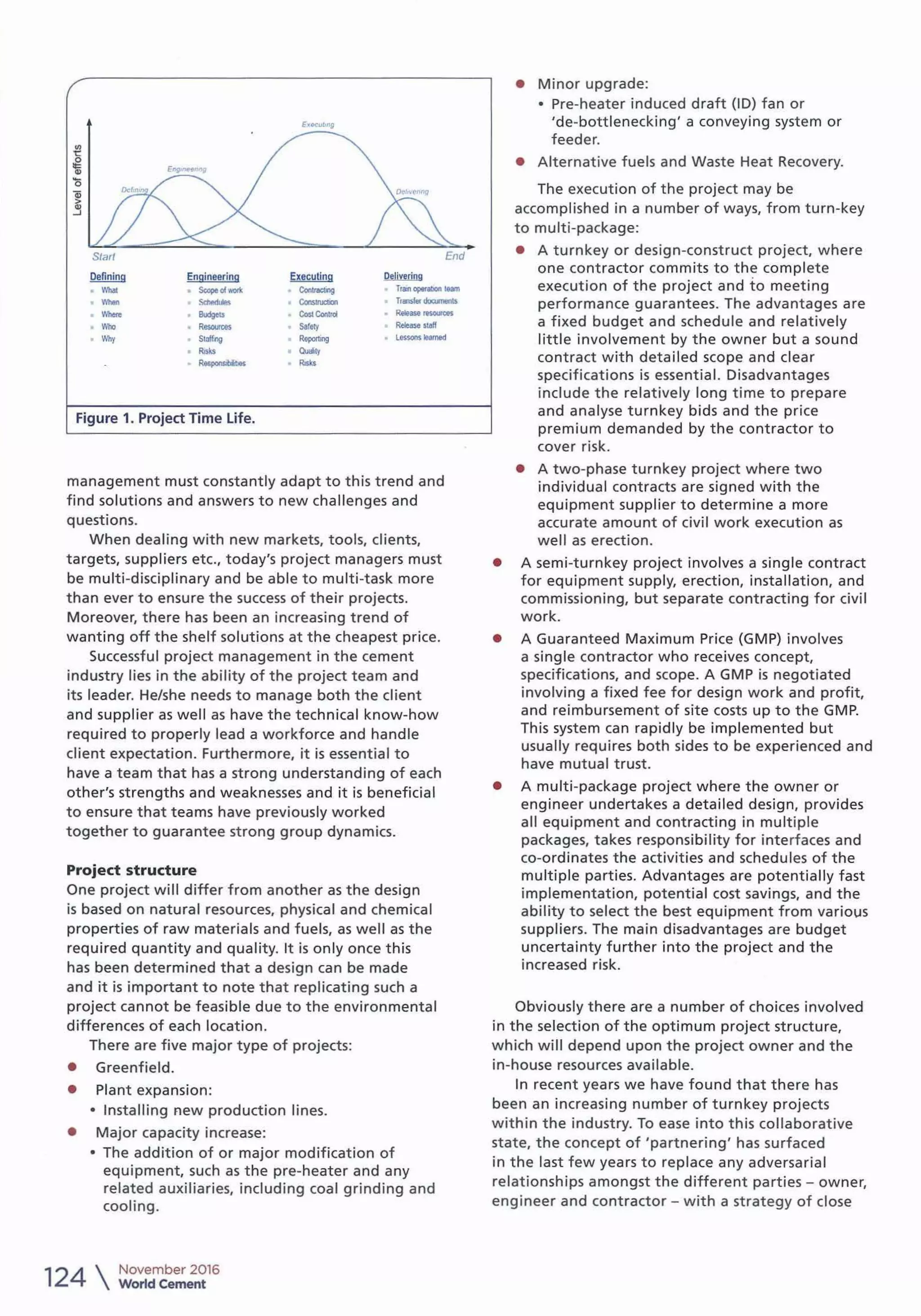
Figure 1. Project Time life.
management must constantly adapt to this trend and
find solutions and answers t o new challenges and
questions.
When dealing with new markets, tools, client s,
targets, suppliers etc., today's project managers must
be multi-disciplinary and be able to multi-task more
than ever to ensure the success of their projects.
Moreover, there has been an increasing trend of
wanting off the shelf solutions at the cheapest price.
Successful project management in the cement
industry lies in the ability of the project team and
its leader. He/she needs to manage both the client
and supplier as well as have the technical know-how
required to properly lead a workforce and handle
client expectation. Furthermore, it is essential to
have a team that has a strong understanding of each
other's strengths and weaknesses and it is beneficial
to ensure that t eams have previously worked
together to guarantee strong group dynamics.
Project structure
One project will differ from another as the design
is based on natural resources, physical and chemical
properties of raw materials and fuels, as well as the
required quantity and quality. It is only once this
has been det ermined that a design can be made
and it is important to note that replicating such a
project cannot be feasible due to the environmental
differences of each location.
There are five major type of projects:
• Greenfield.
• Plant expansion:
• Installing new production lines.
• Major capacity increase:
• The additio n of or major modification of
equipment, such as the pre-heater and any
related auxiliaries, including coal grinding and
cooling.
124 
November 2016
World Cement
• Minor upgrade:
• Pre-heater induced draft (ID) fan or
'de-bottlenecking' a conveying system or
feeder.
• Alternative fuels and Waste Heat Recovery.
The execution of the project may be
accomplished in a number of ways, from turn-key
to multi-package:
• A turnkey or design-construct project, w here
one contractor commits to the complete
execution of t he project and to meeting
performance guarantees. The advantages are
a fixed budget and schedule and relatively
little involvement by the owner but a sound
contract with detailed scope and clear
specifications is essential. Disadvantages
include the relatively long t ime to prepare
and analyse turnkey bids and the price
premium demanded by t he contractor to
cover risk.
• A two-phase turnkey project where two
individual contracts are signed with the
equipment supplier to determine a more
accurate amount of civil work execution as
well as erection.
• A semi-turnkey project involves a single contract
for equipment supply, erection, installation, and
commissioning, but separate contracting for civil
work.
• A Guaranteed Maximum Price (GMP) involves
a single contractor who receives concept,
specifications, and scope. A GMP is negotiated
involving a fixed fee for design work and profit,
and reimbursement of site costs up to the GMP.
This system can rapidly be implemented but
usual ly requires both sides to be experienced and
have mutual trust.
• A multi-package proj ect where the owner or
engineer undertakes a detailed design, provides
all equipment and contracting in multiple
packages, takes responsibility for interfaces and
co-ordinates the activit ies and schedules of the
mult iple parties. Advantages are potentially fast
implementation, potential cost savings, and the
ability t o select the best equipment from various
suppliers. The main disadvantages are budget
uncertainty further into the project and the
increased risk.
Obviously there are a number of choices involved
in the selection of t he optimum project structure,
which will depend upon the project owner and the
in-house resources available.
In recent years we have found that there has
been an increasing number of turnkey projects
w ithin the industry. To ease into this collaborative
state, the concept of 'partnering' has surfaced
in the last few years to replace any adversarial
relationships amongst the different parties - owner,
engineer and contractor - with a strategy of close
communication and co-operation supported by
incentives.
The methodology
The different phases of a project do not necessarily
mean that there is an equal balance of manpower,
t ime consumed, technical difficulties, skill involved
and timeframe at the different stages. It is also
important to note that the project manager is
responsible for overseeing and regularly monitoring
all other disciplines, from permits to legal issues via
engineering. It is also his/her responsibility to ensure
that there is a clear understanding of the project
flow.
A typical project flow
Phase 1: concept
A project normally starts with a concept that is
primarily the concern of the entrepreneur and
proceeds to design, execution, and commissioning,
which are handled by project professionals. Only
once the concept has been identified can the project
begin.
Phase 2: feasibility study
Enables the formulation of the project and
determines its return on investment. The project
atmoshandling
00 '(.EARS OF SKILLS IN MATERIAL HANDLINC
FOR CEMENT PlANTS, QUARRIES, MININCS.
WoRLDWI~ PRESENCE IN
EUROPE. MICA. MIDDLE EAST,
SOUTH AMERICA AND ASIA.
WEIGHT FEEDERS
BUCKET ELEVATORS
HELMET GATES
features are then set and w ritten dow n as project
Terms of Reference.
Phase 3: design
The Terms of Reference are then transcribed into
specifications; mass flow, flowsheets layout etc.
Phase 4: implementation
Subsequently, the project can be transformed from a
clean site handed-over by the owner to a complete
running plant built by the contractors.
In any case, the success of a project mainly
depends on the complete goodwill and involvement
of all parties who in turn ensure clear decision
making and proper flow of information between
everyone involved in the project.
A project time-life
The Projet Time Life graph illustrates what needs to
be achieved and when. It is a general outline for the
execution of the project, project management and
organisation of the parties involved, and definition
of the division of responsibilities. The level of efforts
truly gives a clear insight into when most of the
resources will be required and gives a general view of
the project and what is to follow during its cycle.
Conclusion
Although many projects are completed on budget
and on schedule, one has a tendency to hear about
those that over-run.
There are a number of reasons why projects
produce disappointing results:
• Unrealistic cost estimates, profit forecast
and overly optimistic market studies and
investigations.
• Setting the budget before sufficient engineering
has been performed and, when the budget is
shown to be inadequate, reducing the scope
rather than raising the budget but without
reassessing benefits.
• Beating down engineering, contracting
and equipment prices to a level where only
desperate or unqualified bidders will respond,
thereby increasing the risk of poor performance
or failure.
• Attempting to fast-track by contracting on a
cost plus basis before engineering has been
completed.
• Lack of diligence in pre-qualifying of bidders.
• Inadequate analysis of competing bids to
correlate cost with scope.
• A number of order changes issued straight after
contract initiation resulting in unplanned cost
and schedule increase.
• Excessive pressure on commissioning team.
It is important to complete a good project in due
time rather than t rying to achieve the best project in
the least time. ~

Project management in practice - world cement magazine nov 2016

  • 2.
    I E1t.cuM9 en '!: .g "'0 Qj > ~ Start End Defining EngineeringExecuting ~ What ScopeoloOll< Con~ lrBr'I oplfabon 1eam Whln ~ Consuucllon Transferdoo.menls Wheno Budgots eo..Contra Reltase...,,..... Who Resources Safely Release •tall Why Staffing RoportJng Le<sonslUmld Risks Quljty R__..,. Risb Figure 1. Project Time life. management must constantly adapt to this trend and find solutions and answers t o new challenges and questions. When dealing with new markets, tools, client s, targets, suppliers etc., today's project managers must be multi-disciplinary and be able to multi-task more than ever to ensure the success of their projects. Moreover, there has been an increasing trend of wanting off the shelf solutions at the cheapest price. Successful project management in the cement industry lies in the ability of the project team and its leader. He/she needs to manage both the client and supplier as well as have the technical know-how required to properly lead a workforce and handle client expectation. Furthermore, it is essential to have a team that has a strong understanding of each other's strengths and weaknesses and it is beneficial to ensure that t eams have previously worked together to guarantee strong group dynamics. Project structure One project will differ from another as the design is based on natural resources, physical and chemical properties of raw materials and fuels, as well as the required quantity and quality. It is only once this has been det ermined that a design can be made and it is important to note that replicating such a project cannot be feasible due to the environmental differences of each location. There are five major type of projects: • Greenfield. • Plant expansion: • Installing new production lines. • Major capacity increase: • The additio n of or major modification of equipment, such as the pre-heater and any related auxiliaries, including coal grinding and cooling. 124 November 2016 World Cement • Minor upgrade: • Pre-heater induced draft (ID) fan or 'de-bottlenecking' a conveying system or feeder. • Alternative fuels and Waste Heat Recovery. The execution of the project may be accomplished in a number of ways, from turn-key to multi-package: • A turnkey or design-construct project, w here one contractor commits to the complete execution of t he project and to meeting performance guarantees. The advantages are a fixed budget and schedule and relatively little involvement by the owner but a sound contract with detailed scope and clear specifications is essential. Disadvantages include the relatively long t ime to prepare and analyse turnkey bids and the price premium demanded by t he contractor to cover risk. • A two-phase turnkey project where two individual contracts are signed with the equipment supplier to determine a more accurate amount of civil work execution as well as erection. • A semi-turnkey project involves a single contract for equipment supply, erection, installation, and commissioning, but separate contracting for civil work. • A Guaranteed Maximum Price (GMP) involves a single contractor who receives concept, specifications, and scope. A GMP is negotiated involving a fixed fee for design work and profit, and reimbursement of site costs up to the GMP. This system can rapidly be implemented but usual ly requires both sides to be experienced and have mutual trust. • A multi-package proj ect where the owner or engineer undertakes a detailed design, provides all equipment and contracting in multiple packages, takes responsibility for interfaces and co-ordinates the activit ies and schedules of the mult iple parties. Advantages are potentially fast implementation, potential cost savings, and the ability t o select the best equipment from various suppliers. The main disadvantages are budget uncertainty further into the project and the increased risk. Obviously there are a number of choices involved in the selection of t he optimum project structure, which will depend upon the project owner and the in-house resources available. In recent years we have found that there has been an increasing number of turnkey projects w ithin the industry. To ease into this collaborative state, the concept of 'partnering' has surfaced in the last few years to replace any adversarial relationships amongst the different parties - owner, engineer and contractor - with a strategy of close
  • 3.
    communication and co-operationsupported by incentives. The methodology The different phases of a project do not necessarily mean that there is an equal balance of manpower, t ime consumed, technical difficulties, skill involved and timeframe at the different stages. It is also important to note that the project manager is responsible for overseeing and regularly monitoring all other disciplines, from permits to legal issues via engineering. It is also his/her responsibility to ensure that there is a clear understanding of the project flow. A typical project flow Phase 1: concept A project normally starts with a concept that is primarily the concern of the entrepreneur and proceeds to design, execution, and commissioning, which are handled by project professionals. Only once the concept has been identified can the project begin. Phase 2: feasibility study Enables the formulation of the project and determines its return on investment. The project atmoshandling 00 '(.EARS OF SKILLS IN MATERIAL HANDLINC FOR CEMENT PlANTS, QUARRIES, MININCS. WoRLDWI~ PRESENCE IN EUROPE. MICA. MIDDLE EAST, SOUTH AMERICA AND ASIA. WEIGHT FEEDERS BUCKET ELEVATORS HELMET GATES features are then set and w ritten dow n as project Terms of Reference. Phase 3: design The Terms of Reference are then transcribed into specifications; mass flow, flowsheets layout etc. Phase 4: implementation Subsequently, the project can be transformed from a clean site handed-over by the owner to a complete running plant built by the contractors. In any case, the success of a project mainly depends on the complete goodwill and involvement of all parties who in turn ensure clear decision making and proper flow of information between everyone involved in the project. A project time-life The Projet Time Life graph illustrates what needs to be achieved and when. It is a general outline for the execution of the project, project management and organisation of the parties involved, and definition of the division of responsibilities. The level of efforts truly gives a clear insight into when most of the resources will be required and gives a general view of the project and what is to follow during its cycle. Conclusion Although many projects are completed on budget and on schedule, one has a tendency to hear about those that over-run. There are a number of reasons why projects produce disappointing results: • Unrealistic cost estimates, profit forecast and overly optimistic market studies and investigations. • Setting the budget before sufficient engineering has been performed and, when the budget is shown to be inadequate, reducing the scope rather than raising the budget but without reassessing benefits. • Beating down engineering, contracting and equipment prices to a level where only desperate or unqualified bidders will respond, thereby increasing the risk of poor performance or failure. • Attempting to fast-track by contracting on a cost plus basis before engineering has been completed. • Lack of diligence in pre-qualifying of bidders. • Inadequate analysis of competing bids to correlate cost with scope. • A number of order changes issued straight after contract initiation resulting in unplanned cost and schedule increase. • Excessive pressure on commissioning team. It is important to complete a good project in due time rather than t rying to achieve the best project in the least time. ~