
Project Management
Chapter 5:
What does Project Sponsorship mean?
Part of a series considering different aspects of Business Change
1Understanding and Supporting Business Change – by Martin Schyns/ FILE: Project Management_Chap_5_FINAL.pptx
IntroductionWho am I?
My headline would be…..Global Engineer Understands Successful Change
Key take away is that I have been doing projects my whole career. I am an engineer at heart with a diverse
background and I recognize that all organizations, and individuals for that matter, must continually seek to
proactively change and adapt. As I am sure most organizations can attest, Change is hard. I thought I would
try using this medium to collect various themes and ideas on the subject of Business Change and share my
insights.
Understanding and Support Business Change
Naturally enough, Project Management is my first theme. It is a rich and complex endeavor and it is certainly an
area where I think most organizations would acknowledge they could do better. Typically the challenge is
that if you ask five people within an organization, what needs to change, and how, you get five different
responses.
The Initial Path for this Enquiry
1. Chapter 1 – 10: Project Management – 10 questions to explore some involved situations
2. Chapter 11 > : Sustaining Business Health – physiology of a modern business
3. Chapter X > : Insights on making relevant Change happen – road map to the future
4. Chapter Y : CONCLUSIONS – reflection on the relevance / value of what we have uncovered
Approach
I thought it would be interesting to use the Socratic method to explore what can often be some
what dry material; and, because it helps me understand, a series of supporting diagrams
that, I hope, encapsulate and convey the key ideas and their context.
I would welcome any comments and alternative views to help challenge my desire to grow and
make a difference.
Thank you, Martin Schyns. 2
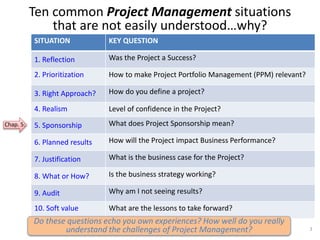
Ten common Project Management situations
that are not easily understood…why?
3
SITUATION KEY QUESTION
1. Reflection Was the Project a Success?
2. Prioritization How to make Project Portfolio Management (PPM) relevant?
3. Right Approach? How do you define a project?
4. Realism Level of confidence in the Project?
5. Sponsorship What does Project Sponsorship mean?
6. Planned results How will the Project impact Business Performance?
7. Justification What is the business case for the Project?
8. What or How? Is the business strategy working?
9. Audit Why am I not seeing results?
10. Soft value What are the lessons to take forward?
Do these questions echo you own experiences? How well do you really
understand the challenges of Project Management?
Chap. 5:
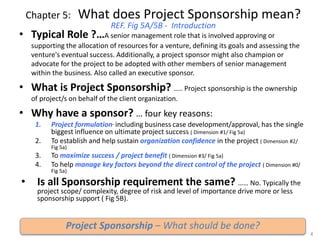
Chapter 5: What does Project Sponsorship mean?
REF. Fig 5A/5B - Introduction
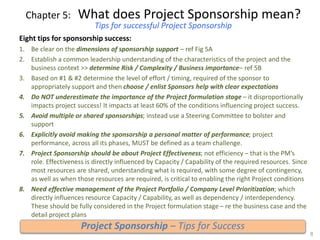
• Typical Role ?…A senior management role that is involved approving or
supporting the allocation of resources for a venture, defining its goals and assessing the
venture's eventual success. Additionally, a project sponsor might also champion or
advocate for the project to be adopted with other members of senior management
within the business. Also called an executive sponsor.
• What is Project Sponsorship? ….. Project sponsorship is the ownership
of project/s on behalf of the client organization.
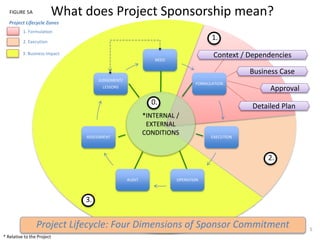
• Why have a sponsor? … four key reasons:
1. Project formulation, including business case development/approval, has the single
biggest influence on ultimate project success ( Dimension #1/ Fig 5a)
2. To establish and help sustain organization confidence in the project ( Dimension #2/
Fig 5a)
3. To maximize success / project benefit ( Dimension #3/ Fig 5a)
4. To help manage key factors beyond the direct control of the project ( Dimension #0/
Fig 5a)
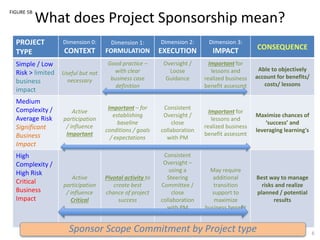
• Is all Sponsorship requirement the same? …… No. Typically the
project scope/ complexity, degree of risk and level of importance drive more or less
sponsorship support ( Fig 5B).
4
Project Sponsorship – What should be done?
2.
1.
3.
What does Project Sponsorship mean?
5
Project Lifecycle: Four Dimensions of Sponsor Commitment
FIGURE 5A
Context / Dependencies
Business Case
Approval
Detailed Plan
NEED
FORMULATION
EXECUTION
OPERATIONAUDIT
ASSESSMENT
JUDGEMENT/
LESSONS
1. Formulation
2. Execution
3. Business Impact
Project Lifecycle Zones
* Relative to the Project
*INTERNAL /
EXTERNAL
CONDITIONS
0.
What does Project Sponsorship mean?
6
FIGURE 5B
PROJECT
TYPE
Dimension 0:
CONTEXT
Dimension 1:
FORMULATION
Dimension 2:
EXECUTION
Dimension 3:
IMPACT CONSEQUENCE
Simple / Low
Risk > limited
business
impact
Useful but not
necessary
Good practice –
with clear
business case
definition
Oversight /
Loose
Guidance
Important for
lessons and
realized business
benefit assessmt
Able to objectively
account for benefits/
costs/ lessons
Medium
Complexity /
Average Risk
Significant
Business
Impact
Active
participation
/ influence
Important
Important – for
establishing
baseline
conditions / goals
/ expectations
Consistent
Oversight /
close
collaboration
with PM
Important for
lessons and
realized business
benefit assessmt
Maximize chances of
‘success’ and
leveraging learning's
High
Complexity /
High Risk
Critical
Business
Impact
Active
participation
/ influence
Critical
Pivotal activity to
create best
chance of project
success
Consistent
Oversight –
using a
Steering
Committee /
close
collaboration
with PM
May require
additional
transition
support to
maximize
business benefit
Best way to manage
risks and realize
planned / potential
results
Sponsor Scope Commitment by Project type
Chapter 5: What does Project Sponsorship mean?
Classic Challenges with Project Sponsorship
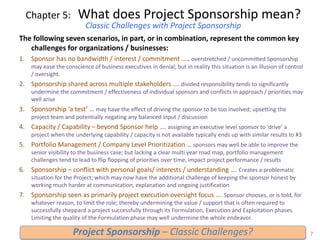
The following seven scenarios, in part, or in combination, represent the common key
challenges for organizations / businesses:
1. Sponsor has no bandwidth / interest / commitment ….. overstretched / uncommitted Sponsorship
may ease the conscience of business executives in denial; but in reality this situation is an illusion of control
/ oversight.
2. Sponsorship shared across multiple stakeholders …. divided responsibility tends to significantly
undermine the commitment / effectiveness of individual sponsors and conflicts in approach / priorities may
well arise
3. Sponsorship ‘a test’ … may have the effect of driving the sponsor to be too involved; upsetting the
project team and potentially negating any balanced input / discussion
4. Capacity / Capability – beyond Sponsor help …. assigning an executive level sponsor to ‘drive’ a
project when the underlying capability / capacity is not available typically ends up with similar results to #3
5. Portfolio Management / Company Level Prioritization … sponsors may well be able to improve the
senior visibility to the business case; but lacking a clear multi year road map, portfolio management
challenges tend to lead to flip flopping of priorities over time, impact project performance / results
6. Sponsorship – conflict with personal goals/ interests / understanding …. Creates a problematic
situation for the Project; which may now have the additional challenge of keeping the sponsor honest by
working much harder at communication, explanation and ongoing justification
7. Sponsorship seen as primarily project execution oversight focus …. Sponsor chooses, or is told, for
whatever reason, to limit the role; thereby undermining the value / support that is often required to
successfully sheppard a project successfully through its Formulation, Execution and Exploitation phases.
Limiting the quality of the Formulation phase may well undermine the whole endeavor.
7Project Sponsorship – Classic Challenges?
Chapter 5: What does Project Sponsorship mean?
Tips for successful Project Sponsorship
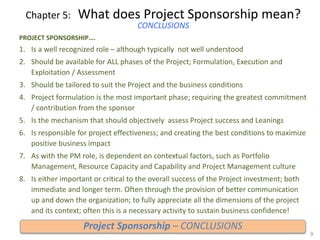
Eight tips for sponsorship success:
1. Be clear on the dimensions of sponsorship support – ref Fig 5A
2. Establish a common leadership understanding of the characteristics of the project and the
business context >> determine Risk / Complexity / Business importance– ref 5B
3. Based on #1 & #2 determine the level of effort / timing, required of the sponsor to
appropriately support and then choose / enlist Sponsors help with clear expectations
4. Do NOT underestimate the importance of the Project formulation stage – it disproportionally
impacts project success! It impacts at least 60% of the conditions influencing project success.
5. Avoid multiple or shared sponsorships; instead use a Steering Committee to bolster and
support
6. Explicitly avoid making the sponsorship a personal matter of performance; project
performance, across all its phases, MUST be defined as a team challenge.
7. Project Sponsorship should be about Project Effectiveness; not efficiency – that is the PM’s
role. Effectiveness is directly influenced by Capacity / Capability of the required resources. Since
most resources are shared, understanding what is required, with some degree of contingency,
as well as when those resources are required, is critical to enabling the right Project conditions
8. Need effective management of the Project Portfolio / Company Level Prioritization; which
directly influences resource Capacity / Capability, as well as dependency / interdependency.
These should be fully considered in the Project formulation stage – re the business case and the
detail project plans
8
Project Sponsorship – Tips for Success
Chapter 5: What does Project Sponsorship mean?
CONCLUSIONS
PROJECT SPONSORSHIP….
1. Is a well recognized role – although typically not well understood
2. Should be available for ALL phases of the Project; Formulation, Execution and
Exploitation / Assessment
3. Should be tailored to suit the Project and the business conditions
4. Project formulation is the most important phase; requiring the greatest commitment
/ contribution from the sponsor
5. Is the mechanism that should objectively assess Project success and Leanings
6. Is responsible for project effectiveness; and creating the best conditions to maximize
positive business impact
7. As with the PM role, is dependent on contextual factors, such as Portfolio
Management, Resource Capacity and Capability and Project Management culture
8. Is either important or critical to the overall success of the Project investment; both
immediate and longer term. Often through the provision of better communication
up and down the organization; to fully appreciate all the dimensions of the project
and its context; often this is a necessary activity to sustain business confidence!
9
Project Sponsorship – CONCLUSIONS
R E F E R E N C E S
10
3.
2.
1.
What does Project Sponsorship mean?
11
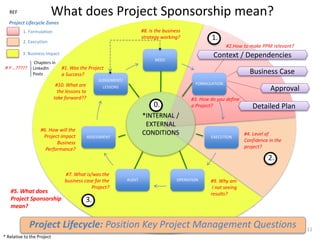
Project Lifecycle: Position Key Project Management Questions
REF
Context / Dependencies
Business Case
Approval
Detailed Plan
NEED
FORMULATION
EXECUTION
OPERATIONAUDIT
ASSESSMENT
JUDGEMENT/
LESSONS
#1. Was the Project
a Success?
#2.How to make PPM relevant?
#3. How do you define
a Project?
#4. Level of
Confidence in the
project?
#6. How will the
Project impact
Business
Performance?
#7. What is/was the
business case for the
Project?
#8. Is the business
strategy working?
#9. Why am
I not seeing
results?#5. What does
Project Sponsorship
mean?
#10. What are
the lessons to
take forward??
2. Execution
1. Formulation
3. Business Impact
Project Lifecycle Zones
*INTERNAL /
EXTERNAL
CONDITIONS
* Relative to the Project
# Y …?????
Chapters in
LinkedIn
Posts
0.

Project Management - What does Project Sponsorship mean?

  • 1.
    Project Management Chapter 5: Whatdoes Project Sponsorship mean? Part of a series considering different aspects of Business Change 1Understanding and Supporting Business Change – by Martin Schyns/ FILE: Project Management_Chap_5_FINAL.pptx
  • 2.
    IntroductionWho am I? Myheadline would be…..Global Engineer Understands Successful Change Key take away is that I have been doing projects my whole career. I am an engineer at heart with a diverse background and I recognize that all organizations, and individuals for that matter, must continually seek to proactively change and adapt. As I am sure most organizations can attest, Change is hard. I thought I would try using this medium to collect various themes and ideas on the subject of Business Change and share my insights. Understanding and Support Business Change Naturally enough, Project Management is my first theme. It is a rich and complex endeavor and it is certainly an area where I think most organizations would acknowledge they could do better. Typically the challenge is that if you ask five people within an organization, what needs to change, and how, you get five different responses. The Initial Path for this Enquiry 1. Chapter 1 – 10: Project Management – 10 questions to explore some involved situations 2. Chapter 11 > : Sustaining Business Health – physiology of a modern business 3. Chapter X > : Insights on making relevant Change happen – road map to the future 4. Chapter Y : CONCLUSIONS – reflection on the relevance / value of what we have uncovered Approach I thought it would be interesting to use the Socratic method to explore what can often be some what dry material; and, because it helps me understand, a series of supporting diagrams that, I hope, encapsulate and convey the key ideas and their context. I would welcome any comments and alternative views to help challenge my desire to grow and make a difference. Thank you, Martin Schyns. 2
  • 3.
    Ten common ProjectManagement situations that are not easily understood…why? 3 SITUATION KEY QUESTION 1. Reflection Was the Project a Success? 2. Prioritization How to make Project Portfolio Management (PPM) relevant? 3. Right Approach? How do you define a project? 4. Realism Level of confidence in the Project? 5. Sponsorship What does Project Sponsorship mean? 6. Planned results How will the Project impact Business Performance? 7. Justification What is the business case for the Project? 8. What or How? Is the business strategy working? 9. Audit Why am I not seeing results? 10. Soft value What are the lessons to take forward? Do these questions echo you own experiences? How well do you really understand the challenges of Project Management? Chap. 5:
  • 4.
    Chapter 5: Whatdoes Project Sponsorship mean? REF. Fig 5A/5B - Introduction • Typical Role ?…A senior management role that is involved approving or supporting the allocation of resources for a venture, defining its goals and assessing the venture's eventual success. Additionally, a project sponsor might also champion or advocate for the project to be adopted with other members of senior management within the business. Also called an executive sponsor. • What is Project Sponsorship? ….. Project sponsorship is the ownership of project/s on behalf of the client organization. • Why have a sponsor? … four key reasons: 1. Project formulation, including business case development/approval, has the single biggest influence on ultimate project success ( Dimension #1/ Fig 5a) 2. To establish and help sustain organization confidence in the project ( Dimension #2/ Fig 5a) 3. To maximize success / project benefit ( Dimension #3/ Fig 5a) 4. To help manage key factors beyond the direct control of the project ( Dimension #0/ Fig 5a) • Is all Sponsorship requirement the same? …… No. Typically the project scope/ complexity, degree of risk and level of importance drive more or less sponsorship support ( Fig 5B). 4 Project Sponsorship – What should be done?
  • 5.
    2. 1. 3. What does ProjectSponsorship mean? 5 Project Lifecycle: Four Dimensions of Sponsor Commitment FIGURE 5A Context / Dependencies Business Case Approval Detailed Plan NEED FORMULATION EXECUTION OPERATIONAUDIT ASSESSMENT JUDGEMENT/ LESSONS 1. Formulation 2. Execution 3. Business Impact Project Lifecycle Zones * Relative to the Project *INTERNAL / EXTERNAL CONDITIONS 0.
  • 6.
    What does ProjectSponsorship mean? 6 FIGURE 5B PROJECT TYPE Dimension 0: CONTEXT Dimension 1: FORMULATION Dimension 2: EXECUTION Dimension 3: IMPACT CONSEQUENCE Simple / Low Risk > limited business impact Useful but not necessary Good practice – with clear business case definition Oversight / Loose Guidance Important for lessons and realized business benefit assessmt Able to objectively account for benefits/ costs/ lessons Medium Complexity / Average Risk Significant Business Impact Active participation / influence Important Important – for establishing baseline conditions / goals / expectations Consistent Oversight / close collaboration with PM Important for lessons and realized business benefit assessmt Maximize chances of ‘success’ and leveraging learning's High Complexity / High Risk Critical Business Impact Active participation / influence Critical Pivotal activity to create best chance of project success Consistent Oversight – using a Steering Committee / close collaboration with PM May require additional transition support to maximize business benefit Best way to manage risks and realize planned / potential results Sponsor Scope Commitment by Project type
  • 7.
    Chapter 5: Whatdoes Project Sponsorship mean? Classic Challenges with Project Sponsorship The following seven scenarios, in part, or in combination, represent the common key challenges for organizations / businesses: 1. Sponsor has no bandwidth / interest / commitment ….. overstretched / uncommitted Sponsorship may ease the conscience of business executives in denial; but in reality this situation is an illusion of control / oversight. 2. Sponsorship shared across multiple stakeholders …. divided responsibility tends to significantly undermine the commitment / effectiveness of individual sponsors and conflicts in approach / priorities may well arise 3. Sponsorship ‘a test’ … may have the effect of driving the sponsor to be too involved; upsetting the project team and potentially negating any balanced input / discussion 4. Capacity / Capability – beyond Sponsor help …. assigning an executive level sponsor to ‘drive’ a project when the underlying capability / capacity is not available typically ends up with similar results to #3 5. Portfolio Management / Company Level Prioritization … sponsors may well be able to improve the senior visibility to the business case; but lacking a clear multi year road map, portfolio management challenges tend to lead to flip flopping of priorities over time, impact project performance / results 6. Sponsorship – conflict with personal goals/ interests / understanding …. Creates a problematic situation for the Project; which may now have the additional challenge of keeping the sponsor honest by working much harder at communication, explanation and ongoing justification 7. Sponsorship seen as primarily project execution oversight focus …. Sponsor chooses, or is told, for whatever reason, to limit the role; thereby undermining the value / support that is often required to successfully sheppard a project successfully through its Formulation, Execution and Exploitation phases. Limiting the quality of the Formulation phase may well undermine the whole endeavor. 7Project Sponsorship – Classic Challenges?
  • 8.
    Chapter 5: Whatdoes Project Sponsorship mean? Tips for successful Project Sponsorship Eight tips for sponsorship success: 1. Be clear on the dimensions of sponsorship support – ref Fig 5A 2. Establish a common leadership understanding of the characteristics of the project and the business context >> determine Risk / Complexity / Business importance– ref 5B 3. Based on #1 & #2 determine the level of effort / timing, required of the sponsor to appropriately support and then choose / enlist Sponsors help with clear expectations 4. Do NOT underestimate the importance of the Project formulation stage – it disproportionally impacts project success! It impacts at least 60% of the conditions influencing project success. 5. Avoid multiple or shared sponsorships; instead use a Steering Committee to bolster and support 6. Explicitly avoid making the sponsorship a personal matter of performance; project performance, across all its phases, MUST be defined as a team challenge. 7. Project Sponsorship should be about Project Effectiveness; not efficiency – that is the PM’s role. Effectiveness is directly influenced by Capacity / Capability of the required resources. Since most resources are shared, understanding what is required, with some degree of contingency, as well as when those resources are required, is critical to enabling the right Project conditions 8. Need effective management of the Project Portfolio / Company Level Prioritization; which directly influences resource Capacity / Capability, as well as dependency / interdependency. These should be fully considered in the Project formulation stage – re the business case and the detail project plans 8 Project Sponsorship – Tips for Success
  • 9.
    Chapter 5: Whatdoes Project Sponsorship mean? CONCLUSIONS PROJECT SPONSORSHIP…. 1. Is a well recognized role – although typically not well understood 2. Should be available for ALL phases of the Project; Formulation, Execution and Exploitation / Assessment 3. Should be tailored to suit the Project and the business conditions 4. Project formulation is the most important phase; requiring the greatest commitment / contribution from the sponsor 5. Is the mechanism that should objectively assess Project success and Leanings 6. Is responsible for project effectiveness; and creating the best conditions to maximize positive business impact 7. As with the PM role, is dependent on contextual factors, such as Portfolio Management, Resource Capacity and Capability and Project Management culture 8. Is either important or critical to the overall success of the Project investment; both immediate and longer term. Often through the provision of better communication up and down the organization; to fully appreciate all the dimensions of the project and its context; often this is a necessary activity to sustain business confidence! 9 Project Sponsorship – CONCLUSIONS
  • 10.
    R E FE R E N C E S 10
  • 11.
    3. 2. 1. What does ProjectSponsorship mean? 11 Project Lifecycle: Position Key Project Management Questions REF Context / Dependencies Business Case Approval Detailed Plan NEED FORMULATION EXECUTION OPERATIONAUDIT ASSESSMENT JUDGEMENT/ LESSONS #1. Was the Project a Success? #2.How to make PPM relevant? #3. How do you define a Project? #4. Level of Confidence in the project? #6. How will the Project impact Business Performance? #7. What is/was the business case for the Project? #8. Is the business strategy working? #9. Why am I not seeing results?#5. What does Project Sponsorship mean? #10. What are the lessons to take forward?? 2. Execution 1. Formulation 3. Business Impact Project Lifecycle Zones *INTERNAL / EXTERNAL CONDITIONS * Relative to the Project # Y …????? Chapters in LinkedIn Posts 0.